13 January 2011

SP 500 and NDX March Futures Daily Charts


A last hour rally took US stocks back closer to almost unchanged.

Onward and upward. In the go-go 1960's the 'big thing' was plastics. Today it is gourmet cupcakes.

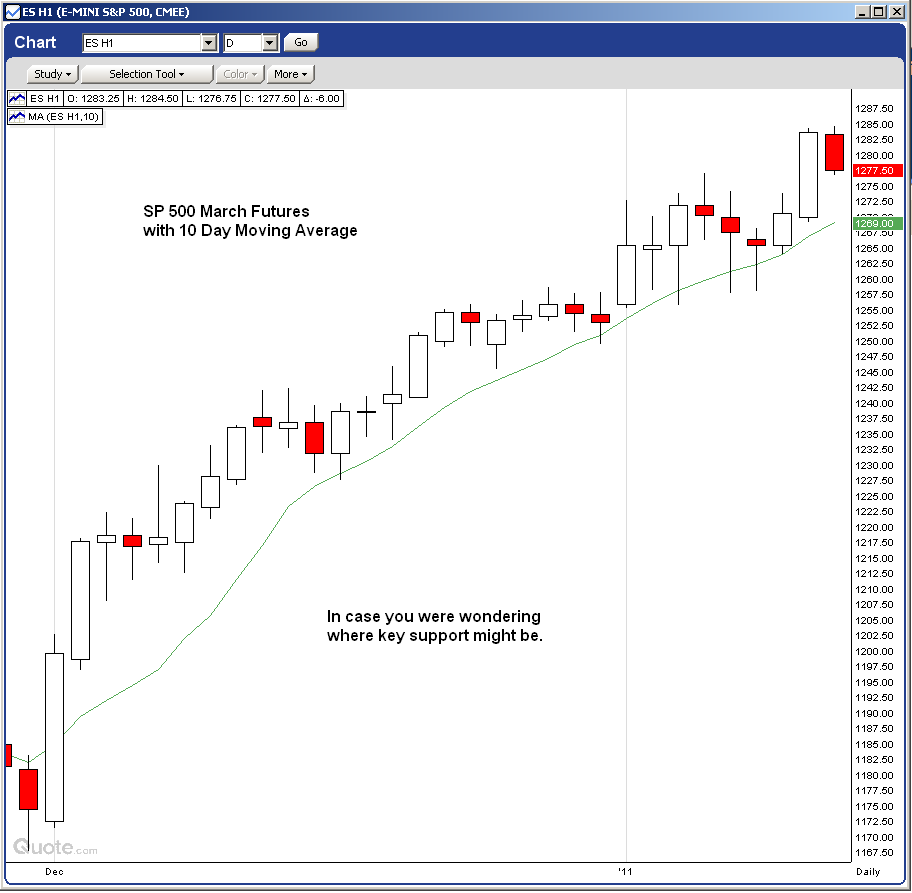
See the SP 500 with Ten Day Moving average for Today's Stock Commentary.

Whatever the case, try not to get in front of this market. Even death by a thousand paper cuts is possible.

As a reminder, US markets are closed on Monday for Martin Luther King Day.


Intraday SP 500: In Case You Were Wondering Where Key Support Might Be...


The picture is similar for the SP 500 cash market.

Someone who keeps track of these things said that this is the most consistent thirty day rally in US equities since 1929, with the SP never closing once below its 10 day moving average.

Do you think that maybe a Wall Street banking cartel is manipulating stock prices higher now as they did that year? Do you think if it is true it will end badly as it did then?

Intel after the bell, and JP Morgan reports tomorrow morning before the open.

VIX seems to be reaching its nadir, conversely the heights of complacency.

Do you think if the US financial system blows up again the Fed and the Wall Street crowd will claim complete ignorance, point to some nameless act of God, and simply blame the government and the public? And will Timmy and Ben appear before Congress (again) and demand many more billions to save the banking system with ugly threats of dire consequences?

Do you think Benny will apologize for being simply mistaken in his theory like Greenspan did and claim a 'mulligan,' and brazenly go on? As an aside, if Bernanke is knighted by QE II (the sovereign not the subsidy) I think its game over.

If a stock market asset bubble does collapse and wipe out many investors, do you think the talking hairball and the cheerleaders on bubblevision will once again say, "Well nobody MADE people buy stocks."

If you do, you might just be right. Or perhaps for now the band will just play on, Nearer My God to Thee, to keep the upper deck evacuations orderly...

You may be there, but I doubt the usual suspects will be at their posts in the wheelhouse.

What dark visions I have some days.


12 January 2011

SP 500 and NDX March Futures Daily Charts


No fear.

The Bernanke put, and the regulatory pass, an echo of 2005-2006.

But can they keep it going?

The volumes in this rally are thin and prices are being set on a margin backed by increasing leverage and credit. This is not a great prescription for market stability.


Gold Daily and Silver Weekly Charts


Different day same script. Early paper selling in NY is bought by steady hands and physical bullion buyers.

I think it is going to take a serious stock market selloff to stop silver's upward momentum.


11 January 2011

SP 500 and NDX Daily Charts


INTC reports on Thursday and JP Morgan on Friday before the bell.


Gold Daily and Silver Weekly Charts


"Gold is the money of kings, silver is the money of gentlemen, barter is the money of peasants - but debt is the money of slaves."

Norm Franz, Money and Wealth in the New Millenium


Charles Ferguson: MIT Brunel Lecture on Economics and the Financial Crisis


See Charles Ferguson's documentary Inside Job when you have the opportunity.  I understand that the DVD may be released sometime around March 2011.

Ferguson starts his presentation at about 7 minutes in.

I was glad to hear him admit that he was wrong, honestly wrong, about his assessment of Japan Inc. and the Japan asset bubble. He also goes on to make a rather pointed observation about economics which needs to be heard dispassionately by related institutions in particular, whose own credibility and integrity is at risk.
"It is one thing to be honestly correct or not correct about something; it's another thing for an academic discipline to have a systemic corruption problem. And that's what I will be talking about in part later, because the economics discipline in my view does have that problem."
In Charles' defense he is only saying publicly what is being said privately amongst academic scientists and mathematicians about the inordinate effect of power and money on the integrity of economic opinions and research.

As you may recall Alan Greenspan was caught up in the Keating Five S&L scandal. The point of this is that the 'empirical objectivity' of the Federal Reserve in setting policy is a myth as egregious as the trickle down theory and the efficient markets hypothesis.

At the heart of the current financial crisis is the weakening and even corruption of a number of institutions, both public and private. And their reform and restoration to a fully functional state remains to be accomplished. Reforms risks disclosure, and coverups protect the status quo against such the effects of such a disclosure. This is why reform from within is problematic.

Yes, there is always the need for some discretion and privacy in executive decisions. But it must be limited and exceptional, subject to overview by a more relatively impartial third party, always.

The Fed, and particularly the New York Fed, is a largely private institution making decisions not only about its own industry, but is taking actions with public funds that approach and sometimes become de facto public policy decisions with far reaching effects, and is doing so largely in secret. It is therefore highly vulnerable to insider dealing and conflicts of interest. Excessive secrecy is inimical to a free society, for wherever secrecy and power exist, corruption quickly follows.

The only cure for these conflicts of interest is a balance of power and above all, transparency. Sunlight is a marvelous disinfectant. Disclosure, disclosure, disclosure. The more that a bureaucratic organization resists even routine disclosure the more likely it is that they have become internally focused, less effective, and probably have some things to hide.


Link to original video at MIT here.

h/t to Paul Kedrosky and Yves Smith.

10 January 2011

The China Miracle: Forex Reserves Hit Record $2.87 Trillion


In the 'Japan Miracle' of the 1980-1990's it is said that Japan essentially 'monetized its real estate.' There was also a mythology of the superiority of Japanese management, with an emphasis on quality management ironically pioneered by the American W. Edwards Deming.

It gained some traction because it was of course a very real and highly useful innovation.  It succeeded in particular because so many Western manufacturing concerns were still under the influence of the management philosophy nurtured during the second World War of production in sheer quantity, and repair and correction of defects later in the field.  Consumer had risen in living standards and preferences and such arrogant treatment by the auto companies in particular was no longer considered acceptable.

But at the end of the day, Japan Inc. was a bubble fueled by a mispricing of risk and assets. I can remember arguing with my business school professors at the time about this, with all their familiar theoretical arguments about efficient markets and the inevitability of the Japanese.

So, with regard to China, it is not an enlightened management prowess, and few make that argument which would just seem silly to anyone who has been there. And it is not the superior quality of their products.

It certainly is fueled by Western investment, particularly driving by companies like Walmart who insisted on suppliers moving production to China starting in the 1990's. A favorable and sizable devaluation in the yuan and a relaxation of US trade rules by Clinton helped to spark the 'miracle' which we are seeing today.

It seems to me that China is monetizing cheap labor, and playing an arbitrage against the middle class sensibilities and public policies of the West. China is exporting deflation and lower living standards for workers in massive quantities, and acquiring sizable foreign reserves in the process. Multinational corporations find this attractive because in the short run it breaks the power which labor and the middle class had gained in the reforms after the 1930's. And it comes complete with vendor financing by China et al., and the promise of fresh economies for exploitation to come. As Bill Gates noted, China represented his kind of capitalism, if only they could start enforcing intellectual property laws. Oligarchy requires pliant labor and obedient and law-abiding consumers.

Unfortunately China and other developing nations must now start growing their domestic markets, and a consuming middle class of their own, or face an economic collapse that will make the Japanese deflation look like a cyclical recession. This is not easy for a oligarchical non-democratic government to manage gracefully. It is harder to control a healthy and wealthy and better educated rising middle class.

Miracles like China and Japan are made possible by a currency system that is broken, subject to manipulation and mercantilist trade policies that protect domestic markets while promoting exports. It is promoted by economic quackery that is funded by Wall Street that is masquerading as a scientific approach to maximizing the common good.

This remnant of the efficient markets hypothesis is creating even more dangerously destabilizing imbalances than those which provoked the collapse of Russia and the Asian currency crisis, and will be at the root of the global currency crisis to come, most likely later this year.

Never one to waste a crisis which they created, the oligarchs will put another emergency offer on the table, as they did with the American TARP bailout. Adopt our solution, one world currency, or suffer the consequences. The econo-parrots will quickly fall into line behind this latest twist in financial engineering, and there will be an hysterical antagonism towards all other competing solutions, anything that runs counter to a larger monetary authority.

With one monetary policy comes the necessity of one fiscal policy, as has been most recently shown in the European union. And with one fiscal and monetary policy, sovereign government becomes increasingly irrelevant.  Ponzi schemes by their nature must continue to grow and consume all, or collapse and be exposed for the fraud which they are.

AFP
China's forex reserves hit record $2.87 trillion

January 10, 2011

BEIJING (AFP) – China said Tuesday its foreign exchange reserves hit a record high at the end of 2010 as new loans topped an official target, highlighting Beijing's difficult task of stemming a flood of liquidity. The country's stockpile of foreign currencies, already the world's largest, expanded 18.7 percent from a year earlier to $2.847 trillion at the end of December, the central bank said in a statement.

New loans issued by state-owned banks in 2010 reached 7.95 trillion yuan ($1.2 trillion), exceeding the government's full-year target of 7.5 trillion yuan but less than the previous year's explosion of lending.

M2, the broadest measure of money washing around the world's second-largest economy, reached 72.58 trillion yuan at the end of last year, up 19.7 percent from a year earlier.

Analysts blame China's huge trade surplus -- $183.1 billion in 2010 -- and its massive stimulus measures since late 2008 to combat the financial crisis for the flood of credit that has been fuelling inflation and property prices.

Foreign exchange earned by Chinese exporters is changed for yuan with the central bank so it can control the value of the local unit -- a policy long criticised by China's trade partners for grossly undervaluing the currency.

The foreign exchange is added to China's growing coffers, while the yuan fuels the amount of money flowing into the economy.

Ever fearful of inflation's potential to spark social unrest, top leaders have been pulling on a variety of levers to rein in consumer prices and calm growing anxiety about soaring food costs and property values.

In December, the central bank hiked interest rates for the second time in less than three months. It has also ordered lenders to keep more money in reserve, effectively limiting the amount of funds they can lend.

Gold Daily and Silver Weekly Charts: Judge Orders Fed to Release Gold Records to Court


The New York traders are trying hard to keep a lid on silver and gold here.

Gold is struggling to break through the 1375 pivot and hold its gain, and silver is toying with the 29 handle.

Unless there is another liquidity market panic I expect these metals to follow their charts higher.

District Court Judge Orders Federal Reserve to Hand Over Gold Records

"If the U.S. gold reserves are just sitting somewhere, inert, unencumbered, and unused for surreptitious market intervention, what's the problem with full disclosure?"
Both Bernanke and Greenspan have testified that there have been no transactions in gold. Yet the Fed refuses to disclose documents that suggest circumstantially that there have been.

Even moreso, since the US bullion reserves belong to the people and not to a private banking cartel, there should be no records of any transactions by the Fed. Any transactions should have been handled by Treasury.

How Much Gold Does the US Have In Its Reserves?

How can the Fed be a trusted government regulator, given its position as a quasi-private banking cartel and an obsessive predilection for secrecy in its own dealings with what are clearly public assets?

If the Fed comes back and argues that it is not able to disclose its records of any gold transactions including sales, loans, and swaps because it was acting as agent for another party, whether it be the Treasury, BOJ, ECB, or the Bundesbank, then its time to audit the reserves by a third party answerable to the people.

Personally I am tired of their obfuscation, cronyism, and ad hominem attacks on even honest critics. If there is nothing to hide then disclose what are essentially public documents about public assets. If there is something to hide, it is time to come clean and stop the coverup.

As an aside, ex-Congressional powerbroker Tom DeLay was sentenced to three years in prison today for conspiracy and money laundering. 

Fiat justitia ruat caelum.


SP 500 and NDX March Futures Daily Charts


Market is struggling to hold its level, but is fighting off the overnight selloffs in light volumes.

Alcoa kicked off earnings season after the bell with a lackluster 'beat.'

Markets are looking forward to Intel and JP Morgan earnings this week, with PPI and CPI on the macroeconomic front.


08 January 2011

Massive Silver Withdrawals From The Comex


It will be interesting to see how the CFTC, the Obama Administration, and the Comex deal with this situation with silver, including the disposition of the massive paper short positions that appear to be undeliverable.

It could prove to be a watershed event, or at least an interesting scandal to observe as it unfolds.

Harvery Organ's commentary:

"And now for the big silver report.

We witnessed a massive withdrawal of silver unprecedented in the history of the comex. First there was a smallish 6507 oz of silver deposited to two customers, one being 497 oz and the other 6010 oz). But just look at the huge withdrawals:

Four customers (not dealers) withdrew a total of 1,019,310 oz from the comex vaults. This is real silver leaving from 4 registered vaults. The individual withdrawals are: 579,081, 30,380, 399,994 and 9855 oz.

The dealer (our bankers) also were involved in the withdrawal of silver to the tune of 769,941 oz (there were 2 dealers involved removing 102,866 and 667,875 ozs). When you see this massive drain of silver, the fire is raging. The total silver withdrawal by both dealer and customer totalled an astronomical 1,789,251. The Brink's trucks must have been very busy yesterday.

The comex folk notified us that an amazing 85 notices were sent down for servicing for a total of 425,000 oz of silver. The total number of silver notices sent down so far total 323 or 1,615,000 oz. To obtain what is left to be served, I take the open interest for January at 153 and subtract 85 deliveries leaving a total of 68 notices or 340,000 oz left to be serviced.

Thus the total number of silver ounces standing in this non delivery month of January is as follows:

1,615,000 oz + 340,000 = 1,955,000 oz (Thursday total = 1,625,000). As promised to you, this number is rising and will continue to rise until the end of the month as our banker cartel scrambles to get any morsel of silver to satisfy the massive demand for this metal. Our bankers are stunned to see such a huge amount of silver options in a traditionally slow month.

I hope everyone caught the Eric Sprott story on Kingworld news that he is having trouble locating silver."

Greenspan: Prove I Was Wrong!


The trickle down effect from a financial asset stock bubble will save the US economy (again).

Even odds chance of a US bond collapse unless the Congress gives the Banks what they demand.

Greenspan is the master of malpractice, a mad scientist of macroeconomics.


Mister Greenspan, at the Fed, with a Printing Press

07 January 2011

Gold Daily and Silver Weekly Charts


The last three days candlestick patterns are interesting.

Prices are smacked down in obvious selling raids designed to dampen price, especially after a higher overnight trade. And then determined buying brings the price back up but is held to a modest loss in the New York Comex session.

Silver is winding up for a run that will take no prisoners, show no mercy.

But these are just my opinions and I could be wrong. Here are two other similar perspectives.

“This may be the best opportunity you’re going to get at least from a price sense to buy gold and silver in the next few days. I think when this correction however long it will last is over, it will probably mark the lows for the year which will then be the liftoff to the eleventh consecutive year of higher gold prices.” John Embry, interview with KWN

New Buyers Are Taking On the Silver Shorts - Turk


SP 500 and NDX March Futures Daily Charts: Opera Buffa


Awful Jobs Report? Send in the clowns.


Progressive Reformer: Theodore Roosevelt


Theodore Roosevelt is an interesting figure in American history, little regarded or understood by most Americans who are, at most, familiar with his 'charge up San Juan hill' and the imperialist expansionism of his foreign policy, and perhaps his conservationism marred by numerous big game safaris.

Wonderfully ignorant of their history, only a few might even remember that he is one of the four president's depicted on their nation's Mt. Rushmore, much less why he was considered among Washington, Lincoln, and Jefferson.

He was a complex man of seeming contradictions, who was as comfortable in New York salons as he was on the back of a horse. As he was a man he had his foibles and shortcomings, which makes him fair game for his critics. His speech at the Sorbonne on The Man In the Arena addressed this.

Here is a brief description of his domestic political agenda from the PBS show American Experience.

The American Experience is a wonderful series of documentaries, and I highly recommend them in general. The Great Crash of 1929 is one of the better depictions of that era that I have seen in a short video documentary.

I wonder if this ignorance of history is a cause or an effect. Does ignorance facilitate gullibility and exploitation, or does it not also make it more bearable for lack of comparison? Perhaps it is something of both.  One can not otherwise explain America's fascination with and fatal attraction to second rate actors, narcissistic lotharios, idiot sons, wardheelers, and reality show divas. Such is the state of an empire in decline.  A still vibrant nation can survive its Warren Hardings and Andrew Johnsons, and perhaps even an unfortunate run of them.  One can only wait and see what will happen next, watchful and prayerful and hopefully prepared.


"Roosevelt appeared an unlikely candidate for a reform president. Born into a wealthy family, he enjoyed a youth beyond the reach of most Americans, touring Europe and the Middle East, studying with private tutors, and coming of age in a New York mansion. A Harvard man, he socialized with America's upper crust. In practice, however, TR looked after the interests of working class Americans against rapacious corporate trusts, defying -- and some would say betraying -- the very society from which he had sprung.

When TR entered the White House in 1901, he took control of a federal government that often aligned itself with big business. Roosevelt restrained his progressive leanings for a short time, wisely avoiding a shakeup on Wall Street, where jittery investors saw him at best as a loose cannon and at worst as a dangerous demagogue.

In early 1902, however, TR took the offensive against powerful corporate trusts. He convinced Congress to create a Bureau of Corporations to regulate big business, then shocked the nation by bringing an anti-trust suit against J. P. Morgan's Northern Securities Corporation. Morgan condemned the president, not just for what he had done, but for the ungentlemanly way in which he had done it -- publicly and without warning. A new paradigm had been established in Washington, and Roosevelt would go on to file suit against more than 40 major corporations during his presidency.

If Roosevelt's trust-busting surprised big business, it was certainly consistent with the major influences on his life. Theodore Roosevelt grew up worshipping a father who preached the moral duty of helping the poor, and he worked to be like his father in every way he could. As a young man, TR experienced life as a rancher in North Dakota's Badlands, where all the money in the world could not make a cow easier to rope or the summer sun less blazing, and years of honest work from sunup to sundown might still leave a person poor.

He learned to value working class people, and he never forgot them. From the time he took office in 1901 to the time he left it in 1909, the cowboy president did much to help working Americans. He passed laws to ensure the safety of food and drugs sold in the American marketplace. He placed millions of acres of land under federal protection, preserving America's natural resources. He regulated interstate commerce and helped laborers to get a fair shake at the negotiating table.

Plutocrats deplored Roosevelt. Yet TR adamantly defended the right of big business to exist. Trying to destroy the trusts, Roosevelt wrote in his Autobiography, "was a hopeless effort... those who went into it, although they regarded themselves as radical progressives, really represented a sincere form of rural Toryism." To TR, Progressivism meant a square deal for the American people and American business, a society where businesses profited by fair competition -- but not at the expense of the average American.

In fact, Roosevelt's relationship with labor was a tenuous one; he probably feared nothing more than he feared labor's potential for violence. "We can no more and no less afford to condone evil in the man of capital than evil in the man of no capital," Roosevelt wrote. One of his greatest frustrations was the inability of capitalists to see that their greed might well foment a bloody American revolution. Labor regularly condemned him, insisting that his brand of reform did not go far enough.

After leaving the presidency, Roosevelt continued to push for domestic reform, most notably during his Progressive party campaign for the presidency in 1912. He ran on a "New Nationalism" platform, calling for women's suffrage, an end to child labor, pensions for the elderly, unemployment insurance, and increased regulation of the trusts. While Theodore Roosevelt failed in this final presidential bid, others picked up his torch, and many of the ideas he championed would later come to fruition."

Note: Le patron is a member of long-standing in the Theodore Roosevelt Association.

06 January 2011

SP 500 and NDX March Futures Daily Charts


See SP 500 Intraday Chart: Credibility Gaps Abounding for today's stock chart commentary.

As a reminder, tomorrow is the US Non-Farm Payrolls report.


Gold Daily and Silver Weekly Charts


Non Farm Payrolls tomorrow.


SP 500 March Futures Intraday at Noon: Credibility Gaps Abounding


Here is an additional interpretation of the big inverse H&S bottom from July 2010 showing a target around 1280 that appears to have been met.

I cannot stress enough how manipulated these markets are, so use caution if you choose to play on their tables.

I was watching some individual stocks on Level II quote feeds and they were marching the prices up and down using 100 share bid/ask transactions. There was a noticeable lack serious buying at most times.

The intraday price manipulation in these markets, and particularly in silver, is becoming so blatantly obvious as to be getting almost silly. It reminds me of our little girl showing me one of her 'card tricks' when she offers me the deck with one card sticking way out and says 'pick one,' and then moves the deck around furiously if I try to pick one of the others.

I think there is a nice setup for a 'flash crash' developing with perhaps some trigger event this time that will be used as a justification for that and perhaps other things.

These fellows on Wall Street and in Washington have gotten through most of their lives by using special privilege, private influence, and simply cheating. By now dishonesty and deception is like a familiar friend that they turn to whenever the going gets tough, so how can we be surprised?

As a reminder, The Quiet Coup - Simon Johnson

“For every credibility gap there is a gullibility fill.” Richard Clopton


05 January 2011

Gold Daily and Silver Weekly Charts


"Whenever destroyers appear among men, they start by destroying money, for money is men’s protection and the base of a moral existence. Destroyers seize gold and leave to its owners a counterfeit pile of paper. This kills all objective standards and delivers men into the arbitrary power of an arbitrary setter of values. Gold was an objective value, an equivalent of wealth produced. Paper is a mortgage on wealth that does not exist, backed by a gun aimed at those who are expected to produce it. Paper is a check drawn by legal looters upon an account which is not theirs: upon the virtue of the victims. Watch for the day when it bounces, marked: "Account Overdrawn."

Ayn Rand

Gold Over $2,000 and Silver Over $50 in 2011 - John Embry (KWN)

I used today as an opportunity to buy a little more broadly in gold and silver near the lows as bullion approached some short term oversold levels below 1370 and 29.00 respectively. These were plays in bullion primarily with little or no leverage, with some paired trades for hedging.


SP 500 and NDX March Futures Daily Charts: Drôle de Guerre Against Fraud


"The more gross the fraud the more glibly will it go down, and the more greedily be swallowed, since folly will always find faith where impostors will find imprudence."

Charles Caleb Colton

I had the opportunity to speak with a pit trader the other day, and he described the mood amongst traders as cautious. They see the stock market rising and cannot get in front of it, as the buying is too well backed. But the volumes are so thin and the action so phony that they cannot get comfortable on the long side either, so are buying insurance against a correction even while riding the rally higher.

This is a market setup for a flash crash.


04 January 2011

Gold Daily and Silver Weekly Charts


Non-Farm Payrolls report on Friday.
"On a side bar. remember a couple of years ago, when I went on CNBC to talk to them about things that were happening in the markets in the afterhours that didn't make sense, and looked like an "outside force" was moving them? And they laughed at me, and told me to take my theory to Hollywood, and see if they would make a movie of it! And then a month or so later, a guy came out and proved my theory? Well. I have to believe that the rise of Gold and Silver, the rise of Treasury yields, and Oil, all being reversed on a dime, smells like PPT. it walks like PPT. and it talks like PPT." Chuck Butler, Everbank World Markets

Fool the people? Yes we can. For a little while, anyway.

"Our government... teaches the whole people by its example. If the government becomes the lawbreaker, it breeds contempt for law; it invites every man to become a law unto himself; it invites anarchy." Supreme Court Justice Louis D. Brandeis


SP 500 and NDX March Futures Daily Charts


Desperately Seeking Suckers


03 January 2011

Gold Daily and Silver Weekly Charts


SP 500 and NDX March Futures Daily Charts


Taking Private Pensions


I would have liked this article better if it had been a 'straight news story' from the Monitor, which I respect for its objectivity, and not from an associated blog with a strong bias to libertarianism, even though I might sympathize with many of their ideals.

I cannot help but notice that reforming the financial system or taxing the windfall profits from financial fraud are never considered as alternatives. Still, it brings forward some interesting facts, and touches on deep concerns held by individuals in many nations.

I suspect this search for the remnants of the people's wealth will continue by the same ravenous corporations and their friends in governments around the world.

The solution to official corruption is not burning down city hall and firing the police force. This just makes it easier for the white collar criminals behind the corruption to operate in the anarchy that follows. This is the modus operandi that has been practiced by these same institutions throughout the third world for the greater part of modern history. And now they come home to eat their own.

It is the dying ember of the efficient market hypothesis that is backed by Wall Street and its demimonde in the press and the academy, and the romantic fantasies of what used to be called 'useful idiots' who would knock down the laws to chase the devil.

The solution is in the hard work of restoring the rule of law, and taking the crooks and throwing them in jail, and their friends out of public offices. History informs us that freedom for the individual is never natural or easy given the reality of human nature in all its manifestations. Corruption is resilient. People band together for their common protection against danger, both natural and of human invention.  The destruction of those bonds of commonality are always the objective of the predator class.

The Adam Smith Institute Blog
European Nations Begin Seizing Private Pensions
By Jan Iwanik
January 2, 2011

People’s retirement savings are a convenient source of revenue for governments that don’t want to reduce spending or make privatizations. As most pension schemes in Europe are organised by the state, European ministers of finance have a facilitated access to the savings accumulated there, and it is only logical that they try to get a hold of this money for their own ends. In recent weeks I have noted five such attempts: Three situations concern private personal savings; two others refer to national funds.

The most striking example is Hungary, where last month the government made the citizens an offer they could not refuse. They could either remit their individual retirement savings to the state, or lose the right to the basic state pension (but still have an obligation to pay contributions for it). In this extortionate way, the government wants to gain control over $14bn of individual retirement savings.

The Bulgarian government has come up with a similar idea. $300m of private early retirement savings was supposed to be transferred to the state pension scheme. The government gave way after trade unions protested and finally only about 20% of the original plans were implemented.

A slightly less drastic situation is developing in Poland. The government wants to transfer of 1/3 of future contributions from individual retirement accounts to the state-run social security system. Since this system does not back its liabilities with stocks or even bonds, the money taken away from the savers will go directly to the state treasury and savers will lose about $2.3bn a year. The Polish government is more generous than the Hungarian one, but only because it wants to seize just 1/3 of the future savings and also allows the citizens to keep the money accumulated so far.

The fourth example is Ireland. In 2001, the National Pension Reserve Fund was brought into existence for the purpose of supporting pensions of the Irish people in the years 2025-2050. The scheme was also supposed to provide for the pensions of some public sector employees (mainly university staff). However, in March 2009, the Irish government earmarked €4bn from this fund for rescuing banks. In November 2010, the remaining savings of €2.5bn was seized to support the bailout of the rest of the country.

The final example is France. In November, the French parliament decided to earmark €33bn from the national reserve pension fund FRR to reduce the short-term pension scheme deficit. In this way, the retirement savings intended for the years 2020-2040 will be used earlier, that is in the years 2011-2024, and the government will spend the saved up resources on other purposes.

It looks like although the governments are able to enforce general participation in pension schemes, they do not seem to be the best guardians of the money accumulated there.

The US Economic Recovery In One Picture


The Banks must be restrained, and the financial system reformed, with balance restored to the economy, before there can be any sustained recovery.


End of Year Window Dressing In the SP 500: 2009-2010 and 2008-2009


I am keeping an open mind on this year's window dressing cycle as to the extent and the timing.

Wall Street desperately wishes to hand off this bubble to mom and pop and foreign hands, but so far the target victims are reluctant to buy in. The standard script is to keep running it higher while protecting your own risks with derivatives. If your derivatives counterparty fails then you obtain public funds to bail out of your losses. The objective is always the same: the public loses.

The Fed and Wall Street *could* conceivably keep this going as they did in the early cycle of housing bubble, or the tech bubble. Never underestimate the recklessness of desperate men caught up in a fraud of their own design. When the suckers start to question the game, double down and act even more resolutely and boldly. The average person will believe because they do not think people are capable of such obvious and blatant deception, since they are not so free of scruples and conscience. And of course greed is a marvellously effective prescription for silence, rationalization, and self-deception.

They may feign ignorance in Washington, New York and London, but they know, and it serves their purpose. This is a classic fraud, not even elegant or complex, but merely clumsy, an obvious abuse of trust and power.  It is as noble and productive as running a protection racket on the neighborhood candy store, and robbing little old ladies for their pension checks.

The only thing that is surprising about Wall Street and the US financial frauds is, as Eliot Spitzer famously observed, their scams and schemes are so simple and so obvious when one can pry back the veil of secrecy and see what is actually being done.   Old frauds never go way; they come back endlessly with minor variations and different shades of lipstick.

How obvious and bold can they be? How about this obvious and bold?

 Setting Your Watch by the Silver Manipulation - WT   

It is called 'running the stops' held by the small specs.  It is an old and treasured fraud on the Street, like running up the prices of stocks and then selling them to the public at the top while you quietly exit with your profits and fees.

On the bright side the metals manipulation seems to be faltering, with silver soaring to new highs as the lack of physical metal for delivery impedes the ability for a few banks to endlessly run their paper ponzi scheme of naked shorting and leverage.

All Ponzi schemes end badly, but timing is everything. While there are overleveraged spec shorts to squeeze and pensions to plunder the money printing and tape painting can continue.  You will run out of real wealth, assets and freedom before they will run out of ink.


01 January 2011

Gold and Silver Weekly Charts: Currency Wars Continue and then Intensify


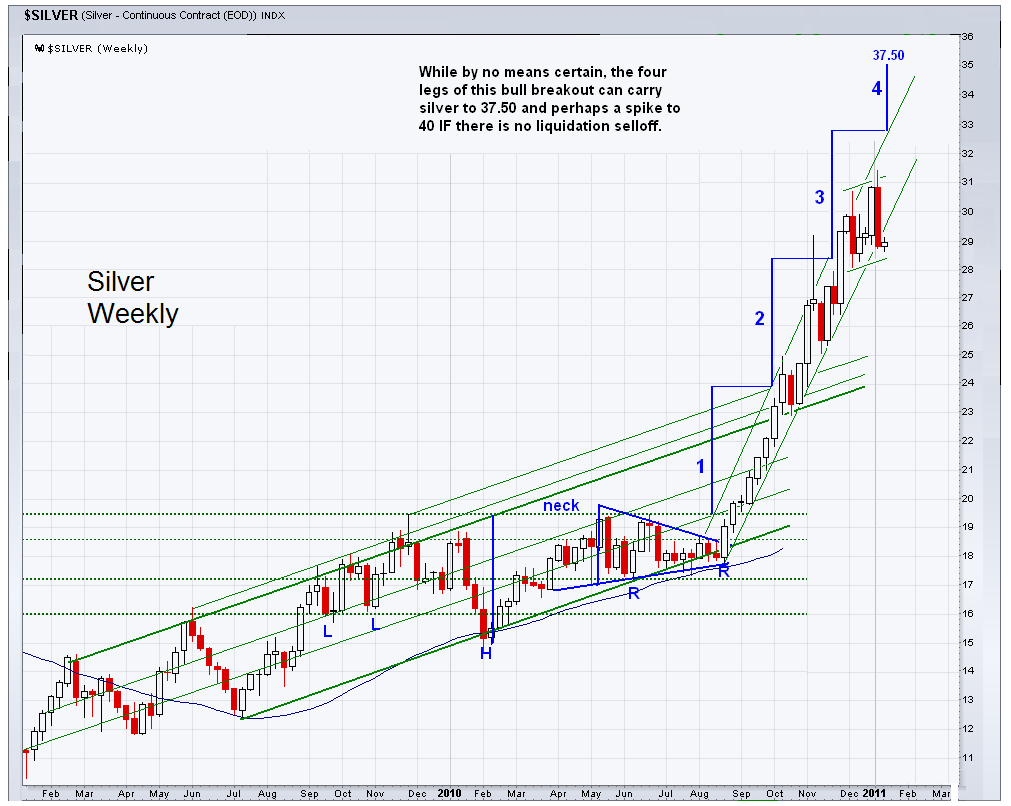
Since the rather sharp breakout from the cup and handle formation, gold has assumed what appears to be a steady, sustainable trend.

Yes there will be rallies and corrections. It appears that gold will be bumping into the upper end of its trend channel between 1455 and 1480 in the beginning of 2011.

If it maintains the current tight channel, which I think it will do unless there is a panic liquidation, 1390 *should* hold.

A more serious sell off could test 1250.

Will those waiting for a chance to get back into the gold bull market buy into position if it drops to 1390? Or even 1250?

If they did not buy into the worst correction down to 700-50 on this chart then they will probably not. Once you lose your position in a bull market it is very difficult to swallow your pride and climb back on board. One tends to keep waiting for THE low.

Gold is rising because the fiat currencies of the developed nations are being devalued. So while 'cash' may seem safe, it may not be, depending on what happens next. I am struggling with the notion that a hyperinflation will occur for reasons previously stated. It CAN happen, but it would take a series of policy blunders and some event for it to happen. And the Fed has the means to stop it, although they may not have the latitude politically or the will.

It would also require a spectacular act of self-destructive gullibility on the part of a greater portion of the American people. But in this I have rarely been disappointed in the last twenty years.

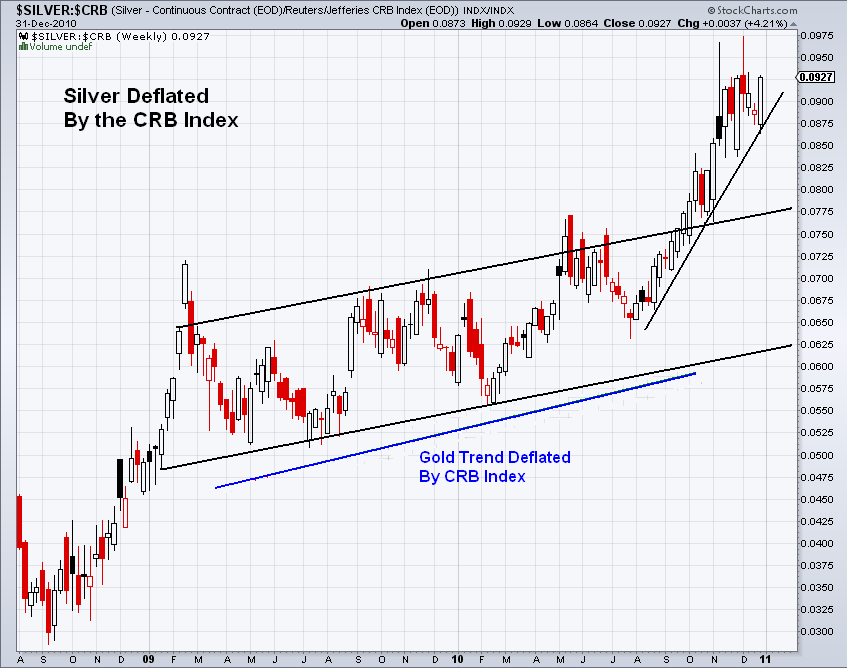
Silver is rising dramatically as an epic naked short position held by a relatively few parties is being slowly unwound. I should add that a similar scenario is underway with gold, except the parties holding the short side are being supplied with bullion to stragecially cover their shorts by some of the central banks and the IMF. But the difference in intensity is apparent if you compare Gold and Silver deflated by the Commodity Index (CRB) as shown below. Silver is undergoing a massive short squeeze since some of the big banks started scaling down their prop trading operations. I think the gold manipulation scheme has more official sanctions than the silver market manipulation.

For me the big question in 2011-12 about silver is whether it will be remonetized by countries who will once again include it in their official reserves, and even provide some silver content to the exchange mechanism of international trade.

There is little doubt that the international monetary scheme is changing more dramatically since the first Bretton Woods agreement established the dollar reserve currency in 1944, and even more than when the US unilaterally changed the arrangement by abandoning the gold standard in 1971.

If silver is remonetized, I suspect the impetus for this will come primarily from the BRIC's in conjunction with Mexico and other Latin American countries.

There is relatively little discussion of this amongst economists, and almost no mainstream media discussion in the US and UK. Europe is consumed with its own monetary identity problems. Monetary without political and fiscal union is like dating. What is now occuring is that Germany is pondering its options as the betrothal grows stale.

2011 will likely be a difficult year, and 2012 will be worse if the current trends continue. The recklessness and hubris of the central government is an awful thing to watch. I am afraid that it will likely reach a climax and turn away from the current path when the real economy 'hits the wall.' I am not confident that the developed countries will be able to resist the call to fascism in the name of expediency. Too few did so in the 1930's. And even then the denial and recriminations may be quite alarming and confusing.

I see no viable reform movements in the US and the UK, and Europe seems leaderless. This concerns me more than anything looking forward to 2012.