11 November 2013

Gold Daily and Silver Weekly Charts - Are We There Yet Daddy?


"We run carelessly to the precipice, after we have put up a façade to prevent ourselves from seeing it."

Blaise Pascal

Gold and silver largely chopped sideways today with a slight downward bias, but nothing of real consequence.

There was a small amount of movement of gold out of the Scotia Mocatta warehouse on Friday. The report is shown below.

The way to play the precious metals market is to not take leveraged or timed (option) positions. Why is this?

Because the markets are being price manipulated, like the currency markets, LIBOR, base metals, and quite a few others it seems.

So what do we not do? We do not try to time the market, since the guys who are pushing prices around have the advantage of 'seeing our hands' given their market positioning and access to non-public information.

This means we are trading for the intermediate to long term. Daily price antics cannot affect us because we are not leveraged, and we are not holding things like options which have expirations.

I wanted to clarify this, because lately I have been getting some questions that make me think that some are trying to time this market, and pile into leveraged positions to maximize their outsized gains. That is not likely to work. The worst thing that can happen to a new trader is to hit a jackpot like that, because they will break themselves trying to regain the feeling of being fortune's child by playing long shots.

Convergence is a more likely way to play markets. That means that even though some things can get out of bounds and stay there for longer than we might think, eventually the fundamentals will come to bear and the markets will converge back to probability again.

In the case of gold, claims per ounce at these prices are at historic highs. The last two times this happened, we saw a major intermediate trend change within six months. Can it be nine months? Sure, why not? With regulators turning a blind eye and the Fed essentially handing the banks and trading desks $80 billion per month by buying their assets at non-market prices, things can go on for quite some time.

But eventually the fundamentals of supply, demand, and value will apply, and sometimes with a vengeance. We saw this in the financial crisis of 2008, wherein the mispricing of risk in Collateralized Debt Obligations blew up, and the housing bubble collapsed.

Sometimes that is what happens when trend becomes overextended. You can break yourself trying for the maximum profit and bragging rights, and miss the big move when it comes from sheer exhaustion.

So I think that is where we are with the precious metals, and with gold in particular. There are no sure things, but this one seems to be unfolding in a fairly classic manner. Try not to pig out and get sidelined before the time comes. As Bernard Baruch once said, better to lose the first ten percent of a major bull move than to try and get in early.

Now, you may not think we are going to see another leg up in precious metals. And you could be right. So what do you do? You sit out and wait for a clear breakout and confirmation. For those more aggressively inclined you take light positions with cool money and no leverage. And then sit and wait to be right.

I do not know how this will unfold exactly. But I do know one thing. All the pundits and master traders don't know any more than that either. But they will be glad to sell you their opinions, and hope that you do the natural human thing and remember the three times they were right, and forget about the six times that they were wrong. Most people certainly tend to keep score that way.

There are ways to get nearly perfect records in trading. But most of them are not available to the average, honest person.

Have a pleasant evening.


SP 500 and NDX Futures Daily Charts - Après les Jobs Report


Techs were off a bit and the financials were weak, but the DJIA and SP 500 both closed near their all time highs today on weak volume and what was really a lackluster trade.

VIX has fallen back into complacency.

The economic calendar this week is a bit light with some more consequential data showing up towards the end of the weak.

Uber-equity Twitter (TWTR) closed around 43 today.

Have a pleasant evening.


Veteran's Day 2013


"Four score and seven years ago our fathers brought forth on this continent a new nation, conceived in Liberty, and dedicated to the proposition that all men are created equal.

Now we are engaged in a great civil war, testing whether that nation, or any nation so conceived and so dedicated, can long endure. We are met on a great battle-field of that war. We have come to dedicate a portion of that field, as a final resting place for those who here gave their lives that that nation might live. It is altogether fitting and proper that we should do this.

But, in a larger sense, we can not dedicate, we can not consecrate, we can not hallow, this ground. The brave men, living and dead, who struggled here, have consecrated it, far above our poor power to add or detract.

The world will little note, nor long remember what we say here, but it can never forget what they did here. It is for us the living, rather, to be dedicated here to the unfinished work which they who fought here have thus far so nobly advanced.

It is rather for us to be here dedicated to the great task remaining before us: that from these honored dead we take increased devotion to that cause for which they gave the last full measure of devotion, that we here highly resolve that these dead shall not have died in vain, that this nation, under God, shall have a new birth of freedom, and that government of the people, by the people, for the people, shall not perish from the earth."

08 November 2013

Moyers: How Big Money and Big Media Undermine Democracy


Gold Daily and Silver Weekly Charts - 'Claims Per Deliverable Ounce' Rises to Record High 60.38


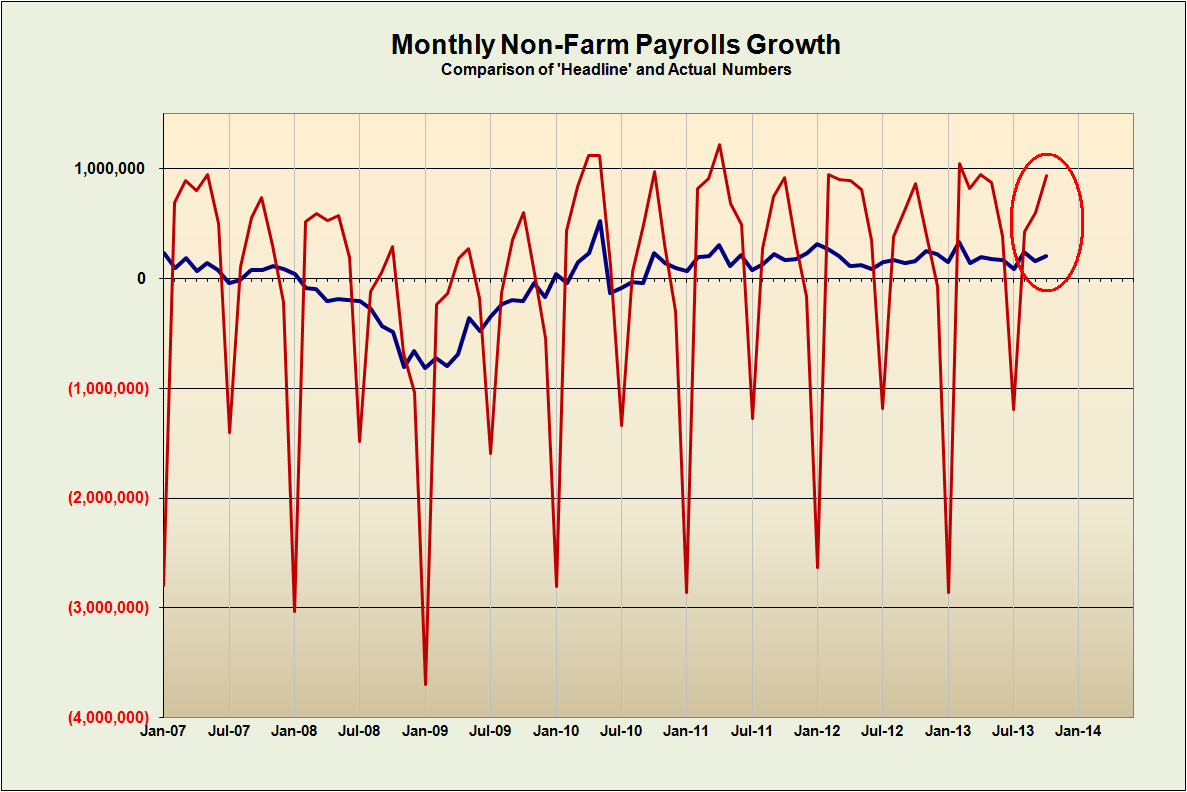
As you probably know the US posted a blowout headline number for the October Non-Farm Payrolls report of 204,000 jobs gains, and upwardly revised the prior month. What made this significant was the thinking that the government shutdown would have negatively impacted the jobs number.

That was not to be, not that it didn't impact jobs, but it did not impact the way in which the government counted jobs in what is the headline, 'establishment' report. The 'Household Report,' which is based on a direct survey of people, and the Labor Participation Rate which compares people who are working versus those who are available for work, were in the tank. Some other aspects like wages and hours worked were not looking very good either.

There was intraday commentary on the Non-Farm Payrolls Report here.

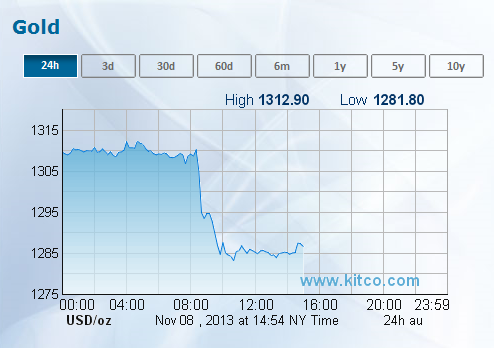
But hey, Wall Street was happy, with both stocks and the dollar rallying, and the SP and DJIA reaching new all time highs. Naturally in keeping with Non-Farm Payroll tradition gold and silver were hit hard, and not all that subtly. The reason for this was that the great jobs number would bring out the Fed taper talk again, but not for stocks, which were just frothing. Except of course for Twitter which had its frothy moment yesterday.

The 'claims per deliverable ounce' for gold on the Comex rose to an all time high of 60.38 contracts per ounce said to be in their warehouses and available for delivery.    There was very little action in or out of the Comex gold warehouses yesterday.  They are the pretty magician's assistance on the stage.  The real action is taking place behind the screens.

Most of the commentary from the US financial media was funny, but in a very sad sort of way. 

Let's see how the delivery process for gold plays out into year end.

Have a pleasant evening.


SP 500 and NDX Futures Daily Charts - New High For the SP On Payrolls Number


I just don't have the words.


Non-Farm Payrolls Report - Small Business Creation Boomed In October


Did new small business jobs creation boom in October during the government shutdown/default crisis?

Well, you might think so by looking at the Bureau of Labor Statistics 'Birth-Death' model report contained in today's October Non-Farm Payrolls Report.

According to the Birth Death Adjustment there were 126,000 jobs added in October. And what an October it was apparently. These are the most new jobs added for any October going back to 2003, which is as far back as my own spreadsheet goes.

A more usual number might be around 103,000 or less. So, someone thinks it was a strong October jobs market.

You can look at the historical Birth-Death Model numbers from 2000-2012 here. And there is a list of Frequently Asked Questions here.

As I have cautioned in the past, the Birth Death number is added to the Non-Seasonally adjusted number, and then seasonally adjusted. So it is not a 'pure addition.'

The Non-Farm Payrolls report contains very large numbers, on the order of 137+ million jobs which are estimated and deseasonalized, and then further revised for the next two months. So reacting strongly to a particular monthly jobs report is a bit of a Wall Street and political game.

What is more important is the trend in the number of jobs, and the quality of the jobs, both in hours worked and hourly compensation.

Another statistics worth noting is the Labor Force Participation Rate.  There is a fairly good commentary on that data from this Payrolls report here.  There was a similar issue with the Households Report since it dealt with the layoffs from the government shutdown differently than the headline NFP report. 

As an aside, when I hear some financier talking about 'the new normal,' as they were on financial television today, it makes me want to gag.  They are attempting to justify the results of their fraud and financial repression as a necessity, just business as usual. There is nothing 'normal' about this current economic environment.  We are in a financialized society where big money dominates public policy for its own ends.

Getting back to the Non-Farm Payrolls number, the big hoohah question is always, 'Is the government lying?' I think it is fair to say that they are certainly putting their best foot forward, in this and quite a number of things.

I am a little more concerned about the lies that take the US into wars of aggression to be frank. But economic deception can have very bad long term effects when coupled with bad economic policy decisions such as those we are seeing today, that are propagating and even increasing an inherently unstable economy.

All things considered, and not just the numbers in this report,  the recovery is weak, and real median wages do not support any sustainable recovery.  Inequity is increasing, and policy supports and subsidizes this growing inequality in both political and economic power.

Keep an eye on the real median wage, and you will have some indication on how the American public is faring. Although the calculation of inflation is fraught with the fog of politics. John Williams of Shadowstats has done some excellent work in this area.

The Banks must be restrained, and the financial system reformed, with balance restored to the economy, before there can be any sustainable recovery.

And that is the bottom line.


In this case the smaller the seasonality factor the bigger the jobs increase because the raw number is being divided by and reduced in September and October to arrive at the seasonal adjustment.  But there are so many estimates involved that the answer really lies in the trends and even more importantly the quality of the jobs.


07 November 2013

Gold Daily and Silver Weekly Charts - ECB Surprise Cut, Non-Farm Payrolls Tomorrow


The metals caught the patented Comex open price hit and pretty much drifted around there all day.

Molto Mario Draghi cut the ECB rate.   There was fleeting joy in Mudville.

Did we mention that tomorrow is a Non-Farm Payrolls number? 100K is the consensus.

There was a withdrawal of 1,700 gold bullion ounces out of the Brink's Registered category.  That is a remarkably round number., and a deposit of 19,688 ounces of gold in to storage at JPMorgan Chase.

Let's see how the metals finish the week.  The next big Comex event will be the December options expiration on Monday, 25 November.

Have a pleasant evening.


SP 500 and NDX Futures Daily Charts - A Post Twitter Market Commences


Twitter came out this morning, to cheers and jubilation at around 45, ticked as high as 50 intraday, and then closed slightly below the open at about 44 and change.

The rest of the market dumped off, in a somewhat cynically amusing manner, despite a 'better than expected' GDP number.

It was like the Twitter IPO sucked all that fast 'liquidity' out of the market, and tech stocks in particular dropped in the vacuum it created. Momentum is fleeting.

Tomorrow we get the Non-Farm Payrolls number. Consensus if for an add of 100K. I would not even care to hazard a guess.
It comes down to how they handle the 'government shutdown.'

Have a pleasant evening.


Adjusted Monetary Base Is On a Tear Again - Efficient Markets Policy Error


I thought we would drop in at policy central and see what the Fed has been doing with the US money supply using its policy and regulatory powers.

The first chart shows that the Adjusted Monetary Base is growing by leaps and bounds. This is Billions of Dollars in Fed Balance Sheet expansion.


This chart shows the leaps and bounds of monetary base growth a little more clearly, since it is the growth of the base, in Billions of Dollars, but in year over year terms. Those are essentially trillion dollar growth swings.


This next chart indexes a number of measures to the economic trough in 2009, for sake of comparison.

It shows the growth in the Fed's monetary base, as well as the excess reserves being held by the Banks.

Below those it shows Wages, Consumer Credit, M2 Money Supply and the Velocity of M2, that is, the rate at which money is being used by the real economy.

We should bear in mind that despite all the hoopla, sturm und drang, and whining by the Wall Street banking elite, the US financial system is still largely unreformed.

This situation brings to mind a quote about economic policy from John Kenneth Galbraith:
“Trickle-down theory represents the less than elegant metaphor that if one feeds the horse enough oats, some will pass through to the road for the sparrows.”

― John Kenneth Galbraith
There wasn't a Fed database entry for the income of the one percent, but if there had been it would be doing very well indeed.


I did not include this in the already busy chart above, but here is Total Assets of All Commercial Banks, using the same indexing method that was used above.  Looking past the rhetoric, the priorities seem fairly clear if you look at the growth trend in assets starting in 2011, and then look at the same time period in the chart above.

This is when the Fed implemented QE2, from Nov 2010 through June 2011, and then began 'Operation Twist' in September 2011.

QE3 started in September 2012 and continues today.


I think that history may view the co-opting of the urge to reform the banking system, and the outrage at the Wall Street bailouts, into the Tea Party's strong popular backing for financial repression of the victims, and the centering of the political debate on throttling government spending for the public good while propagating a financial system that heavily favors and subsidizes the wealthy financiers, to be one of the great propaganda coups of the 21st century.

Almost as good is running a populist presidential candidate, packaged as a progressive reformer and widely denounced by the opposition as a socialist, who in policy practice is the virtual reincarnation of Herbert Hoover, but without his many prior logistical accomplishments.


06 November 2013

Comex Registered Gold Falls To a New Low at 640,552 Ounces - Claims Per Ounce At High of 59


There was a withdrawal of 17,988 registered ounces of gold from the Scotia Mocatta warehouse on Tuesday.

The three kilogram bars representing 96.46 ounces came back to the registered category at Brinks. 

This brings the total ounces of deliverable (registered) gold down to a new low of 640,552 ounces for this leg of the gold bull market.

The 'owners per ounce' of registered gold is still bumping around the all time high of 59 potential claims per ounce.  For the interest of those who have asked, I include the comparable charts for silver this evening as well.

As claims are presented at these prices, gold will have to be delivered.  If the gold becomes scarce at these prices, higher prices may be called for to make additional supply available. The bullion banks can continue to resort to leasing gold from the central banks and using it to settle claims, but that particular game seems to be coming to a sad and sorry end.  When Germany asked for the return of its gold and was flatly refused, we heard the faint sounds of a fat lady preparing to sing.

Weighed and found wanting.

Stand and deliver.


Gold Daily and Silver Weekly Charts - A Banquet of Consequences


"Everybody, sooner or later, sits down to a banquet of consequences."

Gold was held below the $1320 level and silver the $22 level once again.

I tend to think they are coiling for a move, but we will probably have to wait while Twitter comes out to play, and the Bureau of Labor Statistics squeezes out another Non-Farm Payroll Report on Friday.

We finally had a little action in the Comex warehouses. I will be posting on that separately later tonight.

You may have heard that a group of traders have come forward claiming that they have proof of price manipulation in the Brent Crude market.

Let's see, at last count that makes about EVERY major market that has been rocked by a profound scandal of price rigging and market manipulation, enabled or perpetrated by a major player in the Anglo American banking cartel. There is all kinds of weird shit going on, but nothing to see here in precious metals markets, so move along. 

Have a pleasant evening.


SP 500 and NDX Futures Daily Charts - Bernanke in Twitterland


We start hitting the substance of the economic reports with GDP tomorrow and Non-Farm Payrolls on Friday.

The Twitter IPO looms over the market action as well as the real economy, and I have a sneaking hunch that the Street will support stocks until Twitter gets shoved out the door tomorrow, and perhaps for a few days after.  As you have probably heard it is coming out on the higher side of $26 per share.   Let's see how it does in the market.

I am not in stocks here, but am fighting an urge to get something going on the short side until we get a better idea if they can keep this pig in makeup for the year end ramp at least.  Twitter may give us some insight.

This market is built on a foundation of meringue, supplied by those little elves at the Fed, who are pumping huge sums to Wall Street while Main Street languishes with little excess buying power and a floundering median wage.

While the Fed does not control fiscal policy, they have a huge amount of leverage as a primary bank regulator that they are not using well.

Have a pleasant evening.


The Wall Street Code


“The complaints of the privileged are too often confused with the voice of the masses...The man who is admired for the ingenuity of his larceny is almost always rediscovering some earlier form of fraud. The basic forms are all known, have all been practiced.”

John Kenneth Galbraith


"It is difficult to get a man to understand something, when his salary depends upon his not understanding it."

Upton Sinclair

This is not quite as complex as it seems, at least in my thinking with regard to the principles of the fraudulent aspects of it. The complexity comes in the implementation of the trading code, not in the design of the system. I have been in groups that have taken on much hairier network and computing problems, and I know what self-induced complexity looks like, and understand its true purpose. 

I thought the example of line jumping for concert tickets in the video was a fairly good metaphor from which to start thinking. 

It is all about a lack of transparency, asymmetry of information, and special rules for certain people who are 'connected' in the traditional sense. 

So you establish top down market principles of transparency and equal protection. You place an order and it has a fixed life of one second.  Everyone has the same privileges of trading in the same priorities and monetary units, that is, everyone can trade to the whole cent, or the tenth of a cent with equivalent fill priority.  And everyone knows what the other players can know when they know it.

Yes the exchange can make money by selling certain key information to the highest bidder, but in doing so it has just undermined the integrity of the exchange, so too bad.  Exchanges are utilities operating under license like other utilities, and not spying agencies or extortionists who happen to run an exchange.  And if you don't want to be a utility operating within certain constraints, find some other business.

Transparency and equality. Wow, what arcane concepts.

And a very nominal fixed transaction tax of five cents per every order placed, like a toll, to fund the costs of regulation of the exchange, would be quite effective, in addition to some fundamental hysteresis on every order as described above.

Most of the complexity is unnecessary and designed for asymmetric advantage for insiders, and not for liquidity which is the great bogeyman of the Street. HFT is predatory in nature and provides no liquidity. Liquidity is not volume, it is the money that stands in the market in the locus of genuine price discovery, and stands its ground on that, and not on the next price tick.

You have to ask, what is the purpose of this system? And if the answer is fairness and soundness of price discovery, and not making the most money for powerful insiders, the answers start to clarify from first principles. These used to be called moral values.

Some fairly simple changes would fix all this, based on fundamental concepts like transparency and equal protection. The problem is that politicians and private firms make enormous sums by taking some 'vig' or vigorish from each and every trade by the 'dumb' or outsider money.

Most frauds have a lot of flash and dazzle for misdirection, but deep down they are always shockingly simple, and most often based on time honored cheats.

Eliot Spitzer and Bill Black certainly 'get this.' Lots of good people do. But the Banks use their friendly politicians and the power of money to isolate them. Just denying access to key careers or events is often enough to obtain most people's silence. This is how the status quo perpetuates itself, with money and the credibility trap. It is not dissimilar to organized crime.

The regulators should be ashamed, but they can point to the politicians, and the politicians can take the 'CEO defense' of not understanding what is going on. And the band plays on. There is some hope that the institutions might start using their leverage more effectively in their fiduciary roles, because without them the game ends. They are the 'marks' and their naivete is the criminal's incentive.


05 November 2013

Taibbi: JPM Chase Is Not the Only Bank In Trouble - Credibility Trap - Pigmen Agonistes


If you want to take the unadjusted temperature of the ongoing financial crisis, you don't go to the financial talking heads and spokesmodels at CNBC or Bloomberg TV, but rather to the sportswriter at Rolling Stone magazine.

I particularly liked this piece because it is a nice vignette of the credibility trap in action.

I am not optimistic.  The powers that be have far too much of their own skin in the game to engage in meaningful reform.    Both parties are in the tank for the monied interests.  It will not be easy, but change will come.

And Taibbi does not even touch on the developing gold bullion scandal, which will shake the Western central banks to their foundations when their perfidious collusion with the bullion banks to steal the wealth of nations is finally revealed.

Enjoy.

Chase Isn't the Only Bank in Trouble
By Matt Taibbi
November 5, 12:55 PM ET

"There are multiple scandals blowing up right now, including a whole set of ominous legal cases that could result in punishments so extreme that they might significantly alter the long-term future of the financial services sector.

As one friend of mine put it, 'Whatever those morons put aside for settlements, they'd better double it...'

Firstly, there's a huge mess involving possible manipulation of the world currency markets. This scandal is already drawing comparisons to the last biggest-financial-scandal-in-history (the Financial Times wondered about a "repeat Libor scandal"), the manipulation of interest rates via the gaming of the London Interbank Offered Rate, or Libor. The foreign exchange or FX market is the largest financial market in the world, with a daily trading volume of nearly $5 trillion...

The Forex story broke at a time when the industry was already coping with price-fixing messes involving oil (the European commission is investigating manipulation of yet another Libor-like price-setting process here) and manipulation cases involving benchmark rates for precious metals and interest rate swaps. As Quartz put it after the FX story broke:
For those keeping score: That means the world's key price benchmarks for interest rates, energy and currencies may now all be compromised.
Perhaps most importantly, however, there's a major drama brewing over legal case in London tied to the Libor scandal.

Guardian Care Homes, a British "residential home care operator," is suing the British bank Barclays for over $100 million for allegedly selling the company interest rate swaps based on Libor, which numerous companies have now admitted to manipulating, in a series of high-profile settlements. The theory of the case is that if Libor was not a real number, and was being manipulated for years as numerous companies have admitted, then the Libor-based swaps banks sold to companies like Guardian Care are inherently unenforceable.

A ruling against the banks in this case, which goes to trial in April of next year in England, could have serious international ramifications...

And virtually simultaneous to that, JP Morgan Chase disclosed that it is currently the target of no fewer than eight federal investigations, for activities ranging from possible bribery of foreign officials in Asia to allegations of improper mortgage-bond sales to . . . the Libor mess. "The scope and breadth of risky practices at JPMorgan are mind-boggling," Mark Williams, a former Federal Reserve bank examiner, told Bloomberg.

The point of all of this is that any thought that the potential Chase settlement might begin a period of regulatory healing for it and other Wall Street banks appears to be wildly mistaken. If anything, the scope of potential liability for all the major banks, particularly in these market-rigging furors, appears to be growing in all directions...

One gets the feeling that governments in all the major Western democracies would like to sweep these manipulation scandals under the rug. The only problem is that the scale of the misdeeds in these various markets is so enormous that even the most half-assed attempt at regulation will cause a million-car pileup. (This is the credibility trap in action, and how it impedes the reforms necessary to achieve sustainability. A lot of those cars are limos filled with politicians taking a free ride. - Jesse)

There's simply no way to do a damage calculation that won't wipe out the entire finance sector when you're talking about pervasive, ongoing manipulation of $5-trillion-a-day markets. That's the problem – there's no way to do a slap on the wrist in these cases. If they're guilty, they're done."

Read the entire article here.