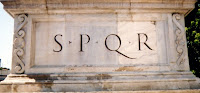
 The Rubicon is a river that marked the boundary between the Roman province of Gallia Cisalpina to the north and Italy proper to the south. Roman law prohibited its returning generals from crossing into Italy with their army, protecting the civilian basis of the Roman Republic: Senatus Populusque Romani. SPQR: the Senate and the People of Rome. (A modern equivalent is the US law of posse comitatus.)
 When the Roman general Gaius Julius Caesar crossed the Rubicon with his army in 49 BC with the intention of going to Rome, he challenged the independence of the Roman political system and made a war to resolve the outcome of the change inevitable. Hence the phrase, "crossing the Rubicon" to mean an action that precipitates major change and inevitable consequences.
The Republic was replaced by an autocracy as Caesar assumed the title dictator perpetuus, dictator for life.
As Julius Caesar crossed the Rubicon, the historian Suetonius reports that he uttered the phrase alea iacta est, "the die is cast".
 Until 1971 the US dollar was backed by gold. The Dollar is no longer the reserve currency of the world. Until last month it was backed by the sovereign debt of the United States government. One can presume that it is still backed by the full faith and credit of the federal government, no matter what. Although the nature and character of its backing is clearly changing, the final outcome of what it will become exactly is yet to be decided.
And so the die is cast.
Bearing Down on the Fed's Balance Sheet
By Randall W. Forsyth
Barron's
Congress turned its sites this week on the rescue -- don't call it a bailout! -- of Bear Stearns by the Federal Reserve and JPMorgan Chase.
All the principals involved, from Treasury to the Fed to the banks, insisted the deal staved off a certain bankruptcy of Bear on St. Patrick's Day, which would have set off a chain reaction that might have threatened a meltdown of the global financial system.
They're probably right; the risk of letting Bear go bust was too great to take. And since then, financial markets have begun to rebound. Stocks have bounced, but more importantly from the standpoint of the economy, the capital markets have improved materially.
Starting with Lehman Brothers' $4 billion convertible preferred offering earlier this week, the capital markets have become much more receptive, allowing banks and other financial firms to rebuild capital that was hit by writedowns of sub-prime-related assets.
While balance sheets in the private sector are being rebuilt, the opposite is happening to the balance sheet of the nation's central bank. Specifically, the Fed's holdings of U.S. Treasury securities are plummeting. In their place, the Fed's various new-fangled lending facilities to banks and the rest of the financial system are burgeoning.
Since Dec. 6, just before the Fed instituted its Term Auction Facility to auction loans to banks, its holdings of Treasury securities plummeted from $780 billion to an average of $589 billion in the week ended Wednesday.
As MacroMavens' Stephanie Pomboy points out, at this rate the Fed will be out of Treasuries before Labor Day, or Aug. 14 to be exact.
Meantime, TAF lending has climbed to $100 billion. And the Primary Dealer Credit Facility -- representing the opening up of the discount to non-banks -- averaged $38.1 billion in the week ended Wednesday. JPMorgan Chase chief executive Jamie Dimond told Congress that Bear Stearns is borrowing about $25 billion via this facility.
That is apart from the controversial $29 billion that will be provided by the Fed to JPMorgan Chase and backed by Bear Stearns collateral -- which won't happen until the merger closes.
In addition, the Fed lent an average of $64.3 billion a day in Treasuries under its Term Securities Lending Facility in the week to Wednesday, in addition to the $21.3 billion a day in Treasuries lent under its overnight lending scheme. Lending Treasuries in exchange for other, lower-quality and less-liquid securities doesn't expand overall liquidity. But it does give dealers securities that are as good as cash in exchange from securities that, in essence, aren't.
But, wait, there's more. In the week ended Wednesday, so-called Other Fed Assets leapt by $21.4 billion a day, to an average of $64.9 billion. In that category resides foreign assets, such as currency swaps with foreign central banks such as the Swiss National Bank and the European Central Banks.
The latest bank-statement week took in the turn of the quarter, when money markets tighten, especially in skittish times such as these. So, European banks likely turned to their friendly, local central bankers for dollar liquidity, which the central banks apparently obtained by drawing on swap lines to the Fed. And those loans were an asset on the Fed's balance sheet, requiring it to shed Treasuries as an offset.
It's enough to make anybody's head spin. But the key point is that all these new and novel loans are displacing Treasuries on the Fed's balance sheet. That means, in effect, the Fed is taking on far greater credit risk in support of the banking system. (and it is the Fed's Balance Sheet Assets that provide the backing for the Federal Reserve Notes - US currency - in circulation - Jesse)
Indeed, says Robert Rodriguez, chief executive of First Capital Advisors, we have "crossed the Rubicon."
"In our opinion, a new financial system is in process of being created," he writes in a report to shareholders. "Some may refer to it as Pre-Bear Stearns and Post-Bear Stearns."
As it becomes the protector of the financial system, Rodriguez continues, the Fed's focus may be distorted by the credit risks that now reside on its balance sheet. Having these risky assets might influence the Fed to follow a less stringent anti-inflation policy as when it just held Treasuries.
For now, Job 1 for the Fed is to keep the financial system functioning -- even if it compromises its other objectives. Hobson, here's your choice.

 We start the first quarter earnings reports this afternoon with Alcoa.












