09 November 2012

Thomas Jefferson On the Danger of a Concentration of Power On Government


Thomas Jefferson, Collected Papers and Correspondence Vol. 12, Letter to George Logan:

Poplar Forest near Lynchburg, Nov. 12, 1816

Dear Sir,

I received your favor of Oct. 16, at this place, where I pass much of my time, very distant from Monticello...

Your idea of the moral obligations of governments are perfectly correct. The man who is dishonest as a statesman would be a dishonest man in any station. It is strangely absurd to suppose that a million of human beings collected together are not under the same moral laws which bind each of them separately.

It is a great consolation to me that our government, as it cherishes most its duties to its own citizens, so is it the most exact in its moral conduct towards other nations. I do not believe that in the four administrations which have taken place, there has been a single instance of departure from good faith towards other nations. We may sometimes have mistaken our rights, or made an erroneous estimate of the actions of others, but no voluntary wrong can be imputed to us.

In this respect England exhibits the most remarkable phaenomenon in the universe in the contrast between the profligacy of its government and the probity of its citizens. And accordingly it is now exhibiting an example of the truth of the maxim that virtue and interest are inseparable.

It ends, as might have been expected, in the ruin of its people, but this ruin will fall heaviest, as it ought to fall, on that hereditary aristocracy which has for generations been preparing the catastrophe.

I hope we shall take warning from the example and crush in its birth the aristocracy of our monied corporations which dare already to challenge our government to a trial of strength and bid defiance to the laws of our country.

Present me respectfully to Mrs. Logan and accept yourself my friendly and respectful salutations.

Thomas Jefferson
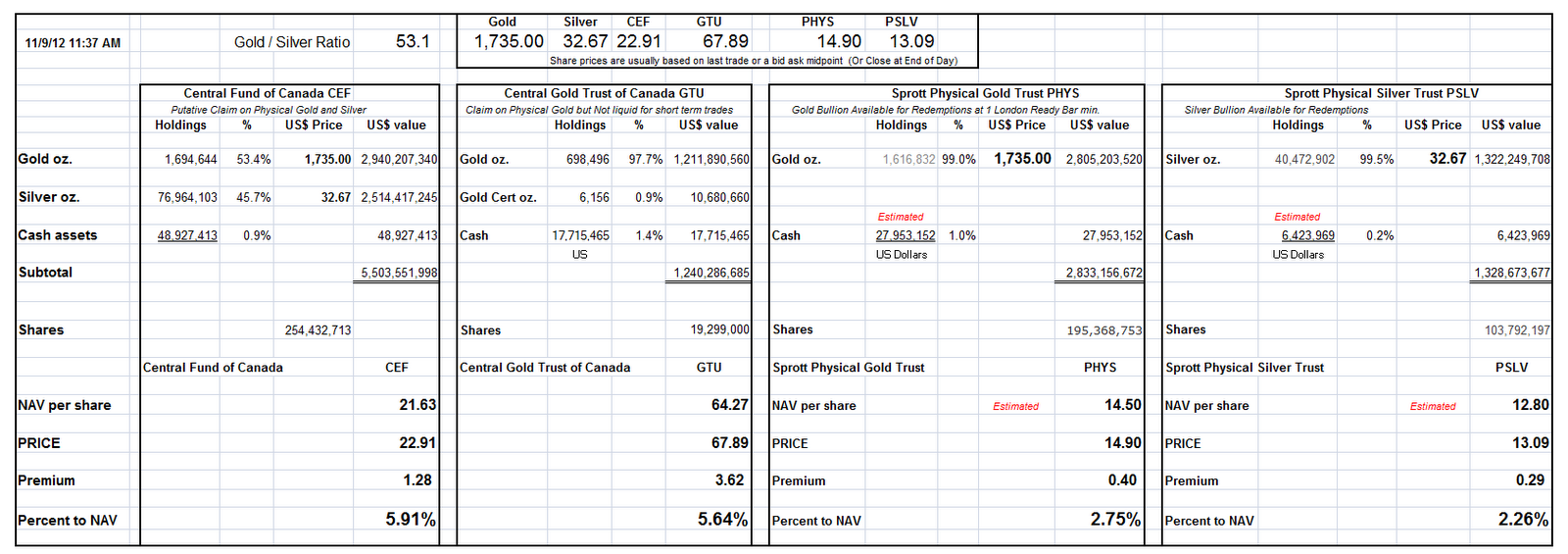
Net Asset Value Premiums of Certain Precious Metal Trusts and Funds


As noted earlier, the Sprott Physical Silver Bullion Trust announced a large follow on offering which priced at $13.15.


Lauren Lyster Interviews Dan Ariely on Financial Fraud, Moral Hazard, and the Psychology of a Cheater


I would not necessarily compare the deterrent effects of punishments for a capital crime, which is often a crime of passion, with financial fraud. And beyond some point no matter how severe the punishment may become, the deterrence is not commensurately increased.

The problem is that there is little or no personal penalty these days for even the most egregious forms of financial misbehaviour and fraud. There is a fellowship of mutual corruption at the heart of the money system.

And as some have warned for years, political capture and moral hazard have broken the Anglo-American financial system with profound implications for the real economy. What I find appalling is when so called progressive economists dismiss this important principle for the sake of their models and expediency.

As you know, my theory on the cycles in society is that there is always a minority of people, perhaps ten percent, who are essentially amoral or immoral, whether from sociopathy or some other outlying behavioural tendency.  They are often attracted to positions of power if they have the mind and education for it, and if not, then perhaps to various forms of crime.

But there are times when corruption and callous greed becomes more tolerated, and a larger segment of the population that is not amoral, but is perhaps morally ambivalent or suggestible, joins in on the action and tries to get theirs. And the guilt which they feel often turns into a mean-spirited contempt and anger against their own victims.
"Because of the increase of wickedness, the love of many grows cold."
I found some of the examples of corporate accounting corruption in this discussion to be interesting. I have seen some of it first hand. This sort of corruption distorts markets, undermines the capitalist system of competition, and destroys whole companies and even industries.

I knew that Erskine Bowles was on the board of Morgan Stanley, but I did not know that his wife is on the board of JP Morgan. It is an interwoven world of mutual benefits and interconnecting interests at the top.

The current climate amongst the power elite is one of personal entitlement based on rationalization as described by Dr. Ariely, and assumptions of a natural superiority, self-portraying their actions even to the point of benevolence and civic spirit, guiding the poor helpless sub-humans who are incapable of self-governance and perhaps not even worthy of freedom: useless eaters. I call it the Tsar Nicholas complex.

It is a culture of narcissism, self-indulgence, exclusion, and self-reinforcement through separation from the other. The private discussions that were exposed in the recent presidential elections were a brief view into the mindset and groupthink.  Their words betray them.

And it always ends, often badly.