
15 November 2012
JPM 'Benched' from Trading in the Energy Markets for Six Months
The US Federal Regulatory Commission (FERC) has suspended JP Morgan's electrical trading privileges for six months in response to JPM's continued provision of false and misleading information.
In the story from Bloomberg:
The action, part of a more aggressive effort by the commission to monitor U.S. power markets, prohibits J.P. Morgan Ventures Energy Corp. from selling electricity at market-based rates for six months starting April 1, 2013.
In its order released late yesterday, FERC said the JPMorgan unit will essentially be allowed to participate as a bystander in wholesale power markets, granting it the ability to offer electricity into the market without a price attached. This will ensure that utilities have the ability to obtain enough power to serve the demand from customers. JPMorgan would still be able to trade derivatives under the order...
"The provision of false, misleading, or inaccurate information undermines the integrity of the FERC decision-making process, the smooth operation of markets, and FERC's ability to ensure just and reasonable rates for customers," FERC said in an e-mailed statement. "The commission continuously has warned market participants of the consequences associated with failing to abide by FERC rules and regulations."
A spokeswoman for the bank said it is reviewing the decision and its next steps. "This is a novel use of FERC's authority over market-based rates and is unsupported by FERC's own regulations," Jennifer Zuccarelli said in an e-mail.
The commission is also investigating alleged manipulation by traders for Deutsche Bank AG and Barclays Plc. Since January 2011 the agency has announced 11 market-manipulation probes, and in March it reached a $245 million settlement with Constellation Energy Group Inc. over one of those cases.
This is also a nice illustration of the moral hazards of weakly regulating the markets. It was not all that long ago that Enron roiled the California economy by manipulating the prices of electricity. It is nice to see that someone is doing something, even if it involves no criminal indictments.
If the CFTC is unable to act in the commodity markets, someone has to do something to maintain orderly pricing and clearing markets for the use of the real economy.
And one might ask, why is a bank that is backstopped by the Federal Reserve and government guarantees on deposits gambling in the energy markets to this extent? Would that function not best be served by a purely private company, rather than a de facto Government Sponsored Enterprise (GSE)?
Bear Raid in the Metals? - Front Running Sharks with Lasers
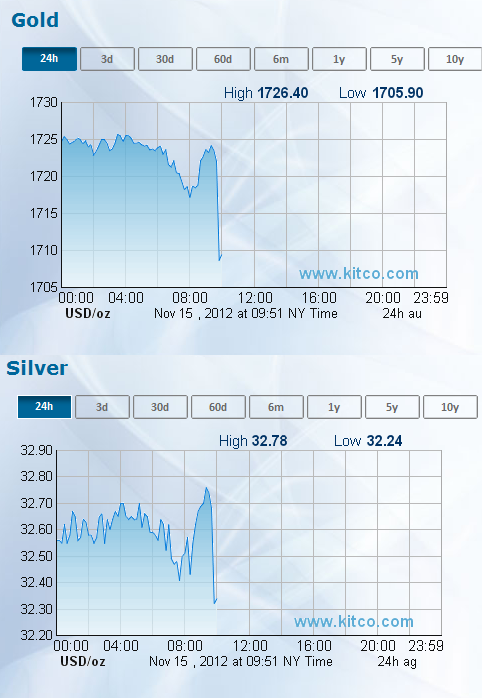
Metals plunged along with stocks in reaction to a worse than expected Philly Fed reading of -10.7. What was unusual was that the plunge preceded the official release by twenty minutes.
November 2012 Business Outlook Survey
Firms responding to the November Business Outlook Survey reported declines in business activity this month following the disruptive effects of Hurricane Sandy on the region. The survey’s indicators for general activity, which had shown improvement in October, fell back into negative territory this month. Firms reported slight declines in shipments, employment, and hours worked. Indicators for the firms’ expectations over the next six months were near their levels in the previous month, but expectations for future employment and capital spending have weakened in the last two months.
Indicators Suggest Diminished Activity
The survey’s broadest measure of manufacturing conditions, the diffusion index of current activity, decreased 16 points, to a reading of ‑10.7. The fallback of the general activity index followed a single positive reading in October that was preceded by five negative monthly readings (see Chart).
Nearly 32 percent of firms reported declines in activity this month, while 21 percent reported increases. The demand for manufactured goods, as measured by the current new orders index, declined 4 points from last month and remains in negative territory.
Shipments also fell this month: The current shipments index fell 7 points, to ‑6.7. Declines in inventories were also more widespread this month; 31 percent of firms reported declines compared with 21 percent in October.

What was initially confusing was that stocks began to decline sharply around 9:35 AM. Gold had a waterfall plunge from 1722 to 1705 from 9:35 to 9:45. I had already completed the initial post of this before the Fed report hit the news.
The Philly Fed was officially released at 10:00 AM. I have not discovered if it was officially released prematurely, or if the markets were just front running the data for a quick 'wash and rinse.' They would suspect that the data would be a 'miss' because of the devastating effect of the hurricane on the region.
In the long run markets are a discounting mechanism, but in the short term they are a pinball game, especially in these days of large leveraged players and lax regulation.
So I think it was either a leak, or a 'trading idea' shared amongst several of the trading desks, or a bit of both. The revolving door also has an intercom.
I had the opportunity to add to a growing silver position. I am sure the wiseguys did much the same. I was not prepared for it, just lucky to be watching it as it happened.
We may wish to bear in mind the knock on effect of Hurricane Sandy on subsequent economic report for the fourth quarter. The devastation on this most populated region of the US was profound. The data will no doubt provide fresh opportunities to game the markets.
Knowledge is power.

Subscribe to:
Posts (Atom)










