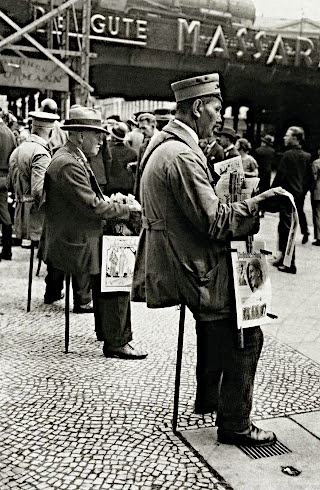
This had been posted on our former site at The Crossroads Cafe.
A new forecast and theme will be done sometime around May for 2008-2009.

"Why is my language not clear to you? Because you are unable to hear what I say. You belong to your father, the devil, and you want to carry out your father’s desires. He was a murderer from the beginning, not holding to the truth, for there is no truth in him. When he lies, he speaks his native language, for he is a liar and the father of lies."
John 8:43-44
This had been posted on our former site at The Crossroads Cafe.
A new forecast and theme will be done sometime around May for 2008-2009.
When they manipulated the stock market,On the Road from Samaria, Jesse
I remained silent;
I was making money and felt superior to the crowd.
When they silenced their critics,
I remained silent;
I was self-righteous and felt they got what they deserved.
When they came for the blue collar workers,
I did not speak out;
I enjoyed my superior social status and the cheap consumer goods.
When they came for my neighbor's possessions
I remained silent;
I was afraid and jealous and glad to see him brought down.
When they grew richer and more powerful
I accepted their lies in silence;
I wanted to gain their favor and be one of them.
When they came for me,
and sent me to a camp as a useless eater
I reaped what I had sown.
 "...And what rough beast, its hour come round at last,
Slouches towards Bethlehem to be born?"
The Second Coming, William Butler Yeats
"In a nod to the debacle in mortgage lending, the administration proposed a Mortgage Origination Commission to evaluate the effectiveness of state governments in regulating mortgage brokers and protecting consumers.
Yet another proposal would, for the first time, create a national regulator for insurance companies, an industry that state governments now oversee.
Administration officials argue that a national system would eliminate the inefficiencies of having 50 different state regulators, who have jealously guarded their powers and are likely to fight any federal encroachment."
Bush Administration Plan Would Concentrate Regulatory Power with the Fed
 The chain reaction was initiated by a simple spark igniting high-explosive charges designed to compress the uranium or plutonium core upon detonation. The compressed core goes critical, initiating a chain reaction that persists until the fuel is consumed...
We knew the world would not be the same. A few people laughed... A few people cried... Most people were silent. I remembered the line from the Hindu scripture the Bhagavad Gita; Vishnu is trying to persuade the prince that he should do his duty, and to impress him takes on his multi-armed form, and says, "Now I am become death, the destroyer of worlds." I suppose we all thought that, one way or another.
Without the radioactive core and nuclear fuel, many would-be weapons of mass destruction are merely large conventional explosions: powerful, but not widely devastating.
The analogy is that the subprime mortgage failure is the spark, a recessionary downturn and credit crunch is the conventional explosion, and the credit derivatives, particularly the credit default swaps, are the nuclear core that amplifies the original misjudgement to massively devastating proportions.
It is hard to believe that something this complex and obviously dangerous was built up over such a long period of time without a few economists noticing it. It is an obvious Ponzi scheme at its simplest. At its most complex, the pointless size and interconnectedness of the Credit Default swaps is almost diabolical. Companies with no substantial ties to the debt of third parties placing enormous wagers on their default that are up to an order of magnitude greater than the total debt involved. Pure, unadulterated, and highly lethal speculation.
Ironically the protective shielding in this case will not be lead and concrete and earth, but gold and silver and other commodities that will endure the coming inferno of paper.
Future generations will ask: what were they thinking?
Indeed.
Bankruptcies in America
Waiting for Armageddon
Mar 27th 2008
The Economist
The recent rise in corporate bankruptcies in America may well be a sign of much worse to come...If the debt markets are to be believed, companies could be in at least as much trouble as they were in the previous two downturns, in the early 1990s and at the start of this decade, after the dotcom bubble burst. A leading indicator is the spread between yields on speculative “junk” bonds and American Treasury bonds. A year ago, the spread was only about 280 basis points; the long-term average is around 500 points. This month the spread exceeded 800 points for the first time since March 2003, reaching 862 on March 17th.
The bankruptcy rate (in the previous 12 months) for high-yielding bonds has so far edged only modestly higher, to 1.28% from a record low of 0.87% in November. But most forecasters expect it to rise sharply over the coming months. For instance, Moody's, a ratings agency, predicts that the default rate will rise to 5.4% by the end of this year, mostly due to problems in America. (Moody's also expects a rise in European bankruptcies this year, but only to 3.4%, thanks to lower levels of borrowing and less exposure to economic weakness.)
That is a relatively optimistic prediction, for it would merely return the bankruptcy rate close to its long-term average after an abnormally trouble-free period, and it assumes only a mild recession in America. But if there is a severe recession, the default rate “could go to double figures,” admits Kenneth Emery, head of corporate-default research at Moody's.
Other forecasters are much gloomier. FridsonVision, a research firm, publishes a default-rate predictor based on the percentage of bonds trading with a spread of at least 1,000 basis points. On March 19th this was forecasting a default rate on high-yielding American corporate bonds of 8.55% by the end of February 2009, compared with Moody's forecast for American bonds of 6.8% for that date....
A look at the firms with distressed debt shows that problems are rapidly moving beyond the long-term sick (airlines, cars) and the industries immediately affected by the crisis (home builders, mortgage lenders, monoline insurers). Craig Deane of AEG Partners, a restructuring-advisory firm, says he is now seeing troubled companies in retailing, restaurants, manufacturing and food processing...
But perhaps the biggest difference this time will be the effects of the huge market for credit derivatives and other credit-related securities, which often dwarf the amount of debt that a firm has issued, says Henry Owsley of Gordion, another restructuring adviser. The interaction between underlying debt and credit derivatives will complicate bankruptcy and near-bankruptcy no end, he says.
A big concern for company bosses will be the role of speculative investors, especially hedge funds. They can use derivatives to pursue complex strategies that may not be in the best interests of the firm that has issued the underlying debt, says Henry Hu, a law professor at the University of Texas, Austin. In a bankruptcy, a hedge fund could use the voting rights attached to different securities to maximise the overall value of its holdings in the firm at the expense of other investors.
Imagine, for instance, a hedge fund that owns debt secured against a company asset. It may prefer to force the firm into liquidation in order to win that asset rather than engage in a restructuring negotiation that will keep the firm alive. Meanwhile, it can boost its returns by short selling its unsecured debt and its equity. Or suppose that a hedge fund owns credit-default swaps as well as a firm's debt. If the fund makes enough money from the pay-out of the credit-default swaps, it may prefer to use the voting rights on its debt to ensure that the firm goes bust rather than negotiate a way to avoid bankruptcy...
Bankruptcies in America - The Economist