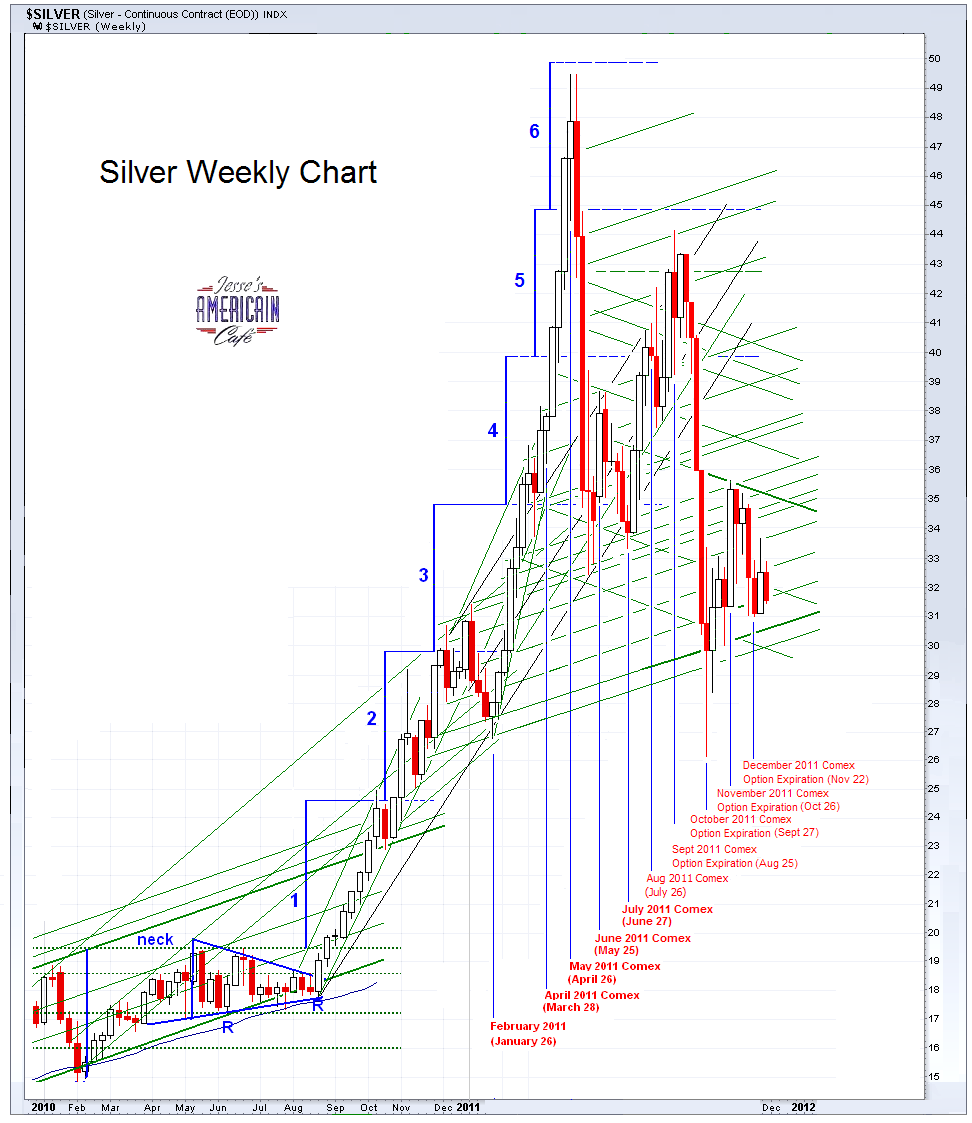
This felt like a 'drift higher' day more than anything else.
The VIX fell.
Watch for a possible SP downgrade of Eurozone debt next week.


"You are the very cause of your ignorance, yourselves. You put away the light, yourselves; you first pluck out both your own eyes, yourselves; and after that other men’s too, so that the blind may lead the blind, until you both fall into the pit.”
Thomas More, The Sadness of Christ (Gethsemane), Tower of London, 1535
Fraus est celare fraudemAnd as sacred as a former US Senator may be, if one of the TBTF Banks is involved as the circumstances seem to indicate, this is the holy of holies in the Pax Americana.
“Poverty wants, but greed wants everything, and more.”Customers run for safety, from one place to another, not sure what or whom they can trust. One thing they may do is to stop trading on margin, and shut down their margin accounts, going to strictly cash investing wherever possible. And for your long term investments, you can take possession of the physical shares and keep them in a safer place than an account statement from any of the TBTF banks and hyper-hypothecating commodity brokers.
Jon Corzine Dodges the Fraud Question
By Janet Tavakoli
12/9/11 07:56 AM ET
It's as if Jon Corzine's PR machine is in top spin mode. You'll recall Jon Corzine is the former head of Goldman Sachs and former CEO of MF Global that appeared in front of Congress yesterday to answer questions about an estimated $600 million to $1.2 billion in missing money from the segregated accounts of customers of MF Global.
Yesterday and today, I heard confusion about whether or not MF Global's diverting customer funds was allowable and the possibility that customers will eventually get the money back.
Let me be clear. The diverting of customer funds from segregated accounts is not legal or allowable, and even if the money is later "found" it is fraud...
"Finding" Money Doesn't Excuse Fraud
Let me address the implication of the potential to "find" the money. The money may indeed be "found." If the bonds mature and pay off one hundred cents on the dollar, it may be possible to claw back money from MF Global's trading partners without much of a fight. Otherwise there may be a legal battle for money that as creditors of MF Global, they were never entitled to in the first place.
The rights of MF Global's customers are superior to the claims of these creditors. But eventually replacing the filched funds is not the same as restitution, since reputations and businesses have already been ruined. Damage has also been done to the trust in the global futures market and Futures Commission Merchants (FCMS).
Never Allowable to Filch Customers' Funds
The key issue is that it is never allowable to divert money from customers' segregated accounts. CFTC Commissioner Jill E. Sommers did a good job of stating that in her testimony yesterday. Moreover, if any trades mimicking Corzine's were done on behalf of the tiny minority of customer accounts that could engage in this trade, the trades would have to be segregated and credits or losses would show up in the relevant customers' accounts.
That still doesn't explain the missing funds in most customer accounts. Most customer accounts would not even be eligible for the "Corzine sovereign bond trade." Why is that? Here's an excerpt from Sommers' testimony: "Under Section 4d of the CEA, customer segregated funds may be invested in: general obligations of a sovereign nation (to the extent the FCM holds customer funds denominated in that sovereign nation's currency)." Most MF Global customers now missing money did not hold foreign currency accounts.
Pushing the idea that this trade was "allowable" for some customer is a distraction trick to avoid the question of whether MF Global impermissibly wired money from customers' accounts to satisfy margin calls for its own trades. Wire fraud is a federal crime.
At Issue is Massive Fraud
The issue under investigation is what appears to be a bold and massive fraud, and Jon Corzine offered no alternative explanation, in fact it seems he cannot explain anything about the firm he ran to anyone's satisfaction.
Jon Corzine may not know where the money is right now, but as head of MF Global, he knew or should have known his trades needed collateral and that customers' money went missing to satisfy part of that need. If it is proved that fraud occurred -- and money missing this long is a very suspicious sign -- it's not plausible to me that Jon Corzine was unaware it was happening at MF Global.
It seems Jon Corzine would have Congress believe he's hopelessly incompetent, because it is better to have them believe that than the business for which he was responsible was breathtakingly wrong.


Gold is cheap relative to the idea that you could have a life’s fortune on a statement from a clearing agent and then find out that you don’t have a penny left anywhere. Which should you have had, physical gold or that clearing house statement? Gold is cheap because of the condition of other things.
Jim Sinclair