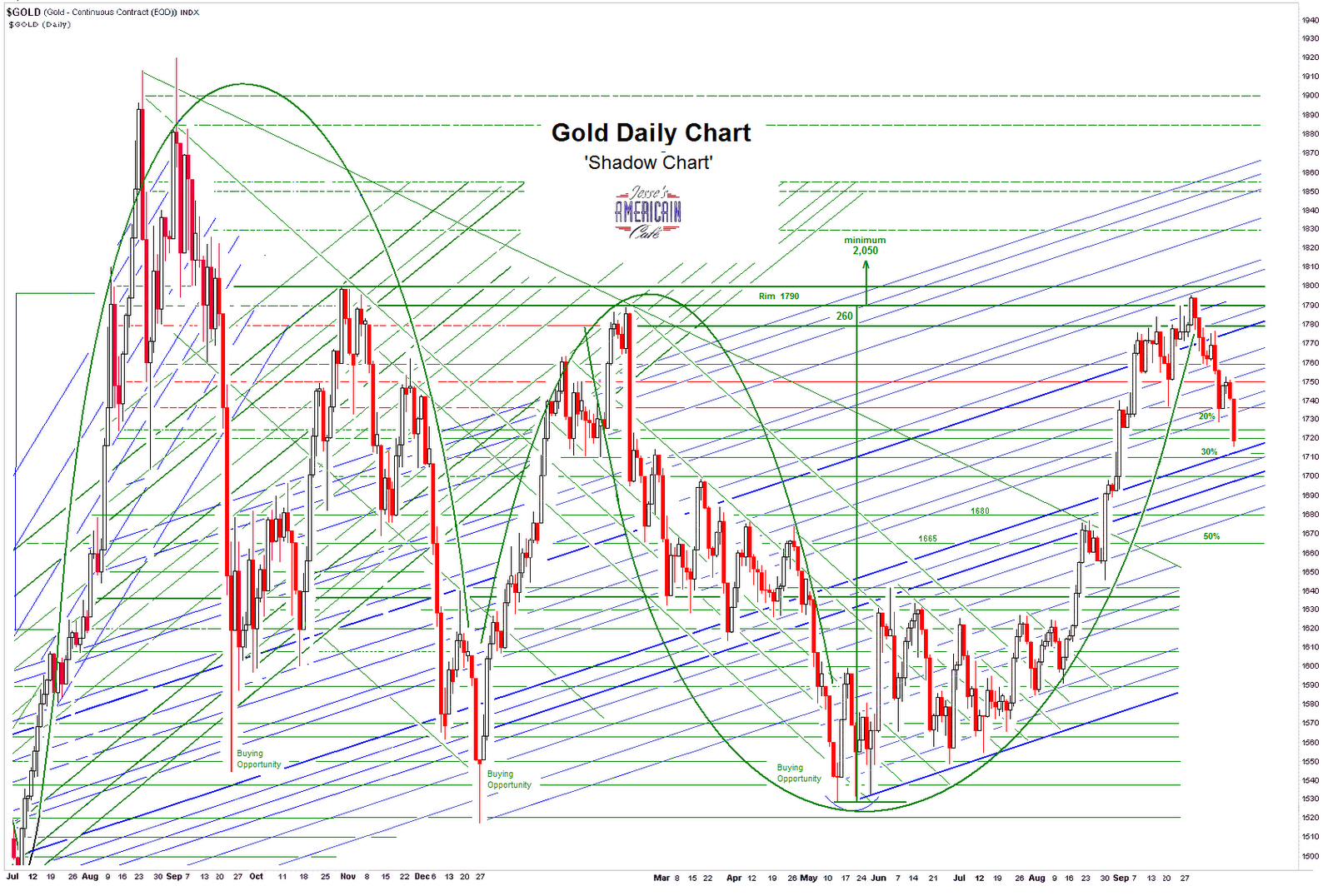
A 30% correction would be reached at roughly 1710. A handle correction in a cup and handle formation is generally 20% to 30$, measured against the rally from bottom to rim. These measurements are rarely precise, given the fluctuating nature of intraday prices.
The handle ought not to go deeper than a 50% correction, which is around 1665, in order to be properly called a 'handle' on a cup and handle. Intraday moves are not significant.
As an aside, I am also watching the SP 500 December futures which have support between 1415 and 1425 depending on timeframes and measurements. The correlation between the SP and gold is there, probably because of the weighting therein of the financials. Gold likes money printing for bailouts, and unfortunately gold acts as a thermometer for this type of financial engineering, to the dismay of the central bankers engaging in it.
If that 50% correction level in gold is broken successfully then we are looking at a trading range and the 'cup and handle' is not activated. A trading range is likely to be a continuing consolidation unless there is a market liquidation event.
A 'cup and handle' would be a suitable way to end this long consolidation in the gold bull market, which is now more than a year old. But we cannot quibble about timing, since that is something the market will decide, accommodating quite a few macro factors besides the gold market itself.
Lies, Damn Lies, and Modern Financial Speculation
Charts are merely reflective of the underlying reality. They don't "do" anything. They are more in the manner of a symbolic representation of many things, like a good road map. And in this case the road map is subject to short term disruptions designed to confuse and befuddle, as though people were changing street signs and putting up barriers on the road while you were trying to read the maps.
I linked to
Sinclair's piece on Metals Dealers today because it helps one to understand the depth of these markets and the schemes that move them. Sinclair obviously knows what he is talking about. A large firm does not merely make and take a uni-directional market position in gold, rather it is taking more complex positions.
As Jim says they are not straight betting the ups and downs of those markets, but working on spreads and hedges, and their expansion and contraction. This is what gives rise to what I like to call the 'wash and rinse' or 'wax on wax off' technical trade in the market that whipsaws the unidirectional specs.
And even moreso today than days gone by the bigger players are making multiple markets, and trading relationships and spreads amongst those different markets, if they are more than mere day traders and scalpers and pool operators.
Even the system which Jim Sinclair describes is a bit simplified as it must be for his audience, given the activities of the 'quants' and their complex algorithms. The recruitment of mathematicians and physicists and engineers by certain Wall Street firms is still hot and heavy, and particularly Goldman and to a lesser extent JPM.
We're not in Kansas anymore Toto. Fraud has risen to a whole new level, the like of which we have not seen in a long time, and never in this particular set of clothes.
They are not doing this massive investment in complex algorithms and computing power in support of simple schemes, but rather more elaborate and esoteric arrangements. But as John Kenneth Galbraith pointed out some years ago, innovate as they will, the substance of the schemes and often their fraudulent nature is essentially unchanged, and relatively simple at their core once all the baroque accouterments of modernity are stripped away. One bribes and browbeats officials, befuddles the public, distorts the markets, and then cashes in for themselves, at least while the system that feeds them remains standing.
"The man who is admired for the ingenuity of his larceny is almost always rediscovering some earlier form of fraud. The basic forms are all known, have all been practiced."
But they do get quite a bit better at concealing and sustaining those frauds at least at the organizational level. Madoff was a relic, almost atavistic, of days gone by. Modern banks and funds are to Charlie Mitchell's National City Bank and the stock pools of the 1920's what the space shuttle Discovery is to the Ford Tri-motor airplane. They operate on the same basic principals, but the complexity and capability are profoundly different.
Flying devices fly according to certain principles of flight, and fraudulent financiers bully, bribe, steal, and cheat according to certain propensities of human nature.
The trades of today are increasingly complex, as different as calculators and high speed computers. They are designed to capture both long term and short term profits, but in this case 'long term' is probably not more than a calendar quarter at most. The front running of HFT and its defenders are shamelessly abusing the public trust, but this is only one simple example of the use of complex computing.
The complexity is used to invent opportunity and market imbalances, and to hide that activity from the other market players, from regulators, and less so the public who are well behind the curve. And most general economists are well behind them given their backward looking bias, or acting as shills and spokesmodels and consultants if they are specialists in money and finance.
As you know, I am convinced that the system is going to blow up, blow itself up no matter how the Wall Street banks and funds try to assign the blame. How and when is very much an open question.
The solution is what some call
ultra-transparency, and a change in the tax policies that incent speculation with subsidies. And of course effective enforcement of regulations to achieve reform. Regulations do not stop crime; regulators do.
And because of the credibility trap and the corrupting power of money we are not likely to get it until something very bad happens. And perhaps not even then.
The pursuit of the perfect system, whether it be in charts or the COT analysis or any other indicator is useful for making money for those who sell those systems, but really they are just aids in reading the likely tilt of the map, of figuring out where you are at any given point in time.
The bigger issue is the nature of the market and the fundamentals for it in the longer term. Are you in a bull or bear market? What time frames are you pursuing? Unfortunately the markets are now the tail wagging the dog, as we saw in the case of Enron and their manipulation of the energy markets, particular
And as you know, I have said that in this market, given all the front running, gaming, spoofing, and lack of sound regulation a private person has no place in trading for the short term. This is a market dominated by machines, which is too bad, not because the amateur punters cannot make their quick and easy money from it, but because it distorts the real economy, hurting everyone.
We live in a land of lies and the misery they bring because we do not love the truth, more than our own selfish desires. And that is the oldest story of all.