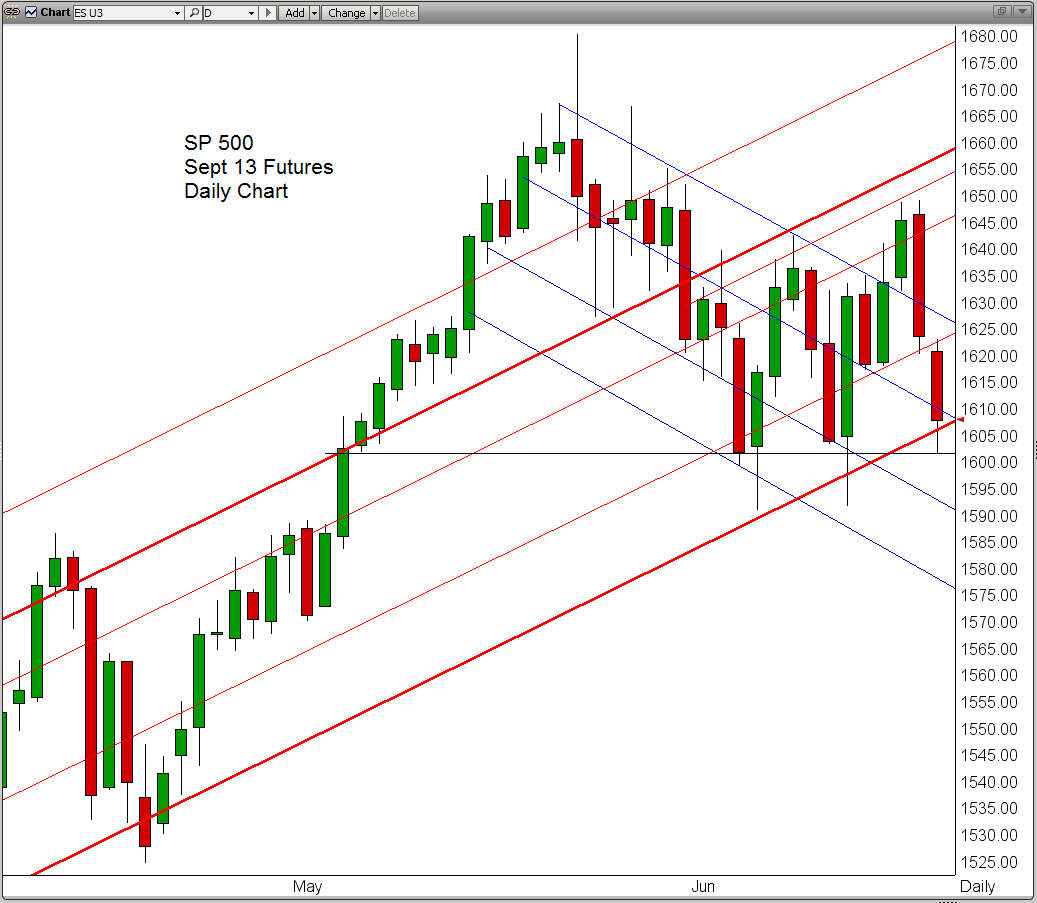
Market is correcting as the hot money takes the public through the rinse cycle.


"Evil when we are in its power is not felt as evil but as a necessity, or even a duty. As soon as we do evil, the evil appears as a sort of duty. Once a certain class of people has been placed by the authorities outside the ranks of those whose life has value, then nothing comes more naturally to men than murder. As soon as men know they that they can kill without fear of punishment or blame, they kill; or at least they encourage killers with approving smiles."
Simone Weil, 1947


The Last Mystery of the Financial Crisis
It's long been suspected that ratings agencies like Moody's and Standard & Poor's helped trigger the meltdown. A new trove of embarrassing documents shows how they did it
by Matt Taibbi
JUNE 19, 2013
What about the ratings agencies?
That's what "they" always say about the financial crisis and the teeming rat's nest of corruption it left behind. Everybody else got plenty of blame: the greed-fattened banks, the sleeping regulators, the unscrupulous mortgage hucksters like spray-tanned Countrywide ex-CEO Angelo Mozilo.
But what about the ratings agencies? Isn't it true that almost none of the fraud that's swallowed Wall Street in the past decade could have taken place without companies like Moody's and Standard & Poor's rubber-stamping it? Aren't they guilty, too?
Man, are they ever. And a lot more than even the least generous of us suspected.
Thanks to a mountain of evidence gathered for a pair of major lawsuits, documents that for the most part have never been seen by the general public, we now know that the nation's two top ratings companies, Moody's and S&P, have for many years been shameless tools for the banks, willing to give just about anything a high rating in exchange for cash.
In incriminating e-mail after incriminating e-mail, executives and analysts from these companies are caught admitting their entire business model is crooked.
"Lord help our fucking scam . . . this has to be the stupidest place I have worked at," writes one Standard & Poor's executive. "As you know, I had difficulties explaining 'HOW' we got to those numbers since there is no science behind it," confesses a high-ranking S&P analyst. "If we are just going to make it up in order to rate deals, then quants [quantitative analysts] are of precious little value," complains another senior S&P man. "Let's hope we are all wealthy and retired by the time this house of card[s] falters," ruminates one more.
Ratings agencies are the glue that ostensibly holds the entire financial industry together. These gigantic companies – also known as Nationally Recognized Statistical Rating Organizations, or NRSROs – have teams of examiners who analyze companies, cities, towns, countries, mortgage borrowers, anybody or anything that takes on debt or creates an investment vehicle.
Their primary function is to help define what's safe to buy, and what isn't. A triple-A rating is to the financial world what the USDA seal of approval is to a meat-eater, or virginity is to a Catholic. It's supposed to be sacrosanct, inviolable: According to Moody's own reports, AAA investments "should survive the equivalent of the U.S. Great Depression."
It's not a stretch to say the whole financial industry revolves around the compass point of the absolutely safe AAA rating. But the financial crisis happened because AAA ratings stopped being something that had to be earned and turned into something that could be paid for.
That this happened is even more amazing because these companies naturally have powerful leverage over their clients, as they are part of a quasi-protected industry that enjoys massive de facto state subsidies. Largely that's because government agencies like the Securities and Exchange Commission often force private companies to fulfill regulatory requirements by retaining or keeping in reserve certain fixed quantities of assets – bonds, securities, whatever – that have been rated highly by a "Nationally Recognized" ratings agency, like the "Big Three" of Moody's, S&P and Fitch. So while they're not quite part of the official regulatory infrastructure, they might as well be...
Read the rest of this article here.