10 May 2012

Michael Hudson and Pierre Rinfret: The Myth of Alan Greenspan


Although he is now passed away, and his internet site has been discontinued, economist Pierre Rinfret published some rather pithy descriptions of the people whom he had known during his long career as an economist in the commercial world, and the halls of power of the US government.    I was reminded of that today by the video from Michael Hudson which is included at the bottom.

Pierre Rinfret was a very good economist with a long and successful career, but made a fairly awful politician to say the least.  That is to say, he was not a politician at all, and why he ever let them talk him into his one fateful run at it is still a bit of a mystery to me.

He was famous for telling the economic truth, even when those in power did not want to hear it.  And he was outspoken, too much so for the pampered princes of politics and the media.   He himself was often naive I think, in believing that the truth would prevail even among those who were determined not to see it because it conflicted with their interests, and that those to whom he had been loyal would repay him in kind.  He was 'set up' to take a loss in his run for governor of NY.   But that was just politics and he had made quite a few enemies, especially amongst the emerging neo-conservatives who took control of his beloved Republican Party. 

I had the opportunity to discuss quite a few things with him before he died, and I found that his information often tracked with things that I knew. We differed greatly on some subjects, especially when it came to certain loyalties he held to faithfully, and on the role of the US dollar as reserve currency going forward. But I welcomed his perspective given the differences in our age and his direct experience with so many of the famous and with the Great Depression. He was an intelligent and often passionate man with a good heart.  I was sorry to see him go, and I remember him in my prayers, as I will remember you.

Here is his stated reason for producing his site.
"I have come to realize that the vast majority of decent, wonderful people, have no idea how they are being hoodwinked day in and day out by the scum of this world. We are lied to, misled, bamboozled, suckered, cheated, misrepresented, conned, manipulated and royally screwed!

They take us to the cleaners day in and day out in every way possible. We, the people, pay the price of their cheating, their folly, their lying and their sheer stupidity."

Although he discussed a wide range of subjects on his website, and had a wonderful section on the Great Depression, what had made it controversial was a set of memoirs called 'People I Knew' that remains only in the internet archives now.  We have to keep in mind that what he says are one man's opinions, and everyone is subjective whether they realize it or not, especially in their opinions of other people.  So I try to concentrate on the facts in what people say, and take the opinions with a grain of salt.

His description of Alan Greenspan was very similar to the description provided here by Michael Hudson in the video interview below.

Here is what Pierre had to say about his impressions of Alan Greenspan:
"I first met Alan Greenspan in 1948 when we both attended the New York University School of Commerce, Accounts and Finance. At that time I was the senior fellow in the Economics Department. The run in was a forerunner of his behavior throughout his entire life. But I am not going to bore you with the gruesome details.I have, therefore, known Dr. Greenspan for more than 50 years and I must say that he has always underwhelmed me! I was in the class of NYU before him and our paths crossed innumerable times in our professional careers.

I debated him on many an occasion, we shared many speaking platforms together, we both worked for Richard Nixon in the 1968 and 1972 campaigns as well as in between , we both graduated from NYU undergraduate school and Graduate School and we both ran our own economic and financial consulting businesses. In addition we played golf together more than once with mutual friends.

One of the absolute lies about him is that he retired from his consulting business a wealthy man. Absolutely and totally untrue. When he closed down his economic consulting business to go on the Board of the Federal Reserve he did so because he had no clients left and the business was going under.We even went so far as to try and hire some of his former employees only to find out he had none for the 6 months prior to his closing. When he closed down he did not have a single client left on a retainer basis. His only source of income was his speech making. As a speaker he had to be the ultimate bore exceeded only by Paul McCracken about who Richard Nixon told me on many an occasion "When he talks MEDGO" meaning "my eyes doth glaze over".

He had a horrible record on forecasting the American economy.  He missed calling, in advance, every single recession in the entire postwar period with only one exception. He neither called recessions nor expansions for the very simple reason that he has never been one to stick his neck out. In American industry they don't pay consultants for Pablum or for saying what everybody else does! And that is what he has always served up:  Pablum...

The driving force that may push Greenspan more than anyone or himself realizes is that he graduated from the "Bronx High School of Science" and that his peers included one Henry Kissinger and other famous (infamous?) politicians of about his age. A classmate of his once said to me that Alan had to prove to them that he was as smart as they were...

I once called him a political hack in a speech before the Chamber of Commerce in Chicago and I did not retract that statement then or now."

The problem is not that Alan Greenspan himself may have been 'a hack' who was willing to say and do whatever power politics required.   There is certainly evidence that he was surrounded by secrecy, and a bit of mythology regarding his infallible judgement that was promoted at the time by the popular press.

The real problem is that being a hack has become fashionable, almost de rigueur, and public policy decisions are being regularly distorted by hacks, economic and otherwise, who are willing to say and do almost anything to curry favor from power, but often dress those political opinions up as science.

 And they are defended by other economists and media people  and talking heads who also seek to curry favor from power, in a pyramid of intellectual corruption.    I have seen this contagion destroy very large companies, and apparently that works for countries as well.

This is of course nothing new.  I have previously written about the book and testimony of A. Newton Plummer, a Wall Street 'public relations man,' who had testified to Congress, most effectively with a suitcase full of cancelled checks in hand, about the widespread payoffs to almost every financial pundit on the Street, that helped to fuel the rampant fraud that led to the Great Crash of 1929.
 
Financial collapses that are not due to natural disasters or war are always founded in fraud.  And if you dig a bit, you will find that there are individuals behind it.  It is not some random madness, but a weakness of character, a perennial gullibility, a feeling that 'everyone is doing it,'  that seems to be exploited periodically by heartless individuals.

Pierre was of the opinion that not everyone is bad, and he was no misanthrope as you can tell from his first quotation above.   But there is always a small number of people who will say or do almost anything to get ahead, and who will obsessively seek money and power. 

In certain periods of history they seem to become more socially acceptable, and less furtive.  And by example and influence they can corrupt the weak, who are many.   I had come to a similar conclusion based on personal observation, and the theory of the white collar sociopath as a foil to the romantic notion of the efficient markets hypothesis and the natural goodness of markets.  To assume that people are perfectly rational and self-effacing actors, like angels, is a dangerous folly.

People are corruptible, some more readily than others, and there are those who are a bad sort, a bad seed if you will, who will corrupt them if the system and the people do not actively oppose it.  It seems fairly simple and common sense when said that way, but if you apply it to certain financial systems and their underlying assumptions, you see their weaknesses exposed.  
 
Corruption hides, and so you look for those who operate in the dark.  When things seem to come mysteriously rushed out of nowhere with little factual basis behind them, and don't make sense, then they probably don't.  This holds true for the Iraq war, and the bank bailouts, MF Global, and the financial and commodity market scandals that are yet to be revealed. 

These are dangerous times of course, because when a people, a nation, have bought into a lie, occasionally they decide that they have gone too far to return, and follow their deceits, straight into a living hell. This is how even an educated and civilized people can, on the whole, gradually become torturers and monsters, often without even realizing it.
"Those who can make you believe absurdities, can make you commit atrocities."

Voltaire
So we see times when corruption seems more prevalent than others.  I think we are in such a time now, as a legacy of the embracing of the 'greed is good' mentality in the 1980's.  Where it will take us, who can say.   But it seems fairly clear that the economic system can only be restored to some working order through reform, transparency, and accountability.

Michael Hudson: Firing Alan Greenspan


By the way, before you write me about it, I do not agree with Michael Hudson on Social Security, and his aversion to taking out money as 'pre-savings.' I think the fact that it is pre-paid insurance, rather than a pure social spending program, without means testing, is one of its enduring strengths. Its greatest single problem is that the deduction cap has not kept pace with inflation. And I think Obama is willfully undermining it with these payroll tax cuts, but that is a matter for another day. But I do find those who promote canards about those bonds in the Trust that seek to justify a 'selective default' in Social Security to be contemptible. If those bonds are no good, then no US bonds are good, and it is time to restructure, revalue, and reissue the currency. And issue plenty of indictments. Therein lies the credibility trap.

09 May 2012

Accumulation/Distribution Trends in Gold and Silver - Building the V Bottom


The accumulation trends seem rather steady despite the recent volatility in price and protracted sawtooth downtrend.

I have included GLD and SLV in case the futures calculations had induced some distortions.

On the last chart I include the Chalkin Money Flows for GLD which are remarkably positive except for the year end selling we saw at the end of 2011.

Someone had mentioned this phenomenon to me earlier today, but I did not think about it until I read Harvey Organ's futures analysis in which he noted his surprise that in the recent price smackdown's the Open Interest of gold and silver were steady or even went UP.

That seems to imply short selling into demand, rather than long liquidation as the cause of the price declines.   From this evening's commentary by Harvey:

"The total gold comex open interest baffled everyone as instead of falling badly surprisingly it rose by 3906 contracts. The raid orchestrated by the bankers somehow did not cause any gold leaves to fall from the gold tree. The May delivery month surprisingly saw its OI rise from 64 contracts to 173. How on earth will the regulators explain this as we witnessed no liquidation of metal of any kind in a huge price downfall and yet more stood for delivery?

...The total OI for silver was even more baffling to our bankers. With silver falling on its sword to finish in the low 29's one would have thought that many silver longs would throw in the towel. Nope!! The total OI actually rose by 1410 contractions from 112,139 to 113,549. Both Ted Butler and I agree that some strong entity is after physical silver. There is no other explanation for this. The front delivery month of May also shocked our bankers. The OI actually rose by 3 contracts (from 406 to 409 contracts) despite the huge downfall in the silver price.  Nobody liquidated. I wish the regulators can explain this phenomena to us."


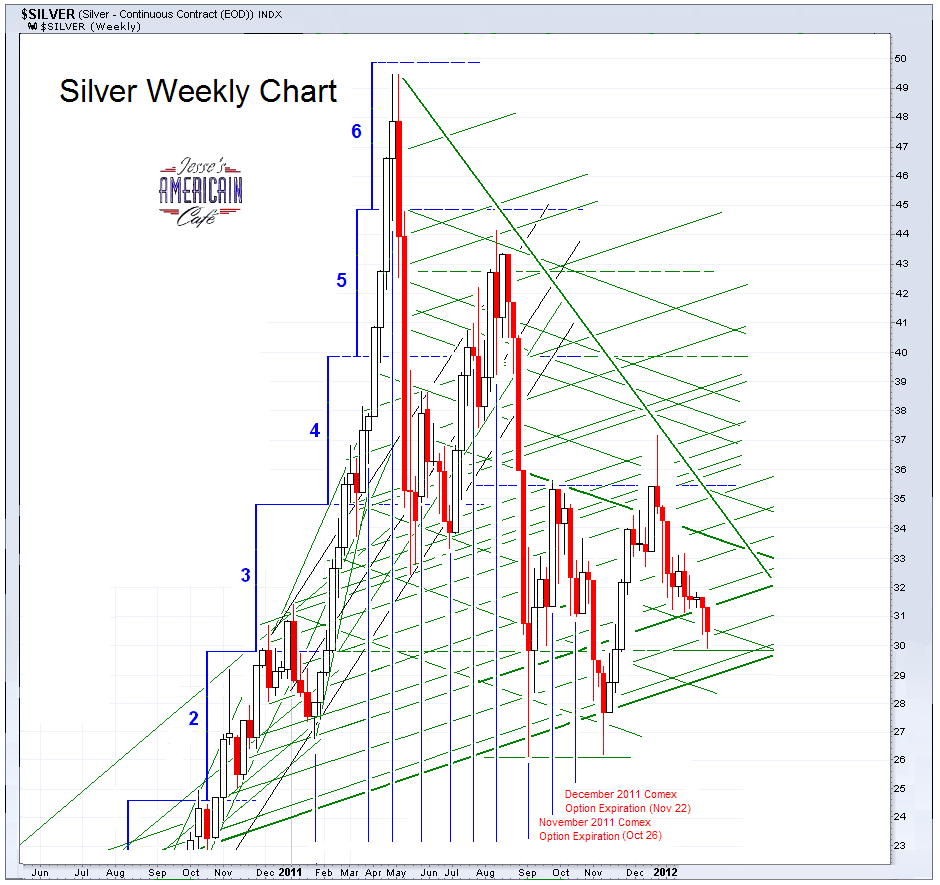
Gold Daily and Silver Weekly Charts


The miners showed a positive divergence today.

If gold is going to set up an inverse H&S bottom it must hold support at 1570 although 1580 is preferable. Otherwise we will be looking for a double bottom.

Intraday commentary here.


SP 500 and NDX Futures Daily Charts


The momentum trade has fallen into an easy pattern of lower futures prices overnight, and then an intraday rally starting around the European close.

To say that I do not trust this market is an understatement. It is running on liquidity and waiting for another fix from the Fed or the ECB.


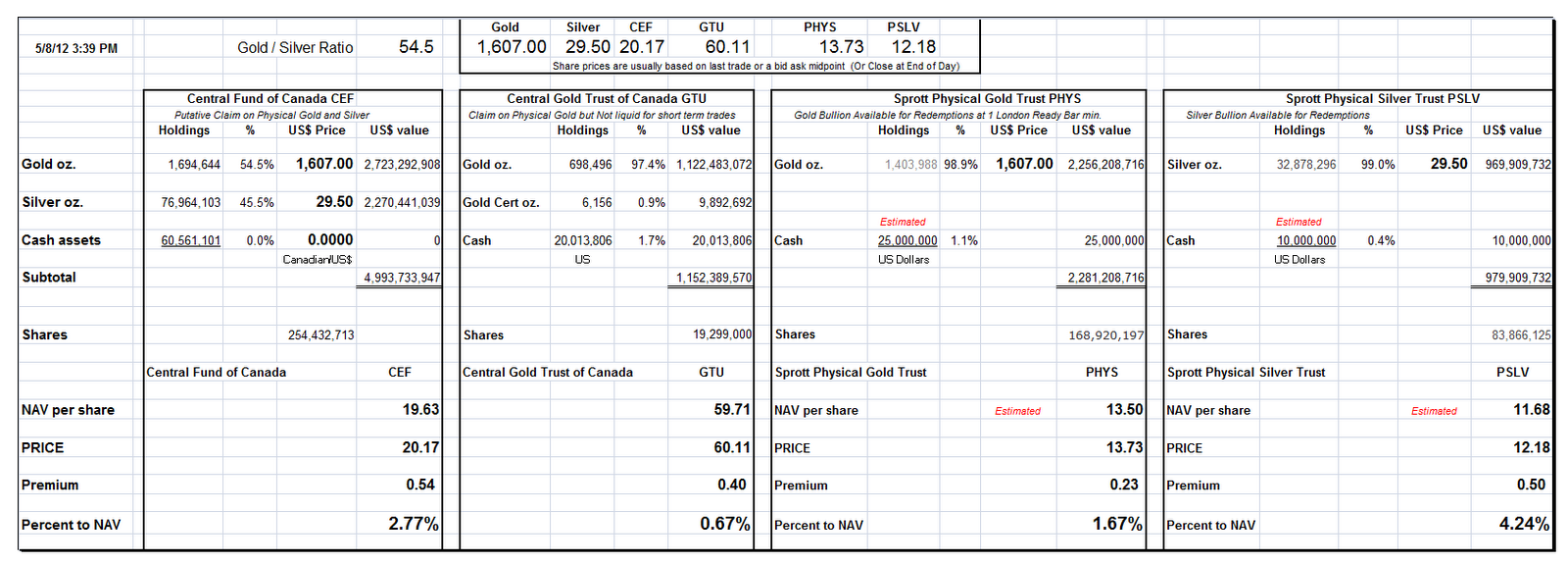
Net Asset Value Premiums of Certain Precious Metal Trusts and Funds - Miners Rally


I see you stand like greyhounds in the slips,
Straining upon the start. The game's afoot:
Follow your spirit, and upon this charge
Cry 'God for Harry, England, and Saint George!'

Henry V, Act 3, Sc. 1

If only investing were so dramatic, and the signals so clear, as they are to insiders by privilege, and foolhardy amateurs by the dawdling nature of their inevitable insolvency.

Those of us who place our pants on one leg at a time build positions steadily, buying on weakness, and holding those positions while the fundamental trend is intact, perhaps trimming a little here and there on excessive movements in price.

If you have not noticed, the better quality miners are running counter-trend to bullion and the equity indices today.

I am still running short broad equity indices and long gold bullion. I have added more to bullion here. I am sidelined for the short term on silver.   Of course it would be nice to have a dramatic capitulative buying opportunity as we have seen a few times recently in the past, but those are only clear in hindsight, even to a seasoned trader.

Those who lose their positions entirely in the bull market have a terrible time buying back in, because they want all in at once, and at the lowest price.  They are victims to their pride, for they are not disciplined, trading not only for profit but bragging rights, in service to a hard mistress, their own ego.

And so they miss opportunity after opportunity and turn sour, wishing more to join them in their regrets.  I hear from them at times like this, and they are my best indicator that things are near to turning.  

If you buy, then buy slowly and not for a trade but to build a position you can hold while the long term trend is in your favor. 
Of course anything can happen, but the most real risk is a general liquidity panic in the manner of 2008. And as then, it would likely represent a spectacular long term buying opportunity.   But timing such a thing is the very devil itself, and often a snare of pride. 

I think the Fed and the central banks were caught by surprise in 2008. So they have no excuses for inaction this time around. But there is a strong element in the financial community that would like to buy real assets on the cheap with overvalued paper.

Otherwise the speculation has been largely 'squeezed out' of the precious metals judging by these premiums.

Still, they could go lower. We need to see the price find chart support. I will not take my hedges off again until I am sure that the price trend has changed.

And I cannot caution enough when I say that these markets are distorted by easy money and tainted by fraud, and cyncially played moreso than I have seen in many years. Such are the times in which we live.

I suspect that quite a few more entities will be taking physical delivery at these prices and that will pressure supply. That is the downside of price manipulation and why it inevitably collapses against the primary trend. 


The Question Is 'How Best To Default' and Not 'How Best to Maintain the Unsustainable'


"The issue which has swept down the centuries and which will have to be fought sooner or later is the people versus the banks."

John Dalberg Lord Acton

Greece is the most awkward of the EU countries by far in terms of economic fit.

There is no conceivable way that Greece can remain in a single currency union without regular transfer payments from the rest of the EU to compensate them for holding a highly overvalued currency relative to their own economy, geared more to the Germans and the French.

The problem is that the political structure of the EU does not accommodate this sort of adjustment, and within the current political character of the EU the notion of such payments is abhorrent.  The Germans, for example, have never thought of themselves as 'fellow Europeans' with a country such as Greece, and the economic structure of Europe does not easily lend itself to de facto payments.

Compare this to the US, with Greece as one of the poorer states, which receives much more in tax receipts and federal projects than the tax revenue that they send in.

It 'works' in the US because it is one nation by structure and by character. Despite their regional differences, most Americans can comfortably think of themselves as 'Americans' first wherever they might live. Unless they are urban cowboys from Texas perhaps (lol).

Every time I look at the structure of the EU politically and economically with the one currency I ask myself, "What were they thinking?"  There is no way to go by halves with a single currency and no accompanying political union. 

But this is the sort of building by half measures to which Europe has often been susceptible.  Bureaucrats love compromise, often blinded to how weak and unsustainable that compromise might be. Any deal is not always better than 'no deal,' except to the dealmakers.

So either the EU will change politically, which is highly unlikely, or Greece will leave the EU and once again obtain its own currency.

I think that outcome is almost predetermined. Now it is only a question of 'how' and mostly with regard to the possibilities of cross-contamination in the financial realm.

The best solution is for Greece to simply leave the EU, default on its debts, nationalize its banks, and restore the drachma at some highly devalued level. I think Iceland shows the way in this. This will greatly disappoint the private financiers who are licking their lips at the prospect of buying real national assets on the cheap with overvalued paper.

The worst problems will be for the European banks who hold Greek debt.

I would consider seriously an action that allows the banks to simply write off the Greek debt, and declare all CDS on Greek sovereigns null and void except for those who actually hold Greek bonds, to the extent of fifty percent of their nominal value.

If this is not workable, I would suggest that Europe also should nationalize and restructure their banks. This is what ought to have been done in 2008, and much of what has been done since then is waste. The greatest resistance to this will come from the one-worlders and their friends in the Anglo-American financial cartel. They would also like a single world currency, which is unworkable without government by a 'new world order.'

The absolute worst model is the American way, in which the banks are given the keys to the Treasury, the markets, and the political process, and allowed to do as they please, while maintaining a thin facade of legitimate government by the people.

They may as well get this done, and stop the charade. And then the rest of the world can begin thinking of how they might reform international trade, replace the existing reserve currency system, and bring the Anglo-American privateers back under control once again.

08 May 2012

Gold Daily and Silver Weekly Chart - World Markets Decouple from US Prices in Oil


With regard to gold and silver, the premiums on the trusts and funds, which I put out earlier today, smell more like capitulation and a forming bottom than anything else. That is, unless the markets in general 'fall out of bed' as they did in 2008 in a panic selloff seeking liquidity.

Below is an interview which Max Keiser has with Leah McGrath Goodman about the speculation in the oil markets.  Goodman is the author of a recent book, The Asylum: The Renegades Who Hijacked the World's Oil Markets."

One of the more interesting facts to come out is that producers became so disenchanted with the wild speculative swings in the US oil markets, affectionately known by trader as 'The Asylum, due largely to paper speculation, that key producers rejected it for other non-US benchmarks.

I suspect strongly that other commodity markets will follow, and the US will lose its role as the world's price setting leader in many markets because of its tolerance for fraud and manipulation.


Source: Max Keiser

SP 500 and NDX Futures Daily Charts - VIX


With earnings season almost over, jitters about Europe bit more deeply.

Key SP futures support is at 1345 with 1350 providing a potential rallying point. Below that is 1330, 1315, and 1300.

While VIX remains elevated it did not expand dramatically today which is a bit of a divergence for the short term, and helped to prompt the short covering rally into the close.


Net Asset Value Premiums Of Certain Precious Metal Trusts and Funds


Unless stock prices sell off further these premiums on the metals are more indicative of a bottom formation than anything else.

But that is a big 'if' given the risk aversion sparked by the disorder in Europe.

For long term investors, this is relatively meaningless, a great deal of noise.

Someone asked me today what will break these paper games. I do not know, but in the short term the markets are very much at the mercy of the big trading desks, given the wild, loosely regulated nature of the US markets.

I am including an interview with the Gold and Silver Daily charts tonight that suggests that the wild speculation in West Texas Intermediate crude futures markets caused the large world producers to decouple from its price, and to migrate instead to other vehicles like Brent.

I will not be surprised to see New York and London lose the same status in the metals if this nonsense continues.


Austerity During a Recession Is Economically Insane - A Warning From History


"The German’s and the ECB are not demanding any sacrifices from European elites. They explicitly target the working class and government workers’ wages and oppose any increased taxation of the wealthy. The Berlin Consensus is a road map to ever greater inequality."

Bill Black


"Thank God the US opted for bailouts and not handouts...People in economic distress should suck it up and cope."

Charlie Munger

I will not mince words with this. I see a world on the brink of war, for all the same old reasons. It will take many forms political and financial, at first civil and then regional. If this does not resolve the situation then the conflict will expand and continue by other means.

The elites' price for peace will be a world without borders, or at most three or four spheres of influence, under their direct control and planning.

Appeasement will only serve to inflame their lust for power and dreams of domination.  They see themselves as moving from victory to victory. The tide of reform is being turned aside by special interests, compromise is viewed as ideological impurity, and legitimate protests are met by not by recognition and justice but by indifference and repression. This will not stand.

"The technetronic era involves the gradual appearance of a more controlled society. Such a society would be dominated by an elite, unrestrained by traditional values. Soon it will be possible to assert almost continuous surveillance over every citizen and maintain up-to-date complete files containing even the most personal information about the citizen. These files will be subject to instantaneous retrieval by the authorities...

In the technotronic society the trend would seem to be towards the aggregation of the individual support of millions of uncoordinated citizens, easily within the reach of magnetic and attractive personalities effectively exploiting the latest communications techniques to manipulate emotions and control reason."

Zbigniew Brzezinski, Between Two Ages: America's Role in the Technotronic Era, 1970

In fairness to Brzezinski, the above quotes in context seem more a forecast, and a threat to be feared rather than a prescription to be followed. 

But others do not fear it, and the threats are real, and with much precedent in history.  They have been viewed favorably by any number of groups where the elite get together to discuss their plans and goals.  Their contempt and distrust of the individual, inferior beings unlike themselves at least in their own minds, is perennial.   The infamous Project for the New American Century that was a center for neo-conservative thinking is just one such example.

Stimulus without significant economic reform leads only to bubbles and more of the same conditions that led to the financial crisis in the first place. The answer is growth, but growth that is real and more broadly based.

The greatest impediment to this solution is greed and financial corruption of the financial predator class that has benefited the most from the distortions that they promoted in the last three decades.

Austerity *might* have a chance if it was accompanied by significant financial reform that did not rely on highly regressive wage reductions to bridge the economic gaps. But it is not likely.   

Without reform, austerity is economic tyranny, a form of neo-colonialism that has been promoted until recently by the developed nations on the Third World, which itself is beginning to rebel against the viceroys and puppets of the powerful.   But now it has come home to feed on its own, and the faithful middle class stands aghast, in quiet disbelief.

The propagandists like to frame the question as 'who will pay,' rather than 'how do we stop the stealing, corruption and waste, and resume healthy growth in the real economy?  So as they often do, they entice the professional and middle class to back their plans from fear, until it is too late.
"...propaganda is entirely founded on the exploitation of the weakness of the human heart. It does not address itself to the strong or the heroic. It tells the rich they are going to lose their money. It tells the worker this is a rich man's war. It tells the intellectual and the artist that all he cherished is being destroyed by war. It tells the lover of good things that soon he would have none of them. It says to the Christian believer: 'How can you accept this massacre?' It tells the adventurer - 'a man like you should profit by the misfortunes of your country.'"

Edouard Daladier, 29 January 1940, radio address to the French people

Will the people never learn? Will their leaders set Europe on fire again before they come to their senses and have to be put down?  And how soon afterwards will the UK and the US have their own moments of crisis?

Although we have been fortunately insulated from this in the developed nations in this generation, it is the oldest theme of history, and one to which we seem determined to return.  And despite the delusions of many, there are never any real winners, only heartache and destruction.
"...Overall, European nations showed significant budgetary restraints in the decade leading up to the Great Recession. Most of the periphery did so – Greece is a special case. The Cato Institute, for example, praised Iceland and Ireland as models of restraint. Spain also received praise. The claim that the periphery was “profligate” through large budgetary deficits in the run up to the crisis reverses the facts.

Austerity during a serious recession is economically insane. It is a pro-cyclical policy that makes the recession more severe. A more severe recession is a mass destroyer of wealth and quality of life. It is pure waste.

It is the primary cause of dramatic increases in public deficits and debt. Unemployment reduces tax payments and increases demands for public spending. One cannot decide to end a budgetary deficit during a recession by adopting austerity. Austerity (some combination of cutting government spending and increasing taxes) reduces private and public sector demand.

This means that imposing austerity is likely to deepen the recession and can make the national deficit and debt larger. It is analogous to the medical insanity of bleeding patients to cure them of disease – and then bleeding them more because the prior bleeding make them sicker.

Europeans of the periphery are having austerity imposed on them by German demands – and they are subjected to repeated insults from German and Dutch leaders for failing to balance their budgets because the austerity imposed by Germany deepened their recession and slashed their tax revenues.

Germany’s demands for austerity have thrown the euro zone back into recession – but it has forced the periphery into Great Depression levels of unemployment. German-imposed austerity, the Berlin Consensus, is even more draconian than the Washington Consensus in Latin America. Germany and the ECB are open that they are not simply demanding austerity and massive privatization – they are also demanding dramatic reductions in working class wages throughout the EU.

The German’s and the ECB are not demanding any sacrifices from European elites. They explicitly target the working class and government workers’ wages and oppose any increased taxation of the wealthy. The Berlin Consensus is a road map to ever greater inequality..."

Read the rest here.

The Berlin Consensus is a road map to civil unrest and war.  It is a war which the powerful few think that they can win, and in their arrogant pride they may be willing to attempt it --- again.  The same industrial and financial interest intend to try and tame the madness once again to serve their self-serving ends, no matter which way in which they try to rationalize it.

But they forget that the madness serves none, only itself.

May God have mercy on us.

Les Rapports de Force Entre Nicolas Sarkozy et François Hollande


Although the recent Presidential election results were close, there was in fact a more clear division of support geographically.


Link to original here.

07 May 2012

Gold Daily and Silver Weekly Charts - Psycho Killers Qu'est-ce Que C'est?"


"Hi. I've got a tape I want to play."

David Byrne, Talking Heads

I think today was a number 36.

Do you think they could just eliminate the traders and exchanges and run the whole US futures complex with CGI from J. P. Morgan's servers?

Hi, this is Virtual Maria from the massively multiplayer NYSE...

Just take Charlie Munger's advice and put your life savings into the equity markets slot machine. But no whining when they take all your money through the mispricing of risk and fraud.
"Charles Munger, the billionaire vice chairman of Berkshire Hathaway Inc., defended the U.S. financial-company rescues of 2008 and told students that people in economic distress should 'suck it in and cope.'"

Bloomberg, Sept 20, 2010
Unless of course you are a member of one of the mongrel races, and then you do something uncivilized and buy gold.


SP 500 and NDX Futures Daily Charts - Something Is Not Right With The US Markets


"The markets are broken, and people desperately would like to see them fixed."

Joe Saluzzi

Are we supposed to take this nonsense seriously?

Oh yes, I want to put my life's wealth into something that has less integrity than carnival toss or a floating crap game.

Charlie Munger is a such a bloviating wanker.


04 May 2012

Gold Daily and Silver Weekly Charts - Miss in Non-Farm Payrolls - Qu'ils mangent de la brioche


Miserable day for stocks and one of the worst weeks of the year for the major equity indices.

Gold and silver held up fairly well in today's equity sell off.

Happy Cinco de Mayo.

It appears that Charlie Munger believes that the people of India and the Mideast are not civilized.  And God only knows what he might say about the Chinese, including their central bank.  Don't they know they are supposed to hold US dollars, and invest them in treasuries and on Wall Street for safekeeping?.  Charlie Munger on gold

I wonder what kind of low lifes he thinks might be buying silver? If the people are fearful of inflation, let them buy a railroad.

Qu'ils mangent de la brioche.

It's the fraud, Charlie. And powerlessness in the face of official corruption that benefits only a few, such as yourself. When the going gets tough, no one is going to bail them out. And they do not have an army of lawyers and powerful friends to protect their interests.

This is the type of narrow ignorance of the world as it is, and lack of empathy for other people who might not be as fortunate, powerfully connected, and secure, that has always confounded the pampered princes of the Anglo-American cartel.

See you Sunday evening.


SP 500 and NDX Futures Daily Charts


As you have probably heard, the Non-Farm Payrolls report came in quite a bit light at 115,000 against the consensus number of 160,000.

The next move in the equity indices will be rather important.


ETFs Part 2: The Next MF Global or Trigger For a Broader Collapse - But Timing Is Everything


It is the introduction of synthetic derivatives in place of actual holdings, and the abuse of counterparty exposure with one's own organization thereby concentrating risk, that start to make these financial creatures look even more deadly, and more like control frauds, than one might have previously imagined.

I think that when one of these constructions fails, as one must almost surely do, we will then have either an MF Global moment, wherein one institution goes down and quite a few customers find that they are holding worthless paper instead of assets, or even worse, an enmeshed counterparty risk triggers another Lehman-like freeze in the credit markets and, as the dominos fall, a new financial crisis even worse than the last.

The nastier version would almost certainly occur if the failure and subsequent disclosure of fraud occurs in some commodity ETF. Why?

In that instance it is more difficult and much more noticeable, although not impossible, for the Congress and the Fed to throw loads public money, and subvert justice, to make the problem and full disclosure of fraud to go away.

Stocks and bonds are relatively easy to counterfeit; physical commodities take a little more energy, boldness, and imagination, the challenge of the shell game rather than the relatively mechanical process of inflating the world's reserve currency on behalf of financial friends with benefits.

So before you short stocks in your trading account, with abandon and quite possibly into insolvency, keep in mind that the Fed is perfectly capable of fomenting another bubble to save the status quo, as they did in 2002-2007. To underestimate the corruptibility of the Fed and the government in partnership with the banks and their corporations can be a costly lesson indeed.


ETFs – Part 2


So far so vanilla. Now lets look at how, as the ETF market has grown, the clever boys and girls of finance have found ‘innovative’ ways of pumping those ETFs up a bit, just like they did to Securities.
Use of Derivatives in ‘Synthetic’ ETFs

The main innovation in ETFs has been the creation of what are called ‘synthetic’ ETFs which instead of actually buying or even borrowing a basket of shares, use derivatives to track the value of the underlying market without the need to match its composition. Instead the Synthetic ETF enters into an asset swap agreement with a counterparty using an over-the-counter (OTC) Derivative. Before explaining what the heck that means let’s just look at how quickly the Synthetic market has grown.
Synthetic ETFs have grown very rapidly in Europe and in Asia. In Europe Synthetic ETFs are now 45% of the over all ETF market. Synthetics doubled their market share between 08 and 09.

The key to Synthetics is the Counterparty.

What happens is the ETF Sponsor designs the deal, the AP (Apporved Participant. Usually one of the big banks or brokers) buys the basket of assets to make it, but then swaps that basket with the Counterparty for a different basket of assets in a derivative swap deal. However it turns out that rather too often for comfort, not only will the Sponsor and the AP be the same bank, but more often than not it will be the Asset Management branch of the same bank who will be the Swap Counter-party as well. It is quite common for the same bank to play all three roles. So a single bank creates the ETF, appoints itself as AP so it can fund it and then its Asset Management desk becomes the derivative counterparty in order to mutate the whole thing into a synthetic ETF. Think about what this does to the risk. What was market risk, where the risk was spread out across all the different shares, is now a single counterparty risk. The bank has effectively put all the ETF’s risk in one basket – itself.

But even if it is a different bank acting as the derivative counterparty the situation is only very slightly less incestuous because it is nearly always the case that the Sponsor, AP and Counter-party will all be from the same small group of big banks, brokers and Asset Managers. And it is also a statistical fact that all of them will be counterparties with each other many, many times over, via the over $1.2 Quadrillion of other repo, rehypothecation and derivative deals. This, as the Financial Stability Board’s report on instabilities in the ETF market rather laconically puts it,

…may also generate new types of risks, linked to the complexity and relative opacity of the newest breed of ETFs. The impact of such innovations on market liquidity and on financial institutions servicing the management of the fund is not yet fully understood by market participants, especially during episodes of acute market stress.
Not fully understood? I think we may not have understood what such entanglements of reciprocal risk meant before the first period of ‘acute market stress’, but I think now it is nutty to imagine the banks don’t know how risky such risk incest really is. The FSB report itself concludes,
Since the swap counterparty is typically the bank also acting as ETF provider, investors may be exposed if the bank defaults. Therefore, problems at those banks that are most active in swap-based ETFs may constitute a powerful source of contagion and systemic risk.(P.4)
Please step forward Deutsche Bank and Soc Gen!

A “powerful source of contagion and systemic risk”. Sounds really good for you and me. So why are the banks doing it anyway? The official answer is that using Derivatives means the ETF can track the value of the market more closely. Though few have complained that Vanilla ETFs don’t track closely enough. And as the BIS report points out,
…the lower tracking error risk comes at the cost of increased counterparty risk to the swap provider. (P.8)
But this doesn’t answer why a bank would enter into a swap with itself as the counterparty. The whole idea of counterparties, once upon a time, was to hedge some of the risk in the original deal by passing it off to someone else. Using yourself as counterparty keeps the risk in-house. So once again why?
The answer is, according to the BIS report on ETFs,
…that this structure exploits synergies between banks’ collateral management practices and the funding of their warehoused securities. (P.5)
‘Synergies’ sounds like it should be good. Sadly it may not be. As the BIS goes on to explain,
…synergies arise from the market-making activities of investment banking, which usually require maintaining a large inventory of stocks and bonds …. When these stocks and bonds are less liquid, they will have to be funded either in the unsecured markets or in repo markets with deep haircuts. (P.8)
In essence it costs the banks money to have illiquid assets on their books. The repo markets won’t accept them as collateral unless they come with a deep haircut. So the banks can do little with them except sit on them. Basically it costs the bank to have the illiquid, hard to sell or Repo, stocks on its books. But.. .if they happen to have created a handy synthetic ETF, then everything changes because,
For example, there could be incentives to post illiquid securities as collateral assets [in the ETF Swap]…. By posting them as collateral assets to the ETF sponsor in a swap transaction, the investment bank division can effectively fund these assets at zero cost….
Handy isn’t it? Assets they can’t repo without hefty haircuts can be posted as collateral to their own ETF with the approval of the ETF Sponsor of course – who will just happen to be… the same bank – without those pesky, hurtful haircuts. In fact,
The cost savings accruing to the investment banking activities can be directly linked to the quality of the collateral assets transferred to the ETF sponsor.
The worse they are, the more illiquid, the more the bank saves/makes by choosing to put them in an ETF rather than having them loiter on its books.
…the synthetic ETF creation process may be driven by the possibility for the bank to raise funding against an illiquid portfolio that cannot otherwise be financed in the repo market. (FSB report P.4)
This is surely financial innovation at its shining best.

Now of course the banks will say they would never consider slipping some old tat into their ETF under cover of opacity. Except that they did, every one of them, do exactly that when they systematically and grossly lied about every single aspect of hundreds of billions worth of shabby mortgages which they intentionally stuffed into CDOs in order to shaft and rob those they sold them to. This is a matter of public record...."

Read the rest here.

See also Part 1 - ETFs and Derivatives Will Be the Trigger Event For the Next Financial Crisis


"The World Is Deaf" (ou peut-être, 'fou furieux à nouveau' - Jess)


Ritholtz: An Uncompromised View of Contemporary American Politics and Economics


The excerpts from this interview are to the point, and it is a rather sharp point at that.

I somehow missed them the first time around, probably due to a family illness, but someone sent this extended set of excerpts from the two interviews that Jonathan Miller did with Barry Ritholtz.

To say that Barry Ritholtz 'pulls no punches' is like saying that Joe Louis had a nice right cross.

Its a good read for a Non-Farm Payrolls Friday. Forgive me if you have already seen it.

Enjoy.

"I have libertarian friends who are always bitching about government. I always say to them, when a dog bites you in the ass... that's what dogs do - don't blame the dog. Look up the leash and see who is holding the handle. When you look at Congress - Congress is the snapping dog.

But they are somebody's bitch. You have to see who is holding the leash. Very often it is banks and Wall Street and the financial sector having Congress do its bidding. Most of the things that got us into trouble have been done at the bequest of the banks...

I don't want to say Congress are whores, that go to these corporate executives with knee pads and lip-gloss. Congress is corrupt. Politicians in both parties are worthless...They don't even hide how corrupt they are anymore. It just came out that one of the new guys had sent out a note to CFO's asking them what legislation they would like to see changed. They will do anything for any kind of campaign contribution... (Not coincidentally most politicians are also lawyers - Jesse)

To me, if you give up your virtue for money, you are a prostitute. Credit rating agencies are prostitutes...

There is no such thing as rogue traders. There are only rogue banks. If you are that grossly negligent that you have to be rescued by the government, then I guarantee you they are doing lots of other things wrong. If you have an entity that messed up so badly that it can't survive... how are you going to go out and run a marathon? Jamie Dimon is the next CEO who needs a humbling...

Putting Rubin, Summers and Geithner in power was the tragedy of the Obama administration. Obama and Bush were both given an opportunity to be transformational - a Churchill, a Roosevelt. Obama's problem was that he sought out the biggest asshole in America - Robert Rubin... (Note, he later recants and nominates Larry Summers - Jesse)

Greenspan has to go down in history as the worst Fed Chairman... (He has my vote - Jesse)

I look at bankers like 5 year olds - if you give a 5 year old a bowl of chocolate bars and say they can have one... As soon as you leave the room they will eat until they are sick. Bankers are no different. As soon as you say, 'You're a big boy... we trust you not to blow up the economy and send the world to the precipice...' They are so short-term focused, they will do whatever is necessary to get that bonus, and then will let the world go to hell and let it be someone else's problem. (History of the World, Part 3 - Jesse)

The whole run-up from 2003-2007 was make-believe, (Ponzi scheme, control fraud, take your pick - Jesse) based on risk not mattering. If risk doesn't matter, you mash your foot to the carpet and let the speedometer go up to 250. When the driver hits the wall he kills himself. The difference is the driver kills himself, but the bankers take everyone with them."

Jonathan Miller, Interview with Barry Ritholtz

The first decade of this century is founded on official corruption, control frauds, the madness of a people incited by the propaganda of fear and ideology, leverage, and the conscious mispricing of risk.  Everything else is commentary.


Forbes: United States Is a Plutocracy and Academic Economists Are the Vichy


Forbes?!

Interesting piece, but what was most interesting was that it is from Forbes, 'the Capitalist Tool' business magazine, and not Rolling Stone or Mother Jones.

As Bloomberg television, and Mayor Bloomberg's city administration I might add, go full bore plutocrat, Forbes is standing for genuine reform, or at least permitting it to be discussed? As Sheldon Cooper on Big Bang Theory might ask when chili and margaritas are served on pizza night, 'where are we, what is happening?'

The author, Lee Sheppard, is "a contributing editor of Tax Notes, a Washington-based weekly tax journal. Trained as a lawyer, she is a legal commentator on tax questions, and is well known for her trenchant observations. She covers all areas of tax law, including international taxation, corporate taxation, partnership taxation, bankruptcy tax questions, pensions and tax accounting questions."

Economics certainly is, as Jamie Galbraith said, a 'disgraced profession' that is largely in denial, but it has good company in politicians, accountants, big media spokesmodels, business CEOs, bankers, and regulators.

Forbes
Economists' Malign Influence on Taxes
By Lee Sheppard
May 3, 2012

If Occupy Wall Street supporters are looking for new places to protest, they might think about picketing the economics departments of the most prestigious American universities.

Not only would they find a more convivial place to camp than an ugly concrete slab in lower Manhattan, but protesting at universities would serve two purposes.

First, those who are unemployed and burdened with non-dischargeable student debt — which now exceeds U.S. consumer debt —could make a point about the inutility and expense of American higher education.

Second, and more important, protesters could confront another group of elites who are responsible for the financial meltdown and have yet to apologize: the nation’s academic economists.

Free market economic “literature” as economists call it — and their papers frequently are works of fiction — gave succor and intellectual respectability to the decades of deregulation and tax cuts that have bankrupted the country. Congress is compromised, to be sure, but lobbyists and members need economic studies as cover for what they are doing.

The United States is a plutocracy, with an income and wealth distribution that rivals South America’s worst cases, but economists refuse to acknowledge that these outcomes are attributable to ill-advised public policies on taxation, regulation, trade, and education spending over the last several decades.

Economists bleat about “globalization” as though it were inevitable rather than a set of deliberate policy choices. Markets are political creations, so results produced by them are not inviolable or free from question. And they don’t always produce equilibrium...

Read the rest at Forbes.

03 May 2012

Gold Daily and Silver Weekly Charts - Pete 'n' Repeat - Fed Is the 'Vampire Squid of Squids'


A bit much perhaps, ahead of the Non-Farm Payrolls.

Let's see if those are inverse H&S bottoms forming up on the gold and silver charts, or something else.


ADDITIONAL STATEMENT BY BILL MURPHY, CHAIRMAN OF THE GOLD ANTI-TRUST ACTION COMMITTEE

HEARINGS ON THE METALS MARKETS, MARCH 25, 2010


On March 23, 2010 GATA Director Adrian Douglas was contacted by a whistleblower by the name of Andrew Maguire. Mr. Maguire, formerly of Goldman Sachs, is a metals trader in London. He has been told first hand by traders working for JPMorganChase that JPMorganChase manipulates the precious metals markets and they bragged how they make money doing so.

In November 2009 he contacted the CFTC enforcement division to report this criminal activity. He described in detail the way in which JPM signals to the market its intention to take down the precious metals. Traders recognize these signals and make money shorting the metals along side JPM.

He explained how there are routine market manipulations at the time of option expiry, Non-farm payroll data releases, and Comex contract rollover as well as other adhoc events…"


Jim Grant had an interesting interview on Bloomberg television this afternoon.


SP 500 and NDX Futures Daily Charts - Jitters In Front of the Non-Farm Payrolls


The Political Continuum and the Uncomfortable Center


It will be important to keep this model in mind as we go forward.

Turmoil and crisis favor polarization, and fear brings out the extremes of both sides who unfortunately tend to make the most noise, because they are often wrong but rarely in doubt.

It will be hard to maintain a centered approach if you are independent or moderate. The far right will see you as a leftist, and the far left will see you as on the right. This does not say much about you and your thinking, but more about them and their unbalanced approach to the serious problems facing the developed nations.

It is hard to talk reasonably to anyone holding a position that is not held in reason, by its very nature. And so we might find ourselves caught in the middle as it were when the histrionics start in earnest.

Even in matters of faith, there are conflicts with the distortions of the far right, who hold faith as a rationale for their own ends rather than an end in itself. I do not judge, but I can listen. And when someone holds forth about a God without compassion and love, and when they reject His own laws, they declare themselves for what they are, rather than anything about Him.

“Thou shalt love the Lord thy God with all thy heart, and with all thy soul, and with all thy mind. This is the first and great commandment. And the second is like unto it, Thou shalt love thy neighbor as thyself. On these two commandments hang all the Law and the Prophets.”

For a believer in one God, Jew, Moslem, or Christian,  everything else is commentary, a 'how-to' and important for the individual on their particular Way, but tragically far too often a snare and a temptation, a place where people wish to hide, to avoid and resist obeying His righteous commands, and to feed their own passions and desires for power and privilege and place.

As for the irreligious far left, they are simply given in to the opposite pursuit of the will to power and glorification of the State (themselves) over all, in the manner of fascists but with a different name. The only freedom they truly desire is the freedom to dominate and enforce their wills as superior beings. They despise the common people, and that permeates their words.   They view themselves apart, and most often don't want anything to do with them after the initial struggle is done and the people have bled for them.

This is why the so-called neo-conservatives were so easily able to shift from far left to far right. They still view the world in the same distorted ways, but with different labels. As Aristotle might have said, it is all a question of balance.

Neither side wants anything to do with the individual soul and spirit of genuine love. They are 'campaigners' fully engaged in expediency for their cause, and its end is power. This is why a period of reform is so often frought with danger of one extreme or the other.

This is all to say, remember, as uncomfortable as it may seem at times, as each side grows louder and more strident, you are not alone. Our calling is to stay the course, maintain the happy medium, and keep the fires burning, and the children fed and warm.


ETFs and Derivatives Will Be the Next Trigger Event for a Major Financial Crisis


ETFs and derivatives may be fine for a trade or a hedge to a trade, but by no means are most of them that I have looked at worthy of a long term hold.  I distinguish them by their opacity, leverage, and lack of transparent audits from legitimate physical trusts.

And some of the ETFs, especially in commodities and on the short equity side, appear to be almost fraudulent both in construction and representation, and are often more instruments of manipulation and raw speculation for extracting wealth from the less sophisticated than investment vehicles. 

The great story of this financial era is the same of all the control frauds that have preceded it: leverage founded on paper claims, asymmetrical information, and the calculated mispricing of risk.

And when the ETFs fail it will be an echo of the market failure of 1929 when firms like Goldman Sachs enjoyed spectacular growth, promoting investment trusts, that blossomed late in the paper speculation of the 1920's, and became a major source of kindling for the flames.  Enough so that John Kenneth Galbraith devoted a chapter to Goldman and the Trusts in The Great Crash of 1929.

"For a long the the New York Stock Exchange looked with suspicion on the investment trusts; only in 1929 was listing permitted. Even then the Committee on the Stock List required an investment trust to post with the Exchange the book and market value of the securities held at the time of listing and once a year thereafter to provide an inventory of its holdings...

It is difficult not to marvel at the imagination which was implicit in this gargantuan insanity. If there must be madness something may be said for having it on a heroic scale."

John Kenneth Galbraith, 'In Goldman Sachs We Trust,' The Great Crash of 1929

I do not know if we are done with bubbles. We might see another yet again. It almost seems likely given the reckless apathy of the public and the passionate resistance against reform fostered by the powerful few. 

And do not presume that these monied interests will shy away from their possible self-destruction in precipitating another financial crisis and collapse.  They are emboldened by their recent brushes with disaster in the manner of the moral and emotional sickness which they share with psychopaths.  They will not respond to reason, because their motivations are not rational, not based in reason.  Was Madoff rational?  I do not think so.  He was intensely deluded and self-destructive.

Even in the ashes of another Great Depression, the powerful see the opportunity to take command and overturn the democratic republic that so inflames their swollen pride and sparks their fears, that a government of the people, by the people, and for the people has endured despite their best efforts to subvert it for themselves.  As they so proudly imagine, they are not like 'us.'  The greed to keep their ill gotten gains, and the will to power to gain more control over others, their inferiors, knows no bounds.

ETFs – The Next Accident Waiting to Happen?
By Golem XIV
May 3, 2012

Where will the next point of instability be? Not what will trigger the next liquidity and credit crunch and cause the next landslide of panic selling and losses. We can already see many candidates for the trigger. But what will be the mechanism by which it is amplified and spread?

I think that in a couple of years, unless something alters the current trends in money flows, we will come to know ETFs the way we already know the securitization and packaging of sub-prime mortgages into CDOs. I think the signs are already there to suggest ETFs are where the instability and risk is accumulating. If I am in any way correct then ETFs will be to the next stage in our on-going state of siege-mentality crisis what CDOs were to the last...

Read the rest here.

02 May 2012

House May Call For Independent Counsel to Investigate MF Global


It is never the crime, but always the obstruction of justice that does them in. 

Obama may be fortunate.  The House Republicans may make noises about a truly independent investigation, but I doubt that it will happen. 

The credibility trap runs far and wide, and on both sides of the aisle.

Fox
House Republicans Expected to Call for Independent Counsel to Investigate MF Global Failure
By Peter Barnes
May 02, 2012

A Republican member of the House Financial Services Committee is circulating a letter in Congress that calls for the appointment of an independent counsel to investigate the failure of MF Global.

Investigators and a bankruptcy trustee are trying to locate and recover a $1.6 billion shortfall in MF Global customer funds. The firm filed for bankruptcy last October after making risky bets on European debt.

Rep. Michael Grimm (R-NY), a former FBI agent who investigated Wall Street for financial fraud, began circulating the letter today, according to sources familiar with the matter. Other House members, mainly Republicans, are expected to sign on, with formal release of the letter planned for next week when Congress returns from its current recess.
Among other things, sources said, the letter is designed to address allegations of conflict of interest in the ongoing investigations of MF Global, including one by the Commodities Futures Trading Commission.

CFTC chairman Gary Gensler is a former executive of Goldman Sachs where he worked with former MF Global CEO Jon Corzine. Gensler has recused himself from his agency’s probe into MF Global.

Also, President Obama’s re-election campaign disclosed last month that Corzine is a top fundraiser for the President, a so-called “bundler...”

Read the rest here.

Bill Black: Geithner Channels Greenspan and Airbrushes Fraud out of our Crises


Tim Geithner is a creature of the system, and no doubt a part of the problem.  But only a part. He is appointed and serves at the pleasure of the President.

The root of the problem is the pervasive corruption of American politics, intellectual discussion, and public policy by Big Money.   And a culture that tolerates a total lack of shame for the abuse of power and trust in the pursuit of personal power and gain. 

After all, greed is good.  And greed is the will to power.

And some public figures of the last twenty years, both political and financial, have been rather proud of their ability to twist words to dissemble and obfuscate, and mean whatever they wish to promote their agendas.

And the lesser leaders, the CEO's, have no problem taking enormous sums of money for superior performance, but willingly feigning almost complete ignorance of the business which they manage when it suits their purposes. Why not, when those in positions of power set the example.

When there are no significant social penalties, much less serious legal consequences, for deceit and dishonor in positions of trust, when personal integrity is not even considered important compared to wealth and power, when all are compromised so that none need even feel embarrassment, truth has no purchase, and justice is a unloved stepchild.

Geithner Channels Greenspan and Airbrushes Fraud out of our Crises
By Bill Black

On April 25, 2012, Treasury Secretary Geithner made remarkable statements about the role of elite financial fraud and greed in producing our recurrent, intensifying financial crises.

In this first installment I focus on the first of five problems with Geithner’s claims: (1) he does not understand the causes of prior crises, (2) he does not understand the causes of the ongoing crisis, (3) he does not understand that if he were correct about the first two points our nation would be in even greater peril and the urgency of Geithner leading a radical transformation of finance and regulation would be greater still, (4) he is not correct that we are prosecuting the elite criminals who drove the ongoing crisis, and (5) the media continues its nine-year pattern of failing to challenge Geithner’s fictions and his failures to lead the radical transformation that he should be desperately seeking given his stated beliefs about the causes of financial crises.

Here are the specifics of what Geithner said about financial crises, fraud, and greed.

"The wheels of justice are turning now," Geithner said at an event in Portland after touring a factory there. "They are not turning as fast as people would like, but we have the best system in the world for making sure we can enforce the laws of the land," he said.

Geithner suggested that holding people accountable for the wreckage caused by the recent housing collapse and the ensuing financial meltdown was not that simple since most crises were not caused by criminal activity.

"Most financial crises are caused by a mix of stupidity and greed and recklessness and risk-taking and hope," said Geithner, who helped tackle the crisis for the Bush administration when he was the head of the New York Federal Reserve and has been urging Europe to act more aggressively to contain its debt problems.

"You can't legislate away stupidity and risk-taking and greed and recklessness. What you can do is make sure when it happens it does not cause too much damage and to do that you have to make sure you have good rules against fraud and abuse, better protections and you force banks to hold more capital against their risk," he said...

Read the rest at Capitalism Without Failure.