28 May 2012

Highly Resolve That These Dead Shall Not Have Died In Vain


"Change does not roll in on the wheels of inevitability, but comes through continuous struggle. And so we must straighten our backs and work for our freedom. A man can't ride you unless your back is bent."

Martin Luther King, Jr.


Judge of Nations, spare us yet,
Lest we forget—lest we forget.

Rudyard Kipling

Four score and seven years ago our fathers brought forth on this continent, a new nation, conceived in Liberty, and dedicated to the proposition that all men are created equal.

Now we are engaged in a great civil war, testing whether that nation, or any nation so conceived and so dedicated, can long endure. We are met on a great battle-field of that war. We have come to dedicate a portion of that field, as a final resting place for those who here gave their lives that that nation might live. It is altogether fitting and proper that we should do this.

But, in a larger sense, we can not dedicate -- we can not consecrate -- we can not hallow -- this ground. The brave men, living and dead, who struggled here, have consecrated it, far above our poor power to add or detract.

The world will little note, nor long remember what we say here, but it can never forget what they did here. It is for us the living, rather, to be dedicated here to the unfinished work which they who fought here have thus far so nobly advanced.

It is rather for us to be here dedicated to the great task remaining before us -- that from these honored dead we take increased devotion to that cause for which they gave the last full measure of devotion -- that we here highly resolve that these dead shall not have died in vain -- that this nation, under God, shall have a new birth of freedom -- and that government of the people, by the people, for the people, shall not perish from the earth.

In Flanders fields the poppies blow
Between the crosses, row on row
That mark our place; and in the sky
The larks, still bravely singing, fly
Scarce heard amid the guns below.

We are the Dead. Short days ago
We lived, felt dawn, saw sunset glow,
Loved and were loved, and now we lie
In Flanders fields.

Take up our quarrel with the foe:
To you from failing hands we throw
The torch; be yours to hold it high.
If ye break faith with us who die
We shall not sleep, though poppies grow
In Flanders fields.


27 May 2012

Bill Moyers & Company: Reckoning With Torture


"Some may argue that we would be more effective if we sanctioned torture or other expedient methods to obtain information from the enemy. They would be wrong. Beyond the basic fact that such actions are illegal, history shows that they also are frequently neither useful nor necessary."

David H. Petraeus, Commander, U.S. Central Command

“The bottom line is these techniques have hurt our image around the world, the damage they have done to our interests far outweighed whatever benefit they gave us and they are not essential to our national security."

Admiral Dennis C. Blair, Director of National Intelligence

"If it were up to me I would close Guantánamo not tomorrow but this afternoon...Essentially, we have shaken the belief that the world had in America's justice system...and it's causing us far more damage than any good we get from it."

Colin Powell, former U.S. Secretary of State

"I have been hard pressed to find a situation where anybody can tell me that they've ever encountered the ticking-bomb scenario... a show like 24...makes all of us believe that this is real--it's not. Throw that stuff out, it doesn't happen."

Jack Cloonan, FBI special agent from 1977 - 2002

"After years of disclosures by government investigations, media accounts, and reports from human rights organizations, there is no longer any doubt as to whether the current [G.W. Bush] administration has committed war crimes. The only question that remains to be answered is whether those who ordered the use of torture will be held to account."

Major General Antonio M. Taguba, US Army Retired

"I consider the insistence on pressing ahead with cases that would be marginal even if properly prepared to be a severe threat to the reputation of the military justice system and even a fraud on the American people...I lie awake worrying about this every night."

Major Robert Preston, former prosecutor, US military commissions


Source

26 May 2012

Ted Butler Calls Out the CFTC On Silver Market Manipulation


Considering how patient and understated he has been for so long, and so often the voice of reasonableness, this latest piece from Ted Butler is a bit surprising in the directness and strength of his language.

Illegalities
By Ted Butler
May 25, 2012

The Commodity Futures Trading Commission (CFTC) has been negligent in failing to terminate the obvious manipulation ongoing in silver. Furthermore, the agency may be complicit in this manipulation. Worse, it has lied to the public and elected officials. This all goes back to the time when Bear Stearns was taken over by JPMorgan in March of 2008.

It is well known that Bear Stearns went under as a result of a sudden loss of liquidity amidst a run by creditors and customers. What is not well known is that those problems were greatly exacerbated by a $2 billion margin call on silver and gold short positions from the end of December 2007 to March 2008. I believe the silver and gold margin calls were at the heart of Bear Stearns’ failure.

We know now (from CFTC correspondence to lawmakers in 2008) that JPMorgan took over Bear Stearns’ giant silver and gold short positions on the COMEX. Up until that time, we did not know that Bear Stearns was the concentrated silver and gold short. Using Commitment of Traders Report (COT) data, Bear Stearns had a COMEX silver short position of no less than 35,000 net contracts and a COMEX gold short position of no less than 60,000 net contracts from the end of December 2007 to their takeover by JPMorgan two and a half months later. From December 31, 2007 to mid-March 2008, the price of silver rose by $6 (from $15 to $21) and the price of gold rose from $850 to over $1000. Based upon the number of contracts held short by Bear Stearns and the price movement at that time, that resulted in margin calls of $2 billion. I would contend that was the real reason for Bear Stearns’ demise.

So where do I get off claiming that the CFTC is complicit in the silver manipulation and lied about it to the public and to lawmakers? This is easy to prove...

Read the rest here.

25 May 2012

Gold Daily and Silver Weekly Charts - Fed Will Backstop a Run On the Exchange


The situation remains rather volatile and open to an exogenous event.

Gold has not yet broken its downtrend. We do have the option expiration under our belts at least and are entering a heavy delivery season.

I thought it was interesting that the US government has directed the Fed to backstop the Comex and ICE in the case of a liquidity event or a run on the exchange.

In that event be ready to accept a forced settlement in paper, and to possibly forsake any metal held in custody at an exchange depository to a soft confiscation, ie it was not there in the first place and will be lost in a wave of defaults.


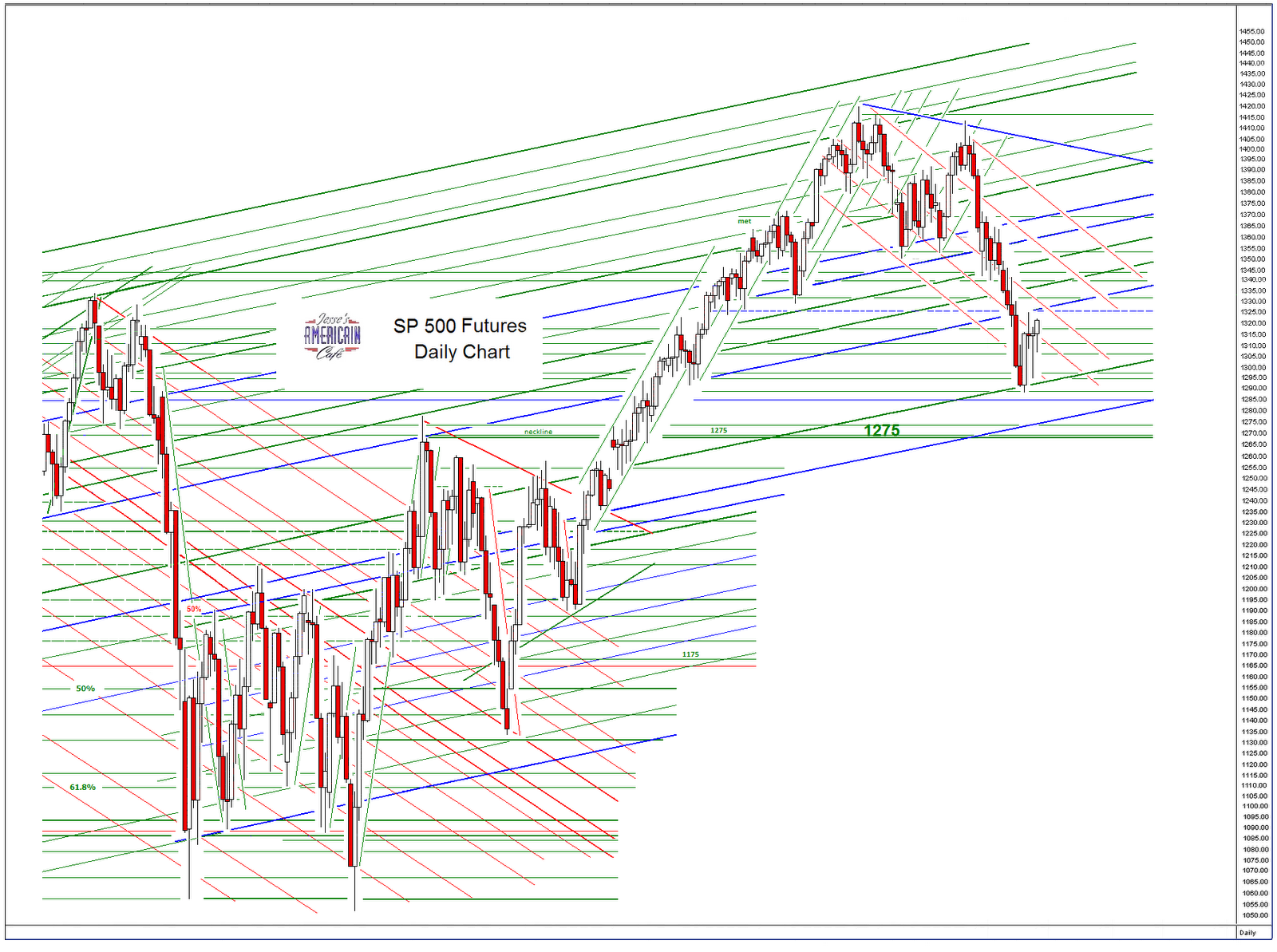
SP 500 and NDX Futures Daily Charts - Tiptoeing Into the Long Holiday Weekend


Concerns about Greece and its potential impact on the global banking system continue to dominate the financial trade.

Some think that there will be some resolution this week because of the US holiday on Monday. That is possible.

If there is a positive resolution the equity markets will rally very hard. On the other hand if Greece withdraws from the euro, and perhaps even the EU altogether, there may be bank runs which the authorities will work very hard to circumvent and ring fence.

Most likely outcome is nothing will happen just yet although one must respect the possibilities for some exogenous event.


Max Keiser Interviews Teri Buhl On JP Morgan's Wells Notice


I found the description of the Wells Notice to be interesting.


Source

Teri Buhl's column discussing this and the implications.

US to Backstop the Anglo-American Derivatives Exchanges with Fed Dollars - 'Too Big To Fail'


It sounds like the principle of keeping AIG whole on its obligations so that it can pay off to the banks at 100 cents on the dollar. This should make Jamie feel a little better about his bad derivatives trades.

And Blythe should rest easy knowing that Benny has her back on those massive metals shorts.

Sounds like they even plan to have the Fed backstop the derivatives trade in London.

Heads the banks win, tails those holding US dollars lose.

How will they support the next bailout? Austerity!

Wall Street Journal
A Mess the 45th President Will Inherit
Thursday, May 24, 2012

Taxpayers Now Stand Behind Derivatives Clearinghouses

...Little noticed is that on Tuesday Team Obama took its first formal steps toward putting taxpayers behind Wall Street derivatives trading -- not behind banks that might make mistakes in derivatives markets, but behind the trading itself. Yes, the same crew that rails against the dangers of derivatives is quietly positioning these financial instruments directly above the taxpayer safety net.

As we noted in May 2010, the authority for this regulatory achievement was inserted into Congress's pending financial reform bill by then-Senator Chris Dodd. Two months later, the legislation was re-named Dodd-Frank and signed into law by Mr. Obama. One part of the law forces much of the derivatives market into clearinghouses that stand behind every trade. Mr. Dodd's pet provision creates a mechanism for bailing out these clearinghouses when they run into trouble.


Specifically, the law authorizes the Federal Reserve to provide "discount and borrowing privileges" to clearinghouses in emergencies. Traditionally the ability to borrow from the Fed's discount window was reserved for banks, but the new law made clear that a clearinghouse receiving assistance was not required to "be or become a bank or bank holding company." To get help, they only needed to be deemed "systemically important" by the new Financial Stability Oversight Council chaired by the Treasury Secretary.

Last year regulators finalized rules for how they would use this new power. On Tuesday, they began using it. The Financial Stability Oversight Council secretly voted to proceed toward inducting several derivatives clearinghouses into the too-big-to-fail club. After further review, regulators will make final designations, probably later this year, and will announce publicly the names of institutions deemed systemically important.

We're told that the clearinghouses of Chicago's CME Group and Atlanta-based Intercontinental Exchange were voted systemic this week, and rumor has it that the council may even designate London-based LCH.Clearnet as critical to the U.S. financial system.

U.S. taxpayers thinking that they couldn't possibly be forced to stand behind overseas derivatives trading will not be comforted by remarks from Commodity Futures Trading Commission Chairman Gary Gensler. On Monday he emphasized his determination to extend Dodd-Frank derivatives regulation to overseas markets when subsidiaries of U.S. firms are involved...

Read the rest here.

JPM Gave Risk Management Oversight To Museum Head Who Sat On AIG's Board


"Financial institutions such as JPMorgan love to buy derivatives because they are opaque, create fictional income that leads to real bonuses, and when, not if, they suffer losses so large that they would cause the bank to fail, they will be bailed out."

William K Black

This is JP Morgan, America's mightiest and unsinkable 'showcase bank,' run by its toughest and craftiest CEO, that holds the counterparty risk on an almost unimaginable $70 TRILLION in derivatives, an amount sufficient to destroy not only their own balance sheet, but probably the entire world's financial system as well, over a weekend.

And Greece is irresponsible.

Are you fucking kidding me?

Sleep well.

Bloomberg
JPMorgan Gave Risk Oversight to Museum Head Who Sat On AIG Board
By Dawn Kopecki and Max Abelson
May 24, 2012

The three directors who oversee risk at JPMorgan Chase & Co. include a museum head who sat on American International Group Inc.’s governance committee in 2008, the grandson of a billionaire, and the chief executive officer of a company that makes flight controls and work boots.

What the risk committee of the biggest U.S. lender lacks, and what the five next largest competitors have, are directors who worked at a bank or as financial risk managers. The only member with any Wall Street experience, James Crown, hasn’t been employed in the industry for more than 25 years...

Read the rest here.

Office of the Comptroller of the Currency 4th Quarter 2011 Derivatives Report

The Pigman's Motto:

If you make people frightened enough, they will give you anything.

24 May 2012

No Justice: SEC Probes Lehman For Three Years, Recommends Nothing


Corruptio optimi pessima.
(The best things when corrupted become the worst.)

Aristotle, Nicomachean Ethics

Not even a wristslap.

Well at least the SEC released its report. The craven curs and hypocrites at the CFTC have been studying the criminal manipulation of the silver market for more than four years, and as of yet have not even had the decency to release their findings, and then proclaim they will do nothing about it.

It is the contempt of vultures. The more you take it, the bolder they become.

But not to worry, you will be able to vote for 'change' again in November.

There will be another financial crisis. And there will be another bailout. And you will take it and do nothing, except perhaps grumble quietly and draw comfort with the thought, 'Thank God, at least we are not socialist like Europe.' Before it is over they may do monstrous things in your name, and you will avert your eyes and say nothing.
"For what does it profit a man, if he shall gain the whole world, but lose his soul?"
There is little downside to white collar crime, and accounting fraud has been effectively decriminalized in the acceptance of Lehman's 'Repo 105.'

Nothing is safe.

Deep Capture the Movie.

Bloomberg
SEC Staff Said to End Lehman Probe Without Seeking Action
By Joshua Gallu
May 24, 2012

U.S. Securities and Exchange Commission investigators have concluded their probe of possible financial fraud at Lehman Brothers Holdings Inc. and determined that they will probably not recommend any enforcement action against the firm or its former executives, according to an excerpt of an internal agency memo.

The agency has been grappling with the case for more than three years amid questions from lawmakers and investors as to whether Lehman misrepresented its financial health before filing the biggest bankruptcy in U.S. history in September 2008.

Under a heading reading “Activity in Last Four Weeks,” the undated document reads, “The staff has concluded its investigation and determined that charges will likely not be recommended.”

SEC officials didn’t dispute the authenticity of the memo or its contents.

Pressure on the agency to punish any wrongdoing related to Lehman’s collapse escalated after Anton Valukas, the court- appointed bankruptcy examiner, found the firm misled investors with “accounting gimmicks” that disguised the firm’s leverage.

Senior officials have been reluctant to formally close the matter even though investigators found a lack of evidence of wrongdoing, according to people with direct knowledge of the matter. The officials have weighed issuing a public report on their findings that would stop short of an enforcement action while describing questionable conduct...

Read the rest here.


Gold Daily and Silver Weekly Charts - Quiet Option Expiration With a Little Gut Check


Precious metal holders were jerked around a little today on the option expiration. I would anticipate another hit tomorrow to test the hands holding in the money calls, which are converted to active futures contracts at the close.

All eyes are on Europe and the western central banks.

Gold needs to break the big downtrend to prove that the decline is over. Until then I would not feel confident enough to say 'all clear.'

It would be a nice 'triple bottom' if we can get it, but it must be confirmed with a breakout.

I 'trimmed my sails' a bit today on the intraday swings. No sense turning down 'free money' which is what the wiseguys have in minds when they try and scare mom and pop out of their positions.

Long term holders would be best served by ignoring the antics.


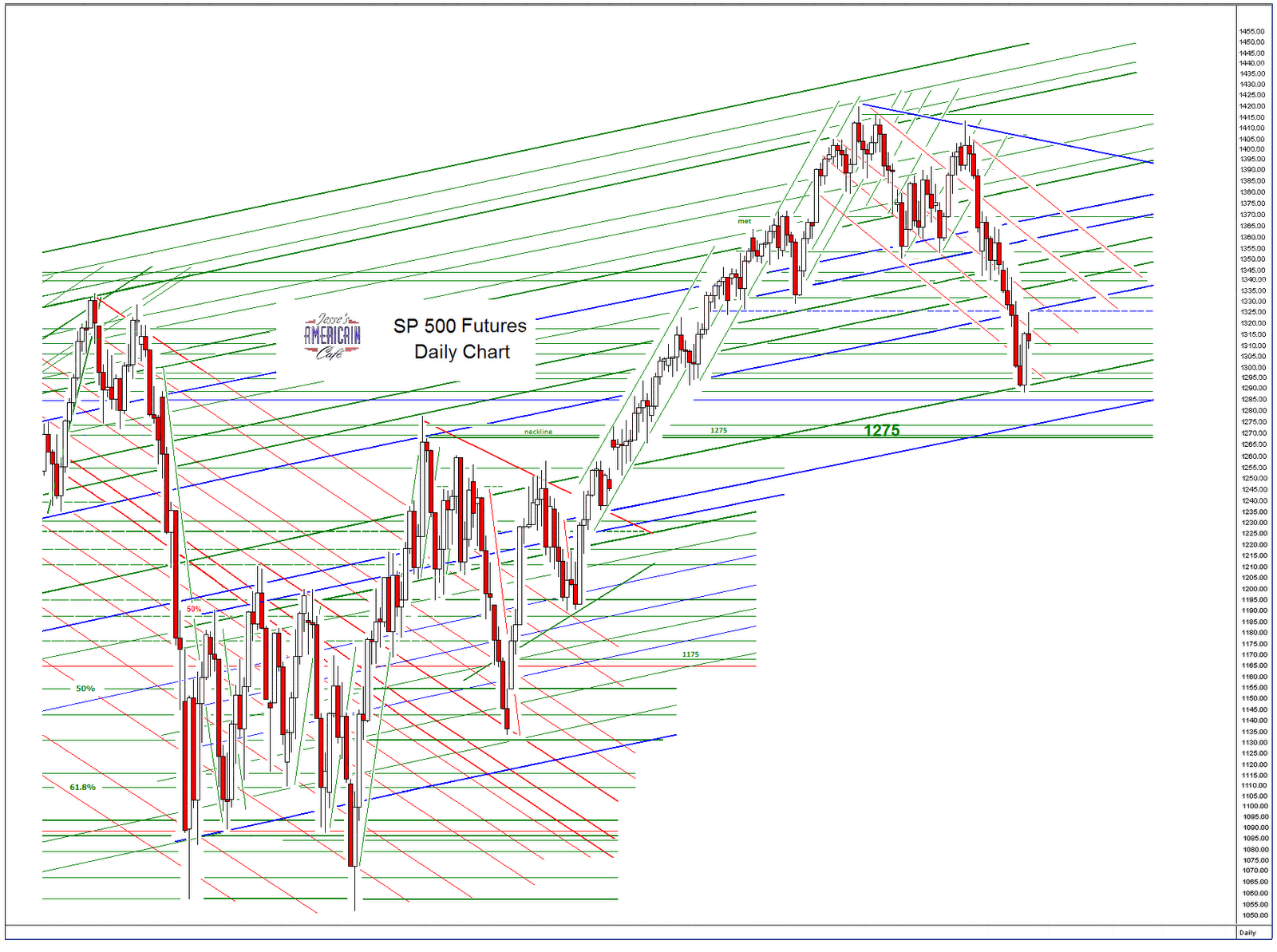
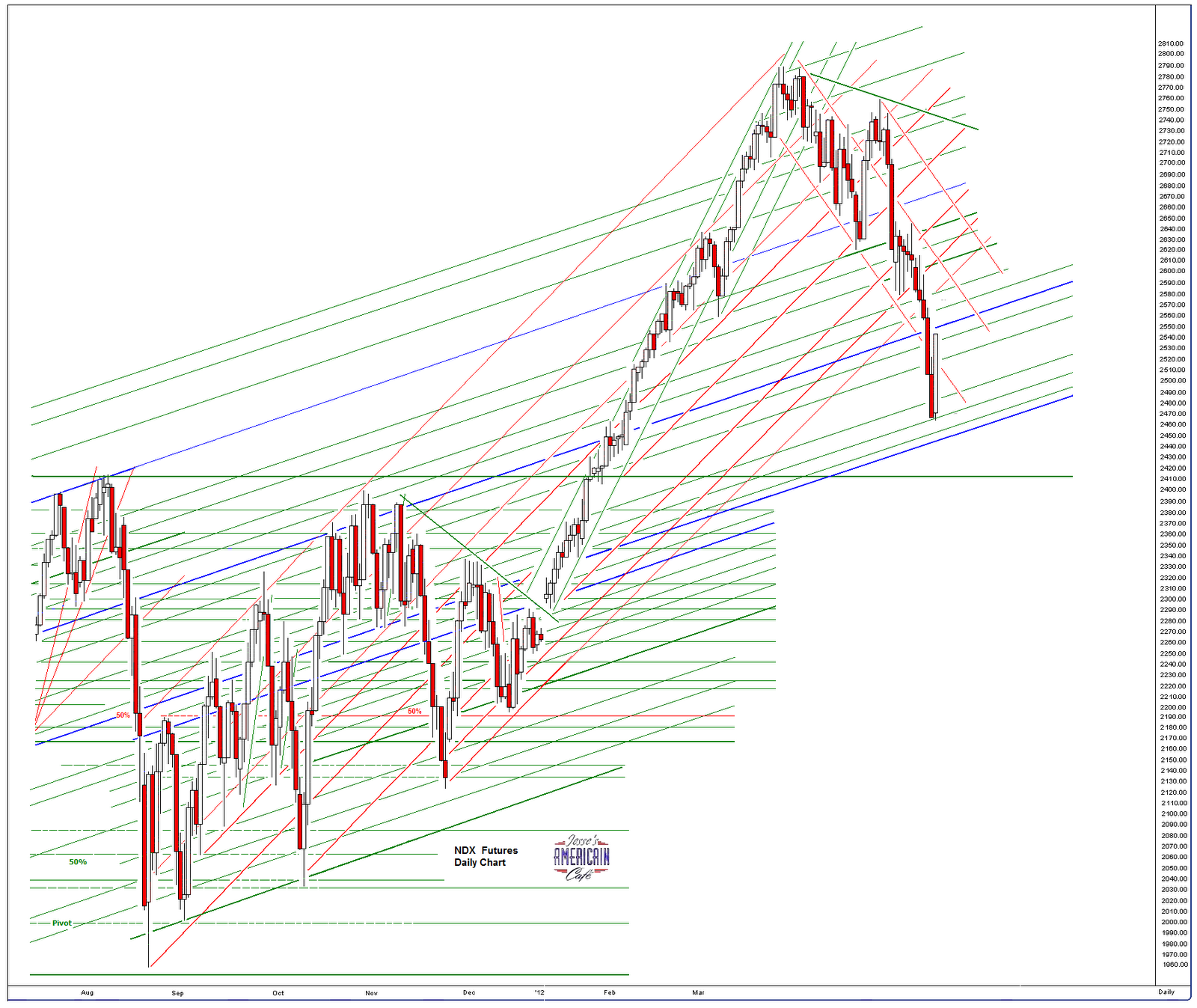
SP 500 and NDX Futures Daily Charts


Another nothing day, marking time. The traders want to see what happens in Europe, and what Ben and his pals will do in response.


23 May 2012

Gold Daily and Silver Weekly Charts - V Bottom Ahead of Option Expiration?


Intraday commentary on important dates in the next two weeks here.

May 24
OG - June 2012 Gold American Options - Last Trade Date
OG - June 2012 Gold American Options - Settlement Date

May 29
QO - June 2012 COMEX miNY Gold - Last Trade Date
QO - June 2012 COMEX miNY Gold - Settlement Date
GC - May 2012 Gold - Last Trade Date
GC - May 2012 Gold - Settlement Date

May 31
GC - May 2012 Gold - Last Delivery Date
GC - June 2012 Gold - First Notice Date

June 1
GC - June 2012 Gold - First Delivery Date

I have reduced cash levels down from 30+% to about 6% in my trading account and added silver bullion to the portfolio mix. Let's see what happens.

All is not bad news in the world. Series 2 of 'Sherlock' is exceptionally good, even to a Baker Street Irregular such as myself, with a long standing dedication to 'the canon.' P.S. I am informed that Series 1 of Sherlock is available on Netflix streaming. It is best to watch them in order if possible as they build on one another, although I do think that Series 2 is a little better.

And The Game of Thrones on HBO is almost as good as the books.  It is a remarkably entertaining performance especially by Peter Dinklage. But if you can take the time read the books by George R. R. Martin. He is a remarkable story-teller in the tradition of J. R. R. Tolkien, with a bit more edge.


SP 500 and NDX Futures Daily Charts - Intraday Reversal


Boys will be boys.


Fed's Kocherlakota: I Reject Your Reality and Substitute My Own


"'When I use a word,' Humpty Dumpty said, in rather a scornful tone, `it means just what I choose it to mean -- neither more nor less.'

`The question is,' said Alice, `whether you can make words mean so many different things.'

`The question is,' said Humpty Dumpty, `to be master -- that's all.'"

Lewis Carroll

I thought it was interesting that Narayan Kocherlakota, president of the Minneapolis Federal Reserve Bank, decided to print a recovery assertion now. This seems almost like a followup to the Recession Myth Claim put forward a few years ago by Deregulator in Chief Phil Gramm: Phil Gramm Says There Is No Recession, The US Is 'a Nation of Whiners' - July 11, 2008

Translation: Our crackpot models and malignantly self-serving regulatory policies that caused the financial crisis in the first place now say that we have done a great job in creating a recovery and that this is the 'new normal,' so in the immortal words of Phil Gramm, suck it up you crybabies.

Considering that the Fed claimed it could not find a housing bubble, or any associated credit risk in the banking sector, with both hands while it was blowing systemic risk, economic distortion, and malinvestment in heroic volumes out of its own ass, you will forgive me if I am a bit skeptical of any 'full employment' assertions here. Yes, I fully understand the economic theory that he is citing. It is soon to be if not already discredited in the conditions and economy that exist today.

Marketwatch
Fed's Kocherlakota: US Close to Full Employment
By Greg Robb

WASHINGTON (MarketWatch) - The United States is much closer than generally thought to full employment and it is time for the Fed to shift away from its ultra-easy monetary policy stance, said Narayana Kocherlakota, the president of the Minneapolis Federal Reserve Bank, on Wednesday.

In a speech in Rapid City, S.D., Kocherlakota noted that, in the wake of a financial crisis in the early 1990s, Sweden saw a sharp, and lasting, spike in the maximum rate of unemployment, or the level of joblessness sustainable over the long-term without causing inflation to rise.

Kocherlakota said the U.S. inflation rate is signaling a similar spike in the maximum employment level in the U.S. and the Fed should "be responsive to such signals."

What 'inflation signal' would that be, Mr. Katcherlakota? The ones that you and the government publish, or some private data that we have not yet seen?

Group Discussion Questions:
What public policy actions might prompt a greater sense of accountability at the Fed? cf. Ron Paul
Do the laws of moral hazard apply to tenured professors and those who hold government sponsored sinecures?
What models could possibly be prompting Mr. Kocherlakota thinking?  Hint:  Princeton AND the University of Chicago
Is this what Jamie Galbraith had in mind when he dscribed economics as 'a disgraced profession?'
What would Andrew Jackson do? (WWAJD)

Key Comex Dates For Gold In the Next Two Weeks


Here are some key dates on the Comex for the Gold Futures and Options.

Tomorrow is the June Gold Options Last Trade and Settlement Date

Next week is the Last Trade and Settlement for the Gold futures contract.

This is historically a heavy physical delivery period for gold and silver.

I suspect that this latest price action is less about Europe and Greece, and more about Chicago and New York.

May 24
OG - June 2012 Gold American Options - Last Trade Date
OG - June 2012 Gold American Options - Settlement Date

May 29
QO - June 2012 COMEX miNY Gold - Last Trade Date
QO - June 2012 COMEX miNY Gold - Settlement Date
GC - May 2012 Gold - Last Trade Date
GC - May 2012 Gold - Settlement Date

May 31
GC - May 2012 Gold - Last Delivery Date
GC - June 2012 Gold - First Notice Date

June 1
GC - June 2012 Gold - First Delivery Date


William Black on JP Morgan and the Failure to Regulate Wall Street Fraud


"It is no exaggeration to say that since the 1980s, much of the global financial sector has become criminalised, creating an industry culture that tolerates or even encourages systematic fraud. The behaviour that caused the mortgage bubble and financial crisis of 2008 was a natural outcome and continuation of this pattern, rather than some kind of economic accident...And yet none of this conduct has been punished in any significant way."

Charles Ferguson, Inside Job


"I know that my retirement will make no difference in its [my newspaper's] cardinal principles, that it will always fight for progress and reform, never tolerate injustice or corruption, always fight demagogues of all parties, never belong to any party, always oppose privileged classes and public plunderers, never lack sympathy with the poor, always remain devoted to the public welfare, never be satisfied with merely printing news, always be drastically independent, never be afraid to attack wrong, whether by predatory plutocracy or predatory poverty."

Joseph Pulitzer


"We are not left to conjecture how the moneyed power, thus organized and with such a weapon in its hands, would be likely to use it. The distress and alarm which pervaded and agitated the whole country when the Bank of the United States waged war upon the people in order to compel them to submit to its demands can not yet be forgotten.

The ruthless and unsparing temper with which whole cities and communities were oppressed, individuals impoverished and ruined, and a scene of cheerful prosperity suddenly changed into one of gloom and despondency ought to be indelibly impressed on the memory of the people of the United States. If such was its power in a time of peace, what would it not have been in a season of war, with an enemy at your doors?

No nation but the freemen of the United States could have come out victorious from such a contest; yet, if you had not conquered, the Government would have passed from the hands of the many to the hands of the few, and this organized money power from its secret conclave would have dictated the choice of your highest officers and compelled you to make peace or war, as best suited their own wishes. The forms of your Government might for a time have remained, but its living spirit would have departed from it."

Andrew Jackson

Here are two pieces by William K. Black on JPMorgan and the rampant and ongoing fraud and speculation on Wall Street. It tells the backstory of the subversion of the democratic process and how it is being rationalized by the corporate media.

A colleague and I were remarking the other day at the effectiveness of the Wall Street machine to spin the media, both at MF Global and JPM most recently. William K. Black strikes to the heart of it.

If you can do nothing else, if you do not have the means or the vocation for speaking out, you can at least offer some moral support and encouragement to those who do, and help to pass the message along to others.

JPMorgan's Addiction To Gambling on Derivatives
By William K. Black

JPMorgan’s flacks and apologists have, unintentionally, exposed the fact that their cover story – hedging gone bad – is false. JPMorgan runs the world’s largest gambling operation in financial derivatives. The New York Times reported the key facts, but not the analytics, in an article entitled “Discord at Key JPMorgan Unit is Faulted in Loss.” The analytics suggest that the latest JPMorgan cover story – it was JPMorgan’s “Achilles the heel” (based in the UK) who caused the loss – is misleading.

The thrust of the story is that in the beginning JPMorgan’s Chief Investment Office (CIO) was run by a fair princess (Ina Drew) and all was fabulous. Sadly, Ms. Drew contracted Lyme’s Disease and was unable to ensure peace and prosperity in her land. The evil Achilles Macris, based in the UK, became disloyal and mean. He made massive, bad purchases of financial derivatives that caused major losses. CIO senior officers based in the U.S. (and women to boot) tried to warn Achilles but he screamed at them and refused to listen and learn. The just king, Jamie Dimon, did not act promptly to save his kingdom from loss because of his great confidence in Princess Drew.

The personal story of Achilles acting like a heel makes compelling journalism, but it obscures rather than clarifies the analysis as to why JPMorgan poses a clear and present danger to the global economy.

We need to begin with context. It was toxic financial derivatives (not) backed by fraudulent liar’s loan mortgages (“green slime”) that drove the U.S. crisis. Paul Volcker urged the administration and Congress to bar any entity that received federal deposit insurance from investing in financial derivatives. The Dodd-Frank Act did so in a provision called “the Volcker rule.” Treasury Secretary Geithner and Federal Reserve Chairman Bernanke, who exist to serve the interests of CEOs of the largest banks, oppose the Volcker rule. Jamie Dimon leads the banking industry’s opposition to the Volcker rule.

Dimon has a three-part strategy: stall the Volcker rule, gut its effectiveness by creating a massive loophole, and get the rule repealed by a future Congress. The loophole takes advantage of the fact that the Volcker rule was not intended to prevent banks from using derivatives to create (true) hedges. The current draft of the rule, however, renders the rule useless because it allows banks to call non-hedges “hedges” – it adopts a standard I call “hedginess.” A systemically dangerous institution (SDI) like JPMorgan has vast amounts of financial derivatives and it can (and does) call any speculative bet it takes in financial derivatives a “hedge.”

The NYT article demonstrates that JPMorgan is speculating, not hedging, and that the current draft of the Volcker rule would render us defenseless against the next financial crisis. The article misses these analytics and presents a misleading portrayal of the purportedly good years of CIO under Princess Drew. It turns out that CIO’s profits and losses come from the same practice – gambling on massive amounts of financial derivatives – not hedging. The NYT misses this key analytical point...

Read the rest here at The Big Picture.

Additionally below is an interview that William K. Black has done with Lauren Lyster at Russia Today.

As always, one does not find this type of insightful discussion at the mainstream media which tends to present fake arguments and discussion between paid consultants and flacks from the major parties, both of whom are obtaining record amounts of money from corporations. The latest estimates are that Obama and Romney will gather in $1.5 Billion in campaign 'donations' for this November.


Max Keiser Interviews Francine McKenna On JP Morgan and MF Global


"In this respect England exhibits the most remarkable phaenomenon in the universe in the contrast between the profligacy of its government and the probity of its citizens. And accordingly it is now exhibiting an example of the truth of the maxim that virtue & interest are inseparable.

It ends, as might have been expected, in the ruin of its people, but this ruin will fall heaviest, as it ought to fall, on that hereditary aristocracy which has for generations been preparing the catastrophe.

I hope we shall take warning from the example and crush in its birth the aristocracy of our monied corporations which dare already to challenge our government to a trial of strength and bid defiance to the laws of our country."

Thomas Jefferson, November 12, 1816


Source

Francine McKenna's site re: The Auditors

PBS Frontline: MF Global's Six Billion Dollar Bet


PBS Frontline did an exceptionally good job putting this together.

Watch it if you can and pass it along.


Source

22 May 2012

Gold Daily and Silver Weekly Charts - Schlock and Awe


SP 500 and NDX Futures Daily Charts - More of the Same


Late day headline about Greece ready to leave Euro caused a light sell off in stocks which had been up much of the day.

Really, nothing of significance yet.


21 May 2012

Gold Daily and Silver Weekly Charts - Is That Jamie's Ring You're Wearing?


More fruitless games in the metals today, and probably some needed consolidation.


SP 500 and NDX Futures Daily Charts - The Wages of Greed


"Men are qualified for civil liberty in exact proportion to their disposition to put moral chains upon their own appetites; in proportion as their love to justice is above their rapacity; in proportion as their soundness and sobriety of understanding is above their vanity and presumption; in proportion as they are more disposed to listen to the counsels of the wise and good, in preference to the flattery of knaves.

Society cannot exist unless a controlling power upon will and appetite be placed somewhere, and the less of it there is within, the more there must be without. It is ordained in the eternal constitution of things that men of intemperate minds cannot be free. Their passions forge their fetters."

Edmund Burke

This quote from Burke is a very fine response to the meme, 'greed is good, markets are naturally efficient, and there is no need for government regulation because people will do the right thing based on their pure and objective rationality and consideration for others.'

A practical exercise in debunking any romantic notions about the natural goodness and rationality of people is to take a drive during rush hour on almost any major American highway.

That puts me in mind of the famous quote from Sophocles, 'many are the wonders, but nothing stranger than man.'


Net Asset Value Premiums of Certain Precious Metal Trusts and Funds


19 May 2012

BBC Interview with Nassim Taleb on JPMorgan


"It is one of the serious evils of our present system of banking that it enables one class of society, and that by no means a numerous one, by its control over the currency to act injuriously upon the interests of all the others and to exercise more than its just proportion of influence in political affairs."

Andrew Jackson, Farewell Address

Rational people keep struggling with the 'why' of all this. I think the struggle is because they start with some wrong assumptions about morally rational behaviour and motives. As Rick Santelli likes to say, traders are not moral when they are trading.

I keep coming back to William K. Black's explanation for this enormous attraction to multi-trillion dollar bets at JPM
"Financial institutions such as JPMorgan love to buy derivatives because they are opaque, create fictional income that leads to real bonuses and when (not if) they suffer losses so large that they would cause the bank to fail, they will be bailed out."

William K Black
The more I look into this and think about it, the more that Barack Obama's 'favorite banker' looks like Enron in their heyday.

I wonder how far the US will go to prevent the failure of their 'best bank' from spoiling the grand illusion, and how many lives of the poor and the middle class will be sacrificed to the god of greed and power.


18 May 2012

CFTC Commissioner Bart Chilton On the Irony of JP Morgan's Trading Loss


"Financial institutions such as JPMorgan love to buy derivatives because they are opaque, create fictional income that leads to real bonuses and when (not if) they suffer losses so large that they would cause the bank to fail, they will be bailed out."

William K Black

When the next financial crisis occurs remember the things that Bart Chilton says in his op-ed piece below. Things like widespread bank fraud and a financial collapse do not just happen. Sandy Weill led a determined and well funded lobbying effort to overturn Glass-Steagall and open the public pocketbook for the banks. And his protege Jamie Dimon continues on with his work, with a lobbying effort and use of the courts to circumvent the return of sensible banking reform.

But this would not have been possible without the lapse in the stewardship of public figures in the Congress, the Executive Office, and private institutions like the media and the Federal Reserve.

The breadth of the fraud makes reform difficult, because the money flowing from the symbiotic relationship between the monied interests and Washington is a highly addictive drug to those for whom money brings power.

But reform will happen. It is just a matter of how bad it has to get before change comes.  The more the resistance, the more sweeping and powerful will be the change.    Corruption never lasts; even the great empires of history, so intimidating and seemingly insurmountable at the height of their power, have fallen.  

And so surely will a few recklessly selfish bankers, with their political hacks and corrupt enablers, fall in disgrace and eventually be forgotten, or if remembered, only as a warning, a tarnished stain on the enduring Republic of free people.

See also: How JPMorgan Is Like Enron

McClatchy
JPMorgan: Isn't life strange?
By BART CHILTON
May 17, 2012

By now, folks have heard much about the announcement that JPMorgan Chase had somehow lost $2 billion over a six-week period. In an irony of ironies, here's what one JPMorgan risk officer had to say about the behemoth bank just a few months ago: "Our metric of success is 'no surprises'; no surprises in terms of the impact on the firm of any individual behavior or outside event."

Hmm. Actually there was good reason to say that at the time as JP had just been named Risk Magazine's "Derivatives House of the Year." As the Moody Blues sing: "Isn't Life Strange?"

Here's a little perspective: $2 billion represents 10 percent of JPMorgan's profits for all of last year. In fact, $2 billion is more than four times the amount the U.S. government prints in one day. And, $2 billion over six weeks is more than $47 million a day!

None of this means we're going to have a repeat of the colossal calamity of 2008. But, it's scary isn't it? The "scary smart," "greed is good," "regulations are bad" folks on Wall Street may be flying below the clouds today.

But think about why. Here we are four years after the collapse of Bear Stearns, Lehman Brothers and AIG, and we're still working toward implementing the rules that Congress and the president put in place to keep another 2008 from happening, i.e. the Dodd-Frank Financial Reform and Consumer Protection Act.

The act itself has been around almost two years and yet, of the roughly 300 rules and regulations, less than a third have been completed - and that's 10 months after the mandated deadline. The JPMorgan announcement reminds us that our financial markets remain susceptible to the impact and contagion of these major market players. Maybe it's just the java jolt we need to wake folks up.


Lots of things have slowed the rulemaking process, not the least of which are lawsuits brought against regulators by the scary smart people. Remember, to some of them, regulation is a dirty word. Then there are those in Congress who never wanted financial reforms in the first place and are either trying to repeal them a piece at a time; drown regulators in their own version of red tape; or just hold back funding to the watchdogs who would keep an eye on the JPs of the world.

Four years ago, the economy was on the verge of collapse for two reasons: the high-flying, above the clouds captains of Wall Street and lax regulation. Is history repeating itself? I hope not and I don't think so, but scary it is.

Are we more secure now than we were when the economy collapsed? To some extent, yes. There's new transparency in markets that will allow us to see the kinds of things JP was doing to lose $47 million a day. But, could our markets suffer significantly before all the rules are in place? Unfortunately, yes. And that's bad for investors, markets, and yes, consumers. To quote the same JPMorgan official, "Investors love not being surprised." Isn't life strange, indeed?

Gold Daily and Silver Weekly Charts - Something Wicked This Way Comes


“Something has to be done because it’s totally out of control these days. I mean you can’t have bank runs like we’re seeing. The one thing the powers that be, the central banks and the governments, have tried to do is to avoid what I call a ‘Liquidation Event.’

Ever since we saw what happened when Lehman was liquidated, they realized we can’t go there. Fannie was taken over as well as AIG and GM to prevent this liquidity event. But I think the market is just liquidating, irrespective of whether the powers that be want it or not.

I just think that process is picking up into a tsunami and the world will start focusing back again on precious metals."

Eric Sprott, interview at King World News

I tend to agree with Eric.   If the markets see Greece slip out of the Euro and fold its debts up and toss them away, the consequences for the banks and debt in some of the other Euro countries are going to be enormous. 

They are deathly afraid of uncontrolled runs on the banks.   And even moreso, they are concerned of contagion to US and UK banks, and a run on the currencies. At the end of the day, when the fundamentals are shot to hell, its all down to running a confidence game.

That is why I think that they will fight the inclusion of gold and silver in the world currency systems tooth and nail.  Once you open the door to alternatives, you erode the span of your control.  And that is fatal to an overextended control fraud, which is what the paper financial markets look like today.

And that is why the price of gold and silver have to be controlled.  They have an objective, but they need to avoid panics and sudden uncontrolled movements from the chose path to reach it.

The key word is 'orderly.'  

Make no mistake and have no illusions.  For all their bravado, I think these guys are scared shitless.  You can have faith in your free market gurus I'm sure. Faith that they will drop you a postcard of gratitude and encouragement from Paraguay and Switzerland, Abu Dhabi and Singapore.

And when they inevitably lose control it could go quite a few ways, but no matter which way it goes, it is likely to be memorable.


SP 500 and NDX Futures Daily Charts - Facebook Face Plant


The Commencement Address That Won’t Be Given
By Robert Reich
Friday, May 18, 2012

Members of the Class of 2012,

As a former secretary of labor and current professor, I feel I owe it to you to tell you the truth about the pieces of parchment you’re picking up today.

You’re f*cked...

Read the rest here.

Facebook closed largely unchanged from the IPO price after an initial pop up to 42. On the first day of trade the underwriters are obligated to support the IPO price. Let's see how it does on Monday.  They seemed to be eating a lot of High Frequency Inventory into the close.

As a point of order, Facebook really went quietly IPO about a year or so at $15, and was being traded on 'private exchanges.' Today was its general public IPO.

NASDAQ blew the open of trade on Facebook in several ways. The NYSE was touting their human backup systems in response.

I think Bernanke will wait until the market is begging before he throws them the next QE bone.

See you Sunday evening.


Bill Moyers Interviews Simon Johnson on JP Morgan Chase and the Next Financial Crisis


“The signs that I see, the body language, the words, the op-eds, the testimony, the way these bankers are treated by certain congressional committees, it makes me feel very worried. I have a feeling in my stomach that is what I had in other countries, much poorer countries, countries that were headed into really difficult economic situations. When there’s a small group of people who got you into a disaster and who are still powerful, you know you need to come in and break that power and you can’t. You’re stuck.”

Simon Johnson


"Financial institutions such as JPMorgan love to buy derivatives because they are opaque, create fictional income that leads to real bonuses and when (not if) they suffer losses so large that they would cause the bank to fail, they will be bailed out."

William K. Black

Are JPMorgan’s Losses A Canary in a Coal Mine?
By Bill Moyers
May 16, 2012

That sound of shattered glass you’ve been hearing is the iconic portrait of Jamie Dimon splintering as it hits the floor of JPMorgan Chase. As the Good Book says, “Pride goeth before a fall,” and the sleek silver-haired, too-smart-for-his-own-good CEO of America’s largest bank has been turning every television show within reach into a confessional booth.

Barack Obama’s favorite banker faces losses of $2 billion and possibly more – all because of the complex, now-you-see-it-now-you-don’t trading in exotic financial instruments that he has so ardently lobbied Congress not to regulate.


Source

See also: Senate Banking Chairman Calls Jamie Dimon to Testify, But JPM Is His Largest Contributor!

Net Asset Value Premiums of Certain Precious Metal Trusts and Funds


Jim Rickards On JP Morgan's Trading (Gambling) Loss - The Hypocrisy of Plutocrats


JPMorgan, the nation's largest bank, receives an explicit federal subsidy (deposit insurance) and a much larger implicit federal subsidy. It's improper for the megabank to use these subsidies to speculate in derivatives. And yet it can do so with hardly any serious regulatory consequences.

Financial institutions such as JPMorgan love to buy derivatives because they are opaque, create fictional income that leads to real bonuses and when (not if) they suffer losses so large that they would cause the bank to fail, they will be bailed out.

The Dodd-Frank Act's Volcker Rule was designed to solve the problem.

However, JPMorgan led the effort to gut the Volcker Rule and the provision that requires transparency. JPMorgan is the world's largest proprietary purchaser of financial derivatives -- precisely what the Volcker Rule sought to end. The bank claims that it does not engage in proprietary trading and that it purchases derivatives solely to hedge. That claim is an example of what Stephen Colbert meant when he invented the term: "truthiness."

William K. Black

What the spokesmodels deftly avoid is the discussion that JPM is not a privately financed hedge fund, but a government supported entity using insured deposits, subsidized funds, and the protection of the Federal Reserve as a bank holding company.

Why was it that the investment banks like Goldman suddenly wanted to become bank holding companies during the financial crisis? Oh yeah, that.

If these jokers want to gamble fine. But Jamie Dimon's mentor Sandy Weil led a lobbying effort that spent hundreds of millions to overturn Glass-Steagall, and now JPM is leading the fight aginst the Volcker Rule.

People don't mind if you bet and lose. They do mind if you cheat and win, and they mind it even more if you keep the money when you win, but you charge it to the public trust when you lose. And that is exactly the game that Wall Street led by JPM is playing right now. And these people know better.

Here is an antidote to the faux market hystrionics on CNBC and Bloomberg TV. Investigating JP Morgan Chase - Simon Johnson
and also Bill Moyers Interviews Simon Johnson on JPM and the Next Financial Crisis

Chris Powell Answers Doug Casey's Questions About Gold Manipulation


I had read Casey's piece, but quickly lost interest in it at the argument that the gold market is so big it cannot be manipulated by the poor weak central banks and their surrounding commercial banks who are practically bankrupt.

If someone is a value sophisticate in a segment of the market, but does not understand and have concern for the power of the Federal Reserve and its associated banks being able to print money at will, then it is probably good advice to stick what you do know, and leave the economics for someone else. The saying that control of the money supply is a powerful tool has been around so long that it has become proverbial.

As for the size of the gold market, it is tiny relative to the financial markets. Consider the enormous size of the international currency markets. Or the bond markets. Do the central banks manipulate them? Did Citi not get caught blatantly shoving Euro bond prices around a few year ago? Of course they did. And as the sanctioned trader protested, it was nothing out of the ordinary. They just don't get caught at it unless they get clumsy.

Prices in a market are set at the margin or 'on the float' in the day to day trade. All a large trader or group of traders has to do is manage that marginal trade and the market will follow. If one looks at the amount of daily trading done on the LBMA in daily volume relative to the amount of physical gold changing hands, the answer is fairly glaring.

Market operators may not be able to resist the primary trend, but given deep enough pockets and high enough leverage, and cooperation from like minded manipulators, and they can make a good game of it for quite a long time. That is an old and familiar story for those who know the history of the markets.

As for the why of the manipulation there are many reasons. But as just one example, if I and a group of associates could knowingly push the bullion price around in the short term, we could make enough money skinning speculators in the ancillary markets, derivatives such as options and in mining stocks for example, to make it a very lucrative trade. This is Markets 201.

All that is required is that the regulators turn a blind eye to the manipulation in the markets. And if anyone close to the markets still doubts that they do that today after all that has happened, you will excuse me if I don't take them very seriously. The big trading desks have been using the markets like their personal ATMs, and every time they do get caught in some slip up it is a slap on the wrist and a nominal fine, and a promise not to do it again.

Has this fellow ever read anything from Ted Butler or Harvey Organ or Bart Chilton?

Forget gold for a moment, what about silver?  Is that market too big to manipulate? How about the energy markets in the US? Remember Enron?

Academics like Paul Krugman might not readily understand this, because this is not what they do, and they tend to approach the world through simplified, abstract models that are without the dark alleys and rough edges of the real world. 

The notion that markets cannot be manipulated are a corollary to the efficient market hypothesis, and idealized markets that naturally tend to stable clearing prices.

But I would expect someone who considers themselves a seasoned speculator and market savvy to know that markets do not behave in this manner, and that as long as there are markets, there will be those who will bend the rules and cheat whenever and wherever they can.

The Wall Street demimonde does not care if the markets are corrupt because if you get enough information to see the 'bezzle you can make money on the swings, or if not by trading then by serving the interests of the trading desks of the large funds.  But market distortions can play hell with investors, and is destructive of the real economy because of the malinvestment that long term market distortion cultivates.

I don't like to dwell on the manipulation when investing as opposed to speculating.  As I have repeatedly said here, take your investment positions based on logic and the fundamentals, and a long term financial portfolio plan, and ignore the short term noise and wiggles.  Thinking back I have always made the most, if not all the profits on balance,  when I took a solid position and then just rode it, sometimes for years.   So if I were in the game of mining stocks I would not want to see people distracted from them IF they were in it for the long term and they were properly fit in a portfolio. And so I understand why some people get frustrated by talk of market manipulation.

Chris Powell makes a good show of answering these sorts of things, but I do not think that the effort here will be worthwhile. Anyone who can trot out the canard that a 'market is too big to be manipulated' does not engage my interest for very long.   All will be revealed in time whether we argue about it or not. 

But the real economy is in dire need of serious and meaningful financial reform, which includes cleaning up the markets and taking the pampered princes off the malinvestment feedbag.  And that is something that matters greatly.

"In an essay posted Thursday at GoldSeek, financial writer Doug Casey of Casey Research asks for evidence of gold market manipulation and some explanation of its purpose. Casey's essay is headlined "Precious Metals Market Manipulation?" and it's posted here.

The evidence and explanation have long been posted in the "Documentation" file at GATA's Internet site here.

Maybe the most comprehensive treatment of the subject is the latest version of your secretary/treasurer's "stump speech" here.

But we're always adding to the "Documentation" file, like the acknowledgment by the late Dutch central banker and Bank for International Settlements President Jelle Zijlstra that Western central banks rig the gold market show here, so if he's at all curious Casey might want to drop by occasionally for updates."

17 May 2012

Gold Daily and Silver Weekly Charts - Massive Short Covering Rally From Deeply Oversold


Facebook priced after the bell, 421 million shares @ $38 with a PE of 107 and a Price/Sales of 25.

This is "the largest internet IPO in history" (Ring Ring Ring).

It will start trading in the public markets, as opposed to dark pools and private deals, tomorrow after 11 am Eastern Time.  That will make share acquisition a bit problematic in Europe.

The wiseguys are geared up for a multiday pop and drop. The drop part may not arrive for a few weeks, and could mark a watershed event if it happens. More relies on Ben Bernanke than Mark Zuckerberg.  I think Facebook will place somewhere between Google and Groupon.  I would not buy at the $60 price I expect to see print tomorrow.  It will probably see sub 20 before it sees 100.

Shares for borrow and shorting may not show up in size until next week after the settlement for shares being sold tomorrow.  But I would not underestimate the 'special arrangements' that might be made for short selling into the close of trade on Friday.

Gold and silver soared today. I had intraday commentary in which I show the metrics I have been watching that showed gold at a major oversold condition that has marked at least short term bottoms for at least the last year.

So what next. Gold and silver must continue to diverge from stocks as a safe haven despite weaker economic news and troubles in Europe. I think that this is possible.

I thought the selling of the last three days was utterly artificial judging by the behaviour of the open interest which stayed steady and even rose! Gold and silver were passing from weak to strong hands in the face of blatant price manipulation designed to frighten the average investor.

Let's see how equities do tomorrow in the face of option expiration, and the uncertainty of Europe and the weekend.

Facebook may ring a bell. Let's hope that the nonsense in gold and silver is over at last.


SP 500 and NDX Futures Daily Charts - Facebook Cometh - Last of the Dot Bombs?


Big down day in the US markets today as the trading desks flushed out their weaker positions and got ready to pump up Facebook tomorrow for what could work out to be the mother of pump and dump operations. I do not expect the fat lady to sing tomorrow, but I think she will start warming up for what could be remembered in a few years as the end of an era, a watershed event.

Let's see what happens. I do not expect a down day in the stock markets tomorrow but I could be wrong. Equities are short term oversold.

Tomorrow is also an options expiration.


Devaluing the Dollar - Against What?


When people talk about devaluing the dollar, as opposed to reissuing it completely, the natural question is, against what? What would one devalue it against officially if you do not wish to reinstitute a formal gold standard, which is clearly the preference of the Western central bank.

One likely candidate might be the SDR issued as a new currency for global trade, and for the pricing of international goods and commodities.

The major bone of contention as I have pointed out before would be the new 'basis' for the SDR. What Will the World's Reserve Currency Become?  The BRICs are adamant for the inclusion of additional currencies and gold and silver to make a portfolio that is less weighted to the US, Europe, and England.

A country would have the option to retain their own national currency for domestic use.

This is regards to devaluation as opposed to a hyperinflation and reissuance in which case old dollars would be scrapped for 'new dollars' with a couple of zeroes knocked off.

A friend sent this information about the US Post Office my way today. The speculation on the 'new composition' of the SDR is mine. I am assuming that the number of Euro countries decreases.

The US Post Office is using US$ to SDR conversion tables for international mail insurance --> US Postal Service US$ to SDR Policy and Tables

Earliest reference I could find to when the USPS started pricing in SDRs is 2009, which is well after the initial financial crisis.

IMF publishes daily tables on SDR values--> IMF SDR Daily Tables

Quick calc: at today's SDR rate of 1.52 SDR to 1 US$, if a new global dollar like currency was issued, then a current $1 US would buy you 66 cents of that new currency.

This is about a 34% drop in the $ value.

And that is probably best case scenario, since the daily SDR rate is priced
relative to 3 other currencies. If the US$ were to take a pounding prior to
issuance of a new currency, the exchange rate would be even less favorable to $ holders.

Summary: The pricing mechanism for replacing the greenback is in place. As
your anxiety level rises on the $, feel free to check daily to see what your bank deposits would be worth after a bank "holiday".