24 July 2012

The Careerists and the Banality of Evil


“We run heedlessly into the abyss after putting something in front of us to stop us from seeing it.”

Blaise Pascal, Pensées

The consciousless functionary guided by expediency is the very image of the regulatory and banking bureaucrat of today, from Tim Geithner to Gary Gensler to Ben Bernanke, and further, almost every member of the governments of the Western World. Expedient amorality is de rigueur these days among the entitled class of power brokers who serve the system, which in their minds is themselves, as a privileged, ruling class.

And it is that very dryness of human empathy, the lack of vigor in moral conviction, the willingness to accept great crimes and injustices as the unfortunate but "necessary outcomes" required by The System, that makes all the difference between a Franklin D. Roosevelt and a Barack H. Obama, between a living human being and a whited sepulchre full of dead men's bones.

After a time it becomes so easy to day, 'I am sorry madam, but the system requires that your child must die.' And so the ceremony of innocence is drowned.

This is not capitalism.  Capitalism does not demand that we destroy human lives for the sake of maximizing profits using any and all means which that end justifies.  The Market is not an end to itself. The Market is not God.  This is beyond capitalism.  This is tyranny.  It is a pernicious form of selfishness and self-indulgence, a privileged arrogance. It is as old as Babylon, and evil as sin

To paraphrase John Kenneth Galbraith, 'The modern economist is engaged in one of man's oldest exercises in moral philosophy; that is, the search for a superior justification for selfishness.'

And this is not a choice between poverty for the sake of truth and a very comfortable living, but the overwhelming need for a fabulous, ostentatious wealth and power that seems to have become the god of  this generation.   And it is a sickness, a sickness unto death.

TruthDig
The Careerists
By Chris Hedges
Jul 23, 2012

The greatest crimes of human history are made possible by the most colorless human beings. They are the careerists. The bureaucrats. The cynics. They do the little chores that make vast, complicated systems of exploitation and death a reality. They collect and read the personal data gathered on tens of millions of us by the security and surveillance state. They keep the accounts of ExxonMobil, BP and Goldman Sachs. They build or pilot aerial drones. They work in corporate advertising and public relations. They issue the forms. They process the papers. They deny food stamps to some and unemployment benefits or medical coverage to others. They enforce the laws and the regulations. And they do not ask questions.

Good. Evil. These words do not mean anything to them. They are beyond morality. They are there to make corporate systems function. If insurance companies abandon tens of millions of sick to suffer and die, so be it. If banks and sheriff departments toss families out of their homes, so be it. If financial firms rob citizens of their savings, so be it. If the government shuts down schools and libraries, so be it. If the military murders children in Pakistan or Afghanistan, so be it. If commodity speculators drive up the cost of rice and corn and wheat so that they are unaffordable for hundreds of millions of poor across the planet, so be it. If Congress and the courts strip citizens of basic civil liberties, so be it. If the fossil fuel industry turns the earth into a broiler of greenhouse gases that doom us, so be it. They serve the system. The god of profit and exploitation. The most dangerous force in the industrialized world does not come from those who wield radical creeds, whether Islamic radicalism or Christian fundamentalism, but from legions of faceless bureaucrats who claw their way up layered corporate and governmental machines. They serve any system that meets their pathetic quota of needs.

These systems managers believe nothing. They have no loyalty. They are rootless. They do not think beyond their tiny, insignificant roles. They are blind and deaf. They are, at least regarding the great ideas and patterns of human civilization and history, utterly illiterate. And we churn them out of universities. Lawyers. Technocrats. Business majors. Financial managers. IT specialists. Consultants. Petroleum engineers. “Positive psychologists.” Communications majors. Cadets. Sales representatives. Computer programmers. Men and women who know no history, know no ideas. They live and think in an intellectual vacuum, a world of stultifying minutia. They are T.S. Eliot’s “the hollow men,” “the stuffed men.” “Shape without form, shade without colour,” the poet wrote. “Paralysed force, gesture without motion.”

It was the careerists who made possible the genocides, from the extermination of Native Americans to the Turkish slaughter of the Armenians to the Nazi Holocaust to Stalin’s liquidations. They were the ones who kept the trains running. They filled out the forms and presided over the property confiscations. They rationed the food while children starved. They manufactured the guns. They ran the prisons. They enforced travel bans, confiscated passports, seized bank accounts and carried out segregation. They enforced the law. They did their jobs.

Political and military careerists, backed by war profiteers, have led us into useless wars, including World War I, Vietnam, Iraq and Afghanistan. And millions followed them. Duty. Honor. Country. Carnivals of death. They sacrifice us all. In the futile battles of Verdun and the Somme in World War I, 1.8 million on both sides were killed, wounded or never found. In July of 1917 British Field Marshal Douglas Haig, despite the seas of dead, doomed even more in the mud of Passchendaele. By November, when it was clear his promised breakthrough at Passchendaele had failed, he jettisoned the initial goal—as we did in Iraq when it turned out there were no weapons of mass destruction and in Afghanistan when al-Qaida left the country—and opted for a simple war of attrition. Haig “won” if more Germans than allied troops died. Death as score card. Passchendaele took 600,000 more lives on both sides of the line before it ended. It is not a new story. Generals are almost always buffoons. Soldiers followed John the Blind, who had lost his eyesight a decade earlier, to resounding defeat at the Battle of Crécy in 1337 during the Hundred Years War. We discover that leaders are mediocrities only when it is too late.

David Lloyd George, who was the British prime minister during the Passchendaele campaign, wrote in his memoirs: “[Before the battle of Passchendaele] the Tanks Corps Staff prepared maps to show how a bombardment which obliterated the drainage would inevitably lead to a series of pools, and they located the exact spots where the waters would gather. The only reply was a peremptory order that they were to ‘Send no more of these ridiculous maps.’ Maps must conform to plans and not plans to maps. Facts that interfered with plans were impertinencies.”

Here you have the explanation of why our ruling elites do nothing about climate change, refuse to respond rationally to economic meltdown and are incapable of coping with the collapse of globalization and empire. These are circumstances that interfere with the very viability and sustainability of the system. And bureaucrats know only how to serve the system. They know only the managerial skills they ingested at West Point or Harvard Business School. They cannot think on their own. They cannot challenge assumptions or structures. They cannot intellectually or emotionally recognize that the system might implode. And so they do what Napoleon warned was the worst mistake a general could make—paint an imaginary picture of a situation and accept it as real. But we blithely ignore reality along with them. The mania for a happy ending blinds us. We do not want to believe what we see. It is too depressing. So we all retreat into collective self-delusion.

In Claude Lanzmann’s monumental documentary film “Shoah,” on the Holocaust, he interviews Filip Müller, a Czech Jew who survived the liquidations in Auschwitz as a member of the “special detail.” Müller relates this story:
“One day in 1943 when I was already in Crematorium 5, a train from Bialystok arrived. A prisoner on the ‘special detail’ saw a woman in the ‘undressing room’ who was the wife of a friend of his. He came right out and told her: ‘You are going to be exterminated. In three hours you’ll be ashes.’ The woman believed him because she knew him. She ran all over and warned to the other women. ‘We’re going to be killed. We’re going to be gassed.’ Mothers carrying their children on their shoulders didn’t want to hear that. They decided the woman was crazy. They chased her away. So she went to the men. To no avail. Not that they didn’t believe her. They’d heard rumors in the Bialystok ghetto, or in Grodno, and elsewhere. But who wanted to hear that? When she saw that no one would listen, she scratched her whole face. Out of despair. In shock. And she started to scream..."

Read the rest here.

Choose your loyalty wisely, because you may be spending a very long time with what you serve. And even if it is not a conscious choice of the moment, what you do, or do not, determines to whom you belong.
"Know you not, that to whom you yield yourselves as servants to obey, his servants you are; whether of a corruption unto death, or of a righteousness unto life?"
It is not surprising that people sell themselves so badly, but rather that they also do it so cheaply.

SP 500 and NDX Futures Daily Charts - APPL and Netflix


Stocks were lower much of the day, with a brief short covering pop into the close.

AAPL missed its numbers, both earnings and revenues in a big way, and the stock is down about six percent after the bell. They also guided lower on lackluster iPhone sales. There is some speculation that consumers are waiting for the new version.

Netflix is taking the gas pipe after hours, as it came in line on the numbers, but streaming subscribers was light. Stock is down ten percent.

Norfolk Southern nailed earnings but missed revenues.

UPS gave a forecast today that boded ill for the US GDP for the rest of the year, showing numbers in the one percent growth range.


Gold Daily and Silver Weekly Commentary


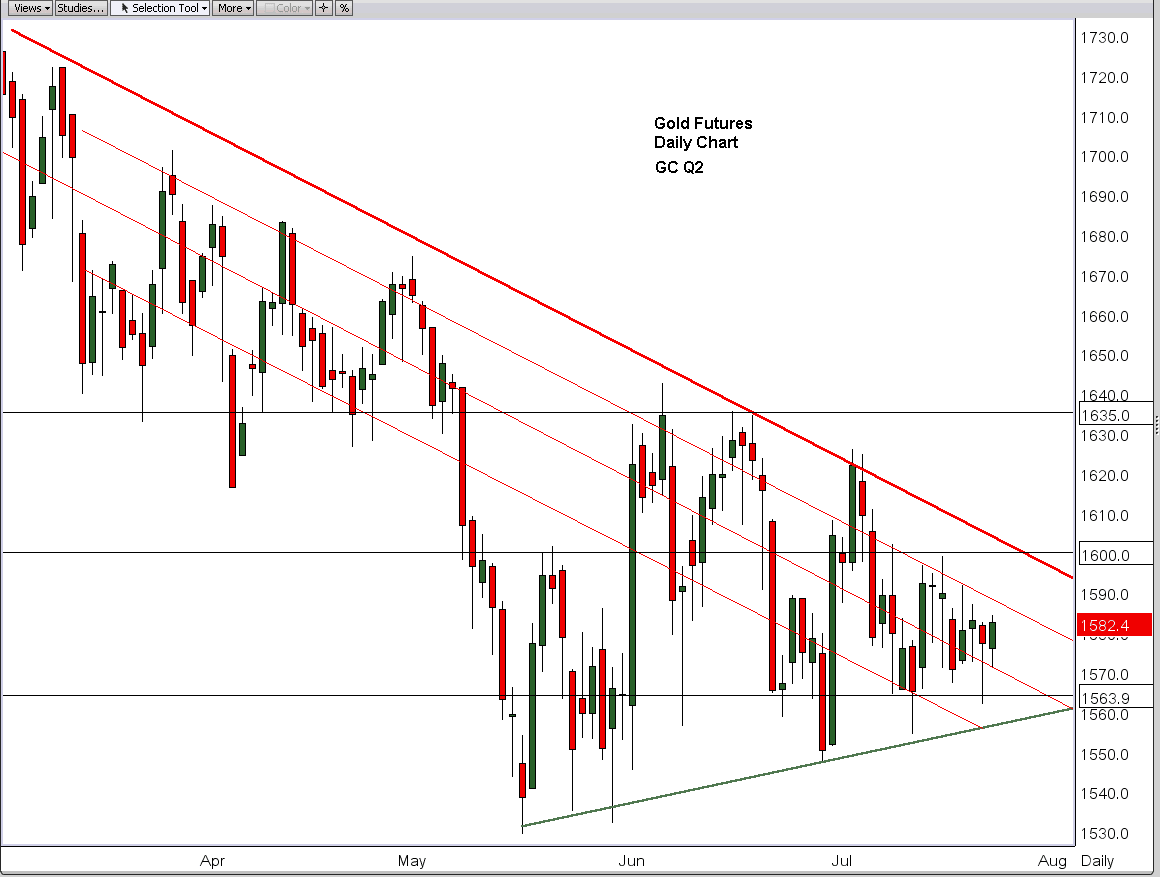
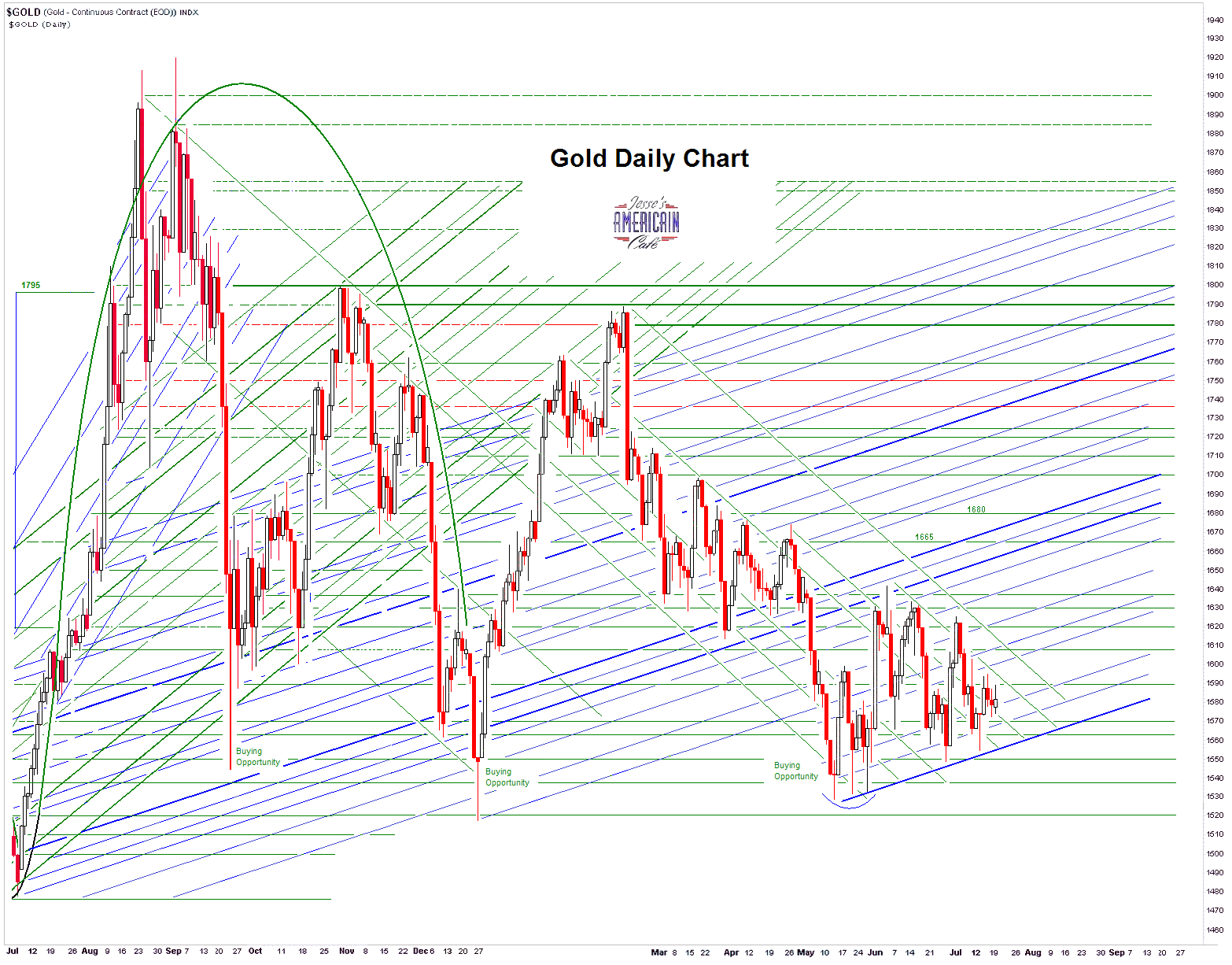
Gold and silver are still obviously coiling into a compression end formation.


Gold Continues Coiling


It is of course a matter of probability as to which way it breaks, and even moreso dependent on a few exogenous monetary events.

But the boundaries of breakout, subject to confirmation to weed out the headfakes, is not a mystery.

It could even resolve into a trading range, that is also well bounded, until someone pulls the trigger and turns the presses on high, or more properly, the din of their running reaches the ears of the public.

Thought For the Day


Do random acts of love and beauty for His sake, and the world is yours.


'Fight the fighters, don't fight their wars.'

Banksy

23 July 2012

About Those Excess Reserves At the Fed


"Some men weave their sophistry until their own reason is entangled."

Samuel Johnson

IOER is Interest On Excess Reserves.

The next time some economist says that paying interest on Excess Reserves does not matter, show them this newswire copied below, and let them argue it with Alan Blinder.   San Francisco Fed President John C. Williams made a similar argument about four weeks ago. And Bernanke concurs that this is a powerful weapon in his mad scientist's toolkit.

But then we see pieces in the financial press or on econo-chatboards like this, scornfully dismissing the notion that interest payments on excess reserves matter at all because the excess reserves don't matter.  Base Money Confusion by Izabella Kaminska.

I have even seen the Fed arguing out of both sides of their mouth on this one.  I know there is room for disagreement, but that is just a bit too much. This is like one of those nice little jargon related sophistries that engineers like to use to make annoying marketing managers go away in despair.

I suspect that some economists argue that Fed interest payments on reserve do not matter because they do not want to deal with the political issue of paying what is essentially a subsidy to the banks for the reserves that the Fed creates for them.

And there are plenty  of economists who seem to make whatever argument that the Banks want them to make on any issue on any given day. It seems to be almost a cottage industry at some university economics departments.

Or in some cases it could be that like most money misconceptions, some folks like to get caught up in the details of the thing, putting an inappropriate linear bustier on a dynamic system process, and thereby become mesmerized by 'chicken and egg questions,'  losing sight of the big picture but 'proving' some outlandish theory about how money is created and how the banking system really works.

If reserves do not matter, if they are a meaningless accounting entity, then it would not matter what the Fed pays on them, except for the purposes of a risk free handout to their banking buddies.  And there may be a valuable insight in that after all.

Regardless, I would just like the Fed to make up its collective mind what their position on this really is, and not trot out whatever argument they feel suits the moment, although that does seem to be à la mode amongst economists these days. They have become as bad as attorneys and accountants.  The truth is whatever we say it is, whatever the guy with the most money wants it to be.

This might be a fine question for some astute Congressperson to pin Benny down on for the record the next time he stops by for a chat. I seem to recall the NY Fed dissing a Congressperson on this matter a few years ago when they suggested that paying interest on Bank Reserves was inhibiting the flow of money out of the banking system and into the real economy.

So the next time I get into a discussion on this with some condescending obscurantist from the NY Fed, I am just going to send them this link and let them have at it with Ben, Alan, John and the other Sorcerer's Apprentices of finance who, like Alice's souffletic friend, choose to define reality to suit their changing needs.

08:12 Former Fed Vice Chairman Blinder says Fed should cut IOER -WSJ

Former Fed Vice Chairman Alan Blinder, in an opinion piece, said the Federal Reserve has many weapons left to provide a boost to the economy, but the most powerful tool would be lowering the interest rate on excess reserves (IOER) held by banks.

Blinder said Operation Twist, QE3, and forward guidance are weak weapons that won't be as effective as cutting the IOER to zero, and if nothing goes wrong, to -25bp.

He argues that doing such would provide a powerful incentive for banks to put some of their idle reserves to work, possibly lending it out or putting it in the capital markets.

Fed Chairman Ben Bernanke said last week that the Fed still has a number of tools available should it decide to implement additional stimulus, including its balance sheet, communications strategy, IOER and the discount window.

Postscript: By the way, I do understand how Excess Reserves are created, and why that really is not relevant to the discussion of paying modest interest on them. I can be playful too.

It is more a matter of the Fed taking extreme measures to cover up the rottenness of the assets on the Banks' balance sheets and their real insolvency, whilst providing them the equivalent of monetary food stamps.

The best argument against Blinder's plan is that since the market is already willing to buy short term Treasuries at negative interest rates, why would not paying interest on excess reserves, or even charging a modest amount, cause the banks to reduce their reserves? Especially when they have access to the gaming tables thanks to the repeal of Glass-Steagall. Easy money chases beta.

It *could* drive more short term money into the longer end of the curve which is another one of the Fed's fruitless attempts to provoke the real economy by imitating vitality.

What makes this problem difficult is not that it is some advanced form of maths, but that it is so enshrouded with prevarication, privilege, fraud, and the other trappings of the credibility trap and a self-serving elite who abuse their good fortune and their talents.

Goûter en Fin de Soirée: Michael Wood's In Search of Shakespeare


The BBC documentary In Search of Shakespeare by Michael Wood is a little gem. I generally like Michael Wood's videos.
And when it comes to documentaries, the BBC is legendary.

It is in four parts. Here is part one.


Chris Hedges' Appearance in NYC on July 25


Wednesday, July 25 at 7pm - A Conversation on the Economy + Performance by The Civilians

Tickets are $10 at the door. 45 Bleecker Street (at Lafayette Street)
Sam Seder, comedian, writer, actor, director, producer and political talk show host of The Majority Report, moderates a conversation on banks, government, housing crisis & Occupy.

With Pulitzer Prize-winning author Chris Hedges (journalist, author, war correspondent & columnist for Truthdig) Robert Johnson, (Executive Director of the Institute for New Economic Thinking and a Senior Fellow and Director of the Global Finance Project at the Roosevelt Institute), and Patrick Markee (Coalition for the Homeless).

The Civilians, a noted Obie award-winning theater company, will share performances from their Occupy Your Mind grassroots project that is dedicated to collecting the living history of the Occupy movement through interviews and live performances. The Civilians will perform monologues crafted from interviews they conducted with Occupy demonstrators over the year offering a unique glimpse into the personal stories behind this current exercise of democracy that is leaving its mark on our nation’s history. Performers for this event include: Matt Dellapina, Dan Domingues, Erika Rose and Jordan Mahome. Learn more about their LET ME ASCERTAIN YOU quarterly cabaret at: TheCivilians.org

Join Chris Hedges in the lobby after the event, where he’ll be signing copies of his latest book Days of Destruction, Days of Revolt, a collaboration with cartoonist Joe Sacco. This searing on-the-ground report on the crisis gripping underclass America will be available for purchase both before and after the event.

IMPACT 2012 July 25

Gold Daily and Silver Weekly Charts - A War On Silver and Gold


"I believe the origins of the manipulation can be traced to collusive and concentrated short selling for profit by large financial institutions, starting with Drexel Burnham, then on to AIG Trading, Bear Stearns and finally to JPMorgan. These were the firms at war with higher silver prices, which the US Government subsequently joined...

The war has been waged against all silver market participants by a few well-connected financial firms and banks for the purpose of price control. This price control enables JPMorgan and others to capture profits on a variety of derivatives transactions, including COMEX futures and options contracts. This is exactly the same motive that caused Barclays to manipulate LIBOR; interest rates were manipulated for mostly short-term payoffs on derivatives contracts valued by the rates being manipulated. Likewise, JPMorgan and others manipulate the price of silver on the COMEX to capture short term profits on silver derivatives contracts.

An important characteristic of the war on silver is that it is centered in the world of derivatives, as opposed to the actual world of metal production and consumption. The main objective of JPMorgan and the other silver manipulators is to take as much money as possible away from those holding the counterparty and opposite derivatives positions. Nevertheless, all producers and holders of metal are harmed when derivatives manipulation causes silver prices to fall for no legitimate supply/demand explanation, as is a regular feature of the silver market."

Ted Butler, The War On Silver

Paper is their ground, and bullion in hand is ours.

They are strong, monied, influential, unscrupulous, greedy, heartless, and cunning.

But we know what they know and greatly fear, that their success is not based on hard work and true excellence but on deceit, on a fraud, and a mass of falsely valued paper holdings.

The fraud that has propelled them into the ranks of the wealthy has them caught in a trap of their own devices. And they are crawling with fear as the house of cards closes in on them, and may soon turn on themselves. They have no conscience.

Although any help from the regulators would be welcome, we ought not to count on it.   If this job be done, then we must do it ourselves. For they have not declared their war just on monetary assets, but on us, the people, as well.

So we hold our ground, and do not go recklessly into their maze of paper when the turn of advantage comes our way, as it always will.   Stand fast, and let them come to us, onto our own chosen field of hard assets, where we are firmly placed on solid ground, and aware of their treachery and deceit.

And if all goes well, the price they pay will be so great that all may see it, and remember.

Fiat justitia ruat caelum. Let justice be done, though the heaven's fall. 

When I despair, I remember that all through history the ways of truth and love have always won. There have been tyrants, and murderers, and for a time they can seem invincible, but in the end they always fall. Think of it--always.

First they ignore you, then they laugh at you, then they fight you, then you win."

Mohandas K. Gandhi


As a reminder, 25 October is St. Crispin's Day.


SP 500 and NDX Futures Daily Charts


Stocks swooned today, and reached their lows around 10:00 Eastern US time, as fresh concerns about Spain and Greece caused a sell off.

After the European close stocks gained back about half their losses.

I think it might be useful to begin looking at this stock market action as the crooked carnival game that it is.

So really in the short term it means nothing except that the financial mechanisms that are intended to support the real economy are broken.

Washington and Wall Street need to be reformed before there can be any sustained economic recovery. And that is not likely to happen anytime soon.


Study Finds About 20% of US Public Companies Cheat On Earnings Reports


"And yet our distress comes from no failure of substance. We are stricken by no plague of locusts. Compared with the perils which our forefathers conquered, because they believed and were not afraid, we have still much to be thankful for. Nature still offers her bounty and human efforts have multiplied it. Plenty is at our doorstep, but a generous use of it languishes in the very sight of the supply.
Primarily, this is because the rulers of the exchange of mankind's goods have failed, through their own stubbornness and their own incompetence...

Faced by failure of credit, they have proposed only the lending of more money. Stripped of the lure of profit by which to induce our people to follow their false leadership, they have resorted to exhortations, pleading tearfully for restored confidence. They only know the rules of a generation of self-seekers. They have no vision, and when there is no vision the people perish...

Recognition of that falsity of material wealth as the standard of success goes hand in hand with the abandonment of the false belief that public office and high political position are to be valued only by the standards of pride of place and personal profit; and there must be an end to a conduct in banking and in business which too often has given to a sacred trust the likeness of callous and selfish wrongdoing. Small wonder that confidence languishes, for it thrives only on honesty, on honor, on the sacredness of obligations, on faithful protection, and on unselfish performance; without them it cannot live...."

Franklin D. Roosevelt, First Inaugural Address, 4 March 1933

Bear in mind that the data from this university study is the result of a survey of 169 CFO's and not a forensic examination of the books.

I am a little surprised that the fraud number came in that high in a survey. I do not know many CFOs that would readily self-identify their work as fraudulent in nature. So therefore I also think that in actuality the number is rather low, given what I have seen for myself and the vagaries of human nature. When cheating becomes accepted and profitable almost everyone does it.

It should not surprise that so many of the CFO's chafe under the rules from FASB, which is the accounting industry self-regulator. They complain of too many restrictive rules, and yet they also admit fraud is pervasive. And it is their own organization that sets the standards.

Since 1973, the Financial Accounting Standards Board (FASB) has been the designated organization in the private sector for establishing standards of financial accounting that govern the preparation of financial reports by nongovernmental entities.
I cannot speak for the current period, but during the build up to the tech bubble the manipulation of earnings was almost par for the course, as certain industry leaders set standards of consistent returns that were obviously based on questionable accounting practices.

From what I have seen, the same is true for the financial sector which had its own bubble and collapse. As a rule of thumb, any genuine bubble conceals a cesspit of fraud and criminal activity amongst insiders.

Here are the red flags that the study derived:
The three most common flags are persistent deviations between earnings and the underlying cash flows, deviations from industry and other peer experience, and large and unexplained accruals and changes in accruals.

There are also a number of red flags that relate to the role of the manager’s character and the firm’s culture, which allow and perhaps even encourage earnings management.
That last sentence is a polite way of saying that some companies become almost indistinguishable from criminal enterprises in their values and methods.

Probably the most easily identifiable red flag is an improbable consistency, the 'beat by a penny' quarter after quarter syndrome. If something looks too good to be 'real' then it is probably based on a fraud, in either the accounting or the market activity, and often both. It may not be illegal, but it certainly may be a material misrepresentation of the health of the business that will bite down the road.

From my own experience and stated as a non-professional accountant the key areas I would look for are in writedowns of inventory that can then be used to supplement profits later, holding back the realization of revenues in an arbitrary manner, shifting of tax and depreciation numbers, transfer pricing from foreign subsidiaries, and the manner in which one accounts for acquisitions.

The key point is that in the US for the past twenty years the numbers are often phony and the game is rigged, because greed in the financial and managerial elite has overcome any fear of prosecution. When the rewards are great and the risks incidental, dishonesty thrives.

The consequence is that the financial sector has become a largely extractive, outsized activity that thrives on the fraudulent manipulation of risk and value, distorting the real economy, and transferring wealth from the productive to the clever and unscrupulous.

This may serve during a period of endless financial expansion, but when the hard times come the frauds collapse quickly.

Regulators and politicians turn a blind eye to this, when the good times are rolling. And when the hard times come, even more wealth is extracted from the public to cover their bets and maintain their grand illusion. And then comes the deluge.

Earnings Quality: Evidence from the Field
By Dichev (Emory), Graham (Duke), Harvey (Duke), and Rajgopal (Emory)

Abstract

We provide new insights into earnings quality from a survey of 169 CFOs of public companies and indepth interviews of 12 CFOs and two standard setters. Our key findings include:
(i) high-quality earnings are sustainable and are backed by actual cash flows; they also reflect consistent reporting choices over time and avoid long-term estimates;

(ii) about 50% of earnings quality is driven by innate factors;

(iii) about 20% of firms manage earnings to misrepresent economic performance, and for such firms 10% of EPS is typically managed;

(iv) CFOs believe that earnings manipulation is hard to unravel from the
outside but suggest a number of red flags to identify managed earnings; and

(v) CFOs disagree with the direction the FASB is headed on a number of issues including the sheer number of promulgated rules, the top-down approach to rule making, the curtailed reporting discretion, the de-emphasis of the matching principle, and the over-emphasis on fair value accounting.

The complete paper can be downloaded here.

Thanks to Matt Taibbi for letting me know of this paper.

22 July 2012

Weekend Viewing: Chris Hedges with Reminiscences of a War Correspondent


Here is a slightly different look at Chris Hedges, as he discusses literature, journalism, and his memories as a war correspondent.

It has some remarkably good, sometimes poignant, moments and is well worth watching.

He has some hard words for Wall Street and the elite academic institutions that serve them en passant starting around minute 38.

I have also added a second appearance by Chris on the Bill Moyers show in which he discusses his more recent visits to American 'sacrifice zones.'

Thanks to a reader from Delray Beach for letting me know of it. Le Café is blessed with the abundant contributions of many readers, members of the invisible community of those who care for the things of the mind and the spirit, from all around the world.

They are a joy and a consolation for us all.

And I have included a third video in which Chris and members of Occupy debate the imperative of non-violence, agents provocateurs, and the 'Black Bloc' movement.


HSBC Scandal: Rampant Drug Money Laundering, Deals With Iran, Record Billion Dollar Fine Rumored


"And remember, where you have a concentration of power in a few hands, all too frequently men with the mentality of gangsters get control. History has proven that."

John Dalberg Lord Acton

This HSBC scandal is being overshadowed by LIBOR a bit in the States at least, and the usual diversions of the day to day, but it seems about to explode into the headlines of the insular major media.

There is chatter in banking circles that HSBC is about to be handed a record fine of one billion dollars, or more. At least this is what I hear. Obama will point to it as a 'get tough' approach to the rampant fraud and bad behaviour that is still plaguing the US recovery and financial system.

The US has been looking to make an example that whilst some banking excesses might be tolerated, there are areas of dirty financial dealing that go a step too far and will be dealt with.   Especially if the perpetrator is not in the official stable of monetary mavens.  The august Senators are still chafing at having to kowtow publicly to some of the pampered princes of Wall Street, whose deep pockets fill their campaign coffers.

Stephen Green, made Baron of Hurstpierpoint in November 2010, and the former head man at HSBC, a conservative politician and current Cabinet Minister for Trade and Investment, will almost certainly plead the CEO defense for the crimes that were committed during his tenure over the Bank. His profile is rather high now because of his role in the London Olympics.

When government officials and candidates refuse to answer questions or disclose information they often have something to hide, especially if it involves some of the dodgier financial havens of the world where cash is king and the law is just a piece of paper.

The deals with Iran rankle, but the drug money laundering through HSBC in Mexico and Brazil was utterly over the top.  I expect some of their money dealings in the Cayman Islands might prove interesting if they ever come to light, given the people and firms that are involved.  But that is not very likely for that very reason.

Let's see what happens.

The Independent
HSBC emails add to pressure on minister
Jane Merrick, Matt Chorley
Sunday 22 July, 2012

Lord Green must come clean on money laundering

Pressure on Lord Green, the trade and investment minister, to explain his role in the HSBC money-laundering scandal escalated last night, after documents showed he attended a meeting with senior bank staff at which "Iranian payments" were discussed.

Lord Green of Hurstpierpoint, who was chief executive and later chairman of Britain's biggest bank during the period of large-scale money-laundering at HSBC, has resisted calls by Labour to appear in the House of Lords to reveal how much he knew about the activities.

Labour's leader in the Lords, Baroness Royall, and the shadow City minister, Chris Leslie, stepped up calls for the minister to explain his role, as it emerged that Lord Green will be at the forefront of the Government's business campaign during the Olympics, hosting events that include a networking lunch on China Business Day on 27 July and a summit on healthcare and life sciences on 2 August.

The full scale of the HSBC scandal emerged last week when the Homeland Security sub-committee of the US Senate published a damning 340-page report into money-laundering at the bank, which included allowing cash transfers linked to Mexican drugs gangs, Iran, al-Qa'ida and Burma.

Emails published by the Senate committee, led by Carl Levin, a Democrat, show that Lord Green was copied in on a number of emails and attended a meeting in June 2005 at which, the emails claimed, top executives discussed how to make sure huge cash transfers from Iran would comply with US regulations on money-laundering.

David Bagley, the HSBC head of compliance who sensationally resigned during last week's Senate committee hearing into the investigation, wrote on 20 June 2005 that Iranian payments had been discussed in a meeting with Lord Green and the bank's top lawyer, Richard Bennett.

Mr Bagley wrote, in an email to another executive, David Hodgkinson, that Stephen Green, as he then was, wanted confirmation that the "agreed arrangements in relation to Iranian payments had been put in place" and that they would comply with the Office of Foreign Assets Control, a US regulator.

Mr Bagley wrote: "I thought it only right and proper however to alert you to the fact that Stephen is looking for confirmation that all payments are not being routed through HBME [HSBC Bank Middle East] via a non-Group clearer, or that a reasonably proximate date has been set by which time those arrangements will be in place."


The email suggests that Lord Green was alerted to the issue and was keen that the Iranian transfers complied with US regulations on money-laundering. There is no suggestion of wrongdoing on the part of Lord Green. However, despite the meeting, and the emails sent to Lord Green, money-laundering continued to be rife at HSBC for at least another two years. Lord Green was chief executive from 2003-06, before being appointed chairman. He stood down from the bank in 2010 when he was given a peerage and the job of trade minister by Mr Cameron.

Senator Levin said last week: "HSBC's chief compliance officer and other senior executives in London knew what was going on but allowed the deceptive conduct to continue." Contacted by The IoS yesterday, Senator Levin's office declined to comment on the role of Lord Green.

Mr Leslie, the shadow City minister, has written to Lord Green asking him to clarify what steps he took to crack down on money-laundering at the bank and its subsidiaries....

Read the rest here.

20 July 2012

Chris Hedges: Church of All Souls in New York City February 7, 2012


Here is another interesting address from Chris Hedges from earlier this year.


Gold Daily and Silver Weekly Charts - Coiling for an Imminent Move


"Everything predicted by the enemies of banks, in the beginning, is now coming to pass. We are to be ruined now by the deluge of bank paper, as we were formerly by the old Continental paper.

It is cruel that such revolutions in private fortunes should be at the mercy of avaricious adventurers, who, instead of employing their capital, if any they have, in manufactures, commerce, and other useful pursuits, make it an instrument to burden all the interchanges of property with their swindling profits, profits which are the price of no useful industry of theirs."

Thomas Jefferson

I think this coiling is almost done, and that we will see a move in the markets within the next two weeks, including stocks and metals.

We get the first look at Q2 GDP on next Friday. Economists consensus is 1.2%.

London Trader has an interesting interview at KWN.

After LIBOR Where Will the Next Scandal Come From? - The Independent


SP 500 and NDX Futures Daily Charts - Interesting Divergences


The stock market is ping-ponging right now, and VIX diverged from the sell off today.

The economic data is very disappointing, and event risk in Europe remains elevated.

Let's see how long this coiling can go on before the markets start to move.


Median Wealth And Those Wealthy Canadians


This chart on Median Wealth is making the rounds, from an article in the Washington Post based on a recent report on global wealth from Credit Suisse.

Please note that this is median wealth, not total and not per capita.

Americans' first reactions seem to be, 1. Australia is in a housing bubble and they'll get theirs, and 2. we're less well off than Canada?!   No one likes to see their little brother doing better than they are.

I think Australia is in the China bubble overall, and there may be some decline in the cards there.

But since this is median wealth, a more useful comparison would be to look at the difference between median and average for each country, to get a better idea of how each nation's public policy decisions have been affecting total wealth distribution, and additionally compare that to growth vector.

Perhaps if I get amibitious I will do it. Here is the original Credit Suisse report.

Here is the original article that sourced this chart from the Washington Post. Are Canadians Richer Than Americans?


The only change I made to this chart from the Washington Post was to redo the names in a larger font, for those who are not adept at reading the original micro-print.


Charles Ferguson Interviewed By Lauren Lyster


A popular author and award-winning documentarian like Charles Ferguson would normally be a featured guest on mainstream American news and discussion programs with his new book release Predator Nation.

But he is not. And that speaks volumes.

It is all a part of the credibility trap. No one wants to say or know anything about the powerfully connected criminals like Mackie Messer.


19 July 2012

Gold Daily and Silver Weekly Charts - More Coiling


The metals are coiling in a sideways chop.


SP 500 and NDX Futures Daily Charts


The real economic news is fairly dismal.

But corporate profits are good, even if revenues are coming in a bit light.

Except for Google which beat on revs and missed earnings, and Microsoft did the opposite.

Dodgy financial paper is still the major US export and most powerful domestic enterprise.

Or as the Master of Wall Street puts it:
"It rubs the lotion on its skin, or else it gets the hose again."
Resistance is futile. lol.


Tim Noah: The Great Divergence


I think what interests me most about this growing economic inequality in the States, worse than at any time since the Great Depression, is the phenomenon of 'alienation.'

People forget that a nominally free society is based to a great part on voluntary association and the conforming of behaviour and resources for a system and the greater good.

That is, a democratic republic is a government of, by, and for the people.

But if the structural makeup of society becomes a rigged game, where the outcome does not matter because most if not all of the gains will go to the top, and most of the work and pain will be sent rolling downhill, people become alienated from that system once they realize its a no win game.

It reminds me of a striking insight that a normally bright eyed quant had one day, some twenty years ago. Speaking of the massive corporation for which we both worked he said, "This place has become all stick and no carrot."

And he was right. The management of this corporation was so intent on serving itself that it no longer cared about the people who worked for it. They only spoke with themselves, rewarded themselves (handsomely I should add), and made increasingly self-serving decisions for the company to benefit not the company itself but themselves.

Perhaps I will write more on this some day, but suffice to say the 'brain drain' out of that company became a torrent, and within five years the accumulated bad decisions of management over the years drove it into bankruptcy, made palatable only by a takeover by another firm that allowed it to save face.

This is the sort of phenomenon I see in the States today. And it matters because if anything is too big to fail, gracefully at least, it is the last remaining superpower.


"You're right to start with the most elementary question: Why should we care about income inequality? A century ago, the answer (at least for the ruling class) was, "Because if we don't, there will be a violent socialist revolution." Today we don't have to worry about that so much, for some reason, so we need to address the question more directly.
Advertisement

Let me start by conceding a point that conservatives often make: Yes, a certain amount of income inequality is necessary in a capitalist system. You have to let the market reward effort and skill. But a system in which inequality of incomes constantly increases over time is worrisome.

Why is it necessary to reward so much more today than in 1979 the effort and skill (and dumb luck) that gets you into the top 1 percent of incomes (i.e., above about $350,000)? In 1979 the top 1 percent consumed about 10 percent of the nation’s collective income. In 2010 it consumed about 20 percent. (That includes capital gains.) Sure, the economy was in lousy shape in 1979. But the top 1 percent contented itself with 9-12 percent of the nation’s collective income for three decades prior to 1979, during the great post-World War II economic boom. Indeed, income share for the top 1 percent fell a little during that period. From the early 1930s through the late 1970s incomes in America didn’t become more unequal; they became more equal. So clearly the top earners can get by on much less without undermining capitalism.

So that’s why growing inequality isn’t necessary. Why is it worrisome?

Because it creates alienation. I worry less about the 99 percent (which, let’s face it, includes a lot of pretty affluent people) than about the bottom 60 or 50 percent. Income earners at the median have not shared in America’s prosperity. They’ve actually seen their incomes go down (after inflation) during the past decade, and over the past three decades their increases seem pitiful compared both with people earning top incomes (and here I mean not just the top 1 percent but the top 10 and even 20 percent) and with people at the median during the postwar era. For a long time economists said: Wait until productivity rebounds. Then working families will get their share. But when productivity rebounded like crazy in the aughts, working families saw no reward.

What this means is that if you’re at the median you have no positive reason to care how the economy does. Your only motivation is fear—if the economy does really badly you may lose your job. But there’s no upside.

I think this situation has a lot to do with why there’s so much suspicion of institutions that knit the country together—Congress, the media, etc. Logically the suspicion should be directed at the rich, but nobody knows what Lloyd Blankfein looks like. Everybody knows what Barack Obama and John Boehner look like. So people rage against Washington, and government, and you get both the Tea Party and Occupy Wall Street. These groups are quite different in their political orientation, but both groups express contempt for democratic processes.

I also think that the social deterioration of the working class described in Charles Murray’s recent book Coming Apart—out-of-wedlock births, dwindling church attendance, etc.—is largely attributable to the Great Divergence. Murray perversely insists that it’s entirely cultural, but if you ignore that then his book does a pretty good job describing what happens to a society in which people lose their sense of common purpose."

Tim Noah in a dialogue with Matt Yglesias in Slate.


Chris Hedges: Brace Yourself, the American Empire Is Over


Hedges offers an interesting interpretation of events that one rarely hears in the mainstream media.


18 July 2012

Gold Daily and Silver Weekly Chart - The Old Shell Game


SP 500 and NDX Futures Daily Charts - Sluggish Rally On Light Volume


Qualcomm missed earnings and revenues and guided down.

IBM hit their earnings but missed revenue.

With the business largely concentrated in services, the 'movement' and costs and earnings makes their accounting very flexible, somewhat deceptively so.


This rally looks tired, but there is such light participation in the market that nothing is going to happen until the trend is struck, and the momentum monkeys pile on to it.

17 July 2012

Gold Daily and Silver Weekly Charts - Pretty Much Meaningless


This is the fog of currency war.

The Anglo-american banking cartel has a huge vested interest in maintaining the status quo of the US dollar reserve currency.

Gold, and to a somewhat lesser extent silver, are benchmarks that show the true health of the fiat monetary system if they are left for the market to freely decide their value.

So the Banks do not leave gold and silver alone, but rather take consistent efforts to attempt to control their increasing prices and manage the perceptions, for the sake of the currency in the case of the central banks, and for their own ill-gotten profits in the case of the private Wall Street banks.

It is very similar to LIBOR, but more prolonged and further reaching. This is not about mortgage or car loan rates; this is the reserve currency of the world, and affects all.


SP 500 and NDX Futures Daily Charts - Slowing Volume, Creeping Economy


This is what they call a 'dull market.'

INTC and CSX after the bell seem to confirm that the economy is slowing, but corporate profits remain sound due to accounting gimmicks and government loopholes.

Wynn Resorts disappointed all around, with grow light in Macau.

Yahoo missed revenue beat earnings. Its an accounting thing.


16 July 2012

Gold Daily and Silver Weekly Charts - Capping


As boring days in the summer trade go this was right up there.

Bernanke speaks tomorrow.

These markets are not going to go anywhere unless 'something happens.'

US fired on a ship off coast of the UAE today, retail sales are weak, and the banks continue to suck the life out of the real economy.


SP 500 and NDX Futures Daily Charts - Lackluster Trade


Retail sales continued to show very weak demand.

Bernanke speaks tomorrow and Goldman reports its earnings in the morning.


15 July 2012

Read This Book: Predator Nation by Charles Ferguson


Chapter 1 (an excerpt)Cover art for "Predator Nation" by Charles H. Ferguson
WHERE WE ARE NOW
MANY BOOKS HAVE ALREADY been written about the financial crisis, but there are two reasons why I decided that it was still important to write this one.
The first reason is that the bad guys got away with it, and there has been stunningly little public debate about this fact. When I received the Oscar for best documentary in 2011, I said: “Three years after a horrific financial crisis caused by massive fraud, not a single financial executive has gone to jail. And that’s wrong.” When asked afterward about the absence of prosecutions, senior Obama administration officials gave evasive nonanswers, suggesting that nothing illegal occurred, or that investigations were continuing. None of the major Republican presidential candidates have raised the issue at all.
As of early 2012 there has still not been a single criminal prosecution of a senior financial executive related to the financial crisis. Nor has there been any serious attempt by the federal government to use civil suits, asset seizures, or restraining orders to extract fines or restitution from the people responsible for plunging the world economy into recession. This is not because we have no evidence of criminal behavior. Since the release of my film, a large amount of new material has emerged, especially from private lawsuits, that reveals, through e-mail trails and other evidence, that many bankers, including senior management, knew exactly what was going on, and that it was highly fraudulent.
But even leaving this crisis aside, there is now abundant evidence of widespread, unpunished criminal behavior in the financial sector. Later in this book, I go through the list of what we already know, which is a lot. In addition to the behavior that caused the crisis, major U.S. and European banks have been caught assisting corporate fraud by Enron and others, laundering money for drug cartels and the Iranian military, aiding tax evasion, hiding the assets of corrupt dictators, colluding in order to fix prices, and committing many forms of financial fraud. The evidence is now overwhelming that over the last thirty years, the U.S. financial sector has become a rogue industry. As its wealth and power grew, it subverted America’s political system (including both political parties), government, and academic institutions in order to free itself from regulation. As deregulation progressed, the industry became ever more unethical and dangerous, producing ever larger financial crises and ever more blatant criminality. Since the 1990s, its power has been sufficient to insulate bankers not only from effective regulation but even from criminal law enforcement. The financial sector is now a parasitic and destabilizing industry that constitutes a major drag on American economic growth.
This means that criminal prosecution is not just a matter of vengeance or even justice. Real punishment for large-scale financial criminality is a vital element of the financial re-regulation that is, in turn, essential to America’s (and the world’s) economic health and stability. Regulation is nice, but the threat of prison focuses the mind. A noted expert, the gangster Al Capone, once said, “You can get much further in life with a kind word and a gun than with a kind word alone.” If financial executives know that they will go to jail if they commit major frauds that endanger the world economy, and that their illegal wealth will be confiscated, then they will be considerably less likely to commit such frauds and cause global financial crises. So one reason for writing this book is to lay out in painfully clear detail the case for criminal prosecutions. In this book, I demonstrate that much of the behavior underlying the bubble and crisis was quite literally criminal, and that the lack of prosecution is nearly as outrageous as the financial sector’s original conduct.
The second reason that I decided to write this book is that the rise of predatory finance is both a cause and a symptom of an even broader, and even more disturbing, change in America’s economy and political system. The financial sector is the core of a new oligarchy that has risen to power over the past thirty years, and that has profoundly changed American life. The later chapters of this book are devoted to analyzing how this happened and what it means.
From:  Predator Nation: Corporate Criminals, Political Corruption, and the Hijacking of America by Charles H. Ferguson

Weekend Viewing: Terror, Robespierre, and the French Revolution


One of the more interesting things in history which I have considered for some time is that contrast between the American and the French Revolutions.

Here is a video that is worth watching, with the caveat that like most short documentaries it does have its point of view, and that is reflected in the compression and emphasis of facts and details. 


It is perhaps understandable that Americans are accustomed to looking at European history through the eyes of the English, which creates its own set of perspectives, political assumptions and justifications for secular actions and expediences.

My own thinking is this.

First, a caution. One must not be triumphalist in comparing short term outcomes, and think that the American Revolution was a 'success' and the French Revolution a 'failure.'

Certainly they were different, and  in their time and circumstance are operating within very different historical contexts and political and social contingencies. And yet they were philosophically intertwined. The American founding fathers were inspired by much of the writing of the French thinkers in particular, and the French people were inspired by the achievement of the Americans in freeing themselves from the English monarchy.

Although one has to say that by resulting in the Terror and then Napoleon, the French Revolution can be said to have fallen into a great diversion from its original intent. But most importantly, neither the American nor the French experience is yet complete.

Despite its great early success, the American Revolution culminated in the bloody Civil War, and the American Empire of the 20th century.  And even today, this story continues to unfold.

The major difference between them, as concisely stated as possible, is that in the American Revolution the Declaration of Independence was followed by the creation of a Constitution, that by its nature and the existing political organization of the country guaranteed individual rights and the dispersion of centralized power amongst thirteen colonies with importantly distinct agendas. There was no Committee of Public Safety, there was no Robespierre.

And there was not an Oliver Cromwell for that matter, and the excesses of the Glorious Revolution of 1688 in England that in its own way helped to shape the American experience that followed. Or a Stalin, as the sad culmination of the Russian popular revolution.

Every country has its  high and low moments, except perhaps in their official legends and self-written history books of the moment.

The broadening perspective is perhaps why history seems to improve with distance and time, with the limitation of decreasing access to source material and factual references considered.

The American Revolution, as embodied in the Constitution, was first and foremost a practical matter of governance, although deeply embedded in philosophical first principles, and not particularly as given to broadly idealistic and Utopian change as was the French.  In other words, it was carefully and thoughtfully limited.

The French Revolution was much more expansive, as if the American Revolution, the War of 1812, and the great Civil War, and the rise of the Imperial Presidency were combined into one short period of history, without the definition of a stable and well-defined government of the people with God given rights and an overarching natural law first being established as a cultural icon.

Idealistic theories, such as the natural perfection of capital markets, and a growing centralized power jealous of its prerogatives, if not greedy for more of them, are a dangerous combination when confronted by limitations and threats to that power.

This reminds me very much of the modern Anglo-American financial system, which seeks to promote and hold on to theories and methods that have been proven false, but which support the enormously influential but unsustainble status quo.  And so society falls into a sort of cognitive dissonance, and official psychosis.

But again, the caution. This is a complex chapter in history, and it is still being written.

14 July 2012

La Fête Nationale


"The longer we dwell on our misfortunes the greater is their power to harm us."

Voltaire


The representatives of the French people, organized as a National Assembly, believing that the ignorance, neglect, or contempt of the rights of man are the sole cause of public calamities and of the corruption of governments, have determined to set forth in a solemn declaration the natural, unalienable, and sacred rights of man, in order that this declaration, being constantly before all the members of the Social body, shall remind them continually of their rights and duties; in order that the acts of the legislative power, as well as those of the executive power, may be compared at any moment with the objects and purposes of all political institutions and may thus be more respected, and, lastly, in order that the grievances of the citizens, based hereafter upon simple and incontestable principles, shall tend to the maintenance of the constitution and redound to the happiness of all. Therefore the National Assembly recognizes and proclaims, in the presence and under the auspices of the Supreme Being, the following rights of man and of the citizen:

Articles:
1. Men are born and remain free and equal in rights. Social distinctions may be founded only upon the general good.

2. The aim of all political association is the preservation of the natural and imprescriptible rights of man. These rights are liberty, property, security, and resistance to oppression.

3. The principle of all sovereignty resides essentially in the nation. No body nor individual may exercise any authority which does not proceed directly from the nation.

4. Liberty consists in the freedom to do everything which injures no one else; hence the exercise of the natural rights of each man has no limits except those which assure to the other members of the society the enjoyment of the same rights. These limits can only be determined by law.

5. Law can only prohibit such actions as are hurtful to society. Nothing may be prevented which is not forbidden by law, and no one may be forced to do anything not provided for by law.

6. Law is the expression of the general will. Every citizen has a right to participate personally, or through his representative, in its foundation. It must be the same for all, whether it protects or punishes. All citizens, being equal in the eyes of the law, are equally eligible to all dignities and to all public positions and occupations, according to their abilities, and without distinction except that of their virtues and talents.

7. No person shall be accused, arrested, or imprisoned except in the cases and according to the forms prescribed by law. Any one soliciting, transmitting, executing, or causing to be executed, any arbitrary order, shall be punished. But any citizen summoned or arrested in virtue of the law shall submit without delay, as resistance constitutes an offense.

8. The law shall provide for such punishments only as are strictly and obviously necessary, and no one shall suffer punishment except it be legally inflicted in virtue of a law passed and promulgated before the commission of the offense.

9. As all persons are held innocent until they shall have been declared guilty, if arrest shall be deemed indispensable, all harshness not essential to the securing of the prisoner's person shall be severely repressed by law.

10. No one shall be disquieted on account of his opinions, including his religious views, provided their manifestation does not disturb the public order established by law.

11. The free communication of ideas and opinions is one of the most precious of the rights of man. Every citizen may, accordingly, speak, write, and print with freedom, but shall be responsible for such abuses of this freedom as shall be defined by law.

12. The security of the rights of man and of the citizen requires public military forces. These forces are, therefore, established for the good of all and not for the personal advantage of those to whom they shall be intrusted.

13. A common contribution is essential for the maintenance of the public forces and for the cost of administration. This should be equitably distributed among all the citizens in proportion to their means.

14. All the citizens have a right to decide, either personally or by their representatives, as to the necessity of the public contribution; to grant this freely; to know to what uses it is put; and to fix the proportion, the mode of assessment and of collection and the duration of the taxes.

15. Society has the right to require of every public agent an account of his administration.

16. A society in which the observance of the law is not assured, nor the separation of powers defined, has no constitution at all.

17. Since property is an inviolable and sacred right, no one shall be deprived thereof except where public necessity, legally determined, shall clearly demand it, and then only on condition that the owner shall have been previously and equitably indemnified.


How Jamie Dimon and 'Flexible Accounting' Hid JPM's London Whale Loss


"I am making an enemy here when I say something like this, but the Fed should replace Jaime Dimon. They should replace him for utter failure of corporate governance and telling the truth too slowly.”

Janet Tavakoli

They will not get rid of him, they will continue to support him, even idolize him, because he is their partner in le vaste contrée mythique du papier, a grand, mythical kingdom made of paper.

As I said when the earnings results came out, before I even looked at the numbers in detail, JPM raided their loss reserves, along with a few other accounting tricks outlined below, to make the London Whale loss go away and achieve their forecast earnings number to the penny.

When a major event occurs and a company can hit forecast to the penny there are only so many ways to accomplish this, and most of them involve creative accounting. The same goes for companies who make the number exactly, or even more arrogantly plus one penny, quarter after quarter after quarter.

Those are 'managed earnings.' And that is a euphemism for the kind of accounting that belies a papier-mâché balance sheet, a scripted income statement, and troubles yet to come when the strong winds of global change start to blow again.

CNN/Fortune
How Jamie Dimon hid the $6 billion loss
By Stephen Gandel, senior editor
July 13, 2012

A mixture of accounting moves and rosy assumptions appear to have masked JPMorgan's London Whale loss.


FORTUNE -- Here is perhaps the most amazing thing about JPMorgan Chase's (JPM) $5.8 billion trading loss: Take a look at the firm's overall results, and it's like the London Whale's misstep, one of the largest flubs in the history of Wall Street, never happened.

Back in mid-April, about two weeks before talk of the trading losses emerged, JPMorgan was expected to earn $1.21 a share in its second quarter. On Friday, JPMorgan reported that it had, Whale and all, earned exactly that.

How the bank appears to have offset the huge trading loss is a prime example of how complex and malleable bank profits actually are, and how much they should be believed. JPMorgan's quarter should give fodder for accountants to talk about for some time.

"Yes, I have seen these results, but I have also seen how the sausage is made and I am worried that I might get food poisoning in the future," Mike Mayo of Credit Agricole Securities and author of the book Exile on Wall Street told Dimon in a meeting with analysts following the bank's earnings release.

Sure some of JPMorgan's businesses were strong. Profits in its mortgage operations, helped by falling interest rates, rose by nearly $1.3 billion. But a good deal of JPMorgan's earnings came from some shifting of losses and an assumption that things for the bank, and the economy in general, are about to get a good deal better. That assumption might prove right, but it could also add to losses in the future.

So how do you make a nearly $6 billion loss go away?

First stop taxes. The bank said that the London Whale's blunder cost the bank $4.4 billion in the second quarter alone. But that's before taxes. After it pays taxes, though, JPMorgan says the loss will shrink to just over $2.7 billion, which means the bank plans to take a $1.7 billion write off from Uncle Sam. Like any loss, banks are allowed to use trading blunders to offset taxable profits elsewhere in the bank. The question is the rate. At $1.7 billion, JPMorgan is writing off roughly 38% of the loss. That's not that out of line with the U.S. corporate tax rate, but it's a far larger percentage of profits than most companies actually pay. Nonetheless, on taxes alone, the bank was able to shrink the London Whale's wake to $4.1 billion.

We haven't left the firm's vaunted chief investment office yet. CEO Jamie Dimon has long said the portfolio is safe and that if he were to liquidate it today he could produce an $8 billion gain for the bank. In the second quarter, he dipped into some of that. London Whale aside, the CIO took a $630 million gain. Now we're down to $3.5 billion.

Next stop loan losses. Banks have to put money away for loans they believe are going to go bad. But banks can lower their expenses by putting away less money for future loan losses. In the second quarter, the bank put away just over $200 million for future loan losses. That was not only the lowest amount the bank had set aside in any three month period since the start of the financial crisis, it was the lowest by far. A year ago, the loan loss provision was $1.8 billion.

What's more, not only did the bank put away less money for future loans, it also pulled back money it had put away in the past. And any money you take out of your loan loss reserves the accountants let you send right to your bottom line. It appears $1.3 billion, or about 28% of the company's total second quarter profit, came from this move, which is again only real earnings to accountants....

Read the rest here.

Tavakoli: JPM's Risky Business