06 March 2014

Lessons From the Panic of 1907


I have just finished reading The Panic of 1907: Lessons Learned from the Market's Perfect Storm, written by Robert Bruner and Sean Carr in 2007. It is an extraordinarily well documented, step by step study of one of the worst bank panics and stock market crashes in modern times.  The broad stock market declined 37% from peak to trough in less than 15 months.

Here is an extended quote from the authors' closing remarks.
"Why do markets crash and bank panics occur? Any single case study, such as the one we have presented here, is subject to a range of interpretations, and we encourage the reader to draw one's own conclusions from the foregoing narrative.

Yet we think that the story of the panic and crash of 1907 inspires consideration that major financial crises can be the result of a convergence of certain unique forces - the forces of the market's perfect storm - that cause investors and depositors to act with alarm.

The recounting of the events of 1907 suggests that the storm gathers as follows.

It begins with a highly complex financial system, whose very complexity makes it difficult for anyone to know what might be going wrong; by definition, the multiple parts of the financial system are linked, which means that trouble in one institution, city, or region can travel easily and quickly to others.

Buoyant growth in the economy makes the financials system more fragile, in part due to the demand for capital and in part due to the tendency of some institutions to take on more risk than is prudent.

Leaders in government and the financials sector implement policies that advertently or inadvertently increase the exposure to risk of crisis.

An economic shock hits the financials system. The mood of the market swings from optimism to pessimism, create a self-reinforcing downward spiral. Collective action by leaders can arrest the spiral, though the speed and effectiveness which they act ultimately determines the length and severity of the crisis."

My own reaction to the Panic of 1907 which they document so well is similar, except for a different emphasis on certain factors and a slightly different slant on their development, based on my own extensive readings about other panics and crashes, including a first hand look at the tech bubble collapse of 2001.

First, almost all panics and crashes are preceded by sustained periods of artificial growth, not based on improvements in productivity, but by a false expansion in the money system, aided and abetted by speculators and financiers. Although they do not act in overt cooperation, yet there is an unmistakable collusion of purpose. It suggests that the impulse to benefit in this way is present in a portion of the people at all times, as there are impulses to do many other things for personal benefit without regard to the public good. But at certain times the prohibitions which normally hold this behaviour in check are weakened, sometimes through active interventions against regulation, at other times from a decline in moral conscience.

Seocnd, almost all panics and crashes involves relatively small groups of people who seem to be at the heart of the matter, and are closely interlinked into small cartels of corrupted self-dealing involving the accumulation of enormous personal fortunes. One is struck by the interconnectedness of the primary players in the Panic of 1907 in each others companies, banks, investments, and boards of directors.

In this instance there did not seem to be any significant corruption of the government, which was actually in a progressive mood under Theodore Roosevelt, although he was by now a lame duck. Rather, the central government at this time was weak, and regulation was largely in the hands of the business principals, of which no greater example than J. Pierpont Morgan. They will act to protect their own interests when threatened, but their benevolent reputations are greatly exaggerated.

Lastly, there is always the overextension of credit and excessive leverage. Always. This is how any Ponzi scheme grows.  In every case this is what precedes and precipitates the growth of a crisis and panic - the unreasonable overvaluation and expansion of assets precipitated by a relatively small number of men, interlinked loosely through business associations and personal financial gain.

As in the case of 1907 and its aftermath, a few visible persons are offered up for punishment and destruction, but the largest and most substantial of the predators remain unscathed, often being lionized as saviours who attempted the rescue of the nation from a few bad apples and the public from its own folly.

Although the authors make a great deal of the need to take swift and decisive action to stem the crisis, they miss the point that the place to stop this is before the leverage and excess build to the point where almost anything will set the overextended system into crisis and panic. Even if decisive action is taken, it is the greater public that is invariably harmed by the cure, with a few becoming even more enriched, although the harm be less than if nothing had been done at all. By the time the crisis is underway, you will be making deals of convenience, and at terms with the devil.

It should be stressed that there is no evidence in the correspondence of any of the principals that they desired to cause this Panic of 1907 for their own benefit. And there does not have to be.

If a general atmosphere of looting is fostered by the provocations of a few like-minded individuals, their subsequent actions need no coordination, other than the insufficient response of society to stop them before they gain sufficient momentum from their desires. It is the apathy and weakness of the many that provides the stimulus and the encouragement for their plans.

The authors recount the subsequent meeting of many of the principals at Jekyll Island in 1910, to craft a reform of the banking system to be later known as The Federal Reserve System.

I do not see anything in the system itself that is improper or malignant; it is only in it ability to increase and amplify leverage in secret and without equanimity that makes it a powerful tool for like-minded individuals to seek to defraud the many of their life savings through unscrupulous abuse of anything and everything that comes under their power and control.

If you wish to take the measure of a society, look to how its weakest members are protected from its strongest, and its predators skulking at the fringes.

More concisely, you will receive the results that you incent, the behaviours that you cultivate, the society that you promote, if only by doing nothing and allowing small groups of like-minded individuals to set your greater agenda. We have seen this repeatedly in companies both large and small, in entire industries, and we think in the national economy.

If you wish a hell on earth, do nothing for the benefit of others, for the greater good, or to inhibit those who act solely out of greed, fear, and hate. Soon enough you will have a society that is intensely self-interested, self-concerned, superficial, destructive and self-consuming.

A free and just society is not a prize to be won or a gift that can be bestowed; it is a recurring commitment, and an enduring obligation.

This is a reprise of a blog entry originally published here on 5 July 2008.  It seems remarkably appropriate today.

That such economic disaster is promulgated by official corruption and the general belief that morality and justice are merely quaint notions is nothing new.   If you have not done so you might read A. H. Beasley's description of Rome prior to the rise of the Gracchi brothers, Marius and Sulla, which I included in a recent blog entry here.

05 March 2014

Gold Daily and Silver Weekly Charts - They Make a Desert, and Call It Peace


"Plunderers of the world, when nothing remains on the lands to which they have laid waste by wanton thievery, they search out across the seas.

The wealth of another region excites their greed; and if it is weak, their lust for power. Nothing from the rising to the setting of the sun is enough for them.  Among all others only they are compelled to attack the poor as well as the rich.

Robbery, rape, and slaughter they falsely call empire; and where they create a desolate wasteland, they call it peace."

Tacitus, Calgacus' Speech from Agricola

Perhaps Calgacus was anticipating the rise of the predatory financial class and their Banks.  They seem to be almost unparalleled in their global power and reach, as well as their lack of self-awareness, and arrogance.

Gold and silver bounced back a little today, but from the charts it is clear that they are now working once again on an important overhead resistance level that marks a key 'neckline' in a series of inverse head and shoulder formations.

We may see quite a bit of sideways chop for the month of March, in anticipation of the next active delivery month of April.

Friday is another Non-Farm Payrolls report, which is often a magnet for market antics.  If the big trading desks cannot shove the price of gold lower, then we might have some indirect confirmation that the shortage of physical gold from the huge transfer of bullion to Asia is starting to bite into the cartel's ability to shove the paper markets around with their position size and leverage. 

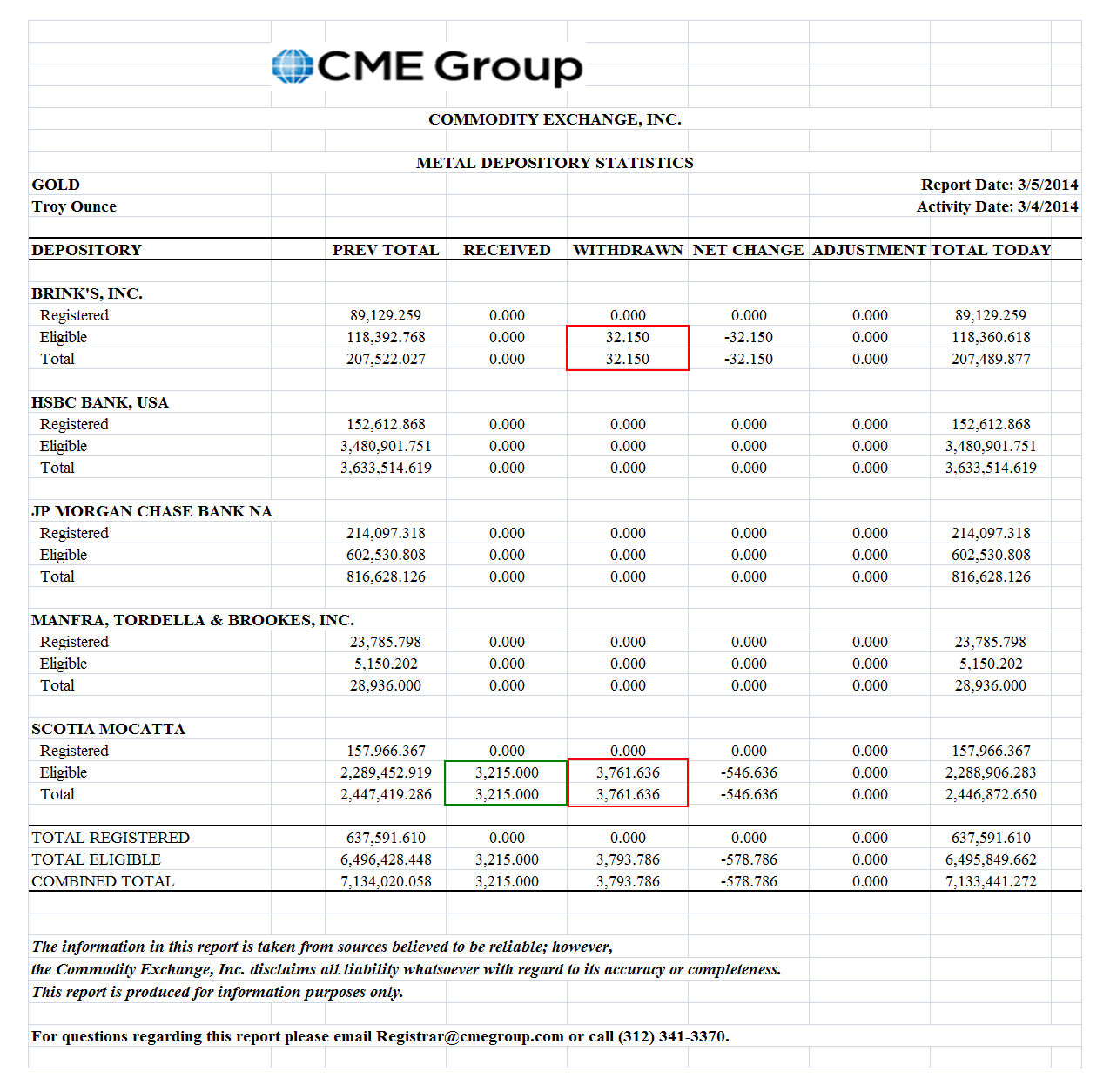
There was no movement of bullion in or out of the Comex warehouses yesterday.

Have a pleasant evening.


SP 500 and NDX Futures Daily Charts - Non-Farm Payrolls Report on Friday


"When in any country the small-farmer class is being squeezed off the land; when its labourers are slaves or serfs; when huge tracts are kept waste to minister to pleasure; when the shibboleth of art is on every man's lips, but ideas of true beauty in very few men's souls; when the business-sharper is the greatest man in the city, and lords it even in the law courts; when class-magistrates, bidding for high office, deal out justice according to the rank of the criminal; when exchanges are turned into great gambling-houses, and senators and men of title are the chief gamblers; when, in short, 'corruption is universal, when there is increasing audacity, increasing greed, increasing fraud, increasing impurity, and these are fed by increasing indulgence and ostentation; when a considerable number of trials in the courts of law bring out the fact that the country in general is now regarded as a prey, upon which any number of vultures, scenting it from afar, may safely light and securely gorge themselves; when the foul tribe is amply replenished by its congeners at home, and foreign invaders find any number of men, bearing good names, ready to assist them in robberies far more cruel and sweeping than those of the footpad or burglar -- when such is the tone of society, and such the idols before which it bends, a nation must be fast going down hill.

A more repulsive picture can hardly be imagined. A mob, a moneyed class, and an aristocracy almost equally worthless, hating each other, and hated by the rest of the world; Italians bitterly jealous of Romans, and only in better plight than the provinces beyond the sea;  more miserable than either, swarms of slaves beginning to brood over revenge as a solace to their sufferings; the land going out of cultivation; native industry swamped by slave-grown imports; the population decreasing; the army degenerating; wars waged as a speculation, but only against the weak; provinces subjected to organized pillage; in the metropolis childish superstition, wholesale luxury, and monstrous vice.

The hour for reform was surely come. Who was to be the man?"

A.H. Beesley, The Gracchi Marius and Sulla, 1921

Stocks shook off the miss in the ISM Service number, and the weaker than expected ADP jobs number, including a huge downward revision in the prior month's number.

There will be a Non-Farm Payrolls report on Friday.   I expect it will be weak, and that weakness will be blamed on the weather.  The Recovery™ will ask to be given a snow day.

It is hard to figure out which way the market will spin this.   Will they view it as a threat to the recovery and consumer demand, or a sign of more Fed largess that will continue to boost financial paper, if not the real economy?  

I suspect the reaction will be largely 'technical' and driven by the large trading desks in a standard wash and rinse of the stock owning public and their institutional proxies. 

The only thing efficient about this market is its extraction of wealth from productive activities to underserving insiders.

Have a pleasant evening.


Sheldon Wolin: Inverted Totalitarianism and the Rise of the Corporatist Neo-Cons


“The enormous gap between what US leaders do in the world and what Americans think their leaders are doing is one of the great propaganda accomplishments of the dominant political mythology.”

Michael Parenti

Note that Sheldon Wolin wrote his essay and book referenced below long before the revelations about the surveillance state, and the bailout and ongoing subsidy of the corporate financial sector by the Treasury and Federal Reserve, with the proposed counterbalance being the imposition of austerity on the greater public, and the confiscation of private savings first through monetary inflation with carefully targeted distribution, preferential immunities, and then through ongoing subsidies and bail-ins.

Although I enjoy Parenti's insight, I think an even greater propaganda accomplishment has been to distort and twist the dissident impulse of a free people into the ironically named libertarian support for dominance of the many by a powerful few, and the subservience of the individual to the corporate State, totalitarianism by another name and shape, but to essentially the same effect. Orwell or Bernays could have not imagined it any better.

And of course, the far left is no better in its elevation of the central power over the rights and integrity of the individual.  Human beings are always an endangered species in times of great change and political polarization.

The Nation
Inverted Totalitarianism
By Sheldon Wolin
May 1, 2003

The war on Iraq has so monopolized public attention as to obscure the regime change taking place in the Homeland. We may have invaded Iraq to bring in democracy and bring down a totalitarian regime, but in the process our own system may be moving closer to the latter and further weakening the former.

The change has been intimated by the sudden popularity of two political terms rarely applied earlier to the American political system. "Empire" and "superpower" both suggest that a new system of power, concentrated and expansive, has come into existence and supplanted the old terms. "Empire" and "superpower" accurately symbolize the projection of American power abroad, but for that reason they obscure the internal consequences.

Consider how odd it would sound if we were to refer to "the Constitution of the American Empire" or "superpower democracy." The reason they ring false is that "constitution" signifies limitations on power, while "democracy" commonly refers to the active involvement of citizens with their government and the responsiveness of government to its citizens. For their part, "empire" and "superpower" stand for the surpassing of limits and the dwarfing of the citizenry.

The increasing power of the state and the declining power of institutions intended to control it has been in the making for some time. The party system is a notorious example. The Republicans have emerged as a unique phenomenon in American history of a fervently doctrinal party, zealous, ruthless, antidemocratic and boasting a near majority. As Republicans have become more ideologically intolerant, the Democrats have shrugged off the liberal label and their critical reform-minded constituencies to embrace centrism and footnote the end of ideology.

In ceasing to be a genuine opposition party the Democrats have smoothed the road to power of a party more than eager to use it to promote empire abroad and corporate power at home. Bear in mind that a ruthless, ideologically driven party with a mass base was a crucial element in all of the twentieth-century regimes seeking total power.

Representative institutions no longer represent voters. Instead, they have been short-circuited, steadily corrupted by an institutionalized system of bribery that renders them responsive to powerful interest groups whose constituencies are the major corporations and wealthiest Americans. The courts, in turn, when they are not increasingly handmaidens of corporate power, are consistently deferential to the claims of national security.

Elections have become heavily subsidized non-events that typically attract at best merely half of an electorate whose information about foreign and domestic politics is filtered through corporate-dominated media. Citizens are manipulated into a nervous state by the media's reports of rampant crime and terrorist networks, by thinly veiled threats of the Attorney General and by their own fears about unemployment. What is crucially important here is not only the expansion of governmental power but the inevitable discrediting of constitutional limitations and institutional processes that discourages the citizenry and leaves them politically apathetic.

No doubt these remarks will be dismissed by some as alarmist, but I want to go further and name the emergent political system "inverted totalitarianism." By inverted I mean that while the current system and its operatives share with Nazism the aspiration toward unlimited power and aggressive expansionism, their methods and actions seem upside down. For example, in Weimar Germany, before the Nazis took power, the "streets" were dominated by totalitarian-oriented gangs of toughs, and whatever there was of democracy was confined to the government. In the United States, however, it is the streets where democracy is most alive--while the real danger lies with an increasingly unbridled government.

Or another example of the inversion: Under Nazi rule there was never any doubt about "big business" being subordinated to the political regime. In the United States, however, it has been apparent for decades that corporate power has become so predominant in the political establishment, particularly in the Republican Party, and so dominant in its influence over policy, as to suggest a role inversion the exact opposite of the Nazis'. At the same time, it is corporate power, as the representative of the dynamic of capitalism and of the ever-expanding power made available by the integration of science and technology with the structure of capitalism, that produces the totalizing drive that, under the Nazis, was supplied by ideological notions such as Lebensraum.

In rebuttal it will be said that there is no domestic equivalent to the Nazi regime of torture, concentration camps or other instruments of terror. But we should remember that for the most part, Nazi terror was not applied to the population generally; rather, the aim was to promote a certain type of shadowy fear--rumors of torture--that would aid in managing and manipulating the populace. Stated positively, the Nazis wanted a mobilized society eager to support endless warfare, expansion and sacrifice for the nation.

While the Nazi totalitarianism strove to give the masses a sense of collective power and strength, Kraft durch Freude ("Strength through joy"), inverted totalitarianism promotes a sense of weakness, of collective futility. While the Nazis wanted a continuously mobilized society that would not only support the regime without complaint and enthusiastically vote "yes" at the periodic plebiscites, inverted totalitarianism wants a politically demobilized society that hardly votes at all. Recall the President's words immediately after the horrendous events of September 11: "Unite, consume and fly," he told the anxious citizenry. Having assimilated terrorism to a "war," he avoided doing what democratic leaders customarily do during wartime: mobilize the citizenry, warn it of impending sacrifices and exhort all citizens to join the "war effort."

Instead, inverted totalitarianism has its own means of promoting generalized fear; not only by sudden "alerts" and periodic announcements about recently discovered terrorist cells or the arrest of shadowy figures or the publicized heavy-handed treatment of aliens and the Devil's Island that is Guantánamo Bay or the sudden fascination with interrogation methods that employ or border on torture, but by a pervasive atmosphere of fear abetted by a corporate economy of ruthless downsizing, withdrawal or reduction of pension and health benefits; a corporate political system that relentlessly threatens to privatize Social Security and the modest health benefits available, especially to the poor. With such instrumentalities for promoting uncertainty and dependence, it is almost overkill for inverted totalitarianism to employ a system of criminal justice that is punitive in the extreme, relishes the death penalty and is consistently biased against the powerless.

Thus the elements are in place: a weak legislative body, a legal system that is both compliant and repressive, a party system in which one party, whether in opposition or in the majority, is bent upon reconstituting the existing system so as to permanently favor a ruling class of the wealthy, the well-connected and the corporate, while leaving the poorer citizens with a sense of helplessness and political despair, and, at the same time, keeping the middle classes dangling between fear of unemployment and expectations of fantastic rewards once the new economy recovers. That scheme is abetted by a sycophantic and increasingly concentrated media; by the integration of universities with their corporate benefactors; by a propaganda machine institutionalized in well-funded think tanks and conservative foundations; by the increasingly closer cooperation between local police and national law enforcement agencies aimed at identifying terrorists, suspicious aliens and domestic dissidents.

What is at stake, then, is nothing less than the attempted transformation of a tolerably free society into a variant of the extreme regimes of the past century. In that context, the national elections of 2004 represent a crisis in its original meaning, a turning point. The question for citizens is: Which way?

Sheldon Wolin is the author of Alexis de Tocqueville: Man Between Two Worlds and Democracy Incorporated: Managed Democracy and the Specter of Inverted Totalitarianism.

Here is a review of Wolin's book 'Democracy Incorporated' by Chalmers Johnson

Inverted Totalitarianism: A New Way of Understanding How the U.S. Is Controlled.


04 March 2014

Gold Daily and Silver Weekly Charts - Ebb and Flow - Gresham's Law


"When a government overvalues one type of money and undervalues another, the undervalued money will leave the country or disappear from circulation into hoards, while the overvalued money will flood into circulation."

Gresham's Law
In case you were wondering why gold is flowing from west to east, it is Gresham's Law in action.  Nothing could be clearer.  What we have not yet seen is mispriced paper flowing back en masse into a vortex of defaults on counterparty risk.

It was 'risk on' in the markets as Russia's Putin reassured the world that he does not intend to invade the Ukraine, but will protect Russia's interests in the Crimea, a traditional base for their navy.

And so stocks soared, and gold and silver gave up some of the ground which they had taken yesterday.

So the ebb was in price, and there was no flow out of the Comex gold warehouse.

I suspect that March will be relatively quiet now, save for the stray exogenous event as we saw yesterday. The line in the sand has long been drawn on the charts, and the Anglo-American banking cartel is likely to try and hold the price about where it is now.

The wild card is the continuing physical offtake of real bullion in the Asia markets, particularly India and China.

President Obama submitted a 2015 budget today that was largely unnoticed with all the sabre rattling being done of the Congressional neo-cons.   It has an interesting infrastructure proposal, and some moves towards real tax reform by closing the massive carried interest loophole that serves the financiers and distorts capital allocation towards gimmickry. 

Given the broken state of the political landscape I sincerely doubt that anything constructive will be done.   Until the financial system is reformed, and balance is restored, there will be no sustainable recovery.   The plundering of the real economy by the moneyed interests will continue until exhaustion or collapse.

Bank of England Seeks to Suspend Derivatives Default Clause Now to Prevent Another Lehman.

I think when the time comes, when people finally wake up to the need to protect some portion of their wealth, there will be little or no physical gold or silver bullion available anywhere, at almost any price, for some period of time.

There will be a market dislocation as we saw in the credit markets when Lehman Brothers collapsed, and the pyramid of leveraged paper and cross claims came to a complete halt overnight, with no one knowing what is the real value of paper, and who owes what to whom.    It will be a cavalcade of broken promises and false representations.

And the Fed may face a daunting task in printing its way out of that one.  If it happens as I think, it will be a reckoning to remember.  It will be MF Global, writ large.

Have a pleasant evening.


SP 500 and NDX Futures Daily Charts - Rally Time, For Now


The markets took off higher overnight as Vladimir Putin indicated he was not interested in invading the Ukraine, but has moved to protect Russia's interest in the Crimea, which is their traditional naval base on the Black Sea.

I will not get into the response from Republicans like John McCain, since much of what they say is just partisan theater, politics as usual,  but let it suffice to say that it is a relief that the neo-cons are out of power and out of favor. One can forget how truly misguided they are.   I don't think they realize how the nation's attitude towards their discretionary wars has changed over the past thirteen years of continuous war. 

So what next. Despite the euphoria on Wall Street, the economic signs are still weak. I was reading the Fed's Mission Accomplished article by Tim Duy about those in the Fed who are urging higher interest rates now because of the 'tight labor market' and wonder to myself, 'what are they thinking?'

It is a tight labor market, if you are applying for a part time job flipping burgers or stacking shelves, but the recovery is tightly constrained to those economic sectors which have financialized the real economy, largely to the detriment of the greater public.

This is not to say that blowing a stock market bubble to cure the housing bubble that was created to offset the tech bubble is a good idea, but the Fed is celebrating The Recovery™ very prematurely, judging by the slack economic demand, continuing stagnation in real disposable income, and high economic uncertainty and insecurity enjoyed by most Americans.

Have a pleasant evening.