29 August 2015

Leveraged Financial Speculation to GDP in the US at a Familiar Peak, Once Again


"I believe myriad global “carry trades” – speculative leveraging of securities – are the unappreciated prevailing source of finance behind interlinked global securities market Bubbles. They amount to this cycle’s government-directed finance unleashed to jump-start a global reflationary cycle.

I’m convinced that perhaps Trillions worth of speculative leverage have accumulated throughout global currency and securities markets at least partially based on the perception that policymakers condone this leverage as integral (as mortgage finance was previously) in the fight against mounting global deflationary forces."

Doug Noland, Carry Trades and Trend-Following Strategies

The basic diagnosis is correct.   But the nature of the disease, and the appropriate remedies, may not be so easily apprehended, except through simple common sense.  And that is a rare commodity these days.

Like a dog returns to its vomit, the Fed's speculative bubble policy enables the one percent to once again feast on the carcass of the real economy.

'And no one could have ever seen it coming.'

Once is an accident.

Twice is no coincidence.

Remind yourself what has changed since then.  Banks have gotten bigger.   Schemes and fraud continue.

What will the third time be like?  And the fourth?

Do you think that Jamie bet Lloyd a dollar that they couldn't do it again?

Should we ask them to please behave, levy some token fines, watch the politicans yell and posture in some toothless public hearings, let all of them keep their jobs and their bonuses?   And then bail them out, wind up the old Victrola,  and have another go at the same old thing again?

Maybe we can vote for one of their hired servants, or skip the middlemen and vote for one of the arrogant hustlers themselves, and hope they get tired of taking us for a ride before we all go broke.

This policy we have now is the trickle down stimulus that the wealthy financiers have been sucking on with every opportunity that they have made for themselves since the days of Andrew Jackson. Whenever the ability to create and distribute money has been handed over by a craven Congress to private corporations and banking cartels without sufficient oversight and regulation, excessive speculation, financial recklessness, and moral hazard have acted like a plague of misery and stagnation on the real economy.

"Gentlemen! I too have been a close observer of the doings of the Bank of the United States. I have had men watching you for a long time, and am convinced that you have used the funds of the Bank to speculate in the breadstuffs of the country. When you won, you divided the profits amongst you, and when you lost, you charged it to the Bank.

You tell me that if I take the deposits from the Bank and annul its charter I shall ruin ten thousand families. That may be true, gentlemen, but that is your sin! Should I let you go on, you will ruin fifty thousand families, and that would be my sin!

You are a den of vipers and thieves. I have determined to rout you out, and by the Eternal, (bringing his fist down on the table) I will rout you out."

From the original minutes of the Philadelphia bankers sent to meet with President Jackson February 1834, from Andrew Jackson and the Bank of the United States (1928) by Stan V. Henkels

I believe all of the above is entirely possible.  Because we still have an unashamed cadre of quack economists and their ideologically blind followers blaming the victims,  prescribing harsh punishments for the weak, laying all the blame on 'government' and not corrupt officials on the payrolls of Big Money, and giving the gods of the market and their masters of the universe a big kiss on the head, and expecting them to just do the right thing the next time out of the natural goodness of their unrestrained natures the next time.  What could go wrong with that?

Genuine reform.   It's too much work, and too much trouble.


Related:  Comprehensive Tally of Banker Fraud

h/t Jesse Felder for the chart


Gold Seasonality And Average Intraday Price Movement


It will be interesting to see how gold moves in the latter half of this year.

As for the intraday movement, the impact of the London - New York on the gold trade is hard to miss.

It might not be too glib to say that the Anglo-Americans are sellling, and the rest of the world is buying overnight.

I certainly hope that this sort of long term price manipulation does not catch up to them on the supply side.


28 August 2015

Recent Trends in the Premium For Silver Coins Versus Spot Silver


"One important aspect of the physical market that is often overlooked is the premium it commands over spot price. Right before the Global Financial Crisis in 2008, the spot Silver price fell as low as USD 9 per oz., whereas the price of a 1 oz. Silver Eagle was around USD 17 on the wholesale market and even higher on the retail market! That’s a price premium of 188%!

That means that if you had held 100 oz. of paper Silver, you might have had to liquidate that for USD 900 (assuming the market was not halted for trading then), whereas if you had held 100 pieces of 1 oz. Silver Eagle coins, you would have gotten at least USD 1700 for them if not more."

BullionStar, The Difference in Paper and Physical Gold and Silver in times of Crisis


For the charts below the price data is the 'Ask'  live price from a major online supplier.

As always, if it is data related to the gold and silver markets and it is publicly available, Nick Laird at goldchartsrus.com is probably keeping track of it.


Shanghai Exchange Has 73 Tonnes of Gold Withdrawn In 4th Largest Week In History


There were a little over 73 tonnes of physical gold withdrawn from the Shanghai Gold Exchange in the latest week ending August 21st.

This is the 4th largest withdrawal of bullion in its history.

It is hard to tell what exactly is going on in such a dodgy, highly leveraged market, with its determined attempts to keep the price knocked lower so often during the late London to NY trading hours.

But I am sensing a change in the market, and more things running under the surface than meets the eye.

Goldman is no major player in the gold bullion market, but it did strike me as odd that they are suddenly stopping large amounts of bullion for their own house account this month. It is not that they are a player in gold, because they are not.  But that they are wired into many sources of information, are good at spotting trends, and are more like a hedge fund, comfortable running on the edge of the markets.

And the gold chart, for what it is worth in these times of market interventions, seems to be trying to form a rounded bottom in the form of  a cup and handle, with a successful retest of the handle this week.  This calls out a price around the bottom of the old trend channel at 1270.

It could also be nothing.  I will pursue the details of such a chart formation if we see the right kinds of follow through next week.

And I will certainly be watching silver very carefully for any signs of life.  It may be pivotal next month.

Let's see what next week brings.  Gold is just one market among many, and it is certainly not the largest one in play.

And while I have your attention, I thought I would include a long term chart of the relation of deliverable gold at current prices to open interest.  It might mean nothing.  But it doesn't seem to be anything familiar before 2013
.

The charts below courtesy of data wrangler Nick Laird at goldchartsrus.com.


Gold Daily and Silver Weekly Charts - Maintaining Confidence - Keep On Dancing


The action was a bit heavy in the metals today, as the Powers-That-Be quietly attempted to restore confidence and a sense of well-being and recovery after the somewhat disconcerting equity market plunge of Monday.

There was intraday commentary here about some interesting Goldman Sachs activity in an otherwise exceptionally sleepy week at The Bucket Shop.

People often ask me for a possible motive as to why central banks might care about gold and silver. Willem Middelkoop does a decent job of briefly explaining why in the first pictorial below.  It is all a part of the confidence game, when a series of bad decisions place a strain on one's full faith and credit.

The goal of the financial class is to keep the music going, and the public out there on the floor dancing so they don't have time to think.

Still out there bottom watching.

Have a pleasant weekend.


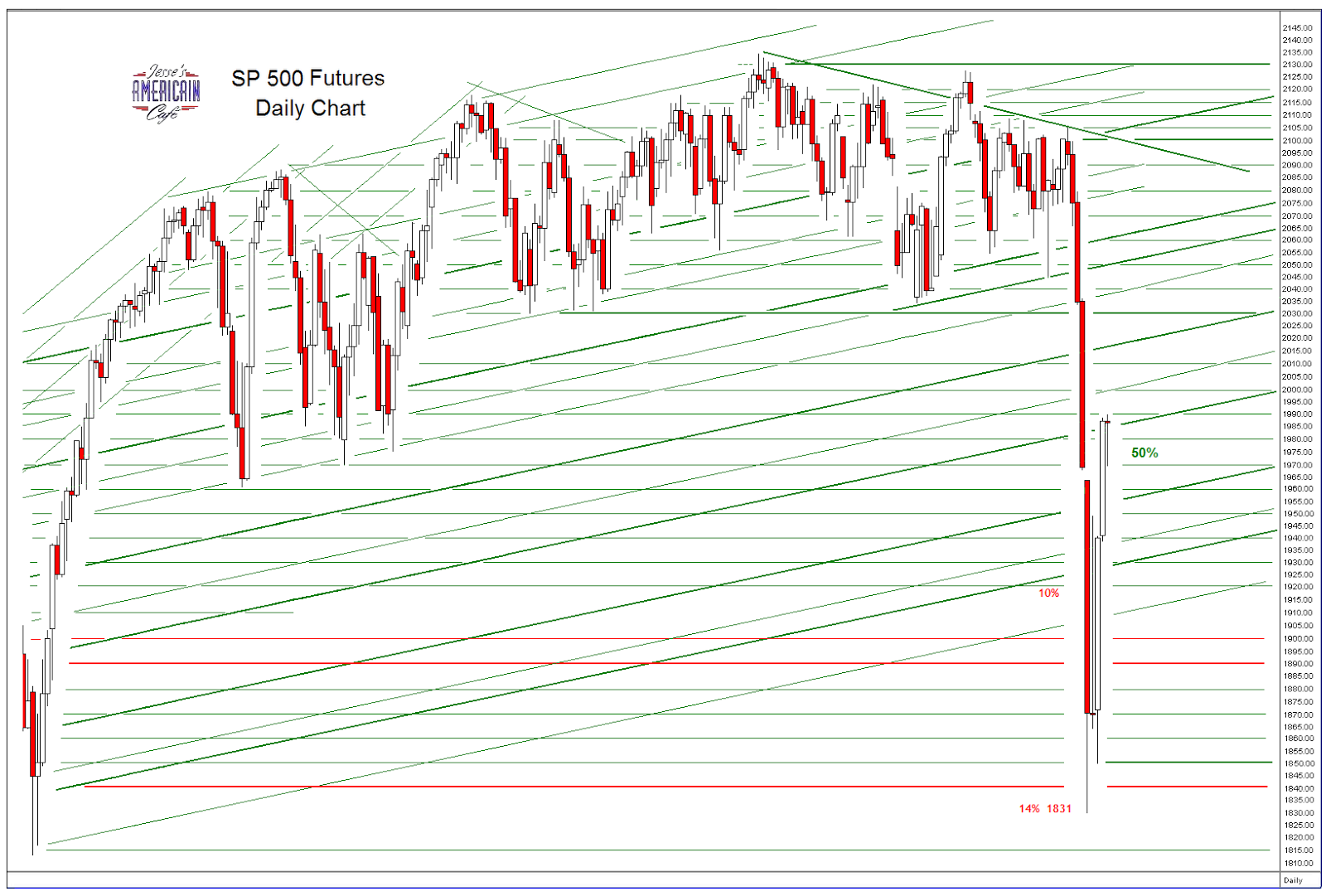
SP 500 and NDX Futures Daily Charts - Fly Me To the Moon


Qualis dominus talis est servus.
As is the master, so is the servant.

Titus Petronius

Stocks came in weakly, but managed to rally in the last hour to closely largely unchanged.

The GDP revision for 2Q yesterday was a bit much.

The conversation on financial tv today was replete with interviews from that moveable feast of finance, from the rarified world at Jackson Hole, where the black swans of monetary policy return every so often to molt old forecasts and acquire new ones that are certain to work better than the last seven years of the same old thing.

Mostly it is just the usual nonsense. Alan Blinder had some interesting and surprisingly realistic things to say. Most of the others were just mouth breathing the talking points about our exceptional and improving economy which will allow the Fed to raise interest rates.

The research paper from the Fed asserting that the US is relatively immune (ok they said insulated) from global currency and economic shocks because of the position of the dollar as the settling currency of choice for international invoices was-- interesting.  Why is it that so many economic, and especially monetary, theories feel so comfortable inhabiting an alternate universe where trees are blue and pigs can fly?

And as a particularly astute reader observed, if this is actually true, is there any wonder why the rest of the world would resent the dollar hegemony if it grants that sort of power to the single nation that controls it?  That they are able to wreak havoc on the rest of the world, exporting malinvestment and willfully fraudulent financial instruments, without having to endure any consequences?

Well it doesn't work so nicely as that, but yes they do resent it for other reasons, and they have been doing more than resenting it for some time now.  And that is the basis for the 'currency war' that these jokers still do not understand. They think it is only 'currency devaluations' which, along with tariffs, was the tactic of choice in the last currency war in the 1930's.

But the one that left me gaping was the tendentious conversation this afternoon on Bloomberg about how fragile China and its markets are. And as evidence they cited the 'obvious interventions' in their stock market this week, wherein the Chinese markets slump, but then miraculously recover in the last hours of trading. They are obviously doing this so the leadership will not be embarrassed for their 70th commemoration of the end of WWII next week. Which by the way, the US is gracelessly boycotting.

Knock, knock, hello? Is self-awareness or unintentional irony at home?

Is there any doubt that we have been seeing the exact types of intervention by a powerful unseen hand in our own stock markets this week, on steroids, after the Monday flash crash? Does that mean that our economy is fragile and doomed as well?

Do these people actually believe what they are saying, or is this just some clumsy attempt to try to reassure our public that if their public gets into trouble there is no need to panic because, wait for it, we are so much better, more wisely and so much more virtuously blessed to be led by those archangels of benevolent wisdom in Washington and New York.

One can only wonder.

Have a pleasant weekend.


JPM Customer Issues and Goldman Takes Another 54,100 Ounces of Gold For the 'House Account'


The receipts for another large chunk of bullion changed ownership from a JPM Customer to the Goldman 'house account' at $1,122 per ounce.

With all the usual caveats, and just taking note.

This is especially intriguing since Goldman has been publicly beating the drums for gold to drop well below $1000.  Perhaps, like Rick who moved to Casablanca 'for the waters,' they are merely misinformed.

We ought not to presume anything about how naive the customer might be, or the sly cunning of any particular buyer.  For all we know the 'customer' could be a large and highly competent ETF or fund, and not some naive or desperate or perhaps whimsical individual.

And as for the buyer and its motives, my friend Dave offered some possible insight on this phenomenon here.   

While it is a hypothesis based on a correlation founded in possibly disparate facts, it is no more untoward than those who will simply dismiss the whole thing, and apparently ascribe no significance to almost anything whatsoever, other than the price of gold and silver must go lower. There is no truth, and there are no fundamentals, when things and their values are merely what we say that they are.

And I am sure that all of this is simply more of God's work, and not sly cunning in service to earthly greed, from such a benevolent and public-spirited institution.