17 December 2015

Gold Daily and Silver Weekly Charts - Gloria In Excelsis Deo


The precious metals' gains from yesterday were smacked lower in the London PM fix and the NY open, as the currency reversal higher in the dollar took down almost the entire commodity index as expressed in the buck.

Gold and silver are now both short term oversold.

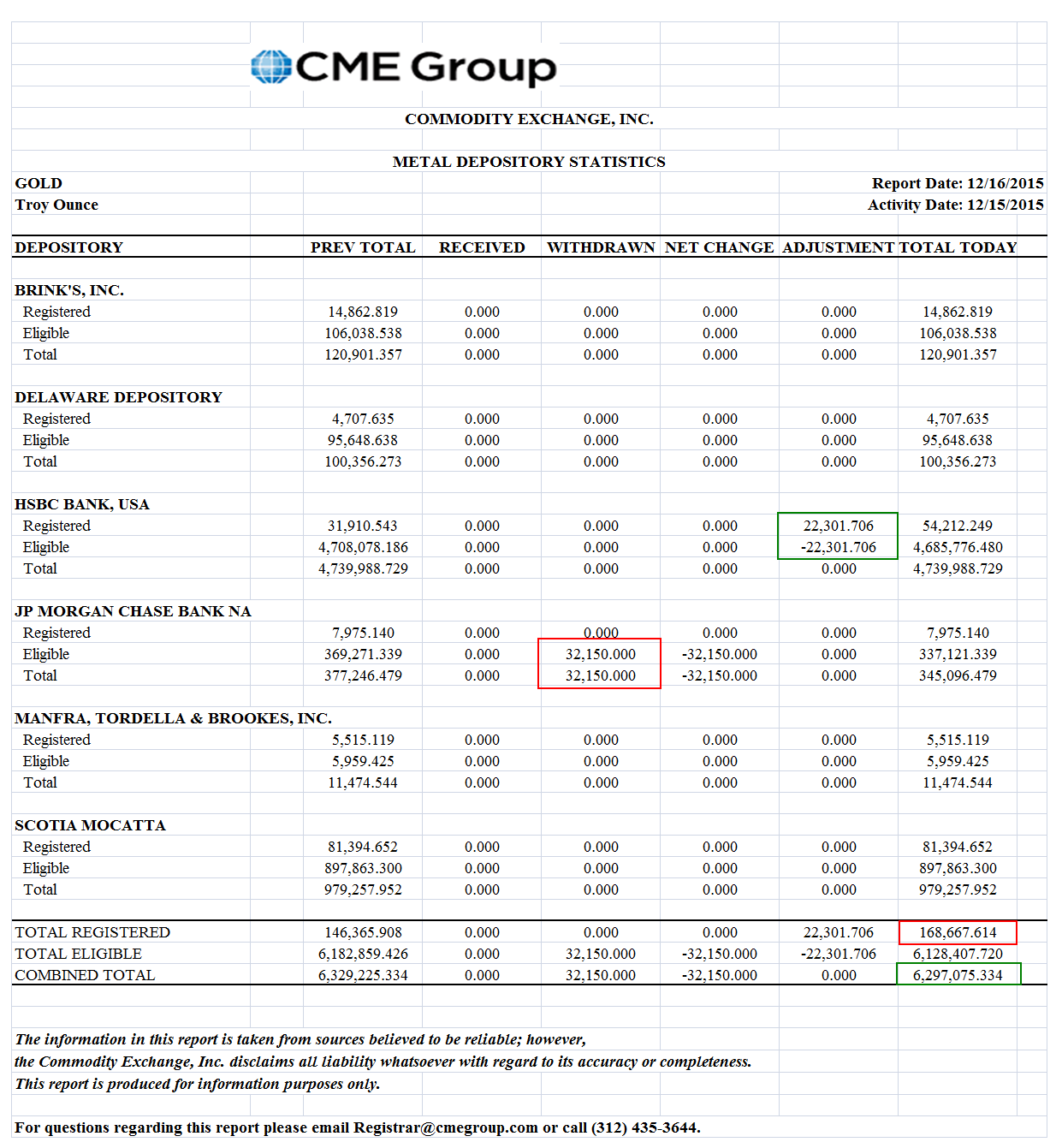
There was another large gold delivery 'house to house' at The Bucket Shop from HSBC/Nova to JPM. This has been the theme for this month. I would not be surprised to see JPM continuing to take the role as 'stopper' of customers standing for deliveries.

There will be a quad witching option expiration in the US equity markets tomorrow.

The weather report is for antics abounding.

And next week is Christmas.  Let's see if the annual 'Santa Claus' rally shows up.

Have a pleasant evening.


SP 500 and NDX Futures Daily Charts - Quad Witching Expiry Tomorrow


"Every century is like every other, and to those who live in it seems worse than all times before it... thus much of comfort do we gain from what has been hitherto, not to despond, not to be dismayed, not to be anxious, at the troubles which encompass us. They have ever been; they ever shall be; they are our portion."

John H. Newman

All the gains from yesterday were swept aside.

In a very real sense, I believe that yesterday was a wash and rinse setup for today ahead of the quad witching expiration in stocks tomorrow.

The economic news this morning continued to be dour.

Have a pleasant evening.


NAV Premiums of Precious Metals Funds and Trusts - Quad Witching Expiry Tomorrow


It appears that the Central Gold Trust, Sprott Gold and Sprott Silver have all sold some bullion to return their cash assets back into the black.

The only one that did not have to sell was the Central Fund. Although it has the currently worst discount to NAV, as it generally does, it now has one of the better cash to expense positions perhaps of these.

Weathering the storm and all that.


16 December 2015

Darth Trump


And here is where The Donald got his public speaking mannerisms.


Gold Daily and Silver Weekly Charts - Gold and Silver Rally Back From Antic Lows


And so the Fed raised rates, in the manner in which you would have expected if you frequent this site.

We are not quite out of the woods yet since the markets are certainly not transparent and efficient by any means, and this Friday is a quad witch. While it does not directly involve the metals at The Bucket Shop, it certainly has plenty of intermarket connections through the miners and the ETFs.

There was another handoff of gold from the house account of HSBC to the house account of JPM.

I suspect at some point if we get some customer who is willing to stand for delivery, JPM is the designated stopper.

The other day I read a fairly contrived comparison of the Comex Hong Kong to The Bucket Shop that was so twisted out of meaning as to be almost grotesque

To elaborate, as you may notice I often include the 'loco Hong Kong' Comex licensed warehouses in the gold reports each day, of which at this time Brinks is the only one of note.  

And as you may have further noticed, there is no 'registered' category for the gold bullion there, and large quantities of it tend to get taken out of the warehouse(s) on a fairly regular basis.  So obviously comparisons of the 'leverage' feature, or potential claims per ounce at a given price from The Bucket Shop is meaningless.

The reason why is that the Comex Hong Kong, such as it is, is not really in practice a paper market dealing in synthetic gold that fluffs around between players, rarely going anywhere.  Rather, it is significantly an 'over-the-counter' market in which, and such a thing is hard to believe these days, customers actually BUY gold and take it out of the warehouse to be used in some manner other than for wagering.

I am wondering if Harriet H., the Ex-Executive Director of the Comex who just took a permanent and unexpected departure from her position, had set this one up, much to the chagrin of the synthetic gold crowd.  It certainly does most thing in quite the opposite manner from New York.

Have a pleasant evening.


SP 500 and NDX Futures Daily Charts - Obvious


If Yellen had written a personal email to everyone in the markets I do not think what the Fed did today could have been more obvious.

The 'big tickle' was supposed to be the use of the word 'gradual' rather than 'measured.'

If the economic data and the dovishness of the Fed did not make that form for this current 'policy tightening cycle' completely obvious one can only wonder what it would take.

Let's see how the wiseguys, having dissembled their way to mid-week, can figure out new ways to skin the naive and the trading tourists.

Have a pleasant evening.


Fed Raises Benchmark Rate 25 Basis Points, Says 'Gradual' Instead of 'Measured'


The distinction is that 'gradual' means as needed, or as seen to be necessary by the ongoing data.

'Measured' was meant to imply a steady 25 basis point at a time rate of increases to an objective which some thought to be 100 bp.

The Fed also raised the interest paid to the Banks on Required and Excess Reserves to 50 bp.

In the second press release below, the NY Fed says that they have about $2 Trillion at the ready to back up the Fed's targets.

As suspected, the Fed raised, but it is very likely to be quite gradual, since the data does not fully support it despite all the verbage which has been put out there to justify it.

So to accentuate a very important point, this is not your father's interest rate tightening cycle.

The Fed is raising rates in order to 'end' ZIRP and to begin to provide themselves some maneuvering room out of the policy corner into which they had painted themselves in their thrashing within a credibility trap of lack of reform, top down stimulus, and thereby a continuing lack of broad, organic recovery which is apparent to all those who are not blinded by an ideological bias, a preoccupation with abstract and otherworldly models, and/or their paychecks.

Federal Open Market Committee - December Policy Statement
Release Date: December 16, 2015

Information received since the Federal Open Market Committee met in October suggests that economic activity has been expanding at a moderate pace. Household spending and business fixed investment have been increasing at solid rates in recent months, and the housing sector has improved further; however, net exports have been soft.

A range of recent labor market indicators, including ongoing job gains and declining unemployment, shows further improvement and confirms that underutilization of labor resources has diminished appreciably since early this year. Inflation has continued to run below the Committee's 2 percent longer-run objective, partly reflecting declines in energy prices and in prices of non-energy imports. Market-based measures of inflation compensation remain low; some survey-based measures of longer-term inflation expectations have edged down.

Consistent with its statutory mandate, the Committee seeks to foster maximum employment and price stability. The Committee currently expects that, with gradual adjustments in the stance of monetary policy, economic activity will continue to expand at a moderate pace and labor market indicators will continue to strengthen.

Overall, taking into account domestic and international developments, the Committee sees the risks to the outlook for both economic activity and the labor market as balanced. Inflation is expected to rise to 2 percent over the medium term as the transitory effects of declines in energy and import prices dissipate and the labor market strengthens further. The Committee continues to monitor inflation developments closely.

The Committee judges that there has been considerable improvement in labor market conditions this year, and it is reasonably confident that inflation will rise, over the medium term, to its 2 percent objective. Given the economic outlook, and recognizing the time it takes for policy actions to affect future economic outcomes, the Committee decided to raise the target range for the federal funds rate to 1/4 to 1/2 percent. The stance of monetary policy remains accommodative after this increase, thereby supporting further improvement in labor market conditions and a return to 2 percent inflation.

In determining the timing and size of future adjustments to the target range for the federal funds rate, the Committee will assess realized and expected economic conditions relative to its objectives of maximum employment and 2 percent inflation. This assessment will take into account a wide range of information, including measures of labor market conditions, indicators of inflation pressures and inflation expectations, and readings on financial and international developments.

In light of the current shortfall of inflation from 2 percent, the Committee will carefully monitor actual and expected progress toward its inflation goal. The Committee expects that economic conditions will evolve in a manner that will warrant only gradual increases in the federal funds rate; the federal funds rate is likely to remain, for some time, below levels that are expected to prevail in the longer run. However, the actual path of the federal funds rate will depend on the economic outlook as informed by incoming data.

The Committee is maintaining its existing policy of reinvesting principal payments from its holdings of agency debt and agency mortgage-backed securities in agency mortgage-backed securities and of rolling over maturing Treasury securities at auction, and it anticipates doing so until normalization of the level of the federal funds rate is well under way. This policy, by keeping the Committee's holdings of longer-term securities at sizable levels, should help maintain accommodative financial conditions.

Voting for the FOMC monetary policy action were: Janet L. Yellen, Chair; William C. Dudley, Vice Chairman; Lael Brainard; Charles L. Evans; Stanley Fischer; Jeffrey M. Lacker; Dennis P. Lockhart; Jerome H. Powell; Daniel K. Tarullo; and John C. Williams.

Approximately $2 Trillion is available to the NY Fed to implement this policy change, although I would hesitate to think of this as anything near a hard limitation to the Treasury's willingness to spend or the Fed's willingness to monetize, and to tinker with the markets through their trading desks and those of their associated Banks.

Federal Reserve Bank of New York
Statement Regarding Overnight Reverse Repurchase Agreements
December 16, 2015

During its meeting on December 15–16, 2015, the Federal Open Market Committee (FOMC) directed the Open Market Trading Desk (the Desk) at the Federal Reserve Bank of New York (New York Fed), effective December 17, 2015, to undertake open market operations as necessary to maintain the federal funds rate in a target range of ¼ to ½ percent, including overnight reverse repurchase operations (ON RRPs) at an offering rate of 0.25 percent, in amounts limited only by the value of Treasury securities held outright in the System Open Market Account (SOMA) that are available for such operations and by a per-counterparty limit of $30 billion per day...

...the Desk anticipates that around $2 trillion of Treasury securities will be available for ON RRP operations to fulfill the FOMC’s domestic policy directive.   In the highly unlikely event that the value of bids received in an ON RRP operation exceeds the amount of available securities, the Desk will allocate awards using a single-price auction based on the stop-out rate at which the overall size limit is reached, with all bids below this rate awarded in full at the stop-out rate and all bids at this rate awarded on a pro rata basis at the stop-out rate.