“We are slow to master the great truth that even now Christ is, as it were, walking among us, and by His hand, or eye, or voice, bidding us to follow Him. We do not understand that His call is a thing that takes place now. We think it took place in the Apostles' days, but we do not believe in it; we do not look for it in our own case.
Every century is like every other, and to those who live in it seems worse than all times before it.
God alone knows the day and the hour when what will at length be, that which He is ever threatening; meanwhile, thus much of comfort do we gain from what has been hitherto, not to despond, not to be dismayed, not to be anxious, at the troubles which encompass us. They have ever been; they ever shall be; they are our portion.
God's presence is not discerned at the time when it is upon us, but afterwards, when we look back upon what is gone and over. The world seems to go on as usual. There is nothing of heaven in the face of society, in the news of the day.
And yet the ever-blessed Spirit of God is there, ten times more glorious, more powerful than when He trod the earth in our flesh.
God beholds you. He calls you by your name. He sees you and understands you as He made you. He knows what is in you, all your peculiar feelings and thoughts, your dispositions and likings, your strengths and your weaknesses. He views you in your day of rejoicing and in your day of sorrow. He sympathizes in your hopes and your temptations. He interests Himself in all your anxieties and remembrances, all the risings and fallings of your spirit.
He encompasses you round and bears you in His arms. He notes your very countenance, whether smiling or in tears. He looks tenderly upon you. He hears your voice, the beating of your heart, and your very breathing. You do not love yourself better than He loves you. You cannot shrink from pain more than He dislikes your bearing it; and if He puts it on you, it is as you would put it on yourself, if you would be wise, for a greater good afterwards.
There is an inward world, which none see but those who belong to it. There is an inward world into which they enter who come to Christ, though to men in general they seem as before. If they drank of Christ's cup it is not with them as in time past. They came for a blessing, and they have found a work.
To their surprise, as time goes on, they find that their lot is changed. They find that in one shape or another adversity happens to them. If they refuse to afflict themselves, God afflicts them.
Why did you taste of His heavenly feast, but that it might work in you—why did you kneel beneath His hand, but that He might leave on you the print of His wounds?
God has created me to do Him some definite service; He has committed some work to me which He has not committed to another. I have my mission— I may never know it in this life but I shall be told it in the next.
I am a link in a chain, a bond of connection between persons. He has not created me for naught.
I shall do good, I shall do His work. I shall be an angel of peace, a preacher of truth in my own place while not intending it if I do but keep His commandments.
Therefore I will trust Him. Whatever I am, I can never be thrown away. If I am in sickness, my sickness may serve Him; in perplexity, my perplexity may serve Him. If I am in sorrow, my sorrow may serve Him.
He does nothing in vain. He knows what He is about.
He may take away my friends. He may throw me among strangers. He may make me feel desolate, make my spirits sink, hide my future from me— still He knows what He is about.
Let us feel what we really are— sinners attempting great things. Let us simply obey God's will, whatever may come. He can turn all things to our eternal good. Easter day is preceded by the forty days of Lent, to show us that they only who sow in tears shall reap in joy.
Contemplate then yourself, not as yourself, but as you are in the Eternal God. Fall down in astonishment at the glories which are around you and in you, poured to and fro in such a wonderful way that you are dissolved into the Kingdom of God.
The more we do, the more shall we trust in Christ; and that surely is no morose doctrine, that leads us to soothe our selfish restlessness, and forget our fears, in the vision of the Incarnate Son of God.
May the Lord support us all the day long, till the shades lengthen, and the evening comes, and the busy world is hushed, and the fever of life is over, and our work is done.
Then in His mercy may He give us safe lodging, and a holy rest, and peace at last.”
John Henry Newman
"In the Incarnation the whole human race recovers the dignity of the image of God. Thereafter, any attack even on the least of men is an attack on Christ, who took on the form of man, and in his own Person restored the image of God in all. Through our relationship with the Incarnation, we recover our true humanity, and at the same time are delivered from that perverse individualism which is the consequence of sin, and recover our solidarity with all mankind."
Dietrich Bonhoeffer
06 August 2017
For Friends In Troubled Times
04 August 2017
Only Ten Years After the Last Financial Crisis the Banks Are At It Again
Apparently the Banks have been lobbying heavily, and expending significant amounts of money again, leaning on their Congressmen and pressuring regulators, saying that their capital standards need to be relaxed so that they can make more loans to stimulate economic growth.
But that, according to the FDIC Vice-Chairman, is utter nonsense.
"Hoenig, who was a high-ranking Federal Reserve official during the crisis, cautioned Senate Banking Committee Chairman Mike Crapo and the committee's senior Democrat, Sherrod Brown, "against relaxing current capital requirements and allowing the largest banks to increase their already highly leveraged positions."
Using public data to analyze the 10 largest bank holding companies, Hoenig found they will distribute more than 100 percent of the current year's earnings to investors, which could have supported to $537 billion in new loans.
On an annualized basis they will distribute 99 percent of net income, he added.
He added that if banks kept their share buybacks, totaling $83 billion, then under current capital rules they could boost commercial and consumer loans by $741.5 billion.
'While distributing all of today’s income to shareholders may be received well in the short run, it can undermine their future returns and weaken the growth outlook for the larger economy,' he wrote."
Reuters, Payouts, not capital requirements, to blame for fewer bank loans: FDIC vice chairman
The Banks are spending a substantial amount of their current income on dividends to shareholders and very large stock buyback programs designed to increase their share prices.
The chart below shows in the first column the almost shocking Payout Ratios being maintained by some of the Banks.
In the second column there is an estimate of how many more loans the Banks could have made at current capital requirements if they had not spent their cash buying back their own shares.
Since Bank managers are personally heavily rewarded on the share price of the Banks through bonuses and share options, the cause of this is clear.
There has been insufficient reform in the Banks. Lending and basic banking would better function like a utility, with much more efficient and effective levels of risk management.
Basic banking including loans and deposits ought not to be an adjunct or cover for the kinds of speculation and gambling with other people's money that led to the last financial crisis that brought the global economy to its knees.
This problem was addressed by Glass-Steagall and functioned very well, keeping the banking system essentially sound for almost seventy years, until it was repealed under the Clinton Administration in conjunction with a Congress all too willing to sacrifice the interests of their voters to Big Money.
And that is why Hillary lost the presidential election, and why the Democrats are in a steady decline as a political party despite the ability to raise huge sums of money from their wealthy patrons.

"If at times his [Andrew Jackson's] passionate devotion to this cause of the average citizen lent an amazing zeal to his thoughts, to his speech and to his actions, the people loved him for it the more. They realized the intensity of the attacks made by his enemies, by those who, thrust from power and position, pursued him with relentless hatred. The beneficiaries of the abuses to which he put an end pursued him with all the violence that political passions can generate. But the people of his day were not deceived. They loved him for the enemies he had made.
Backed not only by his party but by thousands who had belonged to other parties or belonged to no party at all, Andrew Jackson was compelled to fight every inch of the way for the ideals and the policies of the Democratic Republic which was his ideal.
An overwhelming proportion of the material power of the Nation was arrayed against him. The great media for the dissemination of information and the molding of public opinion fought him. Haughty and sterile intellectualism opposed him. Musty reaction disapproved him. Hollow and outworn traditionalism shook a trembling finger at him. It seemed sometimes that all were against him—all but the people of the United States.
Because history so often repeats itself, let me analyze further. Andrew Jackson stands out in the century and a half of our independent history not merely because he was two-fisted, not merely because he fought for the people's rights, but because, through his career, he did as much as any man in our history to increase, on the part of the voters, knowledge of public problems and an interest in their solution. Following the fundamentals of Jefferson, he adhered to the broad philosophy that decisions made by the average of the voters would be more greatly enduring for, and helpful to, the Nation than decisions made by small segments of the electorate representing small or special classes endowed with great advantages of social or economic power.
He, like Jefferson, faced with the grave difficulty of disseminating facts to the electorate, to the voters as a whole, was compelled to combat epithets, generalities, misrepresentation and the suppression of facts by the process of asking his supporters, and indeed all citizens, to constitute themselves informal committees for the purpose of obtaining the facts and of spreading them abroad among their friends, their associates and their fellow workers."
Franklin D. Roosevelt, Jackson Day Dinner Address, Washington, D.C.
January 8, 1936

It is telling that the current crop of Democratic Party plutocrats want nothing to do with the policies of Jackson or Roosevelt. I would like to think that they are merely mistaken. But it is clear that they are serving the corporate masters of Big Money that they love the most. As for the Republicans, they have long ago betrayed their roots, and seem to be beyond all hope of reform.
03 August 2017
Stocks and Precious Metals Charts - And When the Bough Breaks
Non-Farm Payrolls Report tomorrow.
The markets have been 'marking time' ahead of it with a sideways chop.
Let's see if the number tomorrow deviates from expectations enough to cause a move.
Have a pleasant evening.


The DNC and Media Corporate Establishment Is Grooming Kamala Harris as Obama 2.0
One has to wonder how many humiliating defeats party members, and prospective party members, are going to accept from the corporate Democratic establishment before they toss them out, or form a third party, and encourage the zombie politicians to take their after office deals with their Big Money donors and Wall Street.
01 August 2017
Stocks and Precious Metals Charts - Götterdämmerung - Non-Farm Payrolls Report For July This Friday
"Rome has grown so much from its humble beginnings that it is now overwhelmed by its greatness."
William Blake, The Number of the Beast
Titus Livius
"What we have freed ourselves of, however, is any genuine consciousness of how we might look to others on this globe. Most Americans are probably unaware of how Washington exercises its global hegemony, since so much of this activity takes place either in relative secrecy or under comforting rubrics.
Many may, as a start, find it hard to believe that our place in the world even adds up to an empire. But only when we come to see our country as both profiting from and trapped within the structures of an empire of its own making will it be possible for us to explain many elements of the world that otherwise perplex us."
Chalmers Johnson
"We are imperial, and we are in decline."
Lawrence Wilkerson

There was an entry earlier today here showing the trading ranges this year in gold and silver, and the stunning decline in the US Dollar Index.
The markets are winding for a move. I am not sure about stocks, but a large decline this fall would not be a surprise.
Greenspan says that stocks are not excessively valued, but that there is a bubble in bonds. Uh-huh.
If there is a bubble in bonds and it deflates, stocks will be crushed.
Risk is so mispriced in so many ways that is it almost astonishing.
As for gold and silver, the capping this year is obvious.
Let's see if they can maintain it. They will, until they cannot.
As noted below on the economic calendar, there will be a Non-Farm Payrolls Report on this Friday.
And then we will see a reckoning of risks.
And no one could have seen it coming.
Have a pleasant evening.
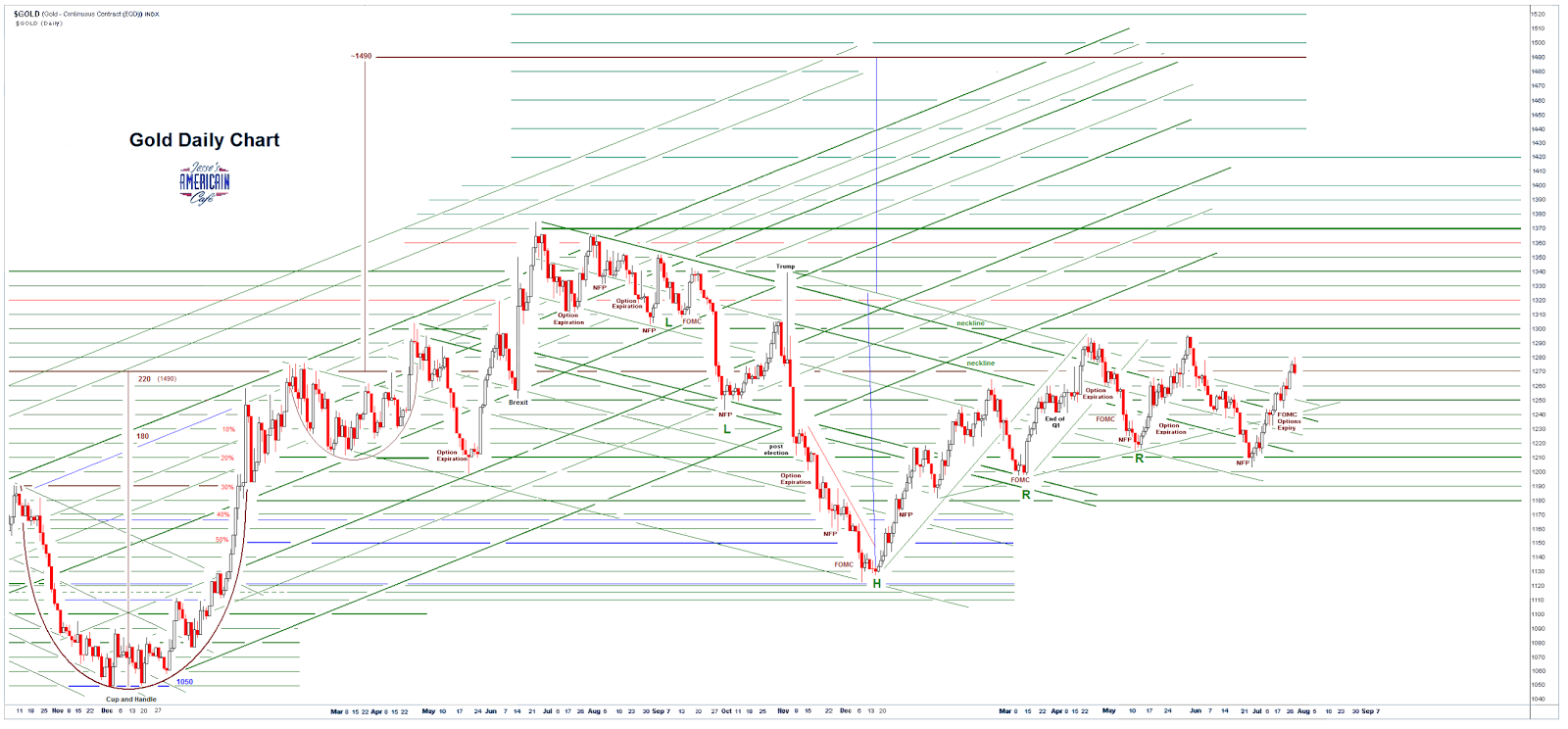





Precious Metals Year-To-Date Trading Ranges, And Stunning Decline in the Dollar Index
“If I had a world of my own, everything would be nonsense. Nothing would be what it is, because everything would be what it isn't. And contrary wise, what is, it wouldn't be. And what it wouldn't be, it would. You see?”
Lewis Carroll, Through the Looking Glass

The Year-To-Date trading range in gold is particularly well-defined, from about 1200 to 1300.
Silver has a less well-defined range, with a secondary declining trend.
The Dollar has just done a swan dive as measured in the DX index.
I would suggest that a breakout in gold will be characterized by a sustained price move above 1300 that manages to hold its ground and advance to take out 1350.
For silver a break above 18.50 would be constructive, although the silver bulls might take *some* encouragement from a successful challenge of the intermediate downtrend which is now around 17.50.
I suspect that the decrease in the value of the Dollar involves a policy move intended to make US exports more competitive, meaning no disrespect to the euro which has been in a corresponding rally based on what, their zombie banking system, or dysfunctional political/economic construct?
Or perhaps it is the reaction of the world to the wild and wacky reign of The Mad Hatter.


31 July 2017
On the Road To Damascus: Faith and Sanctity In Corrupt and Cynical Times
“To know and to serve God, of course, is why we’re here, a clear truth, that, like the nose on your face, is near at hand and easily discernible but can make you dizzy if you try to focus on it hard. But a little faith will see you through.
Michelangelo, Paul On the Road to Damascus
What else will do except faith in such a cynical, corrupt time? When the country goes temporarily to the dogs, cats must learn to be circumspect, walk on fences, sleep in trees, and have faith that all this woofing is not the last word.
What is the last word, then? Gentleness is everywhere in daily life, a sign that faith rules through ordinary things: through cooking and small talk, through storytelling, making love, fishing, tending animals and sweet corn and flowers, through sports, music and books, raising kids — all the places where the gravy soaks in, and grace shines through. Even in a time of elephantine vanity and greed, one never has to look far to see the campfires of gentle people...
What keeps my faith cheerful is the extreme persistence of gentleness and humour. Lacking any other purpose in life, it would be good enough to live for their sake."
Garrison Keillor

In Hoc Anno Domini
By Vermont C. Royster
December 24, 1949
When Saul of Tarsus set out on his journey to Damascus the whole of the known world lay in bondage. There was one state, and it was Rome. There was one master for it all, and he was Tiberius Caesar.
Everywhere there was civil order, for the arm of the Roman law was long. Everywhere there was stability, in government and in society, for the centurions saw that it was so.
But everywhere there was something else, too. There was oppression -- for those who were not the friends of Tiberius Caesar. There was the tax gatherer to take the grain from the fields and the flax from the spindle to feed the legions or to fill the hungry treasury from which divine Caesar gave largess to the people. There was the impressor to find recruits for the circuses. There were executioners to quiet those whom the Emperor proscribed. What was a man for but to serve Caesar?
There was the persecution of men who dared think differently, who heard strange voices or read strange manuscripts. There was enslavement of men whose tribes came not from Rome, disdain for those who did not have the familiar visage. And most of all, there was everywhere a contempt for human life. What, to the strong, was one man more or less in a crowded world?
Then, of a sudden, there was a light in the world, and a man from Galilee saying, Render unto Caesar the things which are Caesar's and unto God the things that are God's.
And the voice from Galilee, which would defy Caesar, offered a new Kingdom in which each man could walk upright and bow to none but his God. Inasmuch as ye have done it unto one of the least of these my brethren, ye have done it unto me. And he sent this gospel of the Kingdom of Man into the uttermost ends of the earth.
So the light came into the world and the men who lived in darkness were afraid, and they tried to lower a curtain so that man would still believe salvation lay with the leaders.
But it came to pass for a while in divers places that the truth did set man free, although the men of darkness were offended and they tried to put out the light. The voice said, Haste ye. Walk while you have the light, lest darkness come upon you, for he that walketh in darkness knoweth not whither he goeth.
Along the road to Damascus the light shone brightly. But afterward Paul of Tarsus, too, was sore afraid. He feared that other Caesars, other prophets, might one day persuade men that man was nothing save a servant unto them, that men might yield up their birthright from God for pottage and walk no more in freedom.
Then might it come to pass that darkness would settle again over the lands and there would be a burning of books and men would think only of what they should eat and what they should wear, and would give heed only to new Caesars and to false prophets. Then might it come to pass that men would not look upward to see even a winter's star in the East, and once more, there would be no light at all in the darkness.
And so Paul, the apostle of the Son of Man, spoke to his brethren, the Galatians, the words he would have us remember afterward in each of the years of his Lord:
Stand fast therefore in the liberty with which Christ has made us free, and be not entangled again with the yoke of bondage.
"Caesar was swimming in blood. Rome and the whole pagan world was mad. But those who had had enough of transgression and madness, those who were trampled upon, those whose lives were misery and oppression, all the weighed down, all the sad, all the unfortunate, came to hear the wonderful tidings of God, who out of love for men had given Himself to be crucified and redeem their sins.
When they found a God whom they could love, they had found that which the society of the time could not give any one— happiness and love."
Henryk Sienkiewicz, Quo Vadis: In the Time of Nero
Subscribe to:
Posts (Atom)