

20 June 2013
Remembering the Forgotten: the Weak, the Infirm, the Dispossessed, the Elderly, the Other
"The greed of gain has no time or limit to its capaciousness. Its one object is to produce and consume. It has pity neither for beautiful nature nor for living human beings.
It is ruthlessly ready without a moment's hesitation to crush beauty and life."
Rabindranath Tagore
“The vast majority of the race, whether savage or civilized, are secretly kind-hearted and shrink from inflicting pain, but in the presence of the aggressive and pitiless minority, they don't dare to assert themselves.”
Mark Twain
The Case of Carrie Buck
“It is worth remembering one of the important lessons of the Buck story: a small number of zealous advocates can have an impact on the law that defies both science and conventional wisdom.”
Paul A. Lombardo, Three Generations, No Imbeciles: Eugenics, the Supreme Court, and Buck v. Bell
“I have studied with great interest the laws of several American states concerning prevention of reproduction by people whose progeny would, in all probability, be of no value or be injurious to the racial stock.”
Adolf Hitler
Übermenschen: The One Percent
"The essential characteristic of a good and healthy ruling elite, however, is that it views itself not as a function of the monarchy or the commonwealth, but as its very meaning and highest justification, and that it therefore accepts with a good conscience the sacrifice of untold human beings who, for its sake, must be reduced and lowered to incomplete human beings, to slaves, to instruments.
Their fundamental belief simply has to be that society must not exist for society's sake, but only as the foundation and scaffolding on which the best type of being is able to raise itself to its higher task and to a higher state of being..."
Friedrich Nietzsche
“The notion that persons should be safe from extermination as long as they do not commit willful murder, or levy war against the Crown, or kidnap, or throw vitriol, is not only to limit social responsibility unnecessarily, and to privilege the large range of intolerable misconduct that lies outside them, but to divert attention from the essential justification for extermination, which is always incorrigible social incompatibility and nothing else."
George Bernard Shaw
“Of all the problems which will have to be faced in the future, in my opinion, the most difficult will be those concerning the treatment of the inferior races of mankind.”
Leonard Darwin
"On Wall Street he and a few others—how many?—three hundred, four hundred, five hundred?—had become precisely that ... Masters of the Universe."
Tom Wolfe, The Bonfire of the Vanities
"As flies to wanton boys are we to the gods.
They kill us for their sport."
William Shakespeare, King Lear
"If you pour yourself out for the hungry, and satisfy the needs of the afflicted, then your light will rise in the darkness, and your gloom will become like the noon day sun."
Is 58:10
"Gentleness is everywhere in daily life, a sign that faith rules through ordinary things...
Even in a time of elephantine vanity and greed, one never has to look far to see the campfires of gentle people. Lacking any other purpose in life, it would be good enough to live for their sake."
Garrison Keillor


Gold Daily and Silver Weekly Charts - Cavalcade of Policy Errors
The hit on the metals began in the quiet hours overnight, with the dumping of contracts in earnest.
Today was the fait accompli.
I don't need to tell you what I did.
Let's see how we close out the week.
Tonight the CME hiked gold margins by 25%.
As a reminder, next Tuesday June 25 is options expiration for gold and silver on the Comex.
The clip below is Central Bankers Implementing Monetary Policy: Scenes from a Currency War


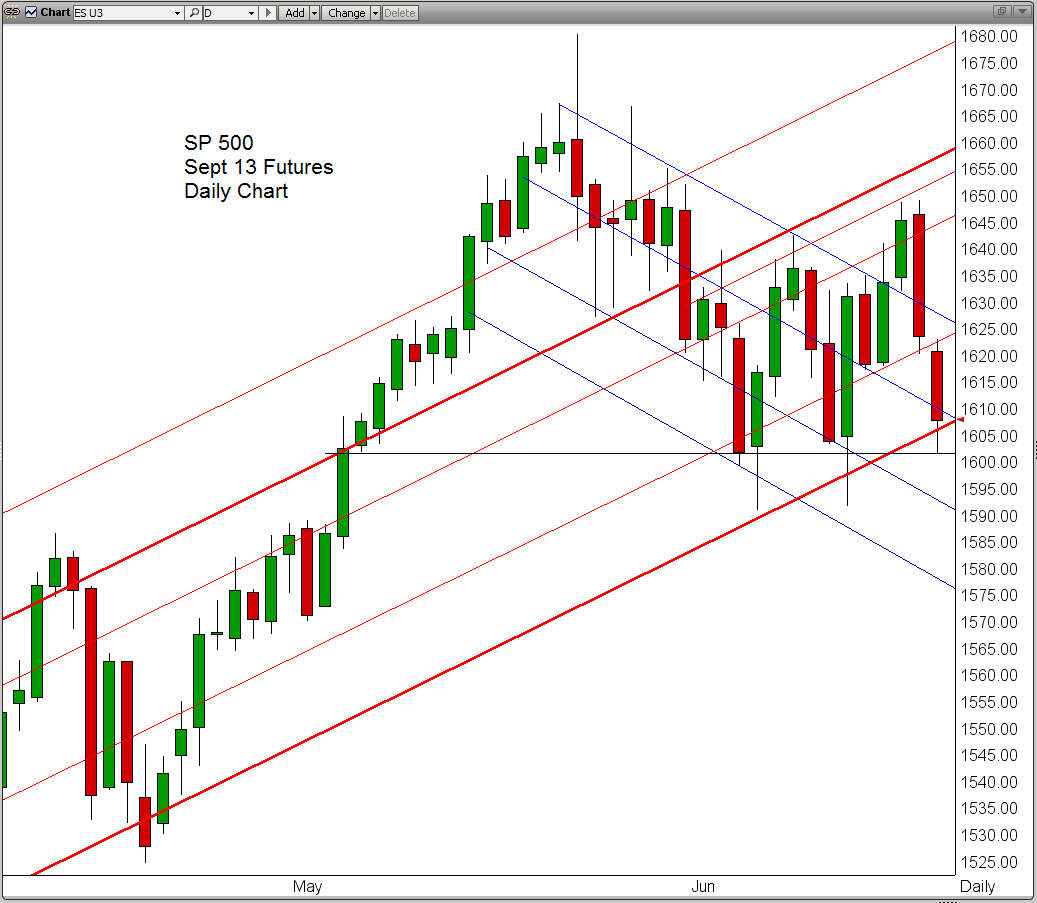
SP 500 and NDX Futures Daily Charts - Correctamundo
Market is correcting as the hot money takes the public through the rinse cycle.


Pictures From a Monetization
The Fed is printing money. Or perhaps more properly, monetizing debt, both public and private, but not efficiently or effectively from the perspective of the broader economy. That money, sometimes euphemistically called liquidity, is flowing directly into the financial system through the Banks as a matter of public policy.
It is not unlike sending aid to a third world country, where it is seized by small groups of powerful warlords for their own use and purposes, with them deciding how much will reach the people.
It is not even sophisticated math. Look at the first chart. It is simple arithmetic.
Granted, the printing is not yet showing up as a pure monetary inflation, but primarily as asset bubbles in financial paper and selective items subject to secular monopoly market and speculative pressure: certain categories of consumer good, medicine, health care, financial fees, perks and bonuses, high end housing and collectibles, and political contributions by large organizations and the one percent for example.
That is because of the 'trickle down' approach of money distribution which the Fed, and the their partners in the government, are pursuing. It manifests in the declining velocity of money, slack aggregate demand, and the stagnant median wage. It has some of the appearance of financial feudalism in which capital substitutes for land.
The games being played in the markets are apparent, heavy-handed, and beneath contempt, operating under the rationale of a 'necessary perception management.' Necessary for whom? It is officially sanctioned theft, pure and simple, however one wishes to rationalize it. The 'new normal' is really the new awful, with a decidedly oligarchic taint.
Please be aware that all the two line charts below are using two scales, one on the left for monetary base and one on the right for the other. The purpose here was to show how the monetary base compares in change, even if the change is not linear, or one for one.
The Fed will not stop expanding its monetary base anytime soon. The economy is on life support.
They can monetize all the private and public debt that they can, but it will not have a positive effect until that money reaches the real economy. For now it is flowing heavily to support a corrupt financial system that has not been reformed, to sustain speculation, and to further enrich those who made outsized gains during the credit bubble.
The government is as culpable and more than the Fed in this. This applies to the Congress, the Administration, and the regulators.
Related: Money Supply: A Primer
There are a number of ways to repair the damage to the real economy and get it growing again. One way NOT to do it is to look at the landscape through the eyes of the trader or the speculator, and those who serve the financial interests. For the most part they are self-absorbed and blinded by their predatory instincts.They are not creators of real wealth. And they tend to distort the vital avenues of economic activity and discourse.
Charles Ferguson, Larry Summers and the Subversion of Economics
The ascent to power of the financiers, facilitated by the Clintons in the 1990's, is at the root of the problems of the day. But to be fair, the last three Presidents and the Congress are all a disgrace. And I see little hope on the horizon except for a few points of isolated light amidst a general erosion of stewardship.
My concern is that as the situation becomes worse, the elite will tend to punish the innocent and the weak. This has been their response so far and in a broader swath of western countries than one might have otherwise imagined. It may get so bad, so out of hand, that I can even imagine calls for a 'financial war crimes' trial some day, or worse. Probably worse, since these fellows are shameless, abusers of oaths, and masters of deceit.
So this will probably not end well. But it will end.


Taibbi: The Last Mystery of the Financial Crisis
Again, how ironic that the truth is coming out, slowly, but certainly not in the mainstream media, which is covering itself in shame.
The financial crisis was not something that just happened. It was nothing like an act of God.
It was a despicable fraud perpetrated by the biggest Banks, and their enablers, over a long period of time.
And many are complicit in the coverup. It is the credibility trap.
The Last Mystery of the Financial Crisis
It's long been suspected that ratings agencies like Moody's and Standard & Poor's helped trigger the meltdown. A new trove of embarrassing documents shows how they did it
by Matt Taibbi
JUNE 19, 2013
What about the ratings agencies?
That's what "they" always say about the financial crisis and the teeming rat's nest of corruption it left behind. Everybody else got plenty of blame: the greed-fattened banks, the sleeping regulators, the unscrupulous mortgage hucksters like spray-tanned Countrywide ex-CEO Angelo Mozilo.
But what about the ratings agencies? Isn't it true that almost none of the fraud that's swallowed Wall Street in the past decade could have taken place without companies like Moody's and Standard & Poor's rubber-stamping it? Aren't they guilty, too?
Man, are they ever. And a lot more than even the least generous of us suspected.
Thanks to a mountain of evidence gathered for a pair of major lawsuits, documents that for the most part have never been seen by the general public, we now know that the nation's two top ratings companies, Moody's and S&P, have for many years been shameless tools for the banks, willing to give just about anything a high rating in exchange for cash.
In incriminating e-mail after incriminating e-mail, executives and analysts from these companies are caught admitting their entire business model is crooked.
"Lord help our fucking scam . . . this has to be the stupidest place I have worked at," writes one Standard & Poor's executive. "As you know, I had difficulties explaining 'HOW' we got to those numbers since there is no science behind it," confesses a high-ranking S&P analyst. "If we are just going to make it up in order to rate deals, then quants [quantitative analysts] are of precious little value," complains another senior S&P man. "Let's hope we are all wealthy and retired by the time this house of card[s] falters," ruminates one more.
Ratings agencies are the glue that ostensibly holds the entire financial industry together. These gigantic companies – also known as Nationally Recognized Statistical Rating Organizations, or NRSROs – have teams of examiners who analyze companies, cities, towns, countries, mortgage borrowers, anybody or anything that takes on debt or creates an investment vehicle.
Their primary function is to help define what's safe to buy, and what isn't. A triple-A rating is to the financial world what the USDA seal of approval is to a meat-eater, or virginity is to a Catholic. It's supposed to be sacrosanct, inviolable: According to Moody's own reports, AAA investments "should survive the equivalent of the U.S. Great Depression."
It's not a stretch to say the whole financial industry revolves around the compass point of the absolutely safe AAA rating. But the financial crisis happened because AAA ratings stopped being something that had to be earned and turned into something that could be paid for.
That this happened is even more amazing because these companies naturally have powerful leverage over their clients, as they are part of a quasi-protected industry that enjoys massive de facto state subsidies. Largely that's because government agencies like the Securities and Exchange Commission often force private companies to fulfill regulatory requirements by retaining or keeping in reserve certain fixed quantities of assets – bonds, securities, whatever – that have been rated highly by a "Nationally Recognized" ratings agency, like the "Big Three" of Moody's, S&P and Fitch. So while they're not quite part of the official regulatory infrastructure, they might as well be...
Read the rest of this article here.
US Equity Futures Intra-Day Look
Here is the picture in equities.
As for gold and silver, the selling of thousands of contracts in quiet hours with the intent of driving the price lower is obvious, and there for all to see.
Someone is trying to free up bullion from the ETFs. But someone, perhaps another related party, is also making a statement.

19 June 2013
Gold Daily and Silver Weekly Charts - Pretty Much as Expected, With a Twist
"There is something on earth greater than arbitrary or despotic power. The lightning has its power, and the whirlwind has its power, and the earthquake has its power; but there is something among men more capable of shaking despotic thrones than lightning, whirlwind, or earthquake, and that is, the excited and aroused indignation of the whole civilized world."
Daniel Webster
"In the realm of economics, price controls are designed to constrain volatility on the grounds that stable prices are a good thing. But although these controls might work in some rare situations, the long-term effect of any such system is an eventual and extremely costly blowup whose cleanup costs can far exceed the benefits accrued.
The risks of a dictatorship, no matter how seemingly stable, are no different, in the long run, from those of an artificially controlled price."
Nassim Taleb, The Black Rose of Cairo, Foreign Affairs v.90 iss 3

In the best of times, the market is often a short term indicator of itself and its own internals, and little else. Although it generally maintains some connection with the underlying reality of what it is intended to represent. It is over the longer term that value is properly discovered and priced, if allowed to proceed without undue interference.
In times like these with genuine investors in short supply, and traders and automated programs gaming nearly everything based on internals, one has to be careful not to read too much into daily moves in market price. That is a sad artifact of a poorly regulated market, and especially of one that is being manipulated by some temporary, albeit powerful, force.
There was nothing unexpected in what Bernanke or the Fed had said. What surprised me was the depth of the stock sell off AND the fact that while stocks were falling, VIX was falling as well. Although VIX did come back a bit into the close. Traders are certainly petrified aren't they. Not.
I hear a thin crowd turned up to hear Obama speak in Berlin today, as compared to the adoring masses that turned out for his last speech there. And that approval by the people of the Congress is hovering around 10 percent.
Is the bloom off the rose? O rose thou art sick.
Let's see what tomorrow brings. But there was nothing in what Bernanke said today that leads me to conclude that things are improving significantly in the economy AND the Fed will end its highly accommodative monetary posture anytime soon. But I also doubt we will see efficient and honest markets in that time horizon either.


SP 500 and NDX Futures Daily Charts - VIX Sells Off With Stocks?
I thought it was kind of odd that as stocks were falling hard, so was the VIX, which is generally viewed as counter market 'insurance' to the downside.


NAV Premiums of Certain Precious Metal Trusts and Funds
As expected the FOMC did little more than jawbone with an 'improving outlook' but no taper.
The traders did a dipsy doodle on the futures, down and up, and now markets are waiting for Bernanke's press conference.
The 'Spicer family' of Central Funds of Canada continue to underperform.

18 June 2013
Gold Daily and Silver Weekly Charts
The precious metals were hit on the first day of a two day FOMC meeting. How unusual. NOT.
Let's leave the speculation aside until Benny tells us what is on his mind in the announcement and his press conference afterwards.


SP 500 and NDX Futures Daily Charts
Stocks rallied higher on the first day of the FOMC meeting.
Tomorrow afternoon could be interesting.


SHIBOR Signaling Stress in the Financial System - Liquidity Crunch
Here is some interesting data out of China. The story is by Matt Phillips.
The inter-bank liquidity crunch is a classic banking problem for which the central bank as lender and regulator was created.
It would be nice if the bankers could get in front of these problems as they develop, and not merely throw the public's money at them after the fact when bad bank management, official corruption, and excessive greed have made the system vulnerable.
LIBOR itself is quiet, which suggests that this problem is particular to China, at least for now. The only LIBOR stories breaking are charges against bank traders for manipulating that interbank rate.
Shibor
Here’s what’s behind the Chinese cash crunch
By Matt Phillips
"Remember Libor? When that once obscure measure of short-term interest rates shot higher in 2007 and 2008, it was one of the earliest warnings signs of what would eventually become the financial crisis. Now, its Chinese cousin—known as Shibor—is telegraphing the rising stress in the opaque financial system of the world’s second largest economy.
What does the spike in rates mean? Large banks are increasingly leery of tapping into their pools of cash to lend to each other. Recent reports that China Everbright Bank failed to repay a short-term loan to Industrial Bank Co. aren’t helping. Industrial Bank says that report is “untrue and exaggerated.” But short-term lending markets suggest other bankers are skeptical.
So what’s the solution? Chinese authorities tamed short-term interest rate spikes before. They could create new cash to lubricate lending, or lower reserve requirements for banks, which would boost liquidity. According to the Wall Street Journal, that’s what bankers are hoping for..."
Read the complete original here.


NAV Premiums of Certain Precious Metals Trusts and Funds
As expected we have a bear raid on the precious metals in honor of the FOMC meeting.
Make no mistake, this is political messaging. Buy our paper.
And a great deal of the world is ignoring it.

17 June 2013
Harvey Organ Comments on the Gold Inventory at the COMEX

Hey Rocky. Watch me pull a rabbit out of a hat.
From Harvey Organ this evening:
"Ladies and Gentlemen, we have a three-fold problem:
i) the total dealer inventory of gold is at a very dangerously low level of only 44.32 tonnes, and none of the 9.5 tonnes delivery notices from May and the 30 tonnes from June have been removed from inventory as of yet.
ii.a) JPMorgan's customer inventory remains at an extremely low 136,380 oz.
If you are a customer of JPMorgan and have your gold in its vault, I think it is best to remove it before we have another fiasco like MFGlobal.
ii.b) JPMorgan's dealer account rests tonight at 413,000 oz. However all of this gold has been spoken for plus an additional 81,000 oz
iii) the 3 major bullion banks have collectively only 30.08 tonnes of gold left!"
I do not watch the Commitments of Traders and the broad sweep of inventory levels like Harvey and others do.
As you know I do not think that this is where the scheme breaks, except as a secondary effect perhaps. The COMEX is a paper shell game. The real fireworks will begin more likely in a run on the bullion banks, and the depletion of physical supply sparked by some major scandal or failure to deliver.
Keep an eye on silver. The central banks don't have any.
And do not think for a moment that this will go down easily. There are desperate but powerful forces at work.
But I do enjoy watching this sort of thing unfold.
"You are a den of vipers and thieves. I have determined to rout you out, and by the Eternal, (bringing his fist down on the table) I will rout you out!"
President Andrew Jackson, February 1834, from Andrew Jackson and the Bank of the United States (1928) by Stan V. Henkels
Pictures In an Exhibition: Who Profits?
Why keep the median wage low, despite rising profits and productivity?
Whom does an increasingly debt-based economy serve?
Who profits from the status quo?
Pictures in an exhibition of elephantine greed.


US Civilian Employment To Population Ratio Since 1970
What recovery was that again?
The lower employment to population ratios of the early post war decade were more manageable because it was prior to the long wage stagnation despite rising productivity.
It was also an era when single worker households were able to maintain a livable income.


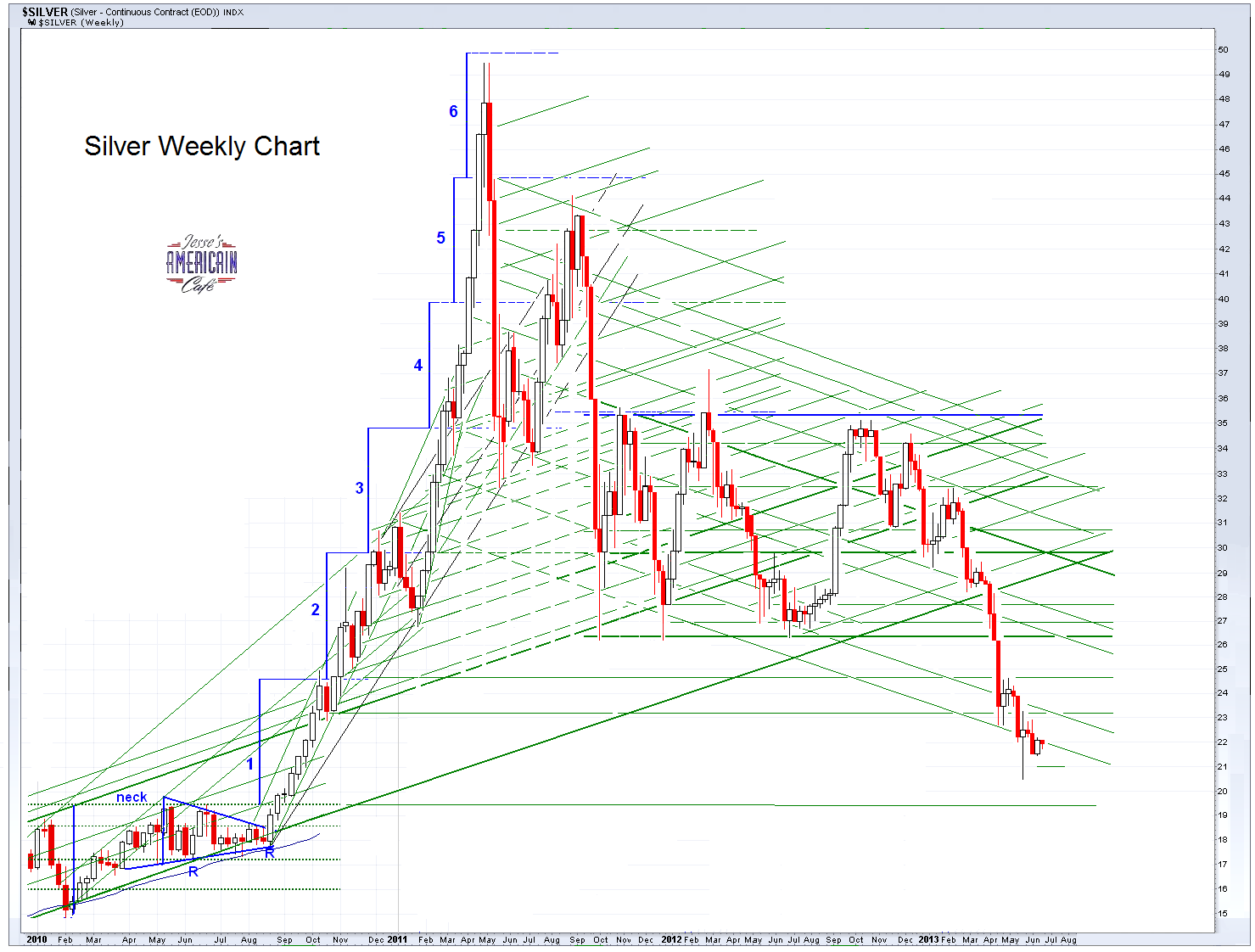
Gold Daily and Silver Weekly Charts - Guess Who's Coming To Dinner?
Paper versus physical.
Intraday commentary on the widening gold premiums in Vietnam here. It will be more impressive when we see the same type of explosive demand in a few other countries. Until then it is what it is.
But on the whole, it's not nice to fool Mother Nature.
Here is an analysis of tomorrow's two day FOMC Meeting from Tim Duy that is fairly comprehensive.
As for what is going on in the markets, there will be an inevitable reckoning. Guess who's coming to dinner?

SP 500 and NDX Futures Daily Charts - Long Con
Two day FOMC meeting this week.
Let's see if we get a 'rally Tuesday' tomorrow.
The general trend is to be long on baloney if you are in the political/financial professions.


Subscribe to:
Posts (Atom)










