01 October 2013

COMEX Warehouse Gold Bullion: Price Moves Smell of Desperation As Inventory Remains Thin


'O sir, to willful men,
The injuries that they themselves procure
Must be their schoolmasters.”

William Shakespeare, King Lear

There were 3,215 ounces of gold bullion taken out of the HSBC warehouse.

The JPM warehouse had 7,143 ounces changed from deliverable to eligible. 

Perhaps the price action freed up some bullion from the GLD ETF.  They need it badly. The levels of gold bullion backing up the leveraged COMEX paper claims on gold exchange remain remarkably thin and oversubscribed.

The international monetary regime is changing.  Nothing could be more clear if one listens to what is being said, and sees what is being done. 

The European Central Banks have made their intentions quite clear, and the Asian monetary powers are in full preparation for their plans, whatever they may finally be.

The forces driving this change are powerful and founded in time and nature. We are watching history unfolding.

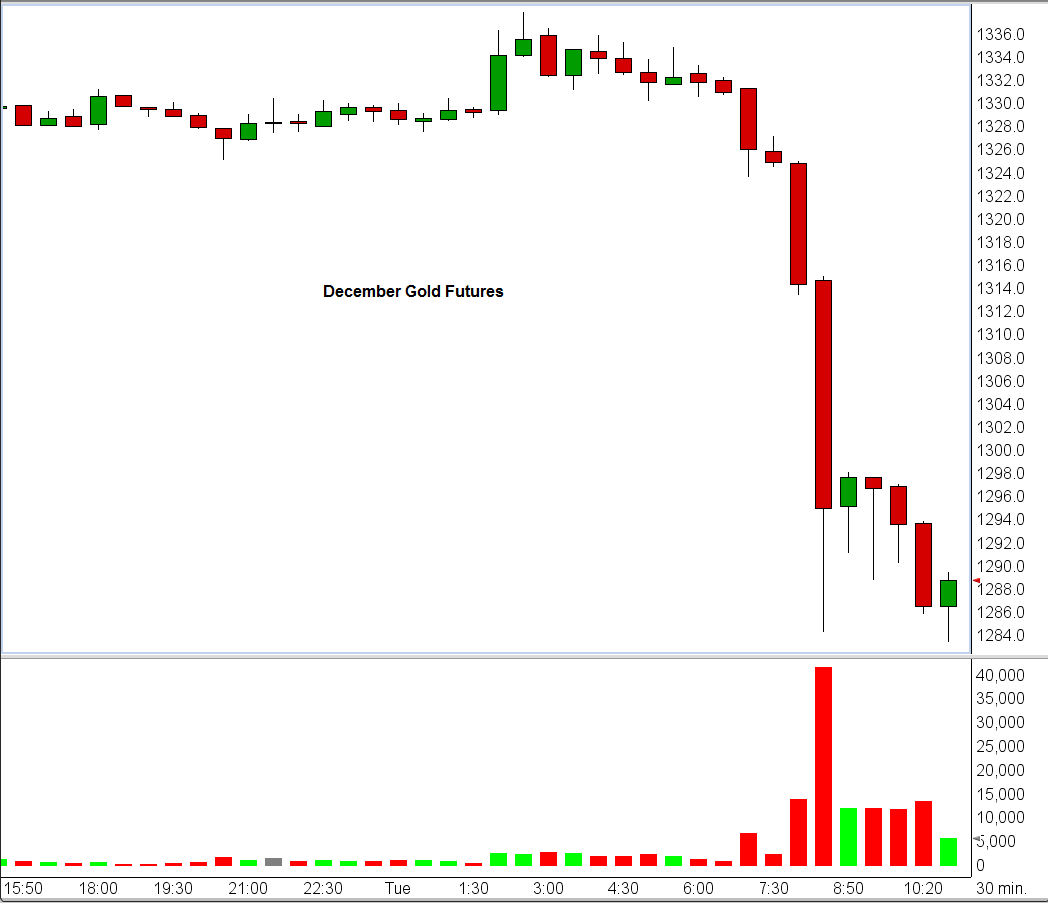
Today we saw the familiar methods of the past in a blatant pricing exercise that smelled of desperation. They can set the price by force in the markets in the short term, but they cannot produce that which they have taken, or fulfill that which is owed.  

Weighed, and found wanting.

Stand and deliver.


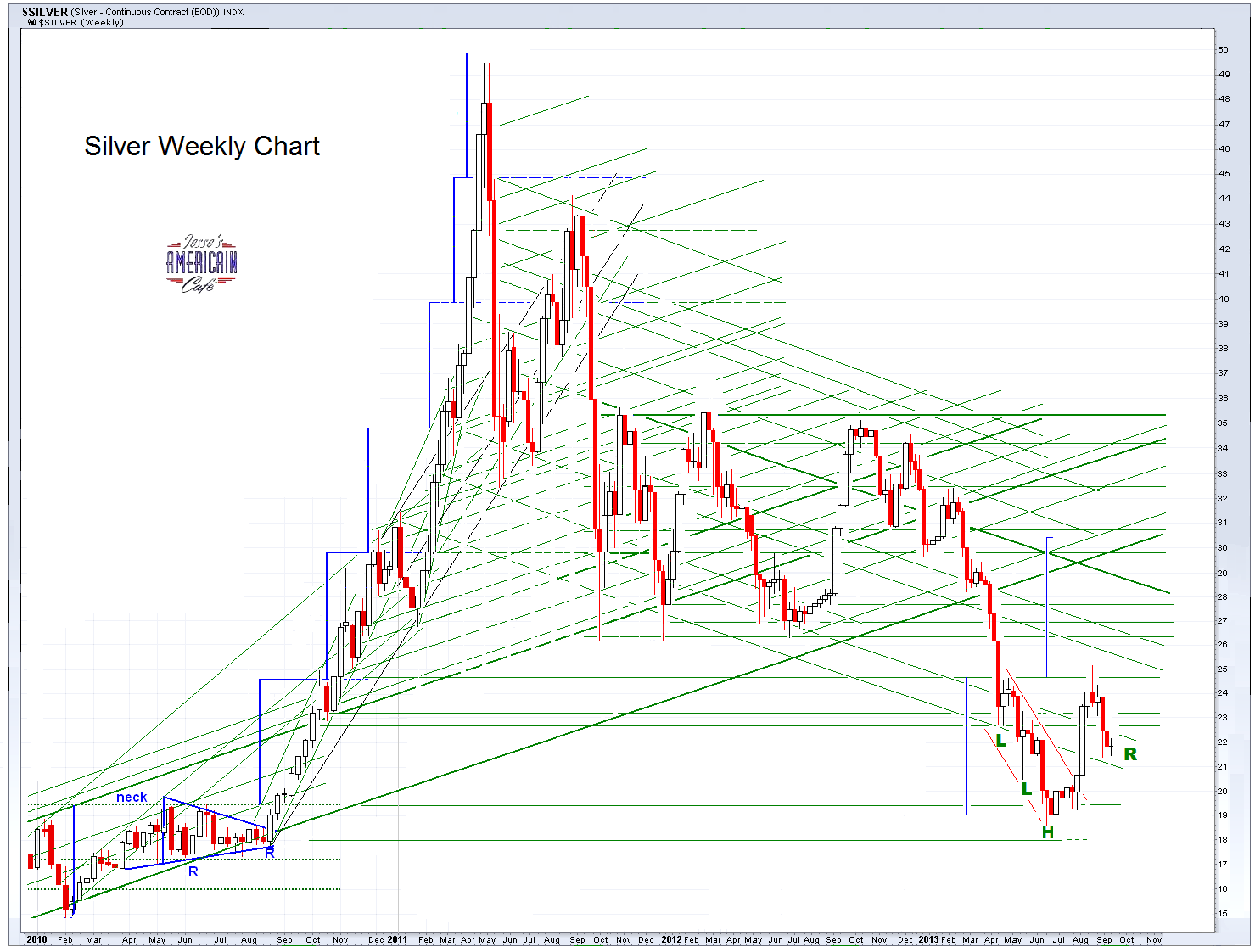
Gold Daily and Silver Weekly Charts - Pigmen Rampant on a Field of Greed


There was a very obvious hit on the precious metals today. I commented on it with pictures here.

Basically the pros saw the broader population of small specs leaning into protection, and took them for a ride today. As Bart Chilton said, there are no regulators watching these markets because of the government shutdown, so you are on your own.  At least that is what he implied.

I laid out the basic market strategy at work today in the stock market commentary. I am sure the Wall Street financiers think that this shutdown will be temporary, a few fleeting days that will harm no one or nothing about which they care.

The masters of the universe who are a bit closer to the inner circle of Moloch will almost certainly have a word with their servants and retainers in the Congress, and bring them to heel after a few days.  It is all a game after all, isn't it? 

The G20 is having a meeting  of their central bankers and finance ministers in Washington DC on October 10-11.

A man hears of things that might be said at such a gathering.  It certainly caught some people by surprise when the Italian Central Bank came out and endorsed gold as a key reserve asset,  at Monday's LBMA meeting.   France and Germany chimed in, even though they are disingenuously at odds with what they say about never selling compared to what they do with leasing the metal.

An economist disciple of Greenspan unreservedly endorsed the idea of the trillion dollar platinum coin today, or more precisely 1,000 billion dollar coins so everyone important can have one for their very own.   Non-specialists may not understand all that this implies in their political zeal, but surely he must know better.  Well, it is a disgraced profession after all.

Hey why fight it?  Let's go all in for it.  The US should announce that striking piece of "monetary innovation" at the G20 meeting, so all the US' major creditors can see what a cynical act of brazen seigniorage looks like up close.  Why hide it?   After all, the whole of the law for the exceptional is to do what thou wilt.

There was some minor movement of gold out of HSBC today, and a recategorisation of some bullion in the JPM warehouse as well, following their impressive move to bolster confidence in the threadbare COMEX registered inventory yesterday.   I might post something about that later on.

We are now in October delivery.  October is not a big month for the futures, but it is an active delivery month so we will be interested to see what happens.


SP 500 and NDX Futures Daily Charts - If You Don't Know Who the Sucker at the Table Is...


There is an old poker saying that if you don't know who the sucker is at the table, it is probably you.

Quite a few people remarked their puzzlement today about the rally in stocks and the hit on the metals. It seems counterintuitive that 'investors' would embrace risk on a government shutdown and shun risk havens.

You have to understand the nature of the game in order to understand what is going on.

In the short term, this market is about as rational as a crooked roulette wheel. The market insiders can see what the broad public is holding and the numbers in which they are holding it.

Yesterday there was a big spike higher in volatility as shown by the VIX. What that means is that people were seeking safety in puts.

Pros rarely direct their bets in one direction but lean toward spreads and other things that diverge and converge, unless of course they have fixed the results somehow or have access to asymmetric information and then bigger directional bets make sense. This is how big firms achieve 'perfect' trading records, which of course would be impossible in a 'free market,' where freedom implied honesty rather than a lack of rules and oversight.

So, the smaller specs piled into puts and other downside bets ahead of the shutdown, the big insiders saw it, and they bid the markets up today to clean them out of their positions. That is what happened. Note the plunge in VIX today. As I say, 'wax on, wax off.'

Should you start 'thinking like a criminal' as some say? Better than guessing stay the hell out of options and other short term leveraged bets in this market and let the insiders try to cheat each other. Amateurs have no business in the futures or options markets.

I suspect the thinking is that the shutdown will be short lived and that there will be no consequences. That *might* be correct as it is how things often go. But I am not so sure this time will be just like that, for reasons which I will elaborate on in the gold commentary.

Have a pleasant evening.


Excess Reserves: No Government Shutdown There


And besides, the Banks own the Fed which is not a part of the government as you may recall.

And by statute the Congress must not skip a single payday or perk. So no problems there either.

Obama is meeting with the Bankers today, who will be asked to help him out with the Congress.

Is Putin coming for the G20 meeting in Washington on October 10-11? Perhaps he can mediate the deadlock amongst the keepers of the world's reserve currency.

We know he likes Super Bowl rings. Maybe he would like a souvenir billion dollar platinum coin ahead of the holiday rush.

I hear the Chinese like bright shiny things and would gladly trade their nasty Treasuries for newly minted billion dollar coins.

Where is Peter Minuit when you really need him?


'Investors' Shun Safe Havens To Bid Up Risk Ahead of US Debt Ceiling and G20 Banking Meeting


Must have been a mass shunning on cue.

I see where Obama has solicited the Bankers like Blankfein and Dimon to help to persuade the Congress.  He is meeting with them today.

It appears they have already had their persuasive hands on the markets this morning.

The government shut down includes market regulators according to CFTC commissioner Bart Chilton.  "No regulators looking at markets due to government shutdown."

Economist Brad DeLong says Obama's only alternative is raw fiat money creation, aka the trillion dollar coin.  Bring it, Brad.  lol.

Aptly enough, there will be a G20 meeting in Washington DC on October 10-11 which will include all the finance ministers and Central Bank governors.  One can only wonder might be said, especially after Italy's bold statements to the LBMA the other day. 

Gold futures tumble as investors shun safe havens
Oct. 1, 2013, 8:50 a.m. EDT

NEW YORK (MarketWatch) -- Gold futures tumbled Tuesday morning, with the traditional safe haven failing to find support as investors shrugged off a long-anticipated shutdown of the U.S. federal government to bid up equities and other assets perceived as risky..."


Chalmers Johnson: The Decline of Empire


Signs of Decay
  1. Internal corruption
  2. Imperial overreach
  3. Inability to reform.


30 September 2013

Central Bank of Italy: Gold Is a Key Asset For Central Banks Because It Has No Counterparty Risk


"Gold is unique among assets, in that it is not issued by any government or central bank, which means that its value is not influenced by political decisions or the solvency of one institution or another."

Salvatore Rossi, Chief of the Central Bank of Italy, 30 Sept 2013

Bam!  Grazie mille, signore.

And that is why gold is the king of assets, Bernanke you great prune.

And thanks to Gordon Brown, the Brits have bugger all.  At least the Germans have a receipt from the Fed in die keksdose.

The other major European Central Banks (France and Germany) say in the second story below that "they will not sell their gold reserves, as they can provide a level of confidence, an element of diversification and can absorb some volatility from the central bank's balance sheet."

This implies that they are not going to account for their gold at an artificially low fixed price on their Balance Sheet, as the Federal Reserve does at the ludicrously out of date price of $45 per ounce.

But it is ironic that France confirms their gold leasing activities. If gold is an item on the balance sheet, one might expect a full disclosure of encumbrances and commitments for any variable balance sheet asset to be disclosed, ne c'est-pas? You know, any counterparty risks you may have accrued for a pittance of a yield on your premiere riskless asset.

And they will get that gold bullion back once it has been melted down and shipped to China how?
"Oh what a tangled web we weave,
When first we practise to deceive."

Sir Walter Scott, Marmion
Theory founders on the rocky shoals of reality once again. This may get even more interesting than I thought, once gold breaks and run higher again.  All those shorts to cover, and lease obligations to fulfill, and no one with bullion in size wishing to sell.  Quel dommage!

Have a pleasant evening.

Banca d'Italia-Les réserves d'or: un élément clé d'indépendance
 
 
ROME, Sept. 30  (Reuters) - Gold reserves are a key element of central bank independence, said an official of Banca d'Italia in a conference on Monday, undermining rumors of the sale of part of its bullion assets.

The crisis in the euro zone has triggered speculation that the central bank may have to sell some of its huge gold reserves to support its economy. Banca d'Italia has the fourth largest gold reserves among central banks in the world.

Central bank regulations prohibited this use of gold reserves [for retiring debt], but the concerns rose after a document from the European Commission claimed in April that Nicosia planned to raise about 400 million euros by sale of its gold surplus. (And see)

In a speech at the annual conference of the London Bullion Market Association, Salvatore Rossi, CEO of the Italian central bank, said that gold had a specific role in the central bank's reserves.

"Not only does it have essential characteristics that allow for diversification, particularly in financial markets that have been largely globalized, but it is also unique among assets because it is not issued by a government or central bank, which means that its value can not be influenced by political decisions or the solvency of an institution or another," he said.

"These features, combined with historical factors and psychological stress the importance of gold as part of the reserves of central banks," he said. "Gold supports the independence of central banks in their ability to (act) as the ultimate guarantor of national financial stability."

Read the entire article (in French) here

Banca d'Italia says gold reserves key to cenbank independence
Mon, Sep 30 13:23 PM EDT
By Jan Harvey and Clara Denina

ROME, Sept 30 (Reuters) - Keeping gold reserves is a key support to central banks' independence, an official from Banca d'Italia told a bullion industry conference on Monday, dampening talk that it might sell some of its holdings.

Speculation has emerged since the financial crisis hit the euro zone that Banca d'Italia might be pressured to leverage or even sell some of its huge gold reserves - the fourth largest among the world's central banks - to help prop up its economy.

Regulations covering central bank independence restrict them from using bullion reserves this way, but concerns grew after an assessment of Cypriot financing needs prepared by the European Commission showed Cyprus under pressure to sell gold to raise around 400 million euros (341.1 million pounds) to help finance its bailout.

In a keynote address to the London Bullion Market Association's annual conference, Salvatore Rossi, director general of the Italian central bank, told delegates that gold plays a special role in central banks' official reserves.

"Not only does it have the vital characteristic of allowing diversification, in particular when financial markets are highly integrated, in addition it is unique among assets in that it is not issued by any government or central bank, so its value cannot be influenced by political decisions or by the solvency of any institution," he said.

"These features, coupled with historic... and psychological reasons, stand in favour of gold's importance as a component of central bank reserves," he said. "Gold underpins the independence of central banks in their ability to (act) as the ultimate bearer of domestic financial stability."

Italy holds 2,451.8 tonnes of gold in its reserves. A slim majority of Italians polled by the World Gold Council in March believed their government should use the country's gold holdings to offset high public borrowing costs, although they did not believe they should sell them.

Italy used gold to collateralise bonds in 1974, when it received a $2 billion bailout from Germany's Bundesbank and put up 500 tonnes of metal as a collateral.

EUROPEAN BANKS WON'T SELL

Other European central banks including the Bank of France and the Bundesbank said at the conference that they will not sell their gold reserves, as they can provide a level of confidence, an element of diversification and can absorb some volatility from the central bank's balance sheet.

"We have no plan to sell gold," Bank of France Alexandre Gautier, director of market operations department, told delegates in a presentation. "We are still active in the lending market, but not retail loans. We can see some yields that are attractive, but we realise that we can't lend gold without collateral."

Number two holder Germany also said at the meeting that it will keep its 3,390 tonnes of gold. (This presumes they can find it, for now they are holding a bag of receipts for some of it - Jesse)

PRICE ACTION IMPACTS CENTRAL BANKS DECISION

Gold price volatility this year has impacted the buying decisions of emerging countries' central banks like Argentina, Juan Ignacio Basco, deputy general manager at the Central Bank of Argentina, said.

Bullion fell by $200 an ounce in two days in its sharpest slide in 30 years in April before hitting a three-year low in June and then regaining 13 percent from that level.

"It's very difficult to decide when to enter the market as we don't follow trends ... (but) the recent volatility in prices has changed the way we have look at gold," Basco said.

"That's why we have started with the product options because volatility in the market is not good for us."

Argentina slowly re-started to rebuild its gold reserves in 2000s after selling them at the bottom of the market in December 1997 to buy U.S. Treasuries. (Q. What do Argentina and England have in common?  Jess)  It currently holds 61.7 tonnes of the metal, representing seven percent of its assets.

"We are accumulating slowly ... and we have to move slowly," Basco said. "We must remember that we are like elephants." (And some are like dinosaurs. - Jess)

Read the entire story here


COMEX Registered Inventories - JP Morgan Moves the Shells Again


With regard to metals inventories, the eligible category includes any bullion of a suitable format that is held in one of the COMEX authorized warehouses, which are individually managed by one of the bullion banks.

The second category of metal is called registered, or dealer, bullion inventory. This is bullion of a suitable format that is held in one of the COMEX authorized warehouses, AND has been registered as deliverable into the market by its owner.

Yesterday JP Morgan changed 99,086 ounces of gold bullion in its warehouse from eligible to registered.  Since as you know if you frequent this café, the level of registered gold was at record lows, and so with the advent of the October deliverable month, Morgan thought they would throw a tranche of metal into the breech.

I will put up the graphs of inventory levels as they become available later tonight.

As you know tomorrow begins the active delivery month of October for precious metals on the COMEX.

With a few other minor changes, the total amount of gold bullion at the COMEX, both registered and eligible, now stands at 6,862,816 ounces.  This is a very low level of total inventory.

The total amount of registered, or 'deliverable' gold, is now at 769,837 ounces.  This is better than it has been, and will bring the 'owners per ounce' back down from the stratosphere.   

But it does have the character of 'robbing Peter to pay Paul,' since all the metal comes from the eligible category which seems to be attracting no new bars of high quality 100 oz. bullion.  And so it does nothing to improve the leverage of all paper claims to allocated ounces of real gold bullion.

While October is active, the month of December is the one that will test the resolve of the bullion banks and their masters to continue to cap the precious metals at artificially low prices, before their discretionary horde of bullion becomes too thing to hold the line.

Antics notwithstanding, the flow of gold from West to East is steady, pronounced, and certainly no secular phenomenon, but a great trend change that is being driven by an evolution in world finance.

The metal came from within the warehouse structure, so it resulted in the same amount of metal leaving the 'eligible category.'   They cling to the thin threads of their great shell game that has run past its prime.  

That game will end when someone puts a stop to the motion on the table, and forces the bullion banks to show what they have in both hands.  And then there will be a reckoning of accounts, which is long past overdue.

Weighed, and been found wanting.

Stand and deliver.


Gold Daily and Silver Weekly Charts - Capping For a Non-Farm Payrolls Report


"The war for liberty never ends. One day liberty has to be defended against the power of wealth, on another day against the intrigues of politicians, on another against the dead hand of bureaucrats, on another against the patriot and the militarist, on another against the profiteer, and then against the hysteria and the passions of the mobs, against obscurantism and stupidity, against the criminal and against the overrighteous.

In this campaign every civilized man is enlisted till he dies, and he only has known the full joy of living who somewhere and at some time has struck a decisive blow for the freedom of the human spirit."

Walter Lippmann
It was cap, cap, cap today, as the precious metals were held back in a week of budget crisis, a Non-Farm Payrolls Report, and the beginning tomorrow of the active delivery month of October.

This is likely to be a confusing week with lots of cross currents and volatility as markets overreact to news. Traders love this sort of volatility, especially if they have advantageous access to information both in market structure, timeliness of orders, and economic events.

I put a brief explanation on the two separate political events that are occurring, the new fiscal year budget and the debt ceiling discussions into the stock market commentary this evening, for those who do not understand the US budgeting process and legislative process.  That includes just about everyone, including the politicians, but only if you believe what they are saying. 


Have a pleasant evening.


SP 500 and NDX Futures Daily Charts - Slouching Towards Stupidity


There are two separate political events that are occurring here for those of you who may be confused about them.

First, there is a funding showdown for the new government fiscal year, which starts at midnight tonight.

What is desired is a 'continuing resolution' or an actual agreement on some sort of budget that funds the existing programs that have already been enacted into law.

The second even is separate, the raising of the debt ceiling. The Congress used to do a perfunctory vote on each debt issuance from the Treasury. That was changed some years ago to a debt ceiling against which the Treasury could issue debt, and which is raised periodically in response to the level of public debt and Treasury issuance. The Secretary of the Treasury Jack Lew has estimated that he will not be able to play any more accounting games beyond 17 October.

So, keep in mind these are two separate events. One is the issuance of a formal or a pro forma budget, known as a Continuing Resolution for the new fiscal year, and the deadline for that is midnight.

And the second event is the debt ceiling, which had no hard date but is estimated to become a problem around 17 October.

Needless to say these events have the extremes of both Left and Right out baying at the moon, with the great middle of ordinary people wondering who these people are, and how we got ourselves into this situation.


29 September 2013

We Are Seeing An All-out Defense of the Status Quo (Excerpt)


This is an excerpt of the interview which I had with Lars Schall.  I wished to preserve a portion of it on this site.

I have taken the liberty of correcting a few typos, and clarifying a few ideas in response to reader comments.

The full and original interview may be found here.

THE MATTERHORN INTERVIEW – September/October 2013

“We Are Seeing An All-out Defense of the Status Quo”

On behalf of Matterhorn Asset Management, financial journalist Lars Schall talked with Jesse, the host of the popular financial web site Jesse’s Café Américain, about, inter alia: his interest in precious metals; why he thinks the U.S. Commodity Futures Trading Commission decided to take no action regarding complaints about manipulation of the silver market; the future of the so called “currency wars;” and last but not least why he believes that the Federal Reserve is laying the groundwork for its own demise.
 
By Lars Schall
 
[big snip]

L.S.: Why do you focus in your work especially on precious metals?
 
Jesse.:  Gold and silver became interesting for the first time in the 1990’s, when I started to study the history of speculation and stock market crashes, and the rise and fall of bubbles.
 
This led to a fairly serious study of the nature of money. Up to about 1999, I had no interest in gold and silver. What I saw happening in the world economy then sparked my interest in that subject.

I write about gold and silver now because they are at the heart of what is happening. And there is not as much about stocks and bonds, because I have stopped trading actively in such a broad range of things.
 
I am fascinated by the sea change in the world monetary system, which has been colloquially called ‘the currency wars.’
 
L.S.: Will those ‘currency wars’ intensify going forward according to your analysis, and if so, how do you think they will play out?
 
Jesse.: Yes they will intensify and we are seeing that already. A fiat currency is an exercise in both confidence and power. As confidence weakens, the use of power must intensify to maintain it.

One of the things that people forget is that when one adopts a common currency, they surrender a portion of their economic autonomy. We are seeing this play out in the European Union as monetary theory would predict.
 
In adopting a common currency, the euro, the entire region thereby agreed to let a central group set their monetary policy for all, which includes the ability to tighten and loosen supply in response to prevailing economic conditions. But whose conditions, when they vary over a broader area?
 
When a country adopts another currency, they surrender a portion of their own fiscal authority, and thereby their political autonomy. If you do not believe this, just look at what is happening in Greece and Cyprus.
 
A common fiat currency system works over a large and diverse region such as the United States because in addition to monetary union there is a political union as well, including transfer payments and spending to those regions which may have differing economic conditions. Fiscal policy evens out the blunt force of a unified monetary policy.
 
This is important, because as the rest of the world is now seeing, the dollar hegemony is not working because the United States is setting monetary policy for itself, but is doing it with the world’s reserve currency. This is where the dislocations begin in some regions of higher natural growth, which see inflation and other effects first that place a stress on their political governance.
 
The outcome of the currency war will be something like a supra-regional government that encompasses most of the developed world, with the same problems that have become apparent in the European Union that leads to repression, or in some other resolution that permits for local autonomy with more flexibility for international trade. Obviously this is a range of possibilities and the actual result will be evolving somewhere in between.
 
The creation of a ‘currency’ that is not under the control of a single political authority could be achieved by creating a unit of trade based on a broad basket of national currencies. It ought to include something that is not under the control of a single country,  such as gold or silver.
 
There will still be manipulation of currencies and metals, but the manipulation would be more difficult because the power of each is diluted within a basket if it has been constructed well.
 
Since money is power, those who are in control of the money of the status quo, the US dollar, will resist this change, even to their own eventual disadvantage and destruction. Pre-eminent among those are the multinational banks, which are loosely called the Anglo-American banking cartel. This extreme defense of untenable positions is an unfortunate tendency of human nature, and especially of those who are driven to seek power and fear losing it.
 By the way, the US is suffering a protracted recession now because while monetary policy is active, although misguided, the fiscal policy has stopped functioning well because of political deadlock. The monetary policy that Bernanke has set is a trickle down approach, which is obviously failing because it is operating in a system that was already skewed by corruption and has not been reformed. It is like sending aid to a Third World country. The aid is seized by powerful warlords and used for their own advantage, with little reaching the people.
 
They know this, but they do not care. It is about personal advantage and careers.
 
In the US in addition to political deadlock, caused by a struggle for power, there is ironically a credibility trap as well. Both sides are dipped so deep in the corruption of the system that they cannot bear to unleash any uncontrolled reform movement, but they are also fighting one another for the spoils. I have seen this play out in the failure of major corporations, and I am seeing it now again on a larger scale.
 
L.S.: What would you say is essential to know in order to understand the precious metals?
 
Jesse.: Exposure to other cultures and times is most important. One can become very insular and parochial in their thinking. We can believe that what is now has always been, and will always be so.

As the great financier Bernard Baruch once said, gold ‘has worked down from Alexander’s time. When something holds good for two thousand years I do not believe it can be so because of prejudice or mistaken theory.’ So if one wishes to understand what money is, they might start with gold and its inherent characteristics, since the majority of history seems to have voted in its favor. This is not to say that gold is the only money, but rather, if you wish to understand money, you must first understand the essential characteristics of gold.
 
One of its great advantages is that gold and silver have no counterparty risk, and depend on nothing but themselves for their value. Think about a time traveler, who takes a fifty US dollar bill and a fifty dollar gold piece back to ancient Egypt or Rome. What is the probable relative value of each? What has changed? Therein are the difference and the risk.
 
L.S.: Would you support a free competition of money so that people can choose the various forms of money that they want to use without a force behind it that imposes it upon them (a monetary diktat)? I think your critique regarding the Modern Monetary Theory (MMT) goes a bit in this direction.
 
Jesse.: Yes you are right, the difficulty I see with Modern Monetary Theory is that is has not constructed a systemically based governor in its monetary construct.
 
In theory the Federal Reserve and the Treasury are circumscribed by the judgement of the debt markets which are diversely held. With regard to Modern Monetary Theory I have asked what the limiting factor on issuing money might be. The reply to date has been that no limitations are required because a fiat currency cannot default, and the valuation of the currency can be maintained by force (manipulation) of various types.
 
This only works if one has sufficient political force over everyone who uses the currency. That has been tried before, in the Soviet Union for example. The currency deteriorates from the outside in, from the basis of international trade. And it takes increasing force to maintain the currency as confidence fails.
 
I am sympathetic to the idea of displacing debt as the basis of currency because of its many abuses. But that speaks more to the corruption of the system which will find no cure in a purely fiat currency as proposed by MMT which is even more discretionary and powerful unto itself.
 
A successful currency must emulate some of the characteristics of gold to be sustainable. They would do well to study it. Bitcoin has some promising characteristics, but also some fatal flaws. I have discussed that in the past.
 
But I should make it clear that I am not in favor of a gold standard per se. First of all, the system is so corrupt and so fragile at the present time that a gold standard would be too severe a cure.
 
Rather, I would like to see a system where people have a choice to store their wealth in a variety of instruments including gold and silver, and have the ability to settle transactions in things other than an official currency. That becomes a problem given the propensity to tax private transactions, to which I am also adverse. But perhaps that is a discussion for another day.
 
L.S.: Do you think to own gold and silver these days is the right choice, and if so: why?
 
Jesse.: I cannot speak for anyone else since everyone’s circumstances are different. In my own case it seems to be a good idea to have a portion of my portfolio in precious metals as a protection against the debasement of the currencies, and the many unknowns that are brought about in a great change in the monetary system such as we are seeing today.
 
These great events tend to happen over time, and that lulls us into complacency. But they then seem to come all in a rush and intrude on the public consciousness so that people say, ‘how did this happen?’ That is how it was with the last financial crisis.
 
L.S.: Is the rigging of the precious metals markets getting more and more obvious for you as a trader?
 
Jesse.: I do not see how anyone who watches the tape can miss it. The sell-at-market of large numbers of contracts in quiet periods, what has been called the Dr. Evil strategy, is hard to miss. The intent is quite clear, to knock the price down for some period of time. A simple rule would suffice to stop this sort of abuse, but it does not happen.
 
L.S.: What’s your comment on the dismissal by the U.S. Commodity Futures Trading Commission of complaints about manipulation of the silver market?
 
Jesse.: It is the credibility trap in action. The manipulation of the silver market has the de facto sanction of the government and the regulators who have turned a blind eye to it for so many years that to admit it now would be awkward and embarrassing. The TBTF banks hold so much power because they can threaten systemic destruction, and also ‘know where the bodies are buried’ so to speak.
 
It is ironic that the US system has now devolved into a series of threats of destruction and power standoffs, in the both the political and financial systems. That is a symptom of lawlessness.
 
I think that if reform does come it will come slowly, as those in political power try to operate behind the scenes to repair things without risking themselves, and upsetting their personally lucrative arrangements and careers. Transparency is not possible because too many still in power are complicit, and speed is not desirable for them because let’s face it, the system is working for them as it is.
 
The problem is that short term thinking like this can allow a situation to become so bad that it reaches a tipping point. That is why there was such a concerted effort to suppress the Occupy Wall Street movement. No deviation or dissent from the status quo can be permitted at this fragile time.
 
And this is why they say that every so often progressives and reformers must save capitalism from the capitalists. Their short term greed takes them to some tipping point, and they become locked down in a credibility trap that must be resolved from the outside. That is a period of great risk, because sometimes cures are as bad or worse than the disease.
 
L.S.: How do you interpret the movement of physical gold from the West to the East?
 
Jesse.: It is just a surmise, but I think we are seeing an all-out defense of the status quo, as represented by the Anglo-American banks whose power is founded on the dollar. This certainly includes the big European banks unfortunately, but I tend to view all but the biggest multinationals as more dupes than insiders. Greed and hypocrisy are the fashion of the day amongst many.
 
The East is taking advantage of the artificial pricing of the metals to ‘stock up’ if you will, and are not only buying for themselves, but urging their people to buy as well, with a few notable exceptions such as India which has accounting imbalances and has lagged behind on official purchases. The East is preparing for what they think will come next. The West is caught in a failing system, and keeps doing the same thing as though it will still work, somewhat neurotically perhaps.
 
L.S.: What does the financial crisis, its causes and how it is managed tell you about the state of the West, for example morally? Or, to ask it differently, do you believe this is just a financial / economic crisis or is this going much deeper?
 
Jesse.: It goes much deeper. Starting in the 1980’s, the culture of greed and self-centeredness has become increasingly ascendant. Yes, there is always a certain amount of cynical corruption amongst a minority of a people, but sometimes that type of behaviour becomes more socially acceptable, almost contagious, and tends to drive out the good behaviour which cannot compete with it in the short term when the rules are overthrown.
 
L.S.: If you were calling the shots, what would you do to solve the crisis?
 
Jesse.: I obviously cannot address that in any reasonable amount of words, except to say that the influence of big money on the political process is the root of much evil. At one time we had a thesis and antithesis in the political debate. But now that the ruling class has found out that they may become quite rich by acquiescing to certain things, and that there are few consequences for what one may do in that pursuit, the outcome is fairly predictable.
 
We have to bring back consequences, transparency, and the rule of law.
 
L.S.: Do you support a free-trade zone between the U.S. and the EU?
 
Jesse.: Normally free trade zones are not necessary amongst mature economies that are operating on a set of common principles and openness. The zones are generally used to encourage growth in a particular geographic area, so it is a form of government subsidy.
 
I also do not favor a regional or world government, because the greater the concentration of power, the higher the probability of groupthink, shared policy errors, crony insider dealings, and corruption. ‘Free trade’ like free markets is a fantasy that seems to be a stalking horse for world government. They are not naturally free.
 
I like differences, and think people should have the ability to determine how their own society should function and what its priorities should be within some reasonable set of decencies. And like a common currency, common governance tends to flatten out differences, and encourage repression. I always enjoyed seeing the cultural differences in my travels and would hate to see that replaced by an artificial blandness and dystopian uniformity.
 
L.S.: This year will see the 100th anniversary of the U.S. Federal Reserve. Your thoughts on this?
 
Jesse.: It really doesn’t matter what I think, but the Fed is laying the groundwork for its own demise.

L.S.: Why do you think so?
 
Jesse.: They are discrediting themselves, and have painted themselves into a corner. The notion that an all-wise and selfless group of technocrats can wield such enormous power, while operating in secrecy and by their own judgement, is a romantic myth.
 
Eventually they make mistakes, and seek to cover up those mistakes, and make even more mistakes in the process. Greenspan was like a slow poison for the Fed, but even if he had not been the chairman in service of the political interests for far too long, I am afraid that the Fed would have probably died of 'old age.' A system must renew itself every so often, and the leadership of the Fed has not been up to that challenge. That change must come from outside the Fed which is a creature of the Banks.
 
It will be replaced by something else. What that will be I cannot say.
 
L.S.: What are your thoughts on the direction that the U.S. has taken in general?
 
Jesse.: If one looks at the marvelous and broad international support which the US had after the 911 attacks, and compares that to where the US stands now, in the depths of its scandals and corruption, the policy failure is obvious. I have likened the modern presidency to the emperors of Imperial Rome, with Reagan as Julius. And so now we have Obama as Claudius.  And will Nero come next again?
 
We speak of the US, but we must distinguish between the government and the people. The government is in the grip of the monied interests, and pays lip service to the wishes of the people. Reform is needed, and a return to the principles that made the US a beacon of freedom, even if it may have faltered in practice.
 
L.S.: Given your background in computer sciences, do the revelations regarding NSA & Co. surprise you? And what are your thoughts about it that privacy seems to be a thing of the past?
 
Jesse.: No it does not surprise me. The Internet has placed a great deal of information on a common network, and this creates enormous risks for security that were lulled to sleep by a faith in encryption and Virtual Private Networks. I had spent a great deal of time helping certain entities construct secure networks in the past, and the permeability of the new networks makes me shudder. The Internet is both a blessing and a curse.
 
Privacy is essential to the individual, but an excess of official secrecy is not compatible with freedom. And the partnering of the corporations and the government in secret arrangements is a deadly threat to personal freedom and privacy. There will be technical solutions. The problem is more in the realm of the political. Again, those who love power rarely wish to relinquish it willingly.
 
The intensity of the reaction against whistleblowers, most lately Mr. Snowden, is a wake-up call to people who cherish their freedom.
 
L.S.: Does it frighten you that computers will be pretty soon more intelligent than humans – the so called ‘singularity’?
 
Jesse.: Not at all because it is not true. A computer is a tool, that does certain things very well. And so is a jackhammer. And a backhoe. And a nail gun.
 
What is intelligence? A computer is very fast and accurate, and can access an enormous amount of data very quickly. But it is only as good as its programming. It is very adept at deterministic processes. It can ‘ape’ human thought if the programming is good enough, the so called Turing machine. But computers are not self-aware and have no imaginations and no souls. They have no sense of justice.
 
They are very powerful tools for processing information. But they are tools that remain in the hands of a human mind, for good or ill. People who do not understand them may fear them, but that is how it has always been with all new technology.

L.S.: Are you optimistic for the future of mankind?
 
Jesse.: Each person sees great peril and challenges in their own time. This is obviously clear from reading history. I have lived a bit over 60 years, and grew up in a period of time when we legitimately feared mass obliteration. My own parents and relatives grew up desperately poor in the Great Depression, and then went off as young people to fight overseas in terrible wars. And we think it is worse now? Only if we think like children who know nothing but their own fears and needs of the moment.
 
The human spirit is resilient, and to strive for the ideal is essere umano (to be fully human).  And so I believe that the long arc of time bends towards justice as has so commonly been observed, even when it appears that entropy has things in hand.
 
I am particularly fond of a German poem by Friedrich von Logau that has popularized a theme that has its roots in a philosophical and historical theme that goes back to the Greeks at least.
“Through the mills of God grind slowly, yet they grind exceeding small;
Though with patience He stands waiting, with exactness grinds He all.”
 
Friedrich von Logau, Sinngedichte
L.S.: Jesse, you’re obviously an homme de lettres. What are the three books / authors you would like to recommend to read?
 
Jesse.: Alas, you may as well ask me what three foods people should eat. I have read voraciously all my life starting from the earliest age. The greatest gift I had ever received as a young boy was a set of books. But what I enjoyed reading then is not suitable to me now.
 
I suggest that people put down the popular novels and magazines once in a while, although I hate to say anything that discourages reading of almost anything these days. As human beings we need to challenge our minds by bringing them flush up against the mind of genius on occasion.
 
But it is hard to do this when one is just coming off the couch of the Internet or television, so one must begin with something that catches their interest. Genuine learning occurs when the mind is taken out of itself by experiencing the joy of learning, and the ecstasy of understanding. But a little learning is a dangerous thing, so learning must become a way of life.
 
As Eric Hoffer said, in times of great change, the future belongs to the learners. The learned, those versed and situated in what has been, are experts in something that is fading away. They may resist that change, but they are fighting a battle against time and forces that are probably beyond their understanding. And with genuine learning comes humility, and that also is essential to adapting to change, and being fully human.
 
L.S.: Thank you very much for taking your time, Jesse!
 
Jesse.: Well, Lars, you’re welcome! But one thing I meant to ask you is why is the German public accepting the de facto confiscation of its gold so cavalierly?
 
L.S.: The main reason is that it isn’t well informed about the subject per se, and the other one is that it has no clue whatsoever about the monetary system and why gold will be important in years to come.
 
If our politicians would say – and one day they will – that we should sell the gold that is on our soil in order to pay down some of our public debt, they will welcome it without a second thought.
 
You can fool them so easily…

27 September 2013

Gold Daily and Silver Weekly Charts - Gold and Silver Now Move Into the October Delivery Month


There was no activity in or out of the COMEX warehouses yesterday, with only a small adjustment at Brinks.

Here is an interview I did with Lars Schall yesterday. You may read at it here.

Lars is a very personable and intelligent fellow, and did a good job of drawing out some comments, and coaxing me to put some things forward more so than I am often wont to do.  I am always grateful for the good work that he does.

Next week may be more eventful for the markets as they shake off the last of the summer doldrums.  A slight chill is in the evening air, and one senses even now that winter is coming.

I was out most of the day, having an early birthday celebration with my wife.  The countryside is quite beautiful, and the farmers markets are laden with the bounty of the Summer.  I think Autumn is my favorite time of the year, as it winds into the holidays, and friends and family.

As you may recall October, unlike September, is an active delivery month for bullion on the COMEX. And December is often the most active of all. The time is coming when we will reap as we have sown. The reckoning comes as the harvest is brought in.

Stand and deliver.

Have a pleasant weekend.


SP 500 and NDX Futures Daily Charts - Tape Winds Up Ahead of the US Debt Level Showdown


Equities were marking time again ahead of the US debt level showdown which may play out next week.

VIX had a bit of an uptake as investors nervously squared off their positions into the weekend.

Have a pleasant evening.


26 September 2013

Gold Daily and Silver Weekly Charts - Quiet Trade Post Expiration In the Last Week of September


Today Jack Lew says that the US will hit the debt ceiling on October 17th. I have heard that the stop date is next Tuesday from a legal perspective. I think Lew is talking the practical exigencies of dodgy accounting and the books he is currently juggling.

I suspect that most of what is going on here is political theatre as some of the House Republicans are putting on a good show for their base.

But it is most likely that adults in the government will eventually rein them in after they have played their part and can face their constituent base and say, 'See I tried.'

But given that the US dollar is the world's reserve currency, these antics take on the character of more than just a domestic squabble.  They are stressing the confidence of the world in the US' ability to continue to manage its reserve currency with a rational regard for justice, and the needs of the rest of the world in addition to their self-aggrandizing antics.  I don't think those in the Congress realize that they are providing aid and boosting the morale of the 'opposition' during a currency war.  But they may very well be.  I could easily see China and Russia talking to the members of the Third World and asking them if this is how they wish to continue to invest the future of their nation's wealth.

To on one hand 'manage' the price of precious metals to achieve your goals and one hand, and on the other to engage in stunts and childish antics that bring your own sanity and judgement into question, and encourage people to place their wealth in assets without such serious counter party risk, is self-defeating at least, and verges on the irrational.

There is so much that needs to be done that it is a shame that the Congress and the Administration have lost their ties to the great majority of their constituents, and have instead given themselves over to the most vocal and the wealthiest.

This nonsense about the leaking of the Fed's FOMC decision, that looks like it might have come out of the embargoed news pool, but may have come out of the Fed itself, is very discouraging because it speaks to the corrupt nature of US markets.

The decision by the CFTC to drop its five year 'investigation' of manipulation in the silver market was discouraging but expected. It appears that learning is going to come the hard way, but that is regrettable because all too often it is innocent people who get the harm, and the jokers who gamed the system in the first place see any new crisis as an opportunity for more looting.

But that is just how it goes sometimes. Gold and silver look like safe havens here, but in the short term anything can happen because the Administration and the Congress are too busy with their political gamesmanship to actually enforce the laws that are already on the books.

It is a currency war after all, and one can try and hide much mischief as has been done in the continuing 'crises' we have seen since 1999. But it tends to add up over time.

There was no physical bullion movement in or out of the COMEX warehouses yesterday. October is the next active delivery month.

Have a pleasant evening.


SP 500 and NDX Futures Daily Charts - Low Volume Jibber Jabber


Most of the action in the equity markets was a 'technical trade' because the punters are edgy to take serious positions while the US government's sovereign debt is being held in what is essentially a hostage situation by a minority in government, that does not like the existing healthcare law, but does not have the votes and the sanction of the people to do anything about it other than threaten the US credit rating.

Like a lot of people I thought that a single payer system made much more sense than an extension of the private healthcare insurance monopolies.  But that was not in the cards, and so a compromise was reached.  And now the parties who don't like the compromise which to hold the government debt hostage while they try to get their way.  This is not government.  One could accept civil disobedience amongst private citizens, but in lawmakers it is embarrassing and unseemly.

And I do not believe for one minute that this hostage taking is in the genuine interest because they believe that the law will harm the country. Think about it. They are saying that we think this is going to harm the country, so we will harm the country first, and in a potentially more substantial way. How nuts is that?

No, they are afraid that the law will work, and people will come to accept it. If they really thought it would fail, they should allow it to go forward, with protests, and then use it as a bludgeon on the Democrats in the 2016 election. That is a more usual course of political strategy.

The Banks do the same thing. Regulate us, pass laws that we do not like, and we will crash again and take the system down. That is what comes of a period when the government sets a bad example and its light regard for the law begins to promote anarchy.

Let's be clear on this. No one in Washington is looking particularly good these days. None of them save a few and they face a formidable task, with harsh criticisms rather than support coming from those who would most likely be their supporters, but have given themselves over to lashing out in their frustration.

So let's see how this plays out, as it comes to a head next Tuesday. We will likely see the adults enforce some rational outcome after the players have played their histrionic tune on television for their base.

Have a pleasant evening.


The Financial States of America and Why the European Union Is Inherently Unstable


I am including this because it shows the economic diversity in growth and wealth amongst the States.

And they all function under a common currency. Why does this work whereas the Eurozone is having such problems?

That is because with a common currency union, a political and fiscal union are required as well. This is a hard lesson from monetary theory and history.

When you have a fiat system with a central authority setting policy according to economic conditions over a geographic area in which there is diversity, there must be fiscal policy and transfer payments to 'even out' the effects of that monetary policy.

That is why the European Union is inherently unsustainable, because it is a monetary union without a public policy and fiscal union.

The EU cannot possibly create the appropriate single government, without undue hardship. So they must consider allowing the individual countries or regions to conduct their own monetary policy and have their own currency and exchange rates.


Source: Financial States of America

This chart is from Moneychoice.org.  They are responsible for the data and the figures. 

25 September 2013

Gold Daily and Silver Weekly Charts - CFTC Sees Nothing and Moves Along


As you most likely have already heard, the CFTC announced today that they have closed their five year investigation into manipulation in the silver market without further comment except that they have seen nothing.

I was disappointed but not surprised, since the regulators and politicians in the US and the UK are deeply wound in a credibility trap. Intraday commentary on that here.

It appears that JP Morgan is embroiled in a settlement over mortgage debt antics that is now rumoured to be in the $11 billion range for this one investigation alone.

As you know, September is considered a non-active delivery month, even though there is the usual delivery schedule as I have posted it below.    Can anyone tell me exactly why it is that some months, like August, October, and December are active delivery months and September and November are not?  I am quite curious.  I doubt it is just custom, and must have some basis in the rules. 

I asked several old gold hands today who certainly know more about the gritty details and they could not say, other than that some months are active in the futures, and others are more active in delivery.  The exception is December which is active in both.  If you know of some specific reason I should like to hear it.

Note: Since no one responded I spent some time and found the answer on the CME site here:
"Trading is conducted for futures contracts with delivery in February, April, June, August, October and December, falling within a 24-month period."
So let's see this last week of September pass, and look forward to October, wherein the rather thin inventory at the COMEX may be in for another run through the gauntlet of real things.

Speaking of real activity in real things, there was little activity in the COMEX bullion warehouses yesterday, with just 30 bars of customer gold being received at the Scotia Mocatta warehouse. 

It appears that the five tonnes withdrawal from the day before has not shifted to another COMEX domain but has said sayonara, and gone to other climes, perhaps not to return for some time and higher prices.

Have a pleasant evening.


SP 500 and NDX Futures Daily Charts - Marking Time Before the Budget Showdown


Stocks were meandering around today, without much conviction, as the comedy of modern government played out in the US capitol.

I expect that the budget showdown will come to little or nothing, more symbolic than substantial, but it might not. And so like the markets I sit and wait, hoping for the best but prepared for the worst.

But the same can be said of so many more important things that the bloviated egos of pompous and distant men and women.

Have a pleasant evening.