18 December 2013

SP 500 and NDX Futures Daily Charts - Year End Rally as Fed Spreads Holiday Cheer


"I am not alone at all, I thought. I was never alone at all. And that, of course, is the message of Christmas. We are never alone. Not when the night is darkest, the wind coldest, the world seemingly most indifferent. For this is still the time God chooses."

Taylor Caldwell

Today's action was all end of year window dressing and bonus pumping, triggered by the 'tiny taper' from the Fed, in which they pledged to reduce the rate at which they are expanding their balance sheet and handing money over the primary dealers at a slightly slower rate.

Low interest rates were unmistakably pledged for as far as the eye can see. And this is probably why stocks rallied, other than this is the time to boost financial asset prices to maximize those bonuses.

Have a pleasant evening.


FOMC Decision: Token Taper in a Trompe l'œil Recovery


The Fed is not 'unwinding its Balance Sheet' as the spokesmodel said on Bloomberg TV. They have slightly decreased the rate at which they are expanding it in the QE II program, roughly reducing the rate of expansion by about 12%, from $85 billion per month to a mere $75 billion per month.

Stocks rallied as I expected they might, given that this is the time to deck the halls with boughs of folly.  And naturally gold and silver were hit.

Information received since the Federal Open Market Committee met in October indicates that economic activity is expanding at a moderate pace. Labor market conditions have shown further improvement; the unemployment rate has declined but remains elevated. Household spending and business fixed investment advanced, while the recovery in the housing sector slowed somewhat in recent months. Fiscal policy is restraining economic growth, although the extent of restraint may be diminishing. Inflation has been running below the Committee's longer-run objective, but longer-term inflation expectations have remained stable.

Consistent with its statutory mandate, the Committee seeks to foster maximum employment and price stability. The Committee expects that, with appropriate policy accommodation, economic growth will pick up from its recent pace and the unemployment rate will gradually decline toward levels the Committee judges consistent with its dual mandate. The Committee sees the risks to the outlook for the economy and the labor market as having become more nearly balanced. The Committee recognizes that inflation persistently below its 2 percent objective could pose risks to economic performance, and it is monitoring inflation developments carefully for evidence that inflation will move back toward its objective over the medium term.

Taking into account the extent of federal fiscal retrenchment since the inception of its current asset purchase program, the Committee sees the improvement in economic activity and labor market conditions over that period as consistent with growing underlying strength in the broader economy. In light of the cumulative progress toward maximum employment and the improvement in the outlook for labor market conditions, the Committee decided to modestly reduce the pace of its asset purchases. Beginning in January, the Committee will add to its holdings of agency mortgage-backed securities at a pace of $35 billion per month rather than $40 billion per month, and will add to its holdings of longer-term Treasury securities at a pace of $40 billion per month rather than $45 billion per month. The Committee is maintaining its existing policy of reinvesting principal payments from its holdings of agency debt and agency mortgage-backed securities in agency mortgage-backed securities and of rolling over maturing Treasury securities at auction. The Committee's sizable and still-increasing holdings of longer-term securities should maintain downward pressure on longer-term interest rates, support mortgage markets, and help to make broader financial conditions more accommodative, which in turn should promote a stronger economic recovery and help to ensure that inflation, over time, is at the rate most consistent with the Committee's dual mandate.

The Committee will closely monitor incoming information on economic and financial developments in coming months and will continue its purchases of Treasury and agency mortgage-backed securities, and employ its other policy tools as appropriate, until the outlook for the labor market has improved substantially in a context of price stability. If incoming information broadly supports the Committee's expectation of ongoing improvement in labor market conditions and inflation moving back toward its longer-run objective, the Committee will likely reduce the pace of asset purchases in further measured steps at future meetings. However, asset purchases are not on a preset course, and the Committee's decisions about their pace will remain contingent on the Committee's outlook for the labor market and inflation as well as its assessment of the likely efficacy and costs of such purchases.

To support continued progress toward maximum employment and price stability, the Committee today reaffirmed its view that a highly accommodative stance of monetary policy will remain appropriate for a considerable time after the asset purchase program ends and the economic recovery strengthens. The Committee also reaffirmed its expectation that the current exceptionally low target range for the federal funds rate of 0 to 1/4 percent will be appropriate at least as long as the unemployment rate remains above 6-1/2 percent, inflation between one and two years ahead is projected to be no more than a half percentage point above the Committee's 2 percent longer-run goal, and longer-term inflation expectations continue to be well anchored. In determining how long to maintain a highly accommodative stance of monetary policy, the Committee will also consider other information, including additional measures of labor market conditions, indicators of inflation pressures and inflation expectations, and readings on financial developments. The Committee now anticipates, based on its assessment of these factors, that it likely will be appropriate to maintain the current target range for the federal funds rate well past the time that the unemployment rate declines below 6-1/2 percent, especially if projected inflation continues to run below the Committee's 2 percent longer-run goal. When the Committee decides to begin to remove policy accommodation, it will take a balanced approach consistent with its longer-run goals of maximum employment and inflation of 2 percent.

Voting for the FOMC monetary policy action were: Ben S. Bernanke, Chairman; William C. Dudley, Vice Chairman; James Bullard; Charles L. Evans; Esther L. George; Jerome H. Powell; Jeremy C. Stein; Daniel K. Tarullo; and Janet L. Yellen. Voting against the action was Eric S. Rosengren, who believes that, with the unemployment rate still elevated and the inflation rate well below the federal funds rate target, changes in the purchase program are premature until incoming data more clearly indicate that economic growth is likely to be sustained above its potential rate.

Chris Hedges: This Was The Year That Was


Here is an excerpt from Chris Hedges' talk at the University of Western Ontario.

It is his summary of where we are today, and how we have gotten here.


17 December 2013

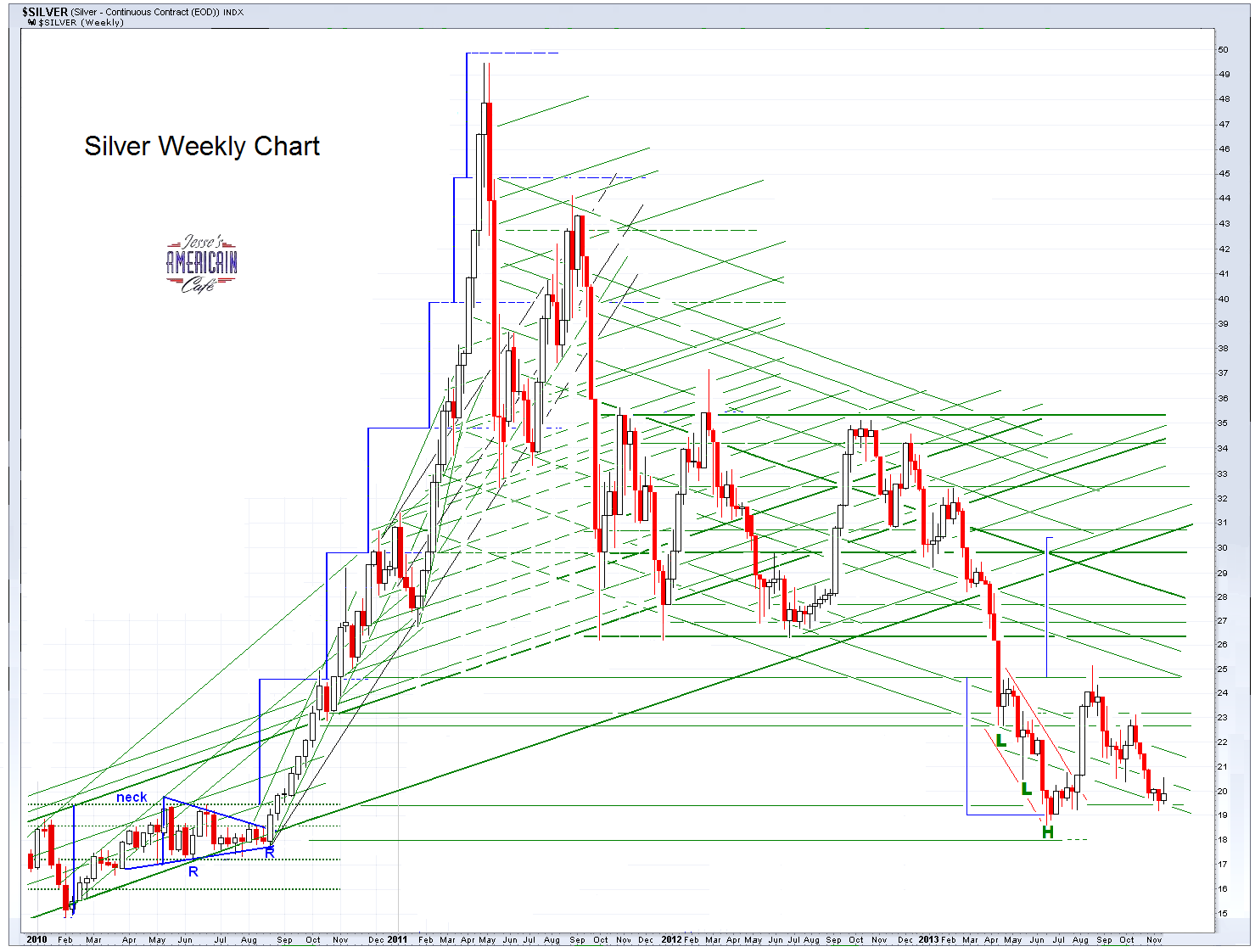
Gold Daily and Silver Weekly Charts - FOMC Tomorrow


"The doctrine of willful blindness is well established in criminal law. Many criminal statutes require proof that a defendant acted knowingly or willfully, and courts applying the doctrine of willful blindness hold that defendants cannot escape the reach of these statutes by deliberately shielding themselves from clear evidence of critical facts that are strongly suggested by the circumstances."

U.S. Supreme Court, Global-Tech Appliances, Inc. v. SEB S.A. (2011)

I spent quite a bit of time looking at the movement of gold and silver bullion in and out of the various funds and ETFs that have sprung up.

I do not have enough facts to be sure, but one might suspect that the bullion banks are using some of the ETFs, as well as leased central bank gold, as their bullion ATMs in support of the great shell game that is the Western pricing of the precious metals.

But why speculate. Let's watch this play out. I am somewhat optimistic that eventually justice will be served, one way or another.

Have a pleasant evening.


SP 500 and NDX Futures Daily Charts - Marking Time Ahead of the Fed


It was a light trade of a technical, rather gamey nature.

Tomorrow is the Federal Reserve policy announcement, the last for 2013.

I suspect it will be much ado about nothing, if at most.

Have a pleasant evening.


Slouching Towards Bethlehem to be Born


"Capitalism is at risk of failing today not because we are running out of innovations, or because markets are failing to inspire private actions, but because we’ve lost sight of the operational failings of unfettered gluttony.

We are neglecting a torrent of market failures in infrastructure, finance, and the environment. We are turning our backs on a grotesque worsening of income inequality and willfully continuing to slash social benefits.

We are destroying the Earth as if we are indeed the last generation."

Jeffrey Sachs, Self-interest, without morals, leads to capitalism’s self-destruction


Self-interest, without morals, leads to capitalism’s self-destruction
By Jeffrey Sachs
Financial Times; January 18, 2012

Capitalism earns its keep through Adam Smith’s famous paradox of the invisible hand: self-interest, operating through markets, leads to the common good. Yet the paradox of self-interest breaks down when stretched too far. This is our global predicament today.

Self-interest promotes competition, the division of labor, and innovation, but fails to support the common good in four ways.

First, it fails when market competition breaks down, whether because of natural monopolies (in infrastructure), externalities (often related to the environment), public goods (such as basic scientific knowledge), or asymmetric information (in financial fraud, for example).

Second, it can easily turn into unacceptable inequality. The reasons are legion: luck; aptitude; inheritance; winner-takes-all-markets; fraud; and perhaps most insidiously, the conversion of wealth into power, in order to gain even greater wealth.

Third, self-interest leaves future generations at the mercy of today’s generation. Environmental unsustainability is a gross inequality of wellbeing across generations rather than across social classes.

Fourth, self-interest leaves our fragile mental apparatus, evolved for the African savannah, at the mercy of Madison Avenue. To put it more bluntly, our sense of self-interest, unless part of a large value system, is easily transmuted into a hopelessly addictive form of consumerism.

For these reasons, successful capitalism has never rested on a moral base of self-interest, but rather on the practice of self-interest embedded in a larger set of values. Max Weber explained that Europe’s original modern capitalists, the Calvinists, pursued profits in the search for proof of salvation. They saved ascetically to accumulate wealth to prove God’s grace, not to sate their consumer appetites.

Keynes noted the same regarding the mechanisms underpinning Pax Britannica at the end of the 19th Century. As he put it, the economic machine held together because those who ostensibly owned the cake only pretended to consume it. American capitalism, more secular and less patriotic, created its own vintage of social restraint. The greatest capitalist of the second half of the 19th century, Andrew Carnegie developed his Gospel of Wealth, according to which the great wealth of the entrepreneur was not personal property but a trust for society.

Our 21st century predicament is that these moral strictures have mostly vanished. On the one hand, the power of self-interest is alive and well and is delivering much that is good, indeed utterly remarkable, at a global scale. Former colonies and laggard regions are bounding forward as technologies diffuse and incomes surge through global trade and investment.

Yet global capitalism has mostly shed its moral constraints. Self-interest is no longer embedded in higher values. Consumerism is the world’s secular religion, more than science, humanism, or any other -ism. “Greed is good” is not only the mantra of a 1980s Hollywood moral fable: it is the operating principle of the top tiers of world society.

Capitalism is at risk of failing today not because we are running out of innovations, or because markets are failing to inspire private actions, but because we’ve lost sight of the operational failings of unfettered gluttony. We are neglecting a torrent of market failures in infrastructure, finance, and the environment. We are turning our backs on a grotesque worsening of income inequality and willfully continuing to slash social benefits. We are destroying the Earth as if we are indeed the last generation. We are poisoning our own appetites through addictions to luxury goods, cosmetic surgery, fats and sugar, TV watching, and other self-medications of choice or persuasion. And our politics are increasingly pernicious, as we turn political decisions over to the highest-bidding lobby, and allow big money to bypass regulatory controls.

Unless we regain our moral bearings our scope for collective action will be lost. The day may soon arrive when money fully owns our politics, markets have utterly devastated the environment, and gluttony relentlessly commands our personal choices. Then we will have arrived at the ultimate paradox: the self-destruction of prosperity at the very moment when technological knowhow enables sustainable prosperity for all.


Those who make peaceful revolution impossible will make violent revolution inevitable.

John F. Kennedy

The Banks must be restrained, and the financial system reformed, with balance restored to the economy, before there can be any sustainable recovery.


16 December 2013

Silver Inventory Changes Since the Beginning of the Year


The changes in the silver ETFs and funds were a little more in keeping with recent price weakness, even though for the most part they are well up on the year as shown below.

What surprised me was the loss of about 320 tonnes of silver from SLV from Nov 1 until last Friday.

I downloaded the inventory history of SLV and verified Nick's numbers. And in doing so I realized that just looking at tonnes is not adequate, because the huge size of SLV exaggerates the nominal changes.  A 300 tonnes move in SLV inventory seems to be more 'normal' than one might expect.

I have included a third chart that shows the fluctuations in the SLV inventory. I think it is in keeping with the high beta in the price of silver. You have to wonder though, if there really is that much physical silver moving around the markets, or if there might not be some other factors in play that 'smooth' that high silver volatility in the inventory levels out.


YTD 856 Tonnes of Gold Bullion Leave the Comex and 10 Major Western ETFs and Funds


About 856 tonnes of gold bullion have left the Comex and the ten major western ETFs and funds that I have been tracking in calendar year 2013.

For comparison I include the same chart with the levels shown on 1 Novemember 2013.

I wonder where all this gold bullion is going?   We can see that twelve tonnes were transferred to the Comex, most likely to meet December delivery requirements. 


As for the rest, who can say where it has gone, and when and under conditions it might be coming back.

I wonder how much of that gold was leased out from Western central banks?


Data is from Nick Laird at Sharelynx.com

Gold Daily and Silver Weekly Charts - FOMC Meeting This Week - No Yellow Dogs Allowed


As a reminder, there will be an FOMC meeting this week, with the announcement on Wednesday the 18th at 2 PM.

Gold and silver showed some strength today, but until they break their downtrends this just the wiseguys doing the Wall Street shuffle.

Janet Tavakoli has an interesting report out today, How Hidden Bank Risks Drive Investors to Productive Assets, U.S. Treasuries, and Gold.

When I first became interested in gold, traders on the chat boards used to call it 'the yellow dog', or yaller dawg if one was of the Southern persuasion. That was because after the long and brutal bear market, gold was wallowing in the mid 200's and was getting little interest and absolutely no respect.

When this dog turns higher again, and I believe that it will, it may show us a run that would put a greyhound to shame.

Have a pleasant evening.


'Truly I tell you, whatever you did for one of the least of these, you did for me.'


SP 500 and NDX Futures - Deck the Hall With Boughs of Folly


The big tickle today was the US Industrial Production number which came in better than expected.

I have included the economic calendar for this week below.

As I said I think the funds have spend the last week or so squaring up portfolios, getting rid of losers and taking some profits, and now the paint and window dressing start going on into the year end.

After the bell Boeing announced a $10 Billion stock buyback program.

Are there no workhouses, are there no prisons?


13 December 2013

JP Morgan 'House Account Only' Trading in Comex Deliveries for 2013


"Are the hedge funds, HFT’s and algos currently having a field day with this worn out trade paying any attention to the steady drain of physical gold on which their speculations are based? As is usually the case in a temporarily successful momentum trade where almost the entire universe is aboard, the answer is probably not."

John Hathaway, The Big Picture in Gold

Here is a chart that I was able to construct from CME data that shows JP Morgan's Comex Gold Delivery activity for their 'house account' only.

I have marked the nominal price of gold on the chart for this year. The last data is as of December 10, 2013.

The months marked with boxes are 'active months' for the delivery process. December is also an active month.

They seem to have had quite a good year for themselves so far. 

For those who would like some color commentary, JPM came into February issuing deliveries to beat the band.  They were quiet in the inactive month and then back swinging hard and delivering in size during April.

In August JPM stopped or took delivery on quite a chunk of gold bullion and the price recovered a bit from its first half of the year pounding.  I can conceptualize this as 'covering' what they have issued in the first half of the year.

Since then the gold price slumped back down into November.   JPM started taking deliveries (stopping) again very heavily in December.   I hear they are stopping something over 90% of warrants issued.

However for the year, and for the year only, their net position is still about 7,600 more contracts issued than stopped in their house account.   This is down from a high of 14,600 contract net issued which they maintained from about April through July. 

I have just added a second chart that shows just the rolling 'net position' for their house account with regard to deliveries for the year.   Just for the sake of tracking their notional position for the year I am going to refer to this as their 'short' although they could just be selling from any inventory which they had somewhere or from the prior year.   And please bear in mind that while this chart show a position that is all negative for the year,  I wanted to be able to plot it against the price of gold, so I inverted the Y axis.

Whether this represents an actual short position or not depends on their opening inventory of gold bullion owned by them, how much of the gold delivered was rehypothecated or leased, and how those contracts were actually settled, be it in equivalent instruments, cash, or actual bullion from whatever sources.

I know this is not all the data we would like to see, and does not begin to address their offsetting positions in other transactions and markets like derivatives.  

And of course I am sure that this is all 'just a hedge' being done in the CTO risk management area, just like the London whale.

Speaking of gold market antics, GATA just sent out this delightful presentation from the Banque de France entitled Managing Gold as a Central Bank.

And here is The Big Picture In Gold by John Hathaway which I recommend that you read.

And the band played on.

Have a pleasant weekend.


Gold Daily and Silver Weekly Charts - 146,000 Ounces Come Out of JPM's Registered Inventory


There were a few notable changes in the Comex gold warehouse inventory yesterday, as 146,000 ounces of gold had their warrants cancelled and were adjusted from 'registered' to 'eligible.'

What is particularly interesting about this is that it knocked the deliverables down back down to 600,000 ounces, with almost half of those held by Scotia Mocatta.

It would certainly be interesting if we knew exactly who held what, and what their net positions might be.   And it would certainly be fun if I knew everything I want to know, and had everything I want to have.  But life is a struggle to find out how things work, and it is especially hard to discover what has been hidden for whatever reason.

There is another interesting chart that Nick and I produced that shows what JPM stopped and issued in terms of Comex gold contracts over the past twelve months.  As you will recall when a party 'stops' a warrant they are taking delivery, and when they issue a warrant they are offering gold for sale. 

I don't think this sorts out what JPM is doing for its house account versus what they are doing overall as a bullion bank.  I may take a crack at that later on.

So obviously some of this is just pure correlation with what customers are doing, ie. selling on price declines, and then buying bottoms and riding it back up. 

What is interesting is the huge spike in year end buying (stopping) of contracts that has not yet been reflected in price.   I am watching this with care, because as you may remember we have seen these big dips in registered inventory signal an intermediate price change within six months, at least within the last ten years of this bull market.

I know quite a few people are getting edgy on this correction and I can't blame them for that.  But that does not mean that someone is going to be able to tell them with high certainty that the market has bottomed and the correction is over so that they can immediately rush out and put in leveraged bull bets and make a fortune. 

There are those who will tell you that, many, many times in fact, almost every other week it seems.  And when and if a turn does come, they will point to that 'call' and say see I was right, and forget about the ninety other times they were wrong. 

It does not work like that.  We will get a confirmation if we get a trend change, and you *might* miss the first ten percent of the up move by waiting.  But you will also miss a lot of wear and tear on yourself and your portfolio in the process.  Most traders who sell the top and buy the bottom with precision are either darn lucky or damn liars.   At least that is what Bernard Baruch says and my own experience tends to validate that.

I do think we are in a bottoming process and the emphasis here is on process.  If we are holding positions without leverage and a longer term time horizon, what difference does it make if the trend change comes next week or next month or even five months from now?  What is important are the fundamentals and the trend. 

I do have both a long term and a short term portfolio.  The long term I have not touched in some years.  The short term has been adjusted to match my thoughts on the current market structure, a little more aggressively than normal perhaps.

I have modified my thinking about Comex a bit, now seeing how much of an insiders' shell game it has become because of the laxity over positions and price antics, and the high amount of paper shuffling and opaque positioning that occurs relative to how much actual clearing of markets between producers and buyers is accomplished.  But it is what it is: a speculative vehicle.  And its role in world markets is changing, diminishing most likely.

Have a pleasant weekend.


SP 500 and NDX Futures Daily Charts - The Pause that Refreshes Before FOMC Next Week


Stocks were treading water this week ahead of the FOMC decision next week.

I think that even though there may be more taper talk that the Fed will not doing anything substantial.

Even if they do taper, we have to keep in mind that this is a cutback on the 80+ billion in monthly liquidity the Fed injects into the financial system by buying Treasuries and Mortgage debt.

But I do think that the discussion about what they will do will be about as substantial as what they actually end up doing which is pretty much nothing.

Have a pleasant weekend.


JP Morgan Stood 'At the Very Center of Madoff's Fraud for Over 20 Years'


I am posting this to make sure we all know that JP Morgan is no passive bank, that occasionally becomes involved with financial criminals like Madoff or the MF Global crowd.

The criminal charges are likely to be a 'deferred prosecution' which means that while JPM may admit to wrongdoing, unusual in the vast majority of settlements for financial crimes, there will in fact be no prosecution or revelations in court.

This is why the 'stimulus' of the Keynesians will not work. They have skipped the critical step in the FDR framework of reforming the financial system, or at least making a serious intent to do so. As it is, Dodd-Frank turned out to be the terms of surrender of the republic which Wall Street dictated to its servants in the government.

The tragedy of our day may have been the financialisation of the Democratic party and the evisceration of the progressive movement, which helped to remove the last remaining significant political serving the people as a counterbalance to those elements of society which have become the servile mouthpiece for Big Business and Big Money, no matter what ideological disguises or social niceties which they may wish to put upon their intentions.

As for any necessary complicity in the abuses of the world, we have the power of our refusal: our refusal to participate in the madness, to be seduced by it, to become a part of it.

Why speak out? Why attempt to do anything? Because someday we may wish, at the very least, to be able to look our grandchildren and great-grandchildren in their eyes and say, "I did what I could. I was not silent. I am sorry that I could not have done more. But I did not forget you." And for me my poor parents, both gone now these many years, will know, wherever they may be, that I did not dishonor their memory.

And we may now reread history and discover that this is the challenge of every generation and the rule of our cause, to be in the world, but not of its worst elements. Not to shun the world, but to be a comfort, and a shield, and a source of hope to our friends, our families, and so importantly, to its victims.

"Picard told the Supreme Court that JPMorgan stood “at the very center of Madoff’s fraud for over 20 years.” Picard bases this claim on his lower court filing that showed JPMorgan was well aware that Madoff was claiming to invest tens of billions of dollars in a strategy that involved buying large cap stocks in the Standard and Poor’s 500 index while simultaneously hedging with options. But the Madoff firm’s primary bank account at JPMorgan, which the bank had intimate access to review for over 20 years, was devoid of evidence of stock or options trading.

The petition to the Supreme Court reads: “As JPM [JPMorgan] was well aware, billions of dollars flowed from customers into the 703 account, without being segregated in any fashion. Billions flowed out, some to customers and others to Madoff’s friends in suspicious and repetitive round-trip transactions. But in the 22 years that JPM maintained the 703 account, there was not a single check or wire to a clearing house, securities exchange, or anyone who might be connected with the purchase of securities. All the while, JPM knew that Madoff was using the account to run an investment advisory business with thousands of customers and billions under management and knew that Madoff was using its name to lend legitimacy to his enterprise."

Pam Martens, JPM May Face Criminal Charges Over Madoff

Read the entire piece here.

12 December 2013

Holding Gold or Silver In Unallocated Storage Or in ETFs and Brokerage Accounts


"This is what economics now does. It tells the young and susceptible (and also the old and vulnerable) that economic life has no content of power and politics because the Firm is safely subordinate to the market and the state, and for this reason it is safely at the command of the consumer and citizen.

Such an economics is not neutral. It is the influential and invaluable ally of those whose exercise of power depends on an acquiescent public. If the state is the executive committee of the great corporation and the planning system, it is partly because neoclassical economics is its instrument for neutralizing the suspicion that this is so.”

John Kenneth Galbraith, Power and the Useful Economist

This is not a criticism on any particular precious metal institution, mint, bank, or brokerage. Rather, it is the new normal, a sign of the times.

Trust is a commodity that is in short supply, and for some very good reasons having to do with some longer term trends that I would hope are reaching their zenith.

I know that safe diversification is not always easy to accomplish.

These are the post-MF Global times in which we live.

The ultimate solution will be to reinstate a political system that is responsive to and serves the needs of its own people as its first priority, and not the interests of a global overclass as described by David Malone in The Emerging New World Order.

The most powerful impediment to this reform is the marriage of political power and big money, and the reduction of fundamental values such as freedom and dignity to mere accounting entries in the inhuman calculus of corporate selfishness and greed.   If there is any room for unreasoning optimism it is that these trends tend to be cyclical, and we have been on this current trajectory for the past forty years.

“In the old framework, cash was a risk-free asset.

In the new paradigm of systemic risks, no asset (even cash) is risk-free so long as it is in custody of a financial institution. Investors and depositors no longer have clear title to their own assets if they are held in financial accounts.

There is now a body of law (including Dodd-Frank) that allows custodial assets to be swept into the bankruptcy estate and be subordinated to senior claims.

Hand in hand with the evolution of the banking laws is the subtle but pernicious evolution of the practice of banking: “Various rules and practices have made it almost impossible to use cash and securities. Go try to make large cash withdrawal or cash deposit and see what paperwork you would be forced to complete.”

Simon Mikhailovich, Eidesis Capital LLC, Grant's Interest Rate Observer Nov 15

Gold Daily and Silver Weekly Charts - Friday the 13th - JPM's Comex Deliveries


"The Fed can expand its Balance Sheet to kingdom come, but they cannot produce a single ounce of actual gold bullion in the process.

And that is why gold is such an emotional topic, so feared and derided in turn by those whose power is based on position and paper, because gold resists the forces of fiat money and the human will by its mere stubborn existence."

Jesse

I had the opportunity last night to discuss things with a few old friends, from around the world in fact, and thanks to some helpful folks I was able to get a better idea of the mechanics of delivery at the Comex.

There was intraday commentary about the delivery process for gold at the Comex here.

I have to admit that this gold situation has me interested. There are some odd things happening, and I suppose digging into things one might not ordinarily care about is what must to done to understand them better.

There is nothing of science in this, no particular body of knowledge, but just some secular process and jargon, and some exchange rules that one has to learn in order to understand what is going on better. Since I would never even consider taking delivery from the Comex for anything, it a level of detail that I don't expect to come in handy anytime in the future.

But I can see now that the Comex is more of a paper exchange than I had previously suspected, and is dominated by a relatively small number of players. I would like to think that this is a change from what I was more familiar with in the 1990's and early 2000's, but at that point I was trading in energy and commodities where delivery did not even come up in passing.

What I would really like to find out is the distribution of inventory outside the Comex, especially what encumbrances exist on central bank gold, and especially the harder figures on inventory at the LBMA.

But like the physical market, it seems like a lot of the inventory information is heading east. I don't know how much data will be released from the new Asian exchanges, but that is clearly where the action is moving.

I will be interested to see what kind of December we will end up having, given the 'December gold manipulation' pattern we saw the last couple of years. You can click on the label at the end of this for more info.

JPM is taking quite a bit of gold delivery and at this rate *could* end up with most of the registered gold at the Comex. What they are up to in this I cannot say. Someone suggested they could use it to hammer price during January and February as they did early this year. I don't think they have enough runway to really pull that one off, but I won't underestimate their aggressiveness in swinging the trade their way. One only has to look at the massive declines in inventories in the first half of this year to get an idea of what was thrown at the market. And JPM was a big seller.

Jim Sinclair and Ted Butler think that these smackdowns are used for the Banks to fill their own inventories and cover and even get long, and there is some merit in that as well. I cannot say since I am not sure I have enough data to know. You really have to see a traders whole book and not just their trades in one market to get the bigger picture.

Have a pleasant evening.


SP 500 and NDX Futures Daily Charts - Outsized Unemployment Claims Dampen The Recovery™


Stocks were a bit wobbly today as expectations of a bounce came and faded and then came back again, only to fail into the close. Unemployment claims came in on the high side this morning, somewhat dampening expectations for The Recovery which brings glorious growth and prosperity to the homeland.


Inventories are a bit bloated as well.   Aren't the puppies eating the puppy food?

Don't get me wrong. These markets are as tied to fundamentals as Eddie Lampert's management style was to Sears' customers. This is a year end holiday market already, and despite some possible taper talk about the Fed's next meeting this is a carney game hosted by Dewey, Cheatum and Howe.

Have a pleasant evening.


Delivery Day: Why a Comex Default Is Unlikely as a 'First Mover' Event


"The very hirelings of the press, whose trade it is to buoy up the spirits of the people. have uttered falsehoods so long, they have played off so many tricks, that their budget seems, at last, to be quite empty."

William Cobbett

A couple of people pointed me in the direction of this CME rulebook when I asked for some details about how there can be so many deliveries in a highly active month like December, but so little outgoing activity can be shown in the warehouse inventories.  And several more offered their own information, and I thank them for it.

Here is a link to the CME Rulebook On Deliveries

Another fellow was kind enough to send a couple of the most pertinent passages my way. They are included below. 

As you can see, a 'delivery' can be made, and most likely is most often made, by the transfer of a Warrant for the metal. The Warrants are issued and backed solely by the licensed facility, ie the specific warehouse controlled by JPM, HSBC, etc.

The Warrants have no expiration, so one might assume that they become traded around like currency, for those in the business of not actually taking physical delivery and moving their bullion out of the warehouse complex.

And I would not assume that even a licensed operator like JPM would move their house account bullion out of another operator's warehouse to save on storage costs,  because they typically are not engaging in long term holdings that would make it worthwhile. 

I don't think it becomes too hard to see how this structure, which to my knowledge is not audited, can become quite the twisted paper chase of counterparty risk and rehypothecation, given the general practices of the Banks in some many other areas.

As an aside, I do not necessarily believe that JPM's stopping the vast majority of the gold deliveries for their 'house account' is a bullish sign, not at all.   But it should at least raise some eyebrows that a 'market maker' is buying bullion so heavily for its own account.  Is this to underpin short side obligations in some other markets?   Only the bookkeepers know for sure. 


By taking these warrants and the underlying bullion for their own account, they may even be controlling its disposition of the bullion, eg. making sure it remains within the Comex licensed facility complex and is not taken out and melted into bars for use on other exchanges in Asia.   The Comex inventory is rather thin after all.

By the way, we do know that an operator is taking delivery for their house account, versus a customer, because there is a CME report that explicitly shows this.  I was surprised at this level of detail.

To sum this up, I am now even more persuaded that if there is any default or sudden deleveraging in the gold market it is unlikely that the Comex will precipitate this event. It is more likely that some incident in another market more physically based would trigger deleveraging, which would thereafter cascade throughout the paper gold market in London and New York.

Since we know rehypothecation is taking place as a customary business practice, with the only question being the extent of it, and with operators acting as their own regulators in terms of inventory, with even the exchange explicitly taking no liability for their data, I think it is very possible for an incident in the gold market to occur. 


The probability of this cannot be determined for the usual reasons, in that it is not possible to gauge the actual amount of counterparty risk because of the opaque nature of the information and the market.  It could be discovered, but that would require a third party audit.

But there is rehypothecation, and there is counterparty risk. And it appears to be a bit stretched by historical standards. And this post is certainly no defense of the Comex. If anything its connection to the broad global market for physical bullion is more tenuous than I had even thought previously, more like a shell game than a market that brings together producers and consumers. That it is a price setting mechanism for a much larger and broader physical market that plays a key role in the allocation of resources is almost unbelievable.

Some cavalierly point to 10:1 leverage as acceptable, as being customary for Banks holding around ten percent reserves (in another better day before sweeps etc., but that is no matter).

It begs the question that liquidity in the currency markets is significantly greater and more flexible than in the physical bullion market, a fact that so many modern economists often gleefully celebrate.

The Fed can expand its Balance Sheet to kingdom come, but they cannot produce a single ounce of actual gold bullion in that process. And that is why gold is such an emotional topic, so feared and derided in turn, because it resists the forces of fiat money and the human will by its mere stubborn existence.

706.E. Delivery Day
The day on which the long clearing member receives the Warrant for the metal shall be referred to as "Delivery Day." Delivery may take place on any business day beginning on the first business day of the delivery month or any subsequent business day of the delivery month, but no later than the last business day of the current delivery month

705B-5. A Warrant shall be of unlimited duration and remain valid until cancelled by the Licensed
Facility that issued it.

705B-6. Licensed Facility shall be solely responsible for insuring that no duplicate Warrants are
issued, printed or released by it.

Chapter 113
113102.E. Termination of Trading
No trades in Gold futures deliverable in the current month shall be made after the third last business day of that month. Any contracts remaining open after the last trade date must be either:
(A) Settled by delivery which shall take place on any business day beginning on the first business day of the delivery month or any subsequent business day of the delivery month, but no later than the last business day of the delivery month.
(B) Liquidated by means of a bona fide Exchange for Related Position (“EFRP”) pursuant to Rule 538. An EFRP is permitted in an expired futures contract until 12:00 p.m. on the business day following termination of trading in the expired futures contract. An EFRP which establishes a futures position for either the buyer or the seller in an expired futures contract shall not be permitted...

CME Group Rule Book Chapter 7:
703A-5. "Eligible" shall mean, with respect to any metal, that such metal is acceptable for delivery against the applicable metal futures contract for which a Warrant has not been issued.

538. EXCHANGE FOR RELATED POSITIONS
538.B. Related Positions
The related position (cash, OTC swap, OTC option, or other OTC derivative) must involve the commodity underlying the Exchange contract, or must be a derivative, by-product, or related product of such commodity that has a reasonable degree of price correlation to the commodity underlying the Exchange contract.

It appears that an ETF can be used to settle a Comex futures contract, noting that this is a negotiated settlement and not forced upon the receiving party. There could be subsequent rule changes to this one, but it really doesn't matter much since I am fairly sure they can settle in cash if both parties agree.

11 December 2013

Gold Daily and Silver Weekly Charts - JPM the 'Stopper' - Winter Is Here


"This is the first generation of Americans in modern history expected to enjoy lower living standards than their forebears. It is the first generation in modern history whose life expectancy is dwindling.

It is the first generation of modern Americans whose educational attainment is declining. It is the first generation of modern Americans who face less opportunity than their parents.

Shorter, nastier, dumber, harder, bleaker. That’s the future for not only Americans, but for many in the world’s richest countries."

Harvard Business Review, America's Economy Is Officially Inside Out

Holding precious metals in unallocated storage with a gold or silver dealer to save on storage fees is a particularly risky proposition at this time. The reason that storage fees are waived is because the entity has the right to borrow your metal and to fractionalize your claim on bullion for their own financial purposes, without your specific knowledge of when, and for how long, and to what extent.

It seems to undermine the very nature of a long term precious metals investment as insurance against an unexpected and disruptive financial event.

I hear from those who watch these sorts of things that JP Morgan is said to be 'stopping' or taking delivery on the gold contracts offered in this delivery month to the rate of something like 95%. That certainly is notable.

And even more odd is that they are stopping about 60% of the silver contracts, which is even more odd since they are nominally net short silver in the futures.

Ted Butler has proven to be a useful source of information on these things for me and I thank him for this.

Mr. T. Ferguson has some remarks on the bullish composition of the precious metals markets and JPM's gold acquisitions here.

And as always, Aussie data wrangler Nick Laird and his charts are indispensable.

Have a pleasant evening.