"The most ethereally beautiful music of the twentieth century was first heard on a brutally cold January night in 1941, at the Stalag VIIIA prisoner-of-war camp, in Görlitz, Germany. The composer was Olivier Messiaen, the work “Quartet for the End of Time.”
Messiaen wrote most of it after being captured as a French soldier during the German invasion of 1940. The première took place in an unheated space in Barrack 27. A fellow-inmate drew up a program in Art Nouveau style, to which an official stamp was affixed: “Stalag VIIIA 49 geprüft.” Sitting in the front row—and shivering along with the prisoners—were the German officers of the camp.
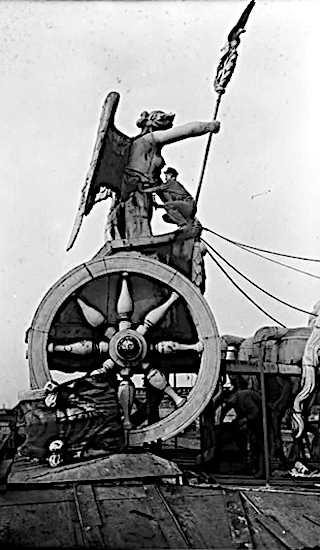
The title does not exaggerate the ambitions of the piece. An inscription in the score supplies a catastrophic image from the Book of Revelation: “In homage to the Angel of the Apocalypse, who lifts his hand toward heaven, saying, There shall be time no longer.”
Messiaen’s quiet answer to the ultimate questions of fear and faith stayed with me...not because he was a greater composer than Bach or Beethoven but because his reply came out of an all-too-modern landscape of legislated inhumanity. In the face of hate, this honestly Christian man did not ask, “Why, O Lord?” He said, “Lord, I love you.”
Alex Ross, Revelations: The story behind Messiaen’s Quartet for the End of Time, The New Yorker, March 2004
31 January 2010
A Quartet for the End of Time
Front-Running the Markets And the Sickness Unto Death
"And that is the nature of Goldman. Gather up as many customers as possible, aggregate the available information to achieve a superior market view and then relentlessly extract rents from the marketplace. Better yet, tell yourself you’re smarter than everyone else and you’ve earned the rents from the symbiosis."
James Rickards, former General Counsel of Long Term Capital Management
This is a nice, concise, albeit somewhat simplified description, from a more mainstream and highly credible source, of how the markets are operating today to the extreme disadvantage of the public and the real economy. Between front-running and naked short selling the banks have things pretty well under their control.
The market makers are the Wall Street banks are the prop trading desks, trading at high frequency slightly ahead of the markets while peeking into your accounts, gaining just enough unfair advantage to defy the odds of winning and losing in a fairly regulated market.
From James Rickards, The Frog, The Scorpion, and Goldman Sachs:
"Now consider another example of data mining, not done by retail firms, but by giant investment banks such as Goldman Sachs. These banks have thousands of customers transacting in trillions of dollars in stocks, bonds, commodities and foreign exchange daily. By using systems with anodyne names like SecDB, Goldman not only sees the transaction flows but some of the outright positions and whether they are bullish or bearish. Data mining techniques are just as effective for this market information as they are for Google, Amazon, Wal-Mart and others. It’s not necessary to access individual accounts to be useful. The data can be aggregated so that the bank can look at positions on a portfolio basis without knowing the name of each customer.
One need not be a market expert to imagine the power of this information. You can see which way the winds are blowing before the storm hits. You get a sense of when momentum is draining out of a trade so you can get out of it before the market turns. You can see when bullish or bearish sentiment reaches extremes, suggesting it may soon turn the other way. This use of information is the ultimate type of insider trading because it does not break the law; you are not stealing the information, you own it.
So what do Goldman and others do with this mountain of market information? Do they send coupons to customers or text them with great trading ideas? A few lucky customers, usually giant hedge funds, may get a call on some insights, but this mountain of immensely valuable market information is used mainly to power their giant proprietary trading desks allowing them to rack up consistent excess returns. Economists have a name for this also. It’s called “rent seeking,” which means taking value from others without any contribution to productivity. The difference between value-added behavior and rent seeking is like the difference between Amazon trying to sell me a book or planning to steal my library. In nature, the name for a rent seeker is parasite.
The ideal existence for a parasite is symbiosis, or balance, where it offers some minimal service to the host, (some parasites devour insects which annoy the host), while extracting as much sustenance from the host as possible without killing it. But sometimes the symbiosis is disturbed and the parasite takes too much and actually destroys the host, which can end up destroying the parasite as well. This recalls the fable of the scorpion and the frog. Both are on the edge of a river looking for a way to cross. The scorpion cannot swim and asks the frog for a ride on its back. The frog at first says, “no,” for fear of being stung. But the scorpion assures the frog it will not sting him because they would both drown. The frog agrees to carry the scorpion. Once they reach the middle of the river, the scorpion stings the frog and they begin to drown. The frog cries, “why did you do that?” and the scorpion replies, “it’s my nature.”
And that is the nature of Goldman. Gather up as many customers as possible, aggregate the available information to achieve a superior market view and then relentlessly extract rents from the marketplace. Better yet, tell yourself you’re smarter than everyone else and you’ve earned the rents from the symbiosis."
How does it continue? Like the bailout of AIG, the stewards of the public trust are choosing to turn a blind eye. The politicians are the beneficiaries of huge campaign contributions. The regulators are overwhelmed, and desirous of Wall Street positions. The other traders are jackals, seeking to follow the lions as they tear into the flocks of sheep and cattle. The economists are timid, adverse to anything but painfully granular analysis of carcasses of other people's ideas and orthogonal scenarios.
"Worse yet, the parasite is now killing the host. The United States is drowning in debt, much of it incurred to bail out Goldman, AIG, GMAC, Fannie Mae and all of the other rent seekers. The U.S. is like the frog; well meaning but blind to nature of scorpions.
Wall Street likes to say, “what’s good for Wall Street is good for Main Street.” That’s the scorpion talking. What’s good for Wall Street is good for Wall Street. Never forget it."
The financial system did not need to be saved by bailouts, it needs to be saved from itself. Their insatiable greed, monstrous appetites, and arrogant pride will take them over the cliff.
Which would not be bad in itself, if our governments had not made us hostage to their reckless schemes, and if we, in our resignation and despair, do not allow them to take us with them.
Category:
bank bailouts,
financial reform,
regulatory capture
The First Year of Obama's Failed Economic Policies: The Worst May Yet Be Avoided
"The banks must be restrained, the financial system reformed, and balance restored to the economy before there can be any sustained recovery."
We have been saying this for some time. The report below from Neil Barofsky says essentially the same thing.
"Even if TARP saved our financial system from driving off a cliff back in 2008, absent meaningful reform, we are still driving on the same winding mountain road, but this time in a faster car," Barofsky wrote.
The US is heading towards a double dip recession, and the next leg down may be more fundamentally damaging than before.
The reason for the decline will be the abject failure of the Obama Administration to address the roots of the problem, instead wasting trillions to prop up a banking system that is a useless distortion.
Worse than useless really, because it actually presents a huge negative influence by stifling the recovery, channeling funds to the crony capitalists and non-producing wealth extraction sector, who tax the people like feudal lords under license of a corrupt government.
So far, Obama has failed the people, but preserved the banks. A source of his failure has been his weakness in listening to Larry Summers and Tim Geithner, the Rubin-Clinton wing of Democrats, who have well established their incompetence and inability to act at a level suitable to their positions. They are captive to special interests, locked into the ways of thinking that brought the world to the point of crisis.
In response to the next leg down, Bernanke will monetize debt at an even more furious and clever pace, perhaps in alliance with the Bank of England and Bank of Japan. The ECB resists, and all who balk will be chastised by the monied powers and their demimonde, the ratings agencies and global banks. This is modern warfare of a sort.
We do not expect the corruption of the world's reserves to be so blatant that the inflation will immediately appear, except in more subtle manner. At some point it may explode, especially if Ben is particularly good at concealing its subtle growth.
Monetary inflation is the growth of the money supply in excess of the demands of the real economy, not nominal growth of the supply. The US has been shifting its growth into the reserves of other central banks for the past twenty years or so, and those eurodollar present an overhang that will egulf the Treasury should they come home to roost too quickly. The great nations see the US problem, most surely. The question is how to handle it, gracefully, since the US is still the world's sole superpower, and given to covert pre-emptive action when it feels threatened.
It is not a pretty picture. We had high hopes for Obama, because he was capable of rising to the challenge. He had the backing of his people. And he is choosing failure, for whatever reason. That is certainly is the template of a modern tragedy.
“Given the same amount of intelligence, timidity will do a thousand times more damage than audacity.” Karl von Clausewitz
ReviewJournal
Watchdog: Bailouts created more risk in system
By DANIEL WAGNER and ALAN ZIBEL
AP Business Writers
WASHINGTON (AP) -- The government's response to the financial meltdown has made it more likely the United States will face a deeper crisis in the future, an independent watchdog at the Treasury Department warned.
The problems that led to the last crisis have not yet been addressed, and in some cases have grown worse, says Neil Barofsky, the special inspector general for the trouble asset relief program, or TARP. The quarterly report to Congress was released Sunday.
"Even if TARP saved our financial system from driving off a cliff back in 2008, absent meaningful reform, we are still driving on the same winding mountain road, but this time in a faster car," Barofsky wrote.
Since Congress passed $700 billion financial bailout, the remaining institutions considered "too big to fail" have grown larger and failed to restrain the lavish pay for their executives, Barofsky wrote. He said the banks still have an incentive to take on risk because they know the government will save them rather than bring down the financial system.
Barofsky also said his office is investigating 77 cases of possible criminal and civil fraud, including crimes of tax evasion, insider trading, mortgage lending and payment collection, false statements and public corruption.
One case concerns apparent self-dealing by one of the private fund managers Treasury picked to buy bad assets from banks at discounted prices. A portfolio manager at the firm apparently sold a bond out of a private fund, then repurchased it at a higher price for a government-backed fund. A rating agency had just downgraded the bond, so it likely was worth less, not more, when the government fund bought it. The company is not being named pending the outcome of Barofsky's investigation.
Barofsky renewed a call for Treasury to enact clearer walls so that such apparent conflicts are less likely.
Treasury said it welcomed Barofsky's oversight but resisted the call to erect new barriers against conflicts of interest. The new rules "would be detrimental to the program," Treasury spokeswoman Meg Reilly said in a statement. The existing compliance rules "are a rigorous and effective method of protecting taxpayers," she said.
Much of Barofsky's report focused on the government's growing role in the housing market, which he said has increased the risk of another housing bubble.
Over the past year, the federal government has spent hundreds of billions propping up the housing market. About 90 percent of home loans are backed by government controlled entities, mainly Fannie Mae, Freddie Mac and the Federal Housing Administration.
The Federal Reserve is spending $1.25 trillion to hold down mortgage rates, and millions of homeowners have refinanced at lower rates.
"The government has stepped in where the private players have gone away," Barofsky said in an interview. "If we take government resources and replace that market without addressing the serious (underlying) concerns, there really is a risk of" artificially pushing up home prices in the coming years.
The report warned that these supports mean the government "has done more than simply support the mortgage market, in many ways it has become the mortgage market, with the taxpayer shouldering the risk that had once been borne by the private investor."
Barofsky's report echoed concerns raised by housing experts in recent months, as home sales and prices rebounded. They warn that the primary reason for the turnaround last year has been billions of dollars in federal spending to lower mortgage rates and prop up demand.
Once that spigot of cash is turned off, they caution, the market will be vulnerable to a dramatic turn for the worse. Daniel Alpert, managing partner of investment bank Westwood Capital, wrote in a report that national home prices are bound to fall 8 to 10 percent below the lows of last spring.
"The lion's share of the remaining decline will occur in markets that saw sizable bubbles but have not yet retrenched," he wrote.
Officials from the Obama administration counter that massive federal intervention has helped the housing market stabilize and prevented more dire consequences.
Barofsky's report also disclosed that, while the Obama administration has pledged to spend $75 billion to prevent foreclosures, only a tiny fraction - just over $15 million - has been spent so far. Under the Making Home Affordable program, only about 66,500 borrowers, or 7 percent of those who signed up, had completed the process as of December.
He said the key to preventing future crises is to reform Fannie Mae and Freddie Mac, create and improve loan underwriting and supervision of banks. He stopped short of endorsing specific proposals for overhauling financial regulation, but said many of the proposals would go far to improving the system.
Subscribe to:
Comments (Atom)