Management does makes a difference.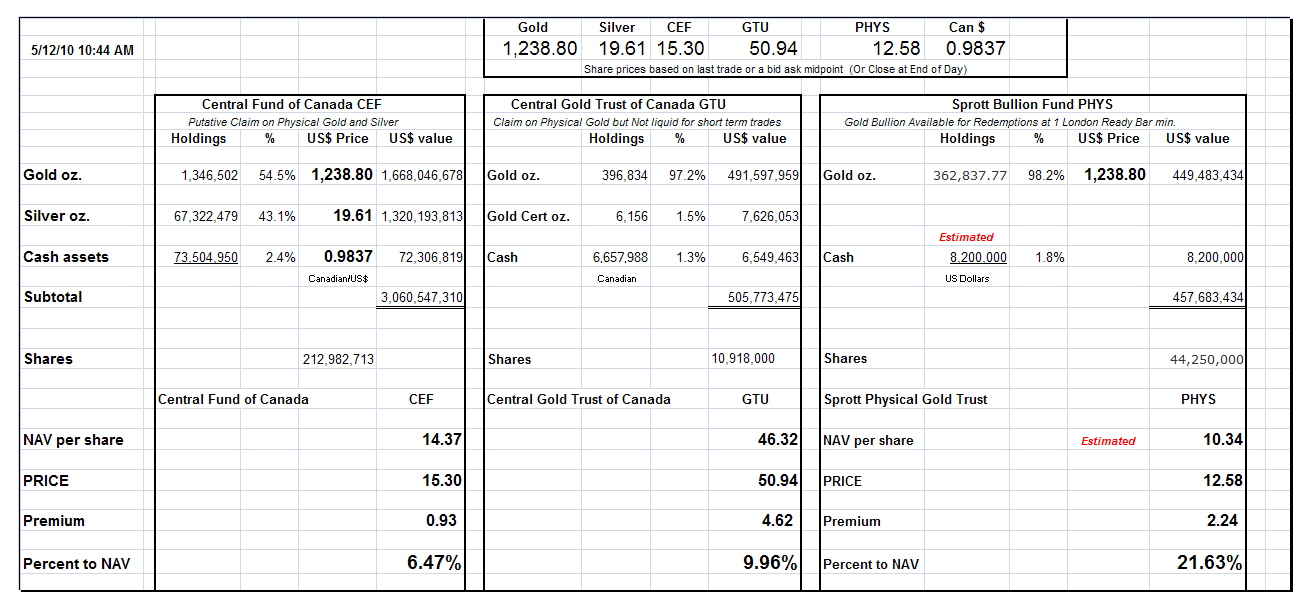
The Central Fund's offering led by CIBC is allowing the underwriters and others given access to this offering to obtain a windfall, being given the right to purchase additional shares at 14.85.
Presumably this will create a weight holding down the premium to NAV of this fund until they have taken their profits by selling those units which they have obtained at discount prices. Perhaps this is not the case, and the news is misleading. But it would certainly explain the contraction in the premium when gold and silver are hitting new highs.
This looks to me like the habit of using an old, familiar method of obtaining funds that may be more suited to other times and different markets. Old habits die hard, and sometimes even harder when new competition enters the markets and changes are not made with the times.
Since CEF will be in the market buying gold and silver bullion, it drives up prices at the very time it is giving its bank underwriters a discount price on their stock.
Yes I understand the difficulty of selling a large tranche like that in the marketplace. But I would contrast this approach with that of PHYS and Sprott Asset Management, which managed to sell an equally large amount of units and buy bullion while continually providing the benefits to shareholders, and not to the banks with whom they are doing business.
To say I am not impressed by the CEF management would be about right. While I do not doubt they have the bullion they represent, I am disappointed by their method of obtaining the greatest value and consideration for shareholders.
I will flip their shares for a trade, but if I want to buy and hold something besides bullion when the metals are running I think there are better ways to play that trade. Some of the miners have higher beta and a better index to the metal moves. PHYS had been a great play but its premium now is a bit prohibitive for my taste. SLW is da bomb when silver runs but it too can get ahead of itself.
Still, you have to have something to hang onto when gold and silver are on a run like this. There is a huge surge of bullion and coin purchases in Europe because of worries about their currencies. When the currency concerns eventually spread to the dollar, which they almost certainly will, the buying will make what we are seeing now seem like a bump on the charts.
12 May 2010
Net Asset Value of Certain Precious Metal Funds and Trusts: Comments on CEF
11 May 2010
General Motors Wants to Get Back into Financing to Increase Its Profits
Bloomberg reports that GM Considers Buying back GMAC
Or starting a new unit.
Having its own financing unit will 'increase its profitabiltiy.'
"As a dog returns to his vomit, so a fool doth repeat his folly." Proverbs 26:11
Unless of course you get to keep the gains, and a greater fool, the public, assumes your losses.
It's good to be the King, but cheaper to lease one.
AP
GM wants to re-enter auto financing
Tom Krisher
Tuesday May 11, 2010
DETROIT (AP) -- General Motors Co. executives want their own auto-financing arm so they can offer more competitive lease and loan deals, according to a person briefed on their plans.
The executives want to buy back the auto financing business from the former GMAC Financial Services or start their own operations, said the person, who asked not to be identified because the plans have not been made public.
A top GM executive has told dealers about the plans, the person said.
GM sold a 51 percent stake in GMAC Financial Services in 2006 when it was starved for cash. The new owners, led by private equity firm Cerberus Capital Management LP, ran into trouble in 2008 with bad mortgage loans and had to be bailed out by the federal government, which now owns 56 percent of the company.
Earlier this month, GMAC changed its name to Ally Financial.
GM dealers say that since GMAC is responsible for making its bottom line look good, it is less likely to lose money by offering to finance sweet lease deals or zero-percent financing. A GM-owned auto financing business would be more likely to "take a bullet" for the company to sell more cars and trucks, the person said.
Competitors, such as Ford Motor Co. or Toyota Motor Corp., control their own financing arms.
GM spokesman Tom Wilkinson said Tuesday that the company would not comment on speculation....
Here Is Why the Fed Cannot Simply Continue to Inflate Its Way Out of Every Financial Crisis That It Creates
 The return on each new dollar of US debt is plummeting to new lows according to figures from the Federal Reserve.
The chart below is from the essay, Not Just Another Greek Tragedy by Cornerstone.
I have been watching this chart for the past ten years, as part of the dynamic of the sustainability of the bond and the dollar as the limiting factor on the Fed's ability to expand the money supply.
The ability to expand debt is contingent on the ability to service debt. If the cost of the debt rises over the net income of the country's capital investment, or even gets close to it, the currency issuing entity is trapped in a debt spiral to default without a radical reform.
In other words, if each new dollar of debt costs ten percent in interest, largely paid to external entities, and it generates less than ten cents in domestic product, it is a difficult task to grow your way out of that debt without a default or dramatic restructuring.
So we are not quite there yet. But we are getting rather close on an historic basis. Without the implicit subsidy of the dollar as the world's reserve currency it would be much closer.
As it is now, this chart indicates that stagflation at least, rather than a hyperinflation, is in the cards for the US. But the trend is not promising, and the lack of meaningful reform is devastating.
A 'soft default' through inflation is the choice of those countries that have the latitude to inflate their currencies. Greece, being part of the European Monetary Union, did not. The US is not so constrained, especially since it owns the world's reserve currency.
The economy is out of balance, heavily weighted to a service sector, especially the financial sector which creates no new wealth, but merely transforms and transfers it. With stagnation in the median wage, and an historic imbalance in income distribution skewed to the top few percent, with the banks levying de facto taxation and inefficiency on the economy as a function of that income transfer, there should be little wonder that the growth of real GDP is sluggish in relation to new debt.
Or as Joe Klein so colorfully phrased it, the elite have been strip-mining the middle class in America for the past thirty years.
Along with the 'efficient market hypothesis,' trickle-down economics is also a fallacy. This is why the stimulus program being conducted by the Federal Reserve, in an egregious expansion of its authority to conduct monetary policy, in subsidies and transfer payments to Wall Street is not working to stimulate the real economy. It merely inflates the bonuses of the few, and extends the unsustainable.
So obviously one might say, "The Banks must be restrained, and the financial system reform, and the economy brought back into balance, before there can be any sustained recovery.