13 August 2010

William K Black on 'Financial Racketeering;' Government Coverup; a 250% Tax Increase


The interview with William K. Black starts at 13:00 in this video and is well worth seeing.

Gresham's Dynamic: The least ethically inclined have an advantage in the US financial system (in which regulatory capture nullifies enforcement) driven by perverse incentives of oversized bonuses and the failure to investigate and prosecute criminal activity.


In addition to the overhang of unindicted and undeclared fraud that is still in place, distorting the clearing of the markets, there is the issue of an imbalanced economy in which an oversized financial sector exacts what amounts to a draconian tax on the real economy, that is, fees and tariffs and other unproductive drains in excess of anything that the government is levying.

What Do You Get for a 250% Tax Increase?

As I recall the percentage of financial sector profits to corporate profits recently peaked at 41%, from a long run average of less than 16%. Granted, this is a bit theoretical because of the pervasive accounting fraud in the banks and the corporations.

I wonder what the percentage of profit, pre-bonus, is being enjoyed now?

This can be viewed as a form of a tax. If the government raised taxes from 16% to 41% what do you think the impact on the US economy would be? And yet there is little discussion of this, or the racketeering that accompanied such a festival of looting.

Yet conceptually this is what has been accomplished through the deregulation of the banks and the repeal of Glass-Steagall, and of course, regulatory capture. The financial sector acts primarily as a capital accumulation and allocation system, and secondarily to facilitate wealth transferals through pure investment and speculation, the famous school of winners and losers. I would suggest that this latter function has grown out of control like a cancer, and metastasized to drain and debilitate the better part of the political system and the non-financial economy.

I would suggest that this system is broken, and that there can be no sustainable recovery until it is fixed. How can confidence return when most of those in the know realize that the fraud is still in play? Who can take positions with confidence in such a corrupt environment wherein the government acts as the handmaiden to a handful of powerful Banks which engage in large scale frauds as a mainstay of their business, and with virtual impunity?

Stimulus that is not targeted, and especially any subsidy that passes through the Banks, is liable to this tax. It reminds me of warlords stealing charitable relief as it arrives in a Third World country before it can be distributed to the people.

But austerity is even worse, because the kinds of austerity being discussed are specifically targeting the ordinary people who have been badly used already to say the least, and not the perpetrators of one of the biggest financial frauds in the history of the world, and those wealthy few who benefited from a culture of deception which they helped to form.

This is a compounding of the suffering and injustice. If one were to set a recipe for a social and civil revolution it would fit the bill nicely. No one ever said that the pigmen are not self-destructive in their lifestyles and obsessions.

The comparison to the aftermath of the Savings and Loan crisis could not be more stark. Why the inability and reluctance to investigate and indict? What is the government covering up? Who is pulling Obama's strings?

12 August 2010

Ben Davies of Hinde Capital: GLD the New CDO in Disguise?


Here is an interesting interview and slide presentation with Mr. Ben Davies, CEO of Hinde Capital. It should be noted that when he speaks about ETFs he is referring to the gold and silver ETFs only, and with a particular type of customer in mind.

His point is that for those buying gold and silver in large quantity as insurance against systemic risk, the precious metal ETFs like GLD and SLV are not very effective because they have vulnerabilities and correlations with the same risks against which one seeks to insure.

If one wants to own bullion, then own it. It appears that GLD and SLV fall a bit short there, compared even to the bullion funds like PHYS, CEF, GTU, and the streaming metals company SLW, which can also be used for trading purposes.

And some may prefer not to do business with GLD and SLV as a matter of principle, as well as principal.

Ben Davies of Hinde Capital on King World News discusses Exchange Traded Funds (audio interview).

Hinde Capital PDF Slide Presentation on ETFs

There are 50 slides in Hinde's presentation. Here are a few.


Related: Options for Storing Precious Metals - Solari

Here is another critique of GLD that is more detailed: Owning GLD Can Be Hazardous to Your Wealth.

Note: Hinde Capital is offering a product that is competitive to the gold and silver ETFs.

SP 500 and NDX September Futures Daily Charts; Gold Daily Chart; Corporate Bonds


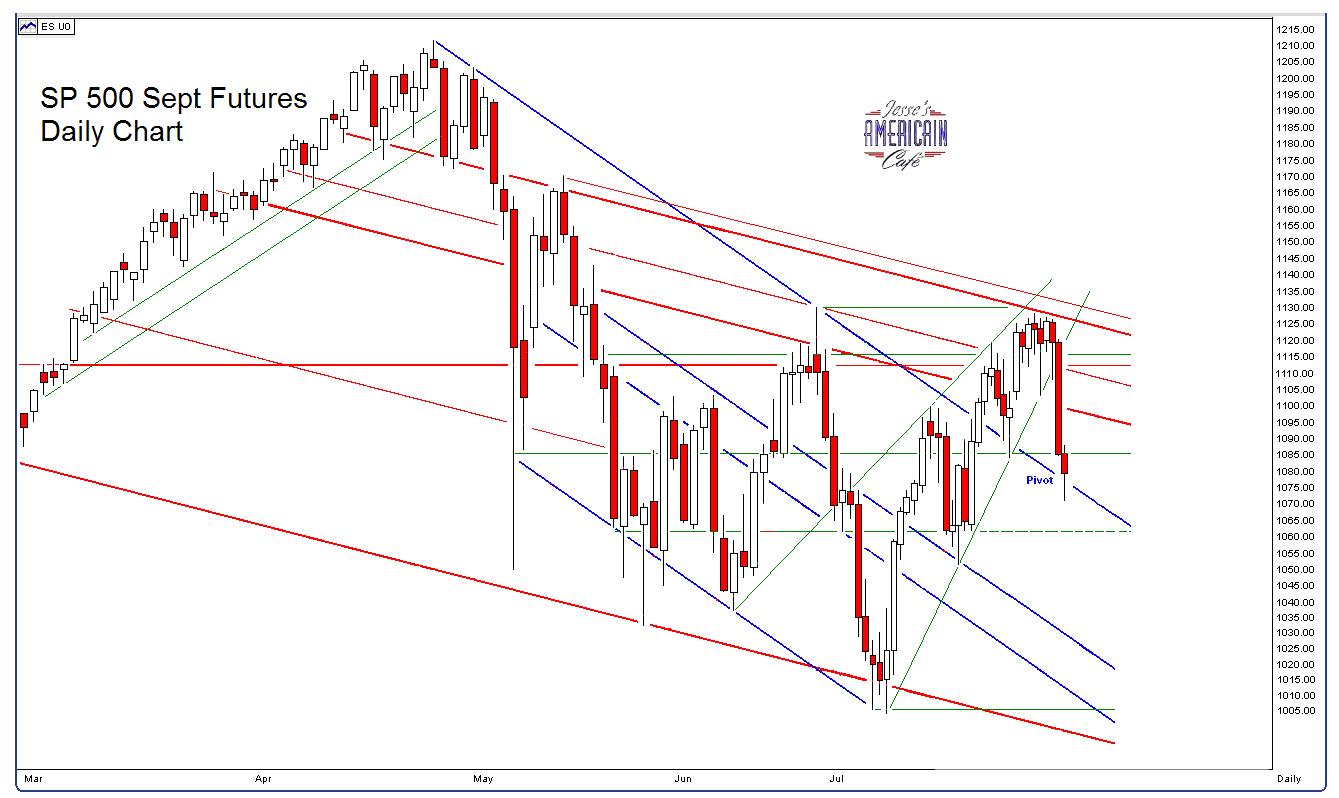
The stock market was hit by a double whammy with the miss in revenue by bellwether Cisco after the bell last night, and then the dreadful unemployment claims number this morning, with 484,000 more people unemployed versus 465,000 expected.

Stocks opened much lower as expected, but as the selling subsided they managed to climb back regaining much of the losses in a low volume trading day.

I think the Street, dominated as it is by the big TBTF banks, will rally around this pivot point of support on the major indices until the General Motors IPO comes out, which should be next week at the latest. CEO Ed Whitacre announced today that he will be stepping down to make way for someone that will stay with the company for a longer time horizon, to give investors confidence in the new share offering as GM becomes a public company again.

So while volumes remain light and 'nothing happens' to trigger hard selling, I would expect these down days to be met with the purchase of the SP futures in particular to give it support. While the SP futures may see unusually high volumes as a fellow blogger noted yesterday, this is indicative of organized Street support to prop the market keying in on the SP 500 futures in the style endorsed by Robert Rubin, and not legitimate investor interest in buying the dip.

There are not many investors in these markets at these prices; the market is primarily consists of speculation and momentum trading, and therefore prone to sharp sell offs like the recent flash crash. This is why I have put out the 'black diamond' sign even though I do not anticipate a serious downleg until the IPO of GM is priced and put out to market. If it is withdrawn that will be a deadly sign that the Street believes there is insufficient liquidity to get it out to market, even though the government wants it to happen, and badly.

By the way, I was just thinking today how fortunate that Bush Jr's proposal to 'privatize Social Security' by investing it in the stock market was turned down, even by Alan Greenspan who never met a pedigreed Wall Street scam he couldn't support.

SP 500


Nasdaq 100

Cisco's weak results (for them) and their weaker forecast sent tech into a tailspin last night. It managed to hold itself together today for the reasons cited above.


Gold appears to have recovered from its FOMC-inspired smackdown and has resumed its uptrend. Do not expect this to be straightforward or easy, and you will not be disappointed.

But anyone who says that gold is a bubble is either talking their book or operating on a badly mistaken theory of money and value. This undeniable bull market in gold and silver is a direct reflection of the well deserved and justified deterioration in the financial system and the currency, the perception that Wall Street is rife with fraud, cronyism and corruption, and hidden counterparty risks.

The way to fix the problem is not by engaging in further fraud and market manipulation, like trying to silence the smoke alarm to keep everyone calm and confident. It takes a particularly perverse Madoff-like view of the world to write that prescription. The way to repair confidence is to reform the markets and weed out the crime, and establish a more equitable and self-governing system of global trade, because the current dollar reserve regime is no longer sustainable.

Failure to reform is gold's best friend. And this is why the crooks hate it publicly, while stuffing their personal vaults with it privately.

Gold


A Sign of a Top in Corporate Bonds

US corporations are issuing large amounts of new debt to take advantage of the exceptionally low rates created by quantitative easing. IBM recently did a major issue of three year notes that went out at one percent. Johnson and Johnson came out today with ten and thirty year notes at record lows.

Johnson & Johnson sold $1.1 billion of debt at the lowest interest rates on record for 10-year and 30-year securities amid surging investor demand for corporate debt.

The drugmaker, in the first offering by a nonfinancial AAA rated company in 15 months, sold $550 million of 2.95 percent, 10-year notes and the same amount of 4.5 percent, 30-year bonds, according to data compiled by Bloomberg. That’s the lowest coupons for those maturities on record, according to Citigroup Inc. data going back to 1981.

Great deal, if you wish to have record low returns in a depreciating currency with counter party risk correlated to an economic recovery. No risk in corporates, right? Maybe less for J&J, but most of the others will be promises writ on water if a major Depression ensues. But perhaps the Fed can buy them.

I obviously cannot predict when and if it will happen with certainty. But if the economy turns down and a dollar currency crisis ensues these corporate bonds will suffer a meltdown between foreign selling and corporate defaults.

Nassim Taleb believes that government bonds will collapse and is betting on it. I think corporates are a better bet, because a business slump and corporate failures could do the trick, even while the dollar and the short end of the curve is viewed as a safe haven.

But if there is a fear of hyperinflation and a greater dollar crisis, even the relative safety of Treasuries will melt down, and the longer end of the curve will drop in value faster than you can say "Sell."