05 August 2012

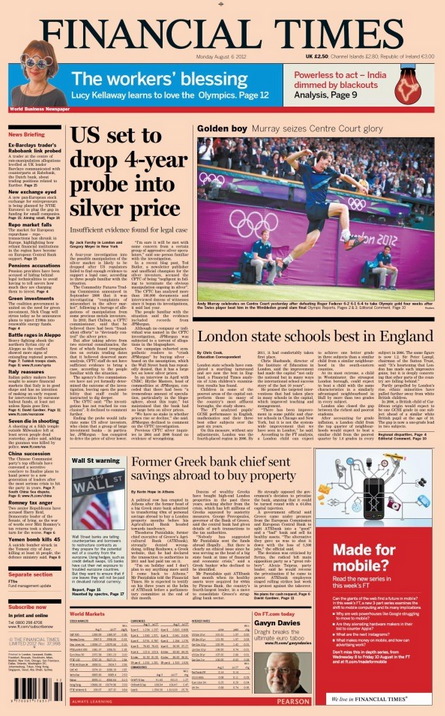
CFTC Said to "Drop" Four Year Investigation Into Silver Just Before Promised Release


CFTC To Investing Public: 'Drop Dead.'


This leak to the FT *could* just be a 'trial balloon' by Mr. Gensler and his crew to see if they can get away with it. But that seems more like the plot of a novel.

This could be one of the best examples of the credibility trap in action. The government regulators can say nothing because of their government's long complicity.

If the CFTC in fact does 'drop' the investigation without presenting findings, one could consider that a slap in the face of the American public which on the whole asked for the investigation to be done in the first place, by the regulators who purportedly are hired and paid to serve their interests.

Given the recent admissions about widespread manipulation in LIBOR, the timing of this outcome to the CFTC invesigation could hardly be more arrogant and high-handed, and designed to put the investing public in their places.  It will certainly not inspire any confidence in the integrity of the markets and their regulation.

It would probably be unwise for the investing public to accept this outcome without presenting some consequences.
I suggest that a mass cancelling of futures trading accounts and the withdrawal of all funds deposited there might be a step in the right direction.

Given the serial criminality that has been exhibited in the US futures markets, that action might be long overdue on the basis of common sense.

Financial Times
Four-year silver probe set to be dropped
By Jack Farchy in London and Gregory Meyer in New York
August 5, 2012 10:00 pm

A four-year investigation into the possible manipulation of the the silver market looks increasingly likely to be dropped after US regulators failed to find enough evidence to support a legal case, according to three people familiar with the situation.

The Commodity Futures Trading Commission first announced that it was investigating “complaints of misconduct in the silver market” in September 2008, following a barrage of allegations of manipulation from a group of precious metals investors.

In 2010, Bart Chilton, a CFTC commissioner, said that he believed there had been “fraudulent efforts” to “deviously control” the silver price.

But after taking advice from two external consultancies, the first of which found irregularities on certain trading dates that it believed deserved more analysis, CFTC staff do not have sufficient evidence to bring a case, according to the people familiar with the situation...

Read the rest here.


Glenn Greenwald On the Rule of Law: With Liberty and Justice For Some


"Most of the events that we consider to be progress in American history were driven by the reverence for this concept that we are all equal under the law, that equality under the law is how we determine if we are perfecting the union...And what I think is radically different about today is not that the rule of law suddenly is not always being applied faithfully, because that has always been true. What is different about today, radically, is that we no longer bother to affirm that principle...

You can often, and I would say more often than not, in leading opinion-making elite circles, find an expressed renouncement or repudiation of that principle...All of these acts entail very aggressive and explicit arguments that the most powerful political and financial elites in our society should not be, and are not, subject to the rule of law because it is too disruptive, it is too divisive, it is more important that we should look forward, that we find ways to avoid repeating the problem...the rule of law is not that important of a value any longer...

The law is no respecter of persons, but the law is also a respecter of reality, meaning if it is too disruptive or divisive that it is actually in our common good, not the elite criminals, but in our common good, to exempt the most powerful from the consequences of their criminal acts, and that has become the template used in each of these instances."

Glenn Greenwald

I have been thinking along these lines for some time, that the rule of law in the West is becoming supplanted by a new kind of utilitarianism, relying on expediency in the service of power and the faux science of amoral economics, in order to excuse the massive frauds and criminal acts of the Anglo-American Empire that seems to be increasing.

Any concerns about the rule of law are roundly dismissed as a false concern with moral hazard as we saw so clearly in the great push for $700 Billion TARP based on a couple of handwritten sheets of paper, and a general amnesty for the perpetrators.


Sunday Viewing: Martin Luther King - 1965 - The Rhyme of History


This interview is interesting for several reasons.

First, it shows what a news discussion program looked like in 1965. One can compare that to the clash of the talking heads that often passes for news discussions today, especially on the mainstream media. It often seems to be a shameful spectacle of sophistry and cynicism.

Secondly, it reminds us of how great movements and protests, even the ones that later come to be viewed as historic, can initially be viewed as 'silly' and 'pointless.'

Thirdly, it is especially meaningful as a reminder that 'the good old days' that people may remember had a particularly ugly and seamy underside of violent repression and the abuse of the weak and the other.

The impulse to evil is not the domain of any particular people or time, but a recurrent problem that must be confronted by each generation, and each individual person, in their own way and calling.

There is always the temptation to look upon such gross injustices as insurmountable, and to simply conclude that things are going to hell in a handbasket, and turn away and to wash our hands of such troubles saying, What is the use of trying, and even further, 'what is truth?'

That is the way of those who who have ceased trying to be human, who have given themselves over to self-absorption, addictions, or despair, who are dying inside, and who when the time comes will make beasts of themselves, to escape the painful fragility of their own insubstantial being.


The 16th Street Baptist Church in Birmingham, Alabama was bombed on Sunday, September 15, 1963 as an act of racially motivated terrorism. The explosion at the African-American church, which killed four girls, marked a turning point in the U.S. 1960s Civil Rights Movement and contributed to support for passage of the Civil Rights Act of 1964.


Martin Luther King Jr. broadened his support for civil rights to human rights, and spoke out forcefully against the US War in Vietnam in January of 1967. He gave a famous speech linking the civil rights and anti-war movements on April 4, 1967 at Riverside Church.

He was assassinated one year to the day on April 4, 1968.

Robert F. Kennedy, another outspoken critic of the war who was running for President, was assassinated a little less than two months later in Los Angeles on June 5, 1968.

Richard M. Nixon was elected President. America finally left Vietnam five years later.

Nixon resigned the Presidency on August 9, 1974 upon facing formal impeachment charges of obstruction of justice, abuse of power, and contempt of Congress.