07 January 2013

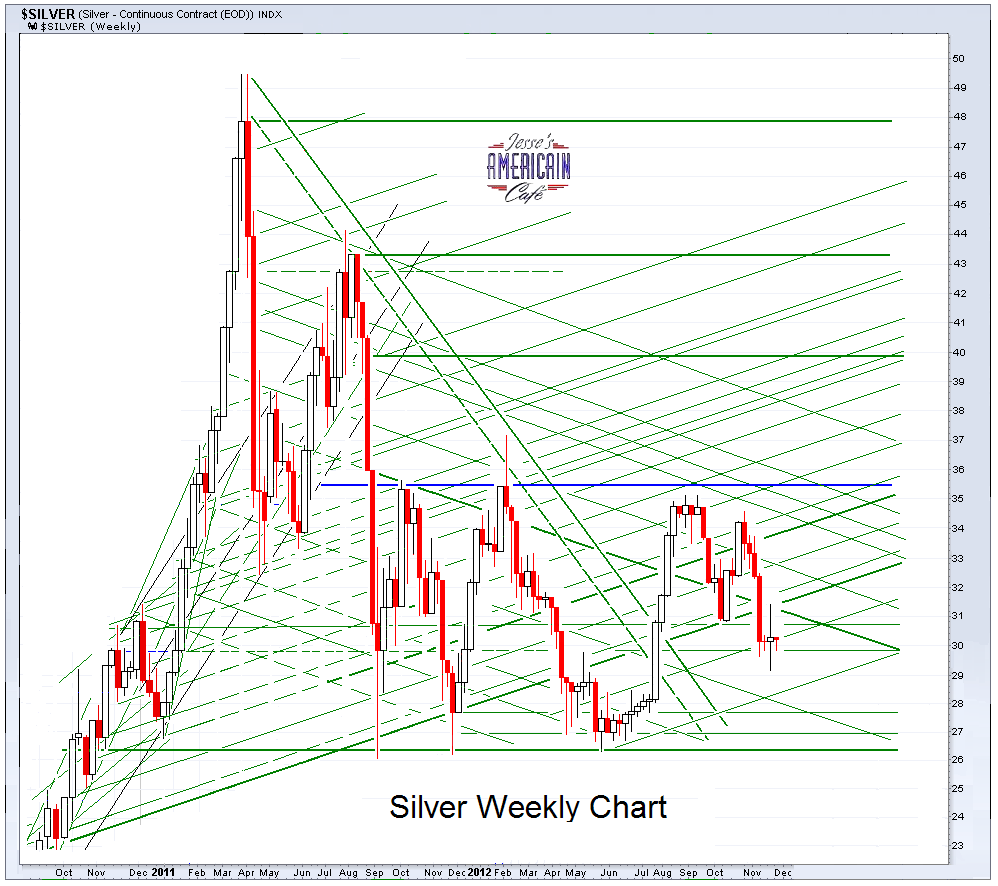
Gold Daily and Silver Weekly Charts - The Silly Season


“So comes snow after fire, and even dragons have their endings.”

J.R.R. Tolkien, The Hobbit


"This empire, unlike any other in the history of the world, has been built primarily through economic manipulation, through cheating, through fraud, through seducing people into our way of life, through the economic hit men."

John Perkins

Earnings season tomorrow after the bell with Alcoa.

The silly season continues as the debt ceiling has caught the can which was kicked down the road by the fiscal cliff.

It will only get stupider as the year goes on.

You can read some commentary about 'The Platinum Coin' if you scroll down for the last few postings.

I suspect strongly that this is all jawboning and political posturing. Who can take these jokers seriously excepting for the power of the office that they hold? The approval rating for Congress is around a disgraceful ten percent. But since they do not care what the people think, but only those few wealthy patrons who pay them their millions in contributions, it ought not surprise us all that much.

But in the interest of keeping it 'real' I think that all those who promote this Platinum Coin idea should be paid this year with a nice shiny single platinum coin, as a symbol in lieu of their normal salary.

Perhaps that will help them to understand why people who have saved their money and are receiving almost no interest for it are so aghast at this latest frivolous idea coming down from the economic sophisticates and their fellow travelers.

The lying and looting will continue until confidence improves.


SP 500 and NDX Futures Daily Charts - Earnings Season Begins


Earnings season kicks off tomorrow with Alcoa after the bell.

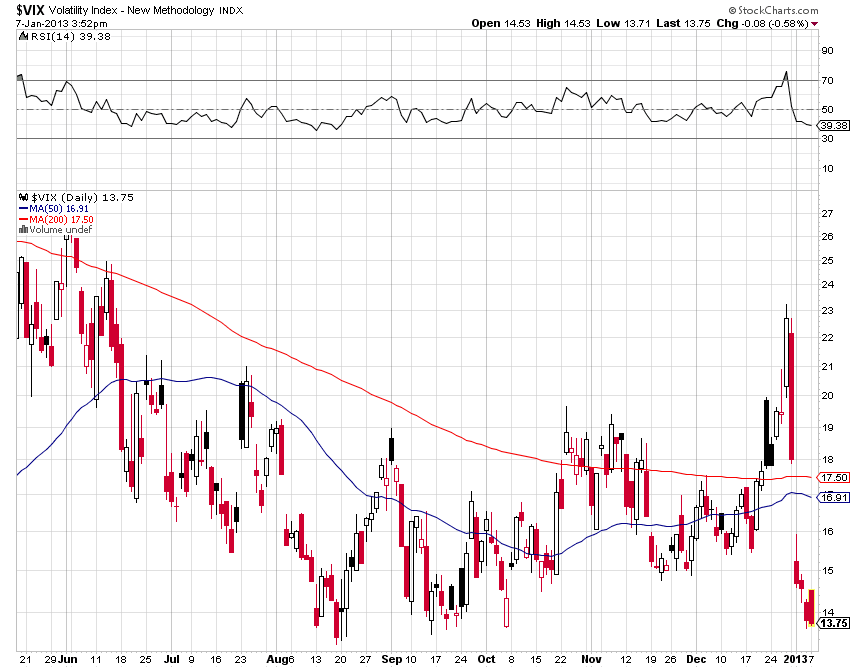
The VIX chart is included to show its dramatic drop back to complacent lows since the end of December and the 'fiscal cliff.' Almost time for another wash and rinse.

The debt ceiling fight looks to be bloody, with both sides already talking trash about threatening debt default, shutting down the government, and platinum coins.

Never waste a crisis they say.

Common decency and humanity are in short supply.

Chris Hedges speaks about the fiscal cliff and financial system here.


The Legacy of the Fed and the US Experiment with Fiat Currency In One Chart


Please notice that the CPI really 'gets some legs' when Nixon closed the gold window and released the modern monetary theory from its next to last restraint, the bond vigilantes being the last thin blue line.

And below that a quote on the modern monetary system, in which I detect the root of Paul Krugman's confusion about money.

To his credit, Krugman does recognize the liquidity trap, which sets him head and shoulders apart from the Austerians. He just does not understand the markets and how they work in practice rather than theory, and the absolutely compelling need for reform. But that puts him in with most regulators, central bankers, and the herd of academic economists.

Shifting Mandates: The Federal Reserve’s First Centennial
Carmen M. Reinhart and Kenneth S. Rogoff

For presentation at the American Economic Association Meetings, San Diego,
January 5, 2013

Session: Reflections on the 100th Anniversary of the Federal Reserve

Read the entire paper in PDF form here.


h/t Bill P and Business Insider


"The current world monetary system assigns no special role to gold; indeed, the Federal Reserve is not obliged to tie the dollar to anything. It can print as much or as little money as it deems appropriate [History suggests that while they technically can print as much as they wish, there is an effective upper bound along with a law of diminishing returns in there somewhere. Weimar and John Law, amongst others, tended to show that. - Jesse]

There are powerful advantages to such an unconstrained system. Above all, the Fed is free to respond to actual or threatened recessions by pumping in money. To take only one example, that flexibility is the reason the stock market crash of 1987—which started out every bit as frightening as that of 1929—did not cause a slump in the real economy.

While a freely floating national money has advantages, however, it also has risks. For one thing, it can create uncertainties for international traders and investors. Over the past five years, the dollar has been worth as much as 120 yen and as little as 80.

The costs of this volatility are hard to measure (partly because sophisticated financial markets allow businesses to hedge much of that risk) [O brave New World, that has such derivative sophisticates in it. - Jesse] but they must be significant. Furthermore, a system that leaves monetary managers free to do good also leaves them free to be irresponsible—and, in some countries, they have been quick to take the opportunity." [Yes, THOSE countries may experience a financial collapse because of a monetary credit bubble, no doubt because of a lack of economic sophisticates. - Jesse]

Paul Krugman, The Goldbug Variations, 22 November 1996