skip to main |
skip to sidebar
The manipulation of prices during the US trading window is fairly apparent, and with more people paying attention to the metals, particularly silver, the duplicity of the markets is becoming more accepted fact, as people see it with their own eyes.
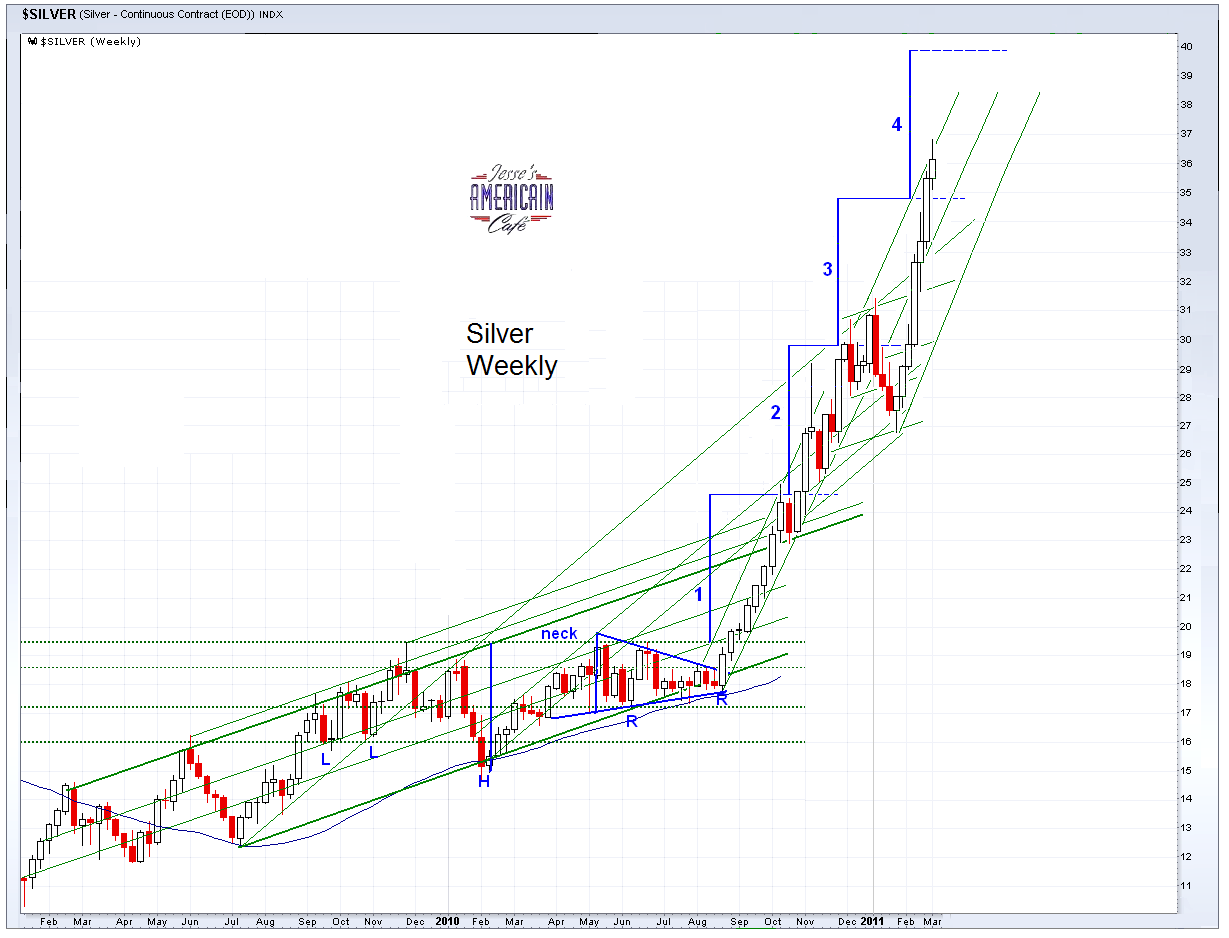
As for silver, even though it was heavy pressed today after a European and Asian session which saw it soaring, a spike up to 40 intraday is still possible, but our target of 37.50 remains intact before any substantial correction or consolidation sets in.
We might also wish to consider that there may be no real correction, just a pause and a move higher. This is what happened after the first pause after the initial breakout, leg 2 in our silver chart shown below.
The Fed is continuing to add liquidity to the markets, and with light volumes it remains relatively easier to subsidize a soft lift to the market throughout the day.
Nice volatility for short term trading, but otherwise a treacherous market.
The weakness with this US Dollar DX index is that it is highly weighted to the developed economies of Europe and Japan. As such it may not reflect erosion of dollar purchasing power vis a vis the BRICs, and external measures such as gold, oil, and silver. It may be masked by the mutual weakness of central banks all inflating their currencies in unison.
This is what the Federal Reserve desires: to repair its economy and unpayable debts by expanding its monetary base while exporting much of the negative effects of such monetary inflation to the rest of the world, keeping things relatively stable to maintain confidence in their paper. And this is why the central banks attempt to control the price of less manageable currencies such as gold and silver. Silver is the most problematic because its supplies are difficult for the banks, as they have none of their own, and the world has largely depleted its discretionary strategic stockpiles of this metal. Long term price suppression breeds underinvestment and the inevitable shortages of real goods.
The support levels are as marked and fairly obvious. With the dollar index around 76.28 today it is threatening to break down out of the chart formation. Lateral support around 74 and 71 is fairly strong.
Rather than rallies through economic vitality and recovery, the dollar rallies have been marked by relative declines primarily in the euro on their sovereign debt problems. It is almost like a couple of drunks leaning on each other for support, except that the US is picking the Eurozone's pockets while they do it.
What has been hidden will be revealed.
The Independent - UK
Saudis Mobilise Thousands of Troops to Quell Growing Revolt
By Robert Fisk, Middle East Correspondent
Saturday, 5 March 2011
Saudi Arabia was yesterday drafting up to 10,000 security personnel into its north-eastern Shia Muslim provinces, clogging the highways into Dammam and other cities with busloads of troops in fear of next week's "day of rage" by what is now called the "Hunayn Revolution".
Saudi Arabia's worst nightmare – the arrival of the new Arab awakening of rebellion and insurrection in the kingdom – is now casting its long shadow over the House of Saud. Provoked by the Shia majority uprising in the neighbouring Sunni-dominated island of Bahrain, where protesters are calling for the overthrow of the ruling al-Khalifa family, King Abdullah of Saudi Arabia is widely reported to have told the Bahraini authorities that if they do not crush their Shia revolt, his own forces will.
The opposition is expecting at least 20,000 Saudis to gather in Riyadh and in the Shia Muslim provinces of the north-east of the country in six days, to demand an end to corruption and, if necessary, the overthrow of the House of Saud. Saudi security forces have deployed troops and armed police across the Qatif area – where most of Saudi Arabia's Shia Muslims live – and yesterday would-be protesters circulated photographs of armoured vehicles and buses of the state-security police on a highway near the port city of Dammam.
Although desperate to avoid any outside news of the extent of the protests spreading, Saudi security officials have known for more than a month that the revolt of Shia Muslims in the tiny island of Bahrain was expected to spread to Saudi Arabia. Within the Saudi kingdom, thousands of emails and Facebook messages have encouraged Saudi Sunni Muslims to join the planned demonstrations across the "conservative" and highly corrupt kingdom. They suggest – and this idea is clearly co-ordinated – that during confrontations with armed police or the army next Friday, Saudi women should be placed among the front ranks of the protesters to dissuade the Saudi security forces from opening fire.
If the Saudi royal family decides to use maximum violence against demonstrators, US President Barack Obama will be confronted by one of the most sensitive Middle East decisions of his administration. In Egypt, he only supported the demonstrators after the police used unrestrained firepower against protesters. But in Saudi Arabia – supposedly a "key ally" of the US and one of the world's principal oil producers – he will be loath to protect the innocent.
So far, the Saudi authorities have tried to dissuade their own people from supporting the 11 March demonstrations on the grounds that many protesters are "Iraqis and Iranians". It's the same old story used by Ben Ali of Tunisia and Mubarak of Egypt and Bouteflika of Algeria and Saleh of Yemen and the al-Khalifas of Bahrain: "foreign hands" are behind every democratic insurrection in the Middle East.
US Secretary of State Hillary Clinton and Mr Obama will be gritting their teeth next Friday in the hope that either the protesters appear in small numbers or that the Saudis "restrain" their cops and security; history suggests this is unlikely. When Saudi academics have in the past merely called for reforms, they have been harassed or arrested. King Abdullah, albeit a very old man, does not brook rebel lords or restive serfs telling him to make concessions to youth. His £27bn bribe of improved education and housing subsidies is unlikely to meet their demands.
An indication of the seriousness of the revolt against the Saudi royal family comes in its chosen title: Hunayn. This is a valley near Mecca, the scene of one of the last major battles of the Prophet Mohamed against a confederation of Bedouins in AD630. The Prophet won a tight victory after his men were fearful of their opponents. The reference in the Koran, 9: 25-26, as translated by Tarif el-Khalidi, contains a lesson for the Saudi princes: "God gave you victory on many battlefields. Recall the day of Hunayn when you fancied your great numbers.
"So the earth, with all its wide expanse, narrowed before you and you turned tail and fled. Then God made his serenity to descend upon his Messenger and the believers, and sent down troops you did not see – and punished the unbelievers." The unbelievers, of course, are supposed – in the eyes of the Hunayn Revolution – to be the King and his thousand princes.
Like almost every other Arab potentate over the past three months, King Abdullah of Saudi Arabia suddenly produced economic bribes and promised reforms when his enemy was at the gates. Can the Arabs be bribed? Their leaders can, perhaps, especially when, in the case of Egypt, Washington was offering it the largest handout of dollars – $1.5bn (£800m) – after Israel. But when the money rarely trickles down to impoverished and increasingly educated youth, past promises are recalled and mocked. With oil prices touching $120 a barrel and the Libyan debacle lowering its production by up to 75 per cent, the serious economic – and moral, should this interest the Western powers – question, is how long the "civilised world" can go on supporting the nation whose citizens made up almost all of the suicide killers of 9/11?
The Arabian peninsula gave the world the Prophet and the Arab Revolt against the Ottomans and the Taliban and 9/11 and – let us speak the truth – al-Qa'ida. This week's protests in the kingdom will therefore affect us all – but none more so than the supposedly conservative and definitely hypocritical pseudo-state, run by a company without shareholders called the House of Saud.