skip to main |
skip to sidebar
Gold and silver rallied back with the G7 intervention in the currency markets on behalf of the Japanese yen.
I think the rationale that this was in support of Japanese exporters is more rationale than fact. The exporters' biggest problem is that their supply chains and manufacturing are disrupted.
Rather, the intervention at this time was most likely in response to what the central bankers euphemistically call 'disorderly markets.' The intervention and its timing had everything to do with the yen carry trade, and the pressures that the extraordinarily strong yen was placing on global financial institutions, especially in their hedges and spreads. There was also some concern that the dollar was falling too far, too fast.
I am rethinking my estimates of a hyperinflation. There is also and increase in the forecast of inflation that will accompany the stagflation to which I am more positively inclined in the intermediate to long term forecast.
I consider a real deflation very unlikely, only as a policy decision. The risk as I see it is an inept slide into a deeper inflation than the central bankers intend.
As such I am now even more inclined to protect my own assets in hard currency and precious metals.
Now that we have a few more data points I adjusted the green 'parabola' which marks what is essentially an inverse head and shoulders formation developing in the gold market. We will look to see if the formation holds and is confirmed by gold breaking out above the neckline which is around the 1450ish area.
Silver is resilient, but as those of you who hold positions, particularly in the miners, the intra-day volatility can be fairly breath-taking.
The G7 will be meeting this evening on a teleconference to discuss the markets and the impact of the Japanese and Middle East situations on them. I expect interventions to be readied, but not necessarily unleashed tomorrow unless things are much worse than we realize.
Options expiration will become more of an issue later this month. For now the focus is on the delivery of March silver at the Comex, and the anticipation building in the April contract.
The G7 is meeting tonight to discuss potential market operations in the event that the situation in Japan and the Middle East worsen and the financial system begins to falter.
The strong yen does not create all that much of a problem yet for Japan, and it does have the benefit of easing their needs to purchase imported energy and supplies. The bigger problem might be for global financial institutions who are not properly hedged to the yen at these previously unthinkable highs.
I do think that more intervention in the markets in terms of buying support is likely, and the central bankers will play their usual games along with the primary banks' trading desks.
The situation in Japan with regard to the reactors is not yet resolved, and there are still follow on earthquakes which complicates the situation. There remains the possible for wider spread damage and loss of life.
Once that situation is resolved, the disruption to their infrastructure and supply chains will be their biggest challenges. Do not underestimate the severe damage that has been done to their electrical infrastructure generating capacity.
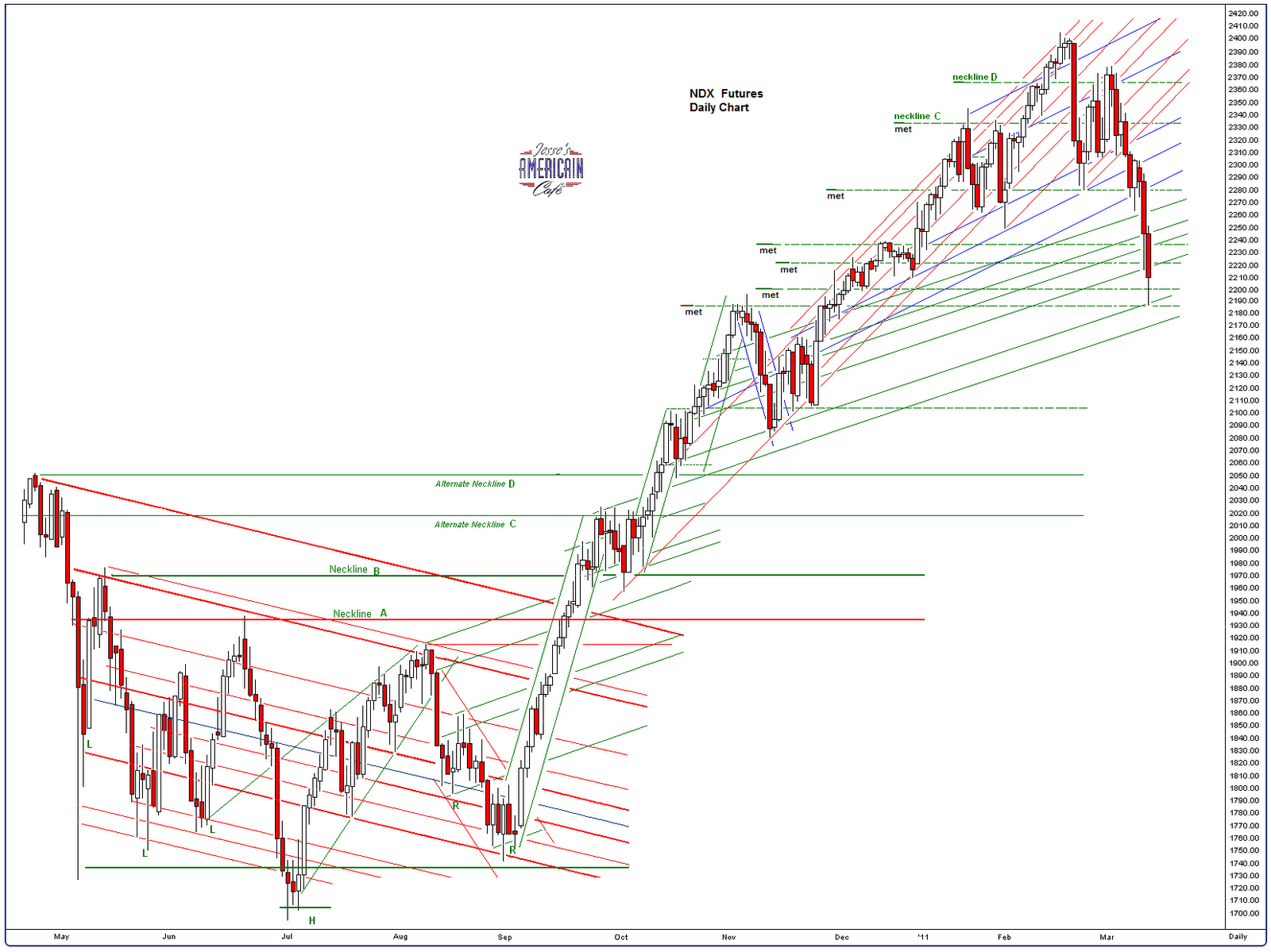
So, let's see what happens. The US indices stopped almost dead on their key support levels and tomorrow is options expiration. The capping in gold and silver has been almost continuous. It is interesting to see the pair trade of long bullion and short stocks working again. This tells us something of the nature of the market.
Stock futures are moving sharply lower after hours based on reports such as this: US Calls Radiation 'Extremely High' and Urges Deeper Caution.
The emphasis was clearly on the risk in Japan today. The Middle East situation continues to deteriorate.
The PPI and import prices are rising at a rate that suggests inflation, and continuing sluggish growth in GDP suggest stagflation is developing.
Stagflation, when not caused by an exogenous event such as occurred in the 1970s with the oil embargo, is the result of an obvious policy error in fiscal, public, and monetary decisions.
It takes an unusual set of circumstances to create stagflation. Before the 1970's economists used to say it was not possible.
Therefore it is a tribute to Obama's Wilsonian dithering, Bernanke's general spinelessness, and the Congress' rapacious venality that they will preside over stagflation's resurgence, without the scapegoat of an oil embargo to blame. They are presiding over the wholesale looting of a generation, and abetting the tranfer of that money and the future prosperity of the public to a wealthy few, their real constituency, in the manner of an oligarchy or crony capitalism.