skip to main |
skip to sidebar
"As it was in the days of Noah, so shall it be with the coming of the Son of man. In the days before the flood, they were eating and drinking, marrying and being given in marriage, even to that very day in which Noah entered into the ark. They did not suspect what was happening until the flood came and swept them all away. So shall the coming of the Son of man also be...Watch therefore, because you do not know at what hour your Lord will come." Matt 24:37-42
"For our struggle is not against flesh and blood, but against the rulers, against the authorities, against the powers of this dark world and against the spiritual forces of evil in the heavenly realms. Therefore put on the full armor of God, so that when the day of evil comes, you may be able to stand your ground, and after you have done everything, to stand." Eph 6:12-13
"Surely, there is at this day a confederacy of evil, marshalling its hosts from all parts of the world, organizing itself, taking its measures, enclosing the Church of Christ as in a net, and preparing the way for a general Apostasy from it. Whether this very Apostasy is to give birth to Antichrist, or whether he is still to be delayed, as he has already been delayed so long, we cannot know; but at any rate this Apostasy, and all its tokens and instruments, are of the Evil One, and savour of death.
Far be it from any of us to be of those simple ones who are taken in that snare which is circling around us! Far be it from us to be seduced with the fair promises in which Satan is sure to hide his poison!
Do you think he is so unskilful in his craft, as to ask you openly and plainly to join him in his warfare against the Truth? No; he offers you baits to tempt you. He promises you civil liberty; he promises you equality; he promises you trade and wealth; he promises you a remission of taxes; he promises you reform.
This is the way in which he conceals from you the kind of work to which he is putting you; he tempts you to rail against your rulers and superiors; he does so himself, and induces you to imitate him; or he promises you illumination, he offers you knowledge, science, philosophy, enlargement of mind.
He scoffs at times gone by; he scoffs at every institution which reveres them. He prompts you what to say, and then listens to you, and praises you, and encourages you. He bids you mount aloft. He shows you how to become as gods.
Then he laughs and jokes with you, and gets intimate with you; he takes your hand, and gets his fingers between yours, and grasps them, and then you are his."
J.H.Newman, The Times of AntiChrist, 1890
March 24, 2011-- "There is only one certainty regarding paper money -- the longer you hold it, the less it will buy in terms of real goods or real money -- gold." Richard Russell.
A late day raid on price, again after Europe went home for dinner. It happened at roughly the same time as it did yesterday, but it really did not do so much, and actually failed rather badly in silver.
Next week should be interesting. I do not know what it is going to take to move gold over that neckline in the big inverse head and shoulders formation, or how long it might take. But I suspect strongly that when it does break out we will see another fast move higher, because so many in the markets are not positioned for it. After at least one serious 'gut check' on the longs, gold will most likely move fairly quickly to 1590.
Depending on what happens, I will not be surprised to see gold hitting $2,000 by year end. What concerns me is the potential for a deflationary event this year with another stock market collapse. This will not be a true deflation, but a liquidation panic, that will set up the next round of monetization and a further deterioration of the social fabric.
There is an obvious push from some of the developed countries to enlarge the wars in the Middle East and Asia, from Libya to Afghanistan. This is all about oil, and Keynesian militarism which is the last refuge of corruption in a failing empire.
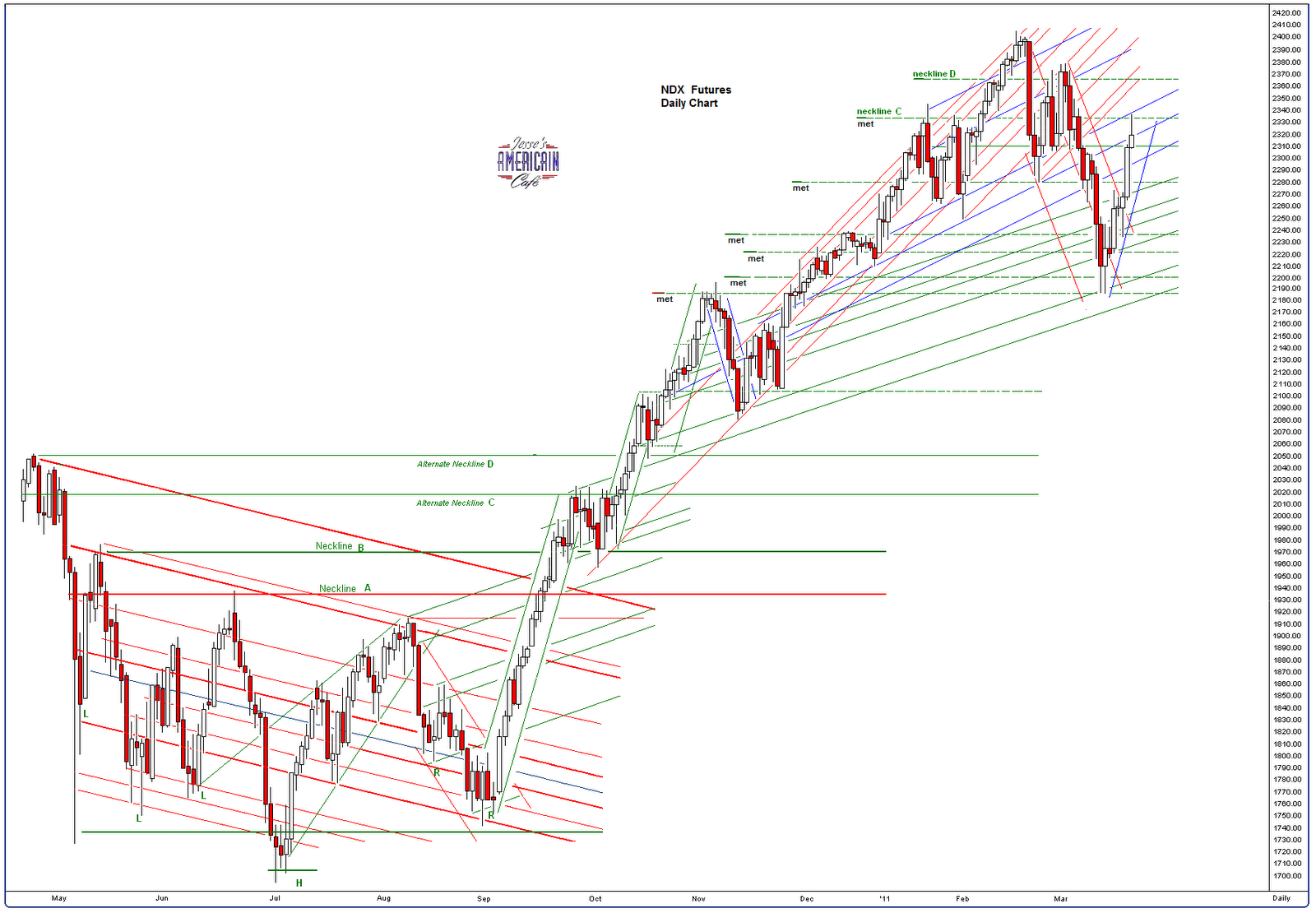
Stocks opened brightly on the slightly 'better than expected' US GDP revision of the fourth quarter to 3.1%, but it really is moot at this point at the end of the first quarter.
Fukushima weighed on the markets, as it now unfolds that the situation is worse than TEPCO and the government had allowed, with a probable reactor breach unleashing more dangerous radioactive fallout over a wider area.
More later...
I do not seem to be hearing this same level of detailed information on the financial news networks anymore. I do not watch network televised news at all, so it could be covered there.
Apparently I am not the only one who feels this way.
Lack of Data from Japan Distresses Nuclear Experts - LA Times
The stock touts on bubblevision are busily promoting blue skies and rainbows ahead of the weekend. Nothing to see here, move along. Just send in your money, and we can have endless prosperity. Or at least some can.
As in the US, the public will be paying for the mess created by corporate greed and negligence: Cleanup Costs To Be Born By Japan Taxpayers
New Scientist
Fukushima radioactive fallout nears Chernobyl levels
By Debora MacKenzie
24 March 2011
Japan's damaged nuclear plant in Fukushima has been emitting radioactive iodine and caesium at levels approaching those seen in the aftermath of the Chernobyl accident in 1986. Austrian researchers have used a worldwide network of radiation detectors – designed to spot clandestine nuclear bomb tests – to show that iodine-131 is being released at daily levels 73 per cent of those seen after the 1986 disaster. The daily amount of caesium-137 released from Fukushima Daiichi is around 60 per cent of the amount released from Chernobyl.
The difference between this accident and Chernobyl, they say, is that at Chernobyl a huge fire released large amounts of many radioactive materials, including fuel particles, in smoke. At Fukushima Daiichi, only the volatile elements, such as iodine and caesium, are bubbling off the damaged fuel. But these substances could nevertheless pose a significant health risk outside the plant.
The organisation set up to verify the Comprehensive Nuclear-Test-Ban Treaty (CTBT) has a global network of air samplers that monitor and trace the origin of around a dozen radionuclides, the radioactive elements released by atomic bomb blasts – and nuclear accidents. These measurements can be combined with wind observations to track where the radionuclides come from, and how much was released.
The level of radionuclides leaking from Fukushima Daiichi has been unclear, but the CTBT air samplers can shed some light, says Gerhard Wotawa of Austria's Central Institute for Meteorology and Geodynamics in Vienna.
For the first two days after the accident, the wind blew east from Fukushima towards monitoring stations on the US west coast; on the third day it blew south-west over the Japanese monitoring station at Takasaki, then swung east again. Each day, readings for iodine-131 at Sacramento in California, or at Takasaki, both suggested the same amount of iodine was coming out of Fukushima, says Wotawa: 1.2 to 1.3 × 10¹⁷ becquerels per day.
The agreement between the two "makes us confident that this is accurate", he says. So do similar readings at CTBT stations in Alaska, Hawaii and Montreal, Canada – readings at the latter, at least, show that the emissions have continued.
In the 10 days it burned, Chernobyl put out 1.76 × 10¹⁸ becquerels of iodine-131, which amounts to only 50 per cent more per day than has been calculated for Fukushima Daiichi. It is not yet clear how long emissions from the Japanese plant will continue.
Similarly, says Wotawa, caesium-137 emissions are on the same order of magnitude as at Chernobyl. The Sacramento readings suggest it has emitted 5 × 10¹⁵ becquerels of caesium-137 per day; Chernobyl put out 8.5 × 10¹⁶ in total – around 70 per cent more per day.
"This is not surprising," says Wotawa. "When the fuel is damaged there is no reason for the volatile elements not to escape," and the measured caesium and iodine are in the right ratios for the fuel used by the Fukushima Daiichi reactors. Also, the Fukushima plant has around 1760 tonnes of fresh and used nuclear fuel on site, and an unknown amount has been damaged. The Chernobyl reactor had only 180 tonnes.
The amounts being released, he says, are "entirely consistent" with the relatively low amounts of caesium and iodine being measured in soil, plants and water in Japan, because so much has blown out to sea. The amounts crossing the Pacific to places like Sacramento are vanishingly small – they were detected there because the CTBT network is designed to sniff out the tiniest traces.
Dangerous isotopes
The Chernobyl accident emitted much more radioactivity and a wider diversity of radioactive elements than Fukushima Daiichi has so far, but it was iodine and caesium that caused most of the health risk – especially outside the immediate area of the Chernobyl plant, says Malcolm Crick, secretary of a United Nations body that has just reviewed the health effects of Chernobyl. Unlike other elements, he says, they were carried far and wide by the wind.
Moreover the human body absorbs iodine and caesium readily. "Essentially all the iodine or caesium inhaled or swallowed crosses into the blood," says Keith Baverstock, former head of radiation protection for the World Health Organization's European office, who has studied Chernobyl's health effects.
Iodine is rapidly absorbed by the thyroid, and leaves only as it decays radioactively, with a half-life of eight days. Caesium is absorbed by muscles, where its half-life of 30 years means that it remains until it is excreted by the body. It takes between 10 and 100 days to excrete half of what has been consumed.
While in the body the isotopes' radioactive emissions can do significant damage, mainly to DNA. Children who ingest iodine-131 can develop thyroid cancer 10 or more years later; adults seem relatively resistant. A study published in the US last week found that iodine-131 from Chernobyl is still causing new cases of thyroid cancer to appear at an undiminished rate in the most heavily affected regions of Ukraine, Belarus and Russia.
Caesium-137 lingers in the environment because of its long half-life. Researchers are divided over how much damage environmental exposure to low doses has done since Chernobyl. Some researchers think it could still cause thousands of new cases of cancer across Europe.