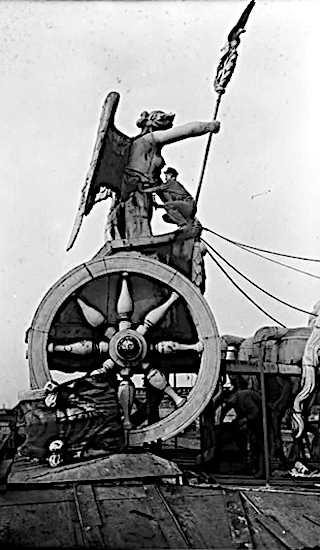
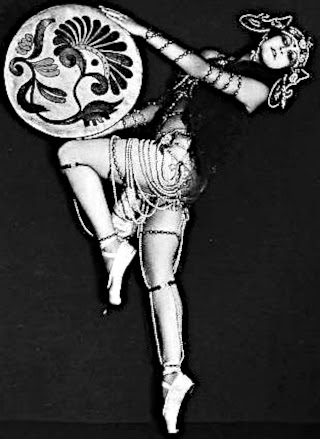
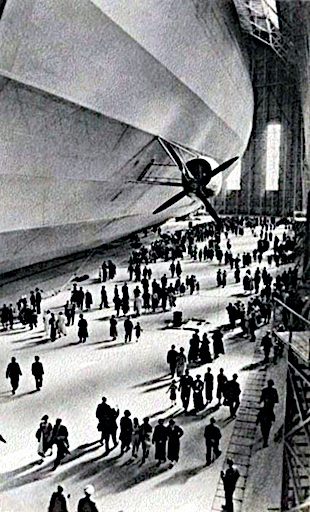
"It is crudely general to suggest collective responsibility for the German populace. It is, however, fair to suggest that those who continued to defend the idea of Germanhood publicly as the war went on—when this had become synonymous with barbarity—were in fact renouncing their humanity for the sake of individual survival and peace of mind."
Panayiotis Demopoulos, Götterdämmerung: Suicide Music
Notice that the need for reform and rebalancing the system never really comes up in the discussion. This is old thinking, and its killing the economy.
As you know, I think both 'expansionary austerity' and 'stimulative easing' are missing the point and ineffective, because the economic, financial, and global trade system is broken, corrupted, and badly in need of reform and structuring.
What the Fed is doing is keeping the zombie banks upright at the expense of the long suffering middle class and savers. Michael Hudson has called it 'the endowing of a financial elite to rule in the 21st century.' The monied interests are gorging themselves on malinvestment, public policy failures, and a well financed campaign of economic propaganda such as that which led to the tragic lapses of regulation and the overturn of Glass-Steagall.
The effective tax rates of the super wealthy are less than 15 percent, because they draw a major portion of their annual increase in wealth from capital gains and dividends, and unrecognized entitlements. as well as a wide menu of tax avoiding schemes.
And while they moan about the nominal headline tax rates, paid only by the 'little people' even if they do not know they are little, corporations and the truly wealthy have not enjoyed just low effective tax rates in the post WW II era. And yet it is still not enough.
In light of the severe unemployment problems plaguing a large portion of families, austerity seems like a cruel joke, a coup de grâce delivered by the bankers to the income producing classes who depend on labor in the creation and delivery of real products, and not artificial arbitrage and gaming the system.
But on the other hand, stimulus seems just another excuse for the special interests to put on the feedbag once again to the detriment of the many of the next generation. There is no comparison between the Obama Administration and the New Deal in terms of real change and productive innovation.
There has been a very strong recovery in corporate profits in the non-financial sector, and the financiers barely missed a beat in distributing a healthy chunk of GDP to themselves in bonuses, while the ashes of the financial crises which they caused still glowing. And their behaviour in the mortgage and derivatives markets has been despicable. I am appalled that people put up with this sort of thing, much less defend it out of some mistaken belief in neoliberal 'free markets.'
The people should never have to bailout reckless banks who engaged in speculative self-interest, and particular when they did so with the intent to personally enrich themselves, come what may.
"The UK Chancellor of the Exchequer's guiding philosophy is refreshingly pro-market: 'All banks should be allowed to fail safely without affecting vital banking serviceswithout imposing costs on the taxpayer.'" George Osborne
The second chart gives some indication of the nature of the problem. The US enjoyed an extraordinary period of productivity and expansion, and the middle class was thrown under a bus. And now they are expected to pay to subsidize the unsustainable bonuses and lifestyles of the monied interests.
Sideways chop continues in bullion although the miners are on Mr. Toad's Wild Ride.
Tomorrow is option expiration. Let's see if the metals bulls can build a base here and take it up. Macro events are moving markets but volumes remain light and so the markets are easily batted around by the wiseguys.
The market action is weak and listless, and prone to short term manipulation by the bigger players.
The action next week could be fairly intense as we approach the QE3 event horizon.
NEW YORK, June 15 (Reuters) - Bill Gross said the Federal Reserve next week could signal that interest rates could be capped if warranted due to soft economic growth.
The world's largest bond fund manager said on Twitter late Tuesday: "QE3 likely to take form of 'extended period' language or interest rate caps on 2-3-year Treasuries."
Gross, the co-chief investment officer of PIMCO, the world's top bond manager, also said on Twitter: "Next week's Fed statement will likely stress 'extended period of time' language or even a period of interest rate caps."
The Fed will hold its next policy meeting on Tuesday and Wednesday, and will issue its policy statement after the close of the meeting.
The recent soft patch of economic data has increased speculation over whether U.S. policymakers will perform a third round of bond purchases, an unconventional monetary measure known as "quantitative easing," or QE2. The second round of QE2's $600 billion in purchases will conclude on June 30.
But Gross tweeted that the Fed could signal a cap on interest rates as a form of QE3.
Mark Porterfield, spokesman for PIMCO, confirmed to Reuters the content of the tweets. Pacific Investment Management Co. oversees more than $1.2 trillion in assets.
While the 10-year Treasury bond is one of the most widely watched securities as it sets the benchmark for almost every other interest rate in the U.S. economy, Fed Chairman Ben Bernanke has long considered the two-year Treasury note as an effective tool.
In a November 2002 speech, entitled "Deflation: Making Sure 'It' Doesn't Happen Here," Bernanke said: "Because long-term interest rates represent averages of current and expected future short-term rates, plus a term premium, a commitment to keep short-term rates at zero for some time--if it were credible--would induce a decline in longer-term rates."
Bernanke, who at the time was a Federal Reserve governor, went on to say that the two-year Treasury note is a long-term maturity and that 10-year notes are "longer" maturing securities.
Bernanke said: "A more direct method, which I personally prefer, would be for the Fed to begin announcing explicit ceilings for yields on longer-maturity Treasury debt (say, bonds maturing within the next two years).
"The Fed could enforce these interest-rate ceilings by committing to make unlimited purchases of securities up to two years from maturity at prices consistent with the targetedyields. If this program were successful, not only would yields on medium-term Treasury securities fall, but (because of links operating through expectations of future interest rates) yields on longer-term public and private debt (such as mortgages) would likely fall as well."
Stocks slid hard today on poor economic news from the US, more significant signs from Europe of a test of the European Union and a Greek default that might cause repercussions in the global banking industry.
There was a flight to safety into the US dollar and into gold and to a lesser extent silver. Gold looks to be making a move to break out of its consolidation range, but it has not done so yet.
Silver continues to struggle after the big smack down, but the inventories on the Comex are still in a very steady decline. Someone sent me a piece from Ted Butler in which he says that over the years he has not been able to correlate the price of silver and the Comex inventory levels.
Well, I think if there is plenty of available supply that makes sense. If the inventory gets low, then the dealers would just procure more.
However, when available supplies start to tighten beyond a certain level, especially after years of price manipulation causing distortions and underinvestment on the supply side, then a demand supply trade off comes into play and the correlations and the significance of the data can most decidedly change.
I was a little disappointed with his analysis since he has studied the Comex for the past twenty plus years, but offered no insight into Comex deliverable inventories from an historical perspective, and in particular, as a percentage of open interest. What was the prior low, and what else was going on in the industry at that time? How low was it?
I will make one prediction. The deliverable Comex inventory will not fall below zero. And that is exactly where is has been heading, slowly but surely, for the past three years, like a train wreck in slow motion. Should there be any sort of default incident, Obama should find a new head for the CFTC.
If you have seen the movie 'Super 8' you will understand it when I say that one can only wonder what ugly thing will be crawling out of a Comex train wreck, looking for payback after years of abuse.
Let us pray for those whose hearts are hardened against His grace and loving kindness by greed, fear, and pride, and the seductive illusion and crushing isolation of evil.
We pray that we all may experience the three great gifts of our Lord's suffering and triumph: repentance, forgiveness, and thankfulness. And in so doing, may we obtain abundant life, and with it the peace that surpasses all understanding.
It is available for your use at no cost, but with attribution and a link to the original posting.
I make every attempt to respect the rights of others. If you feel that something here has infringed your work please let me know and I will correct it immediately. It is not always easy to determine the status of material posted to the Internet with regard to fair use and public domain.