18 November 2011

US Corporate Taxes As a Percent of Corporate Profits


"Once upon a time, the corporate income tax generated a significant share of tax revenues; now, it’s bumping along in the 2%-of-GDP range. Yes, the marginal rate of corporate income tax is high, at 35%. But US companies are extremely good at not paying that.

But at least we know the aggregate amount that corporations pay in taxes. What we don’t know — because they won’t say, and no one’s forcing them to say — is how much any given public company pays.

Allan Sloan has a very good column on this today. Companies already report 16 different tax metrics; they should simply be required to add a 17th — the amount they pay the IRS in taxes — which in many ways is most important. The companies already file tax returns; the number’s right there, on lines 31 and 32. They just refuse to say what it is."

Charts of the day, Corporate Income-tax Edition, Felix Salmon

One thing that is true is that the US has a high 'headline' corporate tax rate at 35%. This was used to justify the distribution of corporate profits as dividends that were made tax free.

But like most things in America, the headline numbers are one thing, and the reality behind the headlines is a very different picture. Some of the loopholes that allow 'offshoring profits' are eating like acid into the real economy. Why is this? As Jack Abramoff recently admitted, Congress is a willing vassal to the monied interests.
"During my years as a lobbyist, I saw scores of congressional staff members become the willing vassals of K Street firms before soon decamping for K Street employment themselves. It was a dirty little secret. And it is a source of major corruption in Congress."
And nothing will make this more clear than the discussions about the US budget. All politicians will work for tips and favors and campaign funds. But if you cannot spot who is on the full-time payroll of the 1 percent, then you might need to change your news channel.

The corporate propagandists do a good job of managing the American people. As one of the more pre-eminent of the pigmen once privately told me: 'Old people are the easiest to handle. You just scare them.'

Greed draws people in, and fear keeps them in line. Its a well-worn script. It is the basis for most ponzi schemes and financial frauds. It is the well-spring of a credibility trap.

The reporting on NYC financial TV was particularly repugnant this morning, as they called the OWS movement over, with nothing left but a few professional agitators.

They contrasted its lack of strict purpose and organized ideology with the much more compliant Tea Party Movement, that allowed itself to be reorganized around corporate advertising principles. It morphed from a financial reform movement into obedient lobbyists for the Koch Brothers and the monied interests.

And it angers the Wall Street demimonde that the loose organization of OWS does not permit an easy foothold with a few influential leaders that can be easily bought and scripted.


17 November 2011

Poll Results: What People Are Thinking


These are the top six themes from our poll.

There was a huge drop off in votes after number six.

There was a pleasant understanding of the role of money and corporations in the readers' selections.


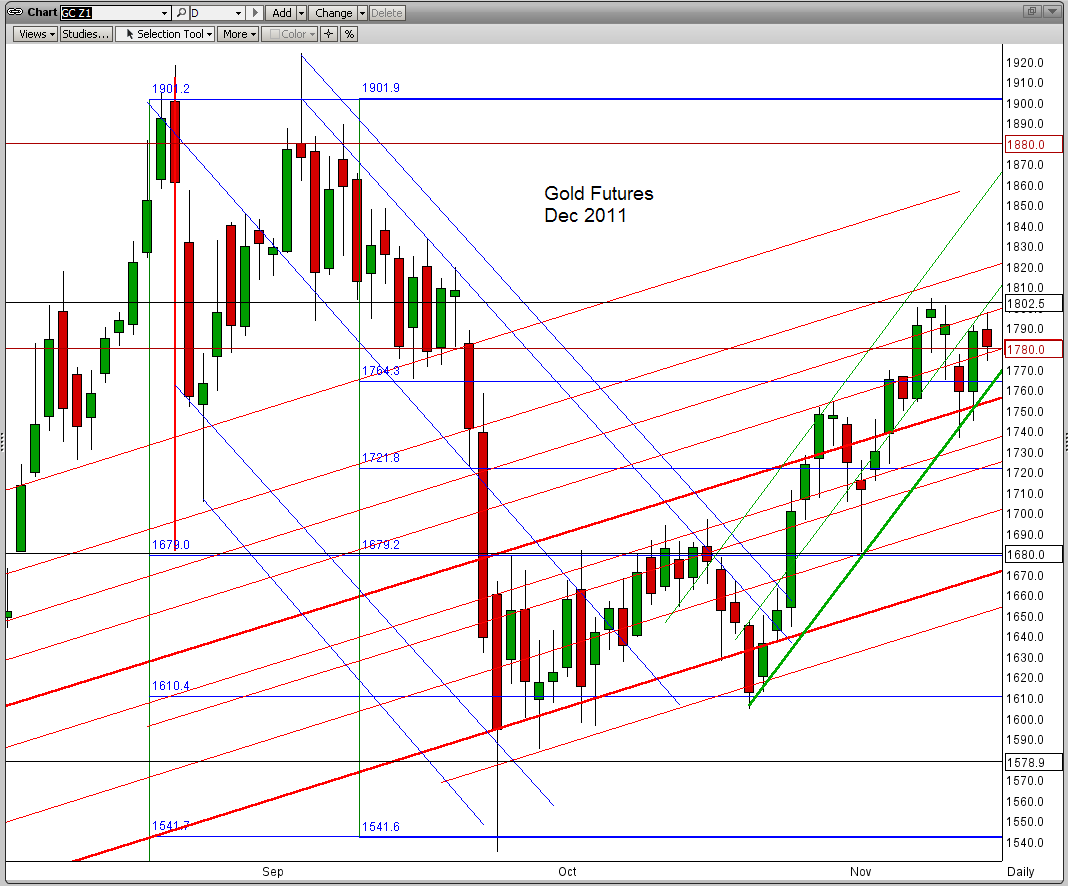
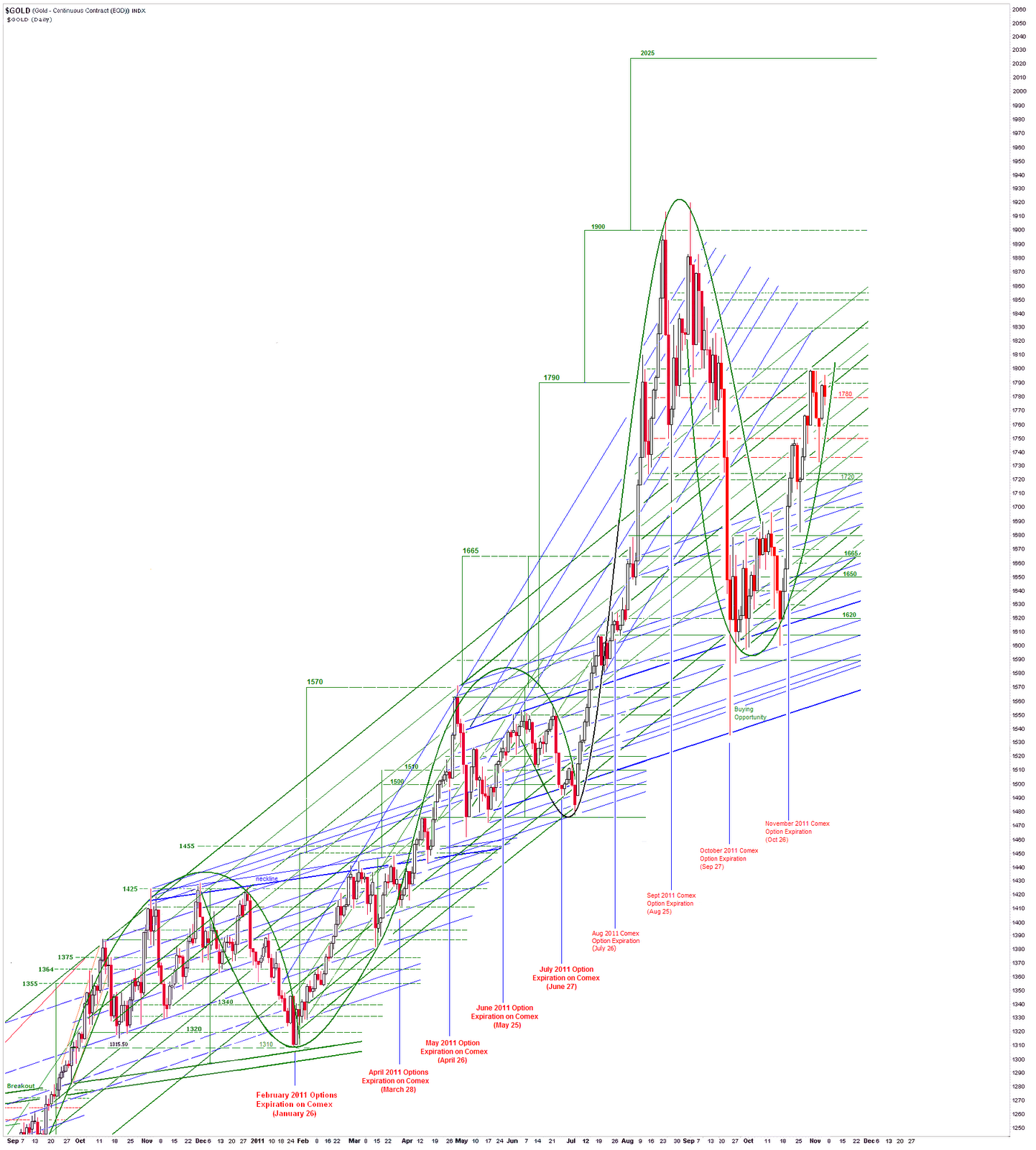
Gold Daily And Silver Weekly Charts


"Never argue with a fool, because they will only drag you down to the level of stupidity, and then beat you with their experience."

Michel de Montaigne

Today was December Option Expiration Metals Takedown Part Deux. As you know the actual expiration will be next Tuesday.

The pampered princesses of Bloomberg TV spent most of the morning alternatively frothing and tittering about the protesters outside the NYSE.

And having been short stocks, expecting a hit on the metals, it actually was a fairly boring day.

So what next.

The shorts cannot possibly deliver the silver on the Comex to cover all the options and contracts, but that has not fazed them before. I have a running theory that says the Comex will default in an event or a scandal. I almost thought MF Global was it, but apparently not.
"Every thing secret degenerates, even the administration of justice; nothing is safe that does not show how it can bear discussion and publicity."

Lord Acton
Let's see how we go into the weekend. After Tuesday the adults on the US exchanges will be taking off for a long Thanksgiving weekend. That leave it up to Asia and Europe to carry on.


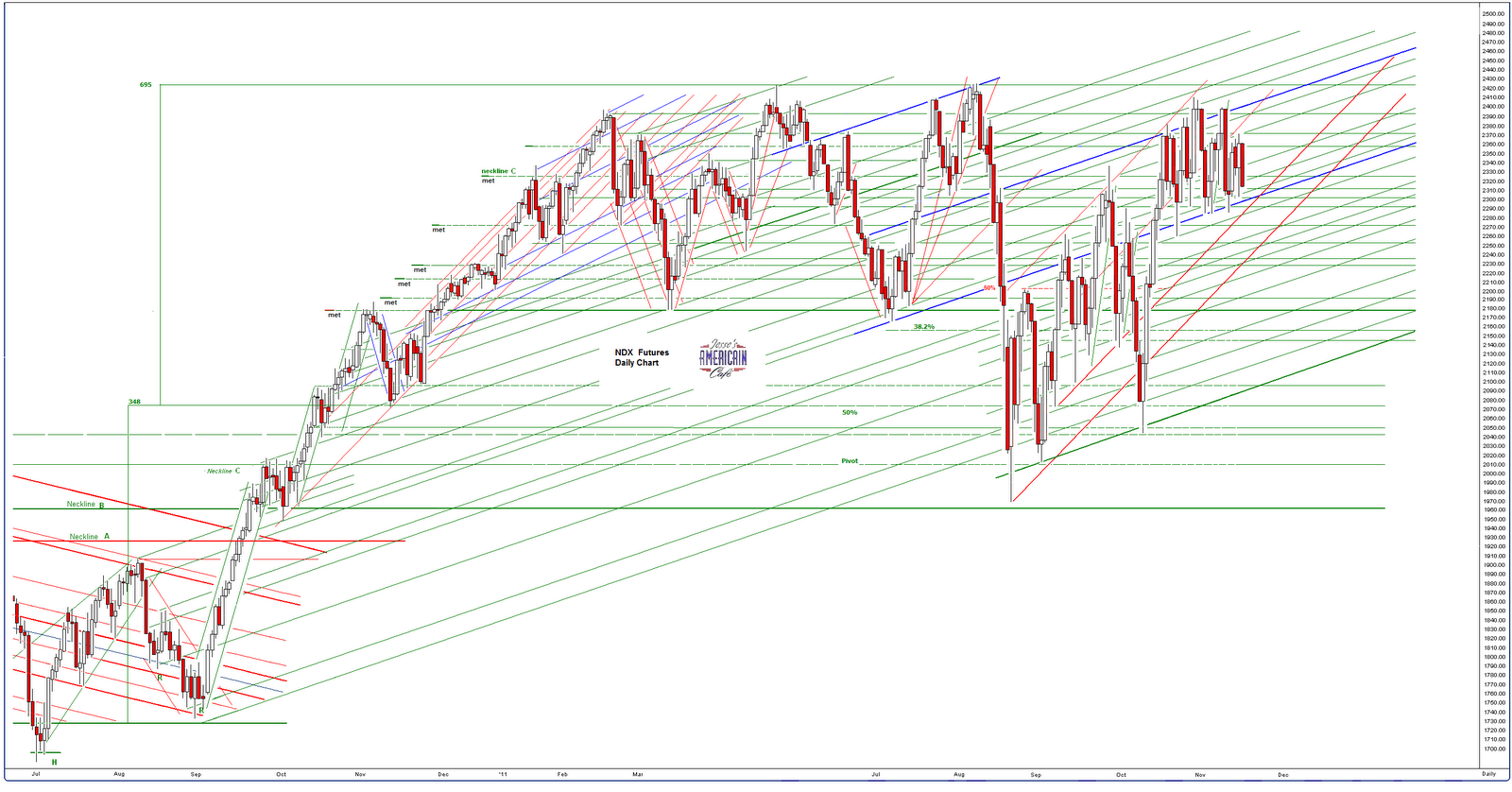
SP 500 and NDX Futures Daily Charts


Tomorrow is option expiration on stocks.

The sell off today seemed a little 'technical' to me. Although the symmetrical triangle has broken to the downside, I don't count it ahead of an option expiration unless they can take it and book it into the weekend and hold it on Monday.

Next Tuesday is metal expiration on the Comex.


Net Asset Value of Certain Precious Metal Trusts and Funds


The December Option Expiration on the COMEX is next week.

US trading will be thin in the holiday shortened week.

Change is in the air. But the biggest changes come slowly, over a long priod of time, and then suddenly make themselves known when the truth is revealed.

I am showing the NAVs and their premiums in the morning and in the afternoon.

Even yesterday some of the premiums were contracting ahead of the hit on metals.


16 November 2011

MF Global: Customers Appeal an Apparent Conflict of Interest With the Bankruptcy Trustee


It's the scandal that keeps on giving.

A party associated with The MF Global Customer Coalition has sent a letter to Judge Glenn asking him to reverse the appointment of James Giddens as Trustee for the MF Global Bankruptcy case.

Apparently Mr. Giddens law firm's largest customers and his own clients in other matters are J.P. Morgan and Price Waterhouse.

J. P. Morgan at least has enjoyed a somewhat contentious relationship with the customers' interests so far. There is strong feeling that this represents a substanial conflict of interest, and has been carrying over into some of the statements and decisions that have been made by the trustee.

It will be interesting to see if the Judge concurs.  I cannot determine the merits of this, obviously.  But I could understand how customers might be concerned, especially given some of the more arbitrary actions of the past few weeks.


Gold Daily and Silver Weekly Charts - Swan Dive on a Statement of the Obvious


The market was running the usual daily routine, with stocks grinding higher and gold under pressure, but in the last hour Fitch came out and warned of US bank exposure to Eurozone debt, and stocks folded quickly, and took gold and silver down with them.

The US dollar was remarkably lacksadaisical. Option expiration in the metals is next week. And it is a holiday shortened week in the States for the Thanksgiving holiday. Trading should be a real treat. I am probably going to take Friday off and catch up on my reading and some work in preparation for the winter.

I believe THIS week is a stock option expiration, so we might see more gimmicks like this as the market coils within a very obvious symmetrical triangle which we have previously noted.

I had a heavy stock short by the last hour as I sold the SP index to cover a bullion position even more fully, and took some of the short off in the after hours session.

Short stocks and long bullion is still making sense if you can get a sense on how to play it. But for 99 percent of investors, staying in the fundamental trends with a time appropriate portfolio allocation is by far the most effective course of action based on my experience.


SP 500 and NDX Futures Daily Charts - Headline Risk


It had appeared that we would see the usual routine, a low opening and a steady grind higher all day as the wiseguys bought the dip, and 'tried to take it up' as they like to see.

However, headline risk reared its ugly head to hammer stocks to their lows in the final hour of trading as Fitch Ratings warned of Eurozone exposure in US banks.

This market is thin. That means that there are few committed buyers and the action is frothy, subject to a sudden collapse.

Be careful. Better to stay out if you are not an experienced trader and know how to hedge risk. Most do not even know what the risks are.

I believe that this week is a stock option expiration so the shenanigans may have started early.

The symmetrical triangle on the SP 500 chart is rather troubling. Let's see how that breaks.


US Federal Prosecutions For Financial Fraud In the Obama Administration Fall to 20 Year Lows


The declines in US Federal prosecutions for financial fraud  that began under G.W. Bush have followed that down trend that in the first three years of the Obama Administration. That might make more sense if Obama had not been elected as a reform president in response to one of the greatest financial frauds in American history. 

In the first three years of the Obama Administration, federal prosecutions have been running at new highs. Over half of the prosecutions involve illegal immigration. Another 17% are drug related.

Illegal immigrants and drug dealers have the reputation for being notoriously cheap in providing campaign contributions.

Prosecutions for financial fraud however have dropped to the lowest levels in over 20 years.

According to the original study, the primary charges for Federal crimes in the latest figures are as follows.
"The single largest number of prosecutions of these matters through August 2011 was for Immigration, accounting for 50.7 percent of prosecutions.  The second largest number of matters were Prosecutions filed under the program area of Narcotics/Drugs  (17.3%)."
In defense of Obama, GW Bush had the unearned benefit of Eliot Spitzer leading the charge for the Feds on financial fraud from his office as the Democratic NY Attorney General. Of course Eliot got taken out by the Feds himself in 2008 as the result of an intensive ad hoc investigation into $5,000-a-night hookers from New Jersey named Ashley. I wonder what category that falls under.  She should have waited for the reality show - it has better residuals.

Don't get me wrong.  I am not trying to pick on BHO.  I am disappointed with his performance to say the least, and that set in around day 50 when he unrolled his appointments, so you can't blame it all on the obviously obstructionist opposition.  The people voted for Franklin Roosevelt and they got a Herbert Hoover.

Whenever you might say, "I don't really like Obama's ineffectiveness as a reformer" or "Although he seems decent and has many effective postions, I am uncomfortable with Ron Paul because of his ideological opposition to civil rights legislation and equal protection laws" at some point you usually hear: "Well who do YOU like?" Life imitates high school.

I don' t like any of them, or should I say like like? And a few are borderline frightening. And most people seem to feel the same way. I cannot believe that in the world's superpower, with about 300 million residents, this motley collection has risen as the cream of the crop.

NY Times
Prosecutions for Bank Fraud Fall Sharply
By CATHERINE RAMPELL

Federal prosecutions for financial institution fraud have tumbled over the last decade, despite the recent troubles in the banking sector, according to a new analysis of Justice Department data by the Transactional Records Access Clearinghouse (TRAC) at Syracuse University.

This category can refer to crimes committed both within and against banks. Defendants include bank executives who mislead regulators, mortgage brokers who falsify loan documents, and consumers who write bad checks.

During the first 11 months of the 2011 fiscal year, the federal government filed 1,251 new prosecutions for financial institution fraud. If that pace continues, TRAC projects a total of 1,365 prosecutions for the fiscal year. That’s less than half the total a decade ago.
The decline in these new cases stands in contrast to the government’s broader approach to federal criminal prosecutions. Federal prosecutions for other crimes have grown tremendously, with the number of total new prosecutions filed for all federal crimes nearly doubling over the last decade.

Read the rest of the NY Times article here.

All Federal Prosecutions

Federal Prosecutions for Financial Fraud

CFTC Commissioner O'Malia Warns of 'Rash Reforms' - "Isolated Incident" - Opposes Position Limits


The CFTC must make haste to prove to the public that MF Global was an isolated incident. It should not become involved in the issues of returning customer funds.

Oh, such wiles are hidden in the voice of reason and 'free market' ideology. Let's not be hasty. After all, it is only customer money, and we are just the regulators responsible for making sure it didn't happen in the first place.

Commissioner O'Malia has also actively opposed 'position limits' on silver and other reforms in commodity trading designed to curtail manipulation.
"O'Malia said the agency had overreached its mandate and echoed the industry's argument that there was no "empirical evidence" to substantiate the rule."
In his opening statement on position limits he said:
"...in addition to failing to detail costs, the two final rulemakings fail to articulate a convincing rationale for eliminating our current regime of principles-based regulation and substituting in its stead a prescriptive “government-knows-best” regime."
Principles based regulation. Unfortunately the principles are being written and administered by the brokerage firm of Dewey, Cheatum and Howe & Assoc.

Let's make haste to show this is an 'isolated incident.' How about making some haste to get the customers' money back, and telling us who took the money and what they are charged with?

How can this possibly be an 'isolated incident?' There's a fine line between an isolated incident and just another episode in a multi-year financial gang bang of the American public by Wall Street's monied interests.

Commissioner O'Malia was appointed by Barack Obama in 2009 according to Huffington Post: Scott O'Malia: Obama Appoints Ex-Lobbyist For Enron-Like Company To Top Regulator Position

Obama's failure to fulfill his electoral mandate, for whatever reasons, is one of the greatest flops since Plan 9 From Outer Space.

Credibility trap. Regulatory capture. Corporate "News." Judas goat reformers.

I fear the truth, and financial reform, will be led down a blind alley, and strangled. The best I can hope for is that the customers' money will be returned out of shame and fear, if not justice and wisdom.

CFTC Chairman Gensler is apparently asking for a December 5 vote to restrict the manner in which brokerages can use customer funds. Hence Commissioner O'Malia's warning on making changes to the status quo, and the new threat from the Congress to pass deep cuts in CFTC funding.

And next year the American public will be given Morton's fork opportunity to choose between two flavors of corporate extrusion, Tweedleflip and Tweedleflop. And so they will hold their noses, and most likely cast their joyless votes.


CFTC official warns about rash reforms post-MF Global
By Christopher Doering
Wed Nov 16, 2011 10:46am EST

WASHINGTON, Nov 16 (Reuters) - A U.S. futures regulator on Wednesday pushed for immediate action in the wake of collapsed brokerage MF Global, including a requirement that all intermediaries should hire an independent party to make sure customers funds are kept separate from the firm's own money.

Scott O'Malia, a Republican commissioner at the U.S. Commodity Futures Trading Commission, said in order to show the public that segregation works and that MF Global was an isolated incident, it must act quickly.

However, he warned about going too far with reforms without full knowledge of what happened at the failed brokerage.

"Many have said that the failure of MF Global was not systemic and that we are lucky. I don't view it in the same light," O' Malia said in a statement laying out the "next
steps" in dealing with the mess MF Global left behind.

MF Global filed for bankruptcy on Oct. 31 after investors and counterparties balked at revelations about the firm's bets on risky European sovereign debt.

Roughly $600 million is missing in customer accounts of the company's brokerage, and the CFTC is among the authorities investigating whether MF Global may have improperly mixed that money with its own funds.

O'Malia said the CFTC must ensure that all intermediaries are in compliance with segregation requirements. The agency also must reconsider rules it is crafting to implement the Dodd-Frank financial reform law.

In the three-page statement, O'Malia said it's too early to hail a proposal that would limit investments of segregated customer funds "as the solution to the MF Global problem."

He also warned against a plan that would have the CFTC intervene in insolvency proceedings to facilitate transfer of customer positions and collateral in the face of a shortfall.  "The Commission has not actively intervened in such a manner in MF Global, and so it is questionable whether the Commission would so intervene in the future," O'Malia said.

In light of MF Global's demise, O'Malia said the CFTC should ensure that clearing organizations are able to diversify their membership without introducing risk.

MF Global Customers to Propose Faster Distribution of Funds Than SIPC Trustee


Commodity Customer Coalition
190 South La Salle Street, Suite 3000
Chicago, IL 60603
www.commoditycustomercoalition.org
info@commoditycustomercoalition.org

November 16, 2011 FOR IMMEDIATE RELEASE

CONTACT: John L. Roe (jroe@btrtrading.com) 312-933-6564

Commodity Customer Coalition to Object to SIPC Trustee’s Claims Process for MF Global Bankruptcy, Propose Faster Alternative Claims Process

In response to the SIPC Trustee’s expedited application for an order from the court to put both securities and commodities customers of MF Global through the same claims process, the Commodity Customer Coalition (“CCC”) is filing an emergency objection to that application and proposing a faster, more efficient claims process to immediately release a majority of customer funds. The CCC issued the following statement:

The Commodity Customer Coalition applauds the Trustee’s recent motion to release 60% of assets held in cash on October 31, 2011. However, that simply isn’t good enough. This only represents a very small portion of the total assets frozen in the bankruptcy. Additionally, the Trustee has proposed a snail mail approach to collecting claims.

He says they cannot use the books of MF Global to verify customer claims, but his process will only result in customers mailing him statements based on those books and it will do so over a period of months. Our proposal will streamline this process with a more commonsense approach, affirm the primacy of customer property over the claims of creditors and return funds to their rightful owners in a matter of days, not months.

The basis for the Trustee’s proposal is that he cannot give us an accurate accounting of the shortfall in customer funds. But MF Global’s estate has $1.2 billion in excess equity and the CME has thrown him a life line of $250 million if he sends home too much money. MF Global claimed under oath that only $600 million in funds is missing. So the shortfall in funds is irrelevant; the Trustee has 250% over the shortfall.

That money is supposedly accounted for on a daily basis to the NFA, CFTC and MF’s DSRO, which was the CME. The Trustee has had over two weeks to sort through this and get clients their money. It’s time to truly expedite this process and make customers whole.

Mr. James Koutoulas, Esq. will appear in person tomorrow to argue the CCC motion before the court. He will make himself available to the press immediately following the hearing on the steps of the courthouse.


The Commodity Customer Coalition now represents over 7,000 former MF Global customers whose funds have been frozen by the SIPC Trustee. For more information, or to schedule interviews, please contact John L. Roe
(jroe@btrtrading.com, 312-933-6564).

15 November 2011

A CFTC Regulatory Change Opened the Door For MF Global Bankruptcy - And Worse


This is a very good analysis of how regulatory capture and the erosion of regulatory oversight opens the door wide for public loss and the defrauding of investors.

And it is also important to remember that in addition to bad investments, the MF Global scandal apparently involves the use of customer funds to meet margin calls for the firm's positions, which is a scandalous theft of funds.  And when they were going bankrupt they used checks instead of wire transfers to fulfill customer requests for the return of their money, so they could bounce the checks, even while they were paying bonuses to their own London traders. 

The government needs to address this as well and if appropriate bring the charges.  I have suggested that the fraudulent conveyance law has some potential applicability, and possibly RICO statutes depending on the involvement of third parties.  Since Jon Corzine is a high ranking Democrat, a lack of action by the Obama Administration on this would be particularly odious.

History shows that it is never the initial criminal action that brings down a government, but it is always the subsequent coverup and obstruction of justice that destroys careers and cripples administrations and their parties.  In this case it might even be worse, since it involves a more widespread corruption that is caught in a credibility trap.  It cannot be addressed credibly with reform over even honest discussion by those in positions of authority because they have been involved in a crony capitalism that is not limited to a few transactions, but is rather, pervasive. 

And this is why even the Republicans may not use this scandal as an issue, because they may be complicit as well.  And so the failure of the honest regulation of the markets festers, crippling the real economy. 

The ideological fantasy that government is the problem, and simply getting rid of it is the answer, is a great propaganda slogan for white collar criminals to promote, but it makes little sense in the real world of flawed human beings and a persistent rogue element in any society.

For it is the constant weakening of regulations by the banks and their lobbyists that led to the financial crisis and the looting of the public trust.   If the criminals have corrupted the policeman, one does not get rid of the police department as a solution, because that is to fulfil the very intent of the criminal element in the first place.  One reforms what has been corrupted, and prosecutes the criminals more vigorously.
"Turn where we may, within, around, the voice of great events is proclaiming to us, Reform, that you may preserve."

Thomas B. Macaulay
The problem is the weakening of government by corruption. And the solution is reform, not more of what went wrong with the rule of law, replacing it with lawlessness.

The danger is that when, in the name of libertarian reform or some other misguided anarchist movement, the laws are knocked down, and the social fabric is torn, very often the worst of us, the truly ruthless opportunists, put forward their 'strong men' or a 'great leader' to bring back order and act as the law, or merely preside over the law of the jungle.

And then begins the real descent into hell.

Bloomberg
Tiny Rule Change at Heart of MF Global Failure
By William D. Cohan
November 15, 2011, 9:15 PM EST

Nov. 16 (Bloomberg) -- Laurie R. Ferber has quite a resume. She is currently the general counsel of MF Global Holdings Ltd., the New York-based futures and commodities brokerage that filed for bankruptcy on Oct. 31, listing some $40 billion in liabilities....

Before that, she spent more than 20 years at Goldman Sachs Group Inc., where first she was general counsel for J. Aron & Co., a commodities business that Goldman Sachs bought in 1981, and then was the co-general counsel of Goldman’s principal business, known as FICC -- for Fixed Income, Currency and Commodities -- when J. Aron was merged into the rest of Goldman’s fixed-income division.

But at the moment, her greatest significance may be as a long-time advocate for revisions to a little-known and vastly underappreciated Commodities Futures Trading Commission rule called Regulation 1.25.

Before 2000, the rule permitted futures brokers to take money from their customers’ accounts and invest it in a number of approved securities limited to “obligations of the United States and obligations fully guaranteed as to principal and interest by the United States (U.S. government securities), and general obligations of any State or of any political subdivision thereof (municipal securities.)” That is, relatively safe securities with high liquidity.

Internal Repo Allowed

The banks, however, pushed the CFTC to expand the investment options that would allow firms to practice “internal repo.” In this scheme, money is taken from customer accounts and invested short-term in a variety of securities, with the futures brokers reaping the not- insignificant financial rewards from their customers’ money.

And, lo and behold, such efforts were successful. In December 2000, the CFTC agreed to amend Regulation 1.25 “to permit investments in general obligations issued by any enterprise sponsored by the United States, bank certificates of deposit, commercial paper, corporate notes, general obligations of a sovereign nation, and interests in money market mutual funds” -- in other words, riskier investments that could make more money for Wall Street.

Then, in February 2004 and May 2005, Regulation 1.25 was further amended and refined to the liking of Ferber and the banks. In the end, the door was opened for firms such as MF Global to do internal repos of customers’ deposits and invest the funds in the “general obligations of a sovereign nation.”

This practice, of course, may well be the centerpiece of the MF Global disaster. We now know that Corzine -- who was CEO of Goldman Sachs from 1994 to 1999 -- bet $6.3 billion on the distressed long-term bonds of countries such as Italy and Spain, although it’s unclear if clients’ funds were used. Bart Chilton, a CFTC commissioner, told Bloomberg News on Nov. 10 the loss to customers’ accounts may have resulted from a “massive hide-and-seek ploy.”

While the CFTC’s and the Federal Bureau of Investigation’s probes into the missing money continue, it isn’t too soon to pass judgment on how the too-close relationship between Wall Street and Washington can lead to seemingly innocuous changes in the obscure rules governing the securities industry, which, in turn, can result in financial disaster.

Hands on Keyboards

This danger is especially relevant now as hundreds of new regulations are being written that will govern the way Wall Street operates in post-crisis, post-Dodd-Frank world. Needless to say, Wall Street’s lobbyists are looking to place a heavy hand on the regulators’ keyboards and make sure the new rules are rewritten the way they want them to be.

This is nothing new, of course. For years, the finance industry has been influencing the regulations that govern it, often with devastating consequences. For instance, in June 2004, the Securities and Exchange Commission -- then the chief Wall Street regulator -- without much fanfare agreed to allow securities firms to vastly increase the amount of leverage they could use in their businesses.

So authorized, the financial institutions went to town, levering up their balance sheets on the order of 50- to-1 intra-quarter, and then lowering the leverage to around 35-to-1 by the end of the quarter when it came time to report their financial condition. As a result, a mere 2 percent or 3 percent decline in the value of the assets on their books could wipe out a firm’s equity.

As anyone who has closely studied what happened to Wall Street in 2008 knows, the value of many of the assets that firms such as Bear Stearns Cos., Lehman Brothers Holdings Inc. and Merrill Lynch & Co. jammed onto their balance sheets declined significantly -- causing huge losses, wiping out their equity and causing them to be virtually or actually bankrupt. (The same thing happened to MF Global of course, which was leveraged by some 40-to-1 at the end.)

We’ll see if MF Global will claim that the changes to Regulation 1.25 during the past decade gave it cover for its actions. It now seems clear that investing customer money in the risky, distressed long-term bonds of European countries shouldn’t have been permitted. Then again, it’s more than a little amazing that the CFTC allowed futures brokers like MF Global to do internal repos with client funds under any circumstances.

Reform Went Nowhere

In a nifty bit of Washington irony, about a year ago, shortly after the Dodd-Frank Bill was passed, the CFTC proposed vastly restricting the way customer money could be invested. One of the proposed changes was to eliminate the possibility of investing in the sovereign debt of other countries. “The Commission seeks to simplify Regulation 1.25 by narrowing the scope of investment choices in order to eliminate the potential use of instruments that may pose an unacceptable level of risk,” read the CFTC proposal.

Unsurprisingly, the reform effort went nowhere. Equally unsurprisingly, one the many comment letters from financial professionals to urge the CFTC to keep the status quo came from Laurie Ferber.

Now, MF Global is gone, along with thousands of jobs and billions of dollars in creditor money -- to say nothing of the still missing $593 million. “I believe we have to tighten how investor funds can be used,” Gary Gensler, the CFTC chairman and another former Goldman Sachs executive, said on Nov. 7. “They’re segregated and must be segregated at every minute of every day. And then if they are invested, they should be invested with good collateral with outside parties.” That’s the right idea; I hope this time the commission means it.

MF Global Customer Fund 'Mystery' - Something Nefarious or Illegal Happened


If the customer funds are not returned, and justice is not done, then nothing and no one is safe from rapacious bankers and insiders who decide to seize your funds for themselves.

Anyone who is familiar with the markets and has a shred of decency is absolutely appalled by this outrageous theft from customer accounts and breach of fiduciary trust. And the wall of silence from the financial system and the Obama Administration is deafening.

If this stands, then there will be more abuse of funds and selective defaults to come, especially for any non-US citizens with assets in the US financial system that involve commodities and precious metals.

Title and ownership mean nothing in an unfolding kleptocracy.  If one does ill and profits, then so shall they all.

The Economic Times of India
MF Global activity 'suspicious': CFTC official
15 Nov, 2011, 10.15PM IST, Reuters

A US futures regulator said on Tuesday that activity leading up to the bankruptcy of brokerage MF Global appears to be "either nefarious or illegal."

Bart Chilton, a Democratic commissioner at the US Commodity Futures Trading Commission, said on CNBC that he could not comment specifically on the agency's investigation, but that the activity "looks suspicious as heck."

"It's either nefarious or illegal in my personal opinion," he said.

An MF Global representative was not immediately available for comment.

Neither MF Global nor its former head Jon Corzine has been charged with any wrongdoing.

MF Global filed for bankruptcy protection on Oct. 31 after concerns over risky bets on European sovereign debt sped its collapse. The CFTC and other regulators are still searching for roughly $600 million in customer account funds.

When asked about whether customers will get their money back, Chilton said: "It depends on what is there."

Meanwhile, it was reported that MF Global Holdings Ltd may have faced a shortfall in customer funds even as far back as Oct. 27, four days before the US futures brokerage filed for bankruptcy protection.

Just hours before the bankruptcy filing, MF Global executives told regulators they believed a shortfall had somehow occurred, possibly starting on Oct. 27 or Oct. 28, it was reported.


Customer funds were found to be short by about $200 million on Oct. 27.

The CFTC is also examining whether hundreds of millions of dollars in customer accounts were transferred at MF Global during the week that began Oct. 24, the paper said.

According to CFTC, the transfers were not recorded in the firm's general ledger reviewed by exchange officials, the paper said.

MF Global filed for bankruptcy after its bets on European sovereign debt unnerved investors, credit agencies, customers and counterparties, causing liquidity to disappear.

Thereafter, regulators are seeking to find some $600 million missing from the company's customer accounts.

A spokesman for MF Global said last week that the firm is cooperating with regulators and the bankruptcy trustee trying to find the missing money, according to the Journal.

MF Global could not immediately be reached for comment by Reuters outside regular US business hours.


Gold Daily and Silver Weekly Charts - What Time is the Next Swan? - And a Divertimento


What time is the next swan?

No I am not referring to the famous ad lib from Czech operatic tenor Leo Slezak.
"One of the most famous ad-libs in theatrical history came from the great tenor Leo Slezak. One night, while playing the title role in Wagner's opera Lohengrin, he ran into an unexpected problem. At the end of the opera, a swan appears at the back of the stage, drawing a boat that is to return Lohengrin to his place with the Knights of the Holy Grail.

This night, however, a stagehand erred and sent the swan boat off prematurely. It was the end of the opera, but there stood Slezak, watching the swan boat sail off without him. It was an awkward moment for the performers on stage and members of the audience, who were familiar with the opera's famous ending. As people began to fidget in their seats, Slezak brought the house down when he turned to a singer next to him and ad-libbed:

"What time is the next swan?"
My favorite Leo Slezak story is about when he went to Bayreuth, and was permitted to audition there for the grand dame herself, Frau Cosima Wagner. Herr Slezak obtained a very hard reception indeed when he chose to sing Vesti la giubba from Pagliacci for his stunned audience. Slezak later said that he did not know that the works of Italian composers were strictly verboten in the home of Richard Wagner. “Even the attendant who had ushered me in tottered when I sang," he admitted.

His memoir, Song of Motley: Being the Reminiscences of a Hungry Tenor is a fun read for opera aficionados.

As an aside, Leo's son Walter became a famed character actor in his own right, with a memorable role in Lifeboat, and published a delightful memoir titled 'What Time's the Next Swan.'  After his long career he settled in New Hope, PA.

Rather, I am wondering when the next black swan will make its arrival. It seems a bit overdue.

As the big retail names in the commodity brokerage world keep collapsing in various frauds, like Refco and MF Global, one has to wonder what event will cause the next wave of failures and collapses, in highly leveraged operations that are dashed on the rocks of hard reality.

As the great economist John Kenneth Galbraith observed, "All successful revolutions are the kicking in of a rotten door." And as rotten doors go, the current financial system run by the Anglo-American banking cartel run out of NYC and London is teeming with vermin.

When the action starts it might come in a hurry. So now is the time to prepare.


SP 500 and NDX Futures Daily Charts


Stocks appear to be coiling for a move.

I am tending to take the short side here, in a paired trade with long gold without leverage. No miners. I adjust the mix intraday to try and capture some of the games as the wiseguys do a wash and rinse with the index.

I do not wish to be caught long until some semblance of order comes to the European debt situation. And not only is it not getting better, but the US seems to be tottering to a reckoning of its own.


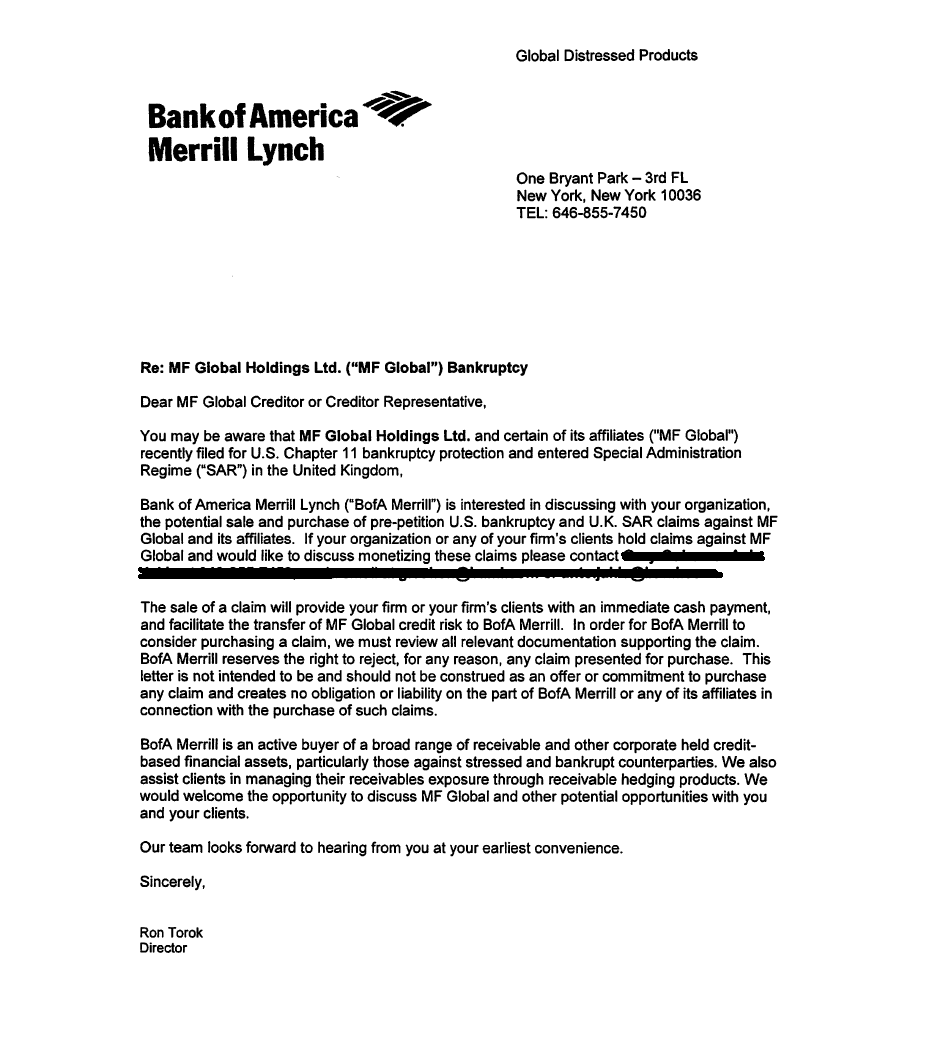
Pigfest 2011: Bank of America/Merrill Lynch Is Offering To Buy Claims Against MF Global


Bank of America's Merrill Lynch unit is soliciting for the purchase of claims against MF Global.

As you may recall, Bank of America is one of the major creditors of MF Global with JPM, and is reported to be one of the Debtors, along with JP Morgan, involved in the litigation trying to obtain superiority of their claims over customers whose money was taken/lost/stolen by parties unknown for now.

I have nothing against vulture funds per se, although what I hear a few of them have done with two of the failed Icelandic Banks and their former directors proves Rule Four of ZombieBankingland: Always Use the Double Tap.

But doesn't this seem like a bit of an impropriety, if Bank of America is one of the holders of assets, or affiliated in a court action with such a holder of contested assets, that would ultimately make customers whole? Is it conceivable that this is a conflict of interest?

I mean, it does seem that BofA with one hand is acting with others to give its own claims superiority in the Trustee liquidation, and on the other hand it is offering to buy up the claims it has weakened by these legal actions.

MF Global has the wafting odour of scandal that keeps on intensifying.

I cannot wait to find out the whole truth. But that might have to wait for kingdom come, if it is in the same justice delivery system as the silver manipulation inquiry.

But for now the pampered princesses of the NY financial media are bubbling with excitement over the clubbing and gassing of peaceful protesters under cover of darkness.

It appears that MF Global is phase two: the clubbing and looting of unsuspecting customers and clients.

When in doubt, get out.


14 November 2011

The Coalition of Customers of MF Global File a Motion To Release Their Funds


"It is to be regretted that the rich and powerful too often bend the acts of government to their selfish purposes."

Andrew Jackson

The Coalition of Customers of MF Global filed a motion to turn down JP Morgan's legal maneuver to give the Bank a priority as a Debtor over the Customers whose $633 million in non-cash assets were apparently 'misplaced' by MF Global.  The location of the funds, and the party to which they were given, has still not yet been disclosed by MF Global's management. 

Bank of Montreal's Chicago based Harris unit was subpoenaed for customer account information, but so far nothing has been released publicly with regard to the location of the customer assets.

This is a somewhat lengthy excerpt but it is an interesting read even for a non-attorney such as myself.

INTRODUCTION

MF Global, Inc. was a registered broker-dealer, used by its Customers to trade commodities, futures and derivatives. Customers maintained accounts at MF Global, Inc., which were supposed to be held inviolate under CFTC Regulation 4.20(c), and which have a first priority right of recovery under 11 U.S.C. § 766(h) and 17 C.F.R. § 190.08. Yet, it appears that over $600 million in Customer funds are unaccounted for at MF Global, Inc. (“Missing Funds”), due to poor internal controls, and may have been commingled with proprietary funds held by MF Global, Inc., and the Debtors.

Presently, the Securities and Exchange Commission (“SEC”), Commodity Futures Trading Commission (“CFTC”), the FBI, and the Trustee overseeing the liquidation of MF Global, Inc., are investigating the disposition of the Missing Funds. It could be that some or all of the missing funds are held by, or are tied up in assets owned by, the Debtors. According to Section 766(h) of Chapter 11 of the Bankruptcy Code, such funds would have to be returned to the Customers before any other creditor.

In the meantime, Debtors, the Liquidity Facility Lenders, and the professionals representing both, have sought approval to carve out funds for themselves — under a so-called super-priority protection — without regard to the Customers’ right to have their funds returned before any other money is spent from the bankruptcy estate. Yet, the Debtors have not provided notice to all MF Global, Inc. customers, nor have they apparently even notified the trustee for MF Global, Inc. of the potential impact of the Motion on potential Customer funds.

Indeed, if granted, such a super-priority right would abrogate sacrosanct protections for commodities account holders, depriving those who trade in commodities, futures, and derivatives, of their only protection and potentially chill economic activity. It is premature to enter such an order — particularly one that includes a “good faith” finding to a lender that may have benefitted from the improper transfer of the Customer Funds to pay down an outstanding loan.

BACKGROUND

MF Global customers represent a cross-section of people across America and the world, from farmers and ranchers who hedge their crops and herds, to oil producers and miners who use futures to lock-in prices and take delivery of physical commodities, to retirees who invest in futures to diversify their portfolios. For example, farmers who have crops in the field need to sell futures in commodity markets so they can lock in prices for their future yields today, instead of taking on market risk as they would otherwise be exposed to volatile price swings.

Large corporations like Coca-Cola who make money in foreign markets do not want to lose money when they repatriate revenue earned in foreign currency. They have to be able to forecast future expenses and profits accurately in the currency of their domicile and hedge that currency price risk in futures markets accordingly.

Investors add volume and liquidity to these markets which allow for better, more efficient pricing of commodities. This allows for stability in prices of commodities and predictability of future profit and loss, which in turn allows for stability in producer and consumer prices. These commodities include everything from grains like corn and wheat, to energy like oil and natural gas, to soft goods like cotton and sugar, to currencies like the US dollar and Euro, to financial instruments like bonds and stock indexes. Simply put, trading in commodity futures markets is a mainstay of the American economic engine.

Segregated Funds: Cornerstone of the Commodities Industry:

One of the big differences between commodities brokers and securities (stocks and bonds) brokers is that commodity brokers have an obligation to keep customer funds completely segregated from the firm’s own assets. This is to ensure that clients are completely protected from losses sustained by the firms’ trading and operations. It also is in contrast to the securities industry, as the Securities Investors Protection Act back-stops losses suffered by securities investors due to broker malfeasance, but does not similarly back-stop similar losses suffered by commodities investors.

Many industry groups and regulators have heralded segregated account protection, arguing that no client has ever lost a penny from a segregated account as the result of a broker bankruptcy, and this has been a key driver of volume and profitability for the Chicago Mercantile Exchange. “However, all futures trading accounts, including managed futures, have the advantage of specific industry rules that require the segregation of customer funds from the firm's own funds. The practice of segregating customer funds protects investors in the event of default at the Futures Clearing Merchant (FCM, the industry term for futures brokerage firms
licensed to trade on futures exchanges in the U.S.) holding their account. While FCM bankruptcies are rare, they do occur. In 2005, Refco Inc. and 23 of its unregulated subsidiaries filed for Chapter 11 bankruptcy protection. However, Refco's regulated subsidiaries (where customers' futures trading and managed futures accounts resided) were unaffected and customers were able to continue trading and managing their accounts.” See “Safeguarding Customers Through Segregated Funds” by CME Group, Inc. http://www.cmegroup.com/managedfutures/Feb2011/safeguarding-customers-through-segregated-funds.html.

So, whereas securities clients are afforded various insurance in the event of a broker bankruptcy, commodities clients are afforded none—which is economically rational only because their funds cannot be commingled with a broker's assets and cannot be used to pay creditors in a bankruptcy. Segregated funds are accounted for daily to the National Futures Association (“NFA”) and to the CFTC through the broker’s designated self-regulatory organization (“DSRO”), which in MF Global’s case was the Chicago Mercantile Exchange (“CME”).

MF Global Did Not Maintain Segregated Accounts

Despite the fact that MF Global was responsible for maintaining full segregation of customer funds on a daily basis, there remains $633M in unaccounted for customer segregated funds two weeks after the firm filed bankruptcy. Moreover, the officers and directors of MF Global have thus far been uncooperative in aiding the court in ascertaining the whereabouts of these missing funds, despite a formal probe by the CFTC, the US futures regulator. This has driven the Trustee’s office to comment: “Our forensic investigators have been there since last week and nothing we have found so far causes us to think anything other than there is an
apparent shortfall at MF.” See “MF Global Fund Frustration Grows, CFTC Confirms Probe,” by Reuters, November 10, 2011,  http://www.reuters.com/article/2011/11/11/us-mfglobal-cftcinvestigation-idUSTRE7A96C420111111

These failures to cooperate are consistent with the operating history of MF Global, which is fraught with examples of misconduct and disregard for regulations. “An analysis of regulatory enforcement actions shows MF Global has drawn more sanctions from the U.S. commodity futures regulator than each of its 14 closest peers in that market over the past decade. MF Global has also drawn the second highest amount in fines, for alleged lapses in risk supervision and record keeping.” See “Insight: Risk, Lax Oversight Riddle MF Global’s Past,” by Reuters, November 11, 2011, http://www.reuters.com/article/2011/11/11/us-mfglobal-legal-fidUSTRE7AA2KO20111111

As of today, it is not clear where the Missing Funds might be—although they may have been taken as part of one or more margin calls related to sovereign debt held by MF Global on its own account. See “MF Global May Have Used Customer Funds In The Losing $6.3 Billion Trade Without Informing Clients,” November 8, 2011, Forbes, at http://www.forbes.com/sites/robertlenzner/2011/11/08/mf-global-used-customer-funds-in-the-losing-6-3-billion-trade-without-informing-clients/.

The CME has gone so far as to say that it appears MF Global moved funds immediately prior to bankruptcy from “segregated funds in a manner that may have been designed to avoid detection,” according to a CME statement on November 2, 2011. http://www.prnewswire.com/news-releases/cme-group-statement-regardingmf-global-133102203.html.

It is equally possible that these funds were seized and used to pay down the line of credit held by MF Global Holdings, Ltd. or have otherwise been used to bolster cash held by the Debtors.

ARGUMENT

Due to the apparent shortfall of customer segregated funds and the lack of cooperation by MF Global officers and directors in determining its whereabouts, it is imperative that the Court does not grant any liens, encumbrances, priorities, or super-priorities of any assets in the Debtors without protection for customer funds at this time. To do so could allow Debtors and JP Morgan Chase Bank, N.A. (“JPMorgan”) to obtain a priority over Customers on Customer Funds, in derogation of the Bankruptcy Code and CFTC regulations. This would deprive commodity investors of the one protection they have — a right to priority payout — and possibly further chill economic activity in these troubled economic times. Accordingly, absent some protection for Customers, Debtors’ Motion must be denied.

I. Customers Have Absolute Priority Over Funds Implicated By The Motion.

According to 11 U.S.C. § 766(h), a bankruptcy trustee “shall distribute customer property ratably to customers on the basis and to the extent of such customers’ allowed net equity claims, and in priority to all other claims, except [limited costs] attributable to the administration of customer property.” (emphasis added.) Under 17 C.F.R. 190.8, “customer property” includes (among other things) cash, securities or other property “received, acquired or held to margin, guarantee, secure, purchase or sell a commodity contract,” any “open commodity contracts,” and even cash, securities or property that “[w]as unlawfully converted but is part of the debtor’s estate.” The Motion implicates customer property in at least two ways.

First, it is unquestionable that there are well over $600 million in Customer funds that simply have not been accounted for. If speculation is true, the Missing Funds could have been seized in a margin call or otherwise improperly applied by the Debtors to their outstanding obligations. Commingling between MF Global, Inc. and Debtors could necessitate a finding of substantive consolidation. Such a finding would, in turn, merit treating Debtors like futures clearing merchants. Such a finding would obviate the protection of Chapter 11, necessitate Debtors’ immediate liquidation, and would unquestionably require priority return of assets to
Customers. Until such time as the SEC, CFTC, FBI, and the trustee overseeing the MF Global, Inc. liquidation have completed their forensic analysis, the Court ought to treat the funds that the Debtors seek to use as if they include the Missing Funds.

Second, the Motion and Amended Interim Order each provide that JP Morgan can obtain a super-priority or first priority lien (JP Morgan currently is an unsecured creditor) on all property in which Debtors have an interest, including “intercompany indebtedness … owed by MF Global, Inc. to each Debtor.” In other words, it is possible, under the Motion, for JP Morgan to obtain a seemingly preferred interest in payments that MF Global, Inc. owes to Debtors—and could use that priority to force MF Global, Inc. to pay JP Morgan rather than pay Customers. The Proposed Order, in Paragraph 5, also gives JP Morgan priority over any claims.

Put simply, given the unknowns at this stage in the proceeding, it is undeniable that the Motion may impact funds and/or assets that should first be paid out to Customers—not to lenders and professionals.

II. Customers Should Have Received Notice.

In this matter, notice has been given in haphazard fashion. Debtors sought and received interim rights over cash collateral and JP Morgan received its super-priority rights on an interim basis without any real notice being given. Then, a hearing was noticed for November 14,2011. An amended notice, found at Dkt. No. 63, re-set the hearing for Thursday, November 16, 2011, at 3:30 p.m. It also set the objection date for November 11, 2011. Of course, the 16th is a Wednesday and November 11, 2011, was a federal holiday.

Even assuming Debtors have calendar-challenges rather than devious intent, Customers still should have received notice of the Motion. As first-priority claimants for whom over $600 million in collateral has vanished, it seems unquestionable that Customers of MF Global, Inc. potentially have rights that ought to be protected in the closely related bankruptcy of MF Global Holdings, Ltd. Yet, no effort was made even to post notice of the Motion on the SIPC trustee’s website in the related bankruptcyhttp://dm.epiq11.com/MFG/Project/default.aspx.

For this reason alone, the Motion ought to be denied at this time, until adequate (and accurate) notice can be provided to Customers.

The Court Ought To Protect Customer Funds.

As noted above, a finding of commingling between MF Global, Inc. and Debtors could necessitate a finding that MF Global, Inc. and the Debtors were substantively consolidated.

Such a finding would, in turn, merit treating Debtors like futures clearing merchants. And, such a finding would require that the Court give first priority not to JP Morgan or the professionals in this matter, but to Customers.

It is not beyond the pale to expect that the massive investigation being undertaken by the SEC, CFTC, FBI, and SIPC trustee, will unearth facts that support such a finding.

Accordingly, assuming the Court finds that Debtors provided adequate notice, the Court should protect the Customers’ funds. One such protection would be to release $633 million immediately from the estate of MF Global Holdings, Ltd., which reports excess equity of more than $1.3 Billion. (See Mot. at 5.) This would leave Debtors and their lenders with sufficient additional equity to wind-down Debtors’ business.

Absent such relief, Customers have no other recourse. Indeed, the SIPC cannot provide relief to the Customers, as its protections only inure to those trading in securities. The CME’s offer of $250,000,000 in liquidity does not staunch the bleeding, either. It is an insufficient band-aid, at best. As a result, hundreds, if not thousands, of commodity traders are being forced to liquidate trading positions, are losing opportunities to trade and to hedge market risk, and are losing trading positions because the cash they need in order to make margin calls is tied up with MF Global. These parties’ inability to trade, combined with the commodity market’s loss of confidence resulting from this collapse, will certainly have a chilling effect on the economy.

Accordingly, the Customers ask that the Court protect Customer funds by immediately releasing $633 million to them or, in the alternative, clearly providing — in any final order relating to the Motion—that: (i) Customers shall have a right to an ad hoc committee to monitor events in these bankruptcy proceedings; and (ii) any priority lien given to any party in this bankruptcy shall not be superior to the rights, if any, of the Customers to recover from this bankruptcy estate; and (iii) professionals have no right to recover for fees and expenses until such time as any funds deemed — by the SEC, CFTC, FBI, the SIPC trustee, or this Court — to be Customer funds have been released to the Customers.

It Is Too Soon To Make A Good Faith Finding.

In the Interim Order, it specifically provides that JP Morgan is deemed to have acted in “good faith” and, accordingly, is entitled to the protection of Bankruptcy Code Sections 363(m) and 264(e). Simply put, until the SEC, CFTC and SIPC trustee have completed their investigations, it is simply too soon to determine whether JP Morgan bargained in good faith, at arms-length, for the right to super-priority liens in this matter.

Accordingly, Customers respectfully request that the Court note, in any final order relating to the Motion, that it is withholding judgment as to whether JP Morgan has acted in good faith in these proceedings.

Conclusion.

Were this Court to allow any party to have an interest superior to customer segregated funds, it would provide a loophole in the protections which are the bedrock of commodity trading. This Court should only provide for the use of Cash Collateral which protects customer funds as Congress, the CFTC, CME, and hundreds of thousands of commodity traders have, for over 100 years, believed to have been the case. The system of regulation in the commodities industry is based on this bedrock principle, and this proceeding should in no way affect it.

Wherefore, Phil Edgerley, et al request this honorable Court to deny the request in its current form to utilize Cash Collateral, and only allow such use in a manner which protects segregated customer account holders.

Gold Daily and Silver Weekly Charts - Who and What Is Safe?


With all the insider trading, ponzi schemes, accounting frauds, and misapporpriation of customer assets, investors have to be asking themselves, 'what is the real value of things, what are the hidden risks, and what is really safe anymore?'

So the average person seems to be flocking to US Treasuries, often held for them by brokers. This rush to paper dollars may be the last bubble, the great killing field of personal wealth and value, as the oligarchs take your savings and wipe you out with a few strokes of the keyboard.

If you think they will protect and save you because you are 'one of them,' and vote their party line and watch their news channels and promote their interests and look down on your fellows, you are wrong.

You are not one of the elite, the .1%, except in your own misplaced aspirations, and delusions of grandeur. To the power of darkness in high places you are prey, and your purpose is to be devoured.

The time to do something to protect yourself and your family, and restore equal protection and the rule of law, is now. You will not appease the madness by throwing victims to it, and hoping it becomes satiated. Its hunger only grows, and serves no other than itself.


SP 500 and NDX Futures Daily Charts


The overnight rally fizzled badly.

Stocks are struggling here, and on light volumes.

Headline risk remains high despite the improvement in the VIX, which is still rangebound.


Letter of Appeal Being Sent by MF Global Customers to the Congress and CFTC


Attached is a letter being sent by customers of MF Global to their Congressional representatives and the CFTC.

Here is the court filing that caused such consternation.

It is hard not to assume as some have already suggested that this Bank which filed this motion with the court was the recipient of the customer accounts in what appears at least on the surface to be a fraudulent conveyance of assets to a creditor just prior to a filing of bankruptcy, while at the same time they were paying bonuses to their London traders. But let's wait to see what the regulators and Justice Department find. The cloak of secrecy cast over this entire event is troubling to say the least.

The example of the Iowa farmer, while legitimate, is a bit labored in that many of the customers were average people like ourselves who were engaged in trading and various forms of investment. I was a trader on the futures exchanges myself for many years.

The point is that if there is such a callous disregard for the rights and protection of retail customers in the US financial system, then no one and nothing is safe from Wall Street in any of their accounts. Although fairly well protected, I am taking even further steps to protect myself from this sort of unconscionable default by the US financial system.  I am stunned by the callous nature of this theft and the official response to such a blatant fraud. 

What is next, the IRA's and 401K's?


Dear xx,

As you well know, MF Global, Inc. recently declared bankruptcy. Despite its obligation as a commodity broker to keep its customer funds completely segregated from the firm’s own assets, about 11.6% of the segregated client funds have yet to be accounted for—approximately $633 million.

However, 88.4% of the segregated client funds have been accounted for, and have not been returned to the clients. There is no reason, whatsoever, that these funds should not be immediately returned to their rightful owners.

Commodity futures markets are very different from securities markets—futures traders are more interested in price movements rather than owning financial instruments. Thus, the effect of freezing funds in a futures market is many times more devastating than in a securities market. A delay in “un-freezing” and returning funds can destroy the entire futures industry. For this reason, the portion of segregated client funds that have been accounted for must be returned to clients immediately.

Keep in mind that commodity futures are used not just by financial firms, but also by farmers, airlines, oil producers, and any business that deals with commodities. They use commodity futures to ensure that they receive and/or pay a fair price for the commodities that they sell and/or use and are not held hostage by price fluctuations that may affect their future sales and/or consumption.

For example, farmers who have crops in the field need to sell futures in commodity markets so they can lock in prices for their future yields today, instead of taking on market risk as they would otherwise be exposed to volatile price swings. Large corporations like Coca-Cola that make money in foreign markets do not want to lose money when they repatriate revenue earned in foreign currency. They have to be able to forecast future expenses and profits accurately in the currency of their domicile and hedge currency price risks in futures markets accordingly.

I fear that the SIPC Trustee overseeing the bankruptcy is not acting in the best interests of commodity futures clients. SIPC, or Securities Investor Protection Corporation, was created by the Securities Investment Protection Act of 1970 and was designed to protect securities in a similar way to how the FDIC protects bank depositories. (Commodities remained unprotected simply because commodities trading was too new and uncommon when SIPA was passed.) As a securities insurance regulator, the Trustee’s actions thus far demonstrate an almost total ignorance of how commodity futures markets operate.

To insist on the completion of a months-long investigation into the missing 11.6% of client funds before returning any of the 88.4% of funds that have been accounted for is patently ridiculous. If customers do not have additional collateral to post for trading purposes, they will lose their positions and will face bankruptcy as they are unable to do business.

For example, farmers whose collateral is locked up may have to sell their land and equipment to post new collateral so they can hedge their crops—or face financial ruin through exposure to volatile price swings in the market. Furthermore, while this collateral is locked up, those price swings will become worse as volume dries up in smaller markets—which, according to the Wall Street Journal, is already happening.

Note that the most recent bankruptcy of a major commodities clearing firm, Refco, Inc., involved no freezing of assets and no cessation of trading for any customer.

Even worse, the Trustee is already putting it out in the media that customers of MF Global may have to share in the loss of segregated client funds pro rata with other creditors. By subordinating customers with collateral in segregated client funds to creditors of MF Global’s estate, the Trustee is essentially subordinating the claims of an Iowa farmer who was supposed to be protected by segregation of client funds to the claims of JP Morgan, an unsecured creditor currently seeking a motion in court 1) to place itself first in line for MF Global assets, before commodity clients who must share in the loss of $633 million of customer funds; and 2) to disallow all investor claw-back lawsuits so that it may keep millions of dollars it withdrew from MF Global’s accounts within the last 90 days.

Paying such a creditor’s claim with an Iowa farmer’s money is not only morally and legally wrong, it risks the future of the American economic model. Segregation of customer funds is the cornerstone that assures the financial integrity of our markets and any violation of these segregation requirements cannot be tolerated.

Therefore, as I see it, it is flagrantly unreasonable that MF Global’s clients have no representation on the Creditor’s Committee, but big banks do. Without intervention on behalf of MF Global’s commodity futures clients (and not the kind of intervention contemplated by SIPC and its Trustee—freezing and investigating client funds for months whilst client positions are liquidated for lack of collateral), I am afraid that the future of commodities trading is sunk.

For all these reasons, please support the immediate release of 88.4% of segregated client funds and the addition to the Creditor’s Committee of a representative for commodity clients and brokers. The futures industry depends upon this action.
Sincerely,

[Your Name]