04 June 2012

SP 500 and NDX Futures Daily Charts - Quiet Day Despite Early Volatility


The light volumes made the Spoos amenable to the old push and shove.

Markets are still very edgy, with today as perhaps just a short covering pause and some profit taking on the bear side.


Gold Is At Imporant Intermediate Term Resistance - Long Term GATA Has It Right


After the spectacular rally of last Friday it is natural for gold to pause and consolidate here.

However, I wanted to make sure you could see the position of the gold price with regard to the intermediate trend.

This is the key resistance which I referred to last week, clearly visible in the chart below.

The hedge funds were leaning very hard on the short side as we had shown in some of the indicators, and as several others had shown in the market structure through the Commitments of Traders Reports. And the bears had 'gotten smoked' by the commercials who hit them with a stiff short squeeze last week. As Ted Butler remarked, 'manipulation goes both ways.' Yes it does, but not in this case, because Ted does not understand even yet it appears the basic underlying reality of the long term gold market, perhaps because he is so focused on silver.

I think that the downward pressure, or bearish manipulation if you will, was greatly exaggerated by the trading desks because of the key market dates including option expiration. The ferocity of the rally was due to that pressure being relieved and turned back. It perhaps then could be better described as 'the end to the manipulation' than an active manipulation itself.

The rounded bottom showed how resolutely the bears had pressed on support, and how equally resolute the market was in holding its ground. If you coil a spring long enough, eventually it may snap back.

Now we see how the physical delivery situation plays out in June and July and if gold can finally break the downtrend. As I said, I do not think that the next leg up may have such an easy time of it because the foundation of the market manipulation is to suppress the gold price for the sake of a macroeconomic policy being put forward by the central banks.

As several commentators have pointed out, Kosares, Coxe and even my lowly self among them, the great trend change in the central bank attitudes towards gold which had driven the twenty year bear market with their organized selling has changed.  Central banks are now net buyers of gold.  It was their change in selling that marked the first turn in the market in 2000.  And now that they are buying we may see the next turn, until the market clears, or until they try to reinstitute a gold standard and fix the price at whatever valuation they believe they can sustain without provoking a 'black market' assault on their authority.

Make no mistake, they are still fighting the rally in gold every step of the way, not so that they can stop it, but because they want to control it, make sure it is 'orderly.' This is the underlying fundamental message of the market, and you will not find it in the Commitments of Traders reports. But you will find it in the kind of analysis and information being promoted by GATA for example.  For the last fifteen years they are the only group, as far as I can see, who have 'gotten it right.'

And it is not clear to me at all that a number of gold commentators get this fundamental fact yet. At some point they will, they will all get it. But not until the price of gold is much higher. But they may benefit from this market fundamental without realizing why, when the reversion to the long term trend occurs, and perhaps with a vengeance. And so they can ride the coattails of those who do get it, and occasionally try to appear 'wise' and curry favor with the popular financial media with dismissive and even snide remarks.

There are great events at work in the global financial markets. Only those who truly understand them will have the ability to profit in the longer term, because they will not be buffeted by the slick campaigns and the jawboning of the Anglo-American financial establishment which has been using the creation and distribution of fiat dollars as their personal piggybank for far too long.


03 June 2012

Chris Hedges: Days of Destruction, Days of Revolt


The video starts after the introductions.

"Unfettered, unregulated capitalism...turns everything into a commodity, human beings become commodities, the natural world becomes a commodity, that it exploits until exhaustion or collapse. In essence it cannibalizes itself, and this is the process that we are undergoing."

Chris Hedges

The essence of statism, of the far left or the far right, is to objectify the individual and diminish their value to some measurement held by the state itself.

This is what can turn market captialism into corporatism and then fascism, often in a reaction against the rising of the people against economic repression of crony capitalism and corruption.

Hedges helps to illustrate this. He is certainly further to the left of my own more centrist views, but I find his perspective interesting. And certainly a refreshing perspective given the corporatist and dehumanizing skew to most modern American dialogue where all creation is weighed in the balance of money.


01 June 2012

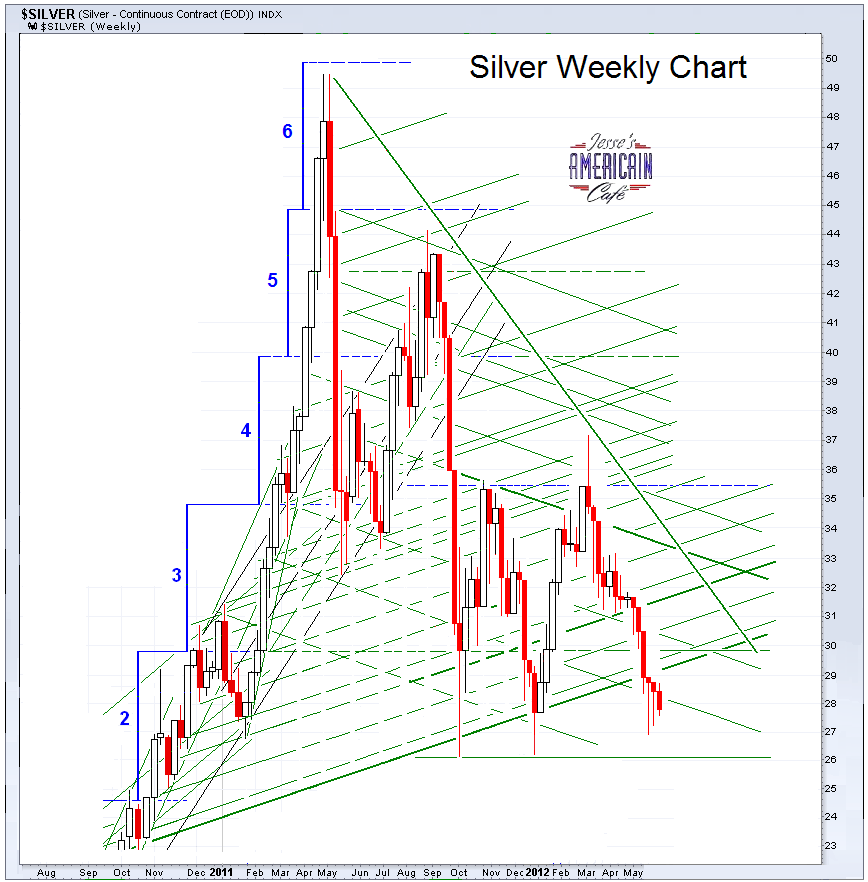
Gold Daily and Silver Weekly Charts - Did We See A Bottom In Gold Today?


"Quite unexpectedly, except perhaps among a handful of long-time gold advocates, gold is quietly and gradually moving back to its centerpiece role in international reserves. Stretched and threatened financially, nation states have begun accumulating gold for the same reason private individuals do -- as portfolio insurance to cover a wide assortment of economic uncertainties.

What's more, this restoration has not occurred formally as a result of an international agreement as has so often the case in the past, but informally as a natural evolution in the way nation states think about and react to the long-term value of currency reserves. As such, it suits the times and suggests an authenticity that is likely to transform the gold market at its core.

In my view, this swing in the supply-demand fundamentals will come to be recognized in future years the most important gold market event since the Central Bank Gold Agreement (CBGA) of 1999 -- the accord that many believe kicked-off the secular gold bull market."

Michael Kosares, The Most Important Gold Event Since 1999, USA*Gold

Quite a few of the uncivilized entered the markets today, and sparked a rally in gold and silver in what appeared to be an obvious 'flight to safety' and also a powerful relief rally after the awful pounding the metals and the miners had taken into the Comex expiries and delivery dates. 

Some of the dividend paying gold and silver stocks had impressive gains even moreso than the metal, with at least one royalty trust up 11 percent or so.   Yes I flipped one from yesterday, and even trimmed my entirely outsized bullion positions bought on the dips back to something a little more 'normal' and comfortable. Of course I never touch my long term holdings in place since 2000. It is not raining nearly hard enough yet.

During hard times a solid dividend paying miner is hard to beat, unless you get lucky with one of those lottery tickets known as junior miners.  When the right time comes I hope to be there.  But for now I will play it a bit more safe. I see more potential downside in stocks until the banks step up and print it up harder. No telling how well they will fare against the splash from across the sea.

After a triple spiked test of support, the gold market went vertical today, marking perhaps what might be regarded by some of the more astute as a well-rounded bottom. I live for days like today.  Much of this was due to a reversal of the sheer manipulation for short term gains, that broke in the face of the unfolding global currency crisis.  Bam!

Never underestimate the power of the CFTC to stand idly by while the markets, taken in hand by the titans of Wall Street, degenerate into something that resembles a round of golf at the Piedmont Driving Club, or an impromptu fight club meeting at the New York Athletic Club.

Well, boys will be boys, in proportion to their toys. 

Chart-wise follow through is everything. Yes we have a short term rounded bottom, and the potential for much larger formations including a broad cup and handle the likes of which we have not seen in quite some time.  But do not underestimate the baseness of desperate men accustomed to having their way.

But first things first. We must see if gold can break the intermediate downtrend and then establish at least a broad trading range, which will form the lid of the potential cup.  It could happen in a rush, given some exogenous trigger event and the right convergence of circumstances, but I suspect it will be a long and arduous climb, fought in stages and levels. 

Chart porn-wise, the cup and handle, should it work, would take gold well over $2,000 by year end or so, and probably set up a new leg into the 3000's.

But that is all speculation. Time to do the hard climbing work for now, one day at a time.

Have a pleasant weekend.


SP 500 and NDX Futures Daily Charts - Something Wicked This Way Comes


"The yield on the 10-yr Treasury is at a record all-time low and the yield on the 30-yr Treasury - the Big Daddy - is below it's lowest point during the Lehman crisis. That's not just warning signals flashing, that's the equivalent of financial nuclear air raid sirens going off.

What this means is that the liquidity is being sucked out of the global financial engine and is going into Treasuries and precious metals."

Dave in Denver

It's getting ugly out there.

Is the beach growing larger, or is that just the ocean of world liquidity receding dramatically ahead of something else?

A snapback rally here and there will not surprise me.  So be careful about leaning too hard on any shorts, if you should be one of those nickel chasers. 

The economic outlook is fairly poor and unlikely to get better. The Republicans certainly would not like to see a recovery this year. Anyone who does not think so please smoke your Jimson weed outside. So the US is standing on a one-legged stool, propped up largely by monetary inflation without significant reform and restructuring.

This is not your father's recession, more like your grandfather's depression. But the children ruling the world capitals have not quite gotten that yet. Or perhaps they do understand it, but just have not yet figured out how to play it for their greatest personal advantage.

These pampered princes and princesses who are talking austerity, and stop whining, and other such posturing (Madame Lagarde for example) are playing with fire, but just do not know it.

It may not take long but that will change, and become a whole other story and a turn of the page of history.


Dude, Where's My Deflation? Yes the Fed Has Lowered Rates and Grown Money Supply But...


My email box pretty much exploded today as the metals rally and divergence from stocks woke up the audience. And the action in my own accounts tended to be diverting, and not unhappily so. Sorry if I have been slow in getting back to you all, and in answering your questions.

Let's take a look at the monetary scorecard and a few ancillary measures to see how Ben and His Merry Pranksters are doing.

While GDP remains very sluggish, growing at less than 2 percent rates, the money supply growth is pegged around 10 percent in M2, with the broadest short term measure MZM hanging in just below that.

CPI remains elevated, and some say and probably correctly understated, with CPI Urban running at 5 percent year over year, which is rather high given all the fundamental metrics of the economy.

Most surprisingly the 10 Year Bond continues to hit new lows as people pile into all Treasuries across the curve.

As you may recall, the purpose of Operation Twist, or QE2ish, is to LOWER the yields of the long end of the curve. And especially with the winds of global financial crisis at their backs, the Fed has certainly done this if one bothers to look at the Ten Year Note Yield chart below, with a big hand from the little lady (Merkel).

Yes rates tend to go up a bit during the Fed operations, as the wiseguys front run and game the Fed's purchases, but they always come down sharply soon afterwards. These are just a few of the many ways that the Fed is quietly passing enormous sums of money to their member banks.

At some point interest rates may have to start increasing again, as the Fed will have to deal with inflation. But it won't be by using QE, quite the contrary. To raise rates the Fed must reverse QE, and gently drain from the system as the economy begins to create its own sustainable growth. That has not happened yet, as is clear from various measures like the Velocity of Money.

So, is the Fed 'successful?' In its purely monetary objectives yes, but not at the end of the day, because the primary measure of their success, besides keeping the markets liquid, is to stimulate the real economy.

Benny is in trouble here. With GDP growing at near recession real rates, and even the long end of the curve priced at NEGATIVE real interest rates depending on how one measures inflation, he is caught in a liquidity trap.
A liquidity trap is a situation described in Keynesian economics in which injections of cash into the private banking system by a central bank fail to stimulate economic growth. A liquidity trap is caused when people hoard cash because they expect an adverse event such as deflation, insufficient aggregate demand, or war. Signature characteristics of a liquidity trap are short-term interest rates that are near zero and fluctuations in the monetary base that fail to translate into fluctuations in general price levels.
The problem is not interest rates, but a more anomalous situation such as war, in this case a class war and a currency war. Demand will not pick up until the median wage rises faster relative to overall economic growth, and global trade becomes equitable and orderly. And of course, when the money flow is not being continually hijacked and taxed by an outsized and predatory financial system that does not allocate so much as confiscate wealth through fees, frauds, and the mispricing of risk.

Contrary to election year rhetoric, the growth of government spending has been flat under Obama. The deficits have ballooned because the revenues (taxes etc) collected by the government have been shrinking due to economic contraction, the Bush tax cuts, etc.

Bernake can only do so much with his monetary hat on. The Fed and Treasury need to get behind financial reform, and restructuring the American economy to stimulate the median wages and jobs, and stop promoting activity that is little more than wealth transferal from the bottom 95 percent to the top.

That is not likely to happen before the end of the year.

I am not a 'fan' of Bernanke, even when he was first appointed to George W. Bush's Council of Economic Advisors in 2002. I thought Obama made a tactical error in reappointing him in 2010, probably to keep from roiling the markets. Besides, Obama himself is more a moderate Republican, in the manner of Herbert Hoover, than a real progressive like Roosevelt, and he is certainly no hard core Keynesian or socialist, no more so than Richard Nixon.

I am concerned that the continuing deadlock in Washington, fostered to a large extent by a Republican policy bloc that refuses to compromise, will prompt Bernanke to pull something even more 'unconventional' from his bag of tricks. That might not be pretty.

Do I really need to say it again?

The Banks must be restrained, and the financial system reformed, with balance restored to the economy, before there can be any sustained growth and recovery.


Joe Stiglitz On the Price of Widening Inequality - The Tsar Nicholas II Syndrome


"Is there a greater tragedy imaginable than that, in our endeavour consciously to shape our future in accordance with high ideals, we should in fact unwittingly produce the very opposite of what we have been striving for?"

Friedrich Hayek

I don't know if I would call that a great tragedy, or a greater irony. It most likely depends on the spirit with which one undertakes that endeavour to shape the future, rather than the words that express the ideals. Words turn into mere slogans, and people are often fooled, but God will not be mocked.

I like to think of the tendency of people to destroy themselves through excess as the 'Tsar Nicholas II Syndrome,' the drive to continue to hold and expand your grasp on unsustainable wealth and power for its own sake, even as it leads you and your family to a cruel death in a cellar, but with jewels sewn into the children's clothes. Winning.

It is the very basis of tragedy. Those traits and circumstances that make a person successful, and raise them to great heights, when taken to an excess that causes them to lose the sight of true value and balance, hamartia, becomes the very instrument of their own destruction.

I think Joe Stiglitz is attempting to put this in economic terms, to show the impracticality of the continuing deterioration of the American social fabric through public and tax policies with their roots in the 1980s.

Simon Johnson has recently written something similar from a slightly different perspective: Jamie Dimon and the Fall of Nations.

This long developing imbalance and erosion of equitable economic justice has led to a chasm of wealth and power, a distortion of the political system, and dangerously unstable social conditions in the developed world more usually seen in the Third World.

And this is a recipe for disaster.  But even so, the monied interests may again make the offer that they think cannot be refused: 'Do as we say, or everything burns.'

I don't think the arguments of Stiglitz and Johnson will be successful in their appeal to reason, but I hope for it. At least the effort is being made in the States. When I watch the televised news I see people utterly possessed by insatiable greed and madness, who will say and do anything to get what they want.  The current crop of political leaders throughout the Western world is a freak show. Europe and the UK may be a lost cause already, ready to heave themselves into the abyss with a spasm of despair.

One cannot reason someone back to rationality when they have been taken to a mad place through an excess of unrestrained desires.

And madness breeds madness, and will serve none but itself.

Vanity Fair
The One Percent's Problem
By Joseph Stiglitz

Let’s start by laying down the baseline premise: inequality in America has been widening for dec­ades. We’re all aware of the fact.

Yes, there are some on the right who deny this reality, but serious analysts across the political spectrum take it for granted. I won’t run through all the evidence here, except to say that the gap between the 1 percent and the 99 percent is vast when looked at in terms of annual income, and even vaster when looked at in terms of wealth—that is, in terms of accumulated capital and other assets.

Consider the Walton family: the six heirs to the Walmart empire possess a combined wealth of some $90 billion, which is equivalent to the wealth of the entire bottom 30 percent of U.S. society. (Many at the bottom have zero or negative net worth, especially after the housing debacle.) Warren Buffett put the matter correctly when he said, “There’s been class warfare going on for the last 20 years and my class has won.”

So, no: there’s little debate over the basic fact of widening inequality. The debate is over its meaning. From the right, you sometimes hear the argument made that inequality is basically a good thing: as the rich increasingly benefit, so does everyone else. This argument is false: while the rich have been growing richer, most Americans (and not just those at the bottom) have been unable to maintain their standard of living, let alone to keep pace. A typical full-time male worker receives the same income today he did a third of a century ago.

From the left, meanwhile, the widening inequality often elicits an appeal for simple justice: why should so few have so much when so many have so little? It’s not hard to see why, in a market-driven age where justice itself is a commodity to be bought and sold, some would dismiss that argument as the stuff of pious sentiment.

Put sentiment aside. There are good reasons why plutocrats should care about inequality anyway—even if they’re thinking only about themselves. The rich do not exist in a vacuum. They need a functioning society around them to sustain their position. Widely unequal societies do not function efficiently and their economies are neither stable nor sustainable. The evidence from history and from around the modern world is unequivocal: there comes a point when inequality spirals into economic dysfunction for the whole society, and when it does, even the rich pay a steep price.

Let me run through a few reasons why...

Read the rest here.

Gold, Silver, and the May Jobs Report


"Through a set of economic policies designed to bail out and subsidize failed and often tainted corporate enterprises, while actively promoting a false sense of confidence to support those policies, the public has become exposed, by those very people entrusted to protect them, to dangerously high levels of hidden counterparty risks.

The cautionary functions of the media, the political class, and the regulatory bodies have been routinely directed, distorted, and even silenced for the benefit of a highly compromised and increasingly self-serving elite. And this corruption has begun feeding on its own momentum, resulting in increasingly blatant examples of deception, distortion, and outright theft.

This is crony capitalism, and its deadly credibility trap."

Jesse

There was a disappointment in the US Jobs Report today, and a shocking (to some) divergence between stocks and the precious metals which are staging a big rally right up now to the intermediate trendline. Although as one can see the premiums are hardly euphoric.

How come?

I looked over the Jobs numbers earlier this morning, and checked the usual suspects. Imaginary additions were 204,000 which are right 'in the groove' for the normal pattern we see for May each year.

If anything the seasonal adjustment was shaded to the downside, meaning that it would have not taken much or been out of the norm to have taken away LESS jobs in the seasonal adjustment, and brought in a report that was in line with expectations.

As an aside you remember how I feel about the histrionics around the highly volatile and revisable monthly changes versus trends.  And additionally while the number of jobs is important, the median numbers and especially the median wage are the thing to watch in addition to the longer term trends.

So why put out a weak number when one could have statistically justified a stronger number?  Besides 'sand-bagging' now with an eye to the second half of the year?

There are an important set of central bank decisions coming up, including the FOMC meeting shortly after the Greek elections at mid month. This weak Jobs number gives Bernanke the cards he needs to play in responding to the evolving crisis.

And you know what that means.

And this is why gold and silver diverged so hard this morning to the upside. They had been artificially pressed down for the May-June contract expirations, and some might say to lessen the impact of their rally when the inevitability of QE became evident. It also gave some of the wiseguys a great opportunity to pick up the means of production, the mining stocks, on the cheap if one is thinking longer term.

Anyone who cannot see manipulation in the precious metals markets is willfully purblind, in every sense of the word.

I am just wondering how the Feds will try and spin it. An extension of Operation Twist? The long end of the curve is approaching the ridiculous along with German and Swiss bonds. More likely there will be a swap line spun bailout of Europe, and more quietly behind the scenes, with the Jobs report for domestic cover. Perhaps the Fed will continue to expand their Balance Sheet, but not so noisily as to jawbone the economy, yet.

As I said the other day, US and Greek bonds are heading in roughly the same direction, just on different trajectories and timelines.

Gentlemen, start your presses. But try not to be too obvious about it.


31 May 2012

Simon Johnson: Jamie Dimon and the Failure of the Nation


No matter how you wish to frame it, the Banks must be restrained, and the financial system reformed, with balance restored to the economy, before there can be any sustained growth and recovery.

Baseline Scenario
Jamie Dimon And The Fall Of Nations

By Simon Johnson
May 31, 2012

“Why Nations Fail: The Origins of Power, Prosperity, and Poverty,” by Daron Acemoglu and James Robinson, is a brilliant and sometimes breathtaking survey of country-level governance over history and around the world. Professors Acemoglu and Robinson discern a simple pattern – when elites are held in check, typically by effective legal mechanisms, everyone else in society does much better and sustained economic growth becomes possible. But powerful people – kings, barons, industrialists, bankers – work long and hard to relax the constraints on their actions. And when they succeed, the effects are not just redistribution toward themselves but also an undermining of economic growth and often a tearing at the fabric of society. (I’ve worked with the authors on related issues, but I was not involved in writing the book.)

The historical evidence is overwhelming. Many societies have done well for a while – until powerful people get out of hand. This is an easy pattern to see at a distance and in other cultures. It is typically much harder to recognize when your own society now has an elite less subject to effective constraints and more able to exert power in an abusive fashion. And given the long history of strong institutions in the United States, it appears particularly difficult for some people to acknowledge that we have serious governance issues that need to be addressed...

Read the rest here.

Gold Daily and Silver Weekly Charts - Brownian Motion


Here is a summary of what the spokesmodels said about precious metals today.

Yada-yada. Yada yada yada.

Non-Farm Payrolls report tomorrow will dominate the short term action perhaps depending on how the number comes in, but the real driver remains the sovereign debt situation with eyes on Greece and Spain in pariticular.

The Greek election mid month may provide some indication of their willingness to accept austerity, or not.


Random and Essentially Meaningless Movement of the Gold Price as Perturbed By High Frequency Bombardment

SP 500 and NDX Futures Daily Charts - Weak GDP, But Markets Watch Payrolls and Greece


Watch for the Non-Farm payrolls report, and the Greek situation. Their elections are mid-month and could be a significant market driver.


Lauren Lyster Interviews CBO Whistleblower Lan Pham


From the February 2, 2012 Wall Street Journal story on Lan Pham's firing:

"I was repeatedly pressured by the CBO Assistant Director, Deborah Lucas, in charge of the Financial Analysis Division to not write nor discuss issues in the banking sector and mortgage markets that might suggest weakness in these sectors and their consequences on the economy and households."

The CBO's 2010 termination letter to Ms. Pham cites her lack of qualifications, "poorly organized" research, and resistance to taking orders from her superiors as the reasons for her firing.

Lan Pham's March interview with ZeroHedge.

It is a little known fact, but probably no surprise to most, that in addition to not prosecuting any key participants in the financial fraud and crisis, the Obama Administration has instead been particularly tough on whistleblowers who expose government corruption.


Net Asset Value Premiums of Certain Precious Metal Trusts and Funds


Bullion prices are bouncing around a bit today with stocks ahead of the Non-Farm Payrolls Report.

Needless to say, the premiums are a bit 'thin' especially on the Spicer family funds.

Sheila Bair on Tightening the Volcker Rule and the JPM 'Hedging' Fiasco


Sheila Bair will be sorely missed as one of the few coherent and less-servile regulators. She was appointed to her position in 2006 by George W. Bush, so no credit to Obama. She was most likely a happy mistake because Bush II certainly was not long on regulatory effectiveness with Hank Paulson at the helm.

Obama's appointments to the financial and economic oversight positions in his Administration have generally been underwhelming to abysmal for what was advertised as a reform administration. These include Larry Summers, Timothy Geithner, Gary Gensler, and Mary Schapiro.

It is important to remember that the 'JPM hedge exception' was heavily promoted to the Congress by the Treasury and the Fed.

It would be interesting to see the 'Bair Rule' applied to JPM's massive paper short position in the silver market, which chief JPM commodity trader Blythe Masters has defended as just 'a hedge.'

Related Story: Sheila Bair Says Break Up JP Morgan Chase


30 May 2012

Gold Daily and Silver Weekly Charts - About Those Special Issue Bonds and Full Faith and Credit


I was expecting another 'hit' on the futures contracts around the May-June contract dates I have posted several times.

Perhaps the antics today will be all for now. Let's see what happens.

Someone said something unintentionally funny about the Social Security Trust Fund bonds and the reliability of the US government today that I ordinarily would ignore, but it may serve to illustrate a point.

This fellow seems to think that defaulting on the Social Security Trust would be fine and good, because 'the money is not there, it is spent.'

That can be said about almost ANY bond that is ever issued. The bonds are essentially instruments with certain terms backed by 'the full faith and credit' of the borrower, or some other designee. The money received for them is almost always 'spent' or in the case of a trust invested in some other instruments. That is the purpose of issuing the bond, whether they are for a retirement plan, a school, or a missile defense system!

In the case of Social Security there are two types of bonds that are now held, both 'special issue' meaning that they are not publicly marketed through the primary dealers. This is a bit of a change, in that the Trust formerly held both public and special issue bonds.

The Social Security trust funds are financial accounts in the U.S. Treasury. There are two separate Social Security trust funds, the Old-Age and Survivors Insurance (OASI) Trust Fund pays retirement and survivors benefits, and the Disability Insurance (DI) Trust Fund pays disability benefits.

Social Security taxes and other income are deposited in these accounts, and Social Security benefits are paid from them. The only purposes for which these trust funds can be used are to pay benefits and program administrative costs.

The Social Security trust funds hold money not needed in the current year to pay benefits and administrative costs and, by law, invest it in special Treasury bonds that are guaranteed by the U.S. Government. A market rate of interest is paid to the trust funds on the bonds they hold, and when those bonds reach maturity or are needed to pay benefits, the Treasury redeems them.
You can see a listing the Treasury bonds held by the Social Security Trust here.

The key point is that the special issue bonds are not subordinate debt, or a secondary obligation, but fully guaranteed by the full faith and credit of the Treasury. I have never actually held or read one of the bonds, but this is my understanding of it, and would accept detailed and specific language that shows that they are susceptible to selective default based on the wording of the bonds or a specific statute and not some interpretation of other documents.

Yes, the Congress can make changes to the Social Security System as they have done in the past, although they generally make those changes gradually, and set future dates for the changes. They have even denied a person in the past from collecting Social Security (Flemming vs. Nestor) because of the transgressions against the state, in this case a non-citizen who was deported for their activities in the Communist party at the height of the Red Scare. It is not a general precedent, and finds no application in general case law with which I am familiar, although I no longer have access to Lexus.  It will stand as a specifically narrow ruling so long as it is not challenged or expanded by some other case(s). That is how law of precedents works.

The government can also revoke your right to vote should you be convicted of a specific class of criminal offense. Does this mean that the government has broad powers to deny the right to vote to anyone it wishes for any reason, or that it can easily do so?

But the key point is that it does not really matter since this does not affect the underlying value and guarantees of the special issue bonds in the Trust fund which is the whole point of this. Not one bit. When it comes to the bonds, they are backed by 'the full faith and credit' of the Treasury, the same as any other bonds it issues.

And as such, they are no different than the bonds issued for public sale by the Treasury which are held by China in exchange for their own inputs for example. And this includes bonds of zero duration, which are Federal Reserve Notes.

What I find a little repugnant about some of the arguments about the Social Security Trust is that they are sometimes put forward by people who would like to see the obligations defaulted upon, in order to provide extra tax cuts to the wealthy for example.  That is a matter of policy and law going forward, and has nothing to do with the status of the special issue Bonds of the Treasury.  If some people wish to take from the old and the poor and give to the rich they will have to find some other justification than the value of the Special Issue Treasury Bonds.

By the way, this argument about the existence of the Trust Fund has its roots in the Bush II Administration.  Who would have guessed that?
"Some in our country think that Social Security is a trust fund – in other words, there's a pile of money being accumulated. That's just simply not true. The money – payroll taxes going into the Social Security are spent. They're spent on benefits and they're spent on government programs. There is no trust."

George W. Bush, February 9, 2005
It is not clear to me that Bush II understood what he was saying, understood the legal and economic issues and their implications, or really did not care.  If some politicians would like to say the money taken from the public and held in Trust is not there, that the bonds are a fraud and subject to default, then they ought to be able to say who stole it and when, because theft and betrayal it surely is, and as bad or worse than the theft of customer money from the accounts at MF Global, which similarly vaporized by unknown hands, or so they claim. 

And that hardly lends itself to trust, for who can have confidence in the full faith and credit of a thief and a betrayer of trusts, who goes so far as to rob the elderly and the disabled?   Is this the government of Washington, Jackson, Roosevelt, Jefferson and Lincoln?

How are the mighty fallen, and their oaths of duty and honor perished.

But these are all plays on words in the manner of Washington and the financiers. There is a Trust and it contains special issue bonds guaranteed by the Treasury.  Some confusion arises because they are not marketable bonds, which means that their value does not vary, and the Banks cannot get their mitts on them to take a piece of the action. So technically one might think that they are not assets. But they are liabilities and are included in the calculation of the public debt.

These comments were criticized as laying the groundwork for defaulting on almost two trillion dollars worth of US Treasury bonds, or more likely facilitating the transfer of the obligations of the Trust into private investments such as US equities. At the same time in 2005 Wall Street brokerage firms were lobbying heavily for the suspension of Social Security in favor of privately held retirement accounts, managed by them of course. George W. was most likely just reading the talking points for his constituents.

Fortunately it did not matter because the President has no power to default on the sovereign obligations in the Trust even by Executive Order; only the Congress has that power. And no matter what existential truthiness arguments pundits like George W. Bush would like to make to justify it, the action would be to declare a selective default on over two trillion in US government bond obligations.

But perhaps more important than the arbitrary respect for legality, the principle of the law of the markets is an impediment to be overcome. Creditors become very uneasy when they see an organization or government that starts to default on its sovereign obligations, particularly foreign holders of the debt who are often as disadvantaged in the local power structure as the weak and the old.

But the punchline of the whole thing was this. This person went on to suggest, in colloquial language, that indeed the bonds are obligations, but so are Greek bonds. And if you can't pay you can't pay.

In other words, US bonds backed by the 'full faith and credit' of the US government are no different than Greek bonds.  To that I might add, not yet, but give it some time.  lol

In one of the instances where I might agree with Modern Monetary Theory (MMT), a sovereign issuer of its own currency never really has to default on its bonds, if the terms of payment are in their own currency, and they have the right and ability to create any amount of that currency which they wish. The US has this ability, and unfortunately for Greece they do not.

Where I disagree somewhat with MMT is that this is a bit of sophistry, a technical nicety. Yes, they may avoid a technical default on the longer duration bonds, but a sovereign issuer most certainly can and has defaulted on the value of their currency, or their bonds of zero duration in a fiat currency regime. In most cases it is a protracted erosion of value, and the US has been doing a good job of this for the past 75 years or so to say the least.

The only 'currencies' that do not bear such counterparty risk from the issuer, that do not rely on the full faith and credit of some issuing authority, are gold and silver. And this is why they have been used throughout history as such, because they are natural currencies from their very characteristics of durability and relative scarcity.

Governments can and have interfered with gold and silver, and made it their own, setting the value. They have even seized it in the past on some pretext. But they have also handed tickets to families and sent them to relocation camps as well. There is a chasm of difference between what can happen and what will likely happen, and what the possible responses to arbirary actions and even the oppression of tyranny might be

And there you have it. The case for the direct ownership of gold and silver, the only currencies that do not rely on the promise of a temporal government or entity, but stand by their own value from their very nature.

*Technical Note: When I refer to Federal Reserve Notes as government bonds of zero duration, one can consider that shorthand for 'government zero coupon bonds of unrestricted duration.' Thanks to Knukles for forcing me to the additional precision. lol.


SP 500 and NDX Futures Daily Charts - Waiting for Greece and the Fed


The economic picture in the States is not good. It is muddling along, but is hardly sustainable or robust.

But the great attention of the markets now is focused on the Greek elections in mid-June, and what the Fed will do in the next meeting which is a few days later.


Taibbi: The Epic Failure of the SEC


"The big thieves hang the little ones."

I cannot argue with what Matt Taibbi says here, having quoted others like Bill Black about the same situation in great detail.

But in fairness to the SEC, this is hardly the case of a single regulator falling into porn-surfing indolence while they wait for another turn through the Wall Street revolving door.

The SEC is just another branch of regulatory incompetence and capture in good company with the CFTC and the FED, which gained even more regulatory powers in the recent 'reforms.' There are a few good regulators but they tend to be isolated and beleaguered.   The sad case of Brooksley Born was a good example of how bad regulatory policy drives out the good. 

This non-specific failure implies that there is much more than an SEC organizational or funding problem, and more likely systemic failure involving misplaced priorities and conflicts of interest that flow down from the Congress and the Administration among others. 

I would like to think that the people are getting a bit tired of handsomely paid and highly comped corporate and political 'leaders' who, when the time comes, don't know anything about anything that is surely within their direct responsibility. There are little to no downsides for failure if you are on the right side of the glass ceiling and a vetted member of the players club, a master of the universe.

And that moral hazard may be the most powerful attraction and incentive to bad behaviour of all. Power attracts the corruptible, without respect to race, gender, or creed.

Rolling Stone
SEC: Taking on Big Firms is 'Tempting,' But We Prefer Whaling on Little Guys
By Matt Taibbi

If you want to see a perfect example of how completely broken our regulatory system is, look no further than a speech that Daniel Gallagher, one of the S.E.C.’s commissioners, recently gave in Denver, Colorado.

It’s a speech whose full lunacy is hard to grasp without some background.

It’s by now been well-established that the S.E.C.’s performance in policing Wall Street before, after, and during the crash has been comically inept. It would be putting it generously to say that the top cop on the financial services beat has demonstrated particular incompetence with regard to investigations of high-profile targets at powerhouse banks and financial companies. A less generous interpretation would be that the agency is simply too afraid, too unwilling, or too corrupt to take on the really dangerous animals in this particular jungle. 

The S.E.C.’s failure to make even one case against a high-ranking executive involved in the mass frauds leading to the 2008 crash – compare this to the comparatively much smaller and less serious S&L crisis twenty years earlier, when the government made 1,100 criminal cases and sent 800 bank officials to jail – became so conspicuous that by the end of last year, the “No prosecutions of top figures” idea became an accepted meme in mainstream news media coverage of the economic crisis.

The S.E.C. in recent years has failed in almost every possible way a regulator can fail to police powerful criminals. Failure #1 was that it repeatedly fell down on the job even when alerted to problems at big companies well ahead of time by insiders. Six months before Lehman Brothers collapsed, setting off a chain reaction of losses that crippled the world economy, one of Lehman’s attorneys, Oliver Budde, contacted the S.E.C. to warn them that there were problems with the company’s accounting; the agency blew him off. There were similar brush-offs of insiders with compelling information in cases involving Moody’s, Chase, and both of the major Ponzi scheme scandals, i.e. the Bernie Madoff and Allen Stanford cases.

Read the rest here.

James Koutoulas Says JP Morgan Is Still Hiding Large Amount of MF Global Customer Money


I do not agree with Rick Santelli's throwaway line in the beginning that there was probably no illegality involved in JPM's trades in London, and certainly not with regard to Facebook where it appears that there was blatantly selective leaking of undisclosed negative financial information ahead of the IPO. And the corollary suggestion that any investigations there are a waste of time.

The trades themselves *may not* have been illegal, but as in most things, the felony is in the coverup and the deception for actions that may or may not themselves have broken but merely bent the law. After all, Watergate was all about 'a third rate burglary.'

Although I have been critical of Louis Freeh in the past for his stonewalling of financial information from MF Global claiming attorney client privilege, withholding it even from Federal investigators and regulators, I thought it was a bit unfair to criticize him for his $25 million in fees for managing the Chapter 11, without mentioning that James Giddens is also billing substantial fees for the MF Global bankruptcy for the brokerage portion of it.

Mr. Giddens billed $170 million for Lehman's bankruptcy for example. His fees for MF Global are not yet disclosed because he asked for an extension for filing them with the court to June 8. Bankruptcies, tort claims, and divorces are often rewarding ventures for the lawyers.

Interviews with Mr. Koutoulas are so rare that any deserve to be shared, even if the interviewer steps all over the interview with selective outrage. The extended corporate infomercial is what passes for financial journalism in the States these days, and in much of the 'straight news' as well unfortunately.

I enjoyed the suggestion that almost $800 million in customer money was transferred late in the game to JPM in London to satisfy margin calls. This was the personal conclusion I put forward about two weeks after the incident.

I also believe that JPM had deep knowledge of MF Global's finanical leverage, condition, and exposure as their banker, which they used before and after the fact.

And I agree that Obama's track record on Wall Street reform is shameful, and a continuation of the Bush policies without real reform. But the idea that Romney will somehow change that is, alas, a terrible fantasy. The torch of corruption is being passed from administration to administration now without regard to party affiliation. That is how bad it has become.

How about JPM's positions in the silver market Rick? Think we need an independent investigator there too in the face of four years of stone-walling by the CFTC? Or do we demand justice only where it might be embarrassing to the Democrats without really hurting Wall Street?

But as I have said before, my goal is to just get the MF Global customer money back for them. I have given up any hopes that justice will be done. So I am grateful for Mr. Santelli's attention. There is far too little of it being given to these gross injustices and violations of trust.

It seems as though ordinary people have few friends or champions these days, just various packs of vultures picking over their bones with fees, scams, and snares.


Freedom in Europe Is Eroding From the Edges, Financed by the Banks


"Greece is not an exception. It is one of the main testing grounds for a new socio-economic model of potentially unlimited application: a depoliticised technocracy in which bankers and other experts are allowed to demolish democracy."

Slavoj Žižek


"Corruption is a tree, whose branches are of an immeasurable length: they spread everywhere; and the dew that drops from thence hath infected some chairs and stools of authority."

Beaumont and Fletcher, The Honest Man's Fortune

This is a fascinating perspective on the financial situation in Europe from Slavoj Žižek which appeared in a recent edition of the London Review of Books. It reads like a modern variation of an age old script with dollars and bankers replacing bullets and shock troops, at least for now.

The role of Goldman Sachs and some of the other banks, with their attendant politicians who are in many cases now their direct representatives in the erosion of freedom in Europe, is fascinating to watch, in the manner of a train wreck in slow motion.

The monied interests are putting forward their own agendas and candidates while maintaining the charade of popular government, goose-stepping to the tune of financial expediency and the 'iron law of oligarchy' that helped to spawn the cult of the Übermensch at the beginning of the twentieth century.

The counter example is Iceland, and at an earlier period Sweden, which took a different course of action with their banks, direct confrontation and resolution of crony capitalism and the debt trap, rather than accomodation and appeasement.

The US and UK are little better off, having established a temporary equilibrium in which the monied interests are consolidating their gains. How else can one explain the lack of investigations and prosecutions of financial frauds, that become increasingly blatant and brazen, while the national economy continues to stagnate under the burden of crony capitalism and the most powerful political agenda is more tax cuts and sinecures for the super rich? And freedom continues to be assaulted and deconstructed in the name of the endless war on terror.

At some point the people will make a stand, and the Banks will make them an offer which they think that they cannot refuse. This is playing out now in Greece, and is coming to a country near you.

London Review of Books
Save us from the saviours
By Slavoj Žižek
25 May 2012

Imagine a scene from a dystopian movie that depicts our society in the near future. Uniformed guards patrol half-empty downtown streets at night, on the prowl for immigrants, criminals and vagrants. Those they find are brutalised. What seems like a fanciful Hollywood image is a reality in today’s Greece. At night, black-shirted vigilantes from the Holocaust-denying neo-fascist Golden Dawn movement – which won 7 per cent of the vote in the last round of elections, and had the support, it’s said, of 50 per cent of the Athenian police – have been patrolling the street and beating up all the immigrants they can find: Afghans, Pakistanis, Algerians. So this is how Europe is defended in the spring of 2012...

The prophets of doom are right, but not in the way they intend. Critics of our current democratic arrangements complain that elections don’t offer a true choice: what we get instead is the choice between a centre-right and a centre-left party whose programmes are almost indistinguishable. On 17 June, there will be a real choice: the establishment (New Democracy and Pasok) on one side, Syriza on the other.

And, as is usually the case when a real choice is on offer, the establishment is in a panic: chaos, poverty and violence will follow, they say, if the wrong choice is made. The mere possibility of a Syriza victory is said to have sent ripples of fear through global markets. Ideological prosopopoeia has its day: markets talk as if they were persons, expressing their ‘worry’ at what will happen if the elections fail to produce a government with a mandate to persist with the EU-IMF programme of fiscal austerity and structural reform.

The citizens of Greece have no time to worry about these prospects: they have enough to worry about in their everyday lives, which are becoming miserable to a degree unseen in Europe for decades...

Here is the paradox that sustains the ‘free vote’ in democratic societies: one is free to choose on condition that one makes the right choice. This is why, when the wrong choice is made (as it was when Ireland rejected the EU constitution), the choice is treated as a mistake, and the establishment immediately demands that the ‘democratic’ process be repeated in order that the mistake may be corrected. When George Papandreou, then Greek prime minister, proposed a referendum on the eurozone bailout deal at the end of last year, the referendum itself was rejected as a false choice.

There are two main stories about the Greek crisis in the media: the German-European story (the Greeks are irresponsible, lazy, free-spending, tax-dodging etc, and have to be brought under control and taught financial discipline) and the Greek story (our national sovereignty is threatened by the neoliberal technocracy imposed by Brussels).

When it became impossible to ignore the plight of the Greek people, a third story emerged: the Greeks are now presented as humanitarian victims in need of help, as if a war or natural catastrophe had hit the country. While all three stories are false, the third is arguably the most disgusting. The Greeks are not passive victims: they are at war with the European economic establishment, and what they need is solidarity in their struggle, because it is our struggle too.

Greece is not an exception. It is one of the main testing grounds for a new socio-economic model of potentially unlimited application: a depoliticised technocracy in which bankers and other experts are allowed to demolish democracy. By saving Greece from its so-called saviours, we also save Europe itself.

Read the entire article here.


29 May 2012

The Death of the Gold Bull May Be Greatly Exaggerated -- Miner / Bullion Ratio at an Extreme Low


There was an opinion making the rounds today from a chief strategist named Suttmeier that the gold bull market was over because the 50 day moving average has fallen below the 200 day moving average for gold, commonly called a 'death cross.'

Interestingly enough he calls for a trading range, and not a further significant decline in gold, but rather a 5% trading range 'for years.'

During the financial crisis in 2008 gold corrected and consolidated for about one year. In each of the prior three 'death crosses' on the chart the period was about three to six months.

Below is a longer term gold chart that shows that the 50 day moving average has fallen below the 200 day moving average at least four previous times since 2003.

Each time this happened it has marked a consolidation and correction that resulted in gold moving another leg higher and sometimes sharply higher after a prolonged correction. This is climbing the classic 'wall of worry.'

Perhaps it will be different this time. But not based on anything I have seen in technical analysis such as this. 

The fundamental drivers of the gold bull market not only remain intact, but seem to be even more compelling based on the fact that central banks have turned net buyers for the first time in over twenty years, as well as recent events in the currency wars regarding the value and security of sovereign debt, which is exactly what the substance of a fiat currency is:  sovereign debt of zero duration.

Thanks to my friend Nick Laird of Sharelynx.com who has one of the best and most diverse collections of online charts around.

If Europe should collapse and bullion enter a protracted trading range, one might consider buying mining shares of high quality that pay dividends, as they are now quite cheap as shown by the XAU - bullion ratio in the second chart.

As a reminder, in times of crisis I tend to find a safer haven in bullion than in miners, and in gold rather than silver. So let's see what happens in the Greek elections this month, and in the next Fed meeting shortly afterwards.

I tend along with others to think that the central banks must print money to secure the current banking system.  That is the raison d'être of a fiat currency system: to be versatilely expansive in repairing the holes made from the inevitable speculative excess caused by crony credit expansion by the Bank for its friends. But in the short term these markets are hardly tied to fundmentals or efficient allocation of capital.

As a reminder we might see a few more antics tied to the June futures contract this week.

May 29
QO - June 2012 COMEX miNY Gold - Last Trade Date
QO - June 2012 COMEX miNY Gold - Settlement Date
GC - May 2012 Gold - Last Trade Date
GC - May 2012 Gold - Settlement Date

May 31
GC - May 2012 Gold - Last Delivery Date
GC - June 2012 Gold - First Notice Date

June 1
GC - June 2012 Gold - First Delivery Date


Greek 'Aid' Is Really Enhanced Vendor Financing and Foreign Bank Bailouts


“They don’t want to kill us [the Greek people] but keep us down on our knees so we can keep paying them indefinitely.”

Eva Kyriadou

The similarity to the Icelandic situation is striking.  Greece must deal with the problem of decoupling from the Euro, but other than that the scenario seems fairly straightforward.

Greece needs to assert their independence, and have the will to make it 'stick.'

In the manner of 'mailing in their keys' on an underwater home and the burden of an outsized dodgy loan, the Greek people should consider mailing their eurozone membership back to the ECB and their friends in the Banks and Wall Street hedge funds c/o Berlin, and suggest that the conquest of their country might have to proceed by more conventional and overt means if they want to take the country's sovereign assets and income.

An investigation of all the debt deals would be a first rate idea, with plenty of public disclosure of the corruption and cronysim that was involved between public officials and the banks.
NYT
Athens No Longer Sees Most of Its Bailout Aid
By LIZ ALDERMAN and JACK EWING
May 29, 2012

PARIS — As Greek membership in the euro currency union hangs in the balance, it continues to receive billions of euros in emergency assistance from the so-called troika of lenders overseeing its bailout.

But almost none of the money is going to the Greek government to pay for vital public services. Instead, it is flowing directly back into the troika’s pockets.

And so, the €130 billion, or $162.2 billion, European bailout that was supposed to buy time for Greece is mainly only servicing the interest on the country’s debt — while the Greek economy continues to plummet.

If that seems to make little sense economically, it has a certain logic in the politics of euro-finance. After all, the money dispensed by the troika — the European Central Bank, the International Monetary Fund and the European Union’s member governments — comes from European taxpayers, many of whom are increasingly wary of the political disarray that has beset Athens and clouded the future of the euro zone.

As they pay themselves, though, the troika is also withholding other funds earmarked for keeping the Greek government in operation...

Read the rest here.

Gold Daily and Silver Weekly Charts - Gold Chart Shows About 10,000 Contracts Dumped in Quiet Market


I felt this bear raid coming on the tape, from the action I was seeing. I cannot express it better than that.

So I had sold my silver bullion trading position and trimmed back gold, adding a hedge in the first hour of trade.

The hit came around mid-day after the European close as you can see on the 5 minute June futures chart.

One does not drop 11,000 contracts in a ten minute period in what might be called a reasonable trade.

The Dr. Evil Strategy and Some Targets

Will the CFTC investigate, asking the seller why perchance they did this? No, and that in itself speaks volumes.

But the solution is not to try and trade these scandalously under-regulated markets, but instead to hold long term investment positions, preferably as far away from Wall Street as is possible.

I had suggested last week that calls that the 'bottom was in' might be premature. It is in the established playbook to hit the futures hard at least once after an options expiration which we had last week.

The shorts are trapped, especially in silver, and they have powerful friends in the government and the media. There are some very worried people out there. Big things may be coming.

Swiss National Bank Considers Capital Controls


SP 500 and NDX Futures Daily Charts - The Well Tempered Clavier


Geithner and Bernanke are playing a tune for us on the US equity futures markets, with the lead vocals coming from the SP 500 June contract.

Can you name that tune?

I do not think they can hit the high note without a serious bump of QE to sustain them. And Benny may provide it, if somewhat stealthily, mid month around the time of the Greek elections.


28 May 2012

Barry Ritholtz Interview On the Financial Crisis from Capitalism Without Failure


Excellent interview as always by Barry, and an interesting list of suggested readings. His blog, The Big Picture, is among the best.

I would respectfully include ECONned by Yves Smith on the reading list. It adds a dimension of scholarship and detailed analysis found nowhere else.

Barry Ritholtz on the Crisis: Causes, Cures, Corptocracy, and Suggested Reading

When you get bit by a dog, you don’t just look at the dog, you have to look at the owner who is holding the leash.To me, a lot of the regulatory changes, and a lot of what the Federal Reserve did, stand on their own as a major factor. But if you’ve read David Hume, if you’ve studied the philosophy of causation, you have to look at what motivated those changes.

I have these debates with friends. One group blames everything on big government; the other group blames everything on big corporations. The sad news is that there’s really no difference between the two: Big government and big corporations work hand-in-hand. If you want to know who is the puppet and who is the puppet master, it sure looks like Wall Street has been pulling the strings of Congress for many, many, many years.

I remember the Dick Durbin quote, right in the middle of the crisis. He was astonished at all the bankers and bank lobbyists running around the halls of Congress, and said, “I can’t believe these guys – they act as if they own the place.” The fact is, it’s not an act – they do own the place...

Read the rest here.