03 August 2012

Chris Hedges On the Current State Of Journalism and Post-Literate Society - The Age of Spectacle


"In our age, the idea of intellectual liberty is under attack from two directions. On the one side are its theoretical enemies, the apologists of totalitarianism, and on the other its immediate, practical enemies, monopoly and bureaucracy. Any writer or journalist who wants to retain his integrity finds himself thwarted by the general drift of society rather than by active persecution. The sort of things that are working against him are the concentration of the press in the hands of a few rich men, the grip of monopoly on radio and the films, the unwillingness of the public to spend money on books...

Wherever there is an enforced orthodoxy — or even two orthodoxies, as often happens — good writing stops. This was well illustrated by the Spanish civil war. To many English intellectuals the war was a deeply moving experience, but not an experience about which they could write sincerely. There were only two things that you were allowed to say, and both of them were palpable lies: as a result, the war produced acres of print but almost nothing worth reading...

The enemies of intellectual liberty always try to present their case as a plea for discipline versus individualism. The issue truth-versus-untruth is as far as possible kept in the background...

The organized lying practiced by totalitarian states is not, as is sometimes claimed, a temporary expedient of the same nature as military deception. It is something integral to totalitarianism, something that would still continue even if concentration camps and secret police forces had ceased to be necessary...

Totalitarianism, however, does not so much promise an age of faith as an age of schizophrenia. A society becomes totalitarian when its structure becomes flagrantly artificial: that is, when its ruling class has lost its function but succeeds in clinging to power by force or fraud. Such a society, no matter how long it persists, can never afford to become either tolerant or intellectually stable.

It can never permit either the truthful recording of facts or the emotional sincerity that literary creation demands. But to be corrupted by totalitarianism one does not have to live in a totalitarian country. The mere prevalence of certain ideas can spread a kind of poison that makes one subject after another impossible for literary purposes.

Totalitarianism demands, in fact, the continuous alteration of the past, and in the long run probably demands a disbelief in the very existence of objective truth. (cf. truthiness - Jesse)

Meanwhile, totalitarianism has not fully triumphed everywhere. Our own society is still, broadly speaking, liberal. To exercise your right of free speech you have to fight against economic pressure and against strong sections of public opinion, but not, as yet, against a secret police force. You can say or print almost anything so long as you are willing to do it in a hole-and-corner way.

But what is sinister, as I said at the beginning of this essay, is that the conscious enemies of liberty are those to whom liberty ought to mean most. The big public do not care about the matter one way or the other. They are not in favour of persecuting the heretic, and they will not exert themselves to defend him. They are at once too sane and too stupid to acquire the totalitarian outlook. The direct, conscious attack on intellectual decency comes from the intellectuals themselves."

George Orwell, The Prevention of Literature, 1946

I feel compelled to say an explanatory word or two about Chris Hedges at this point, about what it is that I 'like' about him, and to answer a couple of inquiries about why some others prefer to ignore him, besides the usual suspects as they say.

As I have said previously, politically I am almost a perfect centrist, in the classical sense of the term. I say this after having taken yet another 'objective test' to place myself on the political spectrum. I do not hold this out as anything of significance other than to say, this is pretty much where I come out, where I am in my thinking at this stage in my life. It is a hard place to be, because one sees the world in shades of grays, in all its complexity, without the comfort of easy forms in black and white. It requires quite a bit more thought and effort than most can afford.

Hedges is a socialist, self-admittedly. And I am not. I am a believer in markets, but in sound regulation of them by an objective, publicly controlled organization, much like a referee or umpire, who transparently enforces the rules which are clear and fair to all. Why? Because people always and everywhere will cheat, some much more readily than others. The meme of naturally efficient markets is a classic 'big lie.'

I believe that widely dispersed, practical rules of organization and decision making within a greater context of general principles are far superior in their effectiveness in the distribution of resources that any sort of central planning, of the right or of the left. As Acton once said, 'no class is fit to govern.' So I like decision making that is broadly based, and subject to compromise. I think the rewards and punishments of the market are an effective stimulus to productive behaviour, provided that the rules do not become slanted by the power of an inequality propagated by cheating.

But I also see that rules alone cannot embody wisdom. There is a need for the conscious hand of humanity to guide the legendary 'invisible hand of the market.'

So I like Hedges, because what he says brings me back to center, even though he is further left. That is how bad things have become in this age of austerity, the willfully immature, and the false bravado of the destructively greedy and ideologically irrational. The western nations have moved and are still moving to the Right, as they did in the 1930's. As corruption enervates the old order, as empires once again crumble, we are re-entering the Age of Spectacle, the time of fire.

And if you stay in place, at the center, you have the false feeling of 'moving left,' relatively speaking. It has become noticeable especially when one compares the Right to their forbears of even ten years ago.

Hedges irritates some of the sacred orthodoxies of the Right without a doubt and to say the least since they are the epitome of intolerance. But he also disturbs the Left, who can be as inflexible and censorious as the Right which they hold in utter disdain for those very qualities. And he tweaks their nose on it, which is doubly irritating for those who are currently not in power.

Hedges has an absolutely wonderful description of this phenomenon of the unseeable center in describing the debates he had with both the new religious right, and the irreligious neo-atheists. The relativity of their extreme views distorts all of their perceptions, so that to both groups, Hedges the religious moderate becomes anathema, for similar reasons of intolerance and vanity.

I think that western society has gone off the tracks, in a loosely cyclical manner, by adopting an unsustainable set of priorities. Rather than forming policies to support the general good of the people, they have instead adopted the objective of the 'greatest good' where that implies the maximization of profit, but for a select few. That was a fateful decision, and I mark it somewhat loosely from 1987 for a number of reasons, not the least of which was the bailout of Wall Street by Alan Greenspan. It had its cultural resonance in the theaters.
"The richest one percent of this country owns half our country's wealth, five trillion dollars. One third of that comes from hard work, two thirds comes from inheritance, interest on interest accumulating to widows and idiot sons and what I do, stock and real estate speculation. It's bullshit. You got ninety percent of the American public out there with little or no net worth.

I create nothing. I own. We make the rules, pal. The news, war, peace, famine, upheaval, the price per paper clip. We pick that rabbit out of the hat while everybody sits out there wondering how the hell we did it. Now you're not naive enough to think we're living in a democracy, are you buddy? It's the free market. And you're a part of it. You've got that killer instinct. Stick around pal, I've still got a lot to teach you."

Gordon Gekko, Wall Street, 1987
This situation, and history, has a lot to teach us indeed, and I think those lessons have only just begun in earnest.

This historically recurrent principle of the greatest greed rather than the greatest good is killing us. There should be no doubt that it will revert to the mean, a balanced society, once again, but that reversion may be painful, and bloody, if history is any guide. But this too shall pass.

I like to include historical quotes in these pieces, like the extended Orwell quote above, not only to illustrate the situation using powerfully resonant words from greater writers than myself, but also, in a Socratic way, to infuse the quiet understanding that every generation fights perhaps not the same, but similar, battles against ignorance, greed, intolerance, mean-spiritedness, carelessness, lawlessness, fear, hysteria, betrayal, hatred, and apathy.

And so there is hope, always.

We are not facing anything new, anything insurmountable,  but rather the same old enemy, the principalities and powers, the rulers of the darkness of this world, and the ancient spiritual wickedness in high places.  And that is the basic plot line of all human history.

And so we will write our own particular chapter in human history and the book of life, and thereby be remembered by our children and our grandchildren, and perhaps by those who interest themselves in all things human, for all time.


I have to note, most strongly, that the same principle of objectifying the other as a prelude to oppression and the language of violence is a tool of both the extreme right and the extreme left.  Their inflexibility and intolerance of differences in the individual virtually indistinguishable, and in every case is used to justify violence and murder.


I include this clip below in particular because he is describing 'the economic hitmen coming home to roost' which has been a forecast and an image I have used for quite a few years.  And it is happening now, predominantly in parts of Europe, but very much in the US and the UK.  The move on from victim to victim, their ravening hunger insatiable.


As they become more extreme, belief systems tend to resemble their putative opposites more closely, and the center becomes almost imperceptible, if noticed at all and not merely held in complete disdain.


02 August 2012

Word For the Day: Modalities


"The adherence of governments to their commitments and the fulfilment by the EFSF/ESM of their role are necessary conditions. The Governing Council, within its mandate to maintain price stability over the medium term and in observance of its independence in determining monetary policy, may undertake outright open market operations of a size adequate to reach its objective.

In this context, the concerns of private investors about seniority will be addressed. Furthermore, the Governing Council may consider undertaking further non-standard monetary policy measures according to what is required to repair monetary policy transmission. Over the coming weeks, we will design the appropriate modalities for such policy measures."

The folks at Bloomberg TV apparently were dumbfounded about the meaning of the word 'modalities' in this sentence. The closing hour anchor, an affable Princetonian, complained that he had called around and could not 'find anyone who understands what this means.'

Modalities means procedures, the processes by which things are done in a more than casual arrangement. It is more commonly used in a medical or official diplomatic context.

So in this case, Monsieur Draghi was saying that 'over the coming weeks, we will hammer out all the processes and procedures and agreements to support a plan.'

They may not GET those agreements, but that is all a part of the hammering process I would imagine. But they did not say that they did not believe him, or doubted his ability to accomplish this, but rather, they just did not know what the word meant which was a little embarrassing for a major US news outlet that is presumably English speaking.

I hope this helps to promote higher quality in broadcast journalism. The word is not all that obscure. The print (read literate) portion of the Bloomberg organisation used it in a headline not all that long ago. India, Pakistan Agree on Modalities for Border Trade in Kashmir. And closer to home, there is an actual stock named "Modern Medical Modalities."

Now I suppose it is likely the young man was coyly playing ignorant to make a point, since he is generally one of the more intelligent commentators on American financial television, and one of the few at Bloomberg TV who can form a declarative sentence without aggressively prefacing it with the word, "Look."

Still, it sounded a sour note to plead such ignorance after an entire day in which one could have used a tool that is now widely available and quite often a great help. It is known as 'google.'


Gold Daily and Silver Weekly Charts


Summer markets. What an enormous waste of time.

Mariao Draghi said, "Within our mandate, the ECB is ready to do whatever it takes to preserve the euro. And believe me, it will be enough."

No more empty bravado has been expressed since Mussolini vowed to conquer Africa, and had to be rescued by the Germans.

CME 'Monitoring' Knight Capital After Being Burned by MF Global

Non-Farm Payrolls tomorrow.


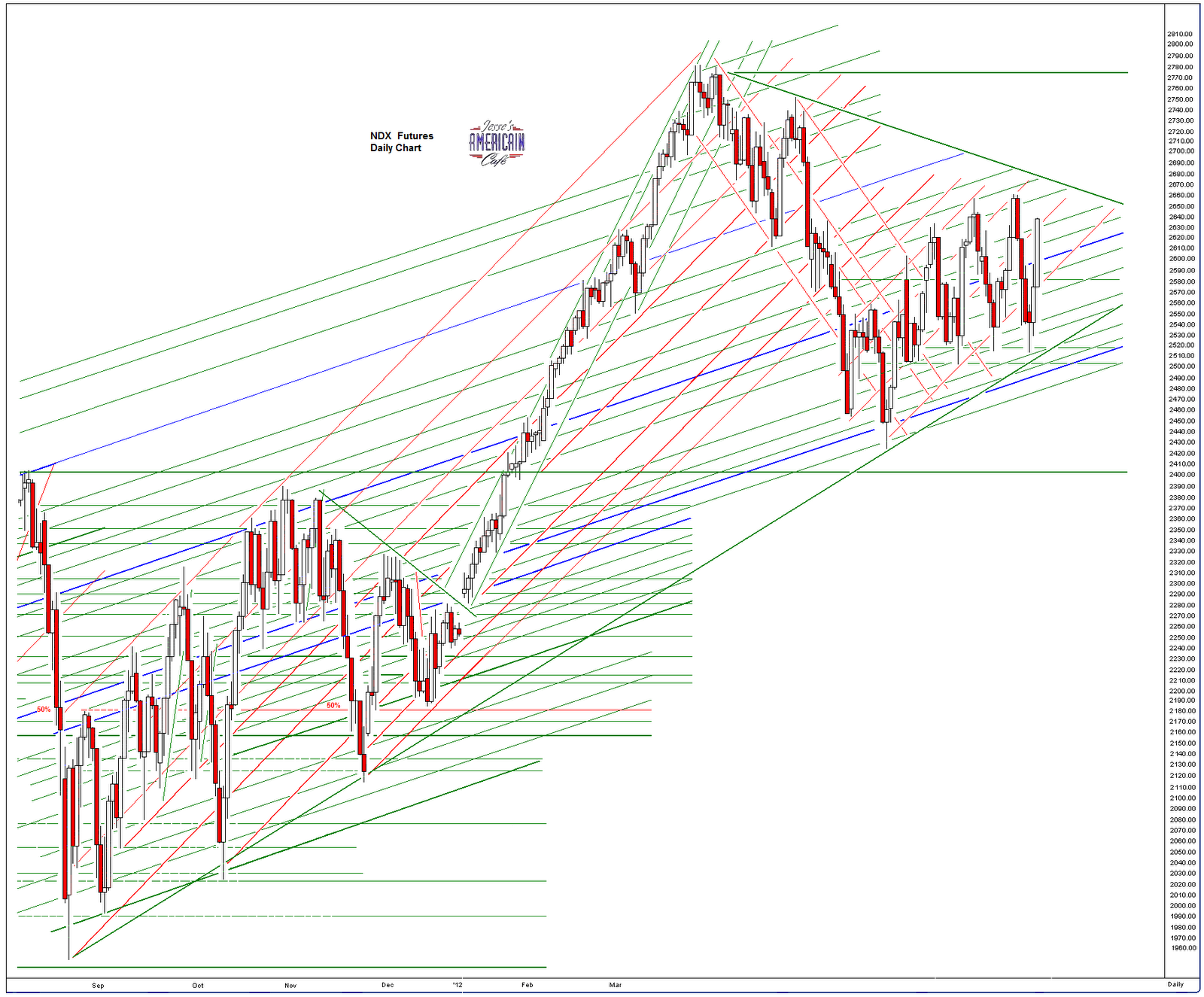
SP 500 and NDX Futures Daily Charts - Draghi Breaks His Jawbone


Facebook and Knight Capital may be telling us something with their spectacular losses.

Facebook's IPO flop may be the high water mark of this phase of the equity bubble. And Knight may show us that many of the financial asset paper handlers are just one incident away from insolvency.

Non Farm Payrolls tomorrow.


A Corporatist Coup d'Etat Led By Think Tanks, Media Control, and Bribery By Lobbyists


“The mess we’re in now did not begin on Wall Street. Long before the financial collapse, the dismantlement of government regulation was well under way. All the consequences are the result of a brilliantly executed coup. This is the story of the biggest heist in American history.”

"HEIST: Who Stole the American Dream? is stunning audiences across the globe, as it exposes the real truth behind the worldwide economic collapse, tracing its origins to a 1971 secret memo entitled Attack on American Free Enterprise System. Written over 40 years ago by the future Supreme Court Justice Lewis Powell, at the behest of the US Chamber of Commerce, the 6-page memo, a free-market utopian treatise, called for a money fueled big business makeover of government through corporate control of the media, academia, the pulpit, arts and sciences and destruction of organized labor and consumer protection groups.

Sound familiar? Today’s crisis and heart stopping headlines can be directly traced to Powell’s real “end game” which was business control of law and politics. Powell’s fingerprints are all over Citizens United, the fateful Supreme Court decision which gave corporations and the super rich unlimited ability to shape our elections with virtually unrestricted donations. HEIST’s step by step detail exposes the systemic implementation of Powell’s memo by BOTH U.S. political parties over the last forty years culminating in the deregulation of industry, outsourcing of jobs and regressive taxation. All of which led us to the global financial crisis of 2008 and the continued dismantling of the American middle class.

Today, politics is the playground of the rich and powerful, with no thought given to the hopes and dreams of ordinary Americans..."

Why take a government by force when you can delude the public, energize a vocal minority, eliminate a few key leaders of any effective opposition thereby setting an example for any others, and through coercion and soft bribery simply buy it?

The Lewis Powell Memo


Plus ça change, plus c'est la même chose.

The White House Coup of 1933


The World At War: A New Germany


"A fascist is one whose lust for money or power is combined with such an intensity of intolerance toward those of other races, parties, classes, religions, cultures, regions or nations as to make him ruthless in his use of deceit or violence to attain his ends. The supreme god of a fascist, to which his ends are directed, may be money or power; may be a race or a class; may be a military, clique or an economic group; or may be a culture, religion, or a political party...

We all know the part that the cartels played in bringing Hitler to power, and the rule the giant German trusts have played in Nazi conquests. Monopolists who fear competition and who distrust democracy because it stands for equal opportunity would like to secure their position against small and energetic enterprise. In an effort to eliminate the possibility of any rival growing up, some monopolists would sacrifice democracy itself...

Still another danger is represented by those who, paying lip service to democracy and the common welfare, in their insatiable greed for money and the power which money gives, do not hesitate surreptitiously to evade the laws designed to safeguard the public from monopolistic extortion. American fascists of this stamp were clandestinely aligned with their German counterparts before the war, and are even now preparing to resume where they left off, after "the present unpleasantness" ceases.

Their final objective toward which all their deceit is directed is to capture political power so that, using the power of the state and the power of the market simultaneously, they may keep the common man in eternal subjection.

They claim to be super-patriots, but they would destroy every liberty guaranteed by the Constitution."

Henry A. Wallace, 33rd Vice President of the US, The Danger of American Fascism

Feed your anger with fear and pride. Make the deal with the devil if you will. The time for thinking and compromise is over, the time for action is here, they will say.

But remember. The madness will serve none but itself, and its appetite for pain and misery is insatiable. After it devours your so-called enemies, it will come for you.


01 August 2012

Gold Daily and Silver Weekly Charts - Typical FOMC Bear Raid at the Comex Open


Gold and especially silver were hit at the Comex open today in a completely cynical exercise in paper price manipulation.

Intraday commentary here.

Nothing has changed.

The ECB and Bank of England may act tomorrow. Non-Farm Payrolls in the US on Friday.


SP 500 and NDX Futures Daily Charts - Broad Swings As Fed Does What We Expected


Bernanke's Fed did nothing today, and the markets sold off a bit although the markets had wide intraday swings.

Tomorrow we may see something from Mr. Draghi in Europe, and the Non-Farm Payrolls on Friday.


Chris Hedges Commencement Address at Rockford College 2003


“O Jerusalem, Jerusalem, you who kill the prophets and stone those sent to you, how often I have longed to gather your children together, as a hen gathers her chicks under her wings, but you were not willing. Look, your house is left to you desolate."

This is the speech that led to his departure from the NY Times.


Silver: This Morning's Mackie Messer Silver Slam


“He did not care for the lying at first. He hated it. Then later he had come to like it. It was part of being an insider, but it was a very corrupting business.”

Ernest Hemingway, For Whom the Bell Tolls

The slam on silver seems to coincide with the ADP Report which was better than expected. Just now the ISM Manufacturing number showed a contraction at 49.8, so now it can go up again?

But all this nonsensical rationale aside, it is more likely due to this being an FOMC day, and the opening of the US Comex for trade, and the sheer power of a paper market dominated by one or two Banks and a few hedge funds who shove prices around in the real economy to tax both productive activity and the public savings.

Did you catch the close of the SP futures last night? Just another example of a market dominated by paper and leverage, insider trading and computerized manipulation.

And the moral hazard of regulators who simply do not do their jobs, going along to get along. They see nothing, they know nothing. Until a financial disaster occurs, and they show up to take a body count.

They turned a blind eye to the rigging of LIBOR for years. So why wouldn't they 'investigate' the rigging in the silver market for four years, and maintain an arrogant silence throughout? I can hardly wait to hear what they find.

These markets are dangerously out of control.

No further comment is necessary.


31 July 2012

Gold Daily and Silver Weekly Charts - End of Month, FOMC Tomorrow


Gold and silver were a little weak to flat today for the end of month.

FOMC announcement tomorrow and possibly something from the ECB on Thursday.

Rough seas ahead.


SP 500 and NDX Futures Daily Charts - End of the Month


Say goodby to July.

Stocks sold off slightly in to the close, with tech slightly stronger than the SP today as there was speculation that AAPl would give a dividend and may be included in the Dow Jones Industrial Average.

FOMC decision tomorrow, and perhaps something from the ECB the next day.

Its almost an even bet if Benny will do the twist, or anything else for that matter, tomorrow.

They *might* follow on the ECB if some news comes out. But if they do nothing this week the next meeting is in September, the last time they are likely to act before the elections.

Take Two Interactive had a big miss across the board after the bell.

Electronic Arts did poorly as well, but their stock is not being hammered like Take Two, which also guided lower.


Confessions of an Insider Trading M&A Attorney Sentenced to 12 Years in Prison


Matthew Kluger's rationalization, self-defense, and righteous indignation is interesting.
"We had a gentlemen's agreement. My accomplices cheated me!"
But it does illustrate the familiar axiom: There is no honor among thieves.

And you just have to love the line from Matthew Kluger's full interview, not included in this clip,
"This is not a victimless crime. I'm going to jail!"


30 July 2012

This Week's US Economic Calendar


The Fed has a meeting scheduled this week with their decision to be announced on August 1.

There are rumours that the Fed will take some action this week after the ECB and the Bank of England take some action on Wednesday or Thursday first. The Fed may need 'air cover' for a decision that is likely to be viewed as political.

I suspect the Fed may wait for the Non-Farm Payrolls Report unless something happens in Europe. Or if they learn of something that we do not know.

The markets are expecting this. If nothing happens, or even worse, something negative occurs, we may see some volume show up, to the downside.


Gold Daily and Silver Weekly Charts - Silver Would Not Be Denied


They were sitting on gold most of the day, but silver would not be denied, rising higher to take out and hold the 28 handle.

This is the end of the month, but not the quarter, and the markets are hesitant ahead of more from Bernanke and the Non-Farm Payrolls at the end of the week.

I think the wiseguys are the only ones left in the room, and they are waiting for some sugar from the Fed and the other central banks to bid the markets up so they can drain a little more vitality from the real economy.

Keep an eye on the Fed, ECB and the Bank of England this Wednesday and Thursday.

The real economy is flagging badly, suffering under malinvestment, misdemeanors, felonies, and market rigging by the bully boy Banks.

Plenty of crime to go around, but no one can do anything, or even knows anything about it.


The Ballad of Mack the Knife
(Trans. John Willett):

See the shark has teeth like razors
And they thrust out from his face
And Macheath has got a knife too, but
Not in such an obvious place.

See the shark, how red his fins are
As he slashes at his prey,
Mack the Knife wears white kid gloves
Which give very little away.

On a beautiful blue Sunday,
See a body stretched out on the Strand
See a man dodge around the corner,
Mackie's friends will understand.

And Schul Meier who is missing
Like so many other wealthy men:
Mack the knife aquired his savings,
God alone knows how or when.

Jenny Towler turned up lately
With a knife stuck in her breast
While Macheath walked the embankment,
Nonchalantly unimpressed.

Where is Alfred Gleet the cabbie?
Who can get that story clear?
All the world may know the answer,
but Macheath has no fear.

And the ghastly fire in Soho,
Seven children at a go,
In the crowd stands Mack the knife, but
He's not asked and wouldn't know

And the child bride in her nightie,
Whose assailant's still at large,
Violently ravaged in her slumber,
Mackie how much did you charge?

SP 500 and NDX Futures Daily Charts - Not Even Enough Volume for End of Month Rally


The markets are drifting higher based on hopes that the ECB and the FED will inflate their currencies and send hot money directly into paper assets on Wednesday or Thursday.

Sometimes in these lazy midsummer days the Wall Street wiseguys become too lazy to steal.

Non Farm Payrolls at the end of the week. It will be interesting to see how that one comes out.

Market today was pathetic, better to tune in the Olympics.


Taibbi and Spitzer on Sandy Weill, Romney, LIBOR and Geithner


“The disposition to admire, and almost to worship, the rich and the powerful, and to despise, or, at least to neglect, persons of poor and mean condition is the great and most universal cause of the corruption of our moral sentiments.”

Adam Smith

Geithner and his apologists are the credibility trap in action. He epitomizes Obama's failure to reform and address the great financial crimes. While it is is interesting that LIBOR may have been manipulated going back to 1991, what is more alarming is that market manipulation still being committed on a broad scale today. This reminds one of the shocking murder of Kitty Genovese.

Geithner is no innocent anomaly. Obama shows quite a few signs of being a willing servant to the financial interests.

Sandy Weill senses that the tide is turning, and is worried about covering his derrière for the sake of history, and perhaps for the reckoning which may come, rats-and-ships-wise. I have also heard that there is very bad blood between Sandy and Jamie, and this is payback, with more to follow.

It seems almost like a deficiency in the American character that some of these jokers, like Weill, Greenspan, and Cheney, can walk around like big successes, and still be given a public platform and taken seriously when they speak.

If Charles Ponzi were still alive, I would not be surprised if he had his own show on financial television, with an avid following.

I suspect that the LIBOR scandal, as bad as it may be, will look like cheating at cards if the scandal of the metals and financial asset markets is ever fully revealed.

I am beginning to wonder if Mitt Romney has Asperger's Syndrome. Seriously. Besides being a loutish, prep school frat rat.


29 July 2012

Thank You For All That You Have Done


This is the 4,000th post for this blog.

Thank you all for your support and your patronage.

It is not possible to sustain such an effort in isolation.


28 July 2012

Big Banks Continue To Game the System With Public Money, Aided By the Fed


"The suspicions that the system is rigged in favor of the largest banks and their elites, so they play by their own set of rules to the disfavor of the taxpayers who funded their bailout, are true.

It really happened. These suspicions are valid.”

Neil Barofsky, TARP Inspector General

The Fed is not the solution; the Fed is a creature of the biggest banks, and very much a part of the problem.

Once again we hear a lone voice of common sense, and reason for reform, in this case Sarah Bloom Raskin, speak out forcefully for reform.

You may recall 'The Warning' which featured Brooksley Born, who sounded the alarm about the growing dangers of the unregulated derivatives market during the Clinton Administration. And who was thwarted and bullied by team Greenspan-Summers-Geithner.

And you might remember how the Wall Street Banks used the NY Fed and the Treasury's Tim Geithner to block the reforms proposed by the FDIC's Sheila Bair.

I do not think that these men who block reform and serious change are evil. Rather, I think they are just dead wood, who know nothing more than the system of privilege that has elevated them, and rewarded them, and which they are loathe to see change.

But the times are getting difficult, and so it is time for a change, which is necessary for there to be a sustainable economic recovery.

And in the election of the President this year the people are being given a choice, as someone so aptly put it, between an ineffective and compromised gamekeeper and one of the worst and greediest of the poachers. Obama was marketed as an independent outsider, but he is not. They are both owned by the system, each in their own way.

And that means change is not going to come from the top. But it will come nonethless.

If this continues the capitalists will eventually destroy themselves, because none of them will want to be the first that calls a stop. And that will be a tragedy.


Baseline Scenario
Fed Governor Speaks Out For Stronger Rules
By Simon Johnson
July 28, 2012

A powerful new voice for financial reform emerged this week – Sarah Bloom Raskin, a governor of the Federal Reserve System. In a speech on Tuesday , she laid out a clear and compelling vision for why the financial system should focus on providing old-fashioned but essential intermediation between savers and borrowers in the nonfinancial sector.

Sadly , she also explained that she is a dissenting voice within the Board of Governors on an essential piece of financial reform, the Volcker Rule. Her colleagues, according to Ms. Raskin, supported a proposed rule that is weaker, i.e., more favorable to the banks; she voted against it in October. At least on this dimension, financial reform is not fully on track.

Two years after the passage of the landmark Dodd-Frank financial reform legislation, you might imagine that the crucial detailed regulations would already be in place.

But, not so, at least with regard to the Volcker Rule, which is intended to limit the ability of big banks to make large “proprietary ” bets. (Proprietary trading is jargon for speculation – betting on asset prices going up and down.)

The basic idea of this is simple and completely compelling. Paul A. Volcker, the former chairman of the Federal Reserve System, has stressed that this measure will help us move away from an arrangement in which the people who run big banks get the upside when they are lucky – and the rest of us are stuck with some enormous, awful bill when things go awry . Senators Jeff Merkley , Democrat of Oregon, and Carl Levin, Democrat of Michigan, fought long and hard to get meaningful provisions into the legislation. But these still need to be turned into regulations that must be followed.

The final Volcker Rule was due out last week but did not appear. The current expectation is that it will appear at some point in August. (The Fed is one of five regulators involved in setting the Volcker Rule;  the others are the Commodity Futures Trading Commission, the Federal Deposit Insurance Corporation, the Office of the Comptroller of the Currency and the Securities and Exchange Commission.)

As Ms. Raskin explained in her speech, “I view proprietary trading as an activity of low or no real economic value that should not be part of any banking model that has an implicit government backstop.”

Our largest financial institutions are bank holding companies, which include both banks and enormous trading operations. These activities are intermingled deliberately by bank management – and typically with the approval of regulators.

In a recent study released by the Federal Reserve Bank of New York, Dafna Avraham, Patricia Selvaggi and James Vickery found that legal and organizational complexity – for example, measured by total number of corporations within a single global financial institution (think Citigroup or JPMorgan Chase) – has increased greatly in recent years.

These structures are intended to benefit from association with federally guaranteed deposits as well as the broader but more nebulous protection that comes from being perceived – by officials and by markets – as too big to fail. A commercial bank gives trading operations huge financing advantages, in part because they have the implied backing of depositors and taxpayers; this is why so many banks have put their enormous derivatives trading operations in their insured banks.

Goldman Sachs this week announced that it will expand its regulated bank as a way to obtain lower-cost financing. The federal insurance on deposits is a great deal for a high-risk trading operation like Goldman’s, lowering its financing costs by perhaps 200 basis points (two percentage points, an enormous amount in today’s markets).

Without government guarantees, creditors to Goldman would want to be compensated for the risks they are taking. As things now stand, Goldman is receiving a large implicit government – and taxpayer – subsidy . The same is true at all the other large banks...

Read the rest here.

27 July 2012

Gold Daily and Silver Weekly Charts - Capping Will Continue Until Confidence Improves


The equity market took off like a scalded cat this afternoon in the US as word went out that Mario Draghi was going to visit Germany and spread the gospel of saving Europe by printing money and rigging the markets.

Gold and silver rallied as one might expect, but they were stepped on repeatedly, keeping it to a modest eight dollar gain for gold and 25 cents for silver.

Let's see how real this latest twist may be. I don't think it is Bundesbank that Mr. Draghi must persuade so much as it is Frau Merkel, because it will be her very difficult task to persuade the German government to go along with whatever the banks may concoct.

A brief video of their planned victory tour across Europe is excerpted below.

Have a pleasant weekend. See you Sunday evening.

Non-Farm US payrolls number next week.


Mario Draghi, Christine Lagarde, und Angel Merkel mit das Europäische Zentralbank Orchester

und spielte die Band auf...


Original 1930 version Hallo Du süsse Frau with Lilian Harvey & Oskar Karlweis

SP 500 and NDX Futures Daily Charts - Mario Daquiri Spikes the PunchBowl, Or at Least Suggests It


The markets were relieved that the first look at Q2 US GDP looked good today (wink wink, nod nod) with such a tame chain deflator number. Especially after all the corporate earnings that betray a growing weakness in the real economy.

But the markets really took off intraday when Mario Draghi, Mr. I will Do Anything pledged to meet with the Bundesbank, presumably to lighten them up on the subject of inflating the currency and rigging the bond markets.

I've got a flask, and I am not afraid to pour it into the punchbowl and liven this snoratorium up. Capice?

Now, we don't know how seriously to take this. Maybe he has looked deeply into the abyss, and gotten a new form of conviction in the matter of a Bernanke like conversion.

But it is also possible that Mr. Draghi might have merely been helping a brother out, in the manner of LIBOR, you know what I mean?

"Yo, Mario. Could you loosen up and say something suggestive of an easing today? I've got these positions on and they're killing me.

Consider it done my good man."

We'll have to wait and see what is real and what is not.

Non-Farm Payrolls next week.


Bill Gates: China Has Created a New Form Of Capitalism


This is an old story from 2005. It is getting harder to find on the web, and so I wanted to copy it here for future reference.

I remember vividly when this came out, because only a month or two before Mr. Gates had reportedly condemned the Opensource software movement in the west as the work of 'communists.'

Irony is like candy to the restlessly cynical mind.

Now we must keep in mind that this story was written before the suicides at the factories like Foxconn in China, that exposed the horrific working condition in those cheerless and faceless manufacturing combines where people live and work like indentured servants or serfs. And we do not know what Bill Gates was shown or told during his official visit to China.

I imagine it was also before the Chinese provoked him for the serial violation of his copyrights. Funny how regulation and good government protects property from unbridled, unprincipled greed for the same people who abhor the protections it might also provide for their workers and customers.

And he was certainly not alone in his opinion at that time. Walmart was actually requiring their key suppliers to shift manufacturing to China to break the back of US labor for their stores, and engage a spiral of lower costs for a competitive advantage.

In the technology sector there was a mass migration to the big box factories with their wonderfully 'low medical and legal overheads.'

And I question how really 'new' this 'new capitalism' might be. It sounds quite a bit like the old British East India company to me, without the gin and tonics.

The neo-liberals economists were gung ho for this, and Clinton and his administration was smoothing the way for them, even before the arrival of Bush II on the scene, who delivered the coup de grace. By the way, remember that scandal involving large campaign contributions from official Chinese sources?

As I recall a certain number of venture capital firms made quite a bit of money encouraging that trend. And that has not stopped some of them from running for President. So one might not be hard at all on Bill.

But I did not appreciate his reported remarks about Opensource which I think is a marvelously capitalist free market force for the busting up of inefficient, overpriced, and underachieving software monopolies, which are too often only challenged by other would be monopolies.

This article struck a chord in me at the time, and I wanted to preserve it, and share it with you.

China has created brand-new form of capitalism: Bill Gates
Sat Jan 29, 2005 3:49 AM ET

DAVOS, Switzerland, (AFP) - US software giant Bill Gates (news - web sites) has high praise for China, which he says has created a brand-new form of capitalism that benefits consumers more than anything has in the past.

"It is a brand-new form of capitalism, and as a consumer its the best thing that ever happened," Gates told an informal meeting late Friday at the World Economic Forum (news - web sites) in this ski resort.

He characterised the Chinese model in terms of "willingness to work hard and not having quite the same medical overhead or legal overhead".

Manufacturers have created "scale economies that are just phenomenal", in part owing to companies there and elsewhere on the planet designing good products, Gates said.

Looking ahead, he added: "You know they haven't run out of labor yet, the portion that can come out of the agriculture sector" was still considerable.

"It's not like Korea, Korea got to a point where, boom, the wages went up a lot," he said, adding "that's good, you know, they got rich and now they have to add value at a different level.

"They're closer to the United States in that sense than they are to where China is right now."

Gates continued by heaping praise on the current generation of Chinese leaders.

"They're smart," he said with emphasis.

"They have this mericratic way of picking people for these government posts where you rotate into the university and really think about state allocation of resources and the welfare of the country and then you rotate back into some bureaucratic position."

That rotation continued, Gates explained, and leaders were constantly subjected to various kinds of ratings.

"This generation of leaders is so smart, so capable, from the top down, particularly from the top down," he concluded.

Official Corruption in Russia: The Torture and Death of Sergei Magnitsky


"Justice in these circumstances turns into a process of grinding human flesh, making mincemeat for prisons and camps. It is a process in which people can neither effectively defend themselves, or even realize what is happening to them. One can only think about when it will end."

Sergei Magnitsky

I know this is going to upset some people, including some that I like and respect. But it needs to be said.

There is quite a bit of romantic talk going around these days about what it is like living and doing business in Russia and China.

Although I have not personally been in Russia since the 1990's I do keep in touch with people I have known there. Less so for mainland China I regret.

Even in the 90's, during the breakdown and collapse of the ruble, and the wild west rise of the oligarchs and Mafia, if you were a pampered guest of the power brokers things could look pretty good, at least on the surface.

This is an old, old story. Life is always good at the top, and people see what they wish to see. If you do not believe this, read the accounts of visiting journalists at the Berlin Olympics of 1936.

Oligarchies are by their very nature corrupt. And the brutality and indifference to human rights that marks a government by dictatorship, of the supremacy of state power whether it is of the left or of the right, does not change all that much when it takes on the more finely tailored veneer of oligarchic capitalism. They just become more concerned about image.

Whatever one wishes to call it, crony capitalism, or to a greater degree state fascism, is still a system of the few exploiting the many, and enforcing their will with increasingly brutal repression as needed, just using different language and methods from time to time, and place to place.

People who believe in sustained, benevolent dictatorships are wonderfully self-deluded.  Or just rooting for 'the home team.'

Oh yes, I know, this story of what happened to Sergei Magnitsky was just the act of a few rogue policemen, and government and court officials.  Unfortunate, but nothing to see here, move along.

Fascism is corporatism, state sanctioned crony capitalism if you will, plus murder.

Even early on, as he was being lionized by his fawning corporate supporters in the West, Mussolini was little more than a brutal, narcissistic gangster and violent thug.

I am not saying that from a purely practical standpoint one cannot do business with or invest in any type of government, not at all. And some of the former dictatorships, or more properly captive states whom the West abandoned, of Eastern Europe that are now free are wonderful places to visit and do business. Even during their transition phase, which could be a little dicey, the difference was marked. Although again, it is not the same as home, and one must make allowances.

One can do business almost anywhere. Even a relatively small player such as myself has done it, I have had business dealings in well over fifty countries in my own modest corporate career. And because of the nature of what I did, providing communications to news agencies, multinational corporations, and a variety of official entities, not every place was cordial or safe.

But have no illusions. Not everyplace is the same, and not every corruption rises to the same degree. I liked China, and I love Russia and its wonderfully poetic people. But I do not love their form of government, even now, when things, compared to the Stalin years, are like a summer vacation. 

As for the West, with corruption as bad as it is, if you think this is really bad, then you ain't seen nothing yet. And I hope you don't, but the trend concerns me.  This Hermitage Fund fraud sounds like the bank bailouts.  But that is not the worst.  I have seen what it can be like, especially during a time of intense financial and monetary turmoil.
"On the night of 16 November 2009, Sergei’s condition became critical. Only then did they move him to a prison with an emergency room. However, when he arrived, he wasn’t treated, but was put into an isolation cell and chained to a bed.

Eight riot guards with rubber batons then entered the cell and beat him until he was dead. He was 37 years old."

Bill Browder, Turning the Tables on Russia's Elite: The Story Behind 'The Magnitsky Act'

The Magnitsky Act is currently being considered by the US House of Representatives. Here is a recent story on it by The Washington Post: The Kremlin's Blacklist.

And in addition to passing laws and pointing out the faults in another, and deservedly so, I hope the Justice League of America can take a lesson from it. Because that brutal carelessness towards the weak, and the individual, the progressive reformer, and the unfortunate other is exactly where they are heading in their untempered extremism and unbridled greed.

Violent, careless talk desensitizes a people, and too often presages violent careless actions.


26 July 2012

Gold Daily and Silver Weekly Charts - Cap, Cap, Cap


Gold and silver had another rally today on the inflationary assurances from Mario Draghi of the ECB this morning that excited a stock market rally.

Real economy numbers continue to appear weak, based on weak consumer demand.

GDP number for Q2 is out tomorrow. A weak number will provoke more talk of QE.


SP 500 and NDX Futures Daily Charts - Facebook, Starbucks, Amazon


Amazon and Starbucks both guided lower on weak earnings reports.

Facebook beat by a penny.

Mario Draghi cheered the markets this morning by pledging that the ECB would do whatever it takes to support the Euro.

Tomorrow the US reports its advance GDP number for the 2Q. According to Briefing.com the consensus of economists is 1.2%. I would not be suprised to see a sub one percent print, and more talk of QE at the next Fed meeting.


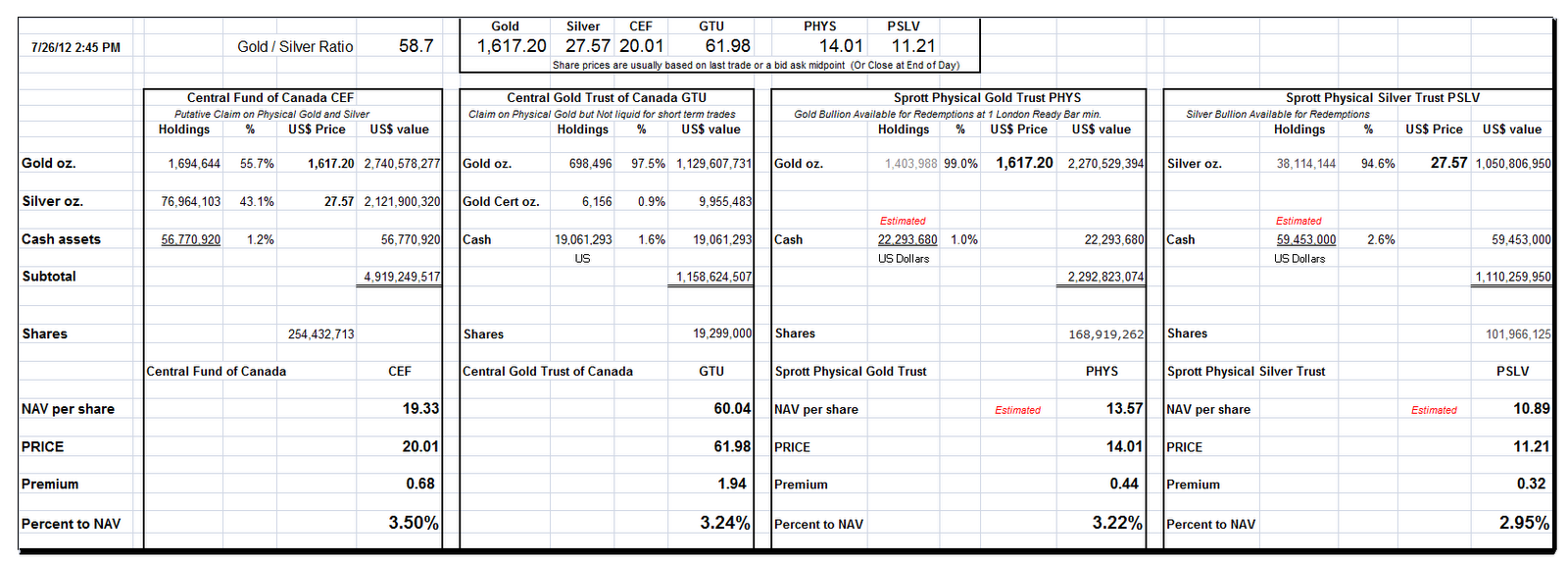
Net Asset Value Premiums of Certain Precious Metal Trusts and Funds


The PSLV premium seems on the historically cheap side, but the fund is still digesting their latest shelf offering that added units and is still adding silver it appears.

The cash level is high.


25 July 2012

Late Night Reading: Jacques Lusseyran - the 'Blind Frenchman' - Poetry In Buchenwald


"It is always the soul that dies first, even if it's departure goes unnoticed. And it always carries the body along with it...Man is nourished by the invisible, man is nourished by that which is beyond the personal. He dies from preferring the opposite."

Jacques Lusseyran, Poetry at Buchenwald


"We can answer these questions from experience as well as on principle. The experiences of camp life show that man does have a choice of action. There were enough examples, often of a heroic nature, which proved that apathy could be overcome, irritability suppressed. Man can preserve a vestige of spiritual freedom, of independence of mind, even in such terrible conditions of psychic and physical stress.

We who lived in concentration camps can remember the men who walked through the huts comforting others, giving away their last piece of bread. They may have been few in number, but they offer sufficient proof that everything can be taken from a man but one thing: the last of the human freedoms — to choose one's attitude in any given set of circumstances, to choose one's own way."

Victor Frankl, Man's Search for Meaning

Jacques Lusseyran was a high school student in Paris at the time the German army occupied France in 1940. Although he had been totally blind since age eight as the result of an accident, Lusseyran, who was then sixteen, decided to organize his friends and other students into an underground group to resist the occupation.
“News was needed, surely, but courage even more so, and clarity. We were resolved to hide nothing. For here was the monster to be fought: defeatism, and with it that other monster, apathy. Everything possible must be done to keep the French from growing accustomed to Nazism, or from seeing it just as an enemy, like enemies of other times, an enemy of the nation, an adversary who was victorious just for the moment. From our past we knew that Nazism (Fascism) threatened the whole of humanity, that it was an absolute evil, and we were going to publish its evilness abroad..."
Within a year the group numbered some 600 members who produced and distributed an illegal underground newspaper despite the risk of imprisonment, torture or death if they were caught. Lusseyran describes the mood of both surrender and joy he experienced in the resistance movement:
“I had not a single friend who had anything left to lose. They had given up literally everything except life. . . On my word of honor, the air was different where my friends were. There you could smell joy. Even when they were sad and talking about their own death, the smell of their talk was good and gave you a lift.”
Lusseyran was eventually betrayed by a pro-Nazi student who infiltrated the resistance group, resulting in the arrest of Lusseyran and other leaders of the group.

Following interrogation, Lusseyran was sent to the Buchenwald concentration camp.

In the camp, disease and malnutrition were rampant, and Lusseyran himself became sick and was very near death. But at that point he became aware that a will to live “had taken possession of me and filled me to overflowing ... Slowly I came back from the dead.”

He recalled that “on May 8, I left the hospital on my two feet. I was nothing but skin and bones, but I had recovered. The fact was I was so happy that now Buchenwald seemed to me a place which if not welcome was at least possible. I was free now to help the others; not always, not much, but in my own way I could help. I could try to show other people how to go about holding on to life. I could turn toward them the flow of light and joy which had grown so abundant in me.”

Lusseyran was asked by his fellow inmates to visit the various blocks of prisoners each day to share whatever factual information was available about the progress of the war and to dispel rumors.

The guards allowed prisoners to hear German news reports; Lusseyran was fluent in German and “read between the lines” of those reports to infer what was actually happening. He also received information from time to time via a clandestine radio which the prisoners had hidden.

Lusseyran writes: “The remarkable thing was that listening to the fears of others had ended by freeing me almost completely from anxiety. I had become cheerful, and was cheerful almost all the time, without willing it, without even thinking about it. That helped me, naturally, but it also helped the others. They had made such a habit of watching the coming of the little blind Frenchman with his happy face, his reassuring words, that on days when there was no news, they had him visit just the same.”

In April 1945, he was liberated by the Allies, surviving German massacres of the concentration camps in which some of his friends were killed. Many of his friends had died during the course of the war. After the war, Lusseyran taught French literature in the United States and wrote books, including And There Was Light and Against the Pollution of the I.

He died together with his third wife Marie in a car accident in France on July 27, 1971.

“We had to live in the present; each moment had to be absorbed for all that was in it. When a ray of sunshine comes, open out, absorb it to the depths of your being. Never think that an hour earlier you were cold and that an hour later you will be cold again. Just enjoy.

The amazing thing is that no anguish held out against this treatment for very long. Take away from suffering its double drumbeat of resonance, memory and fear. Suffering may persist, but already it is relieved by half.”

“Life had taken possession of me. I had never lived so fully before. Life had become a substance within me. It broke into my cage, pushed by a force a thousand times stronger than I. It was certainly not made of flesh and blood, not even of ideas. It came toward me like a shimmering wave, like the caress of light. I could see it beyond my eyes and my forehead and above my head. It touched me and filled me to overflowing. I let myself float upon it… I drew my strength from the spring. I kept on drinking and drinking still more. I was not going to leave that celestial stream… Here was the life which sustained the life in me..."

“The Lord took pity on the poor mortal who was so helpless before him… But there was one thing left which I could do: not refuse God’s help, the breath he was blowing upon me. That was the one battle I had to fight, hard and wonderful all at one: not to let my body be taken by the fear. For fear kills, and joy maintains life..."

“I was nothing but skin and bones, but I had recovered. The fact was I was so happy, that now Buchenwald seemed to me a place which if not welcome, was at least possible. If they didn’t give me any bread to eat, I would feed on hope..."

"I was carried by a hand. I was covered by a wing. One doesn’t call such living emotions by their names. I hardly needed to look out for myself…I was free now to help the others; not always, not much, but in my own way I could help. I could try to show other people how to go about holding on to life. I could turn toward them the flow of light and joy which had grown so abundant in me..."

"From that time on they stopped stealing my bread or my soup. It never happened again. Often my comrades would wake me up in the night and take me to comfort someone…I became “the blind Frenchman.” For many, I was just, “the man who didn’t die.” Hundreds of people confided in me. The men were determined to talk to me. They spoke to me in French, in Russian, in German, in Polish. I did the best I could to understand them all. That is how I lived, how I survived. The rest I cannot describe...”

"That is what you had to do to live in the camp: be engaged, not live for yourself alone. The self-centered life has no place in the world of the deported. You must go beyond it, lay hold on something outside yourself.

Never mind how: by prayer if you know how to pray; through another man's warmth which communicates with yours, or through yours which you pass on to him; or simply by no longer being greedy. Those happy old men were like the hoboes. They asked nothing more for themselves, and that put everything within their reach.

Be engaged, no matter how, but be engaged. It was certainly hard, and most men didn't achieve it.

Of myself I can't say why I was never entirely bereft of joy. But it was a fact and my solid support. Joy I found even in strange byways, in the midst of fear itself. And fear departed from me, as infection leaves an abscess and bursts.

By the end of a year in Buchenwald I was convinced that life was not at all as I had been taught to believe it, neither life nor society."


Gold Daily and Silver Weekly Charts - Up to the Trendline In Options Expiry - Summoning the Bernank


Gold and silver caught a pretty decent pop higher today as the markets turned their eyes from the awful earnings reports given by the real economy stocks, and looked in a candlelit mirror chanting, "Ben Bernanke, Ben Bernanke, Ben Benanke."

Once again we are in the shadow of Comex Options expiration, last trading and first notice days.

July 26 Comex August gold options expiry
July 26 Comex August copper options expiry
July 27 Comex August miNY gold futures last trading day
July 27 Comex July gold futures last trading day
July 27 Comex July silver futures last trading day
July 27 Comex July copper futures last trading day
July 27 Comex August miNY gold futures last trading day
July 27 Comex August E-mini copper futures last trading day
July 31 Comex August gold futures first notice day
July 31 Comex August copper futures first notice day

Far be it from me to tell anyone what to do. But I will say that I have stopped trading all options, both in stocks and commodities.

The rigging that characterizes the markets overall, through the manipulation of price and the mispricing of risk, is most pronounced in the paper derivatives such as options and artificial constructs like some of the ETFs which are designed to lose almost without regard to what the market does.

Gold and silver could go either way here. I do not have enough visibility into where the suckers are placing their bets, and where the wiseguys are placing theirs, at least for the short term.

I do believe that one of these days a major player is going to pop these markets, and rip the faces off some of the funds and specs who are leaning nakedly on the short side in a particularly painful and protracted rally from hell. I just do not know if we are there yet. The more I look at the structure of the Comex and their position and delivery policies the more it looks like a paper Ponzi scheme that could be tough to beat on its own turf.

Despite some of their identifiable predilictions, the Banks and big machers of the Street are very open minded about screwing anybody and everybody. They have no abiding loyalties or allegiances except to themselves.

I see where the House has passed the Ron Paul Bill to Audit the Fed. While that sort of thing may be gratifying I think the Senate also has to pass their own version of it, and then reconcile the two. And that prospect does not seem likely.


SP 500 and NDX Futures Daily Charts


More shenanigans as the equity market shook off the awful earnings reports from last night and came off the lows on expectations that Uncle Ben would crack open the beer barrels of quantitative easing again.

Tim Geithner testified to the Congress today, and he is the very picture of the bureaucrat. Intraday commentary inspired by his performance here.


"And he began to teach them, saying:

'Blessed are the poor in spirit,
  for theirs is the kingdom of heaven.
Blessed are they who mourn,
  for they shall be comforted.
Blessed are the meek,
  for they will inherit the earth.
Blessed are those who hunger and thirst for righteousness,
  for they will be satisfied.
Blessed are the merciful,
  for they will be shown mercy.
Blessed are the pure in heart,
  for they will see God.
Blessed are the peacemakers,
  for they will be called children of God.
Blessed are those who are persecuted for righteousness sake,
  for theirs is the kingdom of heaven.

And blessed are you when people insult you, persecute you, or falsely speak evil
  about you, because you stand with me.'"

About the Poor and Taxes


I see a push coming from the fortunate again, the ones who have been rewarded by the system as it has been, to 'scrap the tax system' and go to a lower flat tax, or even better, a much lower but general consumption tax. Whatever benefits them the most. And economics is a handmaiden flexible and malleable enough to provide them whatever rationale is required to support their arguments.

But the truth is that a consumption tax falls particularly hard on those with the least disposable income, who must still buy the necessities of life.

A flat tax is not much better, for much the same reason. The burden falls disproportionately on those who can bear it the least.

I should add that a shift from an income to a consumption tax is a great idea if you would like to stimulate and subsidize a new bubble in speculative financial paper that would bring down the financial system once and for all when it collapses.

Personally I would like to see a very nominal financial transaction tax of nominal flat of about $5 per trade, with NO exemptions including wiseguys trading for their own books in HFT. I would obviously like to dampen speculation and encourage real investment. And of course I would be in favor of the abolition of all 'dark pools' of publicly traded instruments or delays in reporting those trades. And charging for basic quotes in real time by the exchanges which should be a cost of their doing business. But that is a subject for another day.

The problem with the tax system we have today is that there are so many loopholes and ways to avoid taxes for those with the most power and money. It really is more of a scandal than you might know. It encourages and rewards expoitative behaviour and foments financial corruption.

Until you have some serious walking around money, and it draws in the lawyers and accountants, one does not see what a racket the current system is, and how well it serves those 'in the know,' to the disadvantage of everyone else.

Rather than put forward my own solution, I would like to address a current tagline that is being quoted by the 'tax reformers.'

The fortunate are indignant that the working poor, and the poor themselves, are paying so little in income taxes on the whole. And this is true, if one measures it by actual federal income tax receipts alone.

It is less so if one considers all the other taxes that add up, like sales taxes and gasoline taxes, and fees.

But even further, I contend that the poor are being taxed to death, by a rotten, corrupt crony capitalist economic system.

The tax may not be levied by the IRS, but it is set down by the system itself. It is set down by the banks that cheat them, by the powerful corporations that use the law for their own excessive profits to exploit them.

They are taxed by those who exploit and cheat them and collect their unjust rents, not because they are smart and hard working, but because they can.  They have carefully positioned themselves to do so.

The poor are taxed by sickness, and a healthcare system with insanely different classes of treatment and payments, and extractive and the predatory practices of pharma-healthcare trusts.

They are taxed by the accidents and tragedies of life, that if one is rich or comes from privilege are not a lasting problem, but if one is not, there is no second chance. One is held in debt bondage, forever.

And when it comes to it, it is the poor who predominantly offer their tears and blood, and their own children, to fight the wars for this nation around the world. And when those wars are not entered into reluctantly for the sake of defense, but rather as expansive adventures in nation building in far off places, for the benefit of the hellish combine of the manufacture of death for profits, that is the gravest injustice and most horrific tax of all.

The corporations, in one form or another, own the housing, pay the wages, charge what they will for the food and medicine, and essentially own the company store in a pernicious monopoly whose sole goal is to sustain and maximize itself as its own end.

The system is so unfair and so rigged now that the poor will pay the price of it, the taxes of its corruption and injustice, from the moment they are born until the day that they die.

We have presided over the destruction of almost one hundred years of social progress, almost without parallel in human history. Oh, well done.

That for the most part is the reason why they are poor. Not because they are lazy, not because they are stupid, and not because they engage in high risk behaviours. Yes, some people are poor for these reasons. I know we can always think of someone like that. But just as many of the rich do the same things and more, and remain rich despite it. The system carries and subsidizes their failures, again and again.

The indignation of the well-to-do is like a group of highwaymen, who rob the passengers on a bus, and strip and beat them senseless, and then become angry when the survivors try to go on their way, but do not have enough money left to pay the region's exit tax.

The crony capitalist system is rigged, and it exploits the poor, and that is what makes most of them poor, and keeps their children the same way unless they are both incredibly bright and incredibly lucky.  A few may make it, but most do not.  And sometimes those who make it are among the worst, because they wish to forget who they are and where they have been.

And such a system is not sustainable, without increasing repression and force, until it finally extinguishes itself.

Changing the tax system is not the answer. The real answer is genuine economic reform and real justice, and an end to the principles of the serving the greater greed and might makes right that has shaped the perverse economic system which we have today.

I dare not even bring up the parable of the talents here, that what you have has been given you, and you are obligated to use it well, or it will be taken from you.

And how can I appeal to the principles which have guided many of the progressive gains throughout western history. "When someone has been given much, much will be required in return; and when someone has been entrusted with much, even more will be required."

How can one appeal to noblesse oblige, when nobility and chivalry are dead, and craven grasping by the crudely nouveau riche is the highest example for all?  

One can only appeal to the practical wisdom of the parasites, that when you kill the host, you kill yourself. Or risk being targeted and removed like some intrusive and unproductive organism that you may be.

The fortunate will not admit their humanity, because it lowers them from their exalted and imagined ubermensch status to what they really are: ordinary people with more in common with the poor than they care to think. And that is what frightens them.  The stench of their own mortality drives them obsessively.

That is the lesson which we have forgotten.  Yes, you do not wish to hear it.   But it is the oldest story in the book. It is the sin that brought down the light-bearer, the Son of the Morning, first among angels. Pride. And so we cannot admit it, we cannot even see it in our own blindness to the fact:

There but for the grace of God go I.

Do not feel envious, or fearful, or even angry at the parade of the powerful now, the pampered princes of corruption.  I had a terrible vision, a vivid dream, of what they will look like in the time that comes.  Their souls are so empty, so shallow, so broken and insubstantial, that when stripped of their earthly husks there will not be enough of them left to be recognizable as a personality.  

They look like the remnants of dried brown leaves, blowing along the gutters and alleyways of a hard and unyielding hell.   No one remembers them, or even know what they are.

They still think and feel, but the sounds and cries that they make blend together into an indistinguishable rustling, a chorus of soft scratching from dried remnants on the pavement, made of unyielding alabaster paving blocks, as they cling to their lies and self-delusions.  

And no one hears them, their dry scratching cries, and they are alone.   It is hard to even think of it again, much less imagine falling into that state.  And yet, that is not the worst that I saw.

Charles Biderman On the Markets and the Treasury Ponzi Scheme - The Speculative Life


I am not so sure the Bernanke put is dead. But this is certainly well worth watching.

I lost well over a million dollars, marked to market, underestimating Bernanke and Greenspan, and the government's willingness to whore out the public and the integrity of the markets in the most obvious of fashions once before, in the American housing bubble and fraudulent credit frenzy, whilst all the regulators, economists, and pundits stood aside and did or said nothing. Their hypocrisy knew no bounds.

I am not likely to do that again. That sort of experience leaves an impression. And I learned a great deal from it.

Traders will always tell you about their wins, but rarely about the losses. They think the wins are due to their superior intellect, and the losses are just bad luck. And it keeps them coming back for more, until most of them bust their banks.

I don't think you can really be called a seasoned trader until you have at made and lost a million and won it back again. Or more, if you are playing with Other People's Money. Most just lose.

But don't feel badly for me. I am well ahead of the game, in large part on the other ends of the same deals, both going in and coming out, and that I think is by the grace of God and not by my own devices.

I have made most of my money by taking a sound position and then doing nothing with it, not tinkering with it, or frittering it away in fees and small losses that add up over time. The mispricing of risk creates an enormous amount of transactional friction that is almost impossible to beat.

Investment is one thing, and speculation is another. One rises in wisdom by falling in folly.

The speculative life has a lot of volatility, too much my tastes now, although I have been a 'gamer' most of my life, from horsetracks to computer screens to casino tables. It is not for the money, it is for the effects of a game on a restless mind.

Although like the old dog that I am, I still rise to the hunt, just more slowly and quietly. But with much less interest, now that the markets are so obviously rigged. The Banks and wiseguys are destroying them with their excessive greed and cheating, as they have done so many times before.

When I first started trading many years ago the market was a dead fish, and no average person wanted anything to do with it. We will go back there again, if we are not there already.

As I told my son, who is going on so well at university through his diligent work and bright intellect, the speculative life is not a worthwhile use of one's time and mind, especially if I compare to to the creating of new products and technologies. Or even being a plumber, if one is a good one. They have my sincere admiration; water is unforgiving of error. Whenever I do it, it seems as though one thing always leads to another.

As Thomas More said to Sir Richard Rich, 'Better to be a teacher.' Speculators produce nothing, but a teacher can bring light to the darker corners of life.