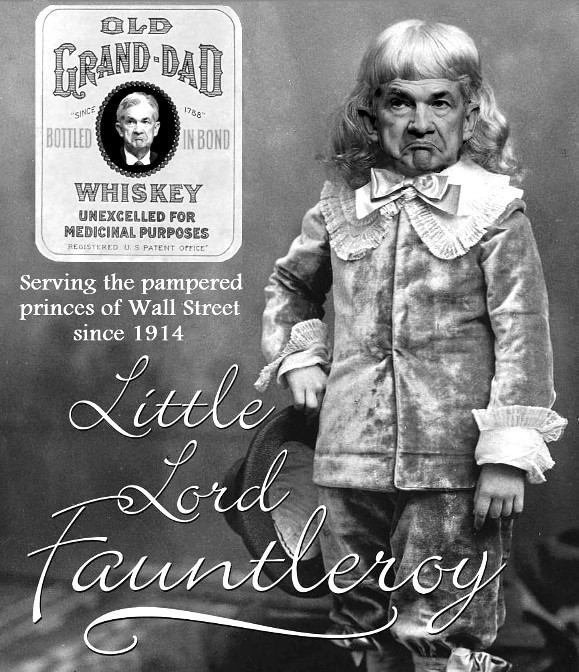
Showing posts with label economics a disgraced profession. Show all posts

27 July 2022

Stocks and Precious Metals Charts - Blue Skies - Forget 'Plastics' Wall Street Says 'Pivot'


"J. P. Morgan and Andrew Mellon made their billions through inter locking directorates and outright ownership of hundreds of nationally prominent enterprises.  Glass-Steagall is one crucial piece of a litany of legislation designed to place checks and balances on the concentration of financial resources. To repeal it would be tantamount to bringing back the days of the robber barons.   The unbridled activities of those gifted financiers crumbled under the dynamic forces of the capital marketplace.  If you take away the checks, the market forces will eventually knock the system off balance."

Mark D. Samber, End Bank Law and Robber Barons Ride Again, NY Times, March 5, 1995


"In 1999, on signing Gramm-Leach-Bliley into law, Clinton said, 'This is a day we can celebrate as an American day' and that 'the Glass-Steagall law is no longer appropriate for the economy in which we live' and 'today what we are doing is modernizing the financial services industry, tearing down these antiquated laws and granting banks significant new authority' and 'This is a very good day for the United States.'"

Columbia Journalism Review, Bill Clinton on Deregulation


"There is no reason to believe either equity swaps or credit derivatives can influence the price of the underlying assets any more than conventional securities trading does."

Alan Greenspan, July 24, 1998, Testimony on the Regulation of OTC Derivatives


"But bad economics was only a symptom of the real problem: secrecy. Smart people are more likely to do stupid things when they close themselves off from outside criticism and advice."

Joseph Stiglitz, What I Learned at the World Economic Crisis, April 17, 2000


"It is no exaggeration to say that since the 1980s, much of the global financial sector has become criminalised, creating an industry culture that tolerates or even encourages systematic fraud.   The behaviour that caused the mortgage bubble and financial crisis of 2008 was a natural outcome and continuation of this pattern, rather than some kind of economic accident."

Charles H. Ferguson


“It is difficult to get a man to understand something, when his salary depends on his not understanding it.”

Upton Sinclair


"We feel that fundamentally Wall Street is sound, and that for people who can afford to pay for them outright, good stocks are cheap at these prices."

Goodbody and Company, The New York Times, October 25, 1929


The market read between the lines of the FOMC decision and in particular Chairman Powell's remarks and assumed that the Fed is in a pivot to a less hawkish stance on interest rates.

And so gold and particularly silver rallied.

Stocks went stratospheric.

The Dollar dumped back to the 106 handle.

Whether this interpretation of the Fed's intentions is valid or not remains to be seen.  

Certainly eyes will be on the data,  

After hours the corporate earnings reports were a very mixed bag.

Tomorrow we will be getting an advance look at 2Q GDP.

Regardless of this backward look, history suggests that we are heading into a recession. 

Unless this time is different.

Have a pleasant evening.

20 May 2008

Economists Discover "Separate but Equal"


On June 9, the 30th day of the McCarthy Army hearings, Army Defense Counsel Robert Welch challenged Roy Cohn to provide McCarthy's list of 130 Communists or subversives in defense plants "before the sun goes down."

McCarthy stepped in and said that if Welch was so concerned about persons aiding the Communist Party, he should check on a man in his Boston law office named Fred Fisher, who had once belonged to the National Lawyers Guild, which Attorney General Brownell had called "the legal mouthpiece of the Communist Party."

Welch responded, "Until this moment, Senator, I think I never gauged your cruelty or your recklessness..."

When McCarthy resumed his attack, Welch interrupted him: "Let us not assassinate this lad further, Senator. You've done enough. Have you no sense of decency, sir, at long last? Have you left no sense of decency?" When McCarthy once again persisted, Welch cut him off and demanded the chairman "call the next witness."

At that point, the gallery erupted in applause and a recess was called.

Until this moment I did not fully appreciate the moral vacuum at the core of these elitists.  They created a wreckage of devices that led us to the edge of an economic precipice. 

Now they attempt to justify the results by defining the poor as those who, by their nature, prefer cheap and shoddy goods and a lower standard of life. They are by choice separate but equal to the wealthy, who genetically require the finer things in life. 

The famous rebuke of 'at long last, have you no decency', to those who thrive from conflict and injustice, and who will say or do almost anything in their pursuit of the will to power, must surely again apply.


Inequality and Prices
May 20, 2008
Lane Kenworthy’s weblog

Steven Levitt and Will Wilkinson point to a new paper that Levitt says “shatters the conventional wisdom on growing inequality” in the United States. The paper is by Christian Broda and John Romalis, economists at the University of Chicago.

Here’s their argument: income inequality has increased over time. But analysis of consumption data indicates that people with low incomes are more likely than those with high incomes to buy inexpensive, low-quality goods. In part because those goods increasingly are produced in China, their prices rose less between 1994 and 2005 than did the prices of goods the rich tend to consume. Hence the standard measure of inequality, which is based on income rather than consumption, greatly overstates the degree to which inequality increased. The incomes of the rich rose more than those of the poor, but because the cost of living increased more for the rich than for the poor, things more or less evened out.

Their point that the prices of some goods have risen less than the overall inflation rate, and that this is due in large part to imports from China, seems perfectly valid and worth making. It has important implications for our understanding of how absolute living standards for America’s poor have changed over time.

But I’m not sure why Broda and Romalis, or Levitt and Wilkinson, think this should alter our assessment of the trend in inequality. Do they mean to suggest that the revealed preference of the poor for cheap goods is exogenous to their income? In other words, people with low incomes simply like buying inexpensive lower-quality goods, and they would continue to do so even if they had the same income as the rich. Likewise, the rich simply have a taste for better-quality but pricier goods, and they would continue to purchase them even if they suddenly became income-poor. If this is the assumption, I guess the conclusion follows. But I can’t imagine the authors, or anyone else, really believe that.

Actually, Levitt may believe it. “How rich you are,” he says, “depends on two things: how much money you have, and how much the stuff you want to buy costs” [my emphasis - LK].

Consumption is worth paying attention to. But income is important in its own right because it confers capabilities to make choices. What matters, in this view, is what you are able to buy rather than what you want to buy.

If a rich person with expensive tastes gets an extra $100,000, she can continue buying high-end clothes and gadgets. Or she can choose to purchase low-end Chinese-made products and save the difference. Suggesting that if she opts for the former there has been no rise in inequality is not very compelling.