19 December 2010

Greed Is Not Good


With regards to the global financial crisis, imposing austerity is not the answer. That is like starving the slaves to improve their condition by making the plantation more profitable.   Looting the 'great house' and the barns to feed the slaves, at least temporarily, is not the answer either. The problem is obviously in the system itself.

But either expedient solution suits the external moneyed interests promoting the system who seek only to plunder and drain the assets and labor of others who are all their common prey, whether they feel their kinship or not. An unjust and unsustainable system tarnishes all participants and leaves them vulnerable to exploitation and decay.

It is the root causes of the debt and the imbalances in the system that must be addressed to make any reform sustainable. And this obviously includes addressing abuses such as the promotion of a global trade regime that is inherently unjust and imbalanced to the favor of the oligarchs of whatever political wrappings around the world who hold the greater profit to themselves and leave their people relatively impoverished and exploited.  And it also includes the waging of unfunded wars to protect and promote privileged commercial interests, and a political funding system that is little more than soft graft and an open invitation to corruption by special interests.

It begins with a debilitating system of taxation by the moneyed interests on every commercial transaction in the form of fees and commissions, and the abuse of a money system that is little more than a fraud perpetrated by private interests for the benefit of a few at the expense of the many. If you wish a simple measure of this, then look to the median wage.

Greed is not good.  Greed is a disease, an aberration of simple honest ambition and necessary provision taken to excess. 
It is a sin, a transgression against love.  This simple distinction may be lost on a people no longer able to distinguish between virtue and sin, honor and expediency, appetite and gluttony, the means and the ends.  Every great religion, every school of philosophy has cautioned throughout history on the perils of unbridled and unregulated greed.  

And yet this generation would make a god of it, although they may not understand, or care, what it is that they are doing, and whom it is they serve. And yet they will be held to account for their willfulness, foolishness, and casual disregard for others.

Greed, often in company with hubris and fear, is a handmaiden of the corrupting influence of power and triumph of the will. Greed is contagious, and attacks the very contentment of society at its heart, turning it towards oligarchy and oppression.

"Greed is a bottomless pit which exhausts the person in an endless effort to satisfy the need without ever reaching satisfaction." Erich Fromm
Any system that promotes greed, gluttony, and insatiability as its highest goods and fundamental ideals is a cult of perversion and addiction on a scale with ancient Rome, an imbalanced insult to the natural law, with a fatal attraction to overreach, failure and self-destruction. What the US has today is not market capitalism that rewards the merits and work of individuals, but rather is the product of dishonest and disordered minds, a system of fraud and plunder by privileged oligarchs masquerading as fair and honest markets of legitimate valuation and price discovery.
"Because the free market system is so weak politically, the forms of capitalism that are experienced in many countries are very far from the ideal. They are a corrupted version, in which powerful interests prevent competition from playing its natural, healthy role." Raghuram G. Rajan
The Banks must be restrained, and the financial system reformed, with balance restored to the economy, before there can be any sustained recovery.

Financial Interests Dictate Sovereign Policy
By Michael Hudson
December 18, 2010

"...The economic problem is not caused by sovereign debt but by bad bank loans, deceptive financial practice and neoliberal bank deregulation. Iceland’s Viking raiders, Ireland’s Anglo-Irish bank and other foreign banks are trying to avoid taking losses on financial claims that are largely fictitious, inasmuch as they exceed the ability of indebted economies to pay. The ‘crisis’ can be solved by making the banks write down their debt claims to realistic ‘junk’ valuations. There is no need to wreck economies by subjecting them to financial asset-stripping.

In such cases there’s a basic principle at work: Debts that can’t be paid, won’t be. The question is, just how won’t they be paid? As matters stand, countries are being told to subject themselves to massive foreclosure – not only a forfeiture of homes, but of national policy.

In this respect the sovereign crisis is a crisis of sovereignty itself: Who shall be in charge of the economy, its tax philosophy and public spending: elected officials acting in the public interest, or an intrusive financial oligarchy? The EU was wrong to tell governments to pay for following its advice – and pressure – to trust financial crooks and deregulate bank oversight. The European Central Bank should reimburse victimized governments for the bailouts that have been paid. This reimbursement can be done by levying a progressive tax policy and creating a central bank to help finance governments.

The proper aim of a national economy is to promote capital formation and rising living standards for the population as a whole. not a narrowing financial class at the top of the pyramid. So I see two major policies to lead the way out of this mess:

First, shift taxes back onto land and resource rent, and onto financial and capital gains. This will prevent another real estate bubble from being inflated by debt leveraging. By holding down housing prices, it will save labor from having to pay an equivalent amount in income tax. Low real estate taxes (under 1% until just recently) have not saved homeowners money in Latvia. Low property taxes merely have left more rental income to be pledged to banks, to capitalize into large mortgage loans.

Second, de-privatize basic utilities and natural monopolies to save Europe from rentiers turning it into a tollbooth economy. Europe needs a central bank that can do what central banks are supposed to do: create money to finance government deficits. But the European Central Bank and article 123 of the European Constitution as amended by the Lisbon Treaty prevents the central bank from lending to governments. This forces governments to levy taxes to pay interest to banks – for creating electronic credit that a real central bank could just as well create on its own computer keyboards.

Government banking is not necessarily inflationary. It finances what is necessary for economies to grow: investment in infrastructure and capital formation to raise productivity and minimize the cost of doing business.

What turns out to be inflationary is commercial bank lending. It inflates asset prices – unproductively. Banks lend mainly against real estate and other assets already in place, and stocks and bonds already issued. This is unproductive credit, not real wealth creation. The only way to keep this unproductive debt overhead solvent is to inflate asset prices more – by untaxing assets to leave more revenue to pay bankers on exponentially growing debts.

It doesn’t have to be this way. The recent 30 years of financial polarization is reversible. The alternative is to succumb to neoliberal austerity."

I think that most people know what needs to be done in their conscience, but their hearts have become so hardened over the past twenty years that the message will be ignored until after they undergo a period of suffering on the scale of the worst of the twentieth century. May God have mercy on us all.


Unless the Lord builds the house, the builders labor in vain.
Unless the Lord watches over the city, the guards stand watch in vain.
In vain you rise early and stay up late,
toiling for food to eat—
for he grants sleep only to those he loves.

Psalm 127

17 December 2010

Weekend Reading - When Money Dies: The Nightmare of the Weimar Collapse - Adam Fergusson


When Money Dies

SP 500 and NDX March Futures Daily Charts - Crony Capitalism: The Fed's Frankenstein


The mechanics of what is happening with money now is fascinating, and seems to be clarifying in my mind. It is hard to imagine a more inherently ineffective system of capital and resource allocation than crony capitalism. It is a game which is rigged to deliver the money in the system to a minority of insiders, thereby bankrupting all the customers.

It is said that in a purely competitive capitalist system, all businesses are vectored to zero profit in a process of creative destruction. As a certain class of participants clearly recognizes this they take every opportunity to corrupt and game the system through fraud. This is why markets must have regulators. At times the fraud overcomes the regulation to such a degree that the normal market balances are rendered ineffective and the system passes to a crony capitalist system, if not an outright oligarchy.

In a crony capitalist system a similar outcome can be achieved, but with the insiders and powerful interests holding most of the money which ultimately becomes worthless because the foundation of the money, the labor of the people, is destroyed.

In other words, greed compels the materially obsessed to obtain the greatest piles of chips, but in the long term renders their chips to be worthless because they are unable to stop their fraud and plundering even when it is in their best interests. They are not governed by rationality or conscience or even common sense. For periods of time oligarchies are able to survive in an uneasy equilibrium enforced by power, but ultimately these wicked wither and die on their great piles of gains.

I now give more weight to the potential for hyperinflation, and will be exploring this topic during 2011. The Congress and the Fed are reckless to the point of self-destruction.


Gold Daily and Silver Weekly Charts


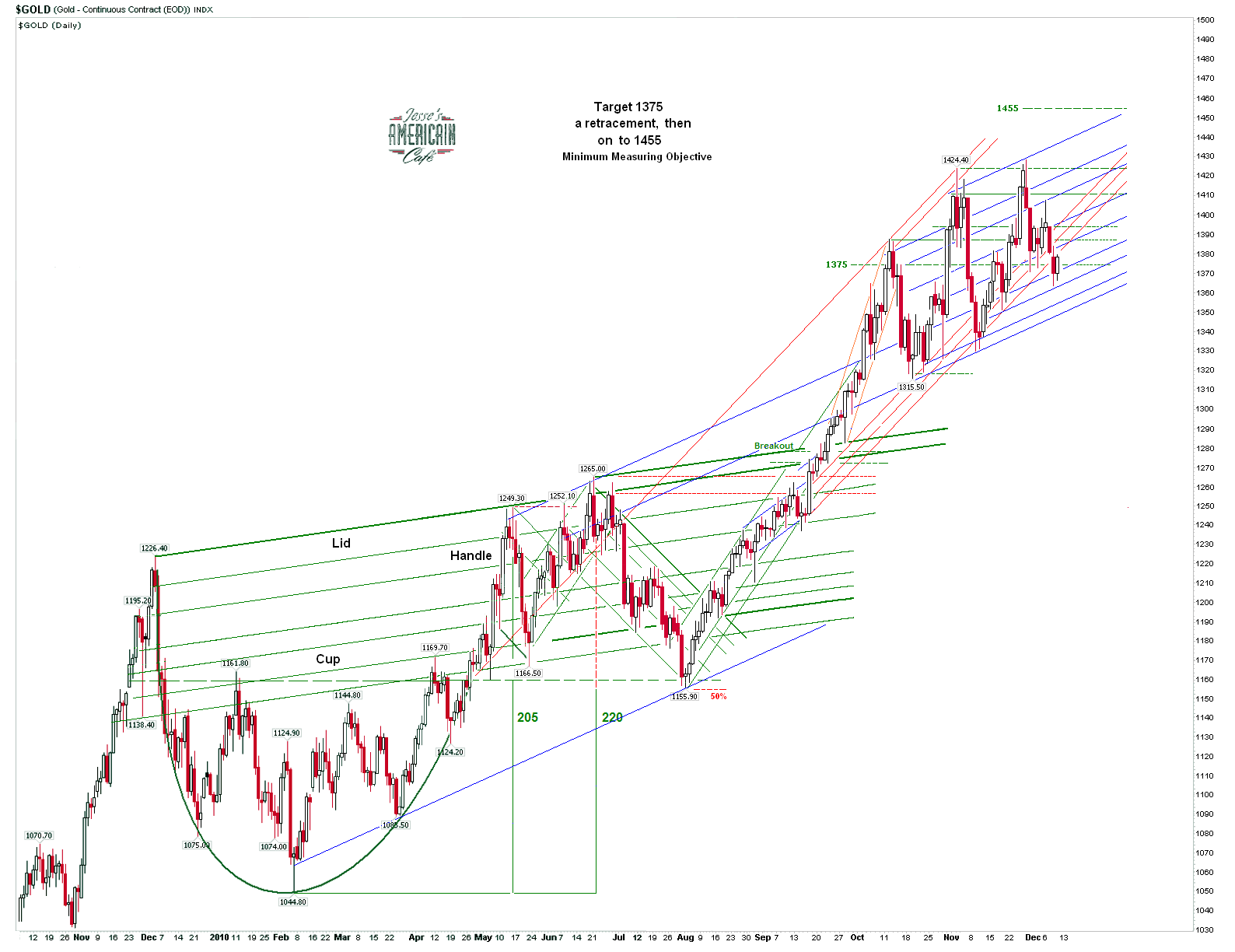
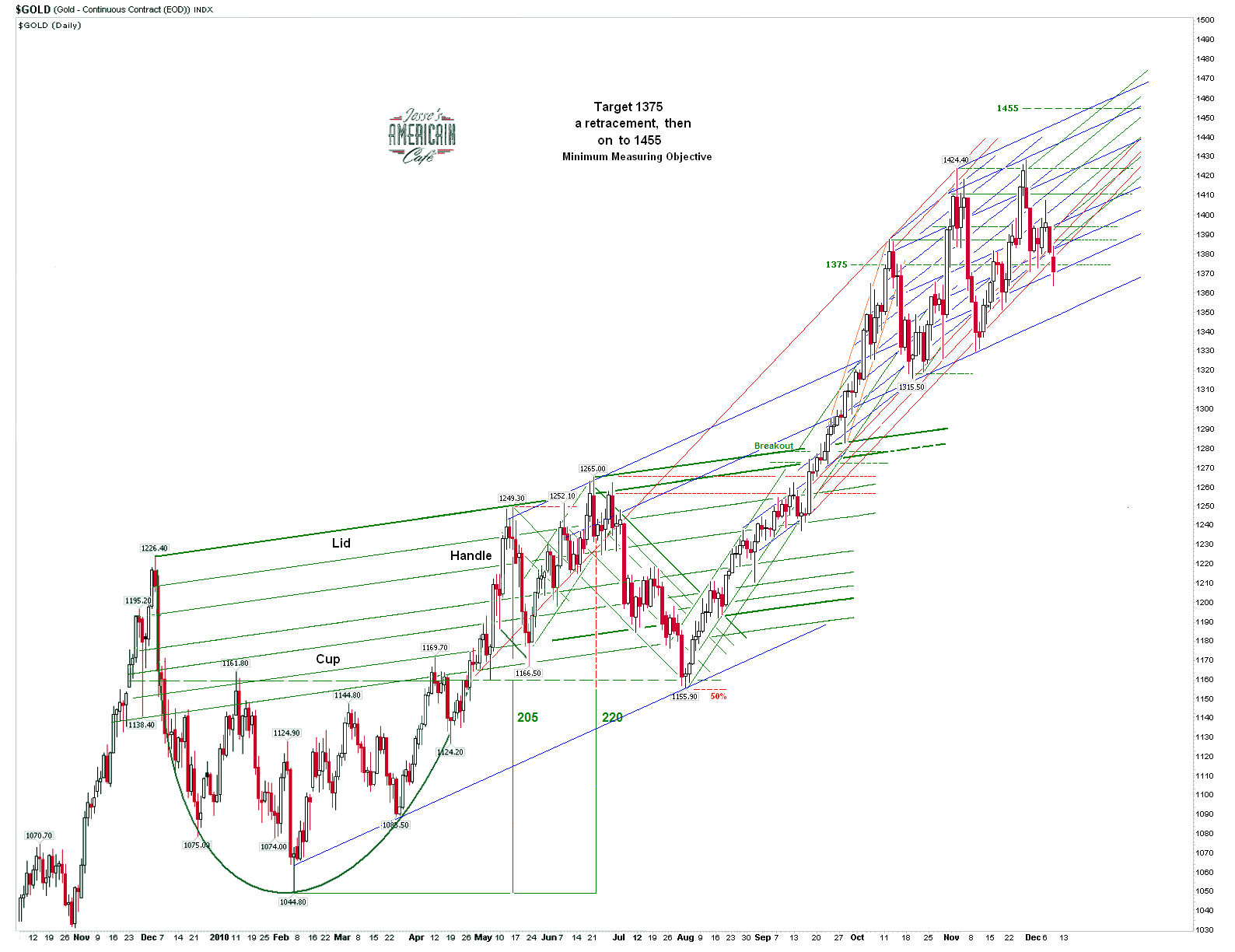
The pattern in the gold market has greatly clarified. It is now following a more gradual path higher as the banks of the world resist its upward trajectory, and the many still do not recognize the inherent value of bullion in the face of currency devaluation.

The gradual rise will take gold much higher over time than a parabolic spike higher would, although it demands more patience as things unfold.

At some point it will regain a more aggressive track higher, and then likely consolidate and resume a more gradual rise for a time.

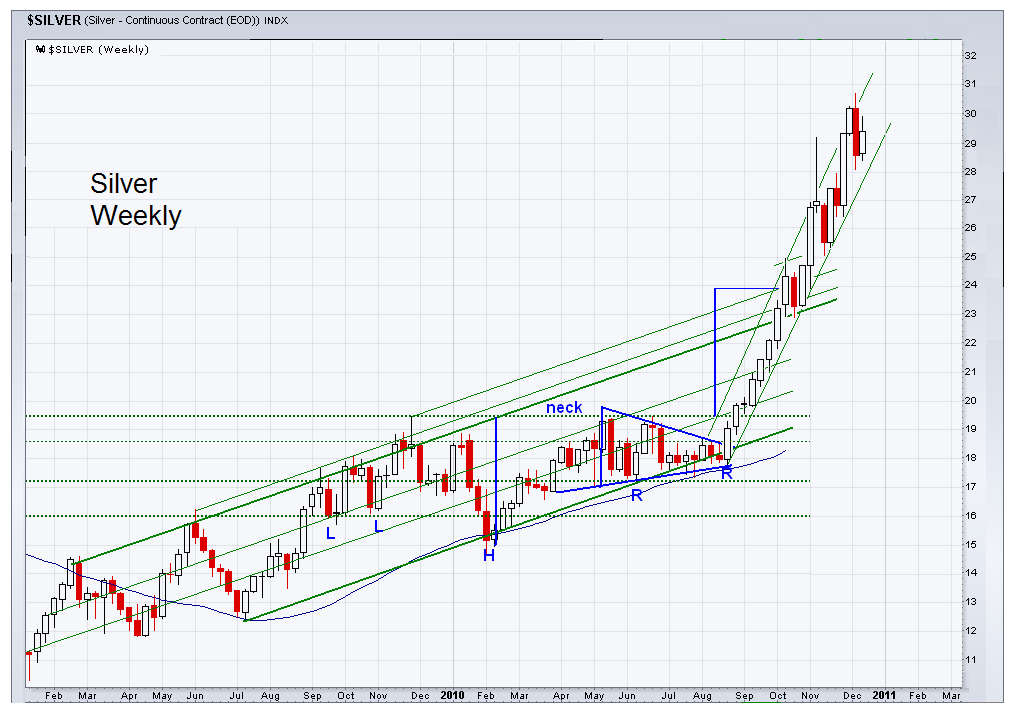
Silver is on an aggressive but sustainable rally path. The many years of suppression and the leverage in this market may call out a path and price much higher on a percentage basis than gold.

I like to buy both, but given a choice I would tend now to overweight silver for trading, and gold for the long term investment and wealth protection.


16 December 2010

Gold Daily and Silver Weekly Charts - Gold With 50 Day Moving Average


The 50 Day Moving Average once again provided support for a dip in bullion. I tended to view the bear raid today as tied to option expiration in equities moreso than in the bullion itself. Mining stocks have been hot, and the call buying may have gotten ahead of itself, setting up an incentive for players to hit the metals and take down the industry associated stocks.

Although the CFTC has enabled a position disclosure trigger at 10% at which the regulators can ask a market participant to show their net swaps, the actual position limits discussion was tabled today for a future meeting.

CFTC delays tough commodity speculation crack-down


SP 500 and NDX March Futures Daily Charts


Tomorrow is December options expiration for equities and the funds are also painting the tape to make their bonuses round up nicely into the year end.

Let's see how the markets go as they hit all our targets in the currently active chart formations. Wait for it, because Benny is in there pumping and it may take a stumble to turn this trend around, which for now is up.


15 December 2010

Gold Daily and Silver Weekly Charts


"Currency values and precious metals prices can be volatile, but the long-term weakness in the U.S. dollar and relative purchasing-power-preservation attributes of gold and silver, and the stronger currencies outside the dollar, remain in place. As with systemic risks in the United States, risks in other areas of the world — such as among the countries using the euro — likely will be addressed by the spending or creation of whatever money is needed (indications of any needed U.S. backing are in place) in order to prevent systemic failure.

Keep in mind that the U.S. remains the proverbial elephant in the bathtub in terms of pending effective sovereign bankruptcies. The various European crises remain an intermittent foil for the U.S. dollar, pulling market attention away from the unfolding solvency crisis in the United States and a likely move to massive selling against the U.S. currency.

Accordingly, high risk of the early stages of a hyperinflation beginning to unfold by mid-2011 continues. Rising inflation should become increasingly broad, reflecting an increasingly serious problem in the first-half of 2011.”

John Williams: Massive Selling of US Currency Ahead - KWN


SP 500 and NDX March Futures Daily Charts


14 December 2010

Gold Daily and Silver Weekly Charts And One Possible Unfolding of the Endgame


This seems mildly reminiscent of the setup which Soros and unnamed Swiss parties engaged in when they took down the Bank of England's defense of the British Pound and its official peg to the Euro.

Will the US ultimately feel compelled to defend some of the gold and silver shorts, both in terms of bullion and derivatives, held by its Wall Street Banks? You could allow for the possibility, if you will, that there is a corresponding web of derivatives that has a links, and a possible chokehold, on a few key European institutions, particularly in England and Germany, involving counterparty derivatives and CDS, and collateral damage to professional and political careers. Ugly stuff, rather messy really. But there are historic precedents.

How Asian Buyers Are Maneuvering the Metals Shorts

There should be no confusion that this involves not only a few large Wall Street players, but also elements, past and present, in the US Treasury and the Federal Reserve. It makes the unfolding insider trading scandal look like a neighborhood numbers racket.

Therefore we should not discount the possibility that if a default should occur there will be an emotional and political reaction put forward as a means of deflecting the disclosure of the true nature of the financial corruption.

It would be most interesting and possibly entertaining to see if Ron Paul's congressional committee could be able to mount an effective investigation into the matter, or if events will take place to pre-empt and redirect such an inquiry to manage the potential collateral damage to careers and possibly governments, both at home and abroad. 

It's never really the act itself, often minor infractions undertaken for practical purposes or what could be rationalized as such by some. Rather it is always the corruption of the policy actions to personal gain, and the subsequent cover-up, that tends to gather substance over time into a first class scandal, acts of felony and high crimes, and all the revelations that follow.
“Oh what a tangled web we weave, When first we practice to deceive." Sir Walter Scott


SP 500 and NDX March Futures Daily Charts


Non-event FOMC statement, the last of 2010, which is what had been expected. The macro retail sales picture was painted in high gloss, but the big miss by Best Buy cuts deeper to the heart of the truth.

The US is becoming two nations, one of privileged fraud and illusion, and another of harsh reality, difficult circumstances, and unnecessary hardship.


Federal Reserve Statement for December 14


The first paragraph is the only thing that has changed and that from slow to insufficient. The Fed is dour on the jobless recovery and its self-sustainability.

"Information received since the Federal Open Market Committee met in September confirms that the pace of recovery in output and employment continues to be slow. Household spending is increasing gradually, but remains constrained by high unemployment, modest income growth, lower housing wealth, and tight credit. Business spending on equipment and software is rising, though less rapidly than earlier in the year, while investment in nonresidential structures continues to be weak. Employers remain reluctant to add to payrolls. Housing starts continue to be depressed. Longer-term inflation expectations have remained stable, but measures of underlying inflation have trended lower in recent quarters."
Contrast this opening paragraph from the Fed's November 3 Statement with their latest below.
Release Date: December 14, 2010
Federal Reserve Open Market Committee Statement

Information received since the Federal Open Market Committee met in November confirms that the economic recovery is continuing, though at a rate that has been insufficient to bring down unemployment. Household spending is increasing at a moderate pace, but remains constrained by high unemployment, modest income growth, lower housing wealth, and tight credit. Business spending on equipment and software is rising, though less rapidly than earlier in the year, while investment in nonresidential structures continues to be weak. Employers remain reluctant to add to payrolls. The housing sector continues to be depressed. Longer-term inflation expectations have remained stable, but measures of underlying inflation have continued to trend downward.

Consistent with its statutory mandate, the Committee seeks to foster maximum employment and price stability. Currently, the unemployment rate is elevated, and measures of underlying inflation are somewhat low, relative to levels that the Committee judges to be consistent, over the longer run, with its dual mandate. Although the Committee anticipates a gradual return to higher levels of resource utilization in a context of price stability, progress toward its objectives has been disappointingly slow.

To promote a stronger pace of economic recovery and to help ensure that inflation, over time, is at levels consistent with its mandate, the Committee decided today to continue expanding its holdings of securities as announced in November. The Committee will maintain its existing policy of reinvesting principal payments from its securities holdings. In addition, the Committee intends to purchase $600 billion of longer-term Treasury securities by the end of the second quarter of 2011, a pace of about $75 billion per month. The Committee will regularly review the pace of its securities purchases and the overall size of the asset-purchase program in light of incoming information and will adjust the program as needed to best foster maximum employment and price stability.

The Committee will maintain the target range for the federal funds rate at 0 to 1/4 percent and continues to anticipate that economic conditions, including low rates of resource utilization, subdued inflation trends, and stable inflation expectations, are likely to warrant exceptionally low levels for the federal funds rate for an extended period.

The Committee will continue to monitor the economic outlook and financial developments and will employ its policy tools as necessary to support the economic recovery and to help ensure that inflation, over time, is at levels consistent with its mandate.

Voting for the FOMC monetary policy action were: Ben S. Bernanke, Chairman; William C. Dudley, Vice Chairman; James Bullard; Elizabeth A. Duke; Sandra Pianalto; Sarah Bloom Raskin; Eric S. Rosengren; Daniel K. Tarullo; Kevin M. Warsh; and Janet L. Yellen.

Voting against the policy was Thomas M. Hoenig. In light of the improving economy, Mr. Hoenig was concerned that a continued high level of monetary accommodation would increase the risks of future economic and financial imbalances and, over time, would cause an increase in long-term inflation expectations that could destabilize the economy.