17 August 2010

SP 500 September Futures, Gold Daily Chart, Silver's Ascending Triangle


SP 500

Goal line defense at that pivot point, but they were unable to break it out above overhead resistance today, even on light volumes.

Come on boys, let's get that GM IPO rolling (even though Goldman poisoned the well for the underwriters by low balling the fee)


Gold

Let's get ready to rumble.


Silver

A Massive Ascending Triangle is building energy for what may be an explosive breakout.


Examples of Ascending Triangles


Gold And Energy Futures Contracts to Begin Trading in Singapore


A little competition is just what the COMEX and LBMA need.

Wouldn't it be sweet if some master-of-the-universe trader caught rigging the markets and violating the rules were to find himself on the receiving end of an old-fashioned caning?

Let's see how the arbitrage develops, because you know it will. I wonder how transparent and liquid this exchange will be. It is certainly in an advantageous location.

Bloomberg
Singapore Mercantile Exchange to Start Gold, Energy Futures Trade Aug. 31

By Christian Schmollinger
Aug 17, 2010

Singapore Mercantile Exchange (SMX) will begin live trading operations on Aug. 31, offering both gold and energy contracts, according to an e-mailed statement.

The exchange will offer futures for gold physically delivered in the island city-state, Brent oil denominated in euros and financially settled West Texas Intermediate crude, the statement said. The bourse also plans euro-dollar futures.

“SMX’s launch is a step in the right direction as we leverage off Singapore’s unique position as a premier financial and commercial hub in the region,” Thomas McMahon, the exchange’s chief executive officer, said in the statement. “The launch will provide market players in Asia the flexibility to trade products generic to regional trade flows within the Asian business day.”

The Singapore Mercantile Exchange is backed by Financial Technologies (India) Ltd., which operates the largest commodity bourse in India. Other commodity exchanges in Asia include Singapore Commodity Exchange and projects in China, Tokyo and Dubai.

16 August 2010

Gold and Silver Charts; US Long Bond


Gold Daily Chart with Cup and Handle Formation

After three up days gold could be in for a bit of a pullback to test support at a little lower level and consolidate its gains. However, there is a whiff of hysteria in the air, and this could feed another advance or two. I do not like to see gold get ahead of itself.

But having said that, at some point it may just break away, and that will be that.

For now I like to hedge against the downside plunge in stocks that will become more likely after the US Labor Day holiday and we enter the period of highest risk, September to November.


Gold Daily Chart With 50 Day Moving Average

Gold has decisively broken through its 50 day moving average. This should provide support around the 1210 level for any pullbacks.


Gold Weekly

Gold is moving up to test the big resistance level again around 1255. I would like to see it approach that level with backing and filling, on a steady sustainable pace.


Silver Weekly

Silver is lagging a bit in its breakout and is facing determined resistance around 18.75 and then 19.50. The coming explosion in the price of silver could see daily gains hitting up limits, trapping shorts. But not yet. The big dogs are trying to back out of their short positions and cover their tracks without creating a buying panic. Silver remains more vulnerable to stock sell offs.


US Long Bond and Ten Year Note

Remarkable climb that probably signals risk concerns, even with the official buying support from the Fed and their friends. When the time comes it will be an epic short. But who can say when that will finally be.


"Do not be afraid of them. There is nothing concealed that will not be disclosed, or hidden that will not be revealed. What I tell you in the dark, speak in the daylight; what is whispered in your ear, proclaim from the rooftops." Matt. 10:26-27

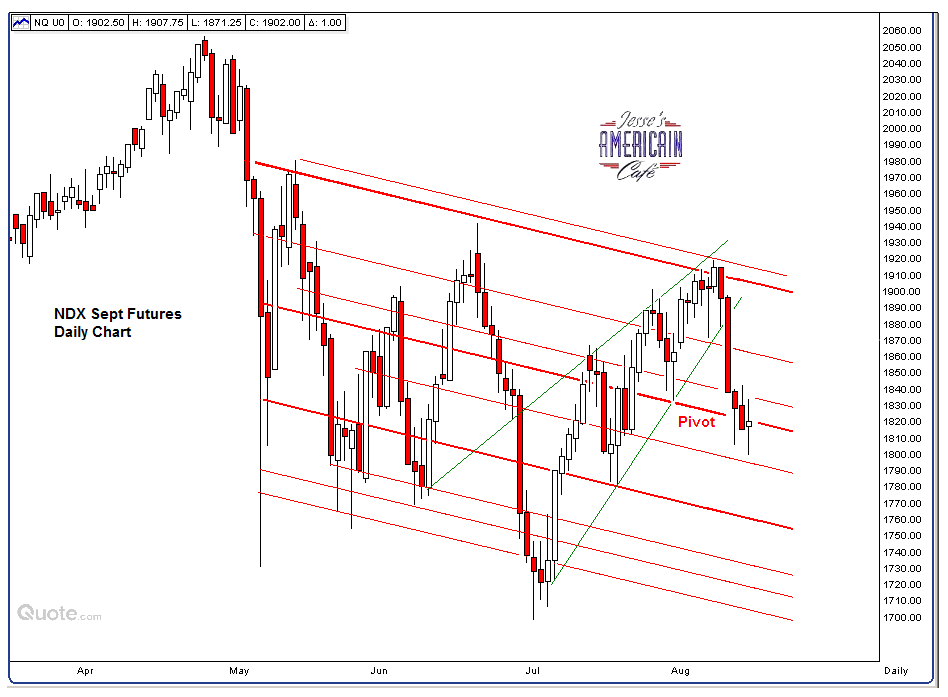
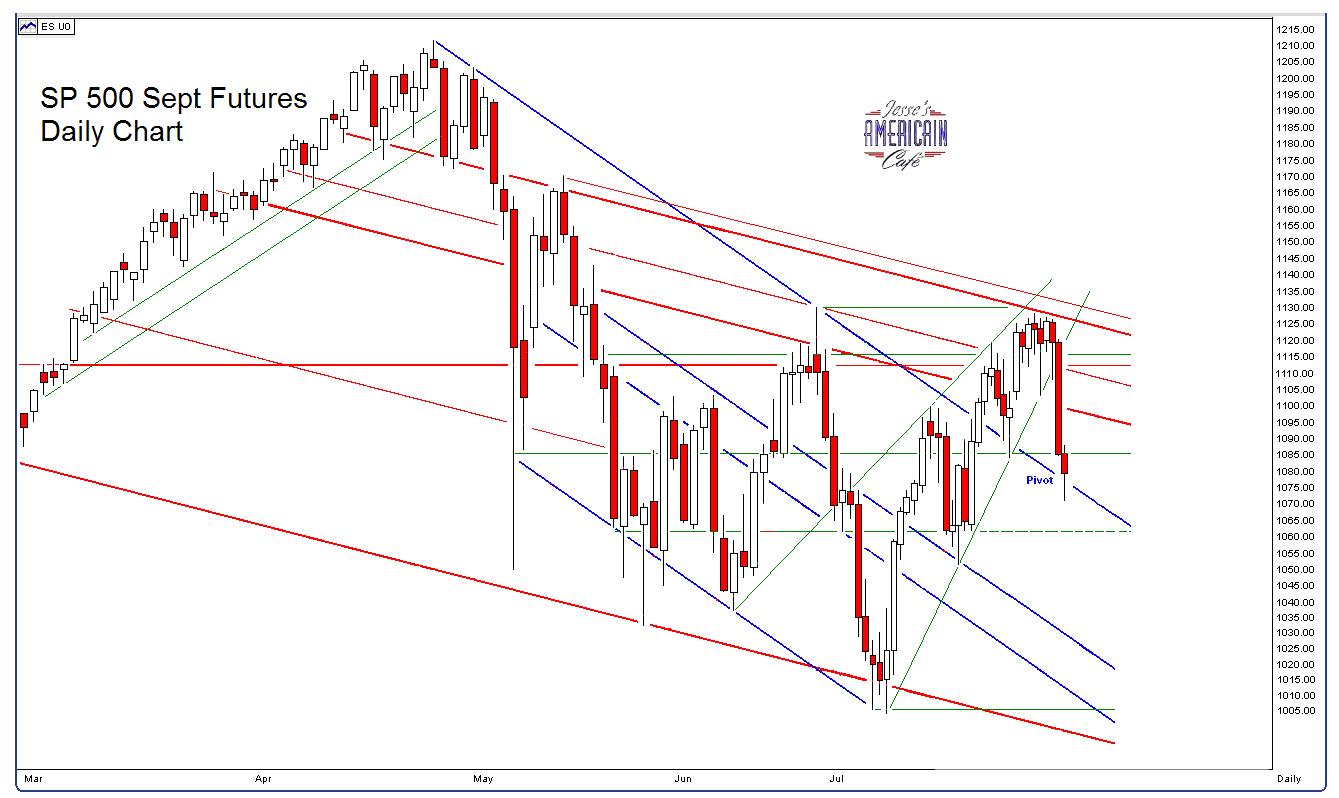
SP 500 and NDX September Futures Daily Charts


The bulls are guarding the pivot points on these charts as though they mean something.

There are quite a few 'crash predictions' floating around. I think they are a bit early, as the period of greatest danger will be from Labor Day to Thanksgiving Day in the States.

There is a whiff of hysteria in the air, and people attempting to use fear to promote their own ends.

SP 500 September Futures Daily Chart


NDX September Futures Daily Chart


13 August 2010

SP 500 and Nasdaq 100 September Futures; Gold Daily Chart at Week's End


Sleepy trade despite the almost 20 point range on the SP futures, and on a Friday the 13th no less.

Light volumes and trader's games.

SP 500


NDX


Gold


GM IPO Timed to Complete Just Before the November Elections


It will be a wonder if the stock market remains favorable to an IPO of this size by October.

ABC News
GM IPO Filing Delayed Until Early Next Week
By Soyoung Kim
August 13, 2010

NEW YORK (Reuters) - General Motors Co has delayed its IPO filing until early next week as it updates its prospectus with the recent CEO change and a management risk factor, a source familiar with the situation said on Friday.

The filing with the U.S. Securities and Exchange Commission was originally scheduled for Friday, sources said previously.

GM Chief Executive Ed Whitacre said on Thursday he would step down and Dan Akerson would take over, effective in September.

The source who said the filing had been delayed declined to be named because preparations for the IPO are not public.

GM's several-hundred-page prospectus will not provide the number of shares to be sold or the pricing range. It will cite the company's bankruptcy, steps completed in restructuring, financial projections, details of ownership, and a large set of risk factors, sources have said.

GM is now adding a new risk factor regarding the departure of Whitacre and increased uncertainty about the automaker's long-term leadership and the change is expected to take more than a day, the source said.

By filing initial paperwork with the SEC next week, GM is aiming to complete its IPO between late October and the U.S. Thanksgiving holiday, another source familiar with the matter said.

A successful GM IPO, which could be the largest ever for the U.S. market, would hand the Obama administration an important political win against critics of its controversial $50 billion bailout of the top U.S. automaker, analysts have said.

The automaker secured a $5 billion credit facility this week, two sources briefed on the deal told Reuters on Wednesday, clearing the last remaining hurdle toward an initial public offering of stock expected to make the U.S. government a minority shareholder.

Ten major banks have signed on to the $5 billion credit facility, committing up to $500 million each, but the individual commitments would be cut as GM adds more banks in other countries and emerging markets as part of its efforts to attract global investors, sources said...

Lair of the Pigmen: FHA to Extend Government Loan Subsidy Benefits to NYC Luxury Condo Market


Weren't FHA loans supposed to be a form a welfare for 'poor people?' Not since the Expanding America Home Ownership Act of 2007.

And it appears this is one 'reform' that can't be blamed on 'the liberals' and Obama. Crony Capitalism is not a political party, it's a way of life in which power and greed are the measure of all things.

Well, some of the New York real estate developers are poor, relatively speaking, compared to an investment banker or a trader pulling down a fifty million dollar annual bonus for packaging fraudulent financial instruments. But they are all rich in their well connected friends in the government.

The kleptocracy never sleeps; crony capitalism knows no bounds...

NBC New York
Luxury Condos Asking the Feds For Help
By JUAN DEJESUS
Fri, Aug 13, 2010

Seek FHA insurance to drive condo sales

The federal government may soon come to the rescue of stalled luxury condominiums in Manhattan.

Manhattan luxury condominiums known for posh amenities and high price tags are beginning to apply for Federal Housing Administration backing.

Condominium developers hope to open financing opportunities for their purchasers as well as guarantee a little protection for themselves. Not only will lending institutions be more willing to lend to purchasers with FHA backing, but the FHA will pay the mortgage should a home buyer default.

The FHA loosened the condo rules because of “market conditions,” Lemar Wooley, an agency spokesman told Bloomberg.com

The administration recently agreed to insure mortgages for apartments at the 98-unit Gramercy Park development, known as Tempo in Match, according to Bloomberg. That deal allowed buyers to make a down payment of as low as 3.5 percent in a complex where apartments run up to $3 million...

William K Black on 'Financial Racketeering;' Government Coverup; a 250% Tax Increase


The interview with William K. Black starts at 13:00 in this video and is well worth seeing.

Gresham's Dynamic: The least ethically inclined have an advantage in the US financial system (in which regulatory capture nullifies enforcement) driven by perverse incentives of oversized bonuses and the failure to investigate and prosecute criminal activity.


In addition to the overhang of unindicted and undeclared fraud that is still in place, distorting the clearing of the markets, there is the issue of an imbalanced economy in which an oversized financial sector exacts what amounts to a draconian tax on the real economy, that is, fees and tariffs and other unproductive drains in excess of anything that the government is levying.

What Do You Get for a 250% Tax Increase?

As I recall the percentage of financial sector profits to corporate profits recently peaked at 41%, from a long run average of less than 16%. Granted, this is a bit theoretical because of the pervasive accounting fraud in the banks and the corporations.

I wonder what the percentage of profit, pre-bonus, is being enjoyed now?

This can be viewed as a form of a tax. If the government raised taxes from 16% to 41% what do you think the impact on the US economy would be? And yet there is little discussion of this, or the racketeering that accompanied such a festival of looting.

Yet conceptually this is what has been accomplished through the deregulation of the banks and the repeal of Glass-Steagall, and of course, regulatory capture. The financial sector acts primarily as a capital accumulation and allocation system, and secondarily to facilitate wealth transferals through pure investment and speculation, the famous school of winners and losers. I would suggest that this latter function has grown out of control like a cancer, and metastasized to drain and debilitate the better part of the political system and the non-financial economy.

I would suggest that this system is broken, and that there can be no sustainable recovery until it is fixed. How can confidence return when most of those in the know realize that the fraud is still in play? Who can take positions with confidence in such a corrupt environment wherein the government acts as the handmaiden to a handful of powerful Banks which engage in large scale frauds as a mainstay of their business, and with virtual impunity?

Stimulus that is not targeted, and especially any subsidy that passes through the Banks, is liable to this tax. It reminds me of warlords stealing charitable relief as it arrives in a Third World country before it can be distributed to the people.

But austerity is even worse, because the kinds of austerity being discussed are specifically targeting the ordinary people who have been badly used already to say the least, and not the perpetrators of one of the biggest financial frauds in the history of the world, and those wealthy few who benefited from a culture of deception which they helped to form.

This is a compounding of the suffering and injustice. If one were to set a recipe for a social and civil revolution it would fit the bill nicely. No one ever said that the pigmen are not self-destructive in their lifestyles and obsessions.

The comparison to the aftermath of the Savings and Loan crisis could not be more stark. Why the inability and reluctance to investigate and indict? What is the government covering up? Who is pulling Obama's strings?

12 August 2010

Ben Davies of Hinde Capital: GLD the New CDO in Disguise?


Here is an interesting interview and slide presentation with Mr. Ben Davies, CEO of Hinde Capital. It should be noted that when he speaks about ETFs he is referring to the gold and silver ETFs only, and with a particular type of customer in mind.

His point is that for those buying gold and silver in large quantity as insurance against systemic risk, the precious metal ETFs like GLD and SLV are not very effective because they have vulnerabilities and correlations with the same risks against which one seeks to insure.

If one wants to own bullion, then own it. It appears that GLD and SLV fall a bit short there, compared even to the bullion funds like PHYS, CEF, GTU, and the streaming metals company SLW, which can also be used for trading purposes.

And some may prefer not to do business with GLD and SLV as a matter of principle, as well as principal.

Ben Davies of Hinde Capital on King World News discusses Exchange Traded Funds (audio interview).

Hinde Capital PDF Slide Presentation on ETFs

There are 50 slides in Hinde's presentation. Here are a few.


Related: Options for Storing Precious Metals - Solari

Here is another critique of GLD that is more detailed: Owning GLD Can Be Hazardous to Your Wealth.

Note: Hinde Capital is offering a product that is competitive to the gold and silver ETFs.

SP 500 and NDX September Futures Daily Charts; Gold Daily Chart; Corporate Bonds


The stock market was hit by a double whammy with the miss in revenue by bellwether Cisco after the bell last night, and then the dreadful unemployment claims number this morning, with 484,000 more people unemployed versus 465,000 expected.

Stocks opened much lower as expected, but as the selling subsided they managed to climb back regaining much of the losses in a low volume trading day.

I think the Street, dominated as it is by the big TBTF banks, will rally around this pivot point of support on the major indices until the General Motors IPO comes out, which should be next week at the latest. CEO Ed Whitacre announced today that he will be stepping down to make way for someone that will stay with the company for a longer time horizon, to give investors confidence in the new share offering as GM becomes a public company again.

So while volumes remain light and 'nothing happens' to trigger hard selling, I would expect these down days to be met with the purchase of the SP futures in particular to give it support. While the SP futures may see unusually high volumes as a fellow blogger noted yesterday, this is indicative of organized Street support to prop the market keying in on the SP 500 futures in the style endorsed by Robert Rubin, and not legitimate investor interest in buying the dip.

There are not many investors in these markets at these prices; the market is primarily consists of speculation and momentum trading, and therefore prone to sharp sell offs like the recent flash crash. This is why I have put out the 'black diamond' sign even though I do not anticipate a serious downleg until the IPO of GM is priced and put out to market. If it is withdrawn that will be a deadly sign that the Street believes there is insufficient liquidity to get it out to market, even though the government wants it to happen, and badly.

By the way, I was just thinking today how fortunate that Bush Jr's proposal to 'privatize Social Security' by investing it in the stock market was turned down, even by Alan Greenspan who never met a pedigreed Wall Street scam he couldn't support.

SP 500


Nasdaq 100

Cisco's weak results (for them) and their weaker forecast sent tech into a tailspin last night. It managed to hold itself together today for the reasons cited above.


Gold appears to have recovered from its FOMC-inspired smackdown and has resumed its uptrend. Do not expect this to be straightforward or easy, and you will not be disappointed.

But anyone who says that gold is a bubble is either talking their book or operating on a badly mistaken theory of money and value. This undeniable bull market in gold and silver is a direct reflection of the well deserved and justified deterioration in the financial system and the currency, the perception that Wall Street is rife with fraud, cronyism and corruption, and hidden counterparty risks.

The way to fix the problem is not by engaging in further fraud and market manipulation, like trying to silence the smoke alarm to keep everyone calm and confident. It takes a particularly perverse Madoff-like view of the world to write that prescription. The way to repair confidence is to reform the markets and weed out the crime, and establish a more equitable and self-governing system of global trade, because the current dollar reserve regime is no longer sustainable.

Failure to reform is gold's best friend. And this is why the crooks hate it publicly, while stuffing their personal vaults with it privately.

Gold


A Sign of a Top in Corporate Bonds

US corporations are issuing large amounts of new debt to take advantage of the exceptionally low rates created by quantitative easing. IBM recently did a major issue of three year notes that went out at one percent. Johnson and Johnson came out today with ten and thirty year notes at record lows.

Johnson & Johnson sold $1.1 billion of debt at the lowest interest rates on record for 10-year and 30-year securities amid surging investor demand for corporate debt.

The drugmaker, in the first offering by a nonfinancial AAA rated company in 15 months, sold $550 million of 2.95 percent, 10-year notes and the same amount of 4.5 percent, 30-year bonds, according to data compiled by Bloomberg. That’s the lowest coupons for those maturities on record, according to Citigroup Inc. data going back to 1981.

Great deal, if you wish to have record low returns in a depreciating currency with counter party risk correlated to an economic recovery. No risk in corporates, right? Maybe less for J&J, but most of the others will be promises writ on water if a major Depression ensues. But perhaps the Fed can buy them.

I obviously cannot predict when and if it will happen with certainty. But if the economy turns down and a dollar currency crisis ensues these corporate bonds will suffer a meltdown between foreign selling and corporate defaults.

Nassim Taleb believes that government bonds will collapse and is betting on it. I think corporates are a better bet, because a business slump and corporate failures could do the trick, even while the dollar and the short end of the curve is viewed as a safe haven.

But if there is a fear of hyperinflation and a greater dollar crisis, even the relative safety of Treasuries will melt down, and the longer end of the curve will drop in value faster than you can say "Sell."


China's Cunning Plan to Destroy the US Dollar


This economic paper might have been funny if it had appeared in The Onion, or on Fox News, and not in a serious journal of economic thought.

This rather clever argument proposes that China is 'destroying the dollar' because they are jealous and hate the US for its happiness and freedom. It is not completely new, but I have not seen it in print. Someone that I know who sometimes spreads spin and stories which they get from highly placed contacts in the banking cartel told me about this diabolical plot about five months ago as I recall.

There reminds me of a long standing corporate tactic that says if you have been doing something underhanded to someone and the shit is about to hit the fan, accuse them of doing the same thing to you first. This was standard management procedure at the multinational where I worked for many years, as it tottered towards its eventual self-destruction.

The theory promoted by this paper is funny because I did not know that Ben Bernanke is Chinese, or that the Federal Reserve is a Chinese state agency. Are the Chinese the cabal of international bankers we hear so much about? How cleverly they disguise themselves.

But it would not surprise me if a portion of the Congress is in on China's payroll. They will take money from anybody and everybody. And after all, the Chinese military were campaign contributors to Bill Clinton (remember that scandal the Clintons tried to pin on Al Gore?) just about the time he opened up trade with them despite their recent 40% currency devaluation and continuing currency peg. And China owns Wal-Mart, and Goldman Sachs, Citi, and JP Morgan there rube, don't ya know. And W doubled down on the deal and went along with this commie plot. Maybe Putin hypnotized him while the Chimp was staring into his soul.

I would file this one under "prospective scapegoats to blame when the dollar currency crisis hits" and everyone in charge denies they could have foreseen it coming. After all, the dollar is as a god, all powerful and immortal.

So this must be an economic sneak attack, a conspiracy of crafty foreign devils. Therefore it's time for a pre-emptive strike on (Venezuela/Iran/some weaker country that has something we want preferably oil). After all, the mighty dollar could NEVER fail because of pernicious abuse by a banking cartel conceived in Georgia and ratified in 1913 by a Congress anxious to go on its Christmas vacation.

Here is another clever plan for the people of the US to consider, when the puffed up dollar finally hits the wall and the Congress and Banksters deny all involvement and responsibility.

* admit that one cannot control one's compulsion for debt and fraud and rule by crooks and idiots;
* recognize a greater power that can give strength and guidance, that most definitely does not work for Goldman Sachs;
* examine past errors with the help of a sponsor (the Constitution and probably the IMF);
* make amends for these errors by cleaning up your corrupt financial system and jailing the white collar criminals involved;
* learn to live a new life by honoring a code of behavior (the Constitution), a hard currency, and give up the idea of empire;
* help others that suffer, as a benevolent US did many years ago before it was hijacked by a group of irresponsible sociopaths.
The dollar has been in the process of self-destruction since that clever Chinese agent Richard Nixon defaulted on the US gold obligations in 1971.

And of course that Sino-Soviet agent Ronald Reagan who convinced the nation that 'deficits don't matter' if it involved tax cuts for the wealthy. And the coup de grâce has been delivered by Wall Street and their crony capitalists in the government as collateral damage in the reckless promotion of self interest, corruption and fraud.

The sad truth, America, is that you were sold out by your own people for their own personal gain. And the crony capitalists and oligarchs are still leading you around by the nose, and telling you what to think, which is whatever is good for them. And this goes double for the UK.

Economic Policy Journal
Is China Executing a Cunning Sun Tzu Strategy to Destroy the Dollar and Cause an Upward Price Explosion in Gold?
By Elizabeth Brinsden
August 12, 2010

Could China be coveting the role of the next economic superpower, thereby supplanting the USA? If so, is China planning to do this by design or is it simply awaiting this result by default as a result of the total collapse of the American economic system?

Whether we like it or not, China has already become the 800 lb Gorilla in the dining room, economically speaking. We ignore this fact at our peril. Thus it may be advisable to reorientate our thinking from that of the rationalist, pragmatic thought processes which arose out of the Enlightenment and complement our thinking with something more akin to that of the Chinese.

In order to accomplish this, it is constructive to take a closer look at the ancient Chinese philosopher, Master Sun Tzu. In an earlier article , based on a book by Harro von Senger on this theme[1], I have attempted to do this in connection with the Special Drawing Rights[2], as advocated by the Chinese earlier this year. However, I will now examine this idea in the context of the the Chinese possession of US Bonds, a subject not only of relevance to these two countries, but also for the stability of the entire international economic system.

At a superficial level, it may appear to the onlooker that China has been sucked into a giant malinvestment by purchasing these bonds, but a closer look at Master Sun’s stratagems may reveal a well conceived and even cunning plan...

Read the rest of this paper here.

Whitney: Obama Is 'a Public Relations Hologram'


As you know I have been trying to 'figure out' Barack Obama and his mysterious background and equally mystifying rise to power, without having done anything notable, either in business, or civil service, or even military service. Granted, he talks one hell of a game but always seems to fall short. He seems to have less substance, far less accomplishments than his fellow actor in the White House, Ronald Reagan, who had been a governor before becoming President.

Perhaps the answer is as simple as this.

"It's hard to believe that a two-year senator from Chicago with a background in 'community organizing' presides over this elaborate and opaque system of imperial rule. He doesn't, of course. The real leaders remain hidden behind the cloak of democratic government and all of Washington's phony institutions. Obama is merely a public relations hologram, a friendly face that conceals the machinations of a global Mafia. Other people--whoever they may be--control the levers of power moving the pieces as needed to assure the best outcome for themselves and their constituents." Mike Whitney, Kill Hugo?
Well, unlike his predecessor, at least he has not tortured anyone that we know about.

11 August 2010

SP 500 and NDX September Futures Daily Charts; Gold Daily Chart


Today we had the reaction to the FOMC announcement that I was expecting, a failure at overhead resistance that dropped down to the support at our pivot, almost exactly, and going out on the lows.

What next? It's hard to say. The best that can be said for the bulls is that the selling today was on volumes that remain light. But that is also a negative, because this means the market has not yet flushed out to the downside.

This leaves the equity market open to manipulation by the big trading desks, who will trigger a snapback rally if too many specs pile on to the short side. But the momentum is now to the downside.

I would look for the futures to test the lowest levels of the overnight trade during that session, and then a recovery and probe back down after the New York open, and most likely a snapback rally during the day to squeeze the spec shorts. At least, that it the strawman, but we'll trade the market we are given.


Cisco missed its revenue after the bell, but hit its earnings, which is a almost a slam dunk given their acquisition and holdback style of accounting. This does not bode well for the techs.


NYSE Volume


Today we had a pullback in gold to support. The traders on chatboards greatly exaggerate these moves in their chatter. Try not to fall into that trap. So far the trend is well intact.


Kotlikoff: The IMF Says That the US Is Bankrupt, and They're Right


I have not read it yet, but Kotlikoff has a book out called "Jimmy Stewart Is Dead" which was reviewed in April by Craig Heimark at Naked Capitalism.

I have not followed Kotlikoff closely and will attempt to read some of his more serious material in the near future. I did listen to a long discussion on Bloomberg television this afternoon, and he made some real sense to me, although he did not penetrate the miasma of corporate sloganeering that represents the minds of the anchors. They seem to lean to the 'cut everything that is not a subsidy to or a cashflow owned by the oligarchy' school of economic reform. And he takes that sort of supply side hoaxing to task, and harshly.

I have to take a closer look at his analysis of Social Security, which is highlighted in this Bloomberg piece (quelle surprise). But his comments on the need for reform in the financial system was point on.

He disagrees with both the supply siders and the demand siders, favoring a systemic overhaul and reform, and so my interest in what he says is obvious.

Bloomberg
U.S. Is Bankrupt and We Don't Even Know

By Laurence Kotlikoff
Aug 10, 2010

Let’s get real. The U.S. is bankrupt. Neither spending more nor taxing less will help the country pay its bills.

What it can and must do is radically simplify its tax, health-care, retirement and financial systems, each of which is a complete mess. But this is the good news. It means they can each be redesigned to achieve their legitimate purposes at much lower cost and, in the process, revitalize the economy.

Last month, the International Monetary Fund released its annual review of U.S. economic policy. Its summary contained these bland words about U.S. fiscal policy: “Directors welcomed the authorities’ commitment to fiscal stabilization, but noted that a larger than budgeted adjustment would be required to stabilize debt-to-GDP.”

But delve deeper, and you will find that the IMF has effectively pronounced the U.S. bankrupt. Section 6 of the July 2010 Selected Issues Paper says: “The U.S. fiscal gap associated with today’s federal fiscal policy is huge for plausible discount rates.” It adds that “closing the fiscal gap requires a permanent annual fiscal adjustment equal to about 14 percent of U.S. GDP.”

The fiscal gap is the value today (the present value) of the difference between projected spending (including servicing official debt) and projected revenue in all future years.

Double Our Taxes

To put 14 percent of gross domestic product in perspective, current federal revenue totals 14.9 percent of GDP. So the IMF is saying that closing the U.S. fiscal gap, from the revenue side, requires, roughly speaking, an immediate and permanent doubling of our personal-income, corporate and federal taxes as well as the payroll levy set down in the Federal Insurance Contribution Act.

Such a tax hike would leave the U.S. running a surplus equal to 5 percent of GDP this year, rather than a 9 percent deficit. So the IMF is really saying the U.S. needs to run a huge surplus now and for many years to come to pay for the spending that is scheduled. It’s also saying the longer the country waits to make tough fiscal adjustments, the more painful they will be.

Is the IMF bonkers?

No. It has done its homework. So has the Congressional Budget Office whose Long-Term Budget Outlook, released in June, shows an even larger problem.

‘Unofficial’ Liabilities

Based on the CBO’s data, I calculate a fiscal gap of $202 trillion, which is more than 15 times the official debt. This gargantuan discrepancy between our “official” debt and our actual net indebtedness isn’t surprising. It reflects what economists call the labeling problem. Congress has been very careful over the years to label most of its liabilities “unofficial” to keep them off the books and far in the future.

For example, our Social Security FICA contributions are called taxes and our future Social Security benefits are called transfer payments. The government could equally well have labeled our contributions “loans” and called our future benefits “repayment of these loans less an old age tax,” with the old age tax making up for any difference between the benefits promised and principal plus interest on the contributions.

The fiscal gap isn’t affected by fiscal labeling. It’s the only theoretically correct measure of our long-run fiscal condition because it considers all spending, no matter how labeled, and incorporates long-term and short-term policy.

$4 Trillion Bill

How can the fiscal gap be so enormous?

Simple. We have 78 million baby boomers who, when fully retired, will collect benefits from Social Security, Medicare, and Medicaid that, on average, exceed per-capita GDP. The annual costs of these entitlements will total about $4 trillion in today’s dollars. Yes, our economy will be bigger in 20 years, but not big enough to handle this size load year after year.

This is what happens when you run a massive Ponzi scheme for six decades straight, taking ever larger resources from the young and giving them to the old while promising the young their eventual turn at passing the generational buck.

Herb Stein, chairman of the Council of Economic Advisers under U.S. President Richard Nixon, coined an oft-repeated phrase: “Something that can’t go on, will stop.” True enough. Uncle Sam’s Ponzi scheme will stop. But it will stop too late.

And it will stop in a very nasty manner. The first possibility is massive benefit cuts visited on the baby boomers in retirement. The second is astronomical tax increases that leave the young with little incentive to work and save. And the third is the government simply printing vast quantities of money to cover its bills.

Worse Than Greece

Most likely we will see a combination of all three responses with dramatic increases in poverty, tax, interest rates and consumer prices. This is an awful, downhill road to follow, but it’s the one we are on. And bond traders will kick us miles down our road once they wake up and realize the U.S. is in worse fiscal shape than Greece.

Some doctrinaire Keynesian economists would say any stimulus over the next few years won’t affect our ability to deal with deficits in the long run.

This is wrong as a simple matter of arithmetic. The fiscal gap is the government’s credit-card bill and each year’s 14 percent of GDP is the interest on that bill. If it doesn’t pay this year’s interest, it will be added to the balance.

Demand-siders say forgoing this year’s 14 percent fiscal tightening, and spending even more, will pay for itself, in present value, by expanding the economy and tax revenue.

My reaction? Get real, or go hang out with equally deluded supply-siders. Our country is broke and can no longer afford no- pain, all-gain “solutions
.”

(Laurence J. Kotlikoff is a professor of economics at Boston University and author of “Jimmy Stewart Is Dead: Ending the World’s Ongoing Financial Plague with Limited Purpose Banking.” The opinions expressed are his own.)

ZeroHedge: Richard Russell Slams Robert Prechter, Praises Gold, Tells Readers Get Out Of Stocks.


First, Richard Russell does not 'slam' Prechter because he is a gentleman and doesn't really 'slam' anyone. Fights between pundits can be fun in a voyeuristic way, but they are largely unproductive and generally used as a means of gaining attention, and providing distraction from what really matters, in the manner of panem et circenses. And sometimes people use provocative headlines to garner interest as well, in the manner of the New York Post and Daily News.

What Russell is saying is that Prechter is wrong in his interpretation of how deflation will play out, and what the endgame will look like. And he is saying almost the same thing that others, including Eric Janszen and myself, have been saying for quite some time, but in a slightly different ways.

Second, what Bob Prechter does not realize is that a contraction in credit does not imply a one for one decrease in 'money' just as an increase in credit these days does not result in a one for one increase in money. That is because credit is not money, it is the potential for money. Why more people don't get that is beyond me. They trumpet the diminishing returns of money production for each marginal dollar of credit, but they don't admit that this credit is vaporous, and as it dissipates it does not reduce money supply one for one either.

Third, and probably most importantly of all, even as the credit contracts, and the money supply contracts at some lesser rate as show in the money supply figures, the 'basis of value' of the money is also contracting. Since the US dollar is not based on gold, we have to look at what is providing the basis of its value. And what are those things, and what is happening to THEIR value.

And finally, there is a huge overhang of eurodollars out there, that are largely parked in Treasuries mostly of a moderate duration of three to ten years. By buying the Three and Ten year notes the Fed is 'monetizing them' and taking that supply off the market, softening the blow when foreign entities first stop buying them, and then eventually start selling them.

We can't detect the selling yet in the Fed Custodial accounts. And we do not have a reliable reporting of eurodollars because that is the ONLY component of M3 that was discontinued by the Fed a few years back. The rest were maintained. When the Fed said they would no longer report M3 what they were really saying is that they would no longer provide a reliable report on eurodollars. The conspiracy guys may have been right, but they were focusing on the wrong item.

Bernanke and the Fed are going to be playing these markets to manage bonds and the dollar, and it is going to be a balancing act, and most likely a race to the bottom. That is why it is hard to predict. So far Ben is being predictable, doing what he said he would do, even if it is not always clear to everyone. But he has some other things in his bag of tricks, and those might be a little more complex.

What the Fed is doing by lowering the Ten year note by buying it in the market, in addition to picking up the slack from the overseas banks, is trying to trigger another round of refinancing in corporates and mortgages. It is estimated that two trillion in refi's will be triggered if the Fed can get the Ten year down below 2.5 and even approach 2 percent.

And this prolonged quantitative easing has a secondary effect that supports this. These low rates tend to drive investors from low yielding instruments in search of return, which implies a mix of greater duration and risk. More on this at some future date.

I think Elliot Waves are popular because they are not particularly rigorous or scientific, are easily learned, and are flexible enough to justify almost any outcome you wish to see. Their value is that they remind people that things do not go straight up or straight down. Since most charting is just a forecast it might be no better or worse than the others.

But what does discredit Prechter is that he is using an economic monetary model from 'the last crisis' that was valid when the dollar was on an external standard. And it is a pure fiat currency now. That is a huge difference, and the failure to account for that in your thinking is an elementary mistake.

AND even worse, he has been repeatedly wrong about gold for the past eight years and has never admitted or understood why, and merely keeps moving his price levels. Although to his credit he has been very right about Treasuries, and people should not forget that either. Treasuries have been in an epic bull market for quite some time, and like bull markets in stocks have created quite a few market geniuses out there.

Bob has his points for and against like everyone else. He has made some very good calls, and some horrible misses. People tend to remember the hits and forget the misses.

Does Bob ever admit it when he is wrong? He has never done so on gold. And I find stubbornness in the face of failure to predict, the unwillingness to admit error and adjust, to be just the kind of amateurish investing error that causes people to take their trading accounts over Niagara Falls. And I think this is what concerns Richard Russell, that if and when the tide changes and the dollar resumes its long decline lower, that Bob will not recognize or admit it, and will take quite a few trusting souls over the cliff with him.

No matter what happens with easing or not, the primary issue is that a relatively small financial elite has taken control of the US economy, and is using it for their personal power and wealth, and corrupted the natural market processes.

And this corruption is being transmitted to the rest of the world's economy creating bubbles and collapses in distant places because of the importance of the US economy and the dollar. Since the Bankers have control of the issuance of the world's reserve currency, they can bend the world to their will, and their willfulness is not beneficial to anyone except themselves. The world is seeing the continuation of the 'cold war' under different means and with different objectives, and with a different set of adversaries and alliances.

But what about Japan? There are easily twenty examples of monetary crises and economic collapses since WW II, and Japan is the one seized upon as THE example of what MUST happen in the US, despite the tremendous differences in position of the two countries economically, culturally, and demographically. Talk about conformational bias. I have spoken about this at length in the past. Japan demonstrates that monetary outcomes in a pure fiat regime are a policy decision. And Japan was homogenous enough, and small enough, to play in its own policy sandbox long enough to realize the outcome that was achieved. Until recently, Japan was essentially a 'one party' democracy imposed on them after the War by the US, ruled by the LDP and the big corporations, the keiretsu.

All things considered, the Russian outcome seem more likely to me, except the US is short on natural resources, so it is hard to forecast what will finally trigger the recovery. The dominant industry is financial fraud, demand that seems to be on the decline in US' trading partners, unholy alliances amongst central banks notwithstanding.

The US financial sector is still greatly oversized, and exacting a debilitating tax on the real economy. The markets are manipulated and rife with fraud, so productive capital formation and allocation is short circuited by short term speculation at almost every turn. There will be no recovery unless the system can be brought back to a pre-bubble state. And the system will not cure itself by deprivation or a false austerity, dishing out more punishment to the victims. This will provoke a destructive reaction, not what anyone would call a cure.

That is the real issue. Everything else to me is a sideshow, gossip, distraction, and noise.

You can read the original article Richard Russell Slams Robert Prechter, Praises Gold, Tells Readers To Get Out Of Stocks.

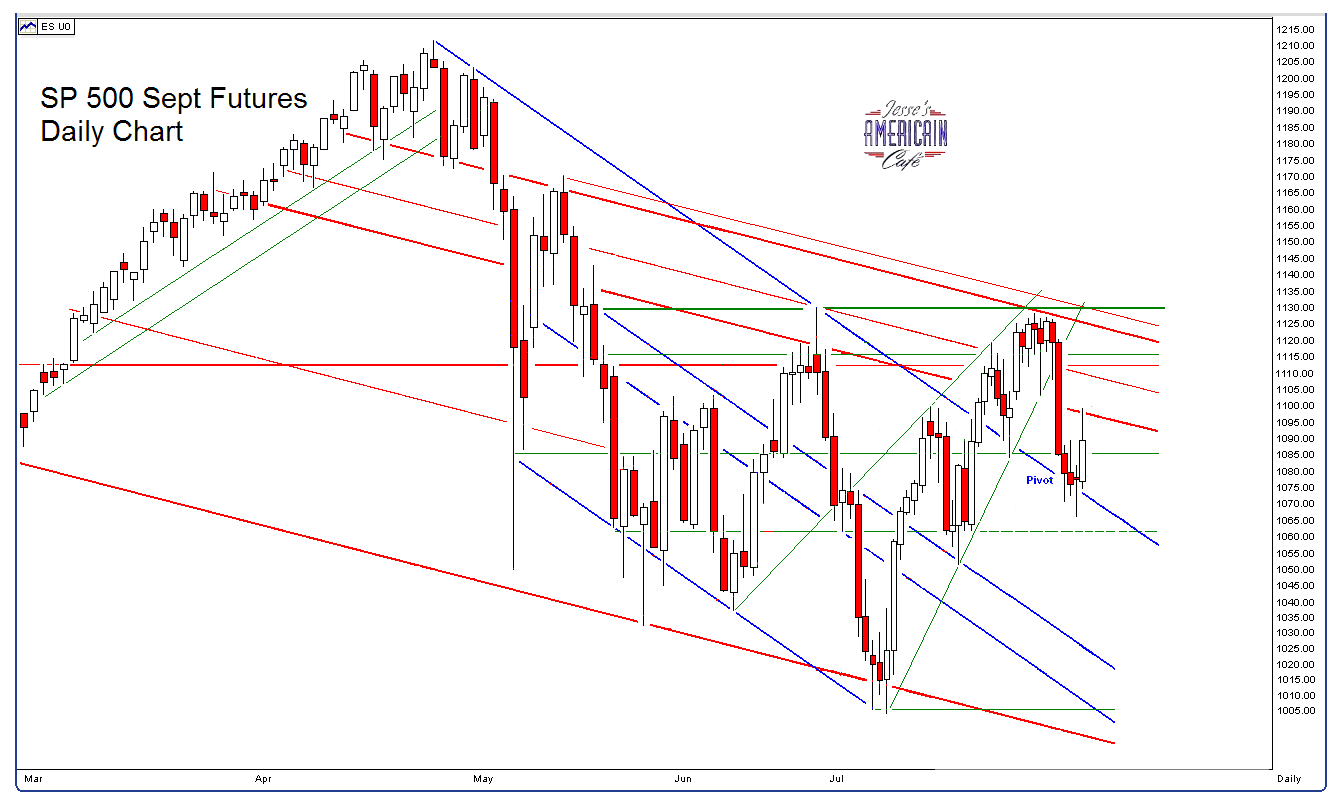
SP 500 September Futures Daily Chart


Gold Daily Chart


10 August 2010

Why The Bankers, The Fed, and Their Allies In Washington Are Afraid of Elizabeth Warren


“Fascist regimes almost always are governed by groups of friends and associates who appoint each other to government positions and use governmental power and authority to protect their friends from accountability. It is not uncommon in fascist regimes for national resources and even treasures to be appropriated or even outright stolen by government leaders."

Dr. Lawrence Britt

The Nation
The AIG Bailout Scandal

William Greider
August 6, 2010

The government’s $182 billion bailout of insurance giant AIG should be seen as the Rosetta Stone for understanding the financial crisis and its costly aftermath. The story of American International Group explains the larger catastrophe not because this was the biggest corporate bailout in history but because AIG’s collapse and subsequent rescue involved nearly all the critical elements, including delusion and deception. These financial dealings are monstrously complicated, but this account focuses on something mere mortals can understand—moral confusion in high places, and the failure of governing institutions to fulfill their obligations to the public.

Three governmental investigative bodies have now pored through the AIG wreckage and turned up disturbing facts—the House Committee on Oversight and Reform; the Financial Crisis Inquiry Commission, which will make its report at year’s end; and the Congressional Oversight Panel (COP), which issued its report on AIG in June.

The five-member COP, chaired by Harvard professor Elizabeth Warren, has produced the most devastating and comprehensive account so far. Unanimously adopted by its bipartisan members, it provides alarming insights that should be fodder for the larger debate many citizens long to hear—why Washington rushed to forgive the very interests that produced this mess, while innocent others were made to suffer the consequences. The Congressional panel’s critique helps explain why bankers and their Washington allies do not want Elizabeth Warren to chair the new Consumer Financial Protection Bureau.

The report concludes that the Federal Reserve Board’s intimate relations with the leading powers of Wall Street—the same banks that benefited most from the government’s massive bailout—influenced its strategic decisions on AIG. The panel accuses the Fed and the Treasury Department of brushing aside alternative approaches that would have saved tens of billions in public funds by making these same banks “share the pain.

Bailing out AIG effectively meant rescuing Goldman Sachs, Morgan Stanley, Bank of America and Merrill Lynch (as well as a dozens of European banks) from huge losses. Those financial institutions played the derivatives game with AIG, the esoteric practice of placing financial bets on future events. AIG lost its bets, which led to its collapse. But other gamblers—the counterparties in AIG’s derivative deals—were made whole on their bets, paid off 100 cents on the dollar. Taxpayers got stuck with the bill.

“The AIG rescue demonstrated that Treasury and the Federal Reserve would commit taxpayers to pay any price and bear any burden to prevent the collapse of America’s largest financial institutions,” the COP report said. This could have been avoided, the report argues, if the Fed had listened to disinterested advisers with a less parochial understanding of the public interest....

Read the rest here

US Taxes As A Percent of GDP


Source: Department of Numbers

09 August 2010

KKR Cancels Their Secondary Stock Offering of $500 Million As Earnings Drop 92%


"Market conditions" says Bloomberg TV. And a freshly announced 92% drop in earnings year over year that the company announced after the bell did not help.

The decline in profits was related to "one time issuance of equity awards from its stock issuance" most likely related to their recent IPO on July 15.

I'll try to keep a straight face. I'm sorry. Who is their CFO, Bernie Madoff? What they hell are they doing with a secondary offering less than a month after the IPO, and having given away most of their earnings in employee bonuses! Are they nuts? Do these jokers have a business plan, or do they just make it up as they go along?

The pulling of a big high profile secondary like this is a sign that the underwriters looked behind the curtain of market depth and volume and said, Yech! There is no way this beast will fly and we are not going to eat the excess shares and risk a failed offering. We're technically insolvent ourselves!

Aug. 5: KKR Rises As Citi Says BUY to $14 Target

Maybe Wall Street really needs those wealthy welfare tax cuts if bonuses are going to be limited to only 92% of earnings, and the shareholding public will not agree to foot the bill in the free market by taking on new shares just a few weeks after the IPO.

Spin that, you gravy sucking Wall Street pigs.

WSJ
KKR Drops Plans for Stock Offering

By PETER LATTMAN
AUGUST 9, 2010, 5:38 P.M. ET.

KKR & Co. said it dropped plans to raise $500 million in a stock offering, a setback for the firm as it begins life as a company publicly traded on the New York Stock Exchange.

In reporting earnings for the first time as an NYSE-listed firm, KKR said late Monday that it earned $29.9 million, compared with $365.8 million during the same period of 2009. That 92% drop, in part, reflects the cost of the one-time issuance of equity awards relating to its stock issuance. (The shareholders should revolt and throw out management - Jesse)

KKR's core private-equity business performed well. Holdings on its balance sheet, which include Texas utility Energy Future Holdings Inc., were marked 6% higher in the three months through June. The Standard & Poor's 500-stock index dropped 12% for the quarter.

Last month, KKR moved its listing to the NYSE from the Euronext exchange to provide its stock with more liquidity and a broader investor base. In May, it announced that as part of its U.S. listing it would raise $500 million to fund the firm's growth and potential acquisitions. KKR has since squelched the offering...