15 November 2012

SP 500 and NDX Futures Daily Charts


Stocks headed lower today on weaker than expected economic data in unemployment claims and the Philly Fed number. There was also some distressing news about fresh outbreaks of fighting in Gaza.

Hurricane Sandy will be affecting all the economic numbers for October, and therefore for the fourth quarter. It was an enormously destructive storm, with economic damage in the $40+ Billion range.

The markets are oversold short term. They could become even more oversold, but I suspect we are nearing the end of the tax selling as a result of the Obama win.

Let's see how tomorrow takes us into the weekend. As a reminded, next week will be holiday shortened in the States for Thanksgiving holiday. This is a good time to count our blessings.


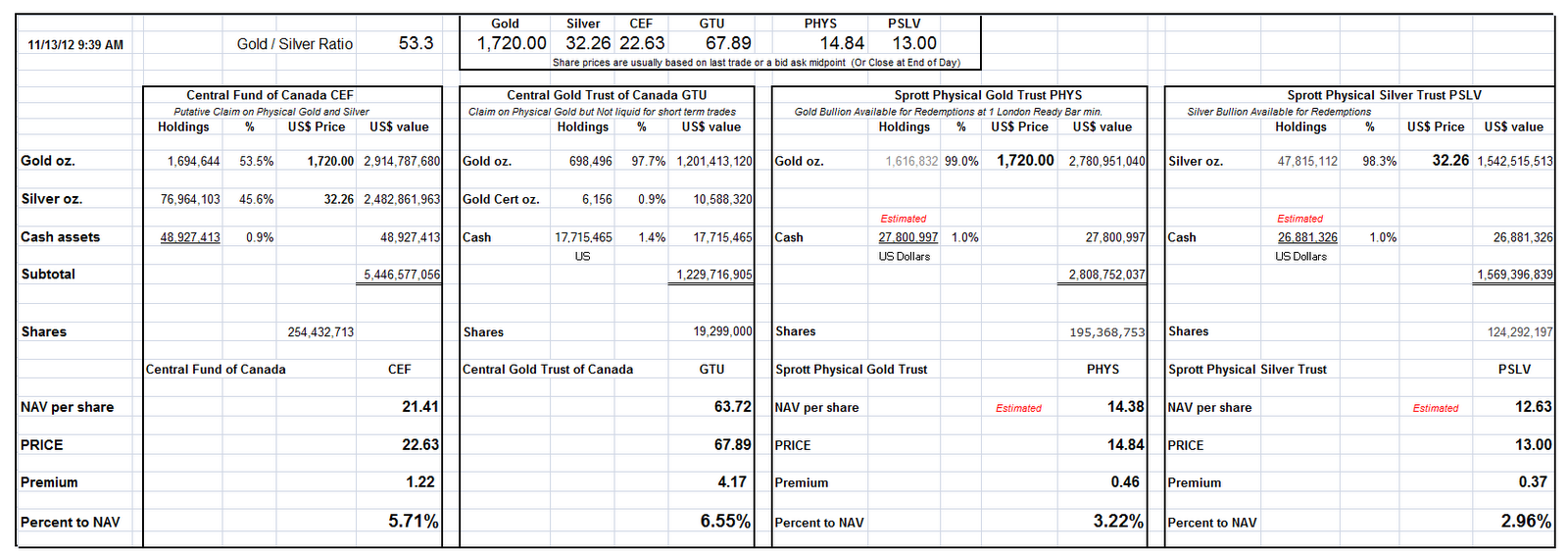
Net Asset Value Premiums of Certain Precious Metal Trusts and Funds - Sprott Underperforms


The Sprott Funds are at historically very low premiums and, when compared to the Central Funds, look cheap.

As I recall the Central Funds are a tougher short. Still, as the chart at the bottom shows, PHYS and PSLV have underperformed the Spicer funds this year.


Bernie Sanders On the Fiscal Cliff and Deficit Reduction


JPM 'Benched' from Trading in the Energy Markets for Six Months


The US Federal Regulatory Commission (FERC) has suspended JP Morgan's electrical trading privileges for six months in response to JPM's continued provision of false and misleading information.

In the story from Bloomberg:
The action, part of a more aggressive effort by the commission to monitor U.S. power markets, prohibits J.P. Morgan Ventures Energy Corp. from selling electricity at market-based rates for six months starting April 1, 2013.

In its order released late yesterday, FERC said the JPMorgan unit will essentially be allowed to participate as a bystander in wholesale power markets, granting it the ability to offer electricity into the market without a price attached. This will ensure that utilities have the ability to obtain enough power to serve the demand from customers. JPMorgan would still be able to trade derivatives under the order...

"The provision of false, misleading, or inaccurate information undermines the integrity of the FERC decision-making process, the smooth operation of markets, and FERC's ability to ensure just and reasonable rates for customers," FERC said in an e-mailed statement. "The commission continuously has warned market participants of the consequences associated with failing to abide by FERC rules and regulations."

A spokeswoman for the bank said it is reviewing the decision and its next steps. "This is a novel use of FERC's authority over market-based rates and is unsupported by FERC's own regulations," Jennifer Zuccarelli said in an e-mail.

The commission is also investigating alleged manipulation by traders for Deutsche Bank AG and Barclays Plc. Since January 2011 the agency has announced 11 market-manipulation probes, and in March it reached a $245 million settlement with Constellation Energy Group Inc. over one of those cases.

This is also a nice illustration of the moral hazards of weakly regulating the markets. It was not all that long ago that Enron roiled the California economy by manipulating the prices of electricity. It is nice to see that someone is doing something, even if it involves no criminal indictments.

If the CFTC is unable to act in the commodity markets, someone has to do something to maintain orderly pricing and clearing markets for the use of the real economy.

And one might ask, why is a bank that is backstopped by the Federal Reserve and government guarantees on deposits gambling in the energy markets to this extent? Would that function not best be served by a purely private company, rather than a de facto Government Sponsored Enterprise (GSE)?

Bear Raid in the Metals? - Front Running Sharks with Lasers


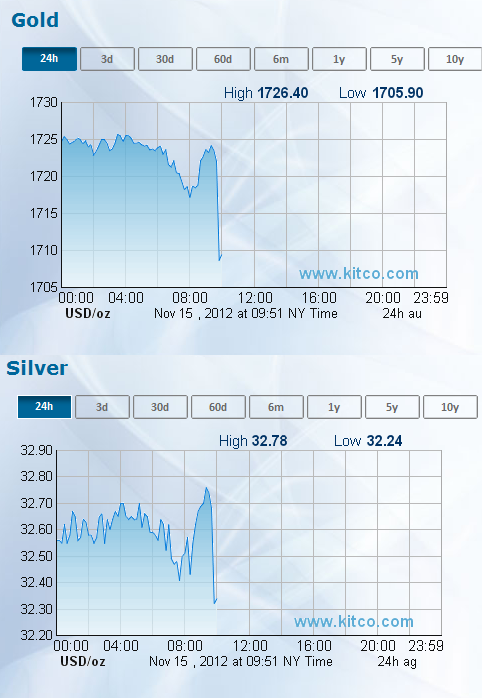
Metals plunged along with stocks in reaction to a worse than expected Philly Fed reading of -10.7. What was unusual was that the plunge preceded the official release by twenty minutes.

November 2012 Business Outlook Survey

Firms responding to the November Business Outlook Survey reported declines in business activity this month following the disruptive effects of Hurricane Sandy on the region. The survey’s indicators for general activity, which had shown improvement in October, fell back into negative territory this month. Firms reported slight declines in shipments, employment, and hours worked. Indicators for the firms’ expectations over the next six months were near their levels in the previous month, but expectations for future employment and capital spending have weakened in the last two months.

Indicators Suggest Diminished Activity

The survey’s broadest measure of manufacturing conditions, the diffusion index of current activity, decreased 16 points, to a reading of ‑10.7. The fallback of the general activity index followed a single positive reading in October that was preceded by five negative monthly readings (see Chart).

Nearly 32 percent of firms reported declines in activity this month, while 21 percent reported increases. The demand for manufactured goods, as measured by the current new orders index, declined 4 points from last month and remains in negative territory.

Shipments also fell this month: The current shipments index fell 7 points, to ‑6.7. Declines in inventories were also more widespread this month; 31 percent of firms reported declines compared with 21 percent in October.

As one might expect, the sharp drop in activity was related to the effects of Hurricane Sandy. I have been expecting this, but I did not know that the Philly Fed survey would pick it up so quickly.

What was initially confusing was that stocks began to decline sharply around 9:35 AM. Gold had a waterfall plunge from 1722 to 1705 from 9:35 to 9:45.   I had already completed the initial post of this before the Fed report hit the news.

The Philly Fed was officially released at 10:00 AM. I have not discovered if it was officially released prematurely, or if the markets were just front running the data for a quick 'wash and rinse.'  They would suspect that the data would be a 'miss' because of the devastating effect of the hurricane on the region.

In the long run markets are a discounting mechanism, but in the short term they are a pinball game, especially in these days of large leveraged players and lax regulation.

So I think it was either a leak, or a 'trading idea' shared amongst several of the trading desks, or a bit of both. The revolving door also has an intercom.

I had the opportunity to add to a growing silver position. I am sure the wiseguys did much the same. I was not prepared for it, just lucky to be watching it as it happened.

We may wish to bear in mind the knock on effect of Hurricane Sandy on subsequent economic report for the fourth quarter. The devastation on this most populated region of the US was profound. The data will no doubt provide fresh opportunities to game the markets.

Knowledge is power.


14 November 2012

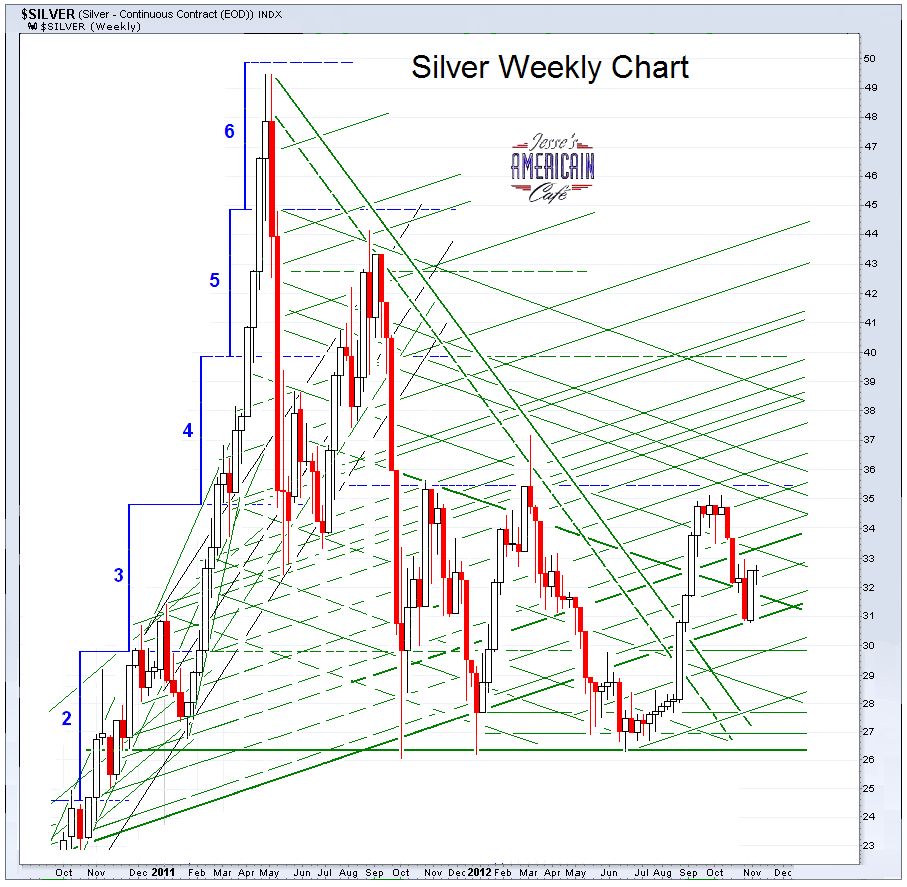
Gold Daily and Silver Weekly Charts


"The voice of protest, of warning, of appeal is never more needed than when the clamor of fife and drum, echoed by the press and too often by the pulpit, is bidding all men fall in and keep step and obey in silence the tyrannous word of command. Then, more than ever, it is the duty of the good citizen not to be silent."

Charles Eliot Norton

In my opinion the bulk of the market action is being driven by tax selling, the taking of profits this year before the expected tax changes which will occur next year either with 'the fiscal cliff' or 'the grand bargain.'

The negotiations around this 'fiscal cliff' are fascinating. I am still wondering how Obama managed to box the Republicans in so thoroughly. Was the GOP just that confident of a big win in the election, or is Boehner playing hardball with the Tea Party wing of the House? One can only wonder.

Gold and silver continue to coil for a move.

Genuine reform remains a distant goal.


SP 500 and NDX Futures Daily Charts - VIX Finally Rises


One of the things that has been puzzling about this decline is the relatively low number on the VIX.

That means that this entire decline has been accompanied by much less 'fear' than one would expect. This is consistent with my prediction that an Obama election win would result in a fairly stiff selloff as profits are taken this year in anticipation of a tax increase for those making over $250,000 per year beginning in January.

Let's see how the VIX goes from here. The selling is very orderly and if it is tax related at some point the selling becomes self defeating, which is when the small speculators will be joining in by design, selling out of fear at the bottom.

IF this is true, and nothing develops in the Middle East for example, I would expect to see prices stabilize and even rally in December.

I do think the fiscal cliff is bollocks. I could be wrong, but I do not think so.


13 November 2012

Bart Chilton On Silver Manipulation - Gold and Silver Coiling For a Major Move - The Next Disaster


In discussing the government's lack of reaction in reforming the high frequency trading developments in the market, the CFTC's Bart Chilton remarks in the video below about the unfortunate tendency of regulators not to act until something unfortunate happens as being a:
"...tombstone mentality, when you wait for a disaster before you put something in place."
The CFTC is hampered and opposed at every step of the way by the financial powers and their exchanges, who unfortunately wield a powerful and well-funded lobbying effort that tends to lead the political element in Washington by the nose, or their wallets, as you prefer.

I have come to believe that the US government will do nothing effective to reform the gold and silver markets and the equity exchanges until there is a MAJOR dislocation in the markets, and a virtual 'run on the exchange.'

Change will come after the US financial system is threatened by a major solvency or liquidity event.

Whether it originates from a failure to deliver in gold and silver markets that exposes them as a highly artificial and overleveraged house of cards, or another 'flash crash' that brings down a major exchange or trading house through counter party failures, I now believe that this sort of failure and scandal is what it will take to bring meaningful reform to this highly unstable Anglo-American financial system.

Change will be not voluntary with these greedy, self-destructive jackals, especially after the moral hazard that was introduced by the unfortunate policy error of 'no-strings' bailouts from the last financial crisis.   And the lack of regulation and accountability that has ensued is corrosive.

Reform will be accomplished, but only under the duress of the next financial disaster.  


Gold Daily and Silver Weekly Charts - Eric Sprott on Gold - JPM Backstops NJ Debt Offering


Gold and silver moved sideways today, as stocks remained weak and treasuries gained.

Trading remained quiet. There is an intraday post on the sort of commentary about gold that was 'popular' in 1999.

In the monetization of official debt department, JPM Agrees to Fully Backstop NJ $2.6 Billion Debt Offering. Just in case you were wondering who the 'house bank' is and why they keep it around.

All the Fed and Treasury need are a few cooperative intermediaries in the private sector willing to take the vig, and they can run the money machine day and night through the wonderful price discovery mechanism of market 'auctions.'

I wonder if they will have an open bar and jumbo shrimp at this prix fixe bond event? Maybe a nice ice sculpture of the queen of the silver market?

Have a pleasant evening.


SP 500 and NDX Futures Daily Charts - 200 DMA Weighs on Stock Indices


Stocks opened weakly and then rallied throughout most of the day, giving up their gains into the close.

Techs weighed all day, and in the last hour the financials joined in and took the SP 500 down as well.

CSCO beat on its earnings report after the bell. The stock was up almost 8 percent on the news in the aftermarket.

Light volumes. Next week is a holiday short (Thanksgiving) trading week.


WayBack Machine 1999: Who Needs Gold When We Have Greenspan?


The irony in this piece is just too good.  

This is almost a template for the anti-gold 'hit pieces' that have appeared almost every year since 1999, put out by the gold bogeys. 

I wonder what people will be saying ten years and five or six more iterations of QE from now?

NY Times
Who Needs Gold When We Have Greenspan?

By Floyd Norris
May 04, 1999

Is gold on its way to becoming just another commodity? The people who run the world's financial system are doing their best to secure that fate for the metal that once was viewed as the only ''real'' money.

"I want to say one word to you. Just one word. Derivatives."
The process of removing the glitter from gold has been a gradual but inexorable one, and is one of the most telling counters to the argument that national governments are less important in this era of globalization. Much of the world is now quite happy to accept the idea that a greenback backed by Alan Greenspan is just as good as one backed by gold(And if they are not happy, send in the drones.  The bombings will continue until they are giddy with joy. - Jesse)

Certainly gold's reputation as a store of value has eroded. At the peak of the gold frenzy in 1980, an ounce of gold cost $873, precisely that day's level of the Dow Jones industrial average. Now the Dow is at 11,014.69, about 38 times higher than the $287.60 price of gold(and today the Dow is 12, 830 and gold is $1,730. - Jesse)

Actually, that measurement understates the amount by which stocks have outperformed gold. If you had owned stocks all those years, you would have received substantial dividends. If you owned a lot of gold, you got no dividends but did have to pay storage fees for the stuff.  (And if you do business with Wall Street you may be paying storage fees on gold that is not even there. - Jesse)

That is, in fact, how the central bankers of the world look at gold these days. Michel Camdessus, the managing director of the International Monetary Fund, said last week he expected the fund to sell gold for the first time in two decades(And how many more times have they said this in the past twelve years?  Jesse)  The Clinton Administration is pushing for such sales by the I.M.F. to help finance a laudable program to forgive debts owed by very poor countries. 

The money received from the gold sales is to be invested in Government securities that will provide income, and that income will pay off the loans. The implicit assumption is that gold, which does not pay interest, is a lousy investment.

A couple of weeks ago, the Swiss electorate voted to begin untying the Swiss franc from its gold backing. The Swiss central bank could begin selling gold as early as next year. Once again, the argument was that selling gold was a way to find easy money for good deeds. To those who still view gold as the only real money, having the Swiss defect is a bit like discovering that Rome is embracing Protestantism. It is the last place that should happen.

But it is happening, and it seems likely that more central banks -- like the Australian and Dutch banks -- will join those that have already begun selling gold.

We have taken the risk out of trading (for ourselves).
The argument against retaining gold is that its day is past. Once it was useful as a hedge against inflation that would hold its value when paper currencies did not. Now financial markets have their own sophisticated ways, using exotic derivative securities, to hedge against inflation.  (Gold bad, CDS good.  Nice trade...if the government is backstopping your enormous losses. - Jesse)

Once gold served as protection for investors against governments that debased their currencies. Now there is plenty of debasing going on -- the Brazilian real is down 27 percent this year -- but the lesson people have drawn is to believe in the dollar. There is growing support for the idea that all of Latin America should adopt the dollar as a currency.

Dollarization, as that idea is called, amounts to a sort of a gold standard without gold. There would be a universal money whose value was based not on gold in the vaults, but on the wisdom of Mr. Greenspan and his successors at the Federal Reserve. (In cyberspace, no one can hear you screaming - Jesse)  Few fear that one of those successors might resemble G. William Miller, the Fed chairman in the late 1970's who seemed to have no idea how to slow inflation.

If the demonetization of gold continues, the price is likely to keep falling as central-bank sales more than offset any increase in demand from jewelers or industrial users. That could change if it turns out that central bankers are not the geniuses they are now deemed to be. But for now, the world believes in Mr. Greenspan and sees little need for gold(And now you can sleep well and believe in Timmy and Ben. Got gold, bitchez? - Jesse)


Money For Nothing Exclusive Clip - "Maestro" from Liberty Street Films on Vimeo.

US Tax Brackets Spread For the Past 100 Years and the Concentration of Economic Decision Making


In 1913, the 16th Amendment to the Constitution made the income tax a permanent fixture in the U.S. tax system. Here is a history of the 'brackets spread.'

These are the nominal rates and do not account for tax shelters and deductions. This also does not include non-income taxes such as the federal gasoline tax.

Below this I also include a chart that shows the share of income obtained by the top 1%. I am not necessarily implying that low tax rates on the wealthy leads to a greater share of income for them, in a causal manner.

I think it is a correlation, that low tax rates for the wealthy are an artifact of their increased political power because of wealth obtained by other means, whether it be through monopolies, changes in public policy, cartels, financial fraud, technological change, and quite often corruption.

There should be little doubt from the last chart that the great turning point occurred during the Reagan era, but that it also obtained a 'second life' during the second term of Clinton and the beginning of the twin financial bubbles in tech and housing.

What was damaging in the Reagan philosophy was not so much any change in tax rates, but the promotion of the idea that the rule of unfettered markets was naturally superior to the rule of law, with beneficial effects for everyone. What this ignores is the tendency of unregulated markets to duopoly, monopoly, cartels, frauds and spectacular failures.

I hypothesize that not only does 'supply side economics' not work, but rather, a concentration of wealth and political power in the top one percent actually tends to drag down the overall well-being of the country in terms of robust growth and median standards of living.

This concentration of economic decision making tends to 'starve' the real economy by dampening aggregate demand, and distorting investment from the real to the artificial, particular, and ostentatious, in the manner of many third world oligarchies. It is similar to the concept that decisions made across the broadest number of market participants tend to be the most correct.

This is a somewhat counter-intuitive observation, that a ruling elite tends to 'get it wrong' as compared to a more broadly based decision model in a transparent information model, because their perspective tends more to distortion and group-think as compared to one that includes a reasonably educated and informed middle class. In other words, for all its flaws, democracy works when information flows.

Oligarchies never work, because benevolent dictatorships are mythical for many of the same reasons as the naturally efficient markets model.

Or as Lord Acton put it so succinctly some years ago:
"Where you have a concentration of power in a few hands, all too frequently men with the mentality of gangsters get control. History has proven that.

Lord Acton
There are two major models for recovering from such a situation: the Japanese model and the Swedish model, with a number of variations.

The Japanese model attempts to hold the financial structure largely intact, diverting huge amounts of policy action and public funds to supporting 'zombie banks' and interwoven corporate cartels. This led to a protracted period of stagnation.

The Swedish model is to nationalize, reorganize, reregulate and reform the financial sector into a more benign banking system. This has proven to be more successful in several instances, including Iceland more recently.

It will be interesting to see how the next ten years play out in North America and Europe.

h/t Barry Ritholtz

Source: WSJ
Looking Past Fiscal Cliff to Fixing Taxes
By Gerald F. Seib

Let's imagine you just landed from Mars and discovered that America's political system is in gridlock, and its economy is being held hostage. What, you would ask, is the giant problem creating all this trouble?

The big dispute, you would discover, is over whether the top individual marginal tax rate should be 35% (the rate established under George W. Bush) or 39.6% (the rate under Bill Clinton).

That is an oversimplification of the issues that are driving Washington toward the so-called fiscal cliff, of course. Still, that top rate is at the heart of the roaring economic debate.

Read the rest here.

Top 1% Share of the Wealth of the US During the same 100 Year Period


A Closer Look at the SP 500 Futures Daily Chart


Net Asset Value Premiums of Certain Precious Metal Trusts and Funds


The recent increases in cash and bullion in Sprott Physical Silver Bullion Trust have been added. The premium is rather modest.


12 November 2012

Veteran's Day 2012 - We Can Stand on the Shoulders of Giants, If We But Remember Them


"If Athens shall appear great to you," said Pericles, "consider then that her glories were purchased by valiant men, and by men who learned their duty." That is the source of all greatness in all societies, and it is the key to progress in our time.

The second danger is that of expediency: of those who say that hopes and beliefs must bend before immediate necessities. Of course, if we must act effectively we must deal with the world as it is. We must get things done.

But if there was one thing that President Kennedy stood for that touched the most profound feeling of young people around the world, it was the belief that idealism, high aspirations, and deep convictions are not incompatible with the most practical and efficient of programs -- that there is no basic inconsistency between ideals and realistic possibilities, no separation between the deepest desires of heart and of mind and the rational application of human effort to human problems.

It is not realistic or hardheaded to solve problems and take action unguided by ultimate moral aims and values, although we all know some who claim that it is so. In my judgment, it is thoughtless folly. For it ignores the realities of human faith and of passion and of belief -- forces ultimately more powerful than all of the calculations of our economists or of our generals.

Of course to adhere to standards, to idealism, to vision in the face of immediate dangers takes great courage and takes self-confidence. But we also know that only those who dare to fail greatly, can ever achieve greatly.

It is this new idealism which is also, I believe, the common heritage of a generation which has learned that while efficiency can lead to the camps at Auschwitz, or the streets of Budapest, only the ideals of humanity and love can climb the hills of the Acropolis.

And a third danger is timidity. Few men are willing to brave the disapproval of their fellows, the censure of their colleagues, the wrath of their society. Moral courage is a rarer commodity than bravery in battle or great intelligence. Yet it is the one essential, vital quality for those who seek to change the world -- which yields most painfully to change. Aristotle tells us: "At the Olympic games it is not the finest or the strongest men who are crowned, but those who enter the lists." "So, too, in the life of the honorable and the good it is they who act rightly who win the prize."3 I believe that in this generation those with the courage to enter the conflict will find themselves with companions in every corner of the world.

For the fortunate amongst us, the fourth danger, my friends, is comfort, the temptation to follow the easy and familiar paths of personal ambition and financial success so grandly spread before those who have the privilege of an education. But that is not the road history has marked out for us.

There is a Chinese curse which says, "May he live in interesting times." Like it or not we live in interesting times. They are times of danger and uncertainty; but they are also the most creative of any time in the history of mankind. And everyone here will ultimately be judged, will ultimately judge himself, on the effort he has contributed to building a new world society and the extent to which his ideals and goals have shaped that effort.

So we part, I to my country and you to remain. We are, if a man of 40 can claim the privilege, fellow members of the world's largest younger generation. Each of us have our own work to do. I know at times you must feel very alone with your problems and with your difficulties. But I want to say how I -- impressed I am with the stand -- with what you stand for and for the effort that you are making; and I say this not just for myself, but men and women all over the world.

And I hope you will often take heart from the knowledge that you are joined with your fellow young people in every land, they struggling with their problems and you with yours, but all joined in a common purpose; that, like the young people of my own country and of every country that I have visited, you are all in many ways more closely united to the brothers of your time than to the older generations in any of these nations. You're determined to build a better future.

President Kennedy was speaking to the young people of America, but beyond them to young people everywhere, when he said: "the energy, the faith, the devotion which we bring to this endeavor will light our country and all who serve it; and the glow from that fire can truly light the world." And, he added, "With a good conscience our only sure reward, with history the final judge of our deeds, let us go forth to lead the land we love, asking His blessing and His help, but knowing that here on earth God's work must truly be our own."

Robert F. Kennedy, Day of Affirmation Address, Cape Town University, June 6, 1966


Gold Daily and Silver Weekly Charts - Zzzzzzz


The US bond market was closed today, and the stock markets posted their lowest volume of the year as the banks were closed for Veteran's Day, once upon a time known as Armistice Day.

There is quite a bit of noise about the 'fiscal cliff' and much of it is grossly overdone. But that is how one can make the people more malleable when it comes time to accept 'the grand bargain.'

Nothing of consequence occurred in the metals market, so why bother with comments?

It was nice outside, a good day for clearing fallen trees and rebuilding broken steps and mending fallen fences. The market will be open tomorrow.

Have a pleasant evening.


SP 500 and NDX Futures Daily Charts - Holiday Snoozer


Today was THE lowest volume full trading day of the year. The bond markets and the banks were closed for Veteran's Day.

Nothing of consequence happened. It was a good day to remember those who have gone before us, and paid for our freedom with their sacrifices.


Bill Black: Grand Bargain and Great Betrayal

09 November 2012

The Distribution of Economic Pain From the Financial Crisis in One Chart


No wonder the wealthiest ten percent feel so clever, and even perhaps triumphant.

The collapse caused by the widespread banking fraud has barely affected them, whereas it wiped out most of the last ten years of growth in the middle class and the poor.

In my considered opinion this is largely the result of policy and tax decisions that have been made by the government over the past twenty or more years, in which they fostered a financially predatory economy.

Financial bubbles are often wealth transfer mechanisms, and in this case it appears that you can also keep what you kill.

From Amir Sufi, Professor of Finance at the University of Chicago.

Net Wealth Shock in US, by Net Worth Percentile


Gold Daily and Silver Weekly Charts - Sprott Silver Does Follow On Offering


"This new form of existence, with its mass psychology and social dependence on the fluctuation of markets and wages, produced an individual who was unstable, insecure, and suggestible.

He was aware that his life depended on boards of directors and captains of industry, and he supposed, rightly or wrongly, that they were chiefly motivated by financial interests. He knew that, no matter how conscientiously he worked, he could still fall a victim at any moment to economic changes which were utterly beyond his control. And there was nothing else for him to rely on.

Moreover, the system of moral and political education prevailing in Germany had already done its utmost to permeate everybody with a spirit of dull obedience, with the belief that every desirable thing must come from above, from those who by divine decree sat on top of the law-abiding citizen, whose feelings of personal responsibility were overruled by a rigid sense of duty.

No wonder, therefore, that it was precisely Germany that fell a prey to mass psychology, though she is by no means the only nation threatened by this dangerous germ. The influence of mass psychology has spread far and wide."

Carl Jung, Civilization in Transition, V.10, 1946

Intraday I reported that the Sprott Physical Silver Bullion Trust has launched its anticipated follow on offering. Details are here.

The cup and handle formation continues its pace, despite the fiscal cliff jitters designed to make the people more malleable to the 'grand bargain.'

Have a pleasant weekend.