09 April 2013

Gold Daily and Silver Weekly Charts - Metals Rally Along With Equities and Miners Outperform


The recently acquired miners, particularly in silver and the better pedigreed gold producers, provided a welcome change of pace today.

I was a little bothered that the metals rallied with stocks, but that they were oversold was unmistakable.

So what next? I bought a little more volatility to go along with the metals holdings as I think we are far from clear of the current troubles. I trimmed a little off the miners today, as one ought never to look at a gift horse in the mouth, and am holding what I would like to see become a 'core' of holdings for quite some time.

Let's see what the FOMC minutes bring tomorrow afternoon, and how the markets in Asia and Europe do overnight.

Have a pleasant evening.


SP 500 and NDX Futures Daily Charts - Obsessive Compulsive Complacency


Not much in the way of economic news today, and stocks tried to rally up on technicals but failed at the big resistance around 1565 to 1570 which as you know is our intermediate target.

Tomorrow we get the Fed's FOMC minutes at 2 PM, and additionally its now going to be all about earnings and the employment numbers. It will be interesting to see what we get in new claims for unemployment on Wednesday and how the markets react to this.

IF the markets cannot take out 1570 and hold it I suspect they will fall back and try to consolidate in some likely area, as one might easily see on the charts.


Reggie Middleton: Bailouts, Bail Ins, and Continuing Insolvency of the Irish Banks


"Gentlemen! I too have been a close observer of the doings of the Bank of the United States. I have had men watching you for a long time, and am convinced that you have used the funds of the bank to speculate in the breadstuffs of the country.

When you won, you divided the profits amongst you, and when you lost, you charged it to the bank. You tell me that if I take the deposits from the bank and annul its charter I shall ruin ten thousand families. That may be true, gentlemen, but that is your sin.

Should I let you go on, you will ruin fifty thousand families, and that would be my sin! You are a den of vipers and thieves. I have determined to rout you out, and by the Eternal, (bringing his fist down on the table) I will rout you out."

From the original minutes of the Philadelphia bankers sent to meet with President Jackson February 1834, from Andrew Jackson and the Bank of the United States (1928) by Stan V. Henkels

Middleton: Ireland May Very Well Be Bust


Stephen Colbert: You Will Truly Serve Only What You Love


"In my experience, you will truly serve only what you love, because service is love made visible.

If you love friends, you will serve your friends. If you love community, you will serve your community. If you love money, you will serve your money. And if you love only yourself, you will serve only yourself, and you will have only yourself.

So no winning. Instead, try to love others, and serve others, and hopefully find those who will love and serve you in return.”

Stephen Colbert


08 April 2013

Moyers: Martin Luther King's Dream of Economic Justice


Theologian James Cone and Pulitzer Prize-winning historian Taylor Branch join Bill to discuss Dr. Martin Luther King’s vision of economic justice, and how so little has changed for America’s most oppressed.


Gold Daily and Silver Weekly Charts - Cap Cap Cap


A little retreat in the metals today after the big rally on Friday.

The markets settle back quite easily into complacency.


SP 500 and NDX Futures Daily Charts - No Memory, No Fear


Earnings season starts tonight with Alcoa Aluminum announcing after the bell that they beat on earnings, but missed slightly on revenues.

The market shook off the bad Jobs report rather easily but on light volumes.

After the bell J.C. Penny bid adios to CEO Ron Johnson.


06 April 2013

Real News: Investigation Finds Trillions Stashed in Global Tax Havens


Only the little people pay taxes.


Linus Torvald Is NOT Joining Microsoft


Linus Torvald suggest some market positioning for Microsoft Windows
Some may have inadvertently mistaken what I think is an April Fool's day article at F.O.S.S. for the real thing.

Linus Torvald, the creator of LINUX and a prominent proponent for common standards and open source software, is NOT joining Microsoft to work on anything.

Microsoft represents the kind of clumsy monopoly that is inimical to everything Torvald believes in and stands for.

When I first read that article at a reputable financial site I spit out my coffee and almost fell out of my chair.  As a former boy programmer who left the 360 gulag to work on the Unix operating system I was stricken.  What the heck is going on in the world? Has everyone gone crazy?

I did not realize that the article was a few days old, and it was printed on April Fools. Well they got me.   This is how bad things have gotten. And I did forget that the next windows is not going to be Windows 9, but Windows Blue.

Torvald joining Microsoft would be like Chris Hedges becoming a salesman for Goldman Sachs, or Noam Chomsky enlisting to pilot drone strikes on domestic peace marches. Or even Pope Francis I resigning his pontificate to join Dancing With the Stars and HRM Queen Elizabeth abdicating the throne to become the new house driver, aka The Stig, for the BBC's Top Gear. Although I must admit it would be thrilling to see her daintily execute her famous hand wave through the window of a Ferrari as she cleared the last sharp turn into the finish.

Not everyone has become a complete whore to their principles, although it may often seem that way if you read and watch the financial media and the observations of very famous establishment economists that fraud is freedom and privation is prosperity.

Here is a recent example of what Torvald thinks about Microsoft, that may have helped inspire the goof from FOSS.    I need a dose of reality.  Time to go out and work in the garden.

(Caution: the following article contains harsh language)

Linus Torvald: I Will Not Change Linux to Deep Throat Microsoft
This is not a d**k-sucking contest," says Linux's benevolent overlord.
by Jon Brodkin
Feb 26 2013

The Linux kernel development process may welcome all those who love open source software and have the right coding chops, but one man remains the ultimate authority on what does and doesn't go into Linux—and he isn't afraid to let everyone know it.

The rants of Linux creator Linus Torvalds often become public through the Linux Kernel Mailing List archive. That's the open source way, and it gives us a glimpse into the thinking of the people behind one of the world's most widely used technologies.

The latest example comes from an argument between Torvalds and other Linux developers over whether the Linux kernel should include code that makes it easier to boot Linux on Windows PCs. This goes back to Microsoft requiring that PCs designed to run Windows 8 use UEFI firmware with the Secure Boot feature enabled.

This has complicated the process of booting Linux on PCs that shipped with Windows 8, but it hasn't prevented people from doing so. There are workarounds, but some people are looking for a solution in the Linux kernel itself...

Read the rest here.

The Fruits of 'Free Markets' and Inequality: Female Mortality Rates In the US


"There is a frightening graph in a recent article in Health Affairs by David Kindig and Erika Cheng. Kindig and Cheng looked at trends in male and female mortality rates from 1992–96 to 2002–06 in 3,140 US counties.

What they found was that female mortality rates increased in 42.8% of counties (male mortality rates increased in only 3.4%). The counties are mapped below: red means that female mortality worsened.

You can see a strong regional pattern: just about every county showed had worsened female mortality in several southern states, while no county showed such decline in New England. There are many questions about what explains this pattern. For example, did healthier women migrate out of the south from 1992 to 2006?

Nevertheless, the map depicts a shocking pattern of female hardship, primarily in the southeast and midwest."

Read the rest from Bill Gardner posting at The Incidental Economist here.


And although they are certainly not the same as overall female mortality rates, here are the latest CIA World Factbook figures on maternal mortality rates (MMR) per hundred thousand. Obviously the lower the number the better.

Hey, don't complain, thank God we're not like Chad or Somalia right?   And how come all those socialist single payer countries are nearer the bottom, and they do it so much more cheaply?

Perhaps some neo-liberal hack can explain the economic principles of freedom involved to the child of a dead mother.

I know what comrade Stalin's or Herr Hitler's answer would have been about deaths and large numbers with regard to the needs of the state. Funny how the extremes tend to converge

05 April 2013

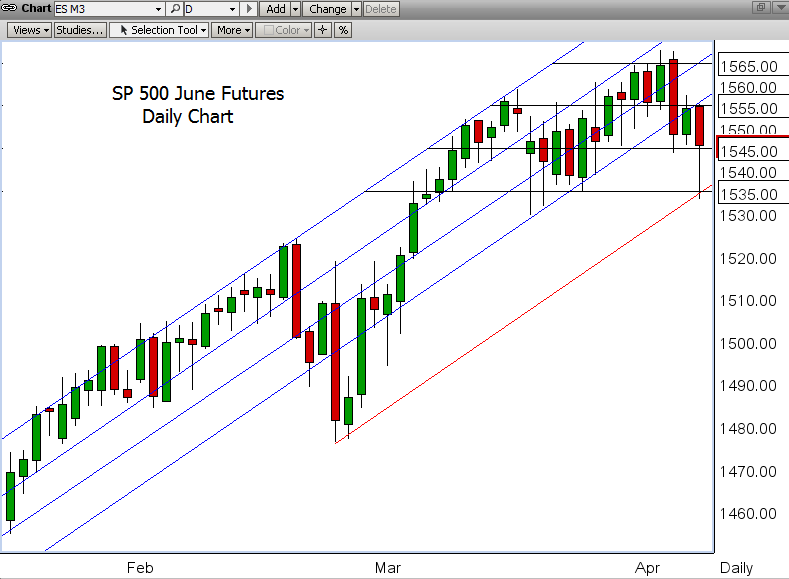
SP 500 June Futures Daily Chart - A Closer Look at Support and Resistance Levels


"This is what has been written: ‘M’ne! M’ne! T’kel ufarsin.’

And this is its meaning:
Numbered — God has numbered your reign and will end it.
Weighed — you are weighed on the scales, and found wanting.
Divided — your power will be divided and given to others.
Daniel 5:25-28

A well-tempered stock market rally/bubble.

The various support and resistance levels are apparent as well as the macro trend.

Take a look at the second chart below. If this is not a 'market operation' to inflate stock prices I don't know anything. 

At least you should have no trouble finding where we are on this road map, and when the wheels start falling off.  This is like a thrown rope.

A stock bubble financed by the Fed is a great way to transfer more wealth to the financiers. 

The US is a tale of two economies.  

Moyers:  Poverty in America Today.

Let's see how things go next week.


Very well-tempered, indeed.


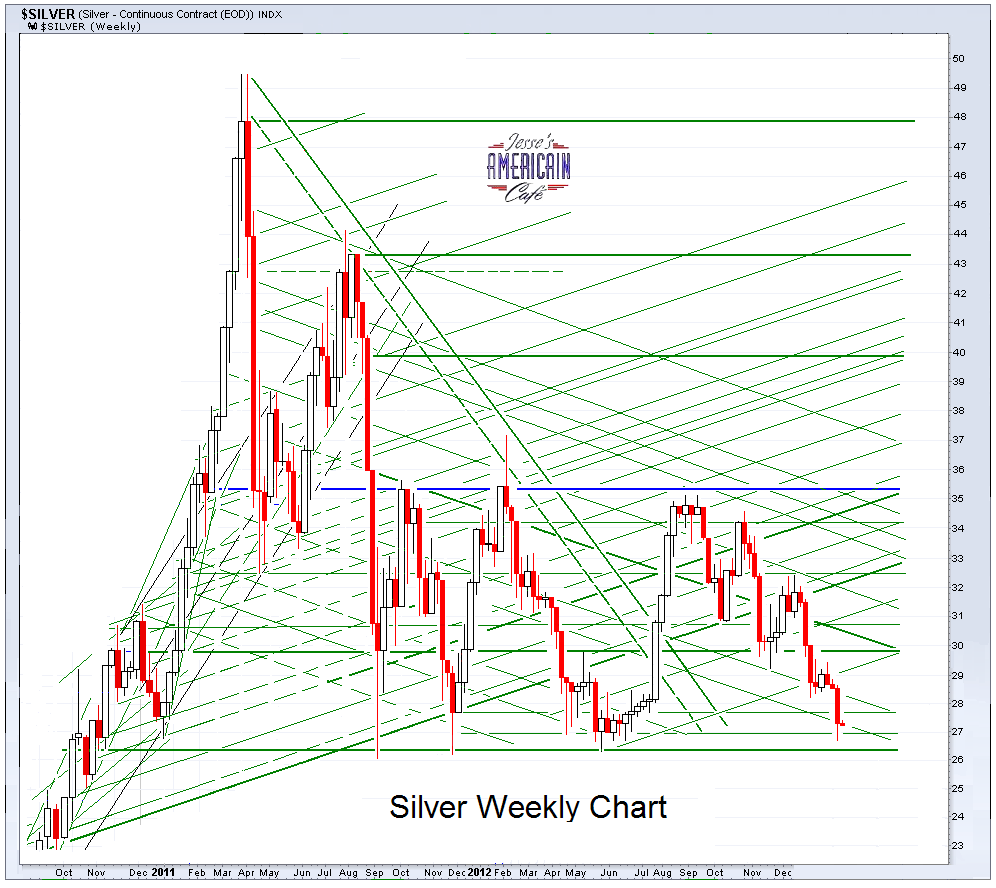
Gold Daily and Silver Weekly Charts - Bounce on a Dose of Reality


"It is hard to tell where Hollywood ends and the DT's begin."

W. C. Fields

Washington and New York, like Hollywood, have become the land of illusion, excess, and make believe.

Non-Farm Payrolls was a dose of cold water on their la-la land, which they quickly shook off.  It is the tale of two economies.

Gold and silver bounced up after the incredible pounding they took from short selling hedge funds and momentum players.

I think the metal bears are one unforeseen sovereign crisis away from getting circumcised with a baseball bat, but that is just my opinion and I could be wrong.

Have a pleasant weekend.


SP 500 and NDX Futures Daily Charts - Hope Floats


The Jobs number was quite bad and a big miss from expectations.

I believe that the economy is floundering, but there is such a bifurcation between the fortunate and the rest that the financiers and politicians are not seeing it, and are in denial.

So let's see how the trend goes over the next couple of months.

It is not a surprise that the wiseguys bulled the number up into the close to cut the losses quite a bit.


Non Farm Payrolls Report - Interesting Seasonality Factors


As you may recall, the raw input into the Non Farm Payrolls report is the actual count of jobs which the BLS compiles.

To this number the BLS adds the output of the Birth-Death Model, which is their estimate of Jobs lost and created by new businesses not included in the report.

And finally, there is the 'seasonally adjusted number.' That is a factor which is applied to the actual count plus BD Model to arrive at what might be considered a steady state or deseasonalized number.

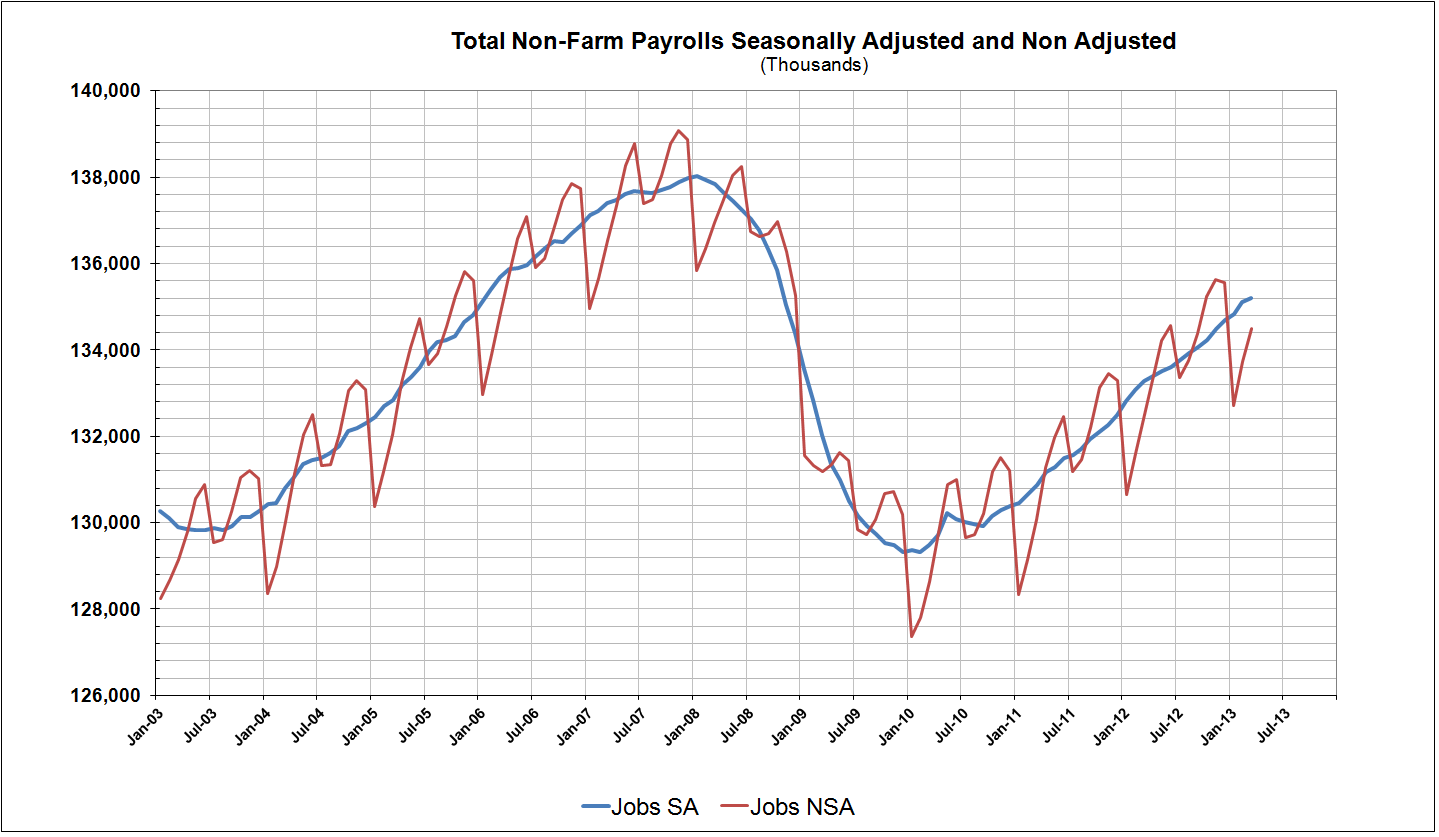
Take a look at the chart below. The line in red is the actual number plus BD model. There are wide swings in the number of jobs added or subtracted based on the changes in the seasons. This is how many economic data present themselves.

For purposes of analysis, economists and statisticians use tools to try and take out the 'seasonality' and provide a number that shows what the change would be if the changes caused by seasonal variation are taken out.

The result is the Seasonally Adjusted number, which is the blue line on the chart below.

As you can see in some months the adjustment is to take jobs out of the actual number, and in other months it is to add jobs to that number. Sometimes those adjustments are very large, and in other months rather modest.


I am including the Birth Death model numbers which I also watch each month and compare to the results from past years. There is nothing untoward here, but people will almost certainly ask about it. It is important to remember that these numbers are added into the actual number BEFORE the seasonal adjustment is applied.


The next chart shows the actual seasonality factor which has been used for a given month. It is just a simple mathematical calculation to show the change which had been applied to the actual number plus BD model input.

I include the results from a number of past years so I can see how the factor used this year compares to factors which have been used by the BLS in other years.

The result is shown below. The current year is graphed with red lines with open circles at the data points.


I think it is interesting that this year is drifting out of the normal factor range. This means that BLS is adjusting the actual numbers to a greater degree than they might have ordinarily done in the past. The adjustment factor is not large, but remember that it is being applied to a raw number of millions of jobs.

Here is another view of the relationship between the seasonally adjusted and non seasonally adjusted total numbers.


It is also important to remember that the BLS normally revises the prior two months whenever they issue a new estimate, so the factors we see on this chart for 2013 may be changed over the next couple of reports.

However I thought it was a trend worth watching. I had been wondering if the BLS would use a 'conservative' approach in their 'headline announcement' this month which might reflect the impact of sequestration, and provide some context for President Obama's budget which he is just releasing.

Is this too Machiavellian? Perhaps. But I like to watch the reports and see if any trends appear. And you know how adverse I am to drawing broad conclusions from just a few data points. I think the headline numbers are mostly useful for news sound bites and Wall Street price shenanigans. The truth is in the trends, and I prefer a nine month moving average.

In case you were wondering, here is what the Jobs numbers would look like if there was no Birth-Death model.  I subtract the BD numbers out after applying the seasonality factor to them.

As you can see, the data is rather 'noisy' to say the least.


Just something to think about.  I do these calculations every month for the NFP. I will keep an eye on them in the future and advise you of anything interesting.

And as a reminder, one must look at other data points outside the Non-Farm Payrolls report to get a clearer picture of what is going on.

One of my favorite additional reports is the Labor Participation Rate. This represents the actual number of potential workers being counted as a percentage of all the people. This is important because the statisticians tend to discard people as potential workers if they have been unemployed over a certain period of time.

 This can make one of the other headline numbers, the unemployment rate, look much better than it really is during severe downturns with abnormally long periods of unemployment. And this is what we are in today.


Since this is budget and sequester season in Beltway Land I am paying particular attention to any numbers which they show. Numbers paint pictures, and where there are large adjustments there is latitude, and often liberties taken with them. This is the human condition.

Net Asset Value Premiums of Certain Precious Metal Trusts and Funds - No Exuberance


I am now accumulating new bullion positions for the intermediate to long term.

I may hedge those positions if I feel there is a higher than normal probability of a general market liquidation.

I tend to agree with Ted Butler and others that the bullion banks are setting up the technical and momentum funds, shifting their physical short positions.

The physical market remains robust despite the short term paper price manipulations.   The gold and silver markets for retail physical are in their nascent phase, largely conducted from large internet sites with little local presence other than a few coin shops and jewelers buying scrap.

I proceed with caution, as I may be incorrect. The markets are opaque, and the currency war adds additional risk.


04 April 2013

Gold Daily and Silver Weekly Charts - Metals Oversold on Paper Metal Gimmickry


Ted Butler is looking at the data he follows, and he believes that the bullion backs are setting up the technical funds to hold the bag on the metal short positions if the metals markets turn higher. I think this is a very valid hypothesis based on the COT reports.

I have included a couple of my own technical charts as well as the usual suspects today.

I went into the market and bought some miners on weakness today and yesterday and also bought some new metals positions.  I do have them hedged out a bit for now.  I don't like to buy on the way down except to establish some initial positions held flexibly.

Let's see what happens. 

If the wiseguys try to bull up stocks and smack metals on a bad Jobs number I will be looking for additional entry positions counter that trend into the weekend.

Today is the 45th anniversary of the assassination of Martin Luther King.


SP 500 and NDX Futures Daily Charts - Non-Farm Payrolls Tomorrow


The new unemployment claims data today was much larger than expected, which put a chill into stocks for most of the day.

Consensus for Jobs tomorrow is about 190k.   I think they will come close or miss, but there might be some 'good news' on the unemployment percentage, which is meaningless since they throw out so many potential workers from their calculations.

What is saving this market is that it is so lightly traded by real investors.  So the algos and momentum shops can just bat the averages around at will.

Chart-wise it was constructive that the SP futures held support but that was about it.  This market looks tired, but quite a few people are waiting for a correction, so it may not come as anticipated.

I put a little volatility back on today.

After the bell HP gave Chairman Ray Lane the boot


Cyprus Is Not So Much An Anomaly as the Template For the Next Financial Crisis


This is not so much anything new, but a concrete reminder of the breadth of systemic banking risks inherent in the Anglo-American banking structure in which depositor money is intermingled with the Bank's speculative interests. 

The repeal of Glass-Steagall stripped the average person of important and time-tested safeguards against loss.   Things are different now.

Any deposits you have at a bank in excess of 'insurance guarantees' are at risk in case of another financial crisis.

This exposure may include wealth you think that you own, but do not know exactly where and how it is being held. This may include 401k's and IRA's, pension plans, health insurance deposits, life insurance and annuities, and so forth.

MF Global was very instructive on how even cash deposits and physical assets backed by a certificate of ownership may be fair game for the banking system in the event of a crisis.

Nothing is perfect and foolproof, but there are degrees of safety.

And you may wish to consider that the next time something like Occupy Wall Street starts up and demands reform, don't stand by on the sidelines and join in with the orchestrated jeering from the one percent's water bearers.

Simplify, streamline, organize.

Demand serious, meaningful, and genuine reform and transparency in the banking and political system.

"The goal is to produce resolution strategies that could be implemented for the failure of one or more of the largest financial institutions with extensive activities in our respective jurisdictions. These resolution strategies should maintain systemically important operations and contain threats to financial stability.

They should also assign losses to shareholders and unsecured creditors in the group, thereby avoiding the need for a bailout by taxpayers. These strategies should be sufficiently robust to manage the challenges of cross-border implementation and to the operational challenges of execution...

But insofar as a bail-in provides for continuity in operations and preserves value, losses to a deposit guarantee scheme in a bail-in should be much lower than in liquidation. Insured depositors themselves would remain unaffected.

Uninsured deposits would be treated in line with other similarly ranked liabilities in the resolution process, with the expectation that they might be written down."

Bank of England and Federal Reserve Joint Statement on Resolving Globally Active, Systemically Important, Financial Institutions.

Related:
A Message From the Banking and Brokerage System
Lawmakers Must Heed the Wisdom of the 1930's
Why Has the Financial System Failed and What Are We Going To Do About It?
A Brilliant Warning on Robert Rubin's Proposal to Deregulate the Banks in 1995

Why Go After the Depositors To Save 'the Taxpayers?'


One thing that puzzled a couple of people is this.

Why go after depositors, in order to save the 'taxpayers.' Aren't they the same people?

Well, obviously in the case of the European Monetary Union this is not the case. And this is the great weakness of a single currency without more comprehensive provisions for fiscal union that makes it inherently unstable.   Wealthy Germans feel no kinship with Cypriots, Greeks, or Spaniards.

But what about New Zealand and Canada, countries that have their own sovereign currencies and are viable political entities? Are the taxpayers and the depositors there essentially the same constituent base? And isn't the government responsible for regulation and policing the banks which they allow to act with a lack of transparency?   Is this not the basis of trust that sustains the financial system?

And what about the rest of the G20 that seemingly has adopted the same template of sacrificing depositors to save the gambling bankers?  What are they thinking?

When a major financial institution gets into trouble it is not usually a sudden event for the most part, but plays out over a period of time. This is true from MF Global to the Popular Bank of Cyprus to Lehman Brothers.

The public does not see what is going on because the financial system is opaque. But wealthy insiders often know what is going on in their interconnected world of money.   Remember the stories of the uber-wealthy who managed to get their funds out of MF Global before it collapsed? I seem to recall those friends of the people, the Koch Brothers, being mentioned.

The monied interests and their political footmen have their funds safely parked in offshore tax havens, and can move the rest around at will based on the distribution of 'asymmetrical information.'

But to the extent that they are taxpayers, they are exposed to bank failures that they may even know about, if the bailout is financed by 'the taxpayers.'

And this is what really irked the wealthy who were caught up in MF Global and Cyprus bank. They thought they were insiders.

The G20 is a tale of two economies, with one set of rules for the one percent, and another set of rules for everyone else. This new template of confiscating the savings of common depositors is just another manifestation of the one percent looting the wealth of the rest.

It may be hard to accept, but the notion of everyone in a country pulling together for the common good is not a viable concept in a crony capital kleptocracy.

And as things get worse, and their schemes start falling apart, their antics may start becoming even more blatant and more brazen, and more incredibly 'unfair.' As you know, I said that MF Global was the 'watershed event' for me.

I don't blame people for being edgy for the reasons I have stated on many occasions. The enforcement of the law is almost incredibly uneven, and the government has hidden key information, and acted in very odd ways far too many times.

When one sees something like this how can one not feel uneasy? Don't Panic, Financial Reform Will Come - By Barney Frank.    Are you kidding me?  These jokers have publicly stated they don't enforce the laws they already have!

Sift everything and look at the evidence, and draw your conclusions and actions accordingly.  Hysteria is contagious and has its dark attractions, but it is not helpful to you and your family's well being.  Trust in God, but make everyone else show their data.


Bank of Japan to Pursue Qualitative and Quantitative Easing - Double Their Monetary Base


Along with most monetary enthusiasts I was anticipating a significant announcement from the BOJ two day policy meeting this week, and this seems to be it.  They are going with an aggressive set of both qualitative and quantitative easing with the express intention of weakening the Yen and creating monetary inflation.

Japan will be firing up their industrial policy using the weaker yen to create more foreign demand for their goods to make up for the slack domestic demand based on their declining demographics.

As you may recall, Japan has been unable to stimulate their economy despite spending rather significant sums on infrastructure and other stimulus projects.  The lack of reform in their fairly well entrenched and pervasive crony capitalist keiretsu structure, which one might say is about a half step removed from outright feudalism, has resisted all their best attempts at livening things up.

And the declining demographics of an island nation that discourages immigration is certainly no help either.  But I would not discount the tax that corruption and inefficiency plays in dampening GDP growth, post bubble.  Corruption creates inefficiency, fraud, and malinvestment, always and everywhere.  Just ask China.

This major policy shift to inflation may help to explain the relentless hammering of the precious metals, which are the only rival currencies that cannot be doubled by the stroke of a bureaucrat's keyboard.

Look for more competitive devaluations from other countries, both explicit and implicit.  This is the more conventional aspect of the currency war, and is a perennial favorite of the political class.

The more secular aspect is the seismic shift of the US dollar reserve currency regime which has been in place since the end of WW II.  That bit of monetary exotica will make this currency war one to remember.

DailyFX
Yen Weakens as BoJ Introduces Qualitative and Quantitative Easing
By Christopher Almeida
04 April 2013 05:10 GMT

THE TAKEAWAY: The Yen weakened as the Bank of Japan introduced Qualitative and Quantitative Monetary Easing including an increase of JGB purchases.

At the end of the two day meeting, the Bank of Japan announced that they were introducing a ‘Quantitative and Qualitative Monetary Easing’ program with an aim to achieve the price stability target of 2 per cent in two years. The Bank announced that it will now use ‘monetary base control’ in pursuing quantitative monetary easing which involves carrying out market operations that will expand the monetary base by 60-70 trillion Yen per year.

The Bank will also increase Japanese Government Bond purchases as well as increasing the average remaining maturity of about 3 years to 7 years. As a result of these, the Japanese Central Bank has decided to terminate the Asset Purchase Program with the outstanding purchases being absorbed into the JGB program. 

In their statement, the policy makers stated that Japan’s economy was showing signs of a pickup with overseas economies seen to be growing at moderate paces. Despite the year on year rate of change of the CPI for Japan being negative recently, the Bank sees that indicators are suggesting a rise in inflation expectations...

Rest of the article with Yen Chart here.
 
Financial Times
Bank of Japan to double monetary base
By Ben McLannahan in Japan
April 4, 2013 6:05 am

Haruhiko Kuroda has announced his arrival as governor of the Bank of Japan by introducing a “new phase of monetary easing”, doubling Japan’s monetary base through aggressive purchases of long-term government bonds and risk assets.

Read the entire article here.