02 December 2014

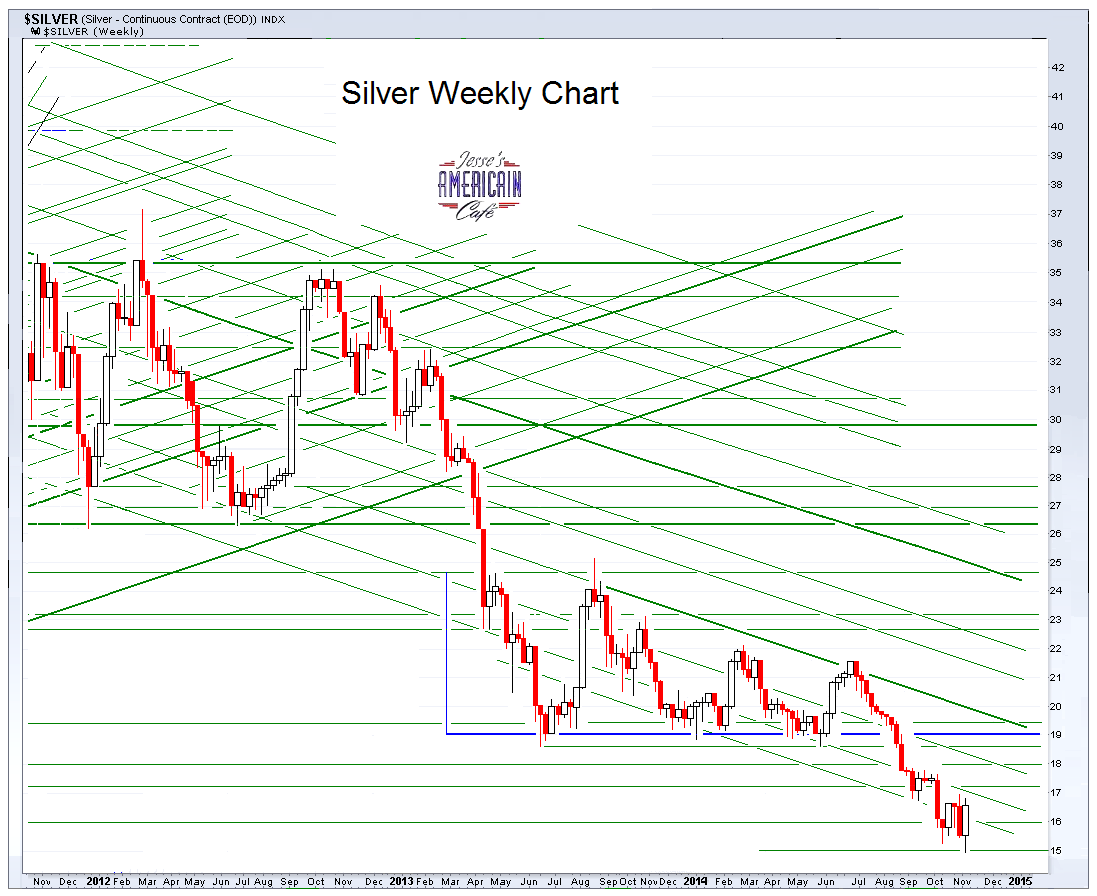
Gold Daily and Silver Weekly Charts - Economic Sophistry


"The commercial world is very frequently put into confusion by the bankruptcy of merchants that assumed the splendour of wealth, only to obtain the privilege of trading with the stock of other men, and of contracting debts which nothing but lucky casualties could enable them to pay; till after having supported their appearance a while by tumultuary magnificence of boundless traffic, they sink at once, and drag down into poverty those whom their equipages had induced to trust them."

Samuel Johnson, Rambler #189, January 7, 1752

It is a good thing that modern economics has proven, through a series of unstated and wildly unnatural assumptions, that these things as described by Samuel Johnson above cannot happen anymore, the gods of the market being selfless and possessed of perfectly rational self-interest, supported by their higher intellects and superior character.
 
Dr. Johnson might respond, as he did when considering Bishop Berkley's 'ingenious sophistry to prove the nonexistence of matter,' by stepping outside and kicking a stone quite soundly saying, 'I refute it thus!'  Or in this case, instead of a stone, he might choose to plant one on the posterior of some smarmy white collar business cheat, whose hands are filled with other people's money, and refute such nonsense once again.
 
It is almost comical to see a short lived ball of dust gather itself up, and throw a puffball of a  proclamation of its superiority into the vastness of the universe.  The lack of self awareness of the self-obsessed is amazing.
 
Speaking of immaterial and manufactured nonsense, there is quite a bit of it swirling around the precious metals this week.  Commentators are inventing strawmen arguments that, as far as I can tell, never existed.  One such example is the assertion that precious metals crowd held a consensus that the passage of the Swiss referendum was a sure thing.   And then these fellows use that canard to mock the metals crowd gullibility, as a sure sign of their deficiency of both intelligence and character.
 
As I responded to several correspondents today, it really doesn't matter anymore.  There are some enormous changes underway in the world.  Whether a few individuals think one thing or not, whether we can truly understand what will happen or not, is a moot point.  What is going to happen will happen now, whether some puffed up Wall Street curb crawlers think so or not, or some blogosphere click generators post screaming headlines of an imminent price spike to incredible levels, every other day.
 
There was intraday commentary called Princes of the Yen, which provides some interesting information on the growth of the Japanese real estate bubble, as well as the bubbles we are now currently enjoying in the West.  I strongly recommend that you watch it. 
 
There are some interesting things happening in the Comex warehouses this month.  I have included the usual reports below, with an observation about gold in particular, and its concentration in two warehouses.  Silver is a bit different, but it always puzzles and fascinated me.  When the going for the metals gets rough, silver gets weird.
 
With regard to the future course of events, I think the die has been cast.  This is a currency war, and a time of great historical and political change.  So as in all such cases, we are in the hands of fortune now.  What is coming will come when it has a mind for it.  But the time seems ripe for such a change.
 
We must wait then, and be watchful.  We must be still, and know, that we are not God.  Great events occur, in both history and nature, to remind us so.  The insubstantial vanity of our pretensions is made all the more hollow by the intensity with which we embrace them. 
 
Men make plans, sacrificing everything around them to raise a mighty empire, designed to last for a thousand years, and the universe laughs.  Life is hidden in the little things, and it alone endures.  So do not squander your true fortune in the pursuit of shadows and illusions.
 
Have a pleasant evening.


SP 500 and NDX Futures Daily Charts - Well Meaning and Clueless, or Reckless and Self-Absorbed


The Bailout
“When bad men combine, the good must associate; else they will fall one by one, an unpitied sacrifice in a contemptible struggle.”

Edmund Burke

In general, I to to apply the maxim that one ought never to attribute to bad intent what can more easily be attributed to well-intentioned stupidity.

I bring this up now, because I continue to struggle with the thought processes of a government and a central bank that seem intent on creating another bubble and subsequent financial crisis.

The first time it was shame on them, and this was the tech bubble and Y2K, that were quickly forgotten in the tragedy of 9/11.

The second time it was the housing and credit fraud bubble, and it was shame on us for idly standing by and allowing ourselves to be robbed and denied justice in the bailout. But in our defense, frightened people often agree to do and accept foolish things.
 
I also wish to remind ourselves of the obvious, that this is not the US or the Fed acting alone.  There seems to be an almost unnatural unanimity in this amongst the Western powers.  The bubble breaks, and some people somewhere are victimized, even if they had relatively little to do with it.  The story is always painted, that they are lazy and foolish, and had it coming to them.

Will there be a third time, yet another financial crisis that shakes the financial system?   Powerful and reckless people often find the changes enabled by a crisis to be both rewarding and exhilarating, in the exercise of raw power and the stuffing of their own pockets.

So, if there is in fact a third financial crisis in the world, we might well expect to see the furtive hand of the financial system reaching into the public's pockets once again, supported by their politicians urging them to give way to save themselves.  And this may happen again in any part of the Western world.

And at that point the most effective course of action may be for the public to gather themselves as a people and say 'enough!'  And with all due process, civility, and respect for justice and the law, to cut that hand off, figuratively speaking.  And then they may proceed on to the difficult business of reform.

Have a pleasant evening.


Princes of the Yen: Central Banks and the Transformation of an Economy


"Central banks have the power to create economic, political and social change. This is how they do it."

While I cringed at some of the early parts of the film and the mid-century American attitudes towards the Japanese, even if it was in the aftermath of a long and viciously fought war, I think this documentary provides some valuable insights into the evolution of the modern economy that is Japan.  I direct your attention to the things that we are often saying about different peoples today.
 
I struggle very hard not to judge other periods, cultures, and people with a righteous and twice removed temporal prejudice, enhanced by distance and hindsight.  And I believe such liberality might serve us well, given that we will most likely appear like blundering, hapless baboons to our great grandchildren some day.  What were they thinking!?
 
As a general observation based on experience, people everywhere are just people. Unless you are wearing the goggles of ignorance, fear, and hatred. And wicked men in business and government often encourage that sort of thing for their own ends.   But, in the end, the madness serves only itself.
 
But some cultures do tend to encourage and reward certain traits of personality and behavior more than others.  This has deep roots in their cultural, social, and religious heritage.  So the same economic conditions in two different cultures might provide two very different outcomes.

I recall explaining some of this to a professor from England whom we had in business school.  He could not quite understand how some of the things that were happening in Japan (Japan Inc. as it was known then) that ought not to be occurring in a two party system. The answer of course was that Japan at that time, in the early 1990's, was essentially a single party system with heavy ties to an embedded bureaucracy in partnership with corporate cartels.  And Richard Werner does a fairly good job at describing the evolution and nature of that system.

I think this structure helps to explain the long economic stagnation in Japan that puzzles so many, and has the Keynesians so befuddled.   They have never met any stimulus that they didn't like, even when it was being poured into and abused by a corrupt and inefficient system. 
 
Rather than being naturally more successful at its financial engineering, as fellows like Bernanke have snarkily suggested in their American exceptionalism,  I think it is becoming painfully obvious that the US is 'turning Japanese' in its serial policy errors propagated by an insular, ruling elite and the moneyed interests with their political power.
 
Speaking of financial engineering, Professor Richard Werner has been a long time economic advisor to Japan, and coined the term quantitative easing for his recommendations to them.
 
Japan, and the 'Asian tigers' as well, were mercantilist in their outlook and crony capitalist in their composition.  The enormous amounts of monetary stimulus were dissipated in supporting zombie corporations, a ruling elite, unproductive investments, and widespread soft corruption and insider dealing.

To engage in 'free trade agreements' under these circumstances with other command and control economies is foolish, especially when it puts domestic labor, social services, and the environment at par.  Especially when such processes are disguised under layers of complex rules and commissions, and easily manipulated by global corporations.   These are the bonds of global repression of the common people by concentrated power.
 
It rips the heart out of local autonomy and democracy under the banner of 'competitiveness.' It is corrosive of precious freedoms, and tramples the Constitution. But money has helped to ease the consciences of Western politicians.

Even moreso, can there be any doubt that the US, rather than helping to provide a positive example of a different way to Asia, inculcating freedom through its success of democratic and free markets, is in fact falling into the same model, a kind of a lowest common denominator of inverted totalitarianism under the standard of globalization.
 
I would like to think that Chalmers Johnson would most likely agree that if the Bank of Japan's economists are indeed the 'princes of the yen,' this is because they are now and have long been liege lords in the Empire of the American Dollar and the Anglo-American banking cartel.