04 November 2011

Gold Daily and Silver Weekly Charts - Freedom Without Virtue


"But what is liberty without wisdom, and without virtue? It is the greatest of all possible evils; for it is folly, vice, and madness, without tuition or restraint."

Edmund Burke

Bloomberg Magazine Advertisement
GroupOn = LinkedIn?

La la la, whatever. La la la, doesn't matter. As cynical an IPO as seen since 1999 they said today.

Where is the MF Global customer money? First it was missing, and then it was not. And then it was lost (or) missing again, and then found at JPM. And then that was denied, and now it seems to be lost at sea in a financial storm of venality.

Maybe Judge Crater and Jimmy Hoffa took it with them.

Value can be an ephemeral thing, but especially when it is defined at a keystroke from the touch of a faceless bureaucrat. To create and distribute a nation's money at will is liberty without virtue, folly, vice and madness.

I have seen strange markets and economies, and the organizations that ran them, going back to the days of Richard Nixon. But this is one for the record books. As I remarked in the equity commentary:

'Perhaps the disconnected nature of the nation's money, its profound alienation from the real economy, is the key to the market's increasingly erratic behaviour, and the remarkable silence of the lambs.'

Relativism at the extremes has a will of its own. You may wish to grab something solid, and hang on. The trick is to properly define 'solid,' and to stick with it amongst the growing madness.

Expect some serious volatility in the days ahead.

"The race is not to the swift, nor the battle to the strong, but to those who see it coming and jump aside."

Hunter S. Thompson, The Rum Diary

Have a pleasant weekend.


SP 500 and NDX Futures Daily Charts


As fraudulent enterprises go, the US markets were relatively calm today in the face of uncertainty in Europe and a rather weak Jobs Report.

Perhaps the disconnected nature of the nation's money, its profound alienation from the real economy, is the key to the market's increasingly erratic behaviour, and the remarkable silence of the lambs.


"Resplendent and unfading is wisdom,
and she is readily perceived by those who love her,
and found by those who seek her.
She hastens to make herself known in anticipation of their desire;
Whoever watches for her at dawn shall not be disappointed,
for he shall find her sitting by his gate.
For taking thought of wisdom is the perfection of prudence,
and whoever for her sake keeps vigil
shall quickly be free from care;
because she makes her own rounds, seeking those worthy of her,
and graciously appears to them in the ways,
and meets them with all solicitude."

Wisdom 6:12-16

CFTC Update on the Investigation Into Manipulation of the Silver Market In Progress Since 2008


The CFTC released a long awaited update on their investigation into the manipulation of the silver market, thereby meeting a key deadline to the public.

November 4, 2011

CFTC Statement Regarding Enforcement Investigation of the Silver Markets

Washington, DC – The Commodity Futures Trading Commission today issued the following statement:
“In September of 2008, the Commission announced the existence of an enforcement investigation into the possibility of unlawful acts in silver markets. Since that time, the staff has analyzed over 100,000 documents and interviewed dozens of witnesses and obtained expert advice. It has been a long, detailed, and thorough investigation, and it continues in an appropriate and considered manner.”

You can read the entire statement here.  Except that WAS the entire statement.

For questions or comments, call 1-800-EAT-CAKE.

Independent Interview with King World News by Bart Chilton, CFTC Commissioner

MF Global: $658 Million in Missing Customer Funds Found in Account at JP Morgan - Maybe


Government Of the People, By the People, and For the People
According to Bloomberg, $658.8 Million in what could be the 'missing customer funds' were 'found' today in an account at JP Morgan.

I know how it is.  Sometimes you forget to check your coat pockets and miscellaneous bank statements too. Sloppy bookkeeping. Tsk tsk. Oh well, just an honest mistake, right?

JP Morgan is one of the largest holders and agents of MF Global debt.

Jefferies Group underwrote MF's bond offering late this year.

MF Global’s commodity customer funds are reported to have a shortfall of $633 million, or about 11.6 percent, out of a segregated fund requirement of about $5.4 billion, according to the CFTC.

The CME is forcing the transfer of customer accounts to other brokers who are demanding double margin and issuing margin calls and forcing liquidation of positions, sometimes at widely fluctuating prices, according to some reports.

And in related news: SEC Investigates Insider Trading of MF Bonds

Hey, now that he has resigned from MF Global, perhaps Jon Corzine will consider taking Tired Timmy's place as Treasury Secretary. He is ex-Goldman you know.

Once you pass through the glass ceiling it becomes a glass floor.

Update:   JPM is now said by some news outlets to be denying that it is holding any MF Global customer money.  "It's MY milkshake. And I'm going to drink it all up!"  slurp slurp grnnfef.

When the going get tough, the weird turn pro.
  

The Disappointing Non Farm Payrolls Number: An Early Christmas 'Goose' Stuffed with Baloney


The Birth-Death Model was out of normal to the high side enough to raise a comment. This is shown in the first slide. Lately the BLS statisticians had not resorted to this and had actually been running at estimates a little more to what one might expect in a business slump.

The headline number without the Birth Death model, deseasonalized, showed negative growth.

So the truth is probably that jobs growth was flat to negative. But even that nugget of truth is liable to be lost in future revisions. I wonder if the desire to show growth will skew the statistics even further as we go forward.

Typical games are to play with the chain deflator in GDP to make it look better, and to play with seasonality, birth-death model, and rolling revisions in the payrolls numbers. And of course the tinkering with CPI is apparent to anyone not carrying an agenda who has looked into the mechanics of the changes in the past ten years.

But I suppose since Obama is speaking this morning at the G20, and telling Europe how to solve its banking and debt problems as the US has done, a passable grade on jobs growth was de rigueur pour le charlatan.

Next up, blame the slump on Europe after allowing your hedge funds, banks, and talking heads of the financial demimonde to drag them down, and then implement QE3 as a rescue plan.  Anything, rather than admit to the corruption in the system and then have to engage in meaningful reform. 

This is the nature of a credibility trap in the aftermath of the deep capture of politicians and their apparatus by the monied interests in a crony kleptocracy, teetering on the edge of general discovery.

If Obama is Hoover, which may be a somewhat flattering comparison to both,  then where on the political horizon is Roosevelt?  So far all that is offered to the voters is a choice amongst a freak show of corporate goons, imperious ideologues, and mini-Mussoliniani.


MF Global: The Mother of All Margin Calls


No, not the credit default implosion of the company itself. This is about the customers whose money was misappropriated.

The treatment of the non-insider investors and speculators by Wall Street is often shameful. This may be one of those times.

I think this has driven some of the recent trading, as the wise guys take advantage of the specs.

Brace for more odd swings in the markets.

Reuters
MF Global clients face day of reckoning as margins call
By Jeanine Prezioso and Karl Plume
NEW YORK/CHICAGO | Thu Nov 3, 2011 6:12pm EDT

(Reuters) - Call it the mother of all margin calls: Up to 50,000 former customers of bankrupt broker MF Global must find some $1 billion in additional collateral almost overnight, or be forced out of their trades.

Come Friday, with the mass transfer of commodity trading accounts from Jon Corzine's fallen firm to six of its erstwhile rivals, margin clerks will be wrapping up a reckoning of how much additional money is needed to cover millions of positions. Clients who can't quickly meet their margin will have to liquidate, making for a tumultuous day's trade.

A court order to move the trades late on Wednesday brought only marginal relief to clients who have been essentially frozen out of their funds and positions since Friday. While accounts will now be transferred more quickly, only 60 percent of the collateral will be moved to the new brokers.

That figure may yet fluctuate as brokers scramble on Thursday to work out the details, but the net result is still likely to mean that customers will be forced to post a hefty sum within a day or two. Many of MF Global's mainly small-scale clients may fail, triggering a mass liquidation of both short and long positions that may roil markets.

"I've got somewhere in the region of 8,000 positions. We can't afford to double margin those sorts of positions," said Tom Wacker, a proprietary gold futures trader in New York. "If we can't get our positions transferred they're going to be liquidated and we're going to lose a lot of money."

Eventually, in days or weeks, the remainder of the money should be returned. The $600 million that regulators say MF Global may have misappropriated from customers could remain outstanding, but that is less than a tenth of its funds.

In the meantime, however, brokers are unlikely to extend loans to new, unfamiliar customers to make up the margin gap -- and in some cases may simply refuse to take them at all.

"We are going to require full margin on our accounts," says Sean O'Connor, chief executive of INTL FCStone, the second-smallest of the six futures commission merchants (FCMs)selected to take the accounts....

03 November 2011

Gold Daily and Silver Weekly Charts - A Pervasive Sense of Disestablishment


"Terror... often arises from a pervasive sense of disestablishment: that things are in the unmaking."

Stephen King

Big up day for the metals.

I do not care for their synchronicity with stocks. So many assets are now correlated to a global reflationary event, and the markets are overly sensitive to headlines. That makes these markets highly dangerous.

What is happening with MF Global and the US futures markets is a disgrace. But hypocrisy and betrayal are the temper of the times.

"By the pricking of my thumbs,
Something wicked this way comes."

William Shakespeare, Macbeth


SP 500 and NDX Futures Daily Charts - Here Comes Groupon


"The wolf thought to himself: 'What a tender young creature! what a nice plump mouthful.-- she will be better to eat than the old woman. I must act craftily, so as to catch both."

The Brothers Grimm, Little Red Cap


The Wall Street wiseguys are shoving the Groupon IPO out the door tonight I hear.

It *could* do well, but it strikes a kind of a chord for a high water mark in the post 2008 equity echo bubble. But I have found it useful not to underestimate the reckless disregard of the US financial system and the Fed for the overall economy. So we may see this bubble higher to a crescendo.  The real prize is Facebook.

I consider this a dangerous market, highly event driven and thin of substance. Kind of like Obama and the rest of the Republican hopefuls.

I have heard from a number of people, including some fund operators, of the heartache this MF Global situation is giving to them in the form of bounced checks and busted positions. It is disgraceful.  But that is getting to be a tired, overused word in these times of general breakdown of equal protection under the law and regulations.


02 November 2011

Gold Daily and Silver Weekly Charts - La Douleur du Monde


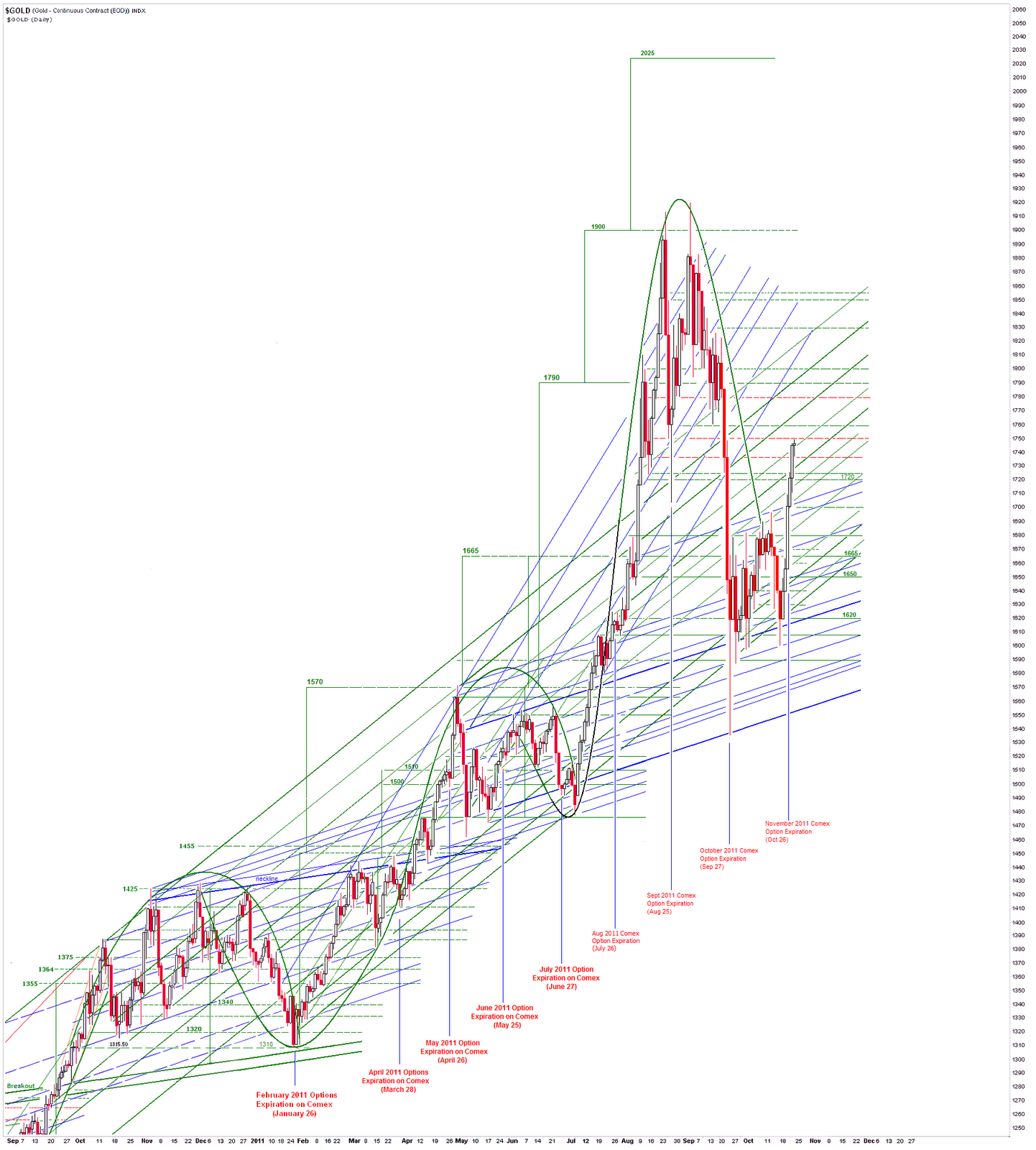
The metals had a nice rally today after the post-option expiration gut check.

Benny cooed some reassuring words but did nothing.  The equity markets rose for lack of anything better to do.

Gold and silver have not yet broken out and set the 'W Pattern' with a strong close above resistance around 1780.

If they can stick a strong close the year end target of 1950 is activated.  Right now I cannot judge the probability, so I am running a more balanced hedge.  Europe weighs heavily on most markets.


SP 500 and NDX Futures Daily Charts - Much Ado About Very Little


Benny reassured the markets without really saying anything.


FOMC November Statement - G20 and Greek Debt - Bernanke at 2:15 - NFP Friday


"Everybody was expecting Tim Geithner and Bob Rubin, who's pulling the strings behind the scenes in the Obama Administration, to roll out some kind of IMF funded bailout for Greece in a global reflation. Your audience would love that.

It hasn't manifested itself yet. Supposedly at the G20 meeting next month, Obama was going to declare the jubilee and have the IMF just print money to bail out Greece, because they do not want to see restructuring here in the US, especially the top four banks.

Isn't it amazing that we have this supposed liberal Democrat as President, and he has never gone after the Big Banks? That's because they own him."

Chris Whalen, in an interview with King World News

The G20 meeting that Chris Whalen mentions begins on Thursday. There is little doubt in my mind that Mr. Papandreou announced his referendum to place the problem of Greek debt high on the G20 agenda.

Bernanke has a press conference at 2:15 EDT which may be interesting.

Non-Farm Payrolls for October will be reported on Friday morning. Expectations are in the 85,000 - 100,000 range.

The Fed is clearly laying the groundwork for some variation of QE3, but perhaps not just yet.  They seem to be playing the game of looking for a rationale for a decision that may be controversial.

But the Fed is facing some time constraints for QE3 with the Presidential elections next year.  The Fed is normally loathe to engage in unusual stimulus in conjunction with important elections for fear of being perceived as 'politically motivated.'   Which it is of course.  It just depends on what politics you care to use as a ruler. The Fed's preoccupation is the banking system first and foremost-- and size matters.

As for the greater public, let them eat food stamps, and whatever else may trickle down from the top 1%.

I suspect that the great exogenous variable remains European financial stability and its possible impacts on the upper crust of the US banking system. 

Federal Reserve Board
Press Release
November 2, 2011

Information received since the Federal Open Market Committee met in September indicates that economic growth strengthened somewhat in the third quarter, reflecting in part a reversal of the temporary factors that had weighed on growth earlier in the year. Nonetheless, recent indicators point to continuing weakness in overall labor market conditions, and the unemployment rate remains elevated. Household spending has increased at a somewhat faster pace in recent months. Business investment in equipment and software has continued to expand, but investment in nonresidential structures is still weak, and the housing sector remains depressed. Inflation appears to have moderated since earlier in the year as prices of energy and some commodities have declined from their peaks. Longer-term inflation expectations have remained stable.

Consistent with its statutory mandate, the Committee seeks to foster maximum employment and price stability. The Committee continues to expect a moderate pace of economic growth over coming quarters and consequently anticipates that the unemployment rate will decline only gradually toward levels that the Committee judges to be consistent with its dual mandate. Moreover, there are significant downside risks to the economic outlook, including strains in global financial markets. The Committee also anticipates that inflation will settle, over coming quarters, at levels at or below those consistent with the Committee's dual mandate as the effects of past energy and other commodity price increases dissipate further. However, the Committee will continue to pay close attention to the evolution of inflation and inflation expectations.

To support a stronger economic recovery and to help ensure that inflation, over time, is at levels consistent with the dual mandate, the Committee decided today to continue its program to extend the average maturity of its holdings of securities as announced in September. The Committee is maintaining its existing policies of reinvesting principal payments from its holdings of agency debt and agency mortgage-backed securities in agency mortgage-backed securities and of rolling over maturing Treasury securities at auction. The Committee will regularly review the size and composition of its securities holdings and is prepared to adjust those holdings as appropriate.

The Committee also decided to keep the target range for the federal funds rate at 0 to 1/4 percent and currently anticipates that economic conditions--including low rates of resource utilization and a subdued outlook for inflation over the medium run--are likely to warrant exceptionally low levels for the federal funds rate at least through mid-2013.

The Committee will continue to assess the economic outlook in light of incoming information and is prepared to employ its tools to promote a stronger economic recovery in a context of price stability.

Voting for the FOMC monetary policy action were: Ben S. Bernanke, Chairman; William C. Dudley, Vice Chairman; Elizabeth A. Duke; Richard W. Fisher; Narayana Kocherlakota; Charles I. Plosser; Sarah Bloom Raskin; Daniel K. Tarullo; and Janet L. Yellen. Voting against the action was Charles L. Evans, who supported additional policy accommodation at this time.

01 November 2011

Gold Daily and Silver Weekly Charts - MF Global Is the Tip of a Pyramid of Lies


"The great masquerade of evil has played havoc with all our ethical concepts.

For evil to appear disguised as light, as charity, as historical necessity, or social justice is quite bewildering to anyone raised on traditional ethical concepts.

But for the Christian who builds his life on the word of God, it merely confirms the fundamental perversity of evil."

Dietrich Bonhoeffer

MF Global, the latest brokerage firm to start slipping under the waves, was using customer funds to back their proprietary trades according to a story from Associated Press.

The CME, the exchange on which the MF Global acted as clearing company, has a reported $4 billion in member contributed funds to cover any customer losses from a member firm. But obviously the guardians of the system cannot risk a run on the exchanges and brokerages.

I fully expect a strong effort will be made to hush this one up and sweep it under the rug. The $700 million was merely misplaced, left it in the other coat pocket, never missing, simple accounting error, completely safe.  They will just juggle the books and shift the equity around, increasing the leverage on positions.  You don't go to prison for carrying excessive leverage.   MF Global should have bought a small bank like Goldman did, and then buried their losses at the Fed. 

I obviously do not know if the cover up will succeed. Worldcom, Enron, Madoff, Countrywide, AIG, MF Global. The US financial system is a pyramid of lies. As the system totters, more naked greed and corruption will be exposed.

The bigger driver of today's market action was the news that Greece may hold a referendum on the bail out plan.  

The reports on Bloomberg went back and forth on this all day.  They dimissed the possibility of a referendum but it seemed like whistling past the graveyard.  They asked, 'Why would Papandreou agree to a referendum?' Because he wants to be able to sleep at night without his eyes open and back against the wall, that's why. 

The analogy between onerous postwar reparations in 1920 and the bailout for the big European banks in this currency war is striking.   Greece may follow Iceland,  drop out of the EU,  and let the German and French gyros rotate on their own rotisseries. 

What has been hidden will be revealed.  And this is only the beginning.


SP 500 and NDX Futures Daily Charts - MF Global Admits Taking Customer Funds


Tough down day on the US equity markets.

I have a hunch that the Wall Street crew will circle the wagons, and that MF Global will suddenly 'find' the 700 million or so in customer funds in some misplaced account.

One after another, all will be led down an alley and strangled, for the sake of systemic corruption, starting with the truth.


MF Global Admits Misappropriating (Taking) Customers' Money For Their Own Purposes (Gambling)


Who do they think they are, the NY Fed?

AP
MF Global says it used clients' money
Tue Nov 1, 2011 2:42pm EDT

Nov 1 (Reuters) - MF Global Holdings Ltd ., the futures broker that filed for bankruptcy protection on Monday, has admitted to using its clients' money as its financial troubles mounted, AP reported, citing a U.S. official.

An MF Global executive made the admission to federal regulators in a phone call early Monday, AP reported.

MF Global did not keep its customers' money separate from its own, CME Group CEO Craig Donohue said on Tuesday.

Six Things No One Will Tell You About MF Global

Are Clients of MF Global Insured Against Fraud?


Nope, Just Another Small Fry...

Net Asset Value of Certain Precious Metal Trusts and Funds


I would like to know the details of how Sprott Silver is managing its cash, and whether it holds any units of the fund back for occasional cash sales.


31 October 2011

Regulators Searching MF Global for Millions in Missing Customer Funds


Do you know where your account funds or assets owned through ETFs really are?  Do the regulators and overseers of the markets?  Do they care, or just look the other way?

NYT Dealbook
Regulators Investigating MF Global
By BEN PROTESS, MICHAEL J. DE LA MERCED and SUSANNE CRAIG

Federal regulators have discovered that hundreds of millions of dollars in customer money have gone missing from MF Global in recent days, prompting an investigation into the company’s operations as it filed for bankruptcy on Monday, according to several people briefed on the matter.

The revelation of the missing money scuttled an 11th hour deal for MF Global to sell a major part of itself to a rival brokerage firm. MF Global, the powerhouse commodities brokerage run by Jon S. Corzine, had staked its survival on completing the deal.

Now, the investigation threatens to tarnish the reputation of Mr. Corzine, the former New Jersey Governor and Goldman Sachs chief who oversaw MF Global’s demise, making it the first American victim of Europe’s debt crisis.

What began as nearly $1 billion missing had dropped to less than $700 million by late Monday. It is unclear where the money went, and some money is expected to trickle in over the coming days as the firm sorts through the bankruptcy process, the people said....

Read the rest of the story here.


Kleptocracy, "rule by thieves" is a form of political and government corruption where the government exists to increase the personal wealth and political power of its officials and the ruling class at the expense of the wider population, often without pretense of honest service.

No outside oversight is possible, due to the ability of the kleptocrats to personally control both the supply of public funds and the means of determining their disbursal.

Gold Daily and Silver Weekly Charts - The Golden Bowl


Is this the long awaited gut check for the longs?

A natural pullback after such a strong rally.

Let's see where it goes next.


"Related Disciplines"

SP 500 and NDX Futures Daily Charts - MF Global Declares Bankruptcy


A strong October as one of the most dangerous of market trading months goes.

Keep an eye on Europe.

This market is triple black diamond, full of hidden risks, much of it caused by corruption and lax regulation.


Reprise: The Causes of the Financial Crisis and the Obsessive Folly of Greed


"There will come a moment when the most urgent threats posed by the credit crisis have eased and the larger task before us will be to chart a direction for the economic steps ahead. This will be a dangerous moment. Behind the debates over future policy is a debate over history—a debate over the causes of our current situation. The battle for the past will determine the battle for the present. So it’s crucial to get the history straight."

Joseph Stiglitz, Capitalist Fools, January 2009

What I find to be of primary concern is that the prescriptions now being circulated for a cure to the economic malaise is more of the same things that caused the financial crisis in the first place, with the addition of more pain for the middle class and the relatively innocent victims of calculated fraud.

The elite are attempting to rewrite history, and promote a field of servile stooges as candidates in the next election for their selfish benefits. And sadly for the nation, for what I believe will prove to be a tearing of the social fabric.

“People of privilege will always risk their complete destruction rather than surrender any material part of their advantage."

John Kenneth Galbraith

Read the original posting from December 2008 about this essay here.

Here is a summation of the Five Major Causes of our financial crisis. As Joe so correctly observes:
  1. Reagan's nomination of Alan Greenspan to replace Paul Volcker as Fed Chairman
  2. The Repeal of Glass-Steagall and the Cult of Self-Regulation
  3. Bush Tax Cuts for Upper Income Individuals, Corporations, and Speculation
  4. Failure to Address Rampant Accounting Fraud Driven by Excessive and Flawed Compensation Models
  5. Providing Enormous Bailouts to the Banks without Engaging Systemic Reform for the Underlying Causes of the Failure

There are other points that might be added, some that are not strictly financial in nature.

An international monetary exchange system that facilitates manipulation to create de facto barriers and subsidies in support of industrial trade policies. This creates destabilizing surpluses and deficits which may be the source of the next stage of the financial crisis.

The concentration of the ownership of the mainstream media in a handful of corporations has had a chilling effect on the newsrooms and commentators.

The lack of Congressional courage in exercising its obligations with regard to the extra-Constitutional excesses of the Executive Office. Certain mechanisms and instruments that facilitate the unilateral exercise of presidential power are tipping the balance of powers.

The existing system of funding inordinately expensive political campaigns is a breeding ground for favors and corruption.

The undue influence on prices, particularly global commodity prices, that is exercised by a handful of US banks operating far outside of traditional banking charters. This is a dangerously destabilizing influence on the real world economy and industrial growth and investment.

A significant step forward would be the imposition of position limits, greater and more timely transparency for those with more than 10% of any market's open interest, and an uptick rule with stronger enforcement against naked shorting and other forms of short term price manipulation.

Vanity Fair
The Economic Crisis:
Capitalist Fools
by Joseph E. Stiglitz
January 2009

Behind the debate over remaking U.S. financial policy will be a debate over who’s to blame. It’s crucial to get the history right, writes a Nobel-laureate economist, identifying five key mistakes—under Reagan, Clinton, and Bush II—and one national delusion.

There will come a moment when the most urgent threats posed by the credit crisis have eased and the larger task before us will be to chart a direction for the economic steps ahead. This will be a dangerous moment. Behind the debates over future policy is a debate over history—a debate over the causes of our current situation. The battle for the past will determine the battle for the present. So it’s crucial to get the history straight.

What were the critical decisions that led to the crisis? Mistakes were made at every fork in the road—we had what engineers call a “system failure,” when not a single decision but a cascade of decisions produce a tragic result. Let’s look at five key moments.

No. 1: Firing the Chairman

In 1987 the Reagan administration decided to remove Paul Volcker as chairman of the Federal Reserve Board and appoint Alan Greenspan in his place. Volcker had done what central bankers are supposed to do. On his watch, inflation had been brought down from more than 11 percent to under 4 percent. In the world of central banking, that should have earned him a grade of A+++ and assured his re-appointment. But Volcker also understood that financial markets need to be regulated. Reagan wanted someone who did not believe any such thing, and he found him in a devotee of the objectivist philosopher and free-market zealot Ayn Rand.

Greenspan played a double role. The Fed controls the money spigot, and in the early years of this decade, he turned it on full force. But the Fed is also a regulator. If you appoint an anti-regulator as your enforcer, you know what kind of enforcement you’ll get. A flood of liquidity combined with the failed levees of regulation proved disastrous.

Greenspan presided over not one but two financial bubbles. After the high-tech bubble popped, in 2000–2001, he helped inflate the housing bubble. The first responsibility of a central bank should be to maintain the stability of the financial system. If banks lend on the basis of artificially high asset prices, the result can be a meltdown—as we are seeing now, and as Greenspan should have known. He had many of the tools he needed to cope with the situation. To deal with the high-tech bubble, he could have increased margin requirements (the amount of cash people need to put down to buy stock). To deflate the housing bubble, he could have curbed predatory lending to low-income households and prohibited other insidious practices (the no-documentation—or “liar”—loans, the interest-only loans, and so on). This would have gone a long way toward protecting us. If he didn’t have the tools, he could have gone to Congress and asked for them.

Of course, the current problems with our financial system are not solely the result of bad lending. The banks have made mega-bets with one another through complicated instruments such as derivatives, credit-default swaps, and so forth. With these, one party pays another if certain events happen—for instance, if Bear Stearns goes bankrupt, or if the dollar soars. These instruments were originally created to help manage risk—but they can also be used to gamble. Thus, if you felt confident that the dollar was going to fall, you could make a big bet accordingly, and if the dollar indeed fell, your profits would soar. The problem is that, with this complicated intertwining of bets of great magnitude, no one could be sure of the financial position of anyone else—or even of one’s own position. Not surprisingly, the credit markets froze.

Here too Greenspan played a role. When I was chairman of the Council of Economic Advisers, during the Clinton administration, I served on a committee of all the major federal financial regulators, a group that included Greenspan and Treasury Secretary Robert Rubin. Even then, it was clear that derivatives posed a danger. We didn’t put it as memorably as Warren Buffett—who saw derivatives as “financial weapons of mass destruction”—but we took his point. And yet, for all the risk, the deregulators in charge of the financial system—at the Fed, at the Securities and Exchange Commission, and elsewhere—decided to do nothing, worried that any action might interfere with “innovation” in the financial system. But innovation, like “change,” has no inherent value. It can be bad (the “liar” loans are a good example) as well as good.

No. 2: Tearing Down the Walls

The deregulation philosophy would pay unwelcome dividends for years to come. In November 1999, Congress repealed the Glass-Steagall Act—the culmination of a $300 million lobbying effort by the banking and financial-services industries, and spearheaded in Congress by Senator Phil Gramm. Glass-Steagall had long separated commercial banks (which lend money) and investment banks (which organize the sale of bonds and equities); it had been enacted in the aftermath of the Great Depression and was meant to curb the excesses of that era, including grave conflicts of interest. For instance, without separation, if a company whose shares had been issued by an investment bank, with its strong endorsement, got into trouble, wouldn’t its commercial arm, if it had one, feel pressure to lend it money, perhaps unwisely? An ensuing spiral of bad judgment is not hard to foresee. I had opposed repeal of Glass-Steagall. The proponents said, in effect, Trust us: we will create Chinese walls to make sure that the problems of the past do not recur. As an economist, I certainly possessed a healthy degree of trust, trust in the power of economic incentives to bend human behavior toward self-interest—toward short-term self-interest, at any rate, rather than Tocqueville’s “self interest rightly understood.”

The most important consequence of the repeal of Glass-Steagall was indirect—it lay in the way repeal changed an entire culture. Commercial banks are not supposed to be high-risk ventures; they are supposed to manage other people’s money very conservatively. It is with this understanding that the government agrees to pick up the tab should they fail. Investment banks, on the other hand, have traditionally managed rich people’s money—people who can take bigger risks in order to get bigger returns. When repeal of Glass-Steagall brought investment and commercial banks together, the investment-bank culture came out on top. There was a demand for the kind of high returns that could be obtained only through high leverage and big risktaking.

There were other important steps down the deregulatory path. One was the decision in April 2004 by the Securities and Exchange Commission, at a meeting attended by virtually no one and largely overlooked at the time, to allow big investment banks to increase their debt-to-capital ratio (from 12:1 to 30:1, or higher) so that they could buy more mortgage-backed securities, inflating the housing bubble in the process. In agreeing to this measure, the S.E.C. argued for the virtues of self-regulation: the peculiar notion that banks can effectively police themselves. Self-regulation is preposterous, as even Alan Greenspan now concedes, and as a practical matter it can’t, in any case, identify systemic risks—the kinds of risks that arise when, for instance, the models used by each of the banks to manage their portfolios tell all the banks to sell some security all at once.

As we stripped back the old regulations, we did nothing to address the new challenges posed by 21st-century markets. The most important challenge was that posed by derivatives. In 1998 the head of the Commodity Futures Trading Commission, Brooksley Born, had called for such regulation—a concern that took on urgency after the Fed, in that same year, engineered the bailout of Long-Term Capital Management, a hedge fund whose trillion-dollar-plus failure threatened global financial markets. But Secretary of the Treasury Robert Rubin, his deputy, Larry Summers, and Greenspan were adamant—and successful—in their opposition. Nothing was done.

No. 3: Applying the Leeches

Then along came the Bush tax cuts, enacted first on June 7, 2001, with a follow-on installment two years later. The president and his advisers seemed to believe that tax cuts, especially for upper-income Americans and corporations, were a cure-all for any economic disease—the modern-day equivalent of leeches. The tax cuts played a pivotal role in shaping the background conditions of the current crisis. Because they did very little to stimulate the economy, real stimulation was left to the Fed, which took up the task with unprecedented low-interest rates and liquidity. The war in Iraq made matters worse, because it led to soaring oil prices. With America so dependent on oil imports, we had to spend several hundred billion more to purchase oil—money that otherwise would have been spent on American goods. Normally this would have led to an economic slowdown, as it had in the 1970s. But the Fed met the challenge in the most myopic way imaginable. The flood of liquidity made money readily available in mortgage markets, even to those who would normally not be able to borrow. And, yes, this succeeded in forestalling an economic downturn; America’s household saving rate plummeted to zero. But it should have been clear that we were living on borrowed money and borrowed time.

The cut in the tax rate on capital gains contributed to the crisis in another way. It was a decision that turned on values: those who speculated (read: gambled) and won were taxed more lightly than wage earners who simply worked hard. But more than that, the decision encouraged leveraging, because interest was tax-deductible. If, for instance, you borrowed a million to buy a home or took a $100,000 home-equity loan to buy stock, the interest would be fully deductible every year. Any capital gains you made were taxed lightly—and at some possibly remote day in the future. The Bush administration was providing an open invitation to excessive borrowing and lending—not that American consumers needed any more encouragement.

No. 4: Faking the Numbers

Meanwhile, on July 30, 2002, in the wake of a series of major scandals—notably the collapse of WorldCom and Enron—Congress passed the Sarbanes-Oxley Act. The scandals had involved every major American accounting firm, most of our banks, and some of our premier companies, and made it clear that we had serious problems with our accounting system. Accounting is a sleep-inducing topic for most people, but if you can’t have faith in a company’s numbers, then you can’t have faith in anything about a company at all. Unfortunately, in the negotiations over what became Sarbanes-Oxley a decision was made not to deal with what many, including the respected former head of the S.E.C. Arthur Levitt, believed to be a fundamental underlying problem: stock options. Stock options have been defended as providing healthy incentives toward good management, but in fact they are “incentive pay” in name only. If a company does well, the C.E.O. gets great rewards in the form of stock options; if a company does poorly, the compensation is almost as substantial but is bestowed in other ways. This is bad enough. But a collateral problem with stock options is that they provide incentives for bad accounting: top management has every incentive to provide distorted information in order to pump up share prices.

The incentive structure of the rating agencies also proved perverse. Agencies such as Moody’s and Standard & Poor’s are paid by the very people they are supposed to grade. As a result, they’ve had every reason to give companies high ratings, in a financial version of what college professors know as grade inflation. The rating agencies, like the investment banks that were paying them, believed in financial alchemy—that F-rated toxic mortgages could be converted into products that were safe enough to be held by commercial banks and pension funds. We had seen this same failure of the rating agencies during the East Asia crisis of the 1990s: high ratings facilitated a rush of money into the region, and then a sudden reversal in the ratings brought devastation. But the financial overseers paid no attention.

No. 5: Letting It Bleed

The final turning point came with the passage of a bailout package on October 3, 2008—that is, with the administration’s response to the crisis itself. We will be feeling the consequences for years to come. Both the administration and the Fed had long been driven by wishful thinking, hoping that the bad news was just a blip, and that a return to growth was just around the corner. As America’s banks faced collapse, the administration veered from one course of action to another. Some institutions (Bear Stearns, A.I.G., Fannie Mae, Freddie Mac) were bailed out. Lehman Brothers was not. Some shareholders got something back. Others did not.

The original proposal by Treasury Secretary Henry Paulson, a three-page document that would have provided $700 billion for the secretary to spend at his sole discretion, without oversight or judicial review, was an act of extraordinary arrogance. He sold the program as necessary to restore confidence. But it didn’t address the underlying reasons for the loss of confidence. The banks had made too many bad loans. There were big holes in their balance sheets. No one knew what was truth and what was fiction. The bailout package was like a massive transfusion to a patient suffering from internal bleeding—and nothing was being done about the source of the problem, namely all those foreclosures. Valuable time was wasted as Paulson pushed his own plan, “cash for trash,” buying up the bad assets and putting the risk onto American taxpayers. When he finally abandoned it, providing banks with money they needed, he did it in a way that not only cheated America’s taxpayers but failed to ensure that the banks would use the money to re-start lending. He even allowed the banks to pour out money to their shareholders as taxpayers were pouring money into the banks.

The other problem not addressed involved the looming weaknesses in the economy. The economy had been sustained by excessive borrowing. That game was up. As consumption contracted, exports kept the economy going, but with the dollar strengthening and Europe and the rest of the world declining, it was hard to see how that could continue. Meanwhile, states faced massive drop-offs in revenues—they would have to cut back on expenditures. Without quick action by government, the economy faced a downturn. And even if banks had lent wisely—which they hadn’t—the downturn was sure to mean an increase in bad debts, further weakening the struggling financial sector.

The administration talked about confidence building, but what it delivered was actually a confidence trick. If the administration had really wanted to restore confidence in the financial system, it would have begun by addressing the underlying problems—the flawed incentive structures and the inadequate regulatory system.

Was there any single decision which, had it been reversed, would have changed the course of history? Every decision—including decisions not to do something, as many of our bad economic decisions have been—is a consequence of prior decisions, an interlinked web stretching from the distant past into the future. You’ll hear some on the right point to certain actions by the government itself—such as the Community Reinvestment Act, which requires banks to make mortgage money available in low-income neighborhoods. (Defaults on C.R.A. lending were actually much lower than on other lending.) There has been much finger-pointing at Fannie Mae and Freddie Mac, the two huge mortgage lenders, which were originally government-owned. But in fact they came late to the subprime game, and their problem was similar to that of the private sector: their C.E.O.’s had the same perverse incentive to indulge in gambling.

The truth is most of the individual mistakes boil down to just one: a belief that markets are self-adjusting and that the role of government should be minimal. Looking back at that belief during hearings this fall on Capitol Hill, Alan Greenspan said out loud, “I have found a flaw.” Congressman Henry Waxman pushed him, responding, “In other words, you found that your view of the world, your ideology, was not right; it was not working.” “Absolutely, precisely,” Greenspan said. The embrace by America—and much of the rest of the world—of this flawed economic philosophy made it inevitable that we would eventually arrive at the place we are today.

28 October 2011

Gold Daily and Silver Weekly Charts


I was out most of the day.

The markets were quiet, digesting the recent developments in the US domestic economy, but especially with the European debt situation.

See you Monday.