28 November 2011

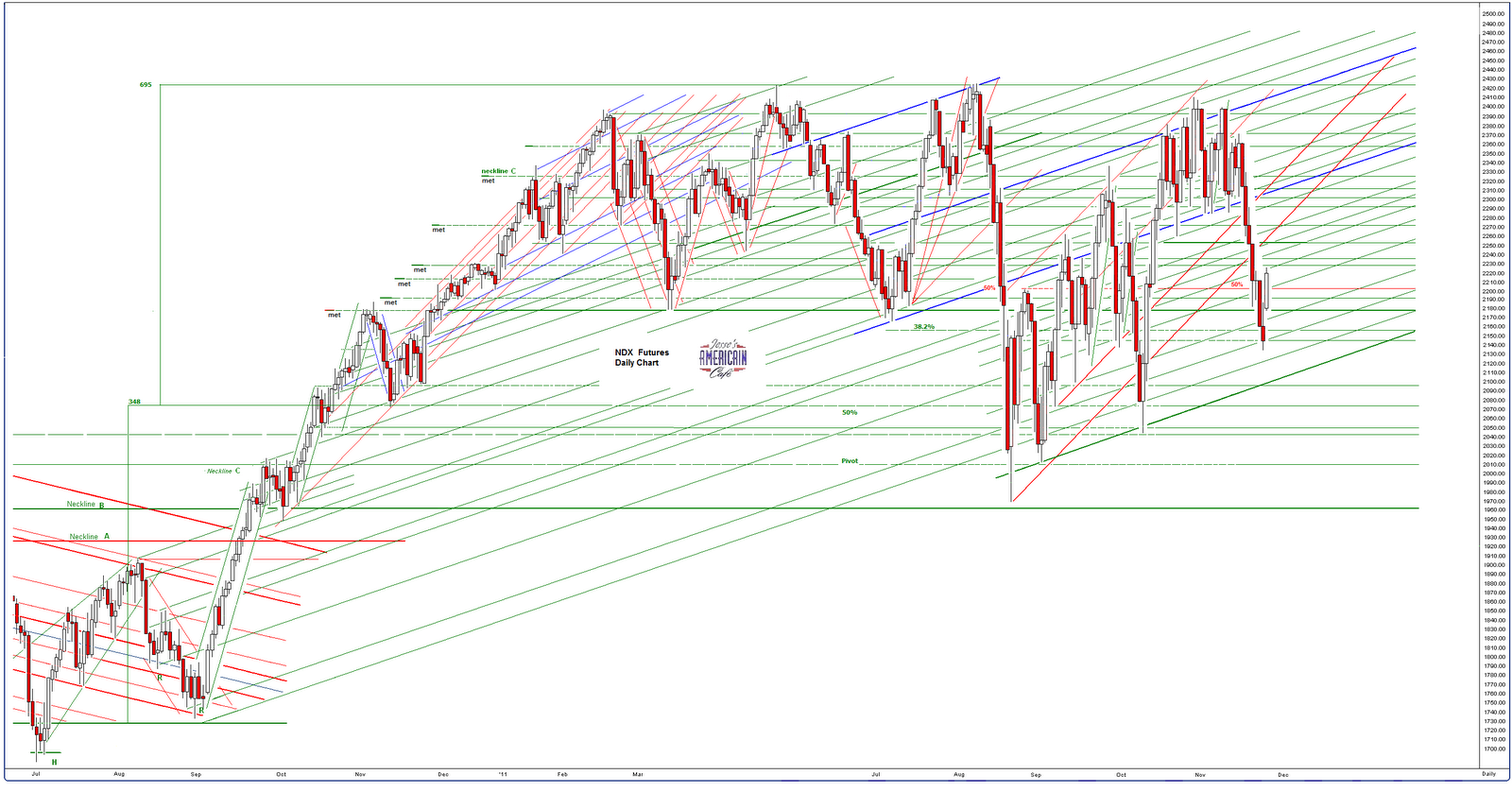
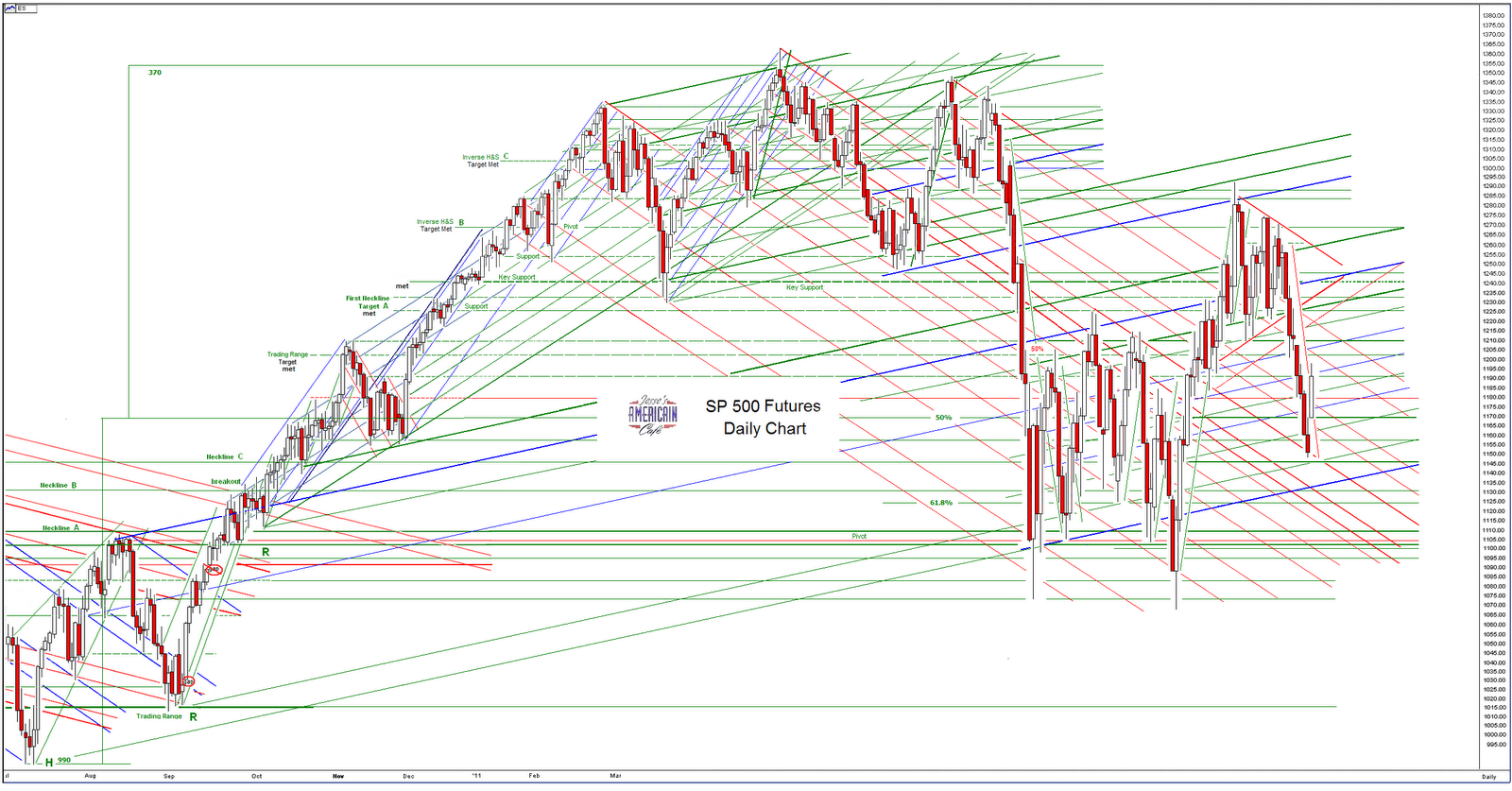
SP 500 and NDX Futures Daily Charts


A reversal, with a big gap open, that so far has retraced the first Fibonacci level. It needs to do better in order to be counted more than a dead cat bounce given the oversold condition stocks had been in.

The market remains headline driven, and 'skittish' to say the least.


25 November 2011

Gold Daily and Silver Weekly Charts


Still running short stocks and long bullion.

No real trading today in this thin holiday market.


SP 500 and NDX Futures Daily Charts


Will stocks really fall all the way to the bottom of the channel?

The big support may be a big test. It is obvious on the charts.


24 November 2011

Warren Pollock: Open Letter to the CME


Wednesday, November 23, 2011

Open Letter to the CME
To: Terrence A Duffy, Chairman CME Group

As illustrated by the failure of MF Global, I am of the opinion that, the CME has not met its basic obligations to the marketplace as a “public fiduciary.”

Our society depends on “basic finance” to provide “utility functions” such as banking, hedging, insurance, and/or capital formation. Presently, we have an “innovative system” that degrades the integrity needed for “basic finance” to perform as required in a well-structured economy.

Worse yet, our “innovative” financial system impedes the effectiveness of the greater “physical economy.” The physical economy is all those individuals and entities tasked with meeting actual need. The physical economy consists of many of your customers including farmers, manufacturers and electric companies.

Our society needs people working in the physical world to create jobs more desperately than it needs the continuity of the CME. Must we endure another market catastrophe to figure this out?

The 2008 bailouts defined “moral hazard,” as the socialization of losses due to over-leverage. MF Global consumers are currently subsidizing losses attributable to over-leverage and “innovation.” Perhaps small percentage moves in speculation rationalized an internal choice between corporate survival and the sanctity of customer funds. Complexity has been specifically designed by “modern finance” to intentionally allow over-leverage leading to out sized profits and reactively-subsidized losses.

The word, “theft,” comes to mind.

I believe that, the products traded by your member firms, at the CME exchange and elsewhere, well exceed the capacity of the monetary system to cover relatively small percentage losses or speculative miscalculations. Clearing OTC derivatives on an exchange does not, and will not, correct the problem.

With repeal of Glass Steagall, and the conversion of mutual companies to publicly traded entities, meaningful regulation has proved to be politically impossible to recapture. The solution therefore resides in simplification from “innovative” towards “basic” finance.

Presently, I would urge you to make MF Global customers whole as a perquisite to market reform towards a “utility function.” More than just the continuity of the CME may be at stake.

Warren E. Pollock

23 November 2011

Franklin D. Roosevelt's 1942 Thanksgiving Proclamation - Kipling's Caution to the Empire


"It is a good thing to give thanks unto the Lord."

Across the uncertain ways of space and time our hearts echo those words, for the days are with us again when, at the gathering of the harvest, we solemnly express our dependence upon Almighty God.

The final months of this year, now almost spent, find our Republic and the nations joined with it waging a battle on many fronts for the preservation of liberty.

In giving thanks for the greatest harvest in the history of our nation, we who plant and reap can well resolve that in the year to come we will do all in our power to pass that milestone; for by our labors in the fields we can share some part of the sacrifice with our brothers and sons who wear the uniform of the United States.

It is fitting that we recall now the reverent words of George Washington, "Almighty God, we make our earnest prayer that Thou wilt keep the United States in Thy holy protection," and that every American in his own way lift his voice to Heaven.

I recommend that all of us bear in mind this great Psalm:
The Lord is my shepherd; I shall not want.
He maketh me to lie down in green pastures; he leadeth me beside the still waters.
He restoreth my soul; he leadeth me I the paths of righteousness for his name’s sake.
Yea, though I walk through the valley of the shadow of death, I will fear no evil; for thou art with me; thy rod and thy staff they comfort me.
Thou preparest a table before me in the presence of mine enemies; thou annointest my head with oil; my cup runneth over.
Surely goodness and mercy shall follow me all the days of my life; and I will dwell in the house of the Lord for ever.
Inspired with faith and courage by these words, let us turn again to the work that confronts us in this time of national emergency : in the armed services and the merchant marine; in factories and offices; on farms and in the mines; on highways, railways and airways; in other places of public service to the Nation; and in our homes.

NOW, THEREFORE, I, FRANKLIN D. ROOSEVELT, President of the United States of America, do hereby invite the attention of the people to the joint resolution of Congress approved December 26, 1941, which designates the fourth Thursday in November of each year as thanksgiving Day’ and I request that both Thanksgiving Day, November 26, 1942, and New Year’s Day, January 1, 1943, be observed in prayer, publicly and privately.

IN WITNESS WHEREOF, I have hereunto set my hand and caused the seal of the United States of America to be affixed.

DONE at the City of Washington this eleventh day of November, in the year of our Lord nineteen hundred and forty-two, and of the Independence of the United States of America the one hundred and sixty-seventh.

FRANKLIN D. ROOSEVELT


God of our fathers, known of old—
Lord of our far-flung battle line—
Beneath whose awful hand we hold
Dominion over palm and pine—
Lord God of Hosts, be with us yet,
Lest we forget—lest we forget!

The tumult and the shouting dies—
The Captains and the Kings depart—
Still stands Thine ancient sacrifice,
An humble and a contrite heart.
Lord God of Hosts, be with us yet,
Lest we forget—lest we forget!

Far-called our navies melt away—
On dune and headland sinks the fire—
Lo, all our pomp of yesterday
Is one with Nineveh and Tyre!
Judge of the Nations, spare us yet,
Lest we forget—lest we forget!

Rudyard Kipling, 1897

Gold Daily and Silver Weekly Charts - Post Option Expiration Gut Check Doesn't Stick


US stock markets went out on their laws, roiled by a failed bond auction in Germany.

Gold and silver received their traditional post option expiration smackdown, designed to pry any new futures position out of the hands of any specs who happened to have held in-the-money calls after yesterday.

The US will be closed tomorrow, and staffed by junior employees on Friday. So eyes will be on the overseas markets.

Pleasant holiday to the Yanks.


SP 500 and NDX Futures Daily Charts - Out on the Lows


A failed bond auction in Germany cast a pall over the holiday markets in the US.

Stocks went out on their lows in thin trading.


Pigs 'R' Us - The Wall Street Groupon IPO


And it is...

When I play cards with the little girls, they make up new rules on the fly and sometimes cheat outrageously, palming cards and sneaking money from my pile of coins, so that we all laugh about it. They know that I know, and that I am being tolerant. They enjoy sneaking up on me, and jumping out of cupboards and behind doors. And I always act surprised, but never am.

After all, it is a duty and the joy of a father to occasionally indulge his children, and especially the little ones, to show them the tender side of his love.

But what is amusing in 10 year olds is not becoming in grown men acting like spoiled little boys, abusing other people's money, betraying trusts,  and taking personal and selfish gains from the livelihood of the public and the nation's future, stealing from their clients.

And Wall Street is even worse than the Congress.

While I never had the heart or even the need for it with any of the children, a stern look being enough, perhaps a spanking is in order for such miscreants as these. Where's the wooden spoon? I am counting to three. lol.


From Le Cafe on 3 November:

"The wolf thought to himself: 'What a tender young creature! what a nice plump mouthful.-- she will be better to eat than the old woman. I must act craftily, so as to catch both."

The Brothers Grimm, Little Red Cap

The Wall Street wiseguys are shoving the Groupon IPO out the door tonight I hear.

It *could* do well, but it strikes a kind of a chord for a high water mark in the post 2008 equity echo bubble.

From Le Cafe on 4 November:
GroupOn = LinkedIn?

La la la, whatever. La la la, doesn't matter. As cynical an IPO as seen since 1999 they said today.


22 November 2011

CME Boosts MF Global Guarantee - Corzine & Gensler Called to Testify At House Hearing


It is good to hear of the increasing likelihood that the customers will be repaid. It may take some time for full repayment.

It is also good that Corzine, Gensler et al. are being asked to appear before the Congress. The article does not mention subpoenas, or whether the testimony will be sworn.

The facts of the case will most likely be buried under a smokescreen of 'accounting errors' and misunderstanding.

But the Congressmen will have their chance to express their 'outrage' as they did with the bank bailouts, and put on a good show for the folks at home.

I wonder if they will ever reveal who had taken the customer funds from MF Global as last minute collateral before the bankruptcy filing?    I notice no one from JP Morgan has been called.  Although I doubt it, it would be interesting if Corzine pleads the fifth.

Like resistance becomes support, so the glass ceiling becomes a glass floor once you pass through it and join the club.

Even with the money returned, without stronger guarantees it is hard to understand why anyone would put money into a US futures account.

Bloomberg
Corzine Called to Testify at House Hearing
By Zeke Faux and Phil Mattingly
Nov 22, 2011 6:45 PM ET

Jon S. Corzine, the former U.S. senator and New Jersey governor who ran MF Global Holdings Ltd. (MF) until the firm filed bankruptcy last month, has been called to testify at a House hearing on the failure next month.

Corzine, who was chairman and chief executive officer of the New York-based firm, will face questions “on the decisions and events leading to the collapse of MF Global” at a Dec. 15 hearing before the House Financial Services Oversight and Investigations panel, according to a statement released today...

Gary Gensler, chairman of the Commodity Futures Trading Commission; Robert Cook, director of trading and markets at the Securities and Exchange Commission; William C. Dudley, the president of the Federal Reserve Bank of New York; and Bradley Abelow, MF Global’s president and chief operating officer, have also been asked to appear at the hearing, according to a person with direct knowledge of the panel’s plans...

Press Release
CME Group Increases Guarantee to $550M to Accelerate Return of 75 Percent of MF Global Inc. Segregated Funds to All Customers

- CME Group confident reports of significantly larger shortfalls are incorrect
- Distribution would result in return of roughly $4 billion total cash returned

CHICAGO, Nov. 22, 2011 /PRNewswire/ -- To accelerate the return of additional securely held funds to MF Global Inc. customers, CME Group today announced it has increased its financial guarantee to the SIPC Trustee from $250 million to $550 million. CME Group's proposal to the Trustee is designed to increase the payout percentage from 60 percent to 75 percent in early December. This distribution would include customers holding cash balances and warehouse receipts, as well as customers who received non-sufficient funds checks from MF Global. As a result of this proposal, roughly $4 billion of the $5.5 billion that was supposed to be held by MF Global in segregation will be returned to customers. With this offer, the entire $2.5 billion securely held at CME Clearing will have been distributed.

While the final accounting of customer segregated assets and claims will occur in the bankruptcy process, CME Group is confident that recent reports of significantly larger customer segregated shortfalls are incorrect. CME Group continues to work with the Trustee and the CFTC to finalize this accounting....

Gold Daily and Silver Weekly Charts - Bounce Back from the Smackdown


Silver would not be denied.

Keep an eye now on the December delivery process in the metals at the Comex.

All eyes on Europe and the US financials.


SP 500 and NDX Futures Daily Charts


Light volumes. Some recovery from the daily low on the Fed minutes.

This gave a little cheer to a market that was digesting a weaker than expected GDP number.

The adults have left the building for the holiday.

All eyes on Europe.

Bank of America was warned by its regulators to stiffen up its assets.

The futures finally closed at 1180.75 which is important support.


JPM to Buy MF Global's Stake in the London Metals Exchange


JP Morgan to buy MF Global stake in LME
By Douwe Miedema
LONDON Tue Nov 22, 2011 9:55am EST


(Reuters) - U.S. investment bank J.P. Morgan (JPM.N) is set to announce it has bought a 4.7 percent stake in the London Metal Exchange for 25 million pounds ($39.1) from defunct U.S. brokerage MF Global, a person familiar with the situation said.

An announcement could come as early as this week, the source said.

J.P. Morgan and the LME declined comment.

KPMG, the administrators for MF Global's UK unit, could not immediately be reached for comment.

The Right of the People Peaceably to Assemble and Petition the Government


Congress shall make no law respecting an establishment of religion, or prohibiting the free exercise thereof; or abridging the freedom of speech, or of the press; or the right of the people peaceably to assemble, and to petition the Government for a redress of grievances.


First they came for the Socialists, and I did not speak out --
Because I was not a Socialist.

Then they came for the Trade Unionists, and I did not speak out --
Because I was not a Trade Unionist.

Then they came for the Jews, and I did not speak out --
Because I was not a Jew.

Then they came for me -- and there was no one left to speak for me.

Martin Niemöller

21 November 2011

Tavakoli: MF Global Revelations Keep Getting Worse


“The moment the idea is admitted into society that property is not as sacred as the laws of God, and there is not a force of law and public justice to protect it, anarchy and tyranny commence.”

John Adams

MF Global is one of the most outrageous and brazen abuses of customers by Wall Street insiders that I have ever seen.

That it has been receiving so little attention by the mass media shows the extreme moral hazard in which the average American unsuspectingly operates.

MF Global is worse than Madoff. It was not a Ponzi scheme. The customers were not betrayed by a fraud.

Rather, within an officially sanctioned system overseen by the government and the guarantees of a major global exchange and the regulators of the markets of the nation, their property was confiscated, stolen, and sold, and then stolen again by the creditors and criminals who conceal it and attempt to claim it as their own.

And yet as bad as it is,  the cover up, which is still under way, may be worse in its eventual effects, and bring down careers, some market organizations,  and perhaps even members of the government.


To read the original pdf by Janet Tavakoli with links click here.

MF Global Revelations Keep Getting Worse
By Janet Tavakoli
November 21, 2011

When MF Global collapsed on October 21, it was the biggest financial firm to collapse since Lehman in September 2008. Then Chairman and CEO Jon Corzine is connected to the head of one of his key regulators, the Commodity Futures Trading Commission (CFTC), through his former protégé at Goldman Sachs, Gary Gensler. He also knows the Fed’s William Dudley, a key member of the Fed’s Open Market Committee, from their days at Goldman Sachs. The Fed approved MF Global’s status as a primary dealer, a participant in the Fed’s Open Market Operations, just before Jon Corzine took its helm and beached it on a reef called leveraged credit risk.

MF Global’s officers admitted to federal regulators that before the collapse, the firm diverted cash from customers’ accounts that were supposed to be segregated:
MF Global Holdings LTD. “violated requirements that it keep clients’ collateral separate from its own accounts…Craig Donohue, CME Group’s chief executive officer, said on a conference call with analysts today that MF Global isn’t in compliance with the rules of the exchange and the Commodity Futures Trading Commission.”

“MF Global Probe May Involve Hundreds of Millions in Funds,” Bloomberg News – November 1, 2001 by Silia Brush and Matthew Leising
Cash in customers’ accounts may be invested in allowable transactions, and MF was allowed to make extra revenue from the income. But what isn’t allowed, and what MF Global apparently admitted to doing, is to commingle customers’ money with its own and take money from customers’ accounts to meet margin calls on MF Global’s own allowable transactions. Even if all of the money is eventually clawed back and recovered, this remains an impermissible act. Moreover, full recovery—even if it is possible—is not the same as restitution. People have been denied access to their money, and businesses and reputations have been tarnished.

In layman’s terms, you may buy a Rolls Royce with customers’ excess cash, sell it at a profit, and pocket part of the profits. You may buy a Rolls Royce and try to resell it at a profit with your firm’s cash. But you aren’t allowed to take customers’ money to make the car payments on your firm’s Rolls Royce. If one engages in this impermissible activity, it becomes almost impossible to cover up if you have an accident driving your Rolls Royce.

Implausible Denial and an Ugly Surprise

On November 1, Kenneth Ziman, a lawyer for MF Global, relayed information from MF Global to U.S. Bankruptcy judge Martin Glenn in Manhattan: ”To the best knowledge of management, there is no shortfall.” If that sounded like a cover-up, it was, unless of course you prefer to believe that the “best knowledge” of management is actually no knowledge at all.

How long does it take to find more than $600 million to $1.2 billion of customers’ money? MF Global’s books seem so messed up that one person couldn’t have created this chaos alone. A lot of people had to agree to throw away controls, standards, and procedures. I doubt this happened just in the final week or two before MF Global blew itself up.
“According to a U.S. official, MF Global admitted to federal regulators early Monday [October 31, 2011] that money was missing from customer accounts. MF Global acknowledged a shortfall in a phone call amid mounting questions from regulators as they went through the firm's books.”

“MF Global’s Collapse Draws FBI Interest,” by Devlin Barrett, Scott Patterson, and Mike Spector, WSJ, November 2, 2011
The initial bankruptcy estimate was a shortfall of around $600 million. As of Monday November 21, MF Global’s liquidating trustee believes the shortfall may be as much as $1.2 billion and possibly even more.

“Repo-to-Maturity” is a “Total Return Swap-to-Maturity,” A Type of Credit Derivative

If you call a total return swap-to-maturity a “repo-to-maturity,” you are much less likely to freak out regulators. Many regulators still remember that Long Term Capital Management (LTCM) used total return swaps (among other things). Jon Corzine should remember, too, since he was closely involved with LTCM when he headed Goldman Sachs. In September of 2011, FINRA seemed to catch on that MF Global’s transactions were riskier than it previously thought and asked for more capital against these trades.

Part of AIG's acute distress in 2008 was due to credit default swaps, another type of credit derivative, linked to the risk of shady overrated collateralized debt obligations. The basic problem was risk on fixed income assets that could only go down in value combined with lots of leverage.

I’d like to interject a side note. I understand that some pundits tried to say that the New York Times’s Gretchen Morgenson was incorrect when she wrote MF Global was felled by derivative bets. She is correct. The pundits leaped to the conclusion that when she referred to credit derivatives and “swaps” that she meant credit default swaps, but she was referring to total return swaps, a type of credit derivative. (Later in the article she discussed a different topic, lack of transparency in credit default swaps, another type of credit derivative.)

MF Global’s problematic trades were different from AIG’s, but they were also derivatives, in fact, they were a form of credit derivative. The "repo-to-maturity" transaction was just a form over substance gimmick to disguise this fact. Specifically the transactions are total return swaps, a type of credit derivative, and the chief purpose of these transactions is leverage.

A total return swap-to-maturity includes a type of credit derivative. It allows you to sell a bond you own and get off-balance sheet financing in the form of a total return swap. Alternatively, you can get off-balance sheet financing on a bond with risk you want (but do not currently own so there is no need to sell anything) and take the risk of the default and price risk. (Price risk can be due both to credit risk and/or interest rate risk.) This is an off-balance sheet transaction in which the total return receiver (MF Global) has both the price risk and the default risk of the reference bonds. In this case, MF Global had the price risk and the default risk of $6.3 billion of the sovereign debt of Belgium, Italy, Spain, Portugal, and Ireland. As it happened, the price fluctuations of this debt in 2011 weren’t due to a general rise in interest rates, they were due to a general increase in the perceived credit risk of this debt.

Repo transactions are on balance sheet transactions, but they don’t draw as much scrutiny from regulators. There was just one little problem. MF Global wanted the off-balance sheet treatment of a derivative, a total return swap, but it didn’t want to call it a total return swap, so it used smoke and mirrors. Even if MF Global engaged in a wash trade at the end (if there is no default in the meantime) to buy back the bonds, MF Global would receive par on the bonds from the maturing bonds. The repurchase trade at maturity is a formality with no real (or material) economic consequence.

In other words, the “repo-to-maturity” exploits a form-over-substance trick to avoid calling this transaction a total return swap. Accountants paid by the form-over-substance seekers and asleep-at-the-switch regulators will sometimes, at least temporarily, go along with this sort of relabeling.

The fact that MF Global was exposed in a leveraged way to default risk and liquidity risk because of these transactions and that the risk was- linked to European sovereign debt was disclosed in MF Global’s 10K for the year ending March 31, 2011, a required financial statement filed with the SEC. The CFTC and other regulators had the information right under their noses, but it appears they didn’t understand that they were looking at a leveraged credit derivative transaction that could lead to margin calls that MF Global would be unable to meet.

The result is that yet another large financial institution has been felled when it couldn’t meet margin calls due to the credit risk of fixed income assets combined with high leverage in an off-balance sheet transaction. The ugliest part of this story, however, isn’t that MF Global got in over its head, it’s that the bankruptcy trustee estimates customers’ money to the tune of $1.2 billion or more is still missing.

Probable Shortfalls Throughout 2011

MF Global reportedly employed 35:1 leverage—some reports are 40:1—against a portfolio comprised around 20% of European Sovereign risks including Belgium, Italy, Spain, Portugal, and Ireland. MF Global would have had several trading days in 2011 with moves of 5% to 10% on this sovereign risk. MF Global was so thinly capitalized that this trade alone could eat up half of its capital. Any of MF Global’s other asset positions moving the same way in 2011’s highly correlated markets would have put MF Global in a position of negative equity. From a risk management point of view, examiners have to consider the very strong possibility that MF Global had several negative equity days throughout 2011.

How did MF Global meet margin calls throughout 2011? It seems an investigation into money flows throughout 2011 is in order.

By the end of October, the combination of a $90 million August legal settlement against MF Global coming due, increased capital calls by FINRA, and margin hikes from counterparties worried about MF Global’s credit made it impossible for MF Global to cover up its shortfall.

Regulators Waive Required Tests for Jon Corzine

Jon Corzine resigned as Chairman and CEO of MF Global on November 4, just days after the October 31 bankruptcy announcement. As a matter of corporate governance, holding the position of Chairman nad CEO meant that Corzine had a lot of concentrated power with little oversight. Many question the wisdom of a corporate structure that allows officers to hold this dual position. (Ken Lewis, the Chairman and CEO that merged Bank of America into the poorhouse held this dual role, too. Lewis defended this practice at the Federal Reserve Bank of Chicago’s Bank Structure Conference in 2003.) Corzine was the former governor of New Jersey and had been out of the active markets for twelve years. Prior to that, until 1999 he had been the CEO of Goldman Sachs.

The Financial Industry Regulatory Authority Inc. (FINRA) gave Jon Corzine a waiver from his Series 7 and Series 24 exams when he took the helm of MF Global in March 2010. The former is required for anyone involved in the investment banking or securities business including supervision, solicitation, or training of persons associated with MF Global, and that included Corzine. As an officer of MF Global the latter was required for Corzine, since he had been out of the business for around 12 years or more than six times the 2 year expiration date for reactivating these qualifications.

Jon Corzine to Credit Derivatives Head: Next Time “Double Up” (See note below)

The test waiver by regulators seems to be blatant cronyism, because Corzine not only hadn’t been involved in the day-to-day markets for more than a decade, his responsibilities at MF Global included active decision making. The waiver wasn’t justified. Corzine reportedly authored the strategy for the MF Global killing trades, and he also had authority on the trading floor.

Jon Corzine pushed traders to increase their risk. According to an MF Global employee, Corzine knelt down beside Jim Parascandola, head of credit derivatives trading, and told him that next time he should “double up” on his winning protection bets on brokerages. Traders loved Corzine, because he pushed them to increase risk. Now the traders aren’t lifting offers, they’re pounding the pavement.
JT Note: Subsequent to this report Jim Parascandola told me that he was never told to increase the size of any position, albeit his trades were profitable.

MF Global Becomes a Primary Dealer Unregulated by the Fed: How Did That Happen?

MF Global’s financials were shaky ever since Man Group spun it off in 2005 and saddled it with a lot of debt. Yet MF Global was added to the Fed’s list of 22 primary dealers in February 2011, just before former Goldman CEO Jon Corzine officially came on board. Primary dealers buy and sell U.S. treasuries at auction and are a counterparty to the Fed’s Open Market operations.

William C. Dudley is the president and chief executive officer of the FRBNY. He is also vice chairman of the Federal Open Market Committee (FOMC) and VP of the Markets Group, which oversees open market and foreign exchange trading operations and provisions of account services to foreign central banks and manages the System Open Market Account. Dudley is a former partner at Goldman Sachs (1986-2007), and he was Goldman’s chief economist.

David Kotok of Cumberland Advisors has raised important questions about the fact that the Fed has dropped its role of surveillance of primary dealers, and his commentaries are available here.

Besides trading treasuries, the big benefit to primary dealers is the perception that the Fed will provide funding to primary dealers during a systemic liquidity crunch. Just before Bear Stearns imploded, the Fed changed the rules so that non-U.S. banks, along with brokers that were primary dealers (as MF Global later became), were allowed to borrow through a program called a Term Securities Lending Facility (TSLF) to finance mortgage backed securities, asset backed securities, and more. TSLF’s start date was too late to help Bear Stearns, and the program has now been discontinued, but the perception of a Fed safety net has precedence.

Why did the Fed award prestigious primary dealer status to a shaky operation like MF Global, an entity it does not regulate?

MF Global Stalled and Wrote Rubber Checks: Did Some Customers Get Better Treatment?

The week before the bankruptcy, when customers asked for excess cash from their accounts, MF Global stalled. According to a commodity fund manager I spoke with, MF Global’s first stall tactic was to claim it lost wire transfer instructions. Instead of issuing an electronic check or sending an overnight check, MF Global sent paper checks via snail mail, including checks for hundreds of thousands of dollars. The checks bounced. After the checks bounced, the amounts were still debited from customer accounts, and no one at MF Global could or would reverse the check entries. The manager has had to intervene to get MF Global to correct this, and still hasn’t gotten the entries corrected. Reuters’s Matthew Goldstein reported more in “MF Global and the Rubber Check.”

I thought that was bad enough, but on November 10 I was a guest on Stocks & Jocks, a Chicago radio show, when Jon Najarian said that a large broker he knows got a $400,000 electronic check from MF Global the Friday before that bankruptcy, and the check cleared. If that’s accurate, MF Global treated some customers differently than others.

Tip-Offs for Some Customers?

In August, customers started pulling billions of dollars out of their segregated accounts with MF Global. It was the biggest outflow of funds since January 2009. The bankruptcy trustee may clawback transfers of funds from MF Global as it was teetering, because it is likely that employees within MF Global were well aware of the problems and tipped off key customers.

Yet Gary Gensler, head of the CFTC, did not investigate or begin transferring accounts out of MF Global before the bankruptcy, and that is unprecedented for the CFTC. Given that Gary Gensler was a protégé of Jon Corzine at Goldman Sachs, one should question why Gary Gensler didn’t act and why he should be allowed to remain head of the CFTC.

CFTC’s Gary Gensler Didn’t Act

Gary Gensler, Jon Corzine’s former Goldman Sachs colleague and current head of the Commodities Futures Trading Commission (CFTC), had reason to be concerned about MF Global’s risk management. In early 2008, a rogue trader racked up $141.5 million in losses in unauthorized trades that exceeded his trading limits. It seems he accomplished this in under seven hours. In August of this year, MF Global and the underwriters of its 2007 initial public stock offering (IPO) paid around $90 million to settle claims by investors that they were misled about MF Global’s risk management prior to the rogue trader’s actions. Since 2008, MF Global’s financial condition has been nothing to brag about. Now the settlement is in jeopardy due to the bankruptcy. [Michael Stockman, the chief risk officer of MF Global as of January 2011 (after the previous mentioned incident) was in my Liar’s Poker training class lampooned by another classmate, Michael Lewis.]

In the past, the exchanges and CFTC “always” moved customer positions before a Futures Commission Merchant (FCM) declared bankruptcy. The CFTC had ample reason to have contingency plans for MF Global based on publicly available information. Yet the Gensler-led CFTC hasn’t followed this historical precedent when an FCM led by his former Goldman colleague teetered on the edge of bankruptcy. Gensler has recused himself from the CFTC’s probe of MF Global.

The exchange-traded futures markets have been shaken to the core. The Bankruptcy Code apparently conflicts with the Commodity Exchange Act, so customers of MF Global have less protection than one might expect. The Securities Investor Protection Corporation (SIPC) is not the FDIC. Account holders have no idea how long it will take to get back all of their money, if it is there to be recovered, and right now, it appears a lot of it cannot be found. This is why many traders sweep all of the excess cash out of their accounts each day, and only put in cash when required.

MF Global Debacle Damages a Key Global Market

The “risk wizards” of Goldman Sachs once again look like market wrecking balls. The futures market is a globally connected market and it is a key mechanism for farmers, metals miners, and metals fabricators (among others) to hedge their risk. Confidence in the futures market has been shaken. No one knows if their money is safe, but what is more disturbing is the appearance of crony capitalism once again giving favored treatment, lax regulation, and absent oversight to a crony capitalist that abused all of these perks to blow up a large financial firm and damage a key global market.
Janet Tavakoli is the president of Tavakoli Structured Finance, a Chicago-based firm that provides consulting to financial institutions and institutional investors. Ms. Tavakoli has more than 20 years of experience in senior investment banking positions, trading, structuring and marketing structured financial products. She is a former adjunct associate professor of derivatives at the University of Chicago's Graduate School of Business. Author of: Credit Derivatives & Synthetic Structures (1998, 2001), Collateralized Debt Obligations & Structured Finance (2003), Structured Finance & Collateralized Debt Obligations (John Wiley & Sons, September 2008). Tavakoli’s book on the causes of the global financial meltdown and how to fix it is: Dear Mr. Buffett: What an Investor Learns 1,269 Miles from Wall Street (Wiley, 2009).

Gold Daily and Silver Weekly Charts - December Option Expiration Tomorrow


"Of all forms of tyranny the least attractive and the most vulgar is the tyranny of mere wealth, the tyranny of plutocracy."

J. Pierpont Morgan

As you may recall I warned several times over the past two months that this option expiration would get 'hit' because December is a big delivery month.

And so it has.

I am going to reset the upward curve on the gold daily chart to wherever this takedown ends up, after the shenanigans are over.

As you can see on the more detailed gold futures chart, the last low in October was reached a day or two before the option expiration. I am not so sure it will play out that way this time because of the delivery issues and the holiday shortened week. But let's see how the charade progresses.

It says a lot about a society where customers can be openly robbed, and markets can be blatantly rigged, and even more about the people who defend it and hold it up as an ideal for the rest of the world.

This is what the average American mind cannot yet grasp, but those outside the system see it clearly. And it is puzzling to them. How can a reasonably educated and well off people act as such willing fools for those who take such shameless advantage of them?

Well after all, it is a currency war.


SP 500 and NDX Futures Daily Charts - Much Ado About Nothing


“The boom, not the slump, is the right time for austerity at the Treasury.”

John Maynard Keynes, 1937

Light volumes and the markets were in the profit-taking mood on the back of JPM's slam on metals.

Anyone who was surprised in the least by the Super-Committee's inability to reach a deal should not be allowed to roam about without a chaperone, as they might hurt themselves.

The whole point of the Super-Committee was to fail. It's failure is a useful tool for the politicos in the Beltway. It allows them to put military spending cuts on the table and point fingers at each other until next November.


Bernanke For A Day


The San Francisco Fed has provided us an online game that is presumably meant to be instructional as well as 'fun.'

After a few tries to test out its assumptions, I have been able to 'win it' pretty regularly, winning being defined as appointed to another term. It is very one dimensional so it gets old rather quickly.

One is hit with various oil and currency and fiscal shocks and surprises, and must adjust to them as you go along in a particular episode.

I imagine the point of this is to educate people to the lags in policy effects, and the dangers of over-reacting to secular events and causing problems for yourself downstream.

At this point I am having some fun examining their assumptions, which are built into the game's algorithms, for what they can tell me about their own thoughts in designing the game. I like to play strategy games on my laptop while the children inflict the latest tweenie programs on me before packing them off to bed.

I was disappointed because there is no option to exercise your role as bank examiner, no metrics for the dollar and trade, and of course, you have no ability to fire Timmy.

Enjoy.

Play The Fed Chairman Game


Trustee Says MF Global May Have Stolen $1.2 Billion in Customer Funds


"The infectiousness of crime is like that of the plague."

Napoleon Bonaparte

Ironically a reader sent me their analysis yesterday that showed that the losses were $1.2 Billion. The twist here is that the Trustee may be accruing those losses to the customers even where there is some discretion.

One would think that the customers should be paid first out of all MF Global creditors. But I suspect that where it is possible, their loss will be subordinated to the unsecured creditors like JPM who have a powerful influence with this Trustee and the courts. The customers of consequence, like the Koch brothers, appear to have been tipped off weeks in advance.

This is the perversity of law without justice.

If that happens, then nothing is safe. If a customer in cash and Treasuries can be robbed, and then be made to stand in line with unsecured creditors, then your 401(k)s are not savings but loans to the custodians of your plans.

Now may be the time to exit all arrangements not specifically guaranteed directly by the government, and bring your money home. And better yet if no guarantees are required, and no parties standing between you and your wealth.

If they steal from one unpunished, they can steal from any and all almost at will. You are not an insider, and there is no honor among thieves. You are prey.

And what are a few customers, and the stewardship of funds, to a group of financiers intent on taking down whole nations and their Treasuries?

Reuters
MF Global trustee says shortfall may be bigger
Mon Nov 21, 2011 11:20am EST

Nov 21 (Reuters) - The trustee liquidating MF Global Holdings Ltd's broker-dealer unit said on Monday that the apparent "shortfall" of customer funds may be larger than the futures brokerage had reported prior to its bankruptcy.

"The trustee believes that even if he recovers everything that is at U.S. depositories, the apparent shortfall in what MF Global management should have segregated at U.S. depositories may be as much as $1.2 billion or more," the trustee, James Giddens, said in a statement. He added that the amount could change.

Giddens also said he expects in early December to transfer 60 percent of what is in segregated customer accounts for U.S. futures positions, pending court approval. He said the transfer would require $1.3 billion to $1.6 billion to implement, exhausting much of the assets under the trustee's control.

MF Global was run by former Goldman Sachs & Co chief and New Jersey governor Jon Corzine before its Chapter 11 filing on Oct. 31. The filing came after the New York-based company revealed that it made a $6.3 billion bet on European sovereign debt. Corzine resigned on Nov. 4.

Net Asset Values of Certain Precious Metal Trusts and Funds


Tomorrow is Comex Options Expirations for Gold and Silver.

Someone remarked this morning that the monied interests seem to be increasingly brazen in their actions.

I have had the opportunity to discuss these things with people more experienced than myself over the years. Before he passed on, a fellow Republican and economist Pierre Rinfret and I had a number of conversations about this.   We had common friends and experiences going back to the Nixon Administration.

It was his opinion there is always a minority element of the dishonest in any system. Their power waxes and wanes. But on a macro level, when the many are complacent and the power of the corrupt has grown, often through the capture and erosion of the law, many of the morally weak join in on the grand corruptions, and so the tenor of the age becomes more noticeably lawless.

And I think this is where we are today, at the natural conclusion of the greed cycle, where pretense is discarded, and theft becomes more brazen, and in the daylight.

It will continue until there is a reaction by the greater number of people, and they waken from their slumber. The course of corruption has momentum, because there are many who view it as their wealth and fortune, forgetting and forsaking all else for a few extra coins.

Those who mock and impede reform are not defenders of freedom, but the rot within the system, the dead wood that must be removed in order for growth to resume and flourish.


19 November 2011

Update on MF Global: Interview with James Koutoulas of he Commodity Customer Coalition


"When bad men combine, the good must associate; else they will fall one by one, an unpitied sacrifice in a contemptible struggle."

Edmund Burke

James Koutoulas is CEO of Typhon Capital Management and recently founded the Commodity Customer Coalition (CCC), comprised of over 7000 customers of MF Global. As an attorney and spokesperson for the CCC, Koutoulas has an inside persective on the legal maelstrom that has erupted in the wake of the MF Global bankruptcy scandal -- he's leading the charge for the commodities trading community. We asked him for an update on the case.

You can listen to the Benzina radio interview here.


What is the latest from the proceedings?

I think JP Morgan realizes we made some really good points in our objection to their motion, and they are stalling the hearing on this as much as they can. As of Tuesday, they had continued that hearing from the 15th to the 22nd. They've gone ahead and continued that again, so our objection has been pushed back to the 30th.

It's our guess that they are probably going to throw $20 million at lawyers to figure out a way to beat our little grassroots coalition on it.

They are allowing MF Global Holdings to continue to use this $8 million, but they haven't gotten the "super-priority" liens that they have sought. From our perspective, let them stall as long as they want and let them throw $20 million worth of lawyers at us. It's our goal to have this situation resolved in two weeks.

Can they get the money back?

If they commingled funds with their own money, then customers would have clawback rights, similar to the Madoff case. So, that would be a fraudulent conveyance.

Customers, in my opinion, would have rights of recovery from the $1.2 billion in excess equity that sits in the holding company, which is why we are fighting to get on the creditor's committee, so we have a say in protecting recoveries on the holding company assets.

Moreover, if there was a crime committed, that opens up Corzine, MF Global directors, the $200 million directors and officers insurance policy--that opens all of that up to potential customer recoveries, and we will aggressively be going after all of those sources so that customers are made whole.

This seems like the kind of thing that could be dragged out for years.

It is a mess, and I think it definitely had that potential before we got involved, but I think the world has never seen an organization like ours, that has been put together so quickly--over 7,000 people in under two weeks, with some very experienced lawyers who are actually motivated by helping customers instead of collecting $891 an hour in legal fees.

We've gone in there and stopped the train for the moment on the JP Morgan cash collateral use. We've gotten the judge to realize the timeliness of the situation, and the judge is an honorable man. He is putting the pressure on the trustees to speed up the process.

I also think we've put a lot of pressure on CME. I've reached out to the CME. I told them, "Look, there are cases where you could (1) be liable for this," due to the way that they have advertised the sanctity of seg [related] funds in order to drive business through their exchange. I've said, "Look, your stock is down something like $2.5 billion in market cap this week, which makes the $600 million look like a drop in the bucket."

The CME could take this major problem that they are having and turn it into an opportunity for goodwill by going out and just putting up the rest of the shortfall. The customers get their money, everybody feels safe, they restore confidence to the futures market, and they get volume going through their exchange again.

I've offered to the CME vice chairman that I will go to court and recommend that the judge grant a lien to the CME on the holding company assets should they put up a temporary fund to cover the shortfall. That way, the CME would be pretty well-protected there. Essentially, they'd be putting up a loan rather than just giving away $600 million.

It seems like the CME is one of the parties with the most at stake here.

I think that is 100 percent accurate. Look, if I'm the CME, I don't look at this as a morality play. They are a publicly-traded company. It's good business to make customers whole as fast as possible, and it's not like they are going to cut a check they are never going to get back.

They could go in and get liens on holding company assets, pay people out, and get them trading ASAP. It's a great business decision.

The CME board is a big board. There is a lot of old-school people there, so I think it takes some time to form a consensus, but I think within a couple of days they are going to have to cave and step up to the plate here for the full amount.

That makes our job easier, it makes the customer's job easier, it deprives the trustee of being able to hold this thing up for three years. It makes them have to get the money out now, and everybody except the trustee and probably JP Morgan and Bank of America win. Guess what? I'm OK with that.

Is the CME big enough to win out over entities like JP Morgan?

"Honestly, it doesn't matter who is big enough if you have people on your side who know the law. The law favors the customers. The problem that normally happens is the customers don't have the quality legal representation they need to fight the big guys.

We're working with Barnes and Thornburg as co-councel and they've assigned some brilliant partners, both on the litigation side and on the bankruptcy side. We have Sam Tenenbaum, head of Northwestern Investor Protection Clinic, who has been litigating for 35 years. He has gone toe-to-toe with Goldman Sachs and won several times.

And you've got me, who truly understands the futures business, but is also an attorney, an organizer, and a good spokesman. And I think that legal team poses a challenge that these high-priced bank lawyers have never seen before."

What's going to happen next?

"I honestly think the CME is going to step up and make customers whole. If they don't do that, we're going to proceed with our plans. Yesterday we met with the Trustee at the judge's orders and we proposed a plan for distribution of partial customer assets that would move about 6-12 months faster than the Trustee's plan.

At this point, we're still open to working with the Trustee; I offered to work with them to implement this. They thus far have not been receptive to that, so unless there is a change of heart there, we're going to come forward and put our plan in front of a judge on Tuesday.

We're also going to continue our efforts to have the Commodity Customer Coalition represented on the creditors' committee in the holdings companies case to protect customers against [Bank of America, JP Morgan, and others] who, in addition to being on the committee, are trying to set up vulture funds where they can buy customers' claims for pennies on the dollar and then get paid out once this whole thing is resolved - which I think is a conflict of interest.

We're going to support Tim Butler's motion on Tuesday. Attorney Butler has filed on behalf of his brother to push for the release of 85 percent of funds now, since the stated shortfall is only 11.6 percent.

We also want to see Corzine in court, under oath, and we want to hear his answer to where he thinks the money is and give him the option to be honorable and forthright, or to be a coward and take the Fifth.

I want to show the American people that no matter how connected you are, no matter if you were the Governor of New Jersey, no matter if you were a senator, if you break the law you should go to jail. And quite frankly, I think it's a disgrace that no one went to jail over the crisis in 2008.

All the people who gave triple-A credit ratings to essentially junk securities, none of them went to jail, none of the people who sold those went to jail, none of the people who committed mortgage fraud went to jail - I think it's ridiculous. If [Corzine] did commit a crime, I want to see him behind bars."

18 November 2011

James Turk Interviews Eric Sprott About Gold and Silver


Gold Daily and Silver Weekly Charts - Brother, You Ain't Seen Nothing Yet


"In a society built largely on confidence, with real wealth expressed more or less inaccurately by pieces of paper, the entire fabric of economic stability threatened to come toppling down."

New York World, October 25, 1929


"In economics, things take longer to happen than you think they will, and then they happen faster than you thought they could."

Rudy Dornbusch

Next week is a Thanksgiving Holiday week in the states, as the markets will be closed on Thursday and a light session on Friday.

Metals Option Expiration is next Tuesday. December is a big delivery month.

Several people have mentioned that the bankruptcy of MF Global takes a lot of large specs out of play for this delivery, with their positions trashed and funds frozen in both gold and silver.   And the failure of MF Global was a 'hit' or some ploy by the Wall Street wiseguys to break the speculative longs in the metals and take down the biggest retail futures firm that arranges physical delivery.  Talk about going the extra mile.

I don't know about that one, but wait until a major exchange defaults on some commodity like silver, and then forces cash settlements on the position holders at a price the big exchange members dictate.  And maybe not even in cash, but some kind of paper markers. If you don't think this can happen then you have not been reading enough about US market history.

That should set a few more minds free of their illusions about fair and efficient markets..

The Super-Committee has its deadline next week and a good resolution seems unlikely, which is what most expect. Obama helped to set this impasse up by extending the Bush tax cuts at the beginning of 2011, which are now a major sticking point.

I have an open mind to the theory that this is a bit of chess, with Defense Department cuts being set up by default if no resolution is reached, although they will only start in 2013. 

Most politicians are loathe to put military spending cuts on the table and take responsibility for them. A failure by the Super-Comm makes the cuts 'automatic.'

Headline risk in European sovereign debt remains very elevated.

I remain in a paired trade of short stocks and long bullion.

Have a pleasant weekend.


SP 500 and NDX Futures Daily Charts


Some decent swings but overall a quiet stock option expiration today.

Next week is a holiday shortened week in the US.

It will be marked by a metals option expiration on the Comex, and the results of the Congressional 'SuperCommitte' on the US budget deficit.

Headline risk from Europe is very high.