12 December 2011

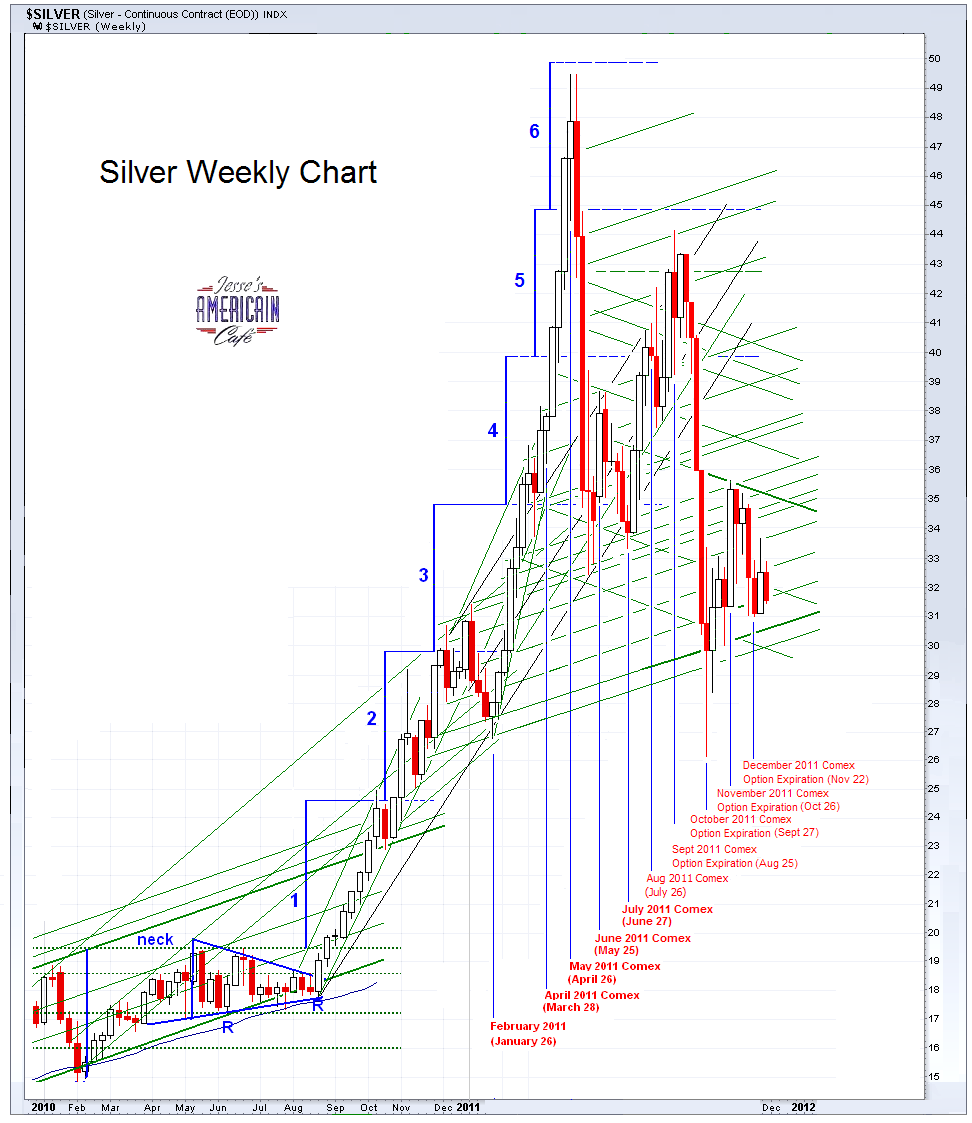
Gold Daily and Silver Weekly Charts - Bear Raids and Perception Management


The lease rates indicate that someone dumped physical gold in a non-profit seeking manner into the gold-paper markets last week. I wonder who that could be. I suspect it helped fuel the bear raid on gold today.

Bloomberg TV was having an all day anti-gold festival, so I will surmise that something gold-friendly is coming up in the next few weeks.

Perverse logic perhaps. But it is what it is.

Gold is in a triangle and given that we have an FOMC day tomorrow I will not be surprised to see another determined bear raid.

Although Silver was hit, it seemed remarkably resilient compared to gold.

Zynga IPO will be out this week along with online fashion store Michael Kors. Perhaps you can take your US paper dollars, which were stronger today on euro weakness, and buy some shares in this zynga based virtual farming economy. Maybe they can send some virtual crops over the homeless victims of the increasingly virtual US ponzi economy.


SP 500 and NDX Futures Daily Charts - Real and Unreal, Intel and Zynga


The US markets were moving lower after a warning by Intel on their forecast. As you may recall I had said last week that my tech sector information was that sales were going to be weak. This has nothing to do with a lack of hard drives, which was the excuse presented.

The stock markets are still within their triangles and I would expect them to stay there unless something really happens to break them lower. The reason is the huge vested interest that the Street has in getting the Zynga IPO out the door, along with a few other IPOs this week.

But Zynga is significant because it sets the tone for Facebook.  Zynga is virtual and produces zynga dollars and fun games, and Intel produces products for the real economy.  The divergence is interesting.

FOMC issues its last rate decision of 2011 tomorrow. I am not sure I expect them to introduce QE3 at this meeting. It may already be underway with the de facto flow of swaps to Europe. But typically they do not wish to take such an action in a Presidential election year.

Let's see what happens.


Gold and Silver Lease Rates


Tom McClellan put forward a hypothesis today on Bloomberg TV that the spread between gold lease rates and LIBOR has been extraordinarily wide, and therefore it has been difficult to short gold. This sustained gold at an unusually high price. But now it is correcting so gold will fall much more in price as the shorts pile in.

I cannot speak to LIBOR, but the gold lease rates have hardly been unusually expensive of late. There is a theory that gold lease rates are the difference between LIBOR and gold swaps.

What these charts imply to me is that someone dumped physical gold into the paper markets, with the emphasis on 'dumped.' The same thing happened to a lesser extent on Dec. 8 to silver.

I also include the six month trend on lease rates for your review.

If this is true, then the same should apply to silver. Does it? I think that mixing paper and metal interchangeably does not necessarily work as well as it does with other paper currencies.


Gold's 150 Day Moving Average


This is a delivery month for gold and silver.

The Fed will be giving its last rate decision for the year tomorrow.

This is one of the more active weeks for stock IPOs of the year.

I came into today heavy on the stock short side and lighter on gold. I have lately taken about half those shorts off and picked up more bullion near 1660.

Let's see which way the stock and precious metal triangles choose to break.

There are several unconfirmed reports of US troops deploying on the Jordanian border with Syria.


Note: RSI has not been updated for today

Net Asset Value Premiums of Certain Precious Metal Funds and Trusts


The European Union Is No Different Than Russia and China?


I was astonished, when I started to read what promised to be an interesting piece about the Fed swap lines, that Chris Whalen thinks that with regard to political and economic freedom there is no distinction to be made among Europe, Russia and China. Perhaps he is writing from the perspective of the banks, who are quite unhappy with some proposed European restraints.

"Many readers of The IRA have asked us in the past several months if we despair for the future of the United States and the economic system built upon the much abused dollar. The short answer is no; we at IRA are bullish on the United States, in part because the very democratic freedom that allows Americans to commit acts of libertine stupidity is also our greatest strength.

No matter how much gold is stored in the central banks of the nations of the old world such as China, Russia and the European Union, these nations are not democratic. No amount of monetary rectitude will offset the fact that the peoples of the old world are not free to act, either in political or economic terms."

Chris Whalen, The Fed as the New Global Aristocracy

Contrast that expression of American financial triumphalism with this blistering comparison of the Arab protests and the Occupy Wall Street Movement.

"And that is the true parallel in the West. The protest movements are indeed against Big Business – a perfectly justified cause – and against "governments". What they have really divined, however, albeit a bit late in the day, is that they have for decades bought into a fraudulent democracy: they dutifully vote for political parties – which then hand their democratic mandate and people's power to the banks and the derivative traders and the rating agencies, all three backed up by the slovenly and dishonest coterie of "experts" from America's top universities and "think tanks", who maintain the fiction that this is a crisis of globalisation rather than a massive financial con trick foisted on the voters.

The banks and the rating agencies have become the dictators of the West. Like the Mubaraks and Ben Alis, the banks believed – and still believe – they are owners of their countries. The elections which give them power have – through the gutlessness and collusion of governments – become as false as the polls to which the Arabs were forced to troop decade after decade to anoint their own national property owners. Goldman Sachs and the Royal Bank of Scotland became the Mubaraks and Ben Alis of the US and the UK, each gobbling up the people's wealth in bogus rewards and bonuses for their vicious bosses on a scale infinitely more rapacious than their greedy Arab dictator-brothers could imagine."

Robert Fisk, Bankers are the Dictators of the West

According to Janet Tavakoli in this account, even the well-heeled and highly educated are beginning to show their puzzlement and disgust for the blatant cover up of fraud as demonstrated in this instance of the credibility trap.
"Afterwards, several people came to me and to the other questioners. Much of the audience complained to CCGA's conference organizers. All were disappointed in Professor Shiller. A male CPA in the audience later contacted me via my website and wrote that he was glad I had put the question to Shiller: "though I have a great deal of respect for him, I was disappointed in his 'response' (if you could call it that)."

One woman who earned a Ph.D. in history found Shiller's response to me "incoherent:"
I was with my husband, brother, and his wife. I chatted with the stranger next to me and at least two people escaping at the same time [leaving after the speech]. No one could believe what a huge "fail" the evening had been...the failure of our political and expert classes to address the core issues...have alienated even those working in the financial industry--right up into the rung below the top of the food chain...this feels like the Ancien Régime's last days.
Alumni of the Federal Reserve, corrupt politicians, and willfully blind academics would be correct to say that evening was a case of "class warfare." Well-heeled U.S. patriots declared war on the lack of class demonstrated by their financial peers."
Perhaps Americans can revel in their unique freedom of action when they step to the voting booths next fall, and vote for one of the two choices offered to them by their corporate oligarchs, while their elected representatives continue to ignore massive bank frauds and the gaming of the system by the monied interests, now colloquially called the 'one percent.'

And don't step out of line or speak up because you may be pepper sprayed at will.

But more interestingly, it seems likely from my read of the demimonde that the States are going to diverge from Europe once again in some greater policy matter, probably involving the handling of the financial crisis, a shock like nationalizing the banks, or even a military solution to a nagging problem. And this may just be an advance serving of 'freedom fries' with extra ketchup and a side of jingoism.

By the way, I am watching this stock market decline somewhat sceptically this morning. There is the Zynga IPO coming out this week, and the markets will welcome it with open hearts and hopefully, your open pocketbooks.

10 December 2011

The Big Question: Are Funds At US Financial Firms Safe?


The short answer is 'maybe.' It is more of a buyer beware situation than most had thought, and still think.

It is nice to see someone in the mainstream media addressing this situation intelligently and without making an apology for what is apparently a criminal act and surely an egregious abuse of the public trust.

It is an axiom that it is not the initial crime that does the greatest and most widespread damage, although in this case it appears likely that someone in MF Global is due for jail time.

The damage is going to be to the US and British financial systems, Wall Street and the City of London, and in a large part because of the capture of political process by the monied interests.

This week the Senate led by Richard Shelby turned down the appointment of Richard Cordray to head the Consumer Financial Protection Bureau.  They have vowed to block any appointee until they can change the law that authorized the Bureau in the wake of the financial crisis in order to provide 'accountability.'  For them that means the ability to control the Bureau and starve it of funds in order to protect their banking cronies on Wall Street.  

Nothing is ever perfectly safe in this world. But some things are safer than others and there are steps one can take to diversify their wealth and avoid higher risks.
'A wise person does at once, what a fool does at last. Both do the same thing; only at different times.' 

Lord Acton
If I am correct, there are even bigger scandals to come when the tide goes out again, although there will be great efforts made to cover them up and excuse them 'for the sake of public confidence in the system.'    The derivatives market is a scandal-in-process, and is likely to rock the US banking system and the Dollar to their foundations when it topples. 

There may be even larger losses and anxiety for the unsuspecting who have misplaced their trust in false ideologies, slogans and theories promoted by a self-serving oligarchy.

NYT
A Risk Once Unthinkable
By James B. Stewart
December 9, 2011

Are customer accounts at brokerage firms safe?

Until the collapse of MF Global, that’s a question I thought I’d never have to ask.

Brokerage firms are required by law to maintain segregated accounts holding all client assets, including stocks, bonds, mutual funds, money market funds and cash. The law was passed after the 1929 crash, in the depths of the Depression, to make sure that customer assets were there at all times, ready to be disbursed even if everyone asked for their money at once...

I had always assumed it was impossible and that strict internal controls existed at all brokerage firms so that firm officials couldn’t tap segregated customer funds even if they were willing to break the law.  Thanks to MF Global, it’s now apparent that isn’t necessarily true. “If people are determined to misuse customer funds, they will misuse them,” said Ananda Radhakrishnan, the director of the division of clearing and risk at the Commodities Futures Trading Commission.

That’s because the commodities and securities industry is mostly self-regulating, and self-regulation ultimately depends on the integrity of the regulated. Broker-dealers — securities firms that execute trades of stocks, bonds and other assets for customers — are overseen by the S.E.C., while futures commission merchants, which trade commodities, derivatives and futures, are regulated by the C.F.T.C. Like most large brokerage firms, MF Global was both a broker-dealer and a futures commission merchant, though its primary business was commodities futures trading...

Typically, this requires transfers from segregated accounts (other than at the customer’s request) to be approved by multiple officials, including in many cases, the firm’s chief financial officer and chief compliance officer.

It’s not a low-level functionary,” a regulator said. “It’s someone who has real standing. Most customer assets are held at the biggest firms and they have scores of people involved in this process....”

The law also allows commodities firms like MF Global to use segregated customer funds as a source of low-cost financing for their own operations, but they are required to replace any customer assets taken from segregated accounts with supposedly ultrasafe collateral of the same value, typically United States Treasuries, municipal obligations and obligations whose payments of principal and interest are guaranteed by the government.

This week, the C.F.T.C. issued new rules restricting how client assets can be invested, which had grown under C.F.T.C. interpretations to include sovereign debt and transactions known as “in-house repos,” or repurchase agreements, in which a firm contracts with itself to use customer assets as, in effect, interest-free loans to finance its inventory of Treasury bonds. MF Global was apparently a heavy user of in-house repos, and before his firm collapsed, Mr. Corzine had argued strenuously against the C.F.T.C.’s proposal to ban them.

Making bad bets on European sovereign debt — like making bad bets on United States mortgage-backed securities — isn’t a crime, but improperly transferring segregated customer assets is a potential criminal violation of the securities laws and a relatively straightforward one at that. (The United States attorney’s office in Manhattan is in the early stages of investigating the removal of customer assets from MF Global.)

I spoke this week to several people involved in the MF Global investigation. No one has reached any firm conclusions about how the assets were transferred, but possible innocent explanations have dwindled to almost none. And James B. Kobak Jr., a lawyer for the MF Global trustee, said in court on Friday that there were “suspicious” trades made from customer accounts. If that’s the case, there may have been a deliberate and concerted effort to override MF Global’s internal controls to gain access to segregated customer assets, and if that can be proved, those responsible should be prosecuted and, if convicted, go to jail.

Unfortunately for MF Global’s customers — and future victims of similar crimes, if that’s what it turns out to be — there’s no easy remedy and it will most likely be months or even years before they recover their money. The Securities and Investor Protection Corporation explicitly warns that it’s “not uncommon for delays to take place when the troubled brokerage firm or its principals were involved in fraud.”

SIPC will replace up to $500,000 of securities and cash (but not futures contracts) missing from customer accounts at member firms. A measure of the magnitude of the problem is that since its creation in 1970, SIPC has advanced $1.6 billion to make possible the recovery of $109.3 billion in assets for an estimated 739,000 investors (through the end of 2010).

Meanwhile, the C.F.T.C.’s enforcement capabilities, like the S.E.C.’s, have been starved for lack of funding...

Read the entire article here.

09 December 2011

Gold Daily and Silver Weekly Charts - Divvying Up the MF Gold and Silver


Do you think you own that gold you have in storage?

Maybe, maybe not.

This is nothing compared to what will happen in the event of a major default.

Bloomberg
HSBC Sues MF Global Brokerage Over 20 Bars of Gold, Silver on Deposit
By Linda Sandler and Tiffany Kary
Dec 9, 2011 3:24 PM ET

HSBC Holdings Plc (HSBA) sued the MF Global Inc. brokerage trustee to establish whether he or another person is the rightful owner of gold bars worth about $850,000 and silver bars underlying contracts between the brokerage and a client.

Five gold bars and 15 silver bars underlie eight Comex contracts between the brokerage and its client Jason Fane of Ithaca, New York, London-based HSBC said in a court filing yesterday. Both parties have asserted claims to the bars, creating difficulties for HSBC, which is storing them, the bank said. HSBC asked a judge to decide who the rightful owner is.

“HSBC has received conflicting instructions regarding ownership and disposition of the property,” it said. “Accordingly, HSBC is exposed to multiple liabilities with respect to the disposition of the properties.”

Bullion is selling for about $1,717 an ounce on the Comex in New York, up about 21 percent this year, as investors bought the metal to protect their wealth from Europe’s escalating debt crisis, and reached a record $1,923.70 in September. Treasuries returned 9.3 percent, a Bank of America Corp. index shows.

‘Bars Are Mine’
“These bars are mine,” Fane said in an e-mail today. “We had a letter from HSBC that they were on the loading dock to be shipped to our warehouse contractor when there was some action taken by a third party to stop or delay shipment.”

The trustee, James Giddens, expects this “relatively minor and not unusual dispute” to be successfully resolved, his spokesman, Kent Jarrell, said in an e-mail.

Fane wrote HSBC after the bankruptcy, asking the bank to transfer the bars to his account at Brink’s, according to a copy of his letter filed in court. The trustee wrote HSBC saying the gold and silver was “customer property,” and the bank shouldn’t turn it over to Fane, HSBC said in the filing. Brink’s provides vaults and other services for the safekeeping of valuables.

The judge handling the bankruptcy said today that in January he would address the matter of distributing physical goods, such as gold and silver bars, after lawyers for some customers said they couldn’t get their share of the payouts because bars can’t be broken into pieces.

According to Fane’s letter, the five Comex gold contracts are for an average of 99 ounces of each....


SP 500 and NDX Futures Daily Charts


This felt like a 'drift higher' day more than anything else.

The VIX fell.

Watch for a possible SP downgrade of Eurozone debt next week.


MF Global: The Issue Is Fraud and the Cover Up


Janet Tavakoli does her usual great job of cutting to the heart of the matter. Below is an excerpt of her Huffington Post piece on MF Global today.

I keep thinking that nothing will shock me anymore in this US financial fraud fest. But the coverup of the MF Global stealing of customer money in a cloud of legal doubletalk, supposedly the one pristine and untouchable principle on Wall Street, is almost too much.

I suspect that this media and legal spin machine referenced in Tavakoli's analysis is as much a coverup of the recipients of the customer money at the banks, and similar brokerage and banking schemes operating out of the City of London, as it is the actual misdeeds of the Corzine crowd. 

Fraus est celare fraudem
And as sacred as a former US Senator may be,  if one of the TBTF Banks is involved as the circumstances seem to indicate, this is the holy of holies in the Pax Americana.

I have heard speculation that this practice of misusing and leveraging customer funds is so widespread that an immediate cessation would cause a sharp contraction in the 'shadow banking system.'

It is NEVER permissible to take customer money and use it for your own purposes and proprietary trading, exposing it to risk of loss. The idea behind this latest scheme evolved from the use of funds in margin accounts in order to generate a safe return for the loan risk taken by the broker.  Give these jokers an inch and they will take your shirt. 

This gambling with customer money is a distortion of the principle of hypothecation and the US regulators need to shut this rathole down immediately through enforcement of the law.  Greed must be tempered by fear, if not by shame and the impulse to honesty.

And the regulators may wish to consider that when they continually turn a blind eye to glaring instances of market manipulation they foster a climate of lawlessness that opens the door for widespread fraud amongst normally law abiding participants.  It becomes a competition in larceny and a moveable feast of fraud.
“Poverty wants, but greed wants everything, and more.”
Customers run for safety, from one place to another, not sure what or whom they can trust.  One thing they may do is to stop trading on margin, and shut down their margin accounts, going to strictly cash investing wherever possible. And for your long term investments, you can take possession of the physical shares and keep them in a safer place than an account statement from any of the TBTF banks and hyper-hypothecating commodity brokers.

This will be a good test for the floundering Obama Administration, as he changes his tune to try and reverse his slide in the polls in an election year, and for the Republican opposition party, which cares nothing for the consumer and average investor with less than a million in yearly income. Let's see what they do, not what they say. Maybe it is time for a third party President.

The real risk here is that the greed and coverup of these fraud is going to scare the customers away from US markets, and bring them back to the days of the 1970s in which the small speculator, sick of being abused and cheated, stayed away from the financial markets in droves.

Perhaps they can start giving origami lessons in the pits, for those dull moments between the open and the close.


Jon Corzine Dodges the Fraud Question
By Janet Tavakoli
12/9/11 07:56 AM ET

It's as if Jon Corzine's PR machine is in top spin mode. You'll recall Jon Corzine is the former head of Goldman Sachs and former CEO of MF Global that appeared in front of Congress yesterday to answer questions about an estimated $600 million to $1.2 billion in missing money from the segregated accounts of customers of MF Global.

Yesterday and today, I heard confusion about whether or not MF Global's diverting customer funds was allowable and the possibility that customers will eventually get the money back.

Let me be clear. The diverting of customer funds from segregated accounts is not legal or allowable, and even if the money is later "found" it is fraud...

"Finding" Money Doesn't Excuse Fraud
Let me address the implication of the potential to "find" the money. The money may indeed be "found." If the bonds mature and pay off one hundred cents on the dollar, it may be possible to claw back money from MF Global's trading partners without much of a fight. Otherwise there may be a legal battle for money that as creditors of MF Global, they were never entitled to in the first place.

The rights of MF Global's customers are superior to the claims of these creditors. But eventually replacing the filched funds is not the same as restitution, since reputations and businesses have already been ruined. Damage has also been done to the trust in the global futures market and Futures Commission Merchants (FCMS).

Never Allowable to Filch Customers' Funds
The key issue is that it is never allowable to divert money from customers' segregated accounts. CFTC Commissioner Jill E. Sommers did a good job of stating that in her testimony yesterday. Moreover, if any trades mimicking Corzine's were done on behalf of the tiny minority of customer accounts that could engage in this trade, the trades would have to be segregated and credits or losses would show up in the relevant customers' accounts.

That still doesn't explain the missing funds in most customer accounts. Most customer accounts would not even be eligible for the "Corzine sovereign bond trade." Why is that? Here's an excerpt from Sommers' testimony: "Under Section 4d of the CEA, customer segregated funds may be invested in: general obligations of a sovereign nation (to the extent the FCM holds customer funds denominated in that sovereign nation's currency)." Most MF Global customers now missing money did not hold foreign currency accounts.

Pushing the idea that this trade was "allowable" for some customer is a distraction trick to avoid the question of whether MF Global impermissibly wired money from customers' accounts to satisfy margin calls for its own trades. Wire fraud is a federal crime.

At Issue is Massive Fraud
The issue under investigation is what appears to be a bold and massive fraud, and Jon Corzine offered no alternative explanation, in fact it seems he cannot explain anything about the firm he ran to anyone's satisfaction.

Jon Corzine may not know where the money is right now, but as head of MF Global, he knew or should have known his trades needed collateral and that customers' money went missing to satisfy part of that need. If it is proved that fraud occurred -- and money missing this long is a very suspicious sign -- it's not plausible to me that Jon Corzine was unaware it was happening at MF Global.

It seems Jon Corzine would have Congress believe he's hopelessly incompetent, because it is better to have them believe that than the business for which he was responsible was breathtakingly wrong.

Read the rest of Jon Corzine Dodges the Fraud Question.

08 December 2011

Not a Clue: What Happened to the MF Global Customers' $1.2 Billion?


Jon Corzine said today that he does not know what happened to the missing $1.2 billion in customers' money.

If the CEO does not know, and if the regulators do not yet know, how can we possibly know?

But it's fun to take a guess. Here is mine.


The Truth is out there.


Gold Daily and Silver Weekly Charts


Gold is cheap relative to the idea that you could have a life’s fortune on a statement from a clearing agent and then find out that you don’t have a penny left anywhere. Which should you have had, physical gold or that clearing house statement? Gold is cheap because of the condition of other things.

Jim Sinclair

There was a very obvious drop in gold today. It was coincident with a decline in the SP futures, but was much sharper and more severe. I include the intra-day chart.  It has every indication of a major bear raid.

There was a quite a bit of disappointment today when the ECB cut rates 25 bp rather than 50 bp, and Mario Draghi did not pledge his central bank to endless quantitative easing and the buying of European bonds.

There was a report today at Zerohedge from Goldcore that the German business wire MNI reported that "MARKET SOURCES REPORT BIS, BOE & FEDERAL RESERVE WERE SELLING GOLD AFTER IT POPPED TO SESSION HIGH AT GMT 1335 -MNI NEWS via BLOOMBERG."

I get the daily report from Goldcore and I have a non-premium subscription at MNI. I have not been able to find the particulars of this, or any details, so I am unable to further comment. It is not that I doubt this, but I would like to know what causes them to say this with such specificity.  How did they know who was selling,  and what were their sources?  

Tomorrow will be interesting. In the afternoon a report/rumour swept the markets that Germany would not be supporting the new EU Treaty to resolve the debt crisis, and the equity markets went out on the lows.

Jon Corzine was testifying today before the House, but the more enlightening testimony may have been by CFTC Commissioner Jill Sommers who made it quite clear that the customers of MF Global have a claim on its assets that is superior to the creditors including JP Morgan.

As John F. Kennedy once said, "My father always said that all businessmen were sons-of-bitches, but I never really believed it until now."

This affaire d'MF will give us some insight into the character of the American government. It might be advisable to have a bag nearby however, because the experience may be truly nauseating.

At the end of last year I promised you a 'year of revelations.' And it seems that they are well underway. But the greatest revelations are not about what those in charge have been doing, but rather about ourselves and how we react to them.

I am thinking about what next year will bring. But I think the time is already here in which to take steps to protect your assets.


SP 500 and NDX Futures Daily Charts - Ugly Selloff Into the Close


The US equity long only fund managers would dearly like to rally this market to ensure their year end bonuses.

And once again they made a play to take the markets off their lows this afternoon, until another report (rumour) swept the market that Germany would not back any new treaty proposal tomorrow.

And so the markets sold off and went out very near their lows.

Texas Instruments lowered guidance after the bell, and the stock is being hammered after hours.

Based on my own industry knowledge the retail electronics industry is becoming desperate to move inventory in the States with a few notable exceptions especially amongst the wireless and personal device cult manufacturers.


CFTC Issues A Clear Statement: MF Global Customers Have Priority In This Bankruptcy


"A good parson once said that where mystery begins, religion ends. Cannot I say, as truly at least,
of human laws, that where mystery begins, justice ends?"

Edmund Burke

Jill Sommers, the CFTC Commissioner who is leading the investigation into the MF Global bankruptcy gave some important testimony to the House today that has been overshadowed by the expected appearance of Jon Corzine.

If you have been following the case, you know that JP Morgan has taken the lead in attempting to file motions to subordinate the customer accounts to their own debts. There is also a motion being heard that the Trustee has a conflict of interest with their fiduciary responsibilities as Trustee and a long standing relationship with JPM.

There are also some confusing arguments being made that because some of the activity was conducted in a subsidiary in London, the UK rules apply to the customer funds. Some of them sound like they are being crafted by the Wall Street attorneys who will be defending and justifying the theft of customer funds. Be careful of some of the 'news' that you get from the corporate media.

As Sommers later made clear, and as Janet Tavakoli encapsulates so well,
"Jill Sommers did a great job with her testimony leaving no room for doubt that 1) the cases in which investment in foreign sovereign debt for customers’ own accounts are limited to the extent of their foreign exchange deposits (so a small minority of accounts) and 2) it is never allowable to transfer money out of the customer accounts to commingle with MF’s investments."

Here is Jill Sommers testimony before the House today.
"When a broker-dealer is also a registered FCM, as MF Global was, there is one dually-registered entity and the entire entity gets placed into liquidation. Because there is one entity, it is not possible to initiate a SIPA liquidation of the broker-dealer, and a separate bankruptcy proceeding for the FCM. It is important to note, however, that when a dually-registered BD/FCM is placed into a SIPA liquidation proceeding, the relevant provisions and protections of the Bankruptcy Code, the Commodity Exchange Act (“CEA”), and the Commission’s regulations apply to customer commodity accounts just as they would if the entity were solely an FCM and in a non-SIPA bankruptcy proceeding.

An obvious point to make is that if a firm is involved in a bankruptcy proceeding, something must have gone very wrong. Bankruptcy proceedings can be very complicated and at times, messy. This can be magnified when the bankruptcy is among the largest in history and there are serious questions about the location of customer funds. The Commission is no stranger to FCM bankruptcies. Lehman Brothers and Refco are the two most recent FCM bankruptcies. While the Lehman Brothers bankruptcy was monumental in scale, and the Refco bankruptcy involved serious fraud at the parent company, commodity customers did not lose their money at either firm. In both instances, commodity customer accounts were wholly intact, that is, they contained all open positions and all associated segregated collateral. That being the case, customer accounts were promptly transferred to healthy FCMs, with the commodity customers having no further involvement in the bankruptcy proceeding. Unfortunately that is not what happened at MF Global because customer accounts were not intact.

In FCM bankruptcies, commodity customers have, pursuant to Section 766(h) of the Bankruptcy Code, priority in customer property. This includes, without limitation, segregated property, property that was illegally removed from segregation and is still within the debtor’s estate, and property that was illegally removed from segregation and is no longer within in the debtor’s estate, but is clawed-back into the debtor’s estate by the Trustee. If the customer property as I just described is insufficient to satisfy in full all the claims of customers, Part 190 of the Commission’s regulations allow other property of the debtor’s estate to be classified as customer property to make up any shortfall. A parent or affiliated entity, however, generally would not be a “debtor” unless customer funds could be traced to that entity.

Within the first weeks of the MF Global bankruptcy, the Trustee for the BD/FCM had, with the encouragement and assistance of the CFTC, transferred nearly all positions of customers trading on U.S. commodity futures markets, and transferred approximately $2 billion of customer property. On November 29th, the Trustee moved to transfer an additional $2.1 billion back to customers, to be used to “top up” all commodity customers to at least two-thirds of their account values as reflected on the books and records of MF Global, Inc. The Bankruptcy Court will hear the motion on December 9th. If the Court grants the motion we expect the transfer may be complete in two to four weeks, given the Trustee’s estimate of the timeframe within which he can complete the administrative functions necessary to effectuate the transfer. These transfers demonstrate that commodity customers are indeed receiving the highest priority in claims to customer property. We understand that more must be done...

While an FCM is permitted to invest customer funds, it is important to note that if an FCM does so, the value of the customer segregated account must remain intact at all times. In other words, when an FCM invests customer funds, that actual investment, or collateral equal in value to the investment, must remain in the customer segregated account at all times. If customer funds are transferred out of the segregated account to be invested by the FCM, the FCM must make a simultaneous transfer of assets into the segregated account. An FCM cannot take money out of a segregated account, invest it, and then return the money to the segregated account at some later time."

I expect that at some point the CFTC will file civil charges and will settle.

What the Obama Justice Department does about any criminal charges will be a significant indication of its character. I think the character of the opposition party is abundantly clear.

I believe that the US based customers will be made whole. I cannot speak for any customers who may have been served by MF's overseas subsidiaries, particularly the UK. I just do not know enough about jurisdictions and the scope of the bankruptcy in the US court.

But I think I can spot disinformation, propaganda, bold injustice, and brazen theft when I see it, given enough time and effort.


Corzine To Take the 'CEO Defense' - The Re-Hypothecation Scheme - Customers Have Priority


"I will be as harsh as truth, and as uncompromising as justice. On this subject, I do not wish to think, or speak, or write, with moderation. Tell a man whose house is on fire, to give a moderate alarm; tell him to moderately rescue his wife from the hand of the ravisher; tell the mother to gradually extricate her babe from the fire into which it has fallen; but urge me not to use moderation in a cause like the present. I am in earnest - I will not equivocate - I will not excuse - I will not retreat a single inch - and I will be heard."

William Lloyd Garrison

Yes I was highly paid.

Yes I signed a statement saying I had reviewed all the financials in keeping with my fiduciary responsibilities.

Yes I am a former Chairman of the investment bank Goldman Sachs and understand the financial industry intimately.


But...

I Know Nothing!

Jon Corzine's Opening Statement

And I am sorry something happened that I did not know about.
"Recognizing the enormous impact on many peoples’ lives resulting from the events surrounding the MF Global bankruptcy, I appear at today’s hearing with great sadness. My sadness, of course, pales in comparison to the losses and hardships that customers, employees and investors have suffered as a result of MF Global’s bankruptcy. Their plight weighs on my mind every day – every hour. And, as the chief executive officer of MF Global at the time of its bankruptcy, I apologize to all those affected."
I am a former US Senator and am therefore untouchable.  So, after the Congressmen are done uselessly yelling at me for the benefit of their constituents, can I go home with my money?

Commingling of customer funds and accounts a sacred trust?  Hah! In the age of globalization, you just take your activity to a favorable jurisdiction and try to hide in the ambiguities of the law.

Look for the Senate Republicans to block the nominee for the Consumer Protection Agency today. They don't want Consumer Protection from the Banks. Better to leave it with the Fed, a private institution.

Read this: MF Global and the great Wall St re-hypothecation scandal
"With weak collateral rules and a level of leverage that would make Archimedes tremble, firms have been piling into re-hypothecation activity with startling abandon. A review of filings reveals a staggering level of activity in what may be the world’s largest ever credit bubble.

Engaging in hyper-hypothecation have been Goldman Sachs ($28.17 billion re-hypothecated in 2011), Canadian Imperial Bank of Commerce (re-pledged $72 billion in client assets), Royal Bank of Canada (re-pledged $53.8 billion of $126.7 billion available for re-pledging), Oppenheimer Holdings ($15.3 million), Credit Suisse (CHF 332 billion), Knight Capital Group ($1.17 billion),Interactive Brokers ($14.5 billion), Wells Fargo ($19.6 billion), JP Morgan($546.2 billion) and Morgan Stanley ($410 billion).

Nor is lending confined to between banks. Intra-bank re-hypothecation is also possible as evidenced by filings from Wells Fargo. According to disclosures from Wachovia Preferred Funding Corp, its parent, Wells Fargo, acts as collateral custodian and has the right to re-hypothecate and use around $170 million of assets posted as collateral.

The volume and level of re-hypothecation suggests a frightening alternative hypothesis for the current liquidity crisis being experienced by banks and for why regulators around the world decided to step in to prop up the markets recently. To date, reports have been focused on how Eurozone default concerns were provoking fear in the markets and causing liquidity to dry up.

Most have been focused on how a Eurozone default would result in huge losses in Eurozone bonds being felt across the world’s banks. However, re-hypothecation suggests an even greater fear. Considering that re-hypothecation may have increased the financial footprint of Eurozone bonds by at least four fold then a Eurozone sovereign default could be apocalyptic.

U.S. banks direct holding of sovereign debt is hardly negligible. According to the Bank for International Settlements (BIS), U.S. banks hold $181 billion in the sovereign debt of Greece, Ireland, Italy, Portugal and Spain. If we factor in off-balance sheet transactions such as re-hypothecations and repos, then the picture becomes frightening."
I was slow to use this Thomson Reuters piece because some of the things it seems to suggest in the beginning do not quite ring true.  As Jill Sommers, the head investigator from the CFTC into MF Global made very clear yesterday,  and as Janet Tavakoli encapsulates so well, 
"Jill Sommers did a great job with her testimony leaving no room for doubt that 1) the cases in which investment in foreign sovereign debt for customers’ own accounts are limited to the extent of their foreign exchange deposits (so a small minority of accounts) and 2) it is never allowable to transfer money out of the customer accounts to commingle with MF’s investments."
And as Commissioner Sommers said in her testimony today,
"In FCM bankruptcies, commodity customers have, pursuant to Section 766(h) of the Bankruptcy Code, priority in customer property. This includes, without limitation, segregated property, property that was illegally removed from segregation and is still within the debtor’s estate, and property that was illegally removed from segregation and is no longer within in the debtor’s estate, but is clawed-back into the debtor’s estate by the Trustee. If the customer property as I just described is insufficient to satisfy in full all the claims of customers, Part 190 of the Commission’s regulations allow other property of the debtor’s estate to be classified as customer property to make up any shortfall. A parent or affiliated entity, however, generally would not be a “debtor” unless customer funds could be traced to that entity."

Perhaps this explains some of the legal maneuvering that was undertaken by the debtors, specifically JPM, and the rush to subordinate the customer claims.

So let's see where the truth of this falls out.  I suspect that the truth and justice will be thoroughly swallowed by the credibility trap.

Speaking of lack of credibility, Under Hank Paulson The Fix Was In - Crudele

As I said at the time, when firms turn in 'perfect trading records' you know that they are gaming the system somewhere, exploiting some advantage.

If you think that your Wall Street funds are safe, you are kidding yourself. If you think you are safe in bullion, but do not own it and know exactly where it is, you don't have it. You may own a claim to something, and will stand in line and take what you are given like the MF Global customers when your time comes.

What will it take for people to realize that what is happening to 'the other guy' will happen to them too?

Former SEC Chairman Harvey Pitt was just commenting that the rules do not matter if the people running the financial firms do not have basic character and integrity and honesty. Of course it does not work voluntarily. Self-regulation is a joke to sociopaths and psychopaths.

And, Harvey, it does matter that they are rarely prosecuted for their crimes, and agree to settlements hardly more than a slap on the wrist. Of course the law does not matter if it is not enforced. As a former SEC Chairman under the last Republican Administration in which the Treasury Secretary was leaking insider information on a regular basis you should know this, and most likely do.

Hey I know how to fix government corruption. Let's just get rid of the government! Then the stealing can really flourish.

Nothing can change while people remain complicit fools in their own destruction.


07 December 2011

Gold Daily and Silver Weekly Charts - Flight to Safety Lifts Gold


Just about everything is coiling for a move.


SP 500 and NDX Futures Daily Charts


A light volume, headline-driven market.

There is a lot of desire on the Street to rally stocks into the year end.

Europe is a stumbling block.


What Is the Primary Trend In Gold?


The market maven Richard Russell often speaks about 'the primary trend' in certain assets and markets.

I speak of it as the fundamentals, and also the primary trend.

Someone asked, "What is the primary trend in gold?"

Here is the big picture chart with the trend marked in green.


The primary trend in gold is being driven by two major fundamentals:
1. The Central Banks were net sellers of gold for over twenty years. One can debate their motivations, but it did appear to be a coordinated effort to suppress the price, exemplified perhaps by the clumsy sale of the Bank of England's gold at what has become known as Brown's Bottom. The Banks have now become net buyers of gold, led by the BRICs and popular movements by individuals to safeguard their wealth from the changes in the fiat money systems.

2. The US Dollar Reserve currency regime, also known as 'Bretton Woods II,' is changing. What exactly it is changing into cannot yet be seen with certainty, but it does appear likely that it will be a basket of currencies and gold, and perhaps silver. The Anglo-American banking cartel is fighting this change, as it affects the basis of their power. They are seeking to control it and the evolving nature of the global money supply.

Change is coming slowly, but surely.
"All things flow, nothing abides. You cannot step into the same river twice, for the waters are continually flowing on. Nothing is permanent except change."

Heraclitus
If you wish to find the unchanging, the perfectly complete and sufficient in itself, do not seek it in this world, but in something much greater than yourself, your money, and your diversions from the face of the eternal.

06 December 2011

Gold Daily and Silver Weekly Charts - Another Bear Raid Down to Support That Fails


There are a lot of 'fingerprints' on the tape these days.

The bear raid in bullion diverged significantly from the miners this morning, as the wiseguys were playing the old fake 'em and take 'em on the public.

Intraday commentary on that topic here.

What next? The markets are looking for a BIG move on Friday based on European headlines. They may not get it, whatever it turns out to be, but if they do, go with it.

There is no better way to divert an abused public than with bread, circuses, and a rising stock market, IF you can afford them.


SP 500 and NDX Futures Daily Charts - Pop and Flop


Another wide ranging day that accomplished very little, and on light volumes.

The option purchasing is showing a lot of convexity. People are looking for a big move on Friday tied to the European summit meeting. They just don't agree on which way it will move.


The Gold Bull Market Back to the Cup and Handle in 2010


I am probably going to truncate the existing daily gold chart again because it is becoming a bit unwieldy. As you know I reduce its scope occasionally to facilitate showing it on the cafe blog.

But for those who asked for it, here is a copy of the 'big picture chart' showing the original breakout formation of the cup and handle going back to 2010.

You may not be able to view it here, but perhaps you can click and save it if you wish.


Intraday: Today's Gold/Silver Cross Trade Between Bullion and Miners Seemed Particularly Blatant


Here is a message to some trading friends this morning with gold around support at 1710.

They normally hit the miners hard before a smackdown in gold and silver. They did this on Friday. But today we saw the opposite happening, at least this morning. Earlier I had sent out a message saying, 'I think the bottom is in.'

Denver Dave and I had come to the same conclusion after some email exchanges and a search of the news.

See Hecla?
They are buying the miners while smacking down bullion.
And now it reverses.
I bought it pretty hard bullion and some miners.
I hedged the stocks with index shorts keyed on the SP.

They started buying some of the miners, especially some of the silver miners, in numbers and aggressively even while they were still smacking down gold and silver spot prices to the lows.

Those lows were an almost perfect hit on the accumulation-distribution trend on my chart.

I think this type of price action gives them the opportunity to buy some decent positions in the higher beta miners without trading against themselves in the market. The negative bullion price action keeps most of the public buyers on the sidelines.

It is not illegal to buy one thing and sell another.  I am running long bullion/miners and short the SP at the same time.

But it is not allowed to manipulate prices in commodities on the futures markets to game the stocks. And today's action in the precious metals futures was especially heavy handed in smacking price and running stops.  Is anyone trading the futures markets anymore except for insiders?  Probably not so many directly, but through things like ETFs and some funds, perhaps more than they realize.

I am not sure we are out of this nonsense yet because of so many guys standing for delivery this month, and the negotiations that are always going on in cash to buy out the longs w/o taking delivery.

But these sorts of moves tend to set up bigger moves higher. Barring the disintegration of Europe in the short term of course.

Speaking of heavy handed, is Standard and Poors working off some sort of community service sentence? Do they have to wear orange jumpsuits while issuing negative statements and downgrades on foreign sovereign debt in high coincidence with US policy measures?

The pressure they are putting on the Europeans to back up Timmy's policy advice (thinly veiled directives) to them is a bit much. I understand the advice is to cut their rate 50 bp or more tout de suite to stop making Ben look bad and smooth the way for the US QE3 without knocking the dollar off its pedestal. And of course they must act to bail out the TBTF banks.

Is Tim going to be appointed financial Viceroy of Europe by the Banks? Would that be an IMF or Treasury title?

One can only look on in wonder these days.

P.S. I have had no position in Hecla today at all. I watch it and a few others as bellwethers.


05 December 2011

Categorizing Those Unemployed by the Recession Caused by the Financial Crisis


Words like 'shameful' and 'national disgrace' do come to mind.

Rutgers University Working Paper
Categorizing the Unemployed by the Impact of the Recession
By Dr. Cliff Zukin, Dr. Carl E. Van Horn, and Charley Stone

In August 2009, the John J. Heldrich Center for Workforce Development at Rutgers, The State University of New Jersey began following a nationally representative sample of American workers who lost a job during the height of the Great Recession.

The research began with a cross-sectional sample of 1,202 who had said they had lost a job at some point in the preceding 12 months (between August 2008 and 2009). They were resurveyed in March 2010, again in November 2010, and then in August 2011.

A total of 3,972 individual surveys were completed over the two years. Well over half of the original respondents participated in all four waves of the project, meaning they spent, on average, 50 minutes of their time responding to roughly 200 questionnaire items.

This resulting measure combines an assessment of the respondent/family’s current economic status with the magnitude of change in the quality of daily life, with an assessment of whether this change represents a new normal or is a temporary stay in limbo. Combining answers to these three questions result in a typology with five groups, defined as follows:

􀀁 Workers who have MADE IT BACK consider themselves in excellent, good, or fair financial shape and have experienced no change in their standard of living due to the recession.

􀀁 People ON THEIR WAY BACK have largely experienced a minor change to their
standard of living, but say the change is temporary. They also consider themselves in excellent, good, or fair financial shape.

􀀁 Workers who have been DOWNSIZED meet one of three conditions; they have
experienced: a minor change that is permanent; a minor change that is temporary, but they are in poor financial shape; or a major change in their standard of living that is temporary and they are in at least fair financial shape.

􀀁 Workers classified as DEVASTATED have experienced a major change to their
lifestyle due to the recession. They can be either in poor financial shape and think the change is temporary, or in fair financial shape but think this change is permanent.

􀀁 Workers that have been TOTALLY WRECKED by this recession have experienced a major change to their lifestyle that is permanent and are in poor financial shape.
Read the rest of this working paper here.


Gold Daily and Silver Weekly Charts - Light Volumes and Frivolous Day Trader Markets


“The world is short water, energy, & commodities. We’ve under-invested in our natural resources as a society and as a consequence, we’ll see higher prices around the globe.”

Mark Cutifani, CEO, AngloGold-Ashanti

Gold was hit early on, and silver shortly followed, despite the rally in stocks and the falling dollar.

This struck me as price manipulation tied to the settlement negotiations that are being done at the Comex as the December positions still standing get resolved for cash with a premium.

Later in the day all prices dropped, with stocks retaining some gains, on news that Standard & Poors would place all the Euro nations on ratings watch, with a pointed reference to the summit meeting later this week.

Speaking of debt, here is a chart showing the worst of the G10 nations in terms of total debt in their economy.  As you may recall, I hav said that before the US economy falters, the UK will go first. 

On Sunday I read The Hunger Games at the suggestion of she-who-must-be-obeyed in my role as the judge and chief taster of things that the household children might consume that could-be-of-a-questionable-nature.   This goes for books, movies, and food.   I am also in charge of spider and other unappealing creatures disposal. 

It was an easy story and diverting for those who like futuristic science fiction. While a bit dark it was not inappropriate for the 13+ set. I picked up books 2 and 3. I believe there is a film coming out on this book next year.


SP 500 and NDX Futures Daily Charts - Light Volumes and Rumours


The stock markets rallied early on with the news that a deal had been struck between German and France.

The volumes were very light and lacked conviction with little follow through even as the SP 500 seemed to break out of its triangle formation.

In the afternoon another headline swept the markets, that Standard & Poors would be placing the entire Euro zone on ratings watch depending on what happens at the Euro summit later this week.

The demimonde is talking stocks up aggressively for 1300+ into year end, or a six percent rally from here.

I went very short on the stock rally, with a corresponding increase in my gold bullion position.


Net Asset Value of Certain Precious Metal Trusts and Funds