24 February 2012

MF Global Turns Into Battle For Scraps Between Hedge Funds and Customers


"Some of the likely litigation targets are MF Global's main trading partners, its primary banker JPMorganChase, and clearinghouses that processed last minute trades for MF Global as it spiraled towards bankruptcy. Another possibility is MF Global's own United Kingdom affiliate, where about $700 million in customer money is tied up.

But recovering any funds won't be easy.

'In terms of resources, the worst counterparty in the world to go up against in court is the government,' said one bankruptcy lawyer, who asked not to be named due to relationships with firms that have a stake in the outcome of potential litigation. 'The next is JP Morgan.'"

In a brokerage bankruptcy the customers have priority over other creditors including bondholders, who in this case include some hedge funds. The CFTC is on record for this in the case of MF Global. But the CFTC seems to be a relatively toothless regulator these days. They have been sitting on a silver market manipulation case for over three years for example, and cannot even begin to say 'peep' about it, except to occasionally make lame excuses for what everyone knows has been happening.

In an almost amazing bit of behind closed doors switcheroo, the regulators at the SEC and the court agreed to treat MF like a Chapter 11 bankruptcy rather than a Chapter 7. As the article points out, there are two trustees, Giddens, a career corporate lawyer who is nominally representing the customers, and Freeh, a former member of the Clinton Administration who is representing the interests of the creditors like JPM.

As an interesting sideshow, Louis Freeh had exclusive possession of the MF Global emails and other evidence, and refused to share it with government agencies until his attorneys had an opportunity to sift through them, and 'find no evidence of wrongdoing.'

Customers of the other big brokers that went bust, like Lehman for example, did not have this sort of problem. They were made whole on their accounts.

Mackie Messer, otherwise known as JP Morgan or simply 'The Morgue,' held an unsecured credit line with MF Global for $1.2 billion, but they managed to snatch the funds in the last week of their operations it appears, and lawyered up on various fronts to make sure they hang on to it.

As Chris Whalen said, we know who has the money, we've always known where it was. The question is how willing and able the system is to make them give it back.

Equal protection under the law is apparently just a theoretical objective these days. It seems to mean that everyone is free to hire as much legal power and political influence as they can afford and then let the stronger party win. And the poor and the rich are both permitted to sleep under bridges in cardboard boxes if they wish. That's only fair.

One can only imagine if anyone will be prosecuted, and at most, some lieutenants may settle up while admitting no guilt.

Battle lines forming between MF Global customers, hedge funds
By Nick Brown and Katya Wachtel
Fri Feb 24, 2012 2:36pm EST

(Reuters) - The MF Global saga could soon become a legal battle between hedge funds and the futures brokerage's shortchanged customers, with more than a billion dollars at stake.

As the investigation into the collapse of the Jon Corzine-led brokerage moves into more of a regulatory whodunnit than a criminal case, the guessing game centers on who the two court-appointed trustees overseeing MF Global's liquidation will sue to recoup money owed to customers of MF's broker-dealer unit and creditors of its parent.

Those decisions are not easy ones, legal experts say, and they could end up pitting hedge funds like David Tepper's Appaloosa Management and Paul Singer's Elliott Management - who own MF Global bonds - against brokerage customers trying to recover an estimated $1.6 billion shortfall in their accounts.

It's likely that James Giddens, the trustee in charge of recovering customer funds, and Louis Freeh, the trustee in charge of recovering money for parent creditors, will dispute the ownership of certain assets, said attorney Chris Ward, vice chair of Polsinelli Shughart's bankruptcy practice, who is not involved in the case.

A more complex battle could arise from the fact that both customers and bondholders claim priority for payouts from MF Global's general estate...

Read the rest here.

The fog of cover up has been wafting heavily over this entire scandal since the first week. I doubt very much that the real truth will ever be fully disclosed. I just hope that the customers, who are surely victims of a corrupt financial system, are able to recover their money.
“Thou shalt not be a victim, thou shalt not be a perpetrator, but, above all, thou shalt not be a bystander."
You may wish to keep this aphorism in mind with regard to your financial transactions going forward, whether you are in the US, Canada, Asia, or Europe.

23 February 2012

An Attempt to Inflate Financial Asset Prices and Maintain Negative Real Interest Rates


As you may recall I said early this year that the stock market had the flavor of a 'market operation' on the tape, a conscious effort to inflate asset prices.

If you look at some of the key market charts below, the price action has pretty much been a thrown rope, almost never violating the 15 Day Moving Average.

It has been a while since I have seen a Williams%R pegged to the topside like this with barely a flutter, especially considering all the hijinks going on in Europe.
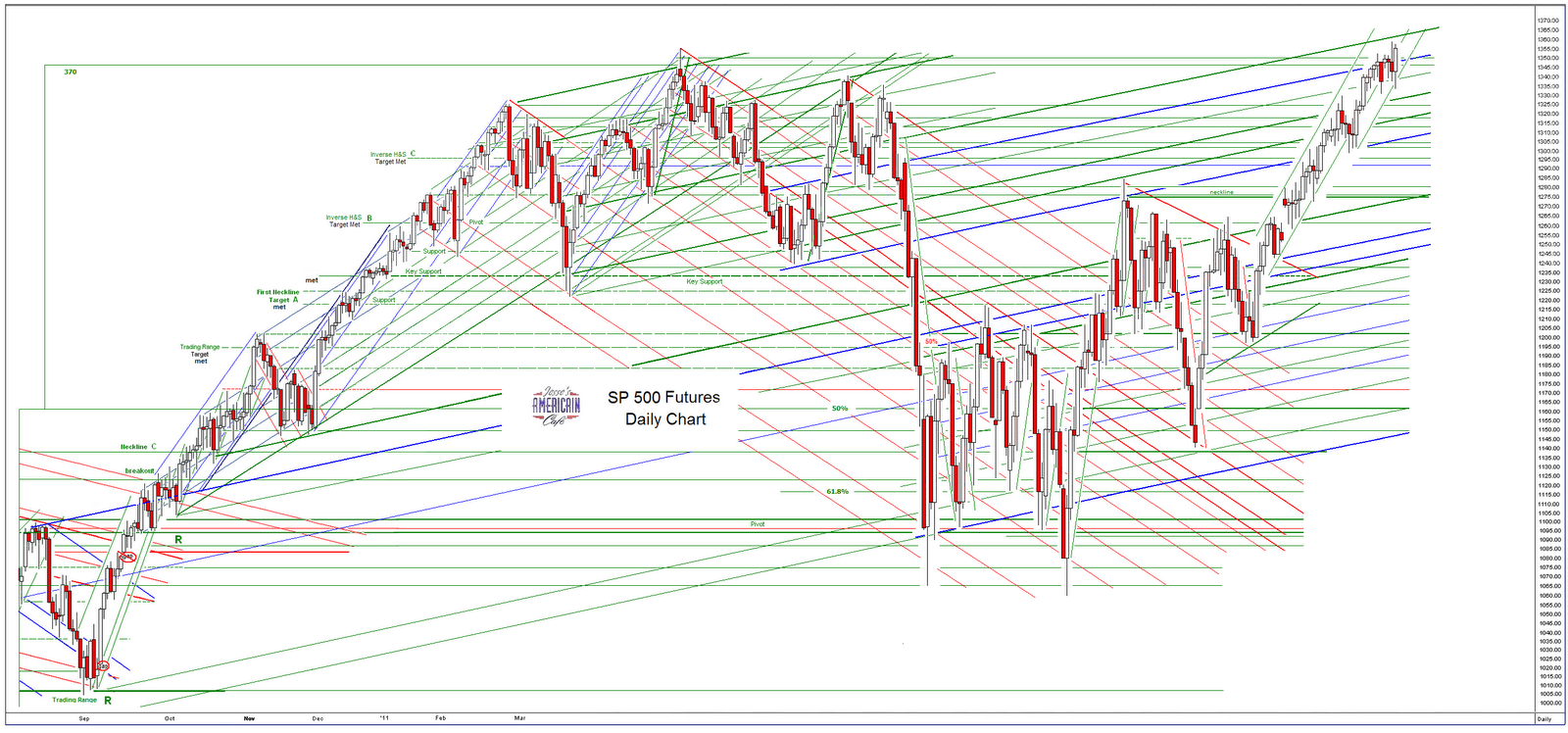
Let's see. Negative real interest rates, incessant stock market climb. Must be an 'inspiring confidence' sort of thing. Looks almost like the upside of a pyramid scheme. The most artful one I had ever seen started around early in 2004 and did not really end until the crash of 2008.

As the touts and cheerleaders were saying on bubblevision today, better buy them now while they're cheap. Yowza, yowzer, getcher hot stocks and nekkid ladies...

If you want to know why the Fed and Treasury keep the TBTF and their financial harpies at the ratings agencies around, this may be the reason: to implement their global financial policy decisions. How long they can keep it up is another matter. But they are not likely to run out of money, and much of the buying and selling in these equity markets is artificial, the quick action of computers shaving off nickels in a well-tempered instrument.

Maybe that's why they had to smack gold and silver so hard into the end of the year. Otherwise they might have taken off with the stock pumping exercise, broken through upside resistance at 2000 and 40, and threatened to get out of hand, shake up the confidence of the other players, and all that.

But if you look at the SP 500 deflated by oil, either WTI or Brent, its been in a serious nose dive.

No matter how good they want to make this look, its still a paint job, and a fairly thin one at that. But it will probably take some incident, or a key economic report gone bad, to break this nominal uptrend, so wait for it.


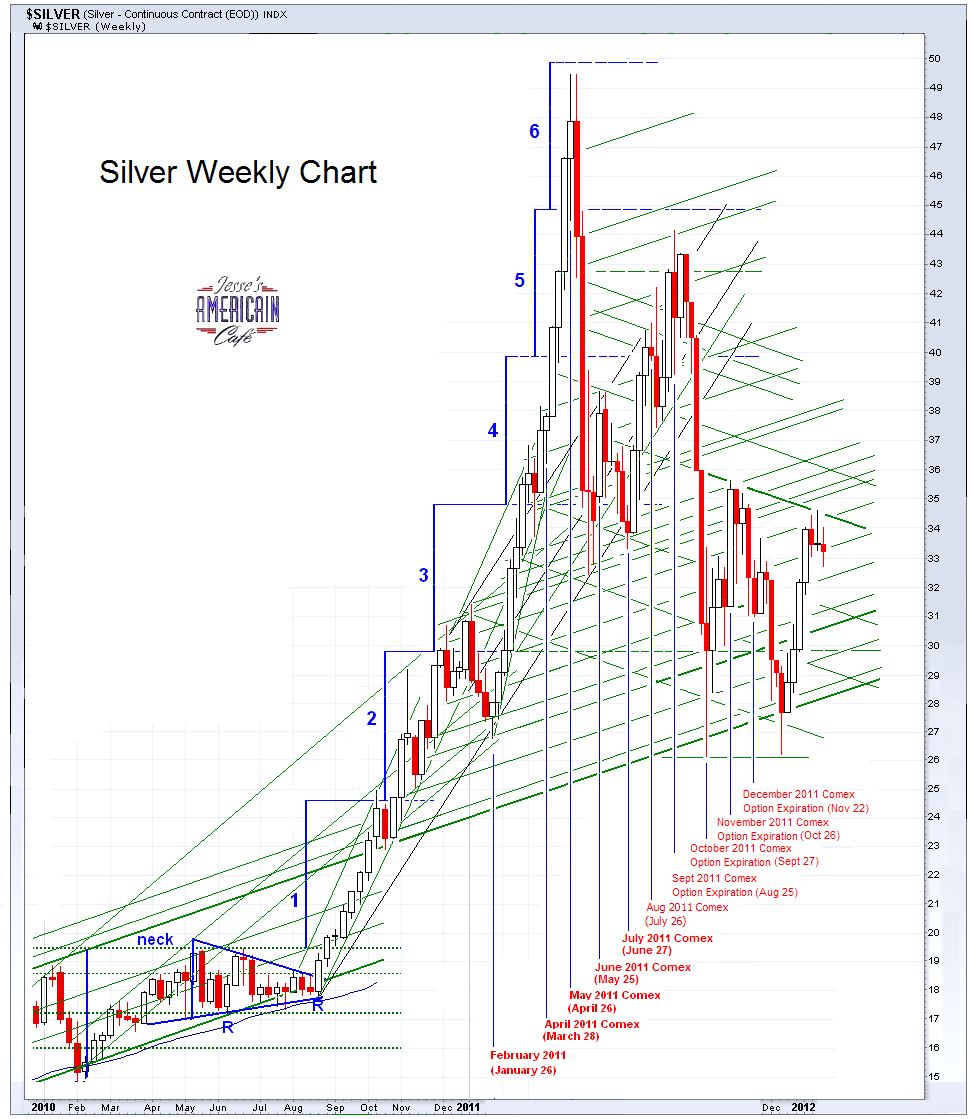
Gold Daily and Silver Weekly Charts - Tales of Brave Ulysses


"...we are overdone with banking institutions which have banished the precious metals and substituted a more fluctuating and unsafe medium, that these have withdrawn capital from useful improvements and employments to nourish idleness, that the wars of the world have swollen our commerce beyond the wholesome limits of exchanging our own productions for our own wants, and that, for the emolument of a small proportion of our society who prefer these demoralizing pursuits to labors useful to the whole, the peace of the whole is endangered and all our present difficulties produced..."

Thomas Jefferson

Today was just another lingering moment on the monetary odyssey of Ben Bernanke.

Gold and silver held up well today for silver's option expiration.

The wheel of fate grinds slowly, but exceedingly fine.


Bernanke Agonistes

...No! I am not Prince Hamlet, nor was meant to be;
Am an attendant lord, one that will do
To swell a progress, start a scene or two,
Advise the prince; no doubt, an easy tool,
Deferential, glad to be of use,
Politic, cautious, and meticulous;
Full of high sentence, but a bit obtuse;
At times, indeed, almost ridiculous—
Almost, at times, the Fool.

I grow old … I grow old …
I shall wear the bottoms of my trousers rolled.

Shall I part my hair behind? Do I dare to eat a peach?
I shall wear white flannel trousers, and walk upon the beach.
I have heard the mermaids singing, each to each.
I do not think that they will sing to me.

I have seen them riding seaward on the waves,
Combing the white hair of the waves blown back,
When the wind blows the water, white and black.

We have lingered in the chambers of the sea,
By sea-girls wreathed with seaweed red and brown,
Till human voices wake us, and we drown.

T. S. Eliot, The Lovesong of J. Alfred Prufrock

SP 500 and NDX Futures Daily Charts


"From a time long ago when we sold our vote to no man, we have abdicated our responsibilities. The People who, once upon a time, handed out military command, high civil office, legions — everything, now sits in craven silence, and anxiously hopes for just two things: bread and circuses."

Juvenal, Satire X

Perhaps that would better be translated for the modern mind, smartphones and reality shows.

The level of conversation amongst the touts and the analysts on bubblevision is starting to sound like the nervous reassurances one might have heard whispered in the hallways of the Domus Flavia or in a later age, the Führerbunker.


US Treasuries - Negative Returns Almost As Far As the Eye Can See


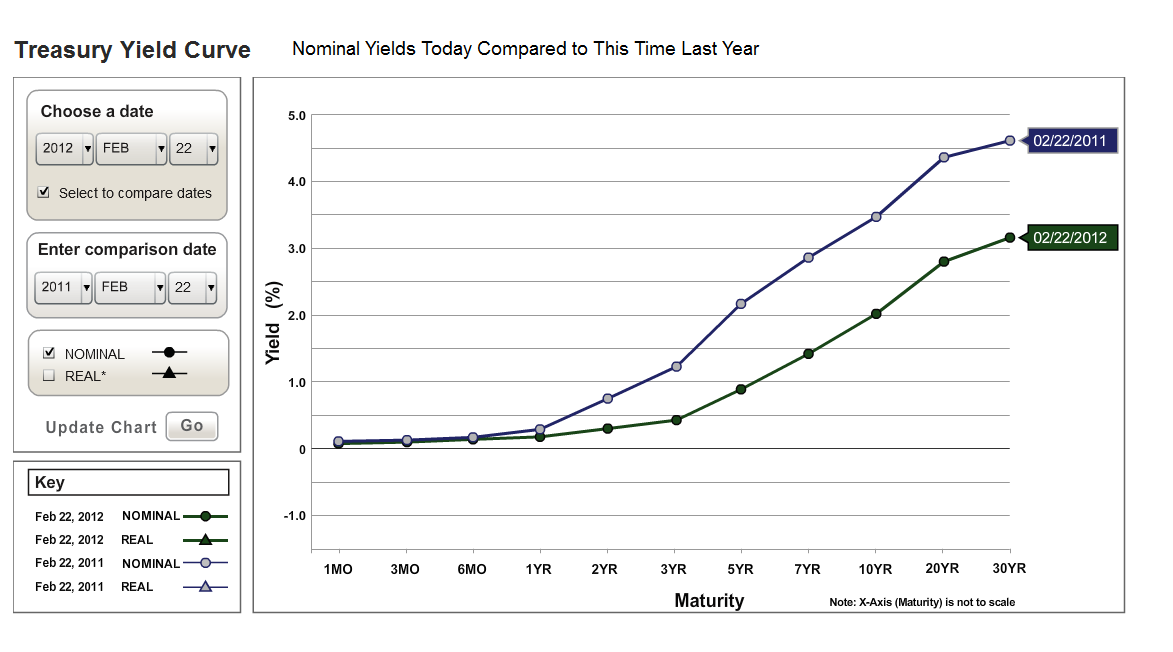
These charts compare the Nominal and Real Treasury Yield Curves provided by the Treasury Department.

The 'real' return is the return on the debt less expected inflation. A note on how the Treasury calculates this is below. Since they use TIPS the real yield are only done for notes of 5 years or more duration.

The comparison is between February 22 data from this year and last year.

As one can see, the Fed's "Operation Twist" has had a profound effect on the real returns achieved by holders of US sovereign debt.

The real yields turn positive about the 15 year mark. The real return these days on a 30 Year Bond is about .76%. And that is probably using rather optimistic assumptions about inflation risk.

What this implies is that savers are by and large paying the US government to borrow from them.

Is this an effective economic stimulus for the real economy, or a sophisticated form of seignorage being performed by the Fed on behalf of its member Banks?

Interesting experiment. I hope Benny's model has the right risk parameters plugged in. If not, as Fed policy errors go, this one could be memorable.

No wonder certain alternative stores of wealth are rallying as a haven from this soft confiscation.


"Treasury Real Yield Curve Rates. These rates are commonly referred to as "Real Constant Maturity Treasury" rates, or R-CMTs. Real yields on Treasury Inflation Protected Securities (TIPS) at "constant maturity" are interpolated by the U.S. Treasury from Treasury's daily real yield curve. These real market yields are calculated from composites of secondary market quotations obtained by the Federal Reserve Bank of New York. The real yield values are read from the real yield curve at fixed maturities, currently 5, 7, 10, 20, and 30 years. This method provides a real yield for a 10 year maturity, for example, even if no outstanding security has exactly 10 years remaining to maturity."

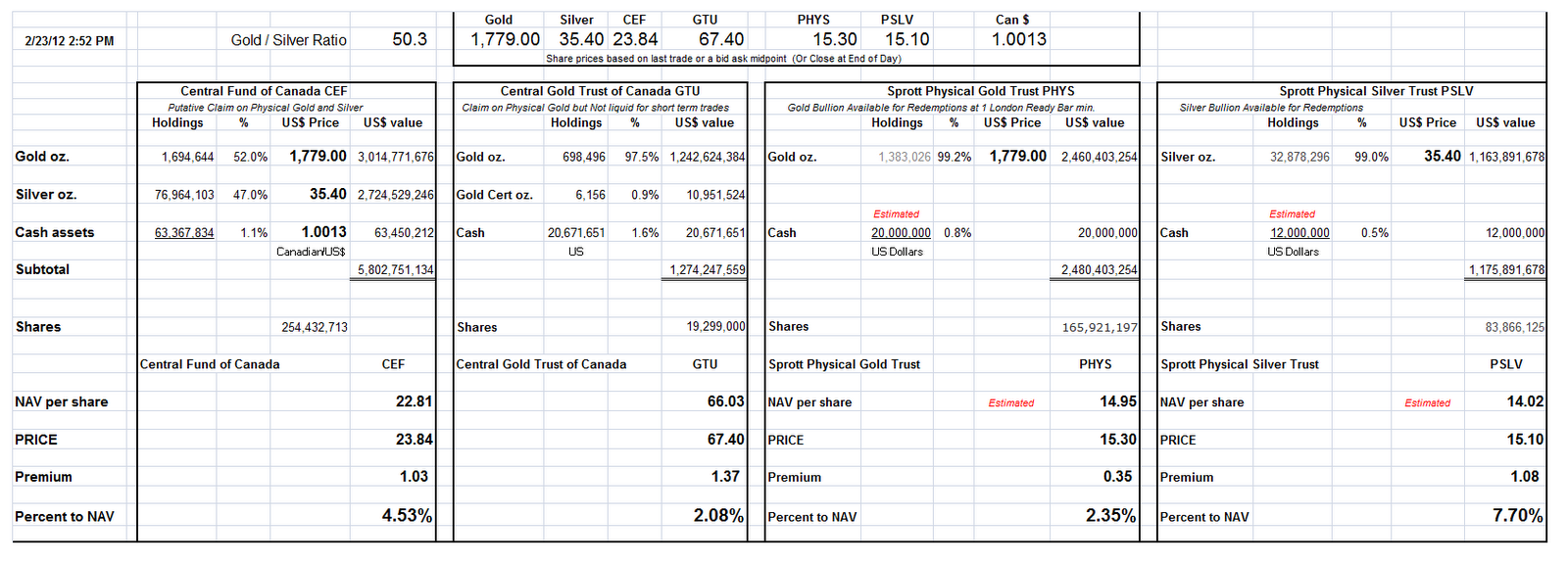
Net Asset Value Premiums of Certain Precious Metal Trusts and Funds


This appears to be a rather 'normal' set of numbers.

With a little tinkering it is almost at my internal 'benchmark.'


Tavakoli: Who's To Blame? Not 'Flawed,' Fraud.


This is a fairly nice description of the tip of the credibility trap.

It is a description of moral hazard, of a partnership between the corporations and individuals in government. And it is a corrosive acid on the body politic. MF Global is not the end of it, but only a new beginning.

With every unpunished crime, with every successful deception, the monied interests grow more self-assured, and bolder.

The more rational in the financial system, academia, and the media wish this to stop, and know it will end badly, but a powerful few will have no restraints.

And so the dance must continue while the music keeps playing. The stewards of society, the Congress, the President, the media, the Fed, none have the moral sense and courage to merely stand up and say, "Stop. Enough. Stop beating your victims. Stop abusing the public."

Well, some may say it. Tavakoli, Yves, William Black, Elizabeth Warren, Barry Ritholz, Simon Johnson, and others have all said it, well, and many times.

And among the powerful Obama may say it. Romney, Santorum, and Gingrich may say it. But they do not mean it, and will do nothing substantial about it. And that is a national tragedy.

Have we no conscience left, no decency?


22 February 2012

Gold Daily and Silver Weekly Charts - Bears Strain As Metals Rally Higher


The Bank is leaning on silver, but the metals are straining to break higher and run.

When silver breaks the bear grip and runs they will be carrying the shorts out of the pits on stretchers.

But when Jesse when?

Don't know, don't care. I just sit back and enjoy the ride.

Call me when it breaks $100.


SP 500 and NDX Futures Daily Charts - Walk Don't Run


They are doing a great job of inflating this asset bubble in equities.

It can keep going higher on light volumes and printed money.

But if it breaks, there isn't much beneath it, so get out of its way.

It just cracks me up that the same old voices are back again talking up another bubble ginned up by the Banks.


21 February 2012

Gold Daily and Silver Weekly Charts - Picture of the Housing Bubble Collapse


As the banking regulator and monetary authority, the Fed was particularly culpable and responsible for the housing asset bubble, the collapse of which is shown in the last chart.

Their 'job' is to take away the punch bowl when the party starts getting out of hand. Instead, first Greenspan and then Bernanke fed and at times even promoted through the stifling of dissent the malinvestment and large scale banking fraud that almost brought the global economy to the brink, and the coming derivatives crisis which almost certainly will if something radical is not done about it.

They have done worse with their handling of the TBTF banks, but the impact of that remains largely in the future. And they operated under a cloak of secrecy and sometimes deception, greatly influencing economic thought through their growing bureaucracy.

The shame is that the craven Congress gave them even more power in the aftermath.


SP 500 and NDX Futures Daily Charts - "C'est pas la chute qui fait mal, c'est l'atterissage."


Stocks hit Dow 13,000 and then pulled back.

I did not see anything approaching serious selling. The markets are zombie like.


Why Inequality Matters: Saving Capitalist Society from Obsessive Greed and Lawlessness


I think this is about as good a statement of the problem facing the US economic system today.

The 'checks and balances' and 'equal protection under the law' of the Constitution has been trampled upon by the monied interests. The obsessions of the few will not permit them to relent on their quest for all the marbles, even to a Pyrrhic victory.

In addition to the massive mortgage and foreclosure frauds, I can think of no better recent example than the looting of the customer accounts at MF Global, the manipulation of justice, and the subsequent cover up, because it is so senseless.

And if it destroys the futures markets in the process, as the members of the Futures Association fear, then so what?

We won, didn't we?

Why can't the Bank give back the customer money which they accepted in the last week of business?  A billion dollars is small change, especially as they are sitting on a pile of unearned loot taken by fraud from the public already, and the price to be paid in the long run for it may be great. 

Why don't serial killers ever quit?  Because it is a matter of principle to them, the principle of pride, the pride of all those masters of the universe who consider themselves to be above all the rest, supra-human, the best.  To give it back would be to admit that they are equal after all, merely human, and subject to the laws of the people.   And the will to power that fills the hole in their being will not allow it.  They need, and that need must be fulfilled, no matter what.  What I must forego diminishes me. And to bend my knee to anything or anyone is a blasphemy against my self.
"Do what thou wilt shall be the whole of the law."

Aleister Crowley
Have we not proved we were smarter, better, different from all the rest, these creatures whom we use and despise? And if these sub-humans prove to be troublesome, we will disparage them, silence them, beat them, corral them, and even burn them.

We are the gods of this age, the great angel of the morning, sitting on a wreckage of devices, gaping in the light.

ND2.0
Why Inequality Matters: The Housing Crisis, The Justice System & Capitalism
By Bruce Judson
February 20th, 2012

Extreme economic inequality is among the most destructive forces in a society. As inequality grows, it undermines the effective functioning of the economy, the basic tenets of capitalism, and the foundations of democracy.

Unfortunately, the housing crisis and now the housing settlement increasingly look like an example of how this mechanism works.

One of the central characteristics of highly unequal societies is that two sets of laws develop: One set for the rich and powerful and one set for everyone else. The more unequal societies become, the more easily they accept the unacceptable, and with each unrebuked violation, the powerful actors at the top of the society gain an ever greater sense of entitlement and an ever greater sense that the laws that govern everyone else don’t apply to them. As a result, their behavior becomes increasingly egregious.

In contrast, sustainable capitalism requires that all participants in a contract or bargain believe their interests will be enforced equally by the courts: Capitalism requires that Lady Justice wear a blindfold. When powerful players are permitted to alter established rules at will, capitalism ultimately collapses. Contracts and the idea of a fair bargain become meaningless as less powerful parties to an agreement know their rights will not be enforced.

Over time, citizens lose faith in government and their own ability to thrive in what becomes a corrupt economy. This uncertainty leads the small businesses, which are so often cited as important to our economy, to shy away from new activities that might put them at the risk of unequal treatment...

Read the rest here.

Modern Monetary Theory Explained Simply and Questioned Again


It is often difficult to get a clear and simple definition or summation of what Modern Monetary Theory is, and what its adherents actually believe.

This is because some of its proponents tend to speak disparagingly and condescendingly to those who ask what it is that they believe. And they do not like to answer simple questions, preferring to engage in lengthy theoretical explanations that speak around the answer to confuse the unenlightened.

But at least one person whose intellectual integrity I respect in other matters seems to believe in this theory, so I have continued to spend some effort to get to the bottom of it, to find out what this theory is, and how it is similar or different from other monetary theories. What makes it modern?

At last there is a Modern Monetary Theory Wiki. Although it is relatively new and underpopulated, it does at least put forward the key tenets of this theory in simple language.

Here are some extended quotes that I think cut to the heart of what MMT is. And it is about what I expected it to be. You can judge what it is for yourself.


Modern monetary theory (often, "MMT") is applicable to countries that use fiat, non-convertible currency with a flexible exchange rate.

Modern monetary theory believes that countries that issue their own sovereign currency do not ever face a risk of being unable to pay their debts (the solvency constraint) but may, under certain circumstances, face undesirable inflation if a deficit is run in excess of the needs of the economy (the inflation constraint).

The "Debt"

In contrast to the deficit, the amount of so-called debt a government has is irrelevant. Government bonds, when issued in the currency of the country issuing them, can never be involuntarily defaulted on.

The government can always create currency, at no cost, to meet any obligation. The "debt" is merely the sum of the government's previous deficits and surpluses.

This is of course different than a household or business, who cannot create currency. As currency users, rather than currency issuers, their debt must be serviced by currency raised through economic activity. This is an example of the fallacy of composition.

Because the government can always simply print currency, a country that controls its own currency does not need to sell bonds to "borrow" funds. A government's decision to issue bonds is voluntary.

Taxes

Taxes serve two main purposes in the economy:

1. Creating demand for currency. The government accepts its currency, and only its currency, as payment for taxes owed. People must hold currency to pay taxes or they are faced with penalties, including prison.

2. Regulating inflation. Inflation occurs when aggregate demand exceeds the productive capacity of the economy. Taxes reduce the amount of money in the hands of the private sector, and thus reduce demand.

Countries that control their own currencies do not need to tax in order to spend. Such countries can always issue currency to purchase any good or service for sale in the economy. Taxes do not fund the government.

Some of the things that this theory says are technically true. But the devil is in the details, and what is left unsaid. True, a sovereign issuer need not endure a hard default on its obligations because it can simply print more money. But this is a de facto default as anyone who has ever read any history will know. This is the economics of Zimbabwe and Weimar.

The biggest single issue in any money system that is not tied to an external standard is: 'how does one regulate its growth, especially in situations where there are conflicting priorities?'
"Paper money eventually returns to its intrinsic value -- zero."

Voltaire
And there are some very good reasons for this tendency to over print money without a system of checks and balances, transparency and restraints.

Debt issuance, or the discipline of the market, is one way to do this. Import constraints are another, that is, any place where the MMT realm touches some other monetary entity not under its control.

By the way, as I have pointed out before, the debt issuance constraint which is at the heart of the US Federal Reserve System is not a hard stop. All the Fed requires is a friendly (captive) primary dealer or two, and an amenable Treasury, and through manipulating the market mechanism for the bonds they can create a fairly effective money printing machine, almost as free of constraint for quite a period of time as the issuance of money without debt.

In a sense they can loot the bondholders' accounts without leaving their offices. But like the management at MF Global, they view this as a short term accommodation, and intend to put things right at some point, with none the wiser.

The domestic constraint against inflation is a little more problematic because the MMT seems to favor or presume a closed system where the people accept the money as it is defined and no other means of exchange is allowed, ever.

So really there seems to be nothing 'new' or 'modern' about it. It does not close the loop and answer the simple questions about all money systems: who controls the issuance and growth of the money supply and how do they do it? What restrains them from exceeding the restraints?

And if it is some central authority of economists, some wise Solomons who will exercise judgement independent of special interests, watching economic metrics supplied by the government to maintain some aura of restraint, I think we have 'been there and done that' many times before.

I personally do not have a problem with going to a non-debt based system of pure currency issuance. Why should a sovereign borrow from the banks and pay them interest? But the practical issue remains that the control of the issuance of the currency is critical.

As that high priest of modern fiat currency Alan Greenspan said, the Federal Reserve's fiat money system 'works' as long as it can emulate something like a gold standard. It is the temptation to print in excess of some realistic balance of economic growth and currency demand that is the sticking point in any centralized system of economic control.

Quis custodiet ipsos custodes?

I learned long ago that if someone cannot answer simple questions then they either do not know the answers, or do not want to give the answers they have to you yet. And so it is I suspect with MMT although I retain an open mind, but not to derision or intellectual intimidation.

So, what is the scheme to prevent the over-printing of money in the MMT, and what recourse do the people have if this system fails?

We are grappling with this very question today with the global dollar reserve currency scheme, so it is not theoretical. Replacing a failed fiat currency with another similar system but with different denominations and names, reissuing the paper currency after it fails, is par for the course.

And I expect that to be the preferred government resolution this time as well. The only question in my mind is how draconian will they get in order to obtain the required obedience of the markets, and how far do they think their control needs to extend geographically in order to succeed?

And what would they do with countries who have things that they need, but who will not accept their monetary diktats?

Is this what we are talking about? Just give the Fed/Treasury more power, greater spans of control, and less restraint, and they will finally get it right?

Or at least right enough, because no one will be left to question it, and say it is wrong.

RealNews: Is Obama Getting Serious About Bank Reform and Financial Fraud?


One only has to look at the unfolding travesty of MF Global to see how serious he is in not pursuing justice and reform.

More at The Real News

See The Real News here.

20 February 2012

SP 500 Futures


The futures are up about 6 1/4 from Friday.

But as you can see, the bulls really need to take it up tomorrow to keep the rally going, or allow this doji of indecision to gap down and leave an 'island top.'

These Greek bailouts are like the US government's financial reforms: oft repeated and long on rhetoric, but containing little of substance.


19 February 2012

Free Kindle Edition of The New Robber Barons By Janet Tavakoli


"The value of the e-book is that it has the embedded links in the book, unlike mainstream publishers. The other part about this book is that it is arranged chronologically by topic; one sees how much Congress and regulators have let us down, enabled cover-ups and then failed to act as evidence reached the public domain. We’re seeing it all over again with MF Global."

Janet Tavakoli

For today and on Tuesday (not on Monday) the $9.99 Kindle edition of The New Robber Barons by Janet Tavoli is free.

You must own a kindle, or have installed the kindle app for PC or mac, to download it. You can find it at Amazon US here, at Amazon UK here, or Amazon France here.

This e-book is a collection of her writings from various sources.

The NEW ROBBER BARONS continues financial expert Janet Tavakoli’s on-going chronicle of the global financial crisis captured in her articles from the September 2008 meltdown through February 2012. Picking up where her previous book, Dear Mr. Buffett, ended, she exposes the criminogenic environment that enabled international oligarchs to solidify power.

In January 2009, Warren Buffett, CEO of Berkshire Hathaway, told Tom Brokaw: “the idea that people that move money around are some favored class…strikes me as getting pretty far away from where we should be.” Two years later he publicly excused apparent insider trading by one of his successor candidates, David Sokol.

Berkshire Hathaway officer Charlie Munger admonished law students that Americans shouldn’t be "bitching about a little bailout."

Shortly before Congress confronted him with Goldman Sachs’s profiteering during the financial crisis, Goldman CEO Lloyd Blankfein quipped he was doing “God’s work.”

CEO Jamie Dimon told shareholders that he didn’t think JPMorgan made a mistake when it came to potential foreclosure fraud: “maybe we’ll have to pay penalties eventually to some of the attorneys general but we really think we should just continue.” Meanwhile the bank scoured 115,000 mortgage affidavits and reserved $1.3 billion for legal costs.

After MF Global’s October 31, 2011, bankruptcy a U.S. Congressman told former CEO Jon Corzine: "You've got thousands of hard working people around this country that feel cheated."

Tavakoli serves up example after stunning international example of no-strings-attached socialization of losses and privatization of gains. In the words of Congresswoman Marcy Kaptur: "I believe most of us would call that theft."

17 February 2012

Weimar Berlin in the 1920's


This is from the television documentary 'Legendary Sin Cities' which was broadcast in 2005 by the CBC Canada.   The three part series covered Berlin, Paris, and Shanghai.

It provides insight into the Weimar Republic and the cultural ferment between the wars.

It is definitely R rated so be advised.

(I am informed by a reader that the entire three part documentary, including Paris and Shanghai, is available on Netflix streaming for those who have access to that sort of thing. The Paris episode was my favorite.)


Gold Daily and Silver Weekly Charts - Palpable Fear of a Rise In Gold


“That paper money has some advantages is admitted. But that its abuses also are inevitable and, by breaking up the measure of value, makes a lottery of all private property, cannot be denied.”

Thomas Jefferson, Letter to Josephus B. Stuart, 1817

The fear in the money masters is palpable. Silence, darkness, and the fog of confusion are their most reliable allies.

The schemes of the monied interests depend on the mispricing of risk, and the public remaining asleep while their wealth is quietly transferred, until one day they wake up and find that their accounts have been looted.

And surprise, the money has simply vaporized.

Fill out these claims and stand over there. We'll give you something, whatever scraps are left over after the oligarchs, bankers, and their politicians have taken their fill.

I saw it happen in Russia, as their empire crumbled. And I am seeing it happening now.


SP 500 and NDX Futures Daily Charts - 'A Great Reckoning in a Little Room'


"When a man's verses cannot be understood, nor a man's good wit
seconded with the forward child Understanding, it strikes a man
more dead than a great reckoning in a little room."

William Shakespeare, As You Like It, Act 3 Sc III

Today was an option expiration.

There was an interesting divergence between the financials and big tech.

Monday the US markets will be closed. Another Greek drama may be in the offing.


Comex and Nymex Metals Calendar for 2012; Something Nasty on the Way?


A few people have asked me to post the complete Comex Metals Calendar for 2012.

So here it is, and you can find it here. I am afraid that the usual futures brokers have not published a handy pocket calendar of the key dates again this year, possibly as MF Global has cast a general pall on enthusiasm for the markets.

As a word of caution for all you amateur analysts, not all expirations and key dates are created equal. And the equations that drive prices, especially in the short term, are multi-variate with multi-dimensional lags and secondary and tertiary effects.

I used to be able to derive decent intermediate term multivariate regressions for certain commodity prices even a few years ago, but lately the markets seems to have become just a shoving match with less rational linkage to the real world than one might imagine.

This is probably the effect of the Fed's ZIRP policy, with the buying and selling of bonds and other instruments in the market at non-market prices, causing the subornation of the pricing of risk that makes most other value discovery just a short term shell game.

And of course the market regulators have pretty much rolled over for the insiders at every key juncture. At least the long term fundamentals prove resilient, but only over the longer term. Negative real interest rates as a powerful force even in la la land.

I have this nagging suspicion that there will be a major break in the equity and other paper markets, possibly tied to some non-market macro event, in the first half of this year, likely in March. I cannot say how the metals will react because that depends on the nature of the trigger event and manner in which the crisis unfolds.

I do like the model of the deflationary withdrawal of the sea of liquidity with the subsequent tsunami of paper. But that is too textbook perhaps.

It is likely, however, that the pigmen will once again place an offer on the table that they think the people cannot refuse. Or the refusal will be ignored by the peoples' representatives even if they do object, as happened in the manner of TARP.

Fear and confusion in the herd creates opportunities for the predators of all stripes. The best remedy would be for the more moderate elements in the Tea Party and the Occupy movement to find common cause and put aside their emotions, but that is not likely since such popular movements of discontent are often led at the extremes and by popular emotions. The lack of leadership and platforms has immunized the OWS movement so far, but one wonders if it can last.

The same coming together of moderate Muslims, Christians and Jews of good will would be effective for promoting the cause of justice for that matter. But there is nothing worse than a family fight among children when it comes to arguing about who is their father's favorite, no matter what their father has said, and the tasks that has given them to do.

An eye for an eye makes the whole world blind.

The great mass of independents seem to be angry, but do not know whether 'to shit or go blind' as the colloquialism goes. History suggests that they will first do the latter, then the former. But there are a range of possibilities.


Feb. 23 Comex March silver options expiry
Feb. 23 Comex March copper options expiry
Feb. 24 Nymex February platinum futures last trading day
Feb. 24 Nymex February palladium futures last trading day
Feb. 27 Comex February gold futures last trading day
Feb. 27 Comex February copper futures last trading day
Feb. 27 Comex February E-micro gold futures last trading day
Feb. 27 Comex March E-mini copper futures last trading day
Feb. 27 Comex March miNY silver futures last trading day
Feb. 29 Nymex March palladium futures first notice day
Feb. 29 Comex March silver futures first notice day
Feb. 29 Comex March copper futures first notice day
March 16 Nymex April platinum options expiry
March 20 Nymex April platinum futures first notice day
March 27 Comex April gold options expiry
March 27 Comex April copper options expiry
March 28 Comex April miNY gold futures last trading
March 28 Comex March silver futures last trading day
March 28 Comex March copper futures last trading day
March 28 Comex April E-mini copper futures last trading day
March 28 Nymex March palladium futures last trading day
March 29 Comex April E-mini gold futures last trading day
March 30 Comex April gold futures first notice day
March 30 Comex April copper futures first notice day
April 25 Comex May copper options expiry
April 25 Comex May silver options expiry
April 26 Comex April gold futures last trading day
April 26 Comex April copper futures last trading day
April 26 Comex April E-micro gold futures last trading day
April 26 Comex May E-mini copper futures last trading day
April 26 Comex May miNY silver futures last trading day
April 26 Nymex April platinum futures last trading day
April 27 Comex April silver futures last trading day
April 30 Comex May silver futures first notice day
April 30 Comex May copper futures first notice day
May 24 Comex June gold options expiry
May 24 Comex June copper options expiry
May 26 Comex June miNY gold futures last trading day
May 29 Comex May silver futures last trading day
May 29 Comex May copper futures last trading day
May 29 Comex June E-mini copper futures last trading day
May 29 Comex June miNY gold futures last trading day
May 31 Comex June gold futures first notice day
May 31 Comex June copper futures first notice day
May 31 Nymex June palladium futures first notice day
June 26 Comex July silver options expiry
June 26 Comex July copper options expiry
June 26 Comex July silver futures last trading day
June 27 Comex June gold futures last trading day
June 27 Comex June copper futures last trading day
June 27 Comex June E-micro gold futures last trading day
June 27 Comex July E-mini copper futures last trading day
June 27 Comex July miNY silver futures last trading day
June 27 Nymex June palladium futures last trading day
June 29 Comex July silver futures first notice day
June 29 Comex July copper futures first notice day
June 29 Nymex July platinum futures first notice day
July 26 Comex August gold options expiry
July 26 Comex August copper options expiry
July 27 Comex August miNY gold futures last trading day
July 27 Comex July gold futures last trading day
July 27 Comex July silver futures last trading day
July 27 Comex July copper futures last trading day
July 27 Comex August miNY gold futures last trading day
July 27 Comex August E-mini copper futures last trading day
July 27 Nymex July platinum futures last trading day
July 31 Comex August gold futures first notice day
July 31 Comex August copper futures first notice day
Aug. 28 Comex September copper options expiry
Aug. 29 Comex August gold futures last trading day
Aug. 29 Comex August copper futures last trading day
Aug. 29 Comex August silver futures last trading day
Aug. 29 Comex August E-micro gold futures last trading day
Aug. 29 Comex September E-mini copper futures last trading day
Aug. 29 Comex September miNY silver futures last trading day
Aug. 31 Comex September silver futures first notice day
Aug. 31 Comex September copper futures first notice day
Aug. 31 Nymex September palladium futures first notice day
Sept. 21 Nymex October platinum options expiry
Sept. 25 Comex October copper options expiry
Sept. 26 Comex October miNY gold futures last trading day
Sept. 26 Comex September copper futures last trading day
Sept. 26 Comex September silver futures last trading day
Sept. 26 Comex October E-mini copper futures last trading day
Sept. 27 Comex October gold options expiry
Sept. 28 Comex September gold futures last trading day
Sept. 28 Comex October E-mini gold futures last trading day
Sept. 28 Nymex September palladium futures last trading day
Sept. 28 Comex October gold futures first notice day
Sept. 28 Comex October copper futures first notice day
Sept. 30 Nymex October platinum futures first notice day
Oct. 25 Comex November copper options expiry
Oct. 27 Comex November E-mini silver futures last trading day
Oct. 27 Nymex October platinum futures last trading day
Oct. 27 Comex October silver futures last trading day
Oct. 27 Comex November E-mini gold futures last trading day
Oct. 29 Comex November E-mini copper futures last trading day
Oct. 29 Comex October gold futures last trading day
Oct. 29 Comex October copper futures last trading day
Oct. 31 Comex November copper futures first notice day
Nov. 27 Comex December gold options expiry
Nov. 27 Comex December silver options expiry
Nov. 27 Comex December copper options expiry
Nov. 28 Comex December miNY gold futures last trading day
Nov. 28 Comex November copper futures last trading day
Nov. 28 Comex December E-mini copper futures last trading day
Nov. 28 Comex December miNY silver futures last trading day
Nov. 30 Comex December gold futures first notice day
Nov. 30 Comex December silver futures first notice day
Nov. 30 Comex December copper futures first notice day
Nov. 30 Nymex December palladium futures first notice day
Dec. 21 Nymex January 2013 platinum options expiry
Dec. 26 Comex January 2013 copper options expiry
Dec. 27 Comex December gold futures last trading day
Dec. 27 Comex December silver futures last trading day
Dec. 27 Comex December copper futures last trading day
Dec. 27 Comex December E-micro gold futures last trading day
Dec. 27 Comex January 2013 E-mini copper futures last trading day
Dec. 28 Nymex December palladium futures last trading day
Dec. 30 Nymex January 2013 platinum futures first notice day
Dec. 31 Comex January 2013 silver futures first notice day
Dec. 31 Comex January 2013 copper futures first notice day

The Greek Experiment: Wir Kinder der Hölle und der Wille zur Macht


What time does the next train arrive, Herr Doktor?


The irony of course is that it is not the Germans but the Anglo-American banks and the global monied interests that have perfected and employed this modern financial warfare, again and again, around the world for the last forty years or more. They have been using debt, money, and the subversion of democratic law to take down whole countries, wage wars of plunder and aggression, create puppet governments, and reduce people everywhere to misery.

Their motto is 'greed is good' and 'der Wille zur Macht.' And they are the terror that spawns the madness, the children of Hell on earth.


"What most occupied the attention of the State Department [in 1934] was the outstanding German debt to American creditors. It was a strange juxtaposition. In Germany there was blood, viscera, and gunfire; at the State Department in Washington, there were white shirts [of the wealthy career diplomats and career politicians], Hull's red pencils, and mounting frustration with [Ambassador] Dodd to press America's case [for full payment of the sovereign German debt]...

In Berlin, Dodd was unmoved. He thought it pointless to pursue full payment, because Germany simply did not have the money, and there were far more important issues at stake...

Through his first year in Germany [1933], Dodd had been struck again and again by the strange indifference to atrocity that had settled over the nation, the willingness of the populace and the moderate elements in the government to accept each new oppressive decree, each new act of violence, without protest...

Dodd continued to hope that the murders would so outrage the German public that the regime would fall, but as the days passed he saw no evidence of any such outpouring of anger..."

Erik Larson, In the Garden of Beasts

They are coming home, little brother. And they are bringing it back with them.  All of it.

"Struggle is the father of all things. It is not by the principles of humanity that man lives or is able to preserve himself in the animal world, but solely by means of the most brutal struggle...I do not see why man should not be just as cruel as nature...Success is the sole earthly judge of right and wrong...The day of individual happiness has passed.

The great strength of the totalitarian state is that it forces those who fear it to imitate it."

16 February 2012

Gold Daily and Silver Weekly Charts - Early Bear Raid, Metals Bounce Back


"The truth is incontrovertible. Panic may resent it, ignorance may deride it, malice may distort it, but, there it is."

Winston Churchill

As a reminder this is a stock option expiration week.

Next week is a Comex silver option expiry.

The US has a three day weekend for the market because of President's Day.

Shenanigans abounding.

Feb. 23 Comex March silver options expiry
Feb. 23 Comex March copper options expiry
Feb. 24 Nymex February platinum futures last trading day
Feb. 24 Nymex February palladium futures last trading day
Feb. 27 Comex February gold futures last trading day
Feb. 27 Comex February copper futures last trading day
Feb. 27 Comex February E-micro gold futures last trading day
Feb. 27 Comex March E-mini copper futures last trading day
Feb. 27 Comex March miNY silver futures last trading day
Feb. 29 Nymex March palladium futures first notice day
Feb. 29 Comex March silver futures first notice day
Feb. 29 Comex March copper futures first notice day


SP 500 and NDX Futures Daily Charts - La Vie En Rose


Nothing but upside, if one is wearing rose colored glasses.


15 February 2012

Barry Ritholtz Has the Main Theme Right, But Gets a Few Specifics Wrong About MF Global


For the record, I am an admirer of Barry Ritholtz, and have been so for quite a long time. He is smart, honest, and what the old folks used to call a mensch.

In a recent piece titled MF Global Reveals You Are a Bank Counter-Party he makes a very strong case that financial institutions that trade for their own accounts place everyone who has money with their firm at counter-party risk.

He uses this to reinforce his opinion, with which I heartily agree, that when private speculation becomes mingled with public funds and government guarantees, a moral hazard results that quite often leads, some might say almost inevitably, to fraud, the mispricing of risk, and bailouts.

"The esteemed former Fed Chairman, Paul Volcker, introduced a very simple regulatory concept that bears his name: The Volcker Rule. It was part of the Dodd-Frank regulatory reforms passed after the financial crisis of 2008-09.

There has been enormous pushback against what should be a simple piece of prophylactic rules on proprietary trading by depository banks (see this Jamie Dimon commentary as an example). Why? The profits of speculation goes to banks, driving bonuses and compensation; but the ultimate risk of loss lay with the FDIC and taxpayer. If the banks blow up, someone else besides the banker pays."

But in making his case, that the MF Global situation proves this rule even though they were not a bank, he characterizes some of the things regarding the MF Global scandal in a way that could be misconstrued, and has been misconstrued in that way by some of the main stream financial media.

Here is what Barry said:
"Recall the basic facts of MFG: Management engaged in leveraged speculations with monies — whether it was their own or clients became irrelevant as the losses were so great as to wipe out much more capital than the bank actually had. Billions in losses meant MFG was insolvent and was wound down. On the winning sides of those trades were folks like JPM and George Soros. It is neither their duty nor obligation to verify whose money is on the other side of the trade — the clearing firms make sure the trade settles.

Those trade settlements are the only possible outcome. Why? Imagine a burglar robs a house of cash, goes to a casino and loses the money playing Roulette. The Casino settles that bet, it clears — and the burgled homeowner can never recover the money. Exchanges work the same way. They simply cannot validate the capital sources of every transaction. In the case of MFG, he money wasn’t even burgled — it was simply entrusted (sic) to an entity that became so insolvent thru excess speculation that even money in “Segregated accounts” was highly compromised." (emphasis mine)

There are at least three things that are wrong with that version of the story.   I had to struggle a bit to  understand what Barry was really saying. More on that later.

First, it was NOT irrelevant whether MF Global was using customer money or their own to finance their trades. That is a matter of regulatory law as recently expressed in Rule 190, and the CFTC has made it very clear that brokerage firms cannot use customer funds in whatever manner they please despite the presumption of regulatory creep that is a favorite ploy amongst the Wall Street wiseguys.

What Barry implies is that this is a nicety, and I would say it most certainly is not. To use customer funds in this manner is a violation of fiduciary trust, known in lesser circles as stealing.   MF Global thought they could take the money and put it back with no one being the wiser, but they were caught up in the discovery of events.   This is not much different than taking company money to pay your private debts, and then failing to return them before the loss is discovered.

There is a difference between a creditor and shareholder in a financial institution like a brokerage and a customer, who has their own private assets on deposit, with specific protections outlined by the exchange and government regulators.   Just because someone is not indicted does not make a thing legal or morally acceptable.  

Using Barry's casino analogy, Soros may have been a player at the tables, albeit a highly informed one,  but JPM had a hand in running the money which was financing the casino action as well as playing at the tables, was advancing MF money, and was then leaning on them for payment while MF Global was taking the funds from the customers' safe deposit boxes at the hotel.

Second, the manner in which the bankruptcy is being handled is a grave injustice. In this case a Chapter 7 bankruptcy was appropriate, and not a Chapter 11 which is not appropriate for a brokerage like MF Global.   That was a tortured interpretation promoted by the powerful creditors led by JPM.

And as the CFTC stated, the customers whose account assets were stolen have a superior claim to the remaining assets, including clawbacks from recipients of funds in the last weeks of business.  This does not even speak to the possibiility of a fraudulent conveyance that favored a few relative insiders.

The customers ought not to be in same situation as all the other parties involved in this scandal.   I believe quite strongly that if JPM was not one of the major creditors, and had not taken such an aggressive stance with the bankruptcy and the regulators at the SEC, this situation would have turned out quite differently as it had done in the past with other failed brokerages.

Thirdly, to characterize JPM as 'just another customer' on the other side of the trade with the clearing organization between them is to utterly ignore and misrepresent JPM's role as MF Global's bank. JPM demanded and received collateral for their credit line of $1.2 billion in the last week before the bankruptcy. They contributed to the bankruptcy of the firm as they delaying payments of asset sales that MF Global had engaged in to raise cash. 

And one can only speculate on the depth of their knowledge on the size and nature of MF Global's trades.   If we are to accept that things like segregated accounts mean nothing then why would we believe in confidentiality of customer positions and their finances?

To say that JPM had no fiduciary responsibility to determine the source of the funds, when they knew beforehand that the company was in serious trouble, is quite incorrect.   They even covered that with a figleaf memo.

JPM has lawyered up in this case, and as Chris Whalen suggests is sitting on the money along with a few other entities.
"But please, to our friends in the Big Media, could we stop saying that we don't know the location of the missing $1.6 billion of client funds from MF Global? The money is safe and sound at JPM and other counterparties. As with Goldman Sachs et al and American International Group, the banks have been bailed out at the cost of somebody else. And the various agencies of the federal government are complicit in the fraud...

The effort by former New Jersey governor and MF Global CEO Jon Corzine to save his firm by stealing customer funds seems to warrant further discussion, yet instead we have silence...

So why is it that the Large Media have such trouble reporting this story? The fact seems to be that the political powers that be in Washington are protecting JPM CEO Jamie Dimon from a possible career ending kind of stumble with respect to MF Global."

Chris Whalen, Institutional Risk Analyst
To say that the customer money was 'not burgled' but rather was 'highly compromsied' may be the current fashion of thinking about taking customer money on Wall Street, but it stinks like the fog of propaganda that has spewed forth from Wall Street and their media friends since last October.

The MF Global money was not vaporized, it is not missing, and it was not 'highly compromised.'

It was stolen, and not once but twice.

I understand what Barry is really saying. In today's environment the protections that investors and depositors think that they have is thin stuff indeed. People think that they are safeguarded by regulation and legal statements, and they think they have equal protection under the law, as compared to the corporate leviathans and political insiders like Jon Corzine.

But they do not. These fine guidelines about Chinese walls and segregated accounts are merely a fiction these days. And so we must cut to the source of the danger, and separate the risky speculation that had been the domain of hedge funds and investment banks from ordinary customer funds and government guarantees designed to maintain confidence in the public.

There is definitely merit in that end as I have said. But it is not proper to begin to accept the lawlessness on Wall Street as the 'new normal' and to overlook what has been done, and the laws that are in place even if they are unevenly enforced under this Administration.

Who is to say that Wall Street will not steal customer money and embezzle depositors funds even if Glass-Steagall is reinstated?  If there are no investigations and prosecutions for such a blatant theft as this, how can anything or anyone ever be safe?

The customer money has not vaporized, is not missing, and was not highly compromised.  It was stolen.  Twice.  They would like to go for three.  

The fog of verbal niceties and legal maneuvers to excuse it is still underway.  And the world sees.
"God has numbered the days of your reign and brings it to an end. Your possessions will be divided, and given away to others. You have been weighed on the scales, and found wanting."

Gold Daily and Silver Weekly Charts


A bounce back up in the metals that stuck with gold even though the equity markets reversed sharply intraday.

Precious metals are coiling on the charts below key overhead resistance, but it may take something perhaps to allow the metals to finally break free.

If a major exchange defaults on silver, I wonder if anyone will be prosecuted, or if there will even be a serious investigation.


SP 500 and NDX Futures Daily Charts - "It's All Upside From Here"


The trader being interviewed this afternoon on Bloomberg television said, "It's all upside from here, for the rest of the year" and the spokesmodel du jour answered, "Go USA!"

Do I hear a bell ringing? Maybe, but don't get in front of it. Let the trend change show its hand, if and when it does. While volumes remain light it can continue to drift higher on the excess liquidity being provided to Wall Street by the Central Banks.

Bubble? What bubble? And the band played on. Hi ho.


Describing the Fraud Underlying the Financial Crisis So Even an Economist Can Understand It


William K. Black is one of the US' leading experts on financial fraud in general, and on banking fraud in particular.

This is why you will rarely see him interviewed or even quoted in the mainstream media. And why he gains so little traction with the Congress and this Administration. He is an informed and honest voice, at a time when the status quo just does not want to hear it. They are caught in a credibility trap in which they can admit nothing, investigate nothing, without risking themselves and their 'good thing.'

He has done an impressive but somewhat lengthy interview with Russ Roberts of EconTalk. It is very informative, but would have benefited tremendously from some judicious editing.

I have to caution you in advance that it is somewhat lengthy, so it is best listened to when you have an extended quiet moment. Russ Roberts is a bright fellow, but in the first half he tends to interject himself quite a bit into the narrative, sometimes it seems not really listening well to what Wm. Black is saying. Perhaps he was having an ideaphoric day as do we all. I found it to be a little annoying at times. But he seems to calm down after a while.

But the interview is really a gem, because it explodes so many economic myths and urban legends about the financial crisis.   Efficient markets hypothesis and the virtues of self-regulation are a joke.  I think most of us who are not wedded to some ideological belief already know that, but Mr. Black puts a stake in that theory's vampiric heart. 

Professional economists tend to make lousy public policy, because they have learned to think in theoretical models that only touch reality at statistical intervals. And those models often suppress and crush the significance out of crucial variables of problems that resist adequate measurement for the sake of mathematical expediency, whether it is the propensity of market participants to cheat and do foolish things, or in gravely underestimating fully priced risk and its dynamic consequences. 

So we too often see economists in the media saying foolish things with a straight face, sometimes alas for pay in the manner of what they unfortunately are, but sometimes because, although they may be highly regarded and even esteemed, when it comes to the rough world of hard ball business and greed, they really are, as the kids are often wont to say, 'pwned noobs.'

Economics is a profession currently gasping in autoerotic asphyxiation, choking on intricately useless models and obfuscating jargon. I do not wish to dwell on their problems and challenges facing the hard-working and honest economists in reforming their profession because it plays a more supportive than primary role in the problems facing the world today. The economists, politicians, spokesmodels, and strategic analysts are merely the hired help, the servants, collaborators; the root of the problem is with the money masters themselves. If you wish to know who they are, then follow the money, if you can.

I think it is important to hear the clear voice of experience and reason in this matter, whether you like it or not, whether it suits your self-interest or political biases or not.

Why is this important? Because there is another financial crisis coming, and the monied interests and their banks will be serving up the same set of propaganda and demands, writ larger.   So it now be a good time to unplug yourself from whatever media bubble machine you follow, so you may have at a least a slim chance of coming out of this intact.

You may listen or download the interview here.


"So, it's, I think, really naive to believe that any lender made loans because they thought it made politicians happy. Lenders made loans because it made individual lenders--I don't mean companies, I mean people--much, much wealthier. And they created those incentive structures not because they could care less about people...

...we think this actually is a story, driven overwhelmingly by what we call accounting control fraud; and we think no one much doubts that about the Enron era. And we think there is pretty good consensus on the Savings and Loan crisis as well, because of all the factual record. We had to go up against the best criminal defense lawyers in the world, and we got a 90% conviction rate.

Plus, we satisfied the economists that looked. I quoted from the National Commission, which was run by economists, that concluded that at the typical large failure, fraud was invariably present.

But if you go and read the economic literature on this crisis, you will find that Akerlof and Romer are cited for example in maybe, generously, 1 out of 100 articles that purport to discuss the causes of the crisis.

And you will see that fraud is virtually never discussed as even a potential major contributor. And that is poor; and that is really the tribal taboo that still exists in economics against any serious consideration of the word fraud."

Wm. K. Black

 Daniel 5:25 מנא ,מנא, תקל, ופרסין Mene, Mene, Tekel u'Pharsin
"...A baited banker thus desponds,
From his own hand foresees his fall,
They have his soul, who have his bonds;
'Tis like the writing on the wall.

How will the caitiff wretch be scared,
When first he finds himself awake
At the last trumpet, unprepared,
And all his grand account to make!

For in that universal call,
Few bankers will to heaven be mounters;
They'll cry, 'Ye shops, upon us fall!
Conceal and cover us, ye counters!'

When other hands the scales shall hold,
And they, in men's and angels' sight
Produced with all their bills and gold,
'Weigh'd in the balance and found light!'"

Jonathan Swift, The Run Upon the Bankers

14 February 2012

SP 500 and NDX Futures Daily Charts - Hard Time Killin' Floor Blues


The credibility trap, or gap if you will, is yawning ever wider.

I am not sure of the source of this latest crisis, what exactly is coming and when, but I suggest you not let your savings, your 401ks' and IRA's, or your trading book get caught on the killing floor when it arrives.