25 October 2013

SP 500 and NDX Futures Daily Charts - Trick or Treat?


Stocks were drifting higher for much of the day as Amazon's beat on revenues cheered the markets.

The economic news not so much.

Next week is another FOMC decision on October 30. Do we think the Fed will have a trick or a treat for the market?

More of the same from their treat bowl is most likely with little new being done or said, as Bernanke winds down his tenure at the Fed.  They may acknowledge done to GDP by the government shutdown.

Have a pleasant weekend.


NAV Premiums of Certain Precious Metal Trusts and Funds


Still thin, but a bit less so.


24 October 2013

On the Eve of Saint Crispin's Day


Tomorrow, October 25, is the feast of Saints Crispin and Crispinian.

It is not otherwise notable or observed in the liturgical calendar anymore, but is remembered because it marks the anniversary of the Battle of Agincourt.

"All things are ready if our minds be so."

William Shakespeare, Henry V

Stand and deliver.


After the Battle - "A Royal Fellowship of Death"


Shakespeare does not include it in his historical drama, which after all was written for his English audiences and the Crown, but as I recall during the Battle of Agincourt King Henry V ordered the execution of a hundred or so French prisoners, because he feared their numbers would turn and in a rearguard action overwhelm his much smaller and highly vulnerable force.

This occurred after a successful raid by the French on the English supply vans, which were guarded by 'old men and boys.' Shakespeare portrays this as a dishonourable deed against the rules of war, but makes no mention of the expediency of killing prisoners in his play. Such is the chronicle of war.

If anything the Battle of Agincourt was fortuitous for the English, having everything to do with the choice of terrain and defensive position, the vagaries of the heavy rains and mud which seriously hurt the French cavalry, even to causing heavily armoured knights to be unhorsed and drown, and the superior range and power of the English longbow.

In a very real sense in their overconfident eagerness for victory, the French chose the wrong tactics for the wrong place at the worst time to try and halt the English army from retreating from France. They ill-advisedly went 'in for the kill' to settle the score decisively, and in turn were slaughtered in one of the bloodiest battles of the Hundred Years War.

The Henry IV-Henry V plays of Shakespeare were among my favorites both in high school and University. The comedic character of Falstaff in Henry IV is among Shakespeare's most memorable creations from the non tragic plays. Kenneth Branagh's version of Henry V is exceptionally well done, and among the most enjoyable.

Gold Daily and Silver Weekly Charts - Straining at the Leash


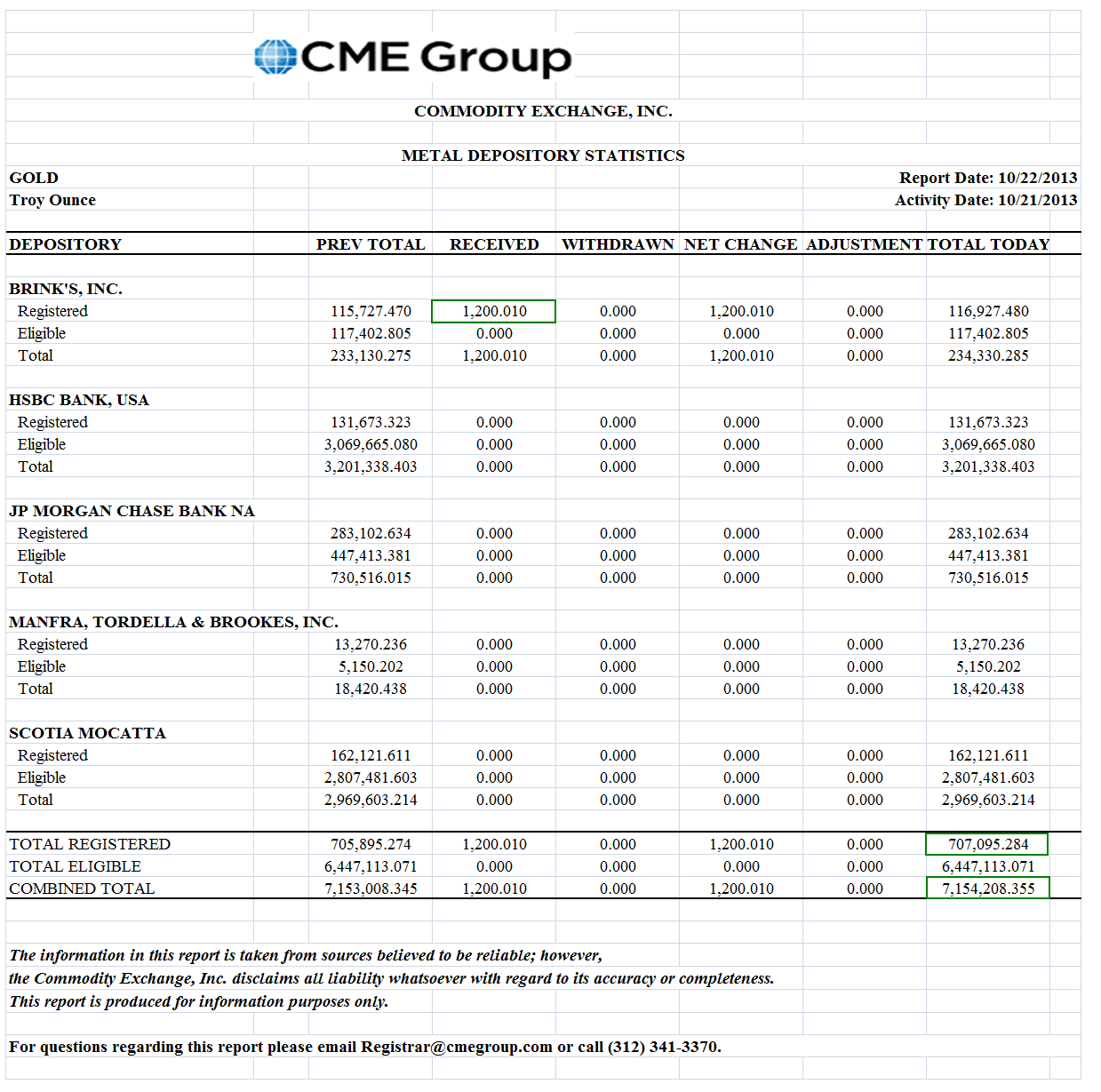
Yesterday we had 32,000 ounces of gold bullion come into customer storage at HSBC, and 64,000 come out of customer storage at Scotia Mocatta.  There was no movement in the registered category.

If you look at the last chart, you can see the details of the individual warehouse holdings.  In addition to outlining the movements of bullion in and out, in green and red, I have also rank ordered the holdings of registered bullion in blue.

As you can see, JPM by far holds the most registered bullion in their vault.  As a reminder, the Comex has on that same statement the disclaimer that they take no responsibility for the bullion statements given to them by parties they assume to be reliable.

Mr. T Ferguson had an interesting commentary today wherein he rightly noted that JPM brought in a couple of tranches of gold into the Comex recently that were 'exceptionally round numbers.'  And they were, down to the metric tonne.

I had assumed that this bullion came from a single source, and it has to be in 100 oz bars as you will recall.  And it has to go through a process to be admitted to the Comex, although by the disclaimer we see that JPM is the party standing behind that statement, and no one else that I can determine.

So, if the bars were received, let's say, from storage by an agreement with some central bank on a lease arrangement, I wonder if one would bother with going through the laborious process of refining them again into bars, or merely recertifying them with a friendly refiner.  And one has to wonder if they are 'unemcumbered' by any conflicting claims.

But what struck me as most odd on the JPM front is how much of the registered gold they are holding, around 283,102 ounces out of a total of about 707,000.  That is about 40 percent of the total registered gold.    I thought they were trying to get out of that business of storing and dealing gold.   

However this turns out, I suspect we will not see the details of what has been going on up close.  But my opinion is that it will be advisable for traders to start settling up now as best they can, and not try to get lucky and skin a few more dollars out of a market whose fundamental structure is starting to look dangerously unstable.  

And if I were in the Exchange or the Regulator, I would not hope to stand quietly behind the fig leaf of my disclaimers and otherwise-too-busy-to-look-and-understaffed life, and start giving a look at what the heck is going on behind closed doors.   Maybe I am wrong, but I see smoke starting to come out of the cracks and seams.

It looks to be about one significant event away from a serious debacle that could prove to be highly embarrassing to a number of Very Serious People.  Not to mention otherworldly economists, bankers, and pundits who dwell in the realms of well spun models land.

But what do I know.  I am just a humble proprietor of my little domain.

Have a pleasant evening.


SP 500 and NDX Futures Daily Charts - Here Comes Twitter


Stocks caught a big today with tech having a bit of an edge.

The big news came out after the bell as Goldman announced that Twitter would be priced somewhere between 17 and 20 dollars per share.

Also after the bell Amazon announced some slightly better than expected earnings and sales numbers.

Microsoft beat revenue as well. So after the bell tech is rising.  The SP 500 caught a bit of a bid, but the Banks were hit with fresh news of a DOJ probe into the Mortgage Backed Securities activity, so that held back the SP a bit.

I will be watching the Twitter IPO very carefully and looking for an opportunity to get on the shorter side of equities sometime after that if I see things forming in that direction.  Goldman is going to make a major effort to get Twitter out well, and avoid the travesty that was the Facebook IPO.

And in a thin market, barring some unforeseen event, it is not hard to move the markets where you wish, especially if quite a few wiseguys are incented to go with the flow.

Have a pleasant evening.


Ochberg: Citizens Living with a Disordered Overclass in Business and Government


As you may know I enjoy listening to Frank Ochberg.  I find his speaking style and his explanations to be very enjoyable, and relaxing.

And I am taking quite a bit of liberty in applying his thoughts to the idea expressed in the title. 

He is primarily known as an expert in Post Traumatic Stress Disorder, and I have been watching his videos in order to be a more effective caregiver, and a better friend to others.   We are all wounded and imperfect in our own ways, and progressing hopefully towards something better.

How do you define better?  Well, that is where morality and ethics come in.  And unfortunately they are quickly chucked overboard as an impediment by a narcissistic culture, much to its own eventual detriment.

He speaks on a wide range of behavioural topics. He has had some interesting things to say about psychopathy which I have shown here in the past.  But Robert Hare is the most prominent name in that area.

He is a cognitive behavioural therapist, and I have a passing knowledge of this only from courses I took as an undergrad, and some work I did for a professor in a related field of 'social styles.'  I don't pretend to be any subject matter expert in this, except for what I have read and seen first hand.

I came across a few new videos from Ochberg's series last night that I thought it would be useful to share.

One new thing did occur to me this time in watching, most likely in light of my having read the book This Town, by Mark Leibovich.  It was an update on the Beltway I had been seeking, since my own involvement there ended about fifteen to twenty years ago.  It was a little worse than I expected.  In many ways London, New York, and Washington have come to resemble The Capitol in The Hunger Games.

Large organizations can take on various characters and personalities that can change with time. They are often referred to as corporate 'cultures.'   If you change companies, you can often see the change in environment, how employees are viewed, how incentives and disincentives are given, and how problems are approached.

Narcissism, and its corrosive effects, first became evident to me in my corporate career, and it was an eye opener.

I believe that today in the US and UK at least, we have seen the rise of a political class dominated by a spirit of narcissism and Darwinistic privilege. It started with the Reagan and Thatcher administrations, but has carried through every one since then to greater or lesser degrees.  Clinton certainly made his own unique contribution in marrying the Democratic party to Big Money.

This is not to say that everyone becomes that way who happens to be in government, but rather, the 'tone' of the organization and its incentives tend to promote and reward that sort of behaviour, making it more acceptable and predominant than it might have been in the past.

And this is certainly no perfect analogy, because adult citizens are not children, just as adult employees are not children. But there is the kind of 'power imbalance' between boss and employee, and Congressman and citizen, that brings some validity into a comparison of responsibility and caring and attendance to oaths and duties that quite frankly I think have been discarded in this age of narcissism.

So, here are a few thoughts on some of these personality types, for your viewing enjoyment.

I have also included an unrelated piece on how men might best support their companions in the recovery from stressful situation. I found it to be very insightful.

So what are we to do about our crazy aunts and uncles, faux moms and dads in government who have taken oaths to 'serve, protect, and defend?'   And the serially abusive Big Daddy Warbucks who seek to bend the law and the country to the service of their personal whimsies and wills. 

Luckily in the intermediate term we can do what children have been doing throughout history.  We can bid them adieu, shun them as best we can, and in the meantime encourage the adults to speak up and bring some goodness and positive qualities to our society.   This is not easy because it is not as personally enriching for them as a corruption fueled by selfish greed.  

Sometimes the 99 percent seem to take on the character of a battered spouse these days: lied to, manipulated, and abused.  And there are enough who fall victim to the Stockholm syndrome and the corporatist propaganda, and allow their anger to be channeled towards their 'own children,' among them the weak.

It may be good to remember that many of those urging us to cut down government and the law are speaking from the very heart of the corruption and narcissism in our society. And once the laws are all cut down, who will be able to stand alone against the cold winds of corporate power that will blow across the land?

Enjoy.


US Dollar Valued In Gold Since 1718


How many ounces of gold can $1000 buy?

The answer over time is instructive. Here is some knowledge about money.

It is remarkable how few economists really understand this, and what it means, what it implies. 

Here is Paul Krugman's opinion on the currency war and the US dollar in a recent piece called Godwin and the Greenback.    I think it speaks for itself, approaching the language of economic jingoism.

And he is certainly not the worst economic voice out there, which is what makes this so disconcerting.   At least he is not an austerian, those who would crucify the public for the sins of the one percent.

Thanks to my friend Nick at Sharelynx.com for this.

Nick impishly added in a note that the US defaulted on its gold obligation in 1933 and 1971, a 38 year gap.  And it has been 42 years, so we might be due again.  

I am not a great believer in cycles.  But I am a confirmed believer in what Thomas Mann called the stupidity of cleverness as being among the worst forms of foolishness. It is the capability of knowledge, but without wisdom and sound judgement.

We seem to have a surfeit of clever ones eager to play fast and loose with the nation's currency these days as a means of pushing off genuine reform, and delaying the reckoning between the people and the banks, and the powerful few that control them.
Postscript (Oct25):    In discussing this chart further with Nick, I think the data is accurate back to about 1790 or so.  As you may recall, the US used various forms of currency prior to declaring its independence.  As someone might wish to extrapolate what a currency might have been, relating it to other currencies, so this is what I think has been used prior to 1792.  

I would have preferred not to have used it since it adds *nothing* to the analysis, but it is not my call.  However I do not agree that this valuation is good prior to 1792 because I do not understand the method that was used to derive it.  That does not mean it is wrong.  It means that I have less confidence in it that the rest of the chart because it is based on a derivation that I have not examined.


23 October 2013

Gold Daily and Silver Weekly Charts - Don't Fear the Reaper


"Those entrapped by the herd instinct are drowned in the deluges of history. But there are always the few who observe, reason, and take precautions, and thus escape the flood.

For these few gold has been the asset of last resort."

Antony C. Sutton


"Like liberty, gold never stays where it is undervalued."

J. S. Morrill

Gold and silver were being capped most of the day on rather light volumes.

The CME inventory report for yesterday shows JPM was again the reaper for the bullion banks, bringing in 32,150 ounces of gold bullion to customer storage.   It appears that 1 bar each left the customer vaults of HSBC and Scotia Mocatta.  There was no change to the deliverable category.

As a reminder, next Monday the 28th is an expiration for November options on the Comex.  November is not a particularly big month for the gold and silver futures.

The mining stocks were hit today along with a general pullback in equities.  That often concerns those who watch them because it can signal a bear raid in the metals, with wiseguys positioning in related markets ahead of the hit.  But let's see what happens.

There seems to be a seasonal manipulation in gold and silver during December, most likely tied into year end shenanigans perhaps.   You can read prior articles about this here.

If they do that sort of thing again this year, I think they might be setting themselves up for a difficult first quarter with regard to available physical supply for delivery. It seems that the wiseguys will hit the wall again, taking it just a bit too far in short term greed, but one can always hope that wiser heads might prevail. If they do something and it doesn't break, the immature tend to double down and do it again. And again. And then it ends, badly.

Despite the antics, the structure of the physical gold bullion holdings in the US markets looks a bit stretched on the downside.  I am growing ever more persuaded that higher prices will be required to bring more metal to meet market delivery demands.   But since there has been a massive drawdown in the ETFs in the face of unrelenting demand for physical gold out of Asia, it could be a good trick. 

Better that they start earlier rather than later.  An exchange failure is not a desirable event.  And if a major scandal hits the Fed, it could not come at a worse time for them since they will be facing a massive confidence game next year with regard to tapering. 

Gold is flowing from West to East. This is something that obtain very little recognition in the mainstream media, and certainly not on from the financial media spokesmodels who appear as though they would be quite comfortable serving as the jaded but carefree hosts and hostesses for The Hunger Games.

As for me, I am ready for a perfect Manhattan, up with a twist. It's been a rather long week already. As Chekhov once said, "Any fool can face a crisis; it's the day to day living that wears you out."

Have a pleasant evening.


SP 500 and NDX Futures Daily Charts - The Magic Mountain


"There are so many different kinds of stupidity, and cleverness is one of the worst."

Thomas Mann, The Magic Mountain


"All for ourselves, and nothing for other people, seems, in every age of the world, to have been the vile maxim of the masters of mankind."

Adam Smith

Stocks pulled back a little today, in the face of weak economic news. Import and export prices came in a little on the high side.

Corporate earnings in the virtual realms remain rather good. The real economy story, not so much.

Stocks have gone almost parabolic, and deserve some time to rest. If we see a trend break it may turn bearish, but for now equities are rising on the Fed's balance sheet, light volumes, and lack of an event that might trigger selling.

If some event does hit, stocks will have the resiliencies of meringue. But that is a big 'if.'


22 October 2013

Gold Daily and Silver Weekly Charts - Pop Go the Weasels


The metals popped higher today as the Non-Farm Payrolls came in light, and visions of QE taper receded further into next year.

There was intraday commentary Tremors and Warnings in the Gold Market that is worth reading. While I was glad to see the wiseguys lighten up on the price capping in the metals, there appears to be a more dangerous set of market conditions that they might realize.    Some of the 'old hands' see it, but the fresh crop of the masters of the universe seem to be quite taken with their powers over paper. 

It is a quaint notion, but the cure for tightness in supply is higher price. But given enough bad behaviour, and the normal market clearing mechanisms can fail to respond in the expected time intervals.

Nature, ain't it a bitch.

Who can say what snowflake will provide the little push that starts the avalanche. Better to see the avalanche conditions developing and do something to relieve them.

Have a pleasant evening.


Fly the Skies of Air Morgan: Never fear, the London Whale is here...


SP 500 and NDX Futures Daily Charts - The Last Fandango


Stocks rallied higher as poor economic news in the US Non-Farm Payrolls caused traders to push the tapering of QE even further into the future.

The current forecast for stagflation is looking quite realistic. The 'deciders' are making the monetary and fiscal policy errors almost on cue.

At some point the stock market will suffer a break, and correct more than the usual 4 to 6 percent. But with the Fed 'put' firmly in place, I suspect that this will be event driven, and the Fed will try to step in quickly to dampen the effects.

We are seeing asset inflation without a doubt. But the assets tend to be those favored by the financial sector, so don't look for them in commodities and other real things for example.

Have a pleasant evening.


Tremors and Warnings in the Gold Market


"Here and there an individual or group dares to love, and rises to the majestic heights of moral maturity. So in a real sense this is a great time to be alive. Therefore, I am not yet discouraged about the future.

Granted that the easygoing optimism of yesterday is impossible.

Granted that those who pioneer in the struggle for peace and freedom will still face uncomfortable jail terms, painful threats of death; they will still be battered by the storms of persecution, leading them to the nagging feeling that they can no longer bear such a heavy burden, and the temptation of wanting to retreat to a more quiet and serene life.

Granted that we face a world crisis which leaves us standing so often amid the surging murmur of life's restless sea. But every crisis has both its dangers and its opportunities. It can spell either salvation or doom. In a dark confused world the kingdom of God may yet reign in the hearts of men."

Martin Luther King


"However, I have learned that in times of crisis, the dodos always charge in to make matters worse."

Andrew Greeley

Here are three charts that capture the somewhat uniquely dangerous situation in the gold futures market on the Comex.  It reminds me of watching a child playing with a chemistry set, or a drunk getting behind the wheel of a car.  Disaster is not assured, but the situation cries out for adult supervision and intervention.

The first chart shows all gold in storage at Comex certified private warehouses. The major bullion banks control the vast majority of this storage. Among these are JPM, HSBC, Scotia Mocatta. Storage and delivery services are also provided by Brinks and Manfra, Tordella, and Brookes, a large NYC coin and bar dealer.

The year long decline in open interest on the Comex is a phenomenon worth noting. It is marked on the third chart.   Even as gold bullion purchasing is soaring, gold futures interest in the US is in a secular decline.   But even with this decline, the 'claims' of ownership as represented by futures contracts over ALL gold in the warehouses is a bit high.

Not to say that futures contract owners can have any claim on gold merely held in storage.  But they can try.   I include this because some people consider it to be important.  If the price is allowed to rise high enough, that customer gold might be tempted into the deliverable category and offered for sale.  The key question is 'how high.'

The better metric to watch is the number of claims per registered, or deliverable ounces of bullion on the Comex.  This gives us a current 'temperature reading.'   And that measure remains near all time highs at 52.62 claims per ounce at these prices.   My friend Nick Laird at Sharelynx, who does a wonderful job of charting and data gathering, prefers to call it 'owners per ounce.'   But since a single ounce of gold cannot have 53 owners if the music stops, I prefer to call them 'claims' or virtual ownership.

Every prior deep decline in registered gold bullion during this bull market has marked an intermediate price trend change.   I do not think this time will be different, all other things being equal.

What exacerbates this situation is the absolutely remarkable drawdown in gold bullion from the ETFs around the world, but most heavily in GLD and on the Comex.   We have not seen anything like this in silver, platinum, or palladium.  It is significant.  See The Amazing Disappearing Gold Bullion

As you know, I am persuaded that the request from the Bundesbank for the return of Germany's gold, and the deferral of this by the Fed for seven years, set off a chain of overreactions and market maneuvers that in retrospect will be viewed as foolhardy.

If the price of gold is allowed to rise closer to the $1650 to $1750 trading range by the end of January, preferably the end of December,  I think the Comex might avert what for them could become a potentially disastrous situation.   And they need to get started on this fairly quickly so that the rise is gradual and controllable. The higher it riser this year, the less pressure there will be on physical gold early next year.

If the bullion banks continue to game the system, and scalp profits with other peoples' money,  my forecast is for a market break and dislocation in the gold market that will imperil quite a few smaller trading houses, and greatly impact confidence and global trade.  I would not be surprised to see a halt called to the paper and physical gold trade, a forced cash settlement on futures and derivatives, and a price adjustment higher, perhaps in multiples of triple digits.   Such price jumps can be unsettling well beyond their immediate circles of interest.

And we could see a TBTF bullion bank or two shaken to their foundations.  If the governments overreact in trying to get them out of their own mess again without loss or reform, then I think it is time to keep your heads down and watch for big changes.  I doubt they could be that clumsy, but most politicians know less about money than most economists, and that is pretty bad.  And they are certainly as craven and pliable, so it is possible.

I have a couple of other forecasts about changing politics in the US, which involves major changes in the current two parties.  People forget that the lifeline of the Republicans and the Democrats as they are now is more current than old in terms of human history.  And a major party change with some splintering and interesting alliances is becoming more probable.

Although it is just a forecast, it looks like the die will be cast in December.  If they try the annual price hit in early December, they might set off a series of unfortunate events as the new year unfolds.

So you might consider this a sort of warning to be watchful, just based on the market mechanics.  It does not have to happen.  But it has been hard to overestimate the reckless stupidity of unbridled greed.

Again, the most likely outcome is the infamous muddle through and the kick of the can down the road, with a rising price in gold as part of an intermediate trend change.  But we are now in a period of high risk, and I don't yet see the right steps being taken to avert it.   Some of that rests on the shoulders of the CFTC, and quite a bit on the exchange, the politicians, and the regulators of the banks.  They need to take the keys away from the drunks and reckless children in their own organizations and in the ones that they oversee.

I do not want to join the doomsayers, those who troll for clicks with ever more dire headlines of impending doom.  It almost gets to be like watching the supermarket tabloids.

All of our problems are soluble, and things are no worse now than they have been many times in the past.  Our parents and grandparents faced much worse, and I personally have seen harder times by far.  But it is getting pretty bad on a secular level, mostly from self-inflicted wounds and corruption.

I wanted to state this unequivocally now because I can see another financial crisis brewing, and if it does come it undoubtedly will be followed by a bunch of hand-wavers running around saying that 'no one could have seen it coming.'  Just like the last two or three financial crises.  Maybe this time the powerful will act with caution and good sense.  I have the impulse to hedge that though, and certainly not to count on it. In their self-centered blindness they are becoming mere players and pawns in the great tide of history.

"The long memory is the most radical idea in America. That long memory has been taken away from us. You haven't gotten it in your schools. You're not getting it on your television. You're being leapfrogged from one crisis to the next. Mass media contributed to that by taking the great movements that we've been through and trivializing important events.

No, our people's history is like one long river. It flows down from way over there. And everything that those people did and everything they lived flows down to me, and I can reach down and take out what I need, if I have the courage to go out and ask questions."

Utah Phillips


"You will study the wisdom of the past, for in a wilderness of conflicting counsels, a trail has there been blazed. You will study the life of mankind, for this is the life you must order, and, to order with wisdom, must know. You will study the precepts of justice, for these are the truths that through you shall come to their hour of triumph. Here is the high emprise, the fine endeavor, the splendid possibility of achievement, to which I summon you and bid you welcome."

Benjamin N. Cardozo


21 October 2013

Gold Daily and Silver Weekly Charts - Cap, Cap, Cap Ahead of Non-Farm Payrolls


“The term propaganda rings melodramatic and exaggerated, but a press that, whether from fear, careerism, or conviction, uncritically recites false government claims and reports them as fact, or treats elected officials with a reverence reserved for royalty, cannot be accurately described as engaged in any other function.”

Glenn Greenwald

Silver and gold chopped sideways today with silver a little higher and gold a little lower.

Action was light.

Tomorrow is the Non-Farm Payrolls report from September that was delayed because of the Beltway antics.

There is a definite divergence between paper and physical gold, but the two are still related and influence one another. The notion that they are completely unrelated now is incorrect based on the data which I see. Even with premiums, the spot price of gold and the price you will pay or sell for plain bullion is definitely related.  

I am sure some traders believe that the two are completely unrelated and shorting gold against the dollar is a nice paper trade.  In some ways it is compared to the other vehicles one might trade.  But given the carry trade like returns,  I think that they are chasing nickels on the freeway.

When and if the two do diverge significantly, we will definitely know it.  They will be carrying traders out on stretchers.  When the gold price turns the short squeeze might become epic.  And the privileged will be able to grab the available supply first.

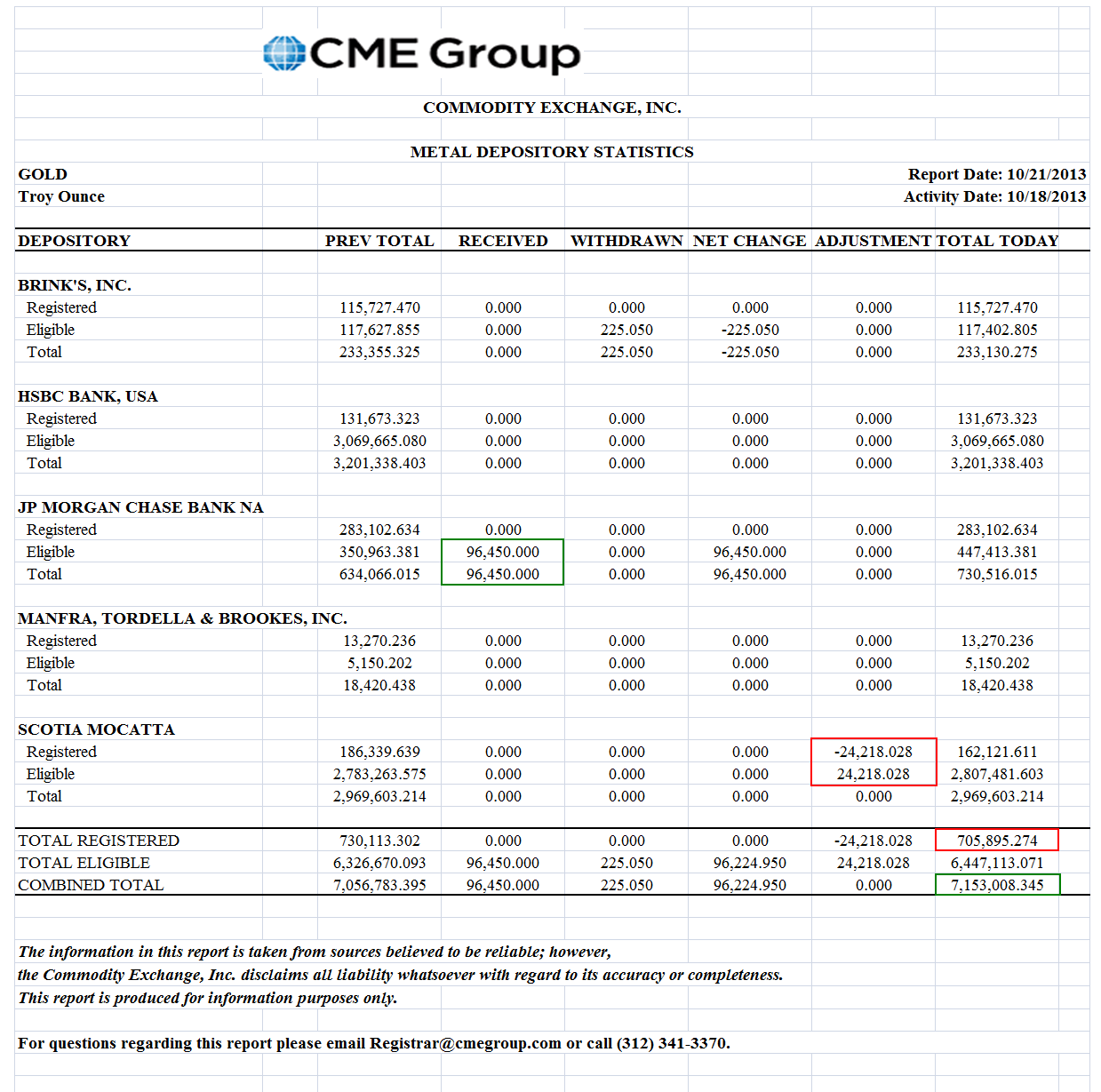
It was JPM to the rescue again with another big chunk of 96,450 ounces of gold bullion for the COMEX warehouse in storage.  I wonder where they are obtaining such large tranches of gold.  Perhaps it has something to do with the price beating and disgorgement of metal by GLD last week.

A transfer of  24,218 gold bullion ounces out of deliverable into storage occurred in the Scotia Mocatta warehouse.

As you may recall Scotiabank cause a bit of a fuss when Harvey Organ and son went there with an auditor to verify the existence of some of their personal holdings for whatever reason.  I believe that this was at the end of 2010 or very early 2011.    The scandal was that when they went to the vault, there was very little actual bullion there, compared to what the total holdings there were reported to be.

And Scotiabank has had one of the better reputations in the industry. 

Well, they repaired that.  But the point that Harvey often makes is that just because you hold a title or a piece of paper for something, does not mean you can obtain it readily when you need it.

Just ask the people of Germany.

Have a pleasant evening.


SP 500 and NDX Futures Daily Charts - Jobs, Jobs, Jobs


Stocks shook off some early morning economic news on housing that was weak and managed to close unchanged to slightly higher ahead of tomorrow's big Non-Farm Payrolls Report for September that was delayed by the government shutdown.

After the bell Netflix turned in higher than expected earnings, which gave a little extra lift to the tech futures.

Have a pleasant evening.


20 October 2013

An American Injustice


Although one might just attribute this to the peculiarities of small town life, for it was a microcosm of how ordinarily decent people can be prompted to do indecent things to outsiders and the other, and then turn and demonize them to justify their unjust persecution.

These sort of injustices were routinely displayed during my childhood, when local fiefdoms pled 'States Rights' and 'local rule' in order to continue to carry out the persecution of outsiders. And the perennial outsiders in America had been African-Americans, Catholics, and Jews, oftentimes as proxies for immigrants. If you read the link to the history of the Ku Klux Klan in the 1920's you know this.

People forget what it was like. Times change, and so do the targets, but the hatred and abusiveness remain the same. This is not to say that this is a uniquely American problem, not at all.

In the US there was greater popular support for this sort of hateful behaviour towards minorities than one might imagine.  In 1968 George C. Wallace ran on a platform of States Rights and the status quo in segregation and the routine oppression of minorities and 'outsiders' and was able to garner 13.5% of the vote.

This type of 'might makes right' attitude never really goes away. It comes back under various names and with different rationalizations, too often falsely cloaked in familiar symbols like the flag and cross, or in some hypocritical theme of the individual freedom to act, horrendously. But we also see this on the far left where ideological rigidity makes inhumanity just as defensible, merely with different targets. It is a weakness of human nature and a common characteristic of fanaticism.

People may be decent overall, but there are a small minority of people who are to easily given over to anti-social actions, for whatever reason. Ordinarily decent people can be led to do and say remarkably indecent things, especially if they enjoy the approval of the powerful and some measure of anonymity, as afforded by the crowd.

The Kansas City Star
Nightmare in Maryville: Teens’ sexual encounter ignites a firestorm against family
October 12
By DUGAN ARNETT

MARYVILLE, Mo. — There wasn’t much left by the time she arrived, just a burnt-out structure and the haze of smoke that lingered around it.

The siding and gutters had melted. The roof was gone. Inside, piles of ash filled the rooms that had once bustled with the pleasant sounds of a family.

That morning last April when Melinda Coleman received word that emergency vehicles were gathering around her Maryville house, she had hoped for the best.

But if the events of the past year and a half had taught her anything, it was that when the town of Maryville was involved, that seemed unlikely.

Since the morning her daughter had been left nearly unconscious in the frost of the home’s front lawn, this northwest Missouri community had come to mean little besides heartache.

Few dispute the basic facts of what happened in the early morning hours of Jan. 8, 2012: A high school senior had sex with Coleman’s 14-year-old daughter, another boy did the same with her daughter’s 13-year-old friend, and a third student video-recorded one of the bedding scenes. Interviews and evidence initially supported the felony and misdemeanor charges that followed.

Yet, two months later, the Nodaway County prosecutor dropped the felony cases against the youths, one the grandson of a longtime area political figure.

The incident sparked outrage in the community, though the worst of it was directed not at the accused perpetrators but at a victim and her family. In the months that followed, Coleman lost her job, and her children were routinely harassed. When it became too much, they left, retreating east to Albany...

Read the entire story here.


18 October 2013

Gold Daily and Silver Weekly Charts - Big Moves In and Out of Comex Bullion Warehouses


Yesterday saw two big withdrawals of gold bullion from the Comex warehouses.

62,050 ounces came out of HSBC and 16,556 ounces left Scotia Mocatta, both out of eligible storage.

But never fear, JPM came to the rescue with a whopping deposit of 192,900 ounce of gold bullion into eligible storage.  I wonder where that came from.  Wink wink, nod nod.

I just want to be able to watch the next leg up in the gold market, if and when it comes.  It could be impressive, and put some serious pressure on bullion supply.

Michael Kosares has a new piece out titled China’s London-Zurich-Hong Kong gold conduit — a major financial coup d'état.

Gold and silver were both capped today,  chopping sideways after the big pop from yesterday.

As a reminder the government will be releasing the September Non-Farm Payrolls Report on Tuesday.  Antics are customary.

Try to keep a clear head as others tend to lose theirs, overwhelmed by the phantoms of their imagination.  I get tired of reading about the imminent collapse of nearly everything as we know it.  I cannot help but note how many 'legends' are seeing imminent dangers growing more terrifying nearly every day.

I suspect that this excess of nervous energy is the result of not having enough to do.  Spending too much time listening to financial opinions and to the uber-wealthy whining about nothing in particular can be nerve wracking.  But that is financial television.

Having a sick dog helps one to maintain a well-grounded perspective.  Young children are an effective sink for excess energy as well.   Grandchildren work, but it is a bit of a cheat because at the end of the day you get to send them home, at least most of the time.

It appears our shitzu has contracted Lyme disease, which is quite common in this area amongst the canine class.  She is so naturally lazy that it was hard to tell at first.  I have been serving as her caregiver, as well as for she-who-must-be-obeyed, and loved beyond all others.  Tomorrow she gets her comeuppance in a trip to the vet, which will confirm her illness and a shot of antibiotics in the rump.  The shitzu that is, not my dearly beloved.  She is in for her own set of treatments again on Monday.

Have a pleasant weekend.


SP 500 and NDX Futures Daily Charts - New All Time High On the SP 500


The SP 500 ran to a new all time high today as the bulls were stampeding on the delay of the budget/debt crisis, and broad expectations of no taper until March of next year.

They were hot and bothered by the results from Google, GE, Morgan Stanly, among a few of the usual suspects.

Notice that VIX has fallen back down into the complacent zone.

Next Tuesday we will be getting the delayed September Non-Farm Payrolls Report. The consensus of economists is for a net add of about 183,000 jobs. I think we will fall short, and that the Street will slough that news off if it does not miss too badly. If it comes in fat, then look for renewed talks of 'taper.'

Have a pleasant evening.


Matières à Réflexion For Friday 18 Octobre

NAV Premiums of Certain Precious Metal Trusts and Funds


Despite the recent rally the premiums remain thin to dour.


Historical Perspective: The Crisis Last Time


Each crisis has familiar facets, but also has its unique characteristics that do make things somewhat different with their own particular outcomes.

One of the great differences in this current financial crisis in the Western world, and I do mean to say 'current' since it has hardly been resolved, has been the policy actions of the governments of the world.

By forestalling a collapse of the banking system, the emerging markets have been somewhat insulated, at least for now, from the economic carnage that has occurred in the more developed nations. China, Brazil, India, and Russia are doing better than one might expect if there were a worldwide Depression. However I do think that those countries that rely on exports are clutching a viper to their breast. For the global trade regime is much more fragile than you might think, although few have yet seen it.

For the moment at least the G7, the U.S., U.K., France, Germany, Italy, Canada and Japan, have also been spared most of the pain that characterized The Great Depression. Quite a bit of this has to do with their central banks, and the eschewing of liquidationism, which these days might be compared to austerity, although it was not quite the same thing.

Where austerity has been applied, selectively forced from the outside in most cases, it has wreaked havoc with the people and the economies of those countries.    And it is giving rise to the extremism in political reactions that was quite common in the 1930's, in Italy, Germany and Japan most notably, although it was much more pervasive than other nations would care to admit.

That is not to say that things cannot go from bad but tolerable, to much worse.  We are not yet out of this financial crisis, because the reforms have not yet been made.  We are in a crisis in slow motion, if you will, and it can still go either way. 

The actions that have been taken to prop up the banking system have only delayed the reckoning that will occur when the economic fallacies and policy errors of the last thirty years that overturned many of the safeguards that fellows like Berle had helped to create, are exposed for what they are.  Then a progressive spirit of government might begin to replace the tired propaganda of deregulation and the natural goodness of the oligarchs and their phony free markets.

I do expect things to remain unsettled, and for hysteria to remain high, especially at the edges of the political spectrum.  I do not expect to see a rise of fascism in the US or Germany per se, but remain more concerned about Spain, Greece, and Portugal. 

It is fortunate perhaps that communism does not represent such a spectre for the oligarchs to incite the people against.  Although it is painfully clear that many groups are searching for a workable 'other,' even one that is largely imaginary,  that helps the unscrupulous demagogues to tap into the darkest impulses of a troubled people.

The Crisis Last Time
By Richard Parker
November 7, 2008

For writers who seek to influence public affairs, timing plays a paramount role. And few writers have had better timing than Adolf Augustus Berle.

In the summer of 1932, with America trapped in the greatest financial crisis in its history, Berle published “The Modern Corporation and Private Property,” a scholarly yet readable analysis of America’s largest companies and their managers. Berle is largely forgotten today, yet with that book he succeeded in persuading Americans to see their economic system in a new way — and helped set the stage for the most fundamental realignment of power since abolition.

The stock market had plunged vertiginously three years earlier, and by 1932 Americans were desperate to reverse the much wider collapse that had ensued — and to make sure it wouldn’t happen again. The New Republic was soon hailing “The Modern Corporation” as the book of the year, while The New York Herald Tribune pronounced it “the most important work bearing on American statecraft” since the Federalist Papers. Louis Brandeis would cite its arguments in a major Supreme Court ruling on corporate power. Running for president, Franklin Delano Roosevelt recruited Berle — a Republican Wall Street lawyer who had supported Hoover — to join his “brain trust,” and that fall entrusted him with drafting what became the most important speech of the campaign. After the election, Berle remained in New York, yet his connection to the president he audaciously addressed as “Dear Caesar” was such that Time would characterize “The Modern Corporation” as “the economic bible of the Roosevelt administration.”

At first glance, the book would hardly seem to merit such broad acclaim. But if the topic was limited, Berle’s analysis was not. He used the data compiled by his co-author, the economist Gardiner Means, to examine how markets had become concentrated in just a few hundred firms and how senior managers had wrested power from the companies’ legal owners, the shareholders. No radical, Berle was eager to preserve the corporate system, which he called “the flower of our industrial organization.” But he now believed that new controls would have to balance “a variety of claims by various groups in the community” — not just its managers or shareholders — and assign “to each a portion of the income stream on the basis of public policy rather than private cupidity.”

In 1932, as in our own moment of financial crisis, most Americans could see that something needed to be done because these new behemoths — which had turned America from a nation of farmers into the world’s largest industrial power — were on the verge of collapse, poised like Samson to pull the entire economy down with them. Berle’s genius in “The Modern Corporation” was to align his professional insights with the public’s fears, and its anger. As he starkly put it in his preface, “Between a political organization of society and an economic organization of society, which will be the dominant form?”

In Theodore Roosevelt’s and Woodrow Wilson’s era, reformers like Brandeis had argued that strict anti­monopoly and anti-collusion laws could return America to a place of small firms and farms, the beau ideal of Adam Smith’s market model. But Americans continued rushing to the cities, spurring an explosion in mass consumption, financed by a boom in cheap consumer credit and easy home loans. Then, in 1929, the markets crashed.

The crash for a time reinvigorated not only the anti-monopolists, but also union organizers, socialists, agrarian populists and crackpot utopians. It also brought forth “forward looking” chief executives like Gerald Swope of General Electric, who supported progressive corporatism — a world of government-mandated business cartels in exchange for higher wages, improved working conditions, and corporate-based workers’ compensation, pension and unemployment plans. Berle, however, was keen on none of these solutions. In his book, he explained that giant corporations were not “natural” economic institutions but recent inventions of the law, cobbled together on the remains of the medieval corporation, a quite different institution. What the Depression showed, he argued, was that modern corporations had failed not only stockholders, but the public — and would do so again, if left unregulated.

But what sort of regulation was required? On details, Berle was maddeningly but deliberately vague. What he did say clearly was that government needed to bear final responsibility for the economy by using its powers to balance supply and demand. It would also need to require corporate directors to manage the managers, not just for shareholders’ benefit but in accordance with new rules codifying the collective rights of stakeholders and the broader social responsibilities of corporations.

The impact of Berle’s ideas was no doubt enhanced by his decidedly nonradical biography. The son of a reform-minded Congregational minister and his wealthy wife, he had entered Harvard at 14 and finished Harvard Law School at 21 — at the time its youngest graduate ever. (Arrogant as well as gifted, he once showed up in Felix Frankfurter’s class the semester after completing it. Puzzled, Frankfurter asked him why he was back. “Oh,” Berle replied, “I wanted to see if you’d learned anything since last year.”) After a year at Louis Brandeis’s firm, he briefly did public-­interest legal work before marrying well and settling down to a prosperous career in Wall Street corporate law.

As clients flocked to him, however, he began questioning the very system that was making them (and him) rich. In 1923, alarmed by the venality, the chicanery and frequently the stupidity of Wall Street, he started writing articles that over the next several years would virtually invent the modern field of corporate finance law, emphasizing moderate solutions. After Columbia Law School offered him a job in 1927, he began cycling between his lucrative practice downtown and his teaching uptown.

But the Great Crash — and the subsequent revelations of market manipulation, fraud and reckless risk-taking — forced Berle to change sides. He was a Mugwump Republican, but the economic chaos of the Depression, and the threat it posed to American democracy, convinced him a new sort of regulation was now unavoidable.

In late 1931, Franklin Roosevelt, then governor of New York, called on the Columbia political scientist Raymond Moley. Roosevelt was weighing a run for president and was looking for fresh ideas. Moley quickly approached Berle and connected the two ambitious Harvard men.

A month after “The Modern Corporation” appeared, Berle drafted Roosevelt’s famous Commonwealth Club address, delivered in September 1932. Proclaiming that “the day of enlightened administration has come,” Roosevelt articulated the rationale for much of the New Deal’s financial and corporate reforms, including deposit insurance and securities regulation. He defended the coming government interventions as protecting individualism and private property against concentrated economic power. Calling for a new “economic constitutional order,” he declared it our common duty to “build toward the time when a major depression cannot occur again.”

“None of Roosevelt’s speeches,” Arthur Schlesinger Jr. later wrote, “caught up more poignantly the intellectual moods of the early Depression than this one.” It helped assure his landslide victory — and earned Berle a series of ever more important posts in the administration. America began an unprecedented 40-year expansion.

By the Reagan era, however, a new philosophy would take hold, and the public oversight of markets that Berle helped pioneer would over time be swept aside, in confident belief that markets could self-regulate and that government was the problem, not the solution.

Today, that era itself seems to be coming to end, and the question Berle posed — will democracy rule the corporations, or will the corporations rule democracy? — seems a profoundly important one worth asking again.


17 October 2013

Moyers: Citizens United the Sequel


I found Heather Gerken to be remarkably articulate, well-informed, and intelligent in this interview.

Enjoy.


Recommended Reading: McCutcheon vs. Federal Election Commission