10 September 2013

SP 500 and NDX Futures Daily Charts - Are Expectations of a September Taper Fading


Another glorious rally as the Pax Americana proves to be irresistible.

Stocks are getting a bit stretched, and the volumes are almost a joke. So this has the appearance of puffery.

But even puffery has its day, as the illuminaries and solons of Washington can attest.

Someone asked if I am hedging precious metals by shorting stocks and the answer is 'absolutely not.'

There is no need to hedge at this point, and stocks are in an almost pure technical trade.

And as Jesse Livermore once said, 'Never short a dull market.' The volume here is very conducive to batting the prices around.

I wanted to go to a room and quietly weep for the pitiable demise of the Dow Theory today. With the inclusion of Goldman and Visa in the Dow Jones Industrial Average, it can be considered officially gone, death by cynicism. Even Nike, which makes things, makes little of them anywhere in the US, preferring the heat of foreign sweat to mold their products.

But I do suppose that this confirms that the major growth of the US is in the rentier sector, including the production of financial instruments of dubious quality, usury, and various forms of white collar managerial abuses of ordinary people. If they could add the Congress to the DJIA it would be a coup de grâce for the real economy.

Have a pleasant evening.


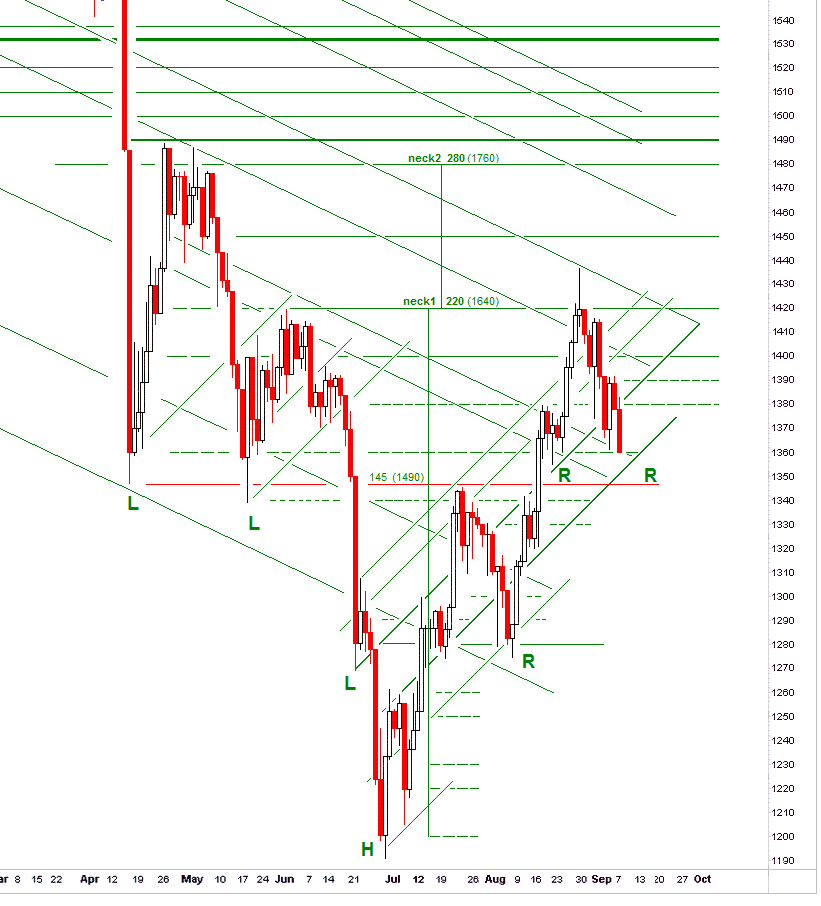
A Closer Look At the Gold Daily Chart - This Town


"Nearly all men can stand adversity, but if you want to test a man's character, give him power."

Abraham Lincoln

I think that the formation of the inverse head and shoulder is apparent.

Let's see if it breaks down, or activates by breaking up through the neckline.

As an aside, Google Blogger seems to be having some issues, and the quote on the header is problematic for now. These are not changes I have made.  I suspect someone messed with the header macro in Java, and I cannot fix that without a major rewrite of the template which I am loathe to start.

By the time I achieved something they would have fixed it, and I would have something non-standard and awkward to maintain.  Been there, done that, too many times.  Best to wait for whatever was broken to either be fixed or replaced by its pristine backup. 

They are making some changes, and have apparently broken something in the process. I thought that it was Yahoo which specialized in that sort of project management.

I am encountering some other problems with the site behind the scenes as well.

Let's give it a few days.  And the same patience is required for this gold chart formation to work itself through its current consolidation.

Life can be disappointing at times. And I think quite a few people have come to the conclusion that among those disappointment's is President Obama, the reformer, and the Congress.

I am about half way through This Town by Mark Leibovich. I do not know that I would recommend it for everyone, but I am enjoying it because quite a long time ago I swam in those waters, and had friends in the political business with whom I kept in touch.  I know the types, and some of the players, so the gossipy elements of the book are enjoyable.  I can easily see where they could become very tedious to someone who was not familiar or interested in that sort of thing.

Other than the personal details of famous and nearly famous people and their idiosyncrasies and antics,  the book is useful because it highlights the bipartisan dedication to personal advancement and greed that has possessed the heirs of the 'Me Generation.'   Politics is always a dirty business, and it therefore always attracts vile creatures.  But when their venality becomes not only accepted but the fashion, then their hypocrisy and toleration of soft bribery knows no bounds.

The book shows how bad things can get when virtue is no longer held in high esteem, and the shame of dishonour, dishonesty, and deceit no longer carries any social sanctions or financial repercussions.  It is the story of moral hazard written in capital letters.  And we are not done with it yet.

Reform in such environments is a risky business, because reform involves a shift of power.  And power brings out the worst in people. The cure is often as bad or even worse than the disease.  But change will come, one way or another.


09 September 2013

Deliverable Gold Bullion on the COMEX Continues Its Decline - Claims Per Ounce Top 56


About 17,000 ounces of gold were taking out of the COMEX registered bullion stocks on Friday. 6,319 ounces were changed from registered to eligible at JPM, and 10,705 ounces were taken out of Brinks altogether.

Total registered (designated deliverable) ounces of gold bullion at all COMEX warehouses dropped to a new low of 669,610 ounces of real gold bullion.

Total gold bullion of all types in storage at COMEX designated warehouses remains at a little over 7 million ounces.

As it says on their own spreadsheet, the COMEX believes these bullion reports are from reliable parties, but assume no liability for their accuracy or for any counterparty risk.

More charts such as claims per ounce will be added to this post as they become available.

Higher prices will most likely be required to motivate title holders of eligible bullion to move it into the deliverable category, so that it can be sold by the bullion dealers.

And those 100 oz. bars of fine gold that are delivered and removed will probably end up being refined and recast into 400 oz. bars in Switzerland, and shipped to the East, not to return to the COMEX and LBMA paper claims bullion game of musical chairs for a long, long time. And that is going to become a problem in the not too distant future.

Weighed, and found wanting.

Stand and deliver.


Gold Daily and Silver Weekly Charts - Gold and Silver Are No Longer Safe Havens So Buy Stocks In Blue Skies


The metals are no safe haven so buy stocks.

That was the subliminal message in today's trade, with the capping on the metals in the works while stocks were bid up on light volumes.

Buy equities now, because it is blue skies ahead.

The slow drain in gold inventories on the COMEX will continue until confidence in the financial system improves, or the paper gold supply hits the wall of reality and crumples.

Intraday commentary about the ongoing currency war and monetary theory here.

You may wish to read this to get the 'lay of the land.'  Not too many people really have a sense of it, and it could prove to be valuable to finding your way through the fog of war.  And while these things unfold slowly and history proves that our times are probably no worse than some times in the past 100 years, that does not mean that there are not unusually challenging times, over the near horizon.

Have a pleasant evening.


SP 500 and NDX Futures Daily Charts - What Taper, What War?


Stocks were on a tear today as the market shook off concerns about the Fed taper which could be coming at their meeting later this month, and the simmering military strike on Syria.

Stocks are getting a bit stretched on the chart. Some important news on the economic front comes out later this week, but the news from the Mideast will likely outweigh anything else.


Currency Wars: Salinas-Price On the Changing Tempo and Tenor of the Growth of International Reserves


"The only resource against political disorders that had been known till then was the concentration of power. Solon undertook to effect the same object by the distribution of power. He gave to the common people as much influence as he thought them able to employ, that the State might be exempt from arbitrary government. It is the essence of Democracy, he said, to obey no master but the law. Solon recognised the principle that political forms are not final or inviolable, and must adapt themselves to facts; and he provided so well for the revision of his constitution, without breach of continuity or loss of stability..."

John Dalberg Lord Acton, History of Freedom in Antiquity

My long time friend Hugo Salinas-Price has shared some uniquely interesting observations on the growth of international paper reserves, which have been largely constituted of claims on debt, often pinned to the US dollar because of its international reach. And with all such fertile and insightful thinking it provokes more thought in others.

In this article he observes that the appetite for sovereign Treasury debt, and other forms of private debt such as mortgages and consumer credit, may not be keeping pace with the issuance of these forms of debt.

I think that with respect to price that this is a foregone conclusion in light of the Fed's QE III. The whole point of this exercise is to ensure that the current pricing is not sustainable without a non-market priced subsidy from the Fed, hopefully until some point that the markets reach some sort of self-sustaining equilibrium.

One of my key theses has long been that this equilibrium cannot occur without major systemic reforms.  The factors that created the problem were not incidental, but fundamental to changes that occurred during the 1990's in particular, with deeper roots back to 1980.  There was a decade long effort to overturn the New Deal Reforms that had allowed for the long stability that the financial world largely enjoyed in the post-WW II era.  These reforms were overturned by greed and corruption of power, and so here we are today.  We cannot go forward without returning to more transparent, honest markets that operate with a bias towards justice, and not bowing to right as defined and sanctified by might.

Modern monetary theorists would postulate that none of this is a problem, because the issuance of money based on debt is not necessary in the first place. All the debt can be repurchased through the direct issuance of money by a sovereign at any time. The proposal of the 'trillion dollar platinum coin' illustrates that principle in action.

But while technically true, there are two important facts that impinge on the wonders of such a brave new monetary world, besides the obvious problem of the ability of concentrated power to corrupt such Utopian arrangements, almost from their inception.  I keep asking, 'where is the flywheel' meaning where is the check and balance on the monetary issuance?  Quis custodes custodiet?

The first obstacle is that such money issuance system of almost unrestrained fiat works best where all the market participants are forced to operate according to the centralized rules. They will accept the money at stated value because they simply have no other choice, no other options.  Given Gresham's Law, if you think about this for a while, it becomes very apparent that this is the case. Fiat of this level of discretion must have the absolute force of law, without viable competition or substitute. 

Money is what we say it is, and is worth our stated official price.

I think we have enough historical examples of how well this works in practice. I saw it up close in both Russia and Czechoslovakia before and during the final collapse of the Soviet System.

In the world as it is, there is really no one world currency, issued by a centralized all-powerful entity, that essentially creates money from nothing, distributes it as it pleases, and dictates its value to all.  At least there is no such system yet, although it is certainly the objective of more groups than you might care to imagine.

In the case of a non-self-sufficient economy, there is the inescapable issue of trade and travel with other economies, that are not under the control of the central authority.

So the second great problem is that in the world as we have it today, oil and natural gas and certain essential commodities are significant factors when considering the international currency regime. In quite a literal sense, the US dollar is the petro-dollar, and control of the world's currency regime requires a strong influence over the world's oil and gas supply first and foremost.

If the US was truly energy self-sufficient, then the issue of trade and tariffs and money would be much simpler.  This would not be the case for some other entities without its geographic reach and the rich variety of its resources.

The other imported products are much more discretionary, and the domestic economy would most likely even prosper under a greater emphasis on self-sufficient production. Although the issue of reform would still remain because of the broken system of wealth distribution along lines of unequal power and undue influence over law to the detriment of justice.

It would have repercussions on international relations no doubt, but that is economic power by other means and would be dealt with through the usual alliances and cooperative ventures that could be denominated in other than a domestic currency.   This arrangement calls for the growth of large areas of common interest, or spheres of interest if you will,  that are able to achieve resource self-sufficiency.

The sophists will seek to dismiss what I am saying here as a paean to the gold standard. I wish to state again, categorically, that it is not. I am not proposing any solution at all, but merely attempting to draw up some outlines around the problem, what might be termed a systems analysis and requirements.

Gold does have some remarkable qualities that make it quite suitable for use as money. No one can create it, it is enduring, and relatively stable in terms of growth. As an external standard it is almost ideal. There is little wonder that diverse societies have gravitated towards gold and things like it down the long corridor of time.   And yet it does have one drawback: gold alone cannot enforce honesty on a corrupted system.  The recent growth on paper of the rehypothecated gold supply is one case in point.

There is no secret to creating a workable system.  I know I could do it, and many other people could so as well and perhaps much better.  The problem is that people of power do not wish to have a good system. 

There will be no good and sustainable monetary system easily reached for the same reasons that this generation of leaders can no longer create and put forward fair and workable laws for their own country.  They are overcome by ego and greed.  They wish for a system riddled with loopholes and personal advantage for them and their friends. So this is what is produced.   And until this changes, progress and change will be spattered with misery and blood, as it has so often been in the past. 

If there is any key point I wish you to take and hold in your minds and hearts it is that there is no such thing as a perfect, self-regulating monetary system. There could only be such an ideal model if men and women were angels, perfectly rational and reliably virtuous.

And like wealth the distribution of reason and virtue is very uneven, and so all systems must rely on a continuing effort and bias towards equal justice for all. And this has inescapable requirements for the design of the system.  Among these are transparency and the rule of law.   And the assumption that there will always be those who will be actively attempting to subvert the system, some bluntly, and some quite cleverly.

Money is power, and power corrupts.  So no system can succeed by its own design if its reins are held in the hands of mortal people, with all their weaknesses and failings.   So the system must account for this, and accommodate change and judgement as well as the balance of justice.

This was the great innovation of the US Constitution, the balance of power and its ability to change and evolve through law, with its commitment to justice and equality as an ideal, integrated into its construction, even though imperfectly by imperfect men of their time.  This is what made it such a bright star on the darkened horizon of human endeavour, a hymn to human freedom.  And look what they've done to our song.

It will be fascinating to see how this evolves. Will we see the creation of an SDR like monetary instrument based on a basket of items and currencies not under the control of a single power bloc? 

Will the world evolve into three or four powerful trading blocs, each with their own currency arrangements? Will the current dollar hegemony continue on until the collapses, and the what could have been an evolution will be a more sudden monetary revolution in which great wealth is destroyed, transferred and created anew?

We do live in interesting times.  And inescapably, these questions are now being addressed in the ongoing struggle for monetary power in what some have called the currency wars.

06 September 2013
Stalling growth of international reserves
Hugo Salinas Price

I have kept track of International Reserves (excluding gold) for many years, with data helpfully provided every week by Doug Noland, at prudentbear.com, who obtained the information from Bloomberg.

Here is the graph I have elaborated with data since 1948, when there was still a modicum of reason operating in the financial world.

Lately, I worked out a graph showing in more detail the growth of these reserves in the period from August 2005 to August 30, 2013.


I draw your attention to the slump in reserves which took place during the year 2008-2009. It was an ugly period, financially.

Then, notice the slowdown in growth of reserves during the past two years (24 months).
Finally, notice that growth in reserves has stalled in the last few months of this year. Growth appears to be topping-out. Since April 13, when reserves passed the $11 Trillion mark at $11.082 Trillion, in the four months to August 30, they have only increased by $86 billion – 0.78%

If the growth in reserves registered from August 2009 to August 2011, which averaged $1.5 Trillion yearly, had continued from August 2011 to August 2013, international reserves would now be over $13 Trillion; as it is, they are stalled at just over $11 Trillion. $2 Trillion are missing!
International reserves have two sources of growth:
  1. Accumulation of Bonds (mainly Euro and Dollar Bonds) in central banks of the exporting nations, which come about due to export surpluses with which the exporters purchase bonds issued by the importing countries.
  2. Accumulation of interest earned on the bonds, re-invested in bonds.

The international reserves are thus a measure of the credit which the exporters are willing and able to grant the purchasers of their exports.

If international reserves are not growing, but stalling out, this means that the exporting countries are not extending further credit, for whatever reasons, to the importing countries, mainly the US and the Euro Zone.

Born of the liberation of the world’s money from the shackles which tied it to gold under Bretton Woods, the world’s great credit-expanding machine is slowing down. $2 Trillion in international reserves have not been generated in the last 24 months. The cause must be a decline in international trade, through which enormous export surpluses of the East were sold to the West on credit, and the East received bonds for the extended credit. The market for government bonds of the West has been the eastern exporting countries, which have used their vast export surpluses to invest in western bonds.

If the exporting countries – the East – are slowing down on bond purchases, it most likely means they have less surplus left with which to purchase the bonds. Of course, they might have generated surpluses and used them to invest in the “Emerging Markets” – another name for what used to be called the Third World. Perhaps they are buying up the underdeveloped and chronically deficit-ridden Third World? That may be, but such a policy could hardly account for a $2 Trillion slow-down in growth of international reserves.

A $2 Trillion market for bonds has not materialized in the last two years; it is no wonder that the Fed has stepped in with QE to purchase the bonds which must be sold to keep the US Government in operation, not to mention to stave off utter collapse if the word were to spread that “There is no market for US and Euro Bonds at the volumes that the sellers require!”

The US and the Euro Zone are finding that they cannot float further credit in the exporting countries. This is a serious condition; the West depends on a market which will accommodate its expansion of credit – a market for its government bonds – for without that continual expansion the whole house of financial cards comes crashing down.

There appears to be no further market where the US and the Euro Zone can float their bonds. The only recourse is to monetize their government debt (QE) and that means monetary inflation.

The consequence of monetizing debt will have to be rising interest rates.

If the government debt were not monetized, US and Euro Zone bonds would have to be thrown on the world market, but – who would purchase them? Interest rates would skyrocket, even if there were possible buyers, which is doubtful.

As it is, the US can only continue to monetize government debt. Higher dollar interest rates are inevitable and will cause further government deficits; the debt overhang in both the US and Euro Zone is so great that a rise of a few points in interest rates will explode the deficits, and so on and so forth.

Bottom line: Stalling growth in International Reserves tells me that a world financial collapse is in the offing.

Please draw your own conclusions.