20 November 2015

An Essay Considering the Current Monetary Order and Gold


This message from a person in the financial business,which is included in quotations below, was shared with me by a reader who received it from a journalist for a major media outlet.  Since it was not clear if this was intended as a private communication or public statement, I will not attribute it by name.

I wanted to use the word 'modern' in the title of this, since this pronouncement below smacks of modernism. You know, the belief that all those who have come before us were ignorant primitives, and those who are not of the same received insights now lack sufficient wisdom and piety.  But since those two words combine to describe a particular and unrelated school of thought, modern monetary theory, whose adherents have already excommunicated me for my stubborn and profane disbelief, I think I will skip that and use 'current' instead of 'modern.'

I could not resist sharing this message with you because it is such a nice, compact expression of what the modern financial media thinks about gold and money. Or at least to the extent that they think about anything, and do not just read their thoughts off the teleprompter provided by the moneyed interests that sustain them.  Or what is considered 'acceptable' by the very serious people, those who are described by Larry Summers as 'insiders.'

It starts as many of these things do, with a few simple statements that seem reasonable and ordinary enough, and use a sort of formalistic style to make it seem 'scientific' and contrast our modern thought with the ignorance of prior days.
"Why do you invest in anything? Because you want to extend the duration of your surplus earnings, the sort of stuff that would have been perishable in olden times.

There are two ways to do that:
1. Share your surpluses today and run a credit exposure to the counterparty that is obliged to pay you back in the future an absolute relative rate that compensates you with respect to income lost and potential earnings made.

2. The alternative is to sell transform your surpluses into something more durable, but which maintains market risk exposure."
Ok, fair enough.  If you have an excess of some presumably perishable asset, you want to do something with it to extend its usefulness to you. Or else it ends up like the neglected lettuce left in a damp plastic package in the back of the fridge.

One way to do that is to provide its use to someone else on loan, and receive adequate compensation that may include some allowance for risk.  Or you may wish to sell it outright, and receive something more durable in return, but again with some allowance perhaps for risk.

Hard to argue with that, right?  It is perhaps a bit simplistic, narrowing down all human economic activity with regard to 'surplus wealth' as investing or saving.  One may donate that surplus to some charitable endeavor, or sacrifice it to their gods of the day for example.  Didn't we just do that with TARP, and the uncounted trillions in bank subsidies?

Or perhaps trade it for something not required but desirable nonetheless, like finely crafted jewelry for one's beloved. Investment? The commercial messages for jewelry would like us to think so, but it rarely works that way in romance except for a fleeting moment, and with a greatly diminishing effect over time.

Not all exchanges of 'surplus wealth' are for productive investments or a truly more durable asset.   What then is 'surplus?'  Anything more than food, water, and shelter?

But let's not quibble about what defines 'surplus' and just say all right for now.  But believe we when I say that people's definitions of what is 'surplus' versus necessary wealth can vary widely, especially in these days of elephantine greed.

That definition of 'surplus' is important because it is so subjective, and yet is later used in this modern theory as a high falutin' accounting entity, the equivalence of all monetary valuation.  But it sounds so 'scientific.'  Is what we spend on food and shelter necessary and all else 'surplus?'  How about healthcare?  Cars and electric lighting?  Things that support knowledge like books?  Would there be a common consensus on what the definition of surplus represents, from let's say between Dorothy Day and Donald Trump?

Let us bookmark that thought and move on.
"Gold was an obvious choice because you could keep it under your bed and it wouldn't depreciate in form ."
Ok, that is a bit snarky, since I do not believe there is a long history of people hiding their gold, or any other large amounts of their durable wealth,  cavalierly 'under the bed.'  But it does serve the modern polemicist who seeks to disparage a choice they do not favor as uninformed, primitive, and naive.

Let's just say that for one of the alternative uses for 'surplus' wealth which is 'savings,' some durable, compact assets were found to be very useful. And that they were stored safely in some appropriate manner, since everyone who was born before our time was not necessarily a complete fool or incompetent naif.

We need to distinguish I think between what is asset barter and what is actual money at some point.  I would like to think that describing the difference is achievable.  For example, we might apply some criteria that suggests that a widespread, highly organized society might be more applicable to our thinking than an isolated island people who have no means of mining or access to precious metals and little access to widespread consensus.

As I recall the first formal coins made for widespread use were gold, silver, or an alloy of gold and silver that started showing up around 600 BC in the eastern Mediterranean. You know, that place where trading cultures that sailed from place to place flourished. Although it is known that gold and silver and certain precious and semi-precious stones were recognized as having great value, as shown by artifacts found as early at the 5th millennium BC in the graves of Varna man.

The point here is that it was not just 'gold' that was considered a durable asset.  Silver was valued as well as a few other things from time to time. They all tended to have similar characteristics.  But at some point the precious metals passed from 'grave artifact' to widely accepted 'coinage' and were used for widespread, diverse trade across governing bodies in addition to asset barter.  And I would not discount barter, which may also be called the black market, as a continuing alternative which may be more viable even now than most theorists will allow.

So why not just trade with rocks and put them under one's bed?  Granite and marble are very durable.

Yes the asset must be durable in that it does not spoil or rot or rust away.  It has to be enduring with regard to time.  But there has to be enough of the durable asset to function as more than ornamentation for a few of the finest people.  It must be malleable enough to be systematized into some uniformity of size and purity so that it can be easily weighed and measured and exchanged to facilitate trade without introducing excessive transactional friction.

And so we notice that the author has ignored one key point: manageable scarcity.  What facilitated that transition of precious metals from grave artifact to money?  I would suggest that it was a manageable scarcity combined with social organization and broad consensus that set standards on purity and form.  It was both a natural and social agreement that was widespread and acceptable enough to be effective.  And that manageable scarcity had to be as reliable as the durability of the material.  The scarcity was not expected to be wildly unpredictable and certainly not discretionary by some ruler over time.

So we will not use common rocks because they are not scarce, and not particularly portable.  There has to be a natural scarcity, to make that durable item 'special.'  But there does have to be enough of it so that it can be widely used by more than just a few of the top people.

Moving along.
"Gold is only worth the total surplus of the nation.  When surpluses are running high there's a lot of spare capacity in the system. Gold will be easily swapped into almost anything."
This is of course where we start to smell a reductio ad absurdam and the authority of the modern equivalent of a burning bush.   Let's read on a bit and see where this is going.
If there's a deficit of stuff, neither gold nor money guarantee you access to current output. 
Yes, is there is a deficit of highly desirable 'stuff' any money and not just gold will guarantee you access to it. Unless it is backed by some hairy knuckled fellows holding weapons, in which case they do not even need to bother with the facade of money.   In the strict sense of the word only your own death is guaranteed.  And maybe the recurrence of whacky theories designed to separate the common people of their rights and wealth.

But assuming that a market still exists, which presumes the dynamic of supply, demand, and price,  and a willingness of participation, then the 'prices' or the exchange value of money of whatever form will rise to meet whatever the holders of that highly desirable item may be.  If there is no market, and the item is highly desirable enough, they may be robbed of it, and they have been, but that is besides the point.

I think this may be the point where someone who was writing this has had a recollection of Adam Smith and is distorting the things which he has said to justify some modern theory.  As if Adam Smith was a received source of truth when it suits their purposes, or so they think.

One of the few advantages of not belonging to a 'school of economic thought' is that you are not compelled to carry its baggage, pro or con.  And believe me when I say that in economics there is more baggage, and much of it having nothing to do with economics and everything to do with politics and a pursuit of position and advantage, than on a Kardashian vacation.  While people say 'money is power,' it might be more correct to day that for some types of people power is everything, and money is just a means to it.

There is no shame in misconstruing Adam Smith's thought.  Some of our finest economic minds may have done it from time to time, despite an otherwise admirable record for the most part.  Nobel prize winner Paul Krugman did it in spades not all that long ago by misconstruing things that Adam Smith 'said' about gold.

What Adam Smith was actually addressing in the paraphrased thought was the non-productive hoarding of 'money' while placing greater emphasis on widespread economic transactions, the 'organic real economy' if you will as opposed to the financialized economy.  And he did favor the flexible expansion of money, as typified in fractional banking it seems, as long as it was in response to a legitimate increase in real activity that produced things.

I do think that Smith would have been dismayed though by the actions of the monetarists who believe that one can create the vigor of a wealthy economy by merely expanding the money supply, in QE for example, and doing nothing else in conjunction with it.  I have previously described that as 'cargo cult economics.'   If big plane of real economic activity brings nice things, we can get more nice things by building some things that look like the big plane of real activity out of paper and sticks.

I wonder at what point the money masters will admit that QE is counter-productive rubbish?  Don't hold your breath.  People of privilege will never let go of what gives them advantages willingly.

I like Adam Smith.  I recall visiting his grave once in Edinburgh.  And he was therefore just a man, whose ideas must be considered as his and of his time and experiences.  I do not hold any dictates of dead economists as sacred, and their 'laws' are all too often opinions and observations written in sand.

Paul Krugman Does Some Injustice to the Thoughts of Adam Smith On Money, Gold, and Silver

Adam Smith was no economist.  He was a 'moral philosopher.'  And many of our modern financial shamans have tried to take the moral considerations completely out of economics, in their vain quest to turn it into a pseudo-science of equations and a priori pronouncements from the god of the market that dictates policy as if it were an oracle, or a black box.

But I digress.  Let us move on.
"Money [fiat money] will hold its value better because in an inflationary period it can't be mined."
There it is. The modernist 'money shot.'  And delivered with a straight face.

There is a lot of nonsense wrapped up in this, combined with a leap of faithlessness to the facts.  Let's just take supply, demand, and price and throw them out the window, along with geology and any sense of the current reality.

Firstly, one of the enduring attractions of gold, and to a slightly lesser extent silver, is that they cannot be created by human means.  They exist on and in this world at least in what can be described as a natural scarcity relative to other things.

I cannot speak to the specific numbers, but it is my understanding given the current state of reality that one does not add to the supply of gold via actual mining without effort and delays.  And I think if we keep distorting the markets and driving the mining companies into red ink we will obtain a serious object lesson in this.

Mining takes time and effort, implying 'costs' and 'risks.'  Yes, the supply of gold and silver may be increased, but it takes money, luck and hard work.  And the pricing of the market adjusts to supply and demand with valuation dynamically as it does all commodities.  And gold and silver are commodities as well as 'money.'  More gold is not mined unless it is a profitable venture in a market economy.

But to contrast gold with fiat paper money and say gold is more easily expansible is a real howler.  Has the author looked at the Fed's Balance Sheet lately?  How much time and effort did that take?

Yes gold and silver can be mined.  There is also the recovery of scrap which, like real physical mining, is more difficult and costly to do than just creating fiat money out of thin air, electronic digits.  We have thousands of years of experience with mining and scrap recovery. How much and what type of experience do we really have with purely fiat money tied to no external standard or limiting factor including transparent exposure to public scrutiny?

Unfortunately it is true that the Western gold supply these days is increasingly 'synthetic' in that the financiers are expanding this supply through selling and reselling claims on the same bullion with leverage.  But this is not real gold or silver but paper claims to it.  They are non-transparently mining the stores of gold in central banks and funds and unallocated supplies and multiplying it on paper in a web of non-transparent counter-party risks.
"Money on the other hand can be withdrawn from supply and ratioed up."
Ok, there is the real heart of the matter. This is where the rubber of financial engineering hits the road to power.

Gold can be 'mined' and therefore it is no good, but 'money' can be manipulated quite easily, both up and down.

But now we get into a stickier subject of a 'gold standard,' of gold and silver as formal money.  As you may recall I am making the case for gold and silver as private stores of wealth, against what are some fairly narrow and nonsensical arguments.  The reasons for this will be provided later.

Our experience with a gold standard and its uses are historically knowable.  Which of course the author completely ignores.  Gold and silver are physical units of measure by purity and weight.  They act as a 'brake' on money supply of sorts.

If one wishes to expand their money supply against a gold standard, are they stuck?  Not happening?  No, they alter the valuation of their particular currency against gold, which is the 'universal money' especially with regard to trade amongst diverse currency regimes.  This is what Roosevelt did in 1933.

What makes this particularly unattractive to the modernist is that it requires a transparent and conscious act which the people can see for themselves.

Since 1971 the world has substituted the US dollar as the 'gold of universal reference,' the reserve currency.   This was the replacement of the 1944 Bretton Woods agreement, which tied the US dollar to gold directly, with what some have called 'Bretton Woods II.'

The Federal Reserve of the US has quite a bit of latitude with regard to the expansion of that US dollar supply AND the distribution and use of that creation through its member banks.  And that is power, real power.

And people who have that kind of power do not give it up easily.  Theoretically in the hands of philosopher princes a purely fiat monetary system can 'work' like a gold standard.  Greenspan said it could 'emulate it.'  And by that he implies restraint and rigor and transparency tied close not to economic models and the whims of power but to real economic activity. And then he betrayed this principle himself.

In every case of recorded history the financiers have stretched and strained against any and all regulatory restraints, and abused their power to create money.  Even for Adam Smith this was already a recognized phenomenon in 1776 when he published Wealth of Nations.  How could it not be with the memory from 1716 of fellow Scotsman John Law and his Banque Générale and the enormous wreckage it caused in continental Europe still fresh in his mind?
"When the people of any particular country have such confidence in the fortune, probity, and prudence of a particular banker, as to believe that he is always ready to pay upon demand such of his promissory notes as are likely to be at any time presented to him; those notes come to have the same currency as gold and silver money, from the confidence that such money can at any time be had for them...

The commerce and industry of the country, however, it must be acknowledged, though they may be somewhat augmented, cannot be altogether so secure, when they are thus, as it were, suspended upon the Daedalian wings of paper money, as when they travel about upon the solid ground of gold and silver."

Adam Smith, Wealth of Nations
But I would like to stop here and see if there are any real objections to what I have said in your mind. Think about it. Gold and silver are stores of value of wealth and, with the proper attention to form and purity, have functioned as a store of wealth, and of money at times, both widely and throughout record history in industrialized and organized societies.

Let us trudge on to the end of this.
"Gold is a volatile asset because it is only ever worth what anyone is currently prepared to pay for it. Since it has little consumption utility, the value is mostly maintained by the mass cornering effect of goldbugs who refuse to sell under any circumstances."
Gold and silver are not particularly volatile.  In their synthetic form, which is leveraged and hypothecated representations of bullion, they are volatile and encumbered with counterparty risks.  There are some who think that the current price manipulation in certain markets is intentionally volatile, for all the reasons that the recent rigging in so many other markets has occurred, and for years.

And that last sentence about gold bugs is just fatuous.  Who holds the greatest concentration of the world's gold?  Those ravening lunatics, the central banks.

One of the characteristics of 'money' versus asset barter is that money ought not to have much consumptive value in addition to its durability and nominal stability.  Have you ever tried to eat dollar bills?   People have used paper money to heat their houses.  But it is not very good at it.

What is particularly volatile now are the financial and international monetary markets, because the 'Bretton Woods II' monetary regime based on the US dollar as purely discretionary reference asset for international trade is falling apart, as theories such as Triffin's Dilemma have suggest that any fiat reserve currency would do.
"The use of a national currency, such as the U.S. dollar, as global reserve currency leads to tension between its national and global monetary policy. This is reflected in fundamental imbalances in the balance of payments, specifically the current account, as some goals require an outflow of dollars [Eurodollars, a component of M3] from the United States, while others require an overall inflow."
When considering who the stronger dollar benefits, would you be surprised to learn that it is primarily the dollar based financial sector?

I think the current volatility may continue for some time due to an historical event that so few really remark upon or even understand fully:  the unraveling of Bretton Woods II, and its slow replacement with something else.  But that begs the question of cause and effect.  It is not gold that is changing.  It is as it always is.  And so is silver.  It is the context in which they exist that is changing.

Valuations are wildly swinging in certain markets because of the mass creation of 'synthetic gold' that, with the effects of Gresham's Law, has caused real physical bullion underlying it to flow in increasing amounts to the centers of real wealth creation.   The 'synthetic gold' remains in the vaults of the West, and the real gold is accumulating in the vaults and strong hands of the East.

I am not proposing a return to the gold or silver standards.  As I have said previously, the existing financial system, and the political process it has corrupted, is in dire need first of rigorous reform. Our system is capable of corrupting almost any monetary changes that are introduced, including a gold standard.

Addressing a final assertion, we can stipulate that valuation of most things, and even people, can be purely arbitrary if such a valuation is enforced with sufficient, draconian power.  Some of the most notorious tyrants of the twentieth century have not only believed this, but have embraced and used it to inflict widespread suffering and death on their people.

What I would like is government to keep their noses out of precious metal pricing, so it may reach an equilibrium that is at least mildly sustainable in the face of massive flows of bullion into Asia. And to start reforming the financial system which quite frankly has slid off the rails several times already and looks perfectly capable of doing it again.  Our philosopher kings have feet of clay.  What a surprise.

But since the banking elite are living a lie, that the precious metals are not a currency even though they treat them as such, hold them as such, and interfere with their pricing relative to other currencies as such, it may take some time for that to unfold.

These poorly thought, often contrived, and politically motivated policies that serve special interests are the sort of things that plunge a country into endless wars, a proliferation of unproductive spending for anti-human purposes, increasing repression, and a financial culture of systemic fraud that over time drains the real economy of all of its vitality.

But what is power, if the powerful and privileged do not exercise it.  Even until their own eventual destruction.

19 November 2015

What Is Driving the Price of Gold?


This is a reprint without changes or updates from a posting on this site on 18 January 2008.

Someone had asked about it, and so I looked and found it.  I stopped updating the spreadsheet described in this posting at least three years ago and have not run any correlation analysis since.

I was not using the native regression in Excel, but a bolt-on tool that was Excel friend and fairly nice, if a bit pricey.

As I have stated in the past, I suspect that the greatest correlation now is to manipulation of price, especially since about 2013.  Trading in precious metals has become very political since they almost let it slip lose in 2012.

I use the term 'we' quite a bit.  I had some help behind the scenes at that time.  It seems odd now.  The time period covered in this analysis is roughly 2003 to 2008.  I had done and published quite a  bit of this sort of thing on my old blog Jesse's Crossroads Cafe.  I used to trade futures actively and would put up ten minute charts of the SP futures three or four times a day.

As I have mentioned several times I think the Dollar DX index is passe,  All you have to do is look at its weighting to see it is a child of Bretton Woods.

One thing I did not mention here is that the weightings of the variables did differ over periods of time.  They were averaged and not always usefully so.  I did quite a bit of work trying to 'crack' the variables looking at their own subcomponent factors.  This I never did publish anywhere.


 What Is Driving the Price of Gold?

As regular readers know, we keep a number of spreadsheets with economic data on them, to help us in tracking various measures of the markets and the economy. One of the things we like to do is to look for intermarket correlations using some relatively good multivariate regression software.

We last took a look at the price of gold a few years ago, and not surprisingly found a high correlation to M3. Since the Fed no longer supplies this data, we thought it might be interesting to see what a fresh analysis turned up for this leg of the gold bull market.

The spreadsheet we used contains weekly data on 35 categories of economic and market measures since January, 2003 which is 265 observations and more than enough for statistical validity. Most of the data comes from the St. Louis Federal Reserve official database.

We aren't going to go into the methodology we used to find correlations, as it gets a bit technical and very tedious. Let's just say its all about finding the prime candidates, and then trying a significant number of 'better or worse' fits. The measure of 'fit' used is the R-Square Adjusted which is expressed as a percentage. The higher the percentage, the more the model explains the price of gold. And before the quant geeks come out of the woodwork, we stipulate that we have simplified and rounded both the equations and the concepts for more generalized readers.

The US dollar is the most obvious factor to check as a driver for the price of gold (in dollars), but our analysis showed that the dollar only explains about 58% of the price of gold since 2003. Money supply is the next most obvious factor. Since we no longer have M3 available as data, we went a different broad measure of money supply, Money of Zero Maturity, MZM. It is what the Fed refers to as the best measure of liquidity in the system, and is M2 less small-denomination time deposits plus institutional money funds. If it included eurodollars and net repos, it would be roughly equivalent to M3.

As you can see from this equation, the Price of Gold (POG) equals .261 times the Money of Zero Maturity supply NSA (Not Seasonally Adjusted). Since .261 is a positive number, we say the correlation is positive, meaning as MZM goes up, the price of gold will go up. The actual number itself means little since we are comparing the price of gold in dollars versus the MZM in billions. The R-Square Adjusted is about 89% which is a very high correlation for a single variable.

POG = 0.26 * MZM NSA billions - 1281
R-Square Adjusted 89%

The way we would state the above result is that the Price of Gold is positively correlated with MZM (NSA) to about 89% from 2003 to today. While the money supply as measured by the broad liquidity measure MZM is increasing, the price of gold will be increasing over time, with an accuracy of about 89%. You could say that each billion in MZM results in about 26 cents to the price of gold, but that is a little misleading since its happening over such a long period of time.

Now, 89 percent sounds good and it is for one variable. As the usual suspects go, liquidity supply of the US dollar is the prime candidate. But we wanted to add some of the other suspects in combinations, to see if we can improve on that without getting ridiculous. When we worked many years ago at Bell Labs, we sometimes saw techs taking projects like this to an impractical degree of fineness, certainly well beyond anything that might be applied to the practical problem at hand. We used to call it "trying to measure the depth of the ocean with a micrometer."

Without getting into too many details, about 50 software runs later we arrived at the following best fit for the price of gold since 2003.

POG = 0.1607 MZM NSA billions + 34.3 EFF + 12.3 Moody's Baa - 740
R-Square Adjusted 94.6%

EFF is the Effective Fed Funds Rate. This is the market expectation of what the Fed Funds rate as expressed as a volume weighted average of all the actual transactions. Moody's Baa is the interest rate for Baa corporate bonds. Its a measure of perceived riskiness in the corporate environment.

So we would say that the price of gold is positively correlated to the growth in the liquid money supply (MZM) and negatively correlated to the higher short term official interest rates and positively correlated to corporate risk. with about 95% accuracy. Makes sense? Passes the red face test? Pretty much we think.

So, if you think on the whole that MZM will keep increasing and the Fed will be lowering short term rates, with a dash of corporate risk in the mix, the price of gold should continue to do well over the long run. Since these variables also feed into the valuation of the US dollar as expressed as DX, without the noise of currency manipulation, we should see a similar negative correlation to the dollar over time.

Well, you might say, that's all very well and good if you are a long term holder of gold for five or more years AND things remain as they are, but what about the shorter term price of gold?

We've been doing a lot of work in this area, and most of it would become incredibly complicated very quickly if we tried to explain it here. Let's just say that the relationship to money supply and EFF is definitely still there, but with a great deal more noise in the model, even if the statistical sample is no smaller than one year. This is where DX comes back into play as a modifier and adds something to the mix. By introducing a risk variable like VIX we have been able to take the R-Square up to 94%.

The market place of buyers and sellers obviously sets the price of gold. As the saying goes, in the short run it's a voting machine (with appropriate antics) and in the longer term its a fundamental discounting machine; what drives it in the short term is somewhat different from what drives it in the longer term.

One might ask, "why don't you factor in Central Bank gold sales?" Prior to 2003 we think they were a significant factor in the price of gold, and several people did quite a bit of work in this area. Since 2002 the data leads us to believe that central bank gold sales have had an increasingly weak and temporary effect on the direction of the price of gold. Why engage in complexity when the data analysis is so straightforward without it?

In summary, the data indicates that since 2003 the price of gold in US dollars is strongly related to the growth in a broad money supply measure like MZM or M3. What the market thinks the Fed intends to do with short term interest rates and therefore money supply growth, Effective Fed Funds, is also a powerful factor. Finally, the perception of riskiness in the business world has a smaller but significant effect, as we see in using Moody's Baa rates and also the VIX.

We expected DX to play a stronger role in driving this leg of the gold bull market, but apparently it is playing a role only in the short term wiggles. If it is money supply expansion and lower short term interest rates that has been driving the price of gold for the past five years, with a bit of riskiness tossed in for spice, then the outlook for the price of gold over the forseeable future looks bright. In some future pieces we will touch upon deflation and credit crunches, but for now those remain possibilities and not certainties.

So what drives the price of gold? In this case, as in so many other financial questions, it always seems that we must follow the money.


Gold Daily and Silver Weekly Charts - Gresham's Law, Mispricing of Risk, & the Synthetic Gold Carry Trade


"Gold is unique among assets, in that it is not issued by any government or central bank, which means that its value is not influenced by political decisions or the solvency of one institution or another."

Salvatore Rossi, Central Bank of Italy, 30 Sept 2013


Real gold does not fear examination or the furnace.

Chinese Proverb


"Gold has worked down from Alexander's time. When something holds good for two thousand years I do not believe it can be so because of prejudice or mistaken theory."

Bernard M. Baruch


"You have to choose between trusting to the natural stability of gold and the natural stability and intelligence of the members of the government. And with due respect to these gentlemen, I advise you, as long as the capitalist system lasts, to vote for gold."

George Bernard Shaw


"Those entrapped by the herd instinct are drowned in the deluges of history. But there are always the few who observe, reason, and take precautions, and thus escape the flood. For these few gold has been the asset of last resort."

Antony C. Sutton


Gresham's law is an economic principle that states:  When a government overvalues one type of money and undervalues another, the undervalued money will leave the country or disappear from circulation into hoards, while the overvalued money will flood into circulation.

And this is why gold is flowing from West to East.

There was a fairly lengthy intraday commentary on gold and silver which you might wish to read here.   It covers quite a few topics related to the precious metals.

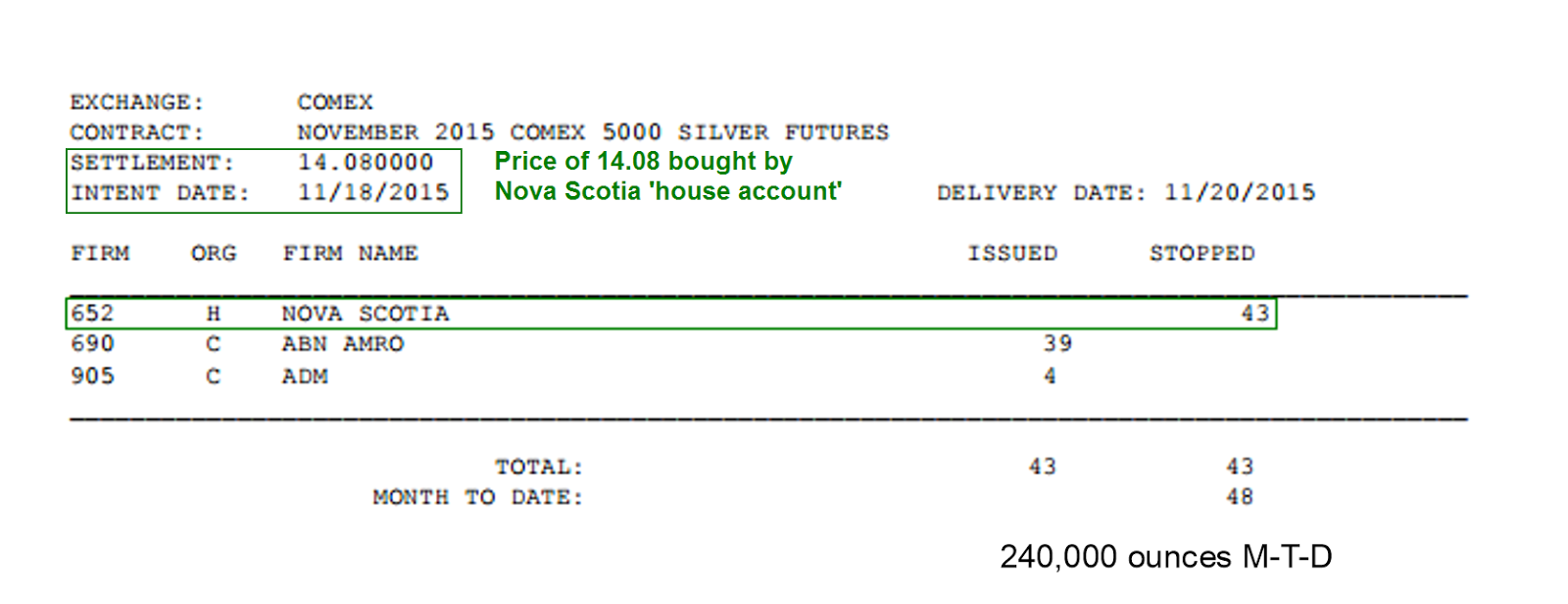
Surprisingly enough there was an actual delivery of silver at The Bucket Shop yesterday as Nova Scotia stopped 43 contracts for its 'house account.'

Otherwise it was the same old, same old with price going down or nowhere in the highly leveraged, synthetic markets of New York, and with physical bullion slowly leaking out of the warehouses.

The question is not whether or not the financial markets are going to slide into another crisis.  The only real question is when, since there is little to no interest in reform.

"We hypothesize that, having learned from the misadventures of the 1960s, the policy elites, well-versed in the practice of financial engineering and market manipulation, would have seen no need to dump stocks of government gold reserves onto the market, 1960s style, to keep the price in check.

Instead, synthetic gold, sourced in pyramids of credit extended to bullion bankers by central banks with little or no claim on physical substance, have provided a more efficient, better-camouflaged form of intervention. COMEX synthetic gold and related over-the-counter derivatives are traded in macro strategies implemented by hedge funds, high-frequency trades, and commodity funds in pair trades with interest-rate, currencies, equity futures, or even more exotic offsets. The volumes traded are huge, and bear little resemblance to actual flows of physical metal.

We suspect that shorting gold has come to seem like a riskless proposition as long as there is confidence in the Fed. Synthetic gold is the perfect substance for a carry trade: an easy borrow with very low carrying cost and little upside basis risk. Such a hypothesis, in our opinion, does much to explain the incongruity of a declining gold price while fundamentals for paper currency, and the U.S. dollar in particular, obviously deteriorate; while demand for physical gold has exceeded new mine supply for several years running; and while above-ground 400-ounce .995-gold bars located in London, New York, and other financial capitals (in cohabitation with speculative trading activity in paper markets) have steadily dwindled and disappeared into Asian financial centers reformulated as .9999 kilo bars."

Tocqueville Gold Newsletter 2Q 2015

Have a pleasant evening.


SP 500 and NDX Futures Daily Charts - Another Unicorn Plops Out of Wall Street


“Participants in our US markets deal with a technological arms race, conflicts of interest, fleeting liquidity in times of stress, and an ever increasing amount of trading taking place in a vast network of opaque darkness.

The public markets are considered ‘toxic’ by varied participants. Studies point out that institutional bids and offers result in too much price movement. High frequency market makers lament that the orders sent to the exchange, outside their own, tend to be orders that have been ‘exhausted’ everywhere else.

Is this a desirable outcome of modern market structure? Did the Commission envision this when it crafted Reg NMS?”

Joe Saluzzi

Maybe we should call this period in our nation's history 'The Carney Wars.'

Stocks pretty much floundered around today, with the two or three tech stock heavy Nasdaq showing a little more spine.

But they did manage to squeeze out another lipstick-smeared crackhead valued IPO, so mission accomplished.

Light volumes, narrow advances, uncertain global situation, looming recession in Europe and weak domestic economy?

Let's buy.  Monkey rally, yay!!

Hey, we *might* get a rally into the FOMC meeting in December, or into year end to plump up those Wall Street bonuses.

US financials have been cast adrift from the fundamentals of economic performance for some time now.

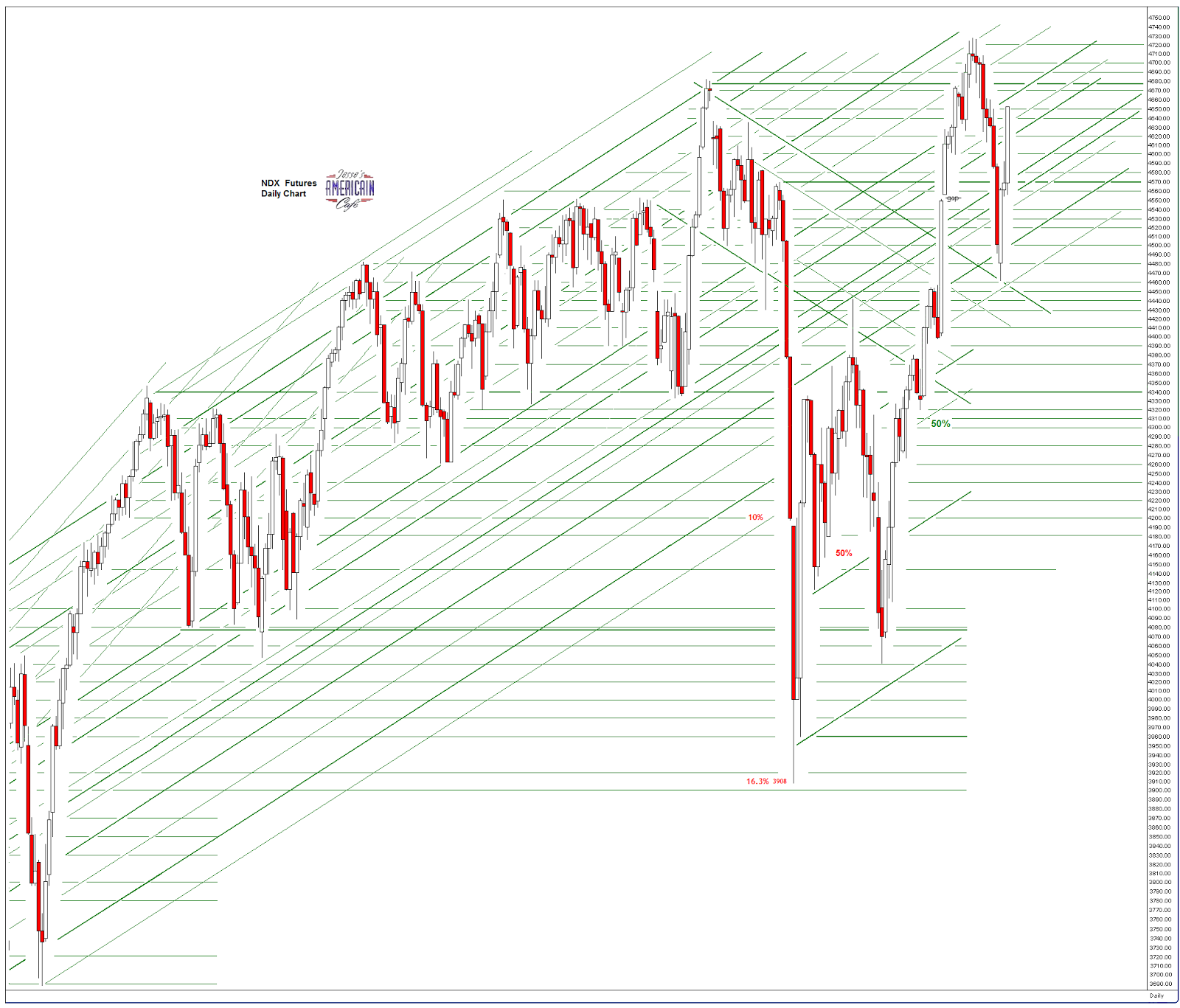
Chart-wise if the SP cannot make a higher high here, it will start to be looking for another wash and rinse lower.

Some fellows on financial TV were pointing to the Shadow Fed Fund Rate from the Atlanta Fed below, and making the case that the Fed is already tightening, so the rate increase in December will make no difference.

Well, that is one point of view.   Personally I will be looking at what they are paying the Banks for their essentially free reserves, and what the size of their Balance Sheet is doing more than anything coming out of a highly distorted financial market.

I am sitting on cash, waiting to pull on something.  We do have a potential for stocks to go a LOT higher IF this 'cup and handle' formation works.   And if it fails, we could go down to test support in the channel, or a LOT lower depending on what exogenous events may encourage stocks lower.

But these are just scenarios and possibilities for now.  And I think that covers all the major possibilities.  LOL.  This is what the guys who charge you money do, but with more certitude and a very eraseable set of past predictions.   The hits are carved in marble, and the misses, well they are chalk dust.

Let's see what the market has to say, if anything.

Have a pleasant evening.


NAV Premiums of Certain Precious Metal Trusts and Funds


I found it interesting that in yesterday's Comex delivery report, Nova Scotia took delivery of 43 x 5000 ounces contracts, about 215,000 ounces of silver bullion, for their 'house account,' at the price of 14.08.  I include that particular CME report below.

Apparently the Central Gold Trust has proposed a conversion of the Trust into an ETF, rather than accept the acquisition offer from Sprott. You may read that proposal as a PDF document. 

The Sprott Funds are mildly negative in price to their NAV, which is the 'new normal' in this bear market leg in precious metals.

What is not so normal, at least in my recollection, is the deepening negative cash balance which I have estimated for Sprott Silver at a little over $430,000.   And from the low level of cash in its account it looks like Sprott Gold is going to be following them soon, unless provisions are made to raise cash.

As you may recall, the Sprott underwriter Morgan Stanley gets a 4% cut on new offers of units, which has been the usual way in which Sprott has raised funds.  With the premiums close to negative, they cannot execute such an offering without 'diluting' the value of the fund in that offering, which they have pledged in their prospectus that they will not do.

So it appears that selling bullion is the only way to raise the required funds.  I have this from third parties, but Sprott has never said anything otherwise or objected to this interpretation.

Another interesting factor in the Sprott funds is the redeemability feature.  Although it has not happened with silver, there have been a number of redemptions of gold bullion out of the Sprott gold Trust over the past couple of years.  That is a good thing, that the process works, and that one might obtain their physical gold for private safekeeping.

But one might wonder what would happen if there was a 'run on physical gold' as some conjecture might occur, given the divergence in pricing between paper and physical.    According to an informal source, there is no provision in the funds to block, slow down, or attempt to prevent any redemption of the gold or declare force majeure.

The counterbalance for this is, of course, the market.  In order to redeem bullion, one must buy the units in the market at a certain price.  And if someone started buying up the Trust units in size, the price of those units would probably adjust to an increasing positive premium which would mitigate the attractiveness of a mass redemption.  And in the case of a 'run on bullion' I would imagine that holders of units would refuse to sell.  But nibbling at the bullion, as it is on almost all Western gold funds, has occurred.

I include the 'Total Holdings' of the Funds and ETFs for gold below to show the decline in bullion inventory.   And to pre-emptively respond to the misinformation of the bullion banks' gold trolls, who like to claim that this rise and fall in gold inventory is merely a matter of price, I include the same time periods for silver bullion as well.  Nine out of ten investors might notice that silver has had a steep decline in price from its all time highs as well.

One cannot take a single data point alone, and even a cursory examination of the bullion flows globally shows a massive movement of gold bullion from West to East, with some significant declines in the 'free float' of gold in some traditionally strong Western markets, such as London for example.

And the outflows from the Asian markets into strong hands on the mainland and the Western exports to them have been absolutely astonishing.  That the financial media and analysts ignore this, with some even denying it overtly, is shocking I suppose, unless you have been paying close attention to some of their more egregious service to the speculative financial interests for the last fifteen years.

By way of disclosure I own no shares in any of these Funds and ETFs at this time, and receive no money or gratuities from any of the funds which I discuss.  I have owned all of them from time to time. I have owned most of the mining stocks from time to time, except for the more obscure 'juniors.'  I do not prefer one over the other so much as each has its place and use in a portfolio.

As I have indicated recently I am cash heavy for the moment in my short term trading, waiting for the market to provide some additional information to prompt some action.  This is normal now because I am no longer a very active trader.  That is a younger man's game. I prefer to take more intermediate term positions and in size.

My long term holdings remain as they have been.


18 November 2015

Gold Daily and Silver Weekly Charts - Why Don't You Do Right


"And finally, in our progress towards a resumption of work, we require two safeguards against a return of the evils of the old order.

There must be a strict supervision of all banking and credits and investments. There must be an end to speculation with other people's money."

Franklin Delano Roosevelt, First Inaugural Address, 4 March 1933


"All political thinking for years past has been vitiated in the same way. People can foresee the future only when it coincides with their own wishes, and the most grossly obvious facts can be ignored when they are unwelcome."

George Orwell, 'December Letter,' Partisan Review, Winter 1945

Today was another boring day in the Homeland.

There were no deliveries at The Bucket Shop yesterday.

The usual dribbles of bullion went in and out of the warehouses.

Gold and silver prices generally oscillated around their current price levels.

Both precious metals are utterly oversold.

Below the charts is a classic song from Peggy Lee.  It became a hit in 1942 with Benny Goodman and was included in the movie Stage Door Canteen.  It sold a million copies and brought her to national recognition. It is shown as the second video below.

She cut the more mellow version, the first video below, with her husband and guitarist Dave Barbour in 1947.  The video is from 1950.  Her vocalization is much more personal and confident, and helps to support Barbour's ice-cold licks on the guitar.

It is not her most famous recording of course, as she is always associated with Fever.

I'll bet you did not know that this song was originally recorded as 'The Weed Smoker's Dream' by the Harlem Hamfats in 1936. I did not.  I found it fascinating that the Harlem Hamfats are really a Chicago jazz group, and the recording featured below was purchased from a British musical instruments, sheet music and apparently record dealer, Saville Pianos on Holloway Road N7 London. The Vocalian Origins of Jazz collection is a 78 RPM series of records issued in 1951 by an American company.

The song was rewritten and released as 'Why Don't You Do Right' by Lil Green in 1941 with Big Bill Broonzy.  As you can hear, it has a distinctive rhythm and blues lilt that sounds more like the 1947 cut by Peggy Lee than the big swing band version by Benny Goodman.
Many others have also recorded this song, including one of my favorite singers Julie London. You may have seen a version of it in 'Who Killed Roger Rabbit.'  But Peggy Lee's rendition still sounds the best of them all to me.

The lyrics sound like something the Banks will say when the next crisis brings them around asking for your money in another bail-out or bail-in.

You had plenty money, 1922
You let other women make a fool of you
Why don't you do right, like some other men do
Get out of here and get me some money too

You're sittin' down and wonderin' what it's all about
You ain't got no money, they will put you out
Why don't you do right, like some other men do?
Get out of here and get me some money too

If you had prepared twenty years ago
You wouldn't be a-wanderin' now from door to door
Why don't you do right, like some other men do?
Get out of here and get me some money too

I fell for your jivin' and I took you in
Now all you got to offer me's a drink of gin
Why don't you do right, like some other men do
Get out of here and get me some money too

No, you don't think so?  You do not think that they would dare propose a 'bail-in' to save Wall Street again?

The Banks own more politicians and judges than Don Vito Corleone.

Have a pleasant evening.


SP 500 and NDX Futures Daily Charts - Policy Errors, Other Peoples' Money, and Fear


What we have freed ourselves of, however, is any genuine consciousness of how we might look to others on this globe. Most Americans are probably unaware of how Washington exercises its global hegemony, since so much of this activity takes place either in relative secrecy or under comforting rubrics.

Many may, as a start, find it hard to believe that our place in the world even adds up to an empire. But only when we come to see our country as both profiting from and trapped within the structures of an empire of its own making will it be possible for us to explain many elements of the world that otherwise perplex us.

Chalmers Johnson


In England, a century of strong government has developed what O. Henry called the stern and rugged fear of the police to a point where any public protest seems an indecency.

George Orwell

Let's see if they can keep this bubble rolling.

As long as the volumes stay light and the Fed and the regulators stay loose, I suspect that they can.

Have a pleasant evening.