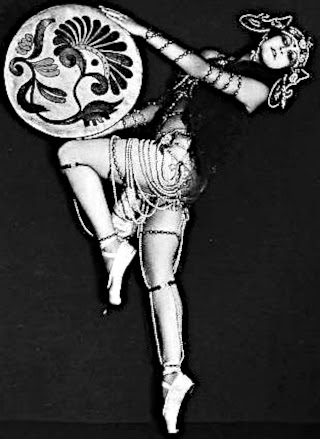
"The most ethereally beautiful music of the twentieth century was first heard on a brutally cold January night in 1941, at the Stalag VIIIA prisoner-of-war camp, in Görlitz, Germany. The composer was Olivier Messiaen, the work “Quartet for the End of Time.”
Messiaen wrote most of it after being captured as a French soldier during the German invasion of 1940. The première took place in an unheated space in Barrack 27. A fellow-inmate drew up a program in Art Nouveau style, to which an official stamp was affixed: “Stalag VIIIA 49 geprüft.” Sitting in the front row—and shivering along with the prisoners—were the German officers of the camp.
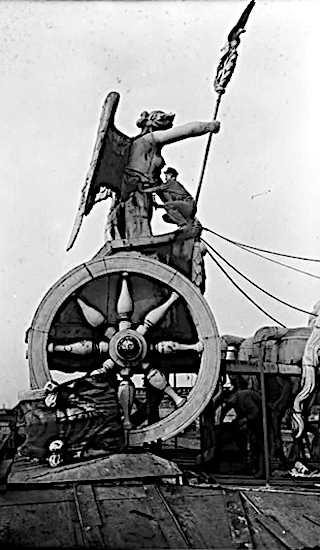
The title does not exaggerate the ambitions of the piece. An inscription in the score supplies a catastrophic image from the Book of Revelation: “In homage to the Angel of the Apocalypse, who lifts his hand toward heaven, saying, There shall be time no longer.”
Messiaen’s quiet answer to the ultimate questions of fear and faith stayed with me...not because he was a greater composer than Bach or Beethoven but because his reply came out of an all-too-modern landscape of legislated inhumanity. In the face of hate, this honestly Christian man did not ask, “Why, O Lord?” He said, “Lord, I love you.”
Alex Ross, Revelations: The story behind Messiaen’s Quartet for the End of Time, The New Yorker, March 2004
31 January 2010
A Quartet for the End of Time
Front-Running the Markets And the Sickness Unto Death
"And that is the nature of Goldman. Gather up as many customers as possible, aggregate the available information to achieve a superior market view and then relentlessly extract rents from the marketplace. Better yet, tell yourself you’re smarter than everyone else and you’ve earned the rents from the symbiosis."
James Rickards, former General Counsel of Long Term Capital Management
This is a nice, concise, albeit somewhat simplified description, from a more mainstream and highly credible source, of how the markets are operating today to the extreme disadvantage of the public and the real economy. Between front-running and naked short selling the banks have things pretty well under their control.
The market makers are the Wall Street banks are the prop trading desks, trading at high frequency slightly ahead of the markets while peeking into your accounts, gaining just enough unfair advantage to defy the odds of winning and losing in a fairly regulated market.
From James Rickards, The Frog, The Scorpion, and Goldman Sachs:
"Now consider another example of data mining, not done by retail firms, but by giant investment banks such as Goldman Sachs. These banks have thousands of customers transacting in trillions of dollars in stocks, bonds, commodities and foreign exchange daily. By using systems with anodyne names like SecDB, Goldman not only sees the transaction flows but some of the outright positions and whether they are bullish or bearish. Data mining techniques are just as effective for this market information as they are for Google, Amazon, Wal-Mart and others. It’s not necessary to access individual accounts to be useful. The data can be aggregated so that the bank can look at positions on a portfolio basis without knowing the name of each customer.
One need not be a market expert to imagine the power of this information. You can see which way the winds are blowing before the storm hits. You get a sense of when momentum is draining out of a trade so you can get out of it before the market turns. You can see when bullish or bearish sentiment reaches extremes, suggesting it may soon turn the other way. This use of information is the ultimate type of insider trading because it does not break the law; you are not stealing the information, you own it.
So what do Goldman and others do with this mountain of market information? Do they send coupons to customers or text them with great trading ideas? A few lucky customers, usually giant hedge funds, may get a call on some insights, but this mountain of immensely valuable market information is used mainly to power their giant proprietary trading desks allowing them to rack up consistent excess returns. Economists have a name for this also. It’s called “rent seeking,” which means taking value from others without any contribution to productivity. The difference between value-added behavior and rent seeking is like the difference between Amazon trying to sell me a book or planning to steal my library. In nature, the name for a rent seeker is parasite.
The ideal existence for a parasite is symbiosis, or balance, where it offers some minimal service to the host, (some parasites devour insects which annoy the host), while extracting as much sustenance from the host as possible without killing it. But sometimes the symbiosis is disturbed and the parasite takes too much and actually destroys the host, which can end up destroying the parasite as well. This recalls the fable of the scorpion and the frog. Both are on the edge of a river looking for a way to cross. The scorpion cannot swim and asks the frog for a ride on its back. The frog at first says, “no,” for fear of being stung. But the scorpion assures the frog it will not sting him because they would both drown. The frog agrees to carry the scorpion. Once they reach the middle of the river, the scorpion stings the frog and they begin to drown. The frog cries, “why did you do that?” and the scorpion replies, “it’s my nature.”
And that is the nature of Goldman. Gather up as many customers as possible, aggregate the available information to achieve a superior market view and then relentlessly extract rents from the marketplace. Better yet, tell yourself you’re smarter than everyone else and you’ve earned the rents from the symbiosis."
How does it continue? Like the bailout of AIG, the stewards of the public trust are choosing to turn a blind eye. The politicians are the beneficiaries of huge campaign contributions. The regulators are overwhelmed, and desirous of Wall Street positions. The other traders are jackals, seeking to follow the lions as they tear into the flocks of sheep and cattle. The economists are timid, adverse to anything but painfully granular analysis of carcasses of other people's ideas and orthogonal scenarios.
"Worse yet, the parasite is now killing the host. The United States is drowning in debt, much of it incurred to bail out Goldman, AIG, GMAC, Fannie Mae and all of the other rent seekers. The U.S. is like the frog; well meaning but blind to nature of scorpions.
Wall Street likes to say, “what’s good for Wall Street is good for Main Street.” That’s the scorpion talking. What’s good for Wall Street is good for Wall Street. Never forget it."
The financial system did not need to be saved by bailouts, it needs to be saved from itself. Their insatiable greed, monstrous appetites, and arrogant pride will take them over the cliff.
Which would not be bad in itself, if our governments had not made us hostage to their reckless schemes, and if we, in our resignation and despair, do not allow them to take us with them.
The First Year of Obama's Failed Economic Policies: The Worst May Yet Be Avoided
"The banks must be restrained, the financial system reformed, and balance restored to the economy before there can be any sustained recovery."
We have been saying this for some time. The report below from Neil Barofsky says essentially the same thing.
"Even if TARP saved our financial system from driving off a cliff back in 2008, absent meaningful reform, we are still driving on the same winding mountain road, but this time in a faster car," Barofsky wrote.
The US is heading towards a double dip recession, and the next leg down may be more fundamentally damaging than before.
The reason for the decline will be the abject failure of the Obama Administration to address the roots of the problem, instead wasting trillions to prop up a banking system that is a useless distortion.
Worse than useless really, because it actually presents a huge negative influence by stifling the recovery, channeling funds to the crony capitalists and non-producing wealth extraction sector, who tax the people like feudal lords under license of a corrupt government.
So far, Obama has failed the people, but preserved the banks. A source of his failure has been his weakness in listening to Larry Summers and Tim Geithner, the Rubin-Clinton wing of Democrats, who have well established their incompetence and inability to act at a level suitable to their positions. They are captive to special interests, locked into the ways of thinking that brought the world to the point of crisis.
In response to the next leg down, Bernanke will monetize debt at an even more furious and clever pace, perhaps in alliance with the Bank of England and Bank of Japan. The ECB resists, and all who balk will be chastised by the monied powers and their demimonde, the ratings agencies and global banks. This is modern warfare of a sort.
We do not expect the corruption of the world's reserves to be so blatant that the inflation will immediately appear, except in more subtle manner. At some point it may explode, especially if Ben is particularly good at concealing its subtle growth.
Monetary inflation is the growth of the money supply in excess of the demands of the real economy, not nominal growth of the supply. The US has been shifting its growth into the reserves of other central banks for the past twenty years or so, and those eurodollar present an overhang that will egulf the Treasury should they come home to roost too quickly. The great nations see the US problem, most surely. The question is how to handle it, gracefully, since the US is still the world's sole superpower, and given to covert pre-emptive action when it feels threatened.
It is not a pretty picture. We had high hopes for Obama, because he was capable of rising to the challenge. He had the backing of his people. And he is choosing failure, for whatever reason. That is certainly is the template of a modern tragedy.
“Given the same amount of intelligence, timidity will do a thousand times more damage than audacity.” Karl von Clausewitz
ReviewJournal
Watchdog: Bailouts created more risk in system
By DANIEL WAGNER and ALAN ZIBEL
AP Business Writers
WASHINGTON (AP) -- The government's response to the financial meltdown has made it more likely the United States will face a deeper crisis in the future, an independent watchdog at the Treasury Department warned.
The problems that led to the last crisis have not yet been addressed, and in some cases have grown worse, says Neil Barofsky, the special inspector general for the trouble asset relief program, or TARP. The quarterly report to Congress was released Sunday.
"Even if TARP saved our financial system from driving off a cliff back in 2008, absent meaningful reform, we are still driving on the same winding mountain road, but this time in a faster car," Barofsky wrote.
Since Congress passed $700 billion financial bailout, the remaining institutions considered "too big to fail" have grown larger and failed to restrain the lavish pay for their executives, Barofsky wrote. He said the banks still have an incentive to take on risk because they know the government will save them rather than bring down the financial system.
Barofsky also said his office is investigating 77 cases of possible criminal and civil fraud, including crimes of tax evasion, insider trading, mortgage lending and payment collection, false statements and public corruption.
One case concerns apparent self-dealing by one of the private fund managers Treasury picked to buy bad assets from banks at discounted prices. A portfolio manager at the firm apparently sold a bond out of a private fund, then repurchased it at a higher price for a government-backed fund. A rating agency had just downgraded the bond, so it likely was worth less, not more, when the government fund bought it. The company is not being named pending the outcome of Barofsky's investigation.
Barofsky renewed a call for Treasury to enact clearer walls so that such apparent conflicts are less likely.
Treasury said it welcomed Barofsky's oversight but resisted the call to erect new barriers against conflicts of interest. The new rules "would be detrimental to the program," Treasury spokeswoman Meg Reilly said in a statement. The existing compliance rules "are a rigorous and effective method of protecting taxpayers," she said.
Much of Barofsky's report focused on the government's growing role in the housing market, which he said has increased the risk of another housing bubble.
Over the past year, the federal government has spent hundreds of billions propping up the housing market. About 90 percent of home loans are backed by government controlled entities, mainly Fannie Mae, Freddie Mac and the Federal Housing Administration.
The Federal Reserve is spending $1.25 trillion to hold down mortgage rates, and millions of homeowners have refinanced at lower rates.
"The government has stepped in where the private players have gone away," Barofsky said in an interview. "If we take government resources and replace that market without addressing the serious (underlying) concerns, there really is a risk of" artificially pushing up home prices in the coming years.
The report warned that these supports mean the government "has done more than simply support the mortgage market, in many ways it has become the mortgage market, with the taxpayer shouldering the risk that had once been borne by the private investor."
Barofsky's report echoed concerns raised by housing experts in recent months, as home sales and prices rebounded. They warn that the primary reason for the turnaround last year has been billions of dollars in federal spending to lower mortgage rates and prop up demand.
Once that spigot of cash is turned off, they caution, the market will be vulnerable to a dramatic turn for the worse. Daniel Alpert, managing partner of investment bank Westwood Capital, wrote in a report that national home prices are bound to fall 8 to 10 percent below the lows of last spring.
"The lion's share of the remaining decline will occur in markets that saw sizable bubbles but have not yet retrenched," he wrote.
Officials from the Obama administration counter that massive federal intervention has helped the housing market stabilize and prevented more dire consequences.
Barofsky's report also disclosed that, while the Obama administration has pledged to spend $75 billion to prevent foreclosures, only a tiny fraction - just over $15 million - has been spent so far. Under the Making Home Affordable program, only about 66,500 borrowers, or 7 percent of those who signed up, had completed the process as of December.
He said the key to preventing future crises is to reform Fannie Mae and Freddie Mac, create and improve loan underwriting and supervision of banks. He stopped short of endorsing specific proposals for overhauling financial regulation, but said many of the proposals would go far to improving the system.
30 January 2010
NY Fed Conspired to Hide Details of AIG Bailouts from Public and Congress
“I have to think this train is probably going to leave the station soon and we need to focus our efforts on explaining the story as best we can. There were too many people involved in the deals -- too many counterparties, too many lawyers and advisors, too many people from AIG -- to keep a determined Congress from the information.” James P. Bergin, NY Fed, in an email to his Fed colleagues
'Though it is hard to divine much understanding from the unredacted filing, it has become clear that Goldman had more involvement than previously believed: In addition to the credit default swaps it bought from AIG, the filing shows that Goldman Sachs also originated many of the underlying assets that AIG and the New York Fed bought back from Société Générale.
The American people have the right to know how their tax dollars were spent and who benefited most from this back-door bailout," said Kurt Bardella, spokesman for Issa. "Now that it's public, let's see if the sky really does fall as the New York Fed said it would to justify its coverup."
Other lawmakers believed that the New York Fed was trying to hide its ties to Goldman Sachs.' AIG Reveals the Story - CNN
"Wednesday’s hearing described a secretive group deploying billions of dollars to favored banks, operating with little oversight by the public or elected officials.
We’re talking about the Federal Reserve Bank of New York, whose role as the most influential part of the federal-reserve system -- apart from the matter of AIG’s bailout -- deserves further congressional scrutiny...
By pursuing this line of inquiry, the hearing revealed some of the inner workings of the New York Fed and the outsized role it plays in banking. This insight is especially valuable given that the New York Fed is a quasi-governmental institution that isn’t subject to citizen intrusions such as freedom of information requests, unlike the Federal Reserve.
This impenetrability comes in handy since the bank is the preferred vehicle for many of the Fed’s bailout programs. It’s as though the New York Fed was a black-ops outfit for the nation’s central bank...
New York Fed staff and outside lawyers from Davis Polk & Wardell edited AIG communications to investors and intervened with the Securities and Exchange Commission to shield details about the buyout transactions, according to a report by Issa.
That the New York Fed, a quasi-governmental body, was able to push around the SEC, an executive-branch agency, deserves a congressional hearing all by itself." Secret Banking Cabal Emerges From AIG Shadows - Reilly - Bloomberg
And this is the same Federal Reserve that was proposed by the Obama economic team to be the 'super regulator' with broad powers and consumer protection responsibilities over the entire financial system.
The Fed is a private agency, quasi-governmental, but not subject to discretionary audit or review by the government, except at arms length, through managed testimony. They make a point of demanding secrecy and independence at their own discretion, oversight on their terms.
This is a choice promoted by Geithner and Summers, who are creatures of the Fed and the banking system, almost sure to return to sinecures there after leaving government. And it is tempting choice for a president and congressmen of a weak character. If the Fed bears the responsibility they do not have to budget money and manage the process, and they can point fingers at its every failure. It is a formula for conflicts of interest, soft bribery and corruption. Confidence does matter.
The Fed and Blackrock are becoming to the Obama Administration what Halliburton and KBR were to Bush and Cheney, and the banking crisis -- the new Iraq. Can the handling of it be so inept that it becomes Obama's Watergate as well?
The Fed must be audited, and its power to disburse public money to private banks, except in the normal course of open market operations, curtailed. Only the Congress has the right to tax the people, and the Fed's ability to disburse billions of funds at its own discretion to domestic and foreign banks is a de facto form of taxation, since the Fed operates on a cost plus basis, without budgetary allotment from the Congress. The obligations of the Federal Reserve flow directly from its balance sheet, which is the basis for the national currency.
And despite the arguments from the Financial Times to 'stop snooping' the press and the Congress should delve deeply into the AIG bailout, because enough has already been exposed that it smells to high heaven.
It is remniscent of Watergate and Enron to see Timmy, Ben, and Hank falling all overthemselves in establishing that they had no knowledge or involvement in the payments of billions to AIG.
The truth must come out.
My own suspicion is that Goldman 'set up' AIG for a proper face ripping with its financial arrangements, playing both sides of the deal. There is further evidence of money flowing from Goldman to AIG executives before the bailout occurred. And at the least the major players saw what was happening and turned a blind eye to it, busying themselves with other things and establishing their plausible deniability.
A proper investigation can establish any specific guilt. It is a shocking scandal that the FBI and Justice Department are still not more actively involved in real investigation rather than these staged hearings.
But this incident should make it absolutely clear why the Fed cannot enjoy the expansion of its role as the regulator of the system. It is too conflicted in its mission of monetary independence, and at the same time the creature of the banks, to be a true civil servant fully answerable to the Congress.
Yes I understand the distinctions between the Fed Board of Governors and the NY Fed with regard to FOIA requests, and the appointmet process. What I am saying is that the distinctions obviously do not hold, do not work. The Fed is one organization. These distinctions are remniscent of the banking scandals exposed by then AG Elliot Spitzer. They simply do not work. They are a thin facade.
As Representative Marcy Kaptur told Geithner at the hearing: “A lot of people think that the president of the New York Fed works for the U.S. government. But in fact you work for the private banks that elected you.”
One difference I have noted, compared to the English and the Japanese, is that the American officials and CEO's never hesitate to hide behind the incompetency defense, but rarely have the dignity to resign when they do so. This is because they have no shame, no real loyalty to anyone but themselves.
And at the very least Geithner should be fired, if not for complicity, then for sheer inability to do the job.
Timeline of NY Fed Payments and Cover-Up: BusinessWeek
Financial Crisis Ahead - Thomas Donlan - Barron's
Paulson's People Colluded with Goldman to Destroy AIG and Get a Backdoor Bailout - Fiderer - Huffington
Sham Transactions That Led to AIG's Downfall - Fiderer - Huffington
Law: Corporate Counsel
Ssshhh ... E-mails Show Lawyers' Push to Keep AIG Details Hush-Hush
By Sue Reisinger
January 26, 2010
E-mails among in-house lawyers at the Federal Reserve Bank of New York show they worked feverishly in early January 2009 to find a way to keep secret the details behind American International Group, Inc.'s $60 billion in payments to counterparties in risky credit default swaps. And, the e-mails show, the lawyers weren't trying to hide the details just from the public but also from Congress.
A Fed spokesman was not immediately available for comment.
The records show that in-house counsel James Bergin wrote to New York Fed general counsel Thomas Baxter Jr. on Jan. 8 that the Securities and Exchange Commission had asked AIG to either disclose the payment schedule, including the counterparties' names and the amount of payments, or file a request for confidentiality. With the request, the SEC requires filers to send the confidential material so it could be reviewed by staff. It also requires the filer to consent to disclosure to Congress and other agencies, he said.
"This requirement is giving us some pause," Bergin wrote to Baxter, "since we haven't otherwise disclosed this information to Congress." Copied were various Fed lawyers, including deputy general counsel Joyce Hansen and banking supervisor Stephanie Heller. Congress had approved AIG's bailout funds, which were used in the payments. Bergin said Fed lawyers were considering their options on the SEC's request.
On the morning of Jan. 13, according to another Bergin e-mail to in-house lawyers, he spoke by phone to SEC staff members who were "receptive" to his request for confidentiality. Included on the call, he said, was Alison Thro, senior counsel for Freedom of Information Act matters at the Fed. The SEC agreed to consider Bergin's request for an alternative procedure for reviewing the schedule — "rather than it [the schedule] becoming an SEC record subject to their FOIA process."
Later that same day Diego Rotsztain, a lawyer then with Davis Polk & Wardwell which was representing the New York Fed, wrote to AIG deputy general counsel Kathleen Shannon about "special SEC procedures." The e-mail said AIG should expect a call from the SEC about delivering the confidential data "via courier to a specific person who will be responsible for ensuring that the letter does not get into the wrong hands and is afforded the appropriate attention."
At 8:46 p.m. that evening, Bergin sent an e-mail updating Baxter, Hansen, and the other in-house attorneys. It said the SEC had agreed to "implement special security procedures for handling of the document," including limiting the reviewing staff to two people, keeping it in a locked safe during the process and, if confidentiality was approved, "providing for its storage in a special area at the SEC where national security related files are kept."
The e-mails are part of some 250,000 documents produced by the New York Fed in response to a subpoena from the House Committee on Oversight and Government Reform. The committee has scheduled a hearing on the AIG bailout on Wednesday, and among the witnesses testifying will be Baxter and Treasury Secretary Timothy Geithner, who was Baxter's boss and president of the regional Fed during the bailout crisis.
The committee wants to know why the counterparties were paid nearly 100 cents on the dollar when other banks were negotiating much lower percentages on credit default debt, and why the Fed tried to hide the information.
29 January 2010
Gold Holdings And the Evolution of Global Trade and Wealth
What fascinated me about this information is that countries that have much less of the official gold, that is gold held by the governments, are leading the effort to recast the SDR with some gold content in the changes scheduled to take place later this year. And they tend to be the high growth nations with the greatest commitments to exports.
And it was a bit of a surprise to see that the Eurozone exceeds the US in total assets by volume. I did not know that. Of course, one may argue about the qualitative unity of the Eurozone. But the big holders of gold there are clearly the core of the union.
 This chart does not address the issue of gold holdings which may be leased out and sold to the private sector but still listed as an asset, but held as hedges, derivatives, and deep storage, that is, claims on ores yet to be extracted and in some cases even discovered.
What is also fascinating, as shown below, is that if one looks at the gross levels of official gold holdings the total was steadily decreasing up until last year.
This chart does not address the issue of gold holdings which may be leased out and sold to the private sector but still listed as an asset, but held as hedges, derivatives, and deep storage, that is, claims on ores yet to be extracted and in some cases even discovered.
What is also fascinating, as shown below, is that if one looks at the gross levels of official gold holdings the total was steadily decreasing up until last year.
 Since there is an annual increase in total gold from mining activity, and very little loss through industrial use that is not subject to later salvage, it appears that there was a steady transfer from the public to the private sector.
 Essentially the private sector has been taking all the new gold production and official sales for an extended period of time. We have to wonder what sparked the spectacular bull run in gold starting around 2001 from about $250 to $1000+ per ounce? I can assure you, the bankers of the world think about this, and frequently.
Since we are denominating gold here in US Dollars, there is an obvious negative correlation of sorts as the dollar moves higher and lower in perceived value by the world. But that does not explain the fact that gold is in a bull market in most of the world currencies except for a few of the commodity exporters and safe havens.
Is gold a bubble? As someone who has been a close observer of bubbles for the past ten years the data does not recommend that conclusion. And what makes me even more curious about this point of view is that the very people who for the most part denied the existence of the obvious bubbles in tech, housing, risk, banking and credit, even to the point of absurdity, who could not or would not see a bubble if it perched on the end of their nose, who are card carrying members of the international monied fraternity, are the most vocal in calling gold a bubble with emotional arguments lacking any fundamental data. What's up with that?
Some people, like Willem Buiter, have recently made silly and distracting arguments regarding their very subjective opinion about gold. That opinion does not bear all that much weight given gold's long history and broad use as a store of value, more enduring than anything else in recorded history. In other words, an opinion is like a vote, and you are casting your one vote in the face of countless votes of millions of people over the span of ages -- so your opinion is worth what it is worth, to you.
It is the supply and demand that interests me. And it surely interests the monied powers, who seem to come out strongly in disfavor of gold and silver at certain intervals when they start getting nervous about the grip they have on the reins of the world's financial markets in paper. The sillier and more baseless their comments, the more my interest.
So you will forgive me for seeming rude, but I do not care about your opinion, whoever you may be. I do not even care for my own opinion. I only care for what can be known.
A good part of me is on the hunt for knowledge here, and whether you believe it yet or not is of little consequence to the outcome. You may as well spin opinions about the likely path of a truck as it bears down upon you where you stand. Only the trajectory and the mass of the truck matters, and the ability to step out of its way in a lively manner.
Given the price action, it is hard to find a more 'popular' commodity as expressed in the action of buying by private individuals with disposable wealth, that at the same time is so seemingly 'unpopular' with public officials, and a genuine antipathy by the world bankers, and so little noted by the general public. The 'gold parties' that people were pointing to as a sign of a top were for companies to BUY gold in the form of old jewelry from the public, not for SELLING it to them and often at preadatory prices, despite the misleading spin from the mainstream media.
I like data anomalies. They are so interesting. As Holmes observed in the story Silver Blaze, "Why didn't the dog bark?"
Essentially the private sector has been taking all the new gold production and official sales for an extended period of time. We have to wonder what sparked the spectacular bull run in gold starting around 2001 from about $250 to $1000+ per ounce? I can assure you, the bankers of the world think about this, and frequently.
Since we are denominating gold here in US Dollars, there is an obvious negative correlation of sorts as the dollar moves higher and lower in perceived value by the world. But that does not explain the fact that gold is in a bull market in most of the world currencies except for a few of the commodity exporters and safe havens.
Is gold a bubble? As someone who has been a close observer of bubbles for the past ten years the data does not recommend that conclusion. And what makes me even more curious about this point of view is that the very people who for the most part denied the existence of the obvious bubbles in tech, housing, risk, banking and credit, even to the point of absurdity, who could not or would not see a bubble if it perched on the end of their nose, who are card carrying members of the international monied fraternity, are the most vocal in calling gold a bubble with emotional arguments lacking any fundamental data. What's up with that?
Some people, like Willem Buiter, have recently made silly and distracting arguments regarding their very subjective opinion about gold. That opinion does not bear all that much weight given gold's long history and broad use as a store of value, more enduring than anything else in recorded history. In other words, an opinion is like a vote, and you are casting your one vote in the face of countless votes of millions of people over the span of ages -- so your opinion is worth what it is worth, to you.
It is the supply and demand that interests me. And it surely interests the monied powers, who seem to come out strongly in disfavor of gold and silver at certain intervals when they start getting nervous about the grip they have on the reins of the world's financial markets in paper. The sillier and more baseless their comments, the more my interest.
So you will forgive me for seeming rude, but I do not care about your opinion, whoever you may be. I do not even care for my own opinion. I only care for what can be known.
A good part of me is on the hunt for knowledge here, and whether you believe it yet or not is of little consequence to the outcome. You may as well spin opinions about the likely path of a truck as it bears down upon you where you stand. Only the trajectory and the mass of the truck matters, and the ability to step out of its way in a lively manner.
Given the price action, it is hard to find a more 'popular' commodity as expressed in the action of buying by private individuals with disposable wealth, that at the same time is so seemingly 'unpopular' with public officials, and a genuine antipathy by the world bankers, and so little noted by the general public. The 'gold parties' that people were pointing to as a sign of a top were for companies to BUY gold in the form of old jewelry from the public, not for SELLING it to them and often at preadatory prices, despite the misleading spin from the mainstream media.
I like data anomalies. They are so interesting. As Holmes observed in the story Silver Blaze, "Why didn't the dog bark?"
Gregory of Scotland Yard: "Is there any other point to which you would wish to draw my attention?" Holmes: "To the curious incident of the dog in the night-time." Gregory: "The dog did nothing in the night-time." Holmes: "That was the curious incident."I cannot think of any single economic phenomenon that is more interesting in recent time, say the past 100 years, than the evolution of global trade, the basis for its exchange, and of course the official reserve holdings that are a natural outcome of this. For if one understands that the power to set and control the currency essentially trumps all local fiscal policy issues, there is almost nothing more important than the path which this evolution takes. Valuation and the ownership of the 'standard' of monetary valuation is key, and yet so little remarked, so little discussed in public. I try to resist the temptation to suspicion that statists are driving towards a unified command and control economy. I do not think that this agenda is the basis for formal discussions, except perhaps tangentially in the hallways of Davos. There is an impetus to power, and more power, that can create the same effect in groups of men without the need for formal discussions. Financial engineers and bankers will alway seek more control and more power, because they are seeking to master something that is a portion of human nature, that does not lend itself easily to linear manipulation. As their plans fail, they need to keep expanding to prevent a collapse and their personal humilitation. This is inherent in what they do. This is how dictatorships are created; they seem to be the easier path to inability, if not incompetency. But it is obvious that the theme since the 1980's at least has been the will to power, the knocking down of laws and regulations, to allow the most powerful to do what they will, to take an even greater share of the riches of the world, to the disadvantage of the many. And my hypothesis is that the global reserve currency is a key plank in this agenda. Perhaps this is such a perennial theme that is almost a tautology to remark about it, like a boy who first discovers the wonders of love, and thinks himself a Balboa discovering new oceans. Perhaps this boy is just discovering in a more profound way the deep roots of the darker side of human nature, the basis of evil: pride, greed, and deceit. But there is an ebb and flow in the tides of men, and the rise and fall of nations, ideas, and fundamental values like freedom, justice, honour, duty, mercy, equality, and hope. And we are certainly at the cusp of a trend change, a trend in place since the second Great War, and the dog is not barking. The game is afoot.
28 January 2010
Elizabeth Warren Explains the Financial Crisis and the Problem with the US Banking System
This is from Elizabeth Warren's 26 January 2010 appearance on The Daily Show.
Brilliant in its simplicity and its honesty. Very tough and straight talk.
Why do we have to see this on the Comedy Central Network, and hear the usual drivel and obfuscation on the mainstream media?
Here is a link if you have trouble viewing this.
Watch for a US Market Move LIkely Before the Close
 It is said that the US Senate will be voting on the confirmation of Zimbabwe Ben, the Oligarch's Friend, around 3:20 PM EST today. Or at least they will be voting for 'cloture' which is the end of debate. This requires a 60 vote majority, the same rule invoked to end the infamous filibusters.
The confirmation would then be voted on itself, requiring only a simple majority.
The equity market is on support, and a move in sympathy with Ben's confirmation or denial is probable, up or down.
After the bell Microsoft reports earnings, and is carrying a whisper number of .66 versus the consensus .59.
This may be overshadowed by the review of the banks' privateering license should it indeed occur today, and not be postponed until tomorrow. Interesting that the banks are rallying while techs are widely lower after QCOM.
If the cloture vote is indeed postponed, then it is likely that some Senators are holding out for better reasons to confirm, in the form of mo' money. As we understand the rules, a single Senator can postpone the vote for 30 hours.
The US Senate is a bit like the House of Lords, with a certain haughty lack of substance and misplaced self-absorption and celebrity, but with more ability to accomplish mischief and interfere with the practical workings of the nation.
Bernanke's current term as Fed Chairman expires on Sunday, 31 January.
A denial to confirm would almost certainly call for an object lesson to the government in the form of a sell off. Threats do not stick if you do not occasionally make good on them.
And the global financiers are still smarting over what one sneering English correspondent for the Financial Times on Bloomberg Television called Obama's senseless "outburst" regarding support for the Volcker rule. Obviously this President has forgotten his place and may need a reminder.
Obama and his team are unabashed in support for the Chairman, and are opposed by an unlikely coalition of progressive Democrats and conservative Republicans who are unhappy with the secrecy of the Fed and the aggressive and expansive nature of the bailouts.
There is also a strong correlation between the Senator's speaking volume on the subject and the proximity of their next election. We are sure many are looking for ways to 'cover themselves' without interfering with what the lobbyists and corporate campaign contributors desire.
27 January 2010
Memories of Beijing Ten Years Past
Below is a brief note from a friend abroad about his trip to Beijing and his experiences there with the retail gold trade which I found to be interesting. It is a sharp contrast to my last trip there over ten years ago.
The last time I was in Beijing was in 1998, and it must seem to be a different world there now. Back then there were few cars and a sea of bicycles. As a friend and I took a pedicab back from the Forbidden City to our hotel, it did seem as though we were in an ocean of moving people, bicyclists weaving about in ever shifting traffic patterns, with order maintained by some unspoken set of rules and deferences. There was no air pollution to speak of, and the sky was a deep blue, and the breeze crisp even on a sunny day.
Beijing was a sharp contrast to the great cities of the south. Vibrant Hong Kong nestled on the coast, and Shanghai, an expanding mass of grey on gray, concrete bristling with construction cranes. The sprawling capital seemed almost pristine, delicate. Especially if you did not see the huddle of one story concrete block villages on the outskirts of the main thoroughfares. But even they were more rural and underdeveloped than squalid like similar dwellings of the lower caste workers in the West. There was no litter or disorder, anywhere.
A major access highway was being constructed for the Olympics which the city hoped to host, which they did roughly ten years later. We marveled at the complete lack of heavy machinery, the mass of hand tools, and spiderworks of tied bamboo scaffolding.
The hotel was marvelous, with the kind of extravagant niceties that only a developing country can effortlessly provide to the prospective export trade. A twenty piece orchestra of excellent musicians in the spacious hotel lobby while you drink your coffee and tea in the afternoon is something that one rarely sees in a European hotel. And in the States, it is always impersonal, mass produced, and perfunctory. Welcome to the cult of death. Have a nice day.
Lovely people really, but the hardships of the countryside marked the faces of the peasants as we traveled outside the city to the Great Wall with our guide, Big Mah, so noted by his stature, which was average by European standards. The Wall itself runs the hilltops, clinging to mountainsides with remarkable tenacity. One does not walk the wall except for brief spans, and then you climb. The inclination is astonishing and the steps really large blocks, so it is an effort to lift your legs high enough from one to the next.
We labor to the top, to obtain a souvenir 'chop' on our paperwork at the summit, a symbol of our resolve. We are oddities again, some of the few Westerners. Crowds though of Chinese tourists exploring their heritage.
I am tired and sweating, regretting the lunch I ate earlier that day before the climb, and shamed by a young Buddhist monk who bounds up the incline like a gazelle, enigmatic smile spreading across his face, large straw hat in a fluid motion with his robes. I wonder why he is there. Do monks go on vacation? All he carries is a small leather purse and a stick.
Beyond that top point is the Wall unrestored, a shambles really, a recognizable collection of stone but not much more. Hardly a wall, more like a resilient pile of manmade things with a sort of quiet endurance, waiting for its renewal and the restoration provided by a Ten Year Plan, or not.
The visit to the cloisonné factory revealed a large showroom with small shops in the back staffed by women, intent as they worked in appalling, dirty conditions on ancient looking machinery. No health and safety inspections here. This is the ideal capitalism as Bill Gates described it after his own visit to the People's Republic. Keep your head down and your mouth shut.
At the tombs of the emperors we saw great stone rooms, empty of any furnishings or artifacts, stripped of all decadence during the Cultural Revolution. At least they have not despoiled the tomb of the great Qin Shi Huangdi, which sits in brooding solitude under its man made mountain on the plain. Is it truly superstition that prevents its excavation, or a fearful respect for what is recorded to have been the labor of tens of thousands of men in burying their first great Emperor in what is said to have been astonishing opulence, rivaling and perhaps surpassing that of the Pharaohs.
At the nearly deserted Friendship Store we watched a man slowly and painstakingly painting the insides of small medicine bottles with intricate strokes from a brush that seemed to consist of a few hairs. I have several of them still, on a shelf in my study. I sometimes wonder what became of him, and his quiet obeisance to art and the dignity of craftsmanship. It is good to surround yourself with little reminders of people whom you have known, for their spirits are all that will remain when the last stars flicker out.
There were few tourists, and my Italian chief engineer and I would draw more than a few stares from the passersby as we walked down the broad avenue towards Tiananmen Square. There was a McDonalds but it was closed for lack of interest. Groups of people crowded around what looked like newspapers posted on public boards, a primitive version of the Internet cafe.
We watched a football match one evening in the hotel bar via satellite, Italy versus the Czech Republic. I pretended to sympathize with my friend in the Italian loss, which for him was disgrazia e disonore, for the Italians to lose to such a team as mine, but I secretly reveled in the win. There was nothing else to do, as they had no grappa on hand to ease his suffering. It was the only thing that would absolve such an indignity, except time.
As a guest of the government we dined one evening in an official restaurant, with doors guarded by soldiers. Dinner was a treat, but the attempts to playfully intimidate me with a still lively lobster 'sushi' were misspent, as I had done my time in Tokyo and the small places off the Ginza playing that same game with my Japanese friend Shino san. I am a citizen of the world, and nothing is alien to me except sin.
Afterwards they had group karaoke and dancing marked by a charming innocence. The old gold toothed host challenged me to a drinking contest, with something that tasted like distilled kerosene served in a heavy white ceramic teapot that in Chinese was called the alcoholic's friend. I refused to be shamed into it and deferred, as I had to get up at 5 AM the next day for a flight that could not be missed, as it only ran twice a week as a nonstop to Scandinavia. If missed, it meant a lengthy flight with a connection through Bombay. No time for hangovers.
One of the young ladies remarked about a recent film she had seen, The Bridges of Madison County. I had never seen it, and still haven't. She was impressed that American men could be so sensitive, as she had been led to believe that we were barbarians. I did not have the heart to tell her that despite some finer moments, we really are. And so are hers.
Everywhere the clerks were polite but restrained, obviously pained to please, but especially when changing money. Slogans in Chinese were everywhere, urging the populace to work hard to achieve the award of hosting the Olympic games, to the point of civic obsession.
The airport was a nightmare of people and traffic. The line to enter the departure area was a clotted mass of people surging towards a tiny female guard. After facing down her fierce glare and outstretched hand, I learned what was required from a young German tourist with backpack and halting English, directing me to first purchase a departure tax coupon at the other end of the terminal. Don't panic, just get it done.
Once past that narrows of official release, there were piles of luggage and a small stand, barely a cardboard table and marked by a tiny sign, where one checked in for the non-stop flight to Copenhagen. I was so worried about missing the flight that I took my carry-on to the gate and sat on it, forgetting to exchange my Chinese money on departure, in violation of their currency controls. The money was a key plank in their ten year plan, like the exhortations on the walls.
It's all different now. China seems to be making the great leap forward. I have heard that the sea of bicycles is gone, replaced by impersonal masses of metal moving in linear formations. They even have smog in the city, an innocence lost.
And where is the West going? Is there some force that is causing the wealth of the people to seek a level, flowing from West to East, to bring all to the lowest common denominator? Or are the elite powers merely leveling the common people under their governance and the will to power? Are the great world civilizations converging around the individual, to crush his spirit?
And what price freedom.
Just returned last night from Beijing. While on standby at airport from 11:30 AM until 6:30 PM (all classes of all half-hourly flights of all airlines were overbooked and loaded full, and so asia mile / marco polo gold membership were ineffective in attempts to cut in the queue). Beijing-HK air travel business must be good.
To kill time, I extracted paper cash from atm network and exchanged same for little one troy ounce monetary gold wafer at airport sub-branch of bank of china. The staff were courteous, and the sub-branch manager spent 5 minutes with me to explain the way to buy and sell back gold.
Each wafer is individually numbered, and registered.
China is progressing fast in its re-engagement with gold. Wonderful. It is interesting that gold seems to be everywhere now at the China retail level, legally bought, kept, sold back, and all tax free, at transparent pricing, in alignment with gold reform that was two decades in planning, implementation, and rollout.
Now that is market capitalism, which the US banking system is now sadly lacking. A free market is not dominated by opaque complexity, endless frauds and limited choices, with high rents extracted by government license, feeding on productive effort, placing toll booths across fundamentally simple transactions with a nightmarish private bureaucracy and regressive taxation. That is feudalism, or more recently, crony capitalism.
Capitalism is about the creation and the adding of value, satisfying customer demands, thereby making them -- happy. It is not the taking of inordinate fees through legalistic snares and artificial complexity, obstacles and contrivances, government sanctioned monopolies and corporate racketeering.
The Banks and politicians no longer respond to the people, their customers, because they have merged their interests to the exclusion of all others, serving themselves, undermining the fundamental basis of social relationships and trust. The starting point of regulatory reform is no longer what the people need, but rather, what Wall Street requires. This is the same model as the US health care system. The corruption starts its financiers, but has its roots in Washington.
And so perhaps we may have a global recovery, even prosperity, and a return to the discipline of the market, if we bury our would-be emperors, the Banks, with their terra cotta army of regulators and politicians.
Interesting Volatility in the Silver Market - Silver Wheaton
Interesting action in Silver Wheaton, SLW, today, one of the stronger and more prominent silver plays in stocks. As spot silver remained weak, down most of day, SLW started climbing off its lows reached around noon ahead of the FOMC announcement.
At one point late in the day around 3 PM SLW was UP almost the same percentage as ZSL, the 2x ultra short silver ETF, which was 1.86% higher! Now that offered some interesting speculation and food for thought. Is there anyone in this market except for daytraders and wiseguys? lol.
At some point I expect the silver market to absolutely explode to the upside because of the severe imbalances in supply and demand being created by the paper manipulation in the futures markets. But perhaps not yet. JPM is holding a heavy short position, and they will play games with it until prohibited from doing so. They certainly will not be forced to take a loss by either the exchange or the regulators.
Still, the divergence was worth noting today, perhaps if only to sell some puts to provide a foothold in this crazy market and hedge some risk to further price fluctuations.
The big swing today looked like either short covering or arbitrage, absent any specific news.
"Silver Wheaton has quickly positioned itself as the largest silver streaming company in the world. The company has entered into seventeen agreements where, in exchange for an upfront payment, it has the right to purchase all or a portion of the silver production, at a low fixed cost, from high-quality mines located in politically stable regions."I obviously hold a position in this stock on the long side. Hedged, I should add, along with any mining and precious metals positions I now hold. I take the hedges off when I think the correction is over, and buy longs very slowly and on daily weakness, as we saw on SLW ahead of the Fed announcement today. I also like to try and 'strip beta' out of stocks like this on an intra-day basis.
I think this is the first time I have ever commented on a specific stock. I ordinarily do not do that, and do not intend to change that habit, but this seemed exceptionally odd price action and I wanted to throw it out there so readers might note it, and even forward any rumours or news or legitimate reason for this kind of countertrend action.
Subscribe to:
Comments (Atom)