A sleepy day in New York trade, and the markets showed light volumes with a late day push higher led, as always, by the SP futures. The index futures front month will be rolling over in a few weeks to December. Can believe it! The first blush on the leaves, and the earthy odours of autumn, the heat of the November elections, and finally the sting of Jack Frost as another year toddles into history. His mill grinds slowly but exceedingly fine.
The markets are expecting the August Non-Farm Payrolls report to show benign or better growth than the expected -120,000 overall, but especially the +44,000 private jobs that is forecast. It may not take much to keep this rally going towards the 1100 level. Let's see what happens.
Along with the big wind of the government statistics, Hurricane Earl will be rolling by the Hamptons tomorrow afternoon *watch it here* and so the Masters of the Universe may take off early leaving their sith apprentices in charge. But they may be all dressed up with no place to go, at least until Mother Nature clears out and the damage if any can be assessed around their pricey watering holes. It appears as though it will be passing well to the east of metro NYC.
SP 500
02 September 2010
SP 500 September Futures Daily Chart
01 September 2010
Gold Daily and Silver Weekly Charts
Gold Daily
It was interesting that gold and silver held their ground, even as the dollar and bond retreated, as it was 'risk trade on.'
They appear to be building another base here, consolidating their recent gains and an impressive rally.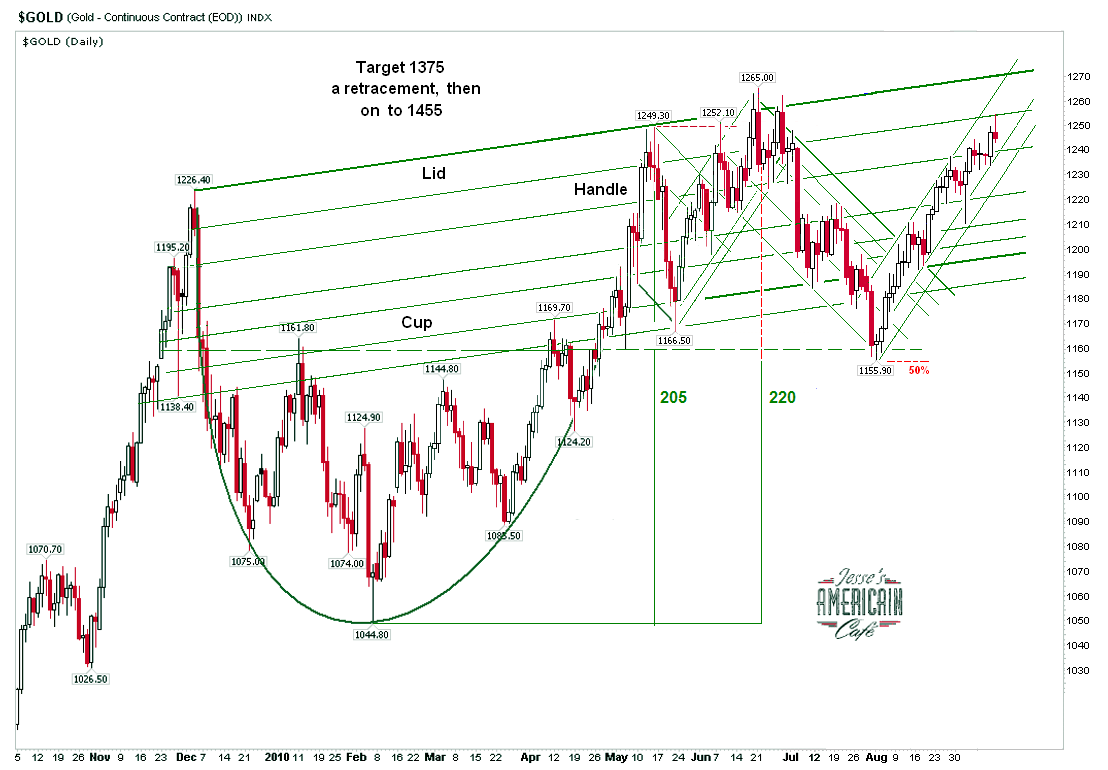
Silver Weekly
SP 500 and NDX September Futures
SP 500
The 50 day moving average is around 1081 and the 50 percent retracement for the entire decline is indicated on the chart.
Today's rally appears to be a technical relief rally, in which the market professionals and insiders use positional knowledge to squeeze the speculators who were holding to the short side. 
NDX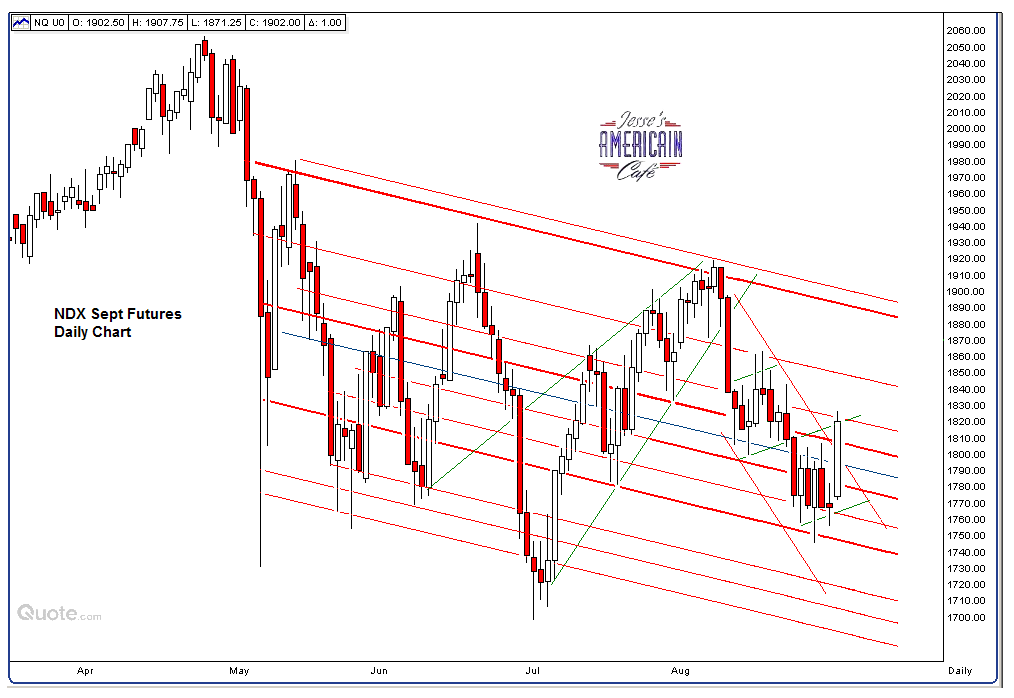
31 August 2010


Bye Bye Blythe: JPM Shutting Down Their Proprietary Commodity Trading Operation
 Breaking news from Bloomberg...
J. P. Morgan said today that they will be shutting down their proprietary commodity trading operations in reponse to the Volcker Rule in the Financial Reform legislation.
The JPM proprietary commodity trading group is headquartered in London with a few traders located in New York.
Within the past month trading head Blythe Masters had reassured her traders that things in the unit would continue on as they had been despite losses and layoffs.
Employees are being told that they may apply for other positions now.
Speculation is that this is also in response to position limits and other reforms in the Commodity Markets spearheaded by Commissioner Bart Chilton which will make it more difficult for large players to dominate the short term markets through sheer position size.
It is not clear if JPM will be exiting all markets at the same time including gold and silver in addition to other commodities.
We will look for clarification from their official statement which has not yet been issued.
According to a person who has been briefed, JPM will eventually be shutting down ALL proprietary trading in all markets in response to financial reform. This will include fixed income and equities which are much larger departments at the bank.
JPM recently suffered heavy losses in their proprietary commodity trading provoking a high level review by top executives.
JPM may continue to deal in these markets for commercial and private customers. They will cease trading for their own book.
It will be interesting to see what JPM does with RBS Sempra, a commodities company which they acquired earlier this year.
Bloomberg
JPMorgan Said to End Proprietary Trading to Meet Volcker Rule
By Dawn Kopecki and Chanyaporn Chanjaroen
Aug 31, 2010 4:45 PM ET
JPMorgan Chase & Co., the second- largest U.S. lender by assets, told traders who bet on commodities for the firm’s account that their unit will be closed as the company begins to shut down all of its proprietary trading, according to a person briefed on the matter.
The bank eventually will end all proprietary trading to comply with new U.S. curbs on investment banks, said the person, who asked not to be identified because JPMorgan’s decision isn’t public. The New York-based bank will shut proprietary trading in fixed-income and equities later, the person said.
Closing the proprietary trading desk for commodities affects fewer than 20 traders, including one in the U.S. and the rest in the U.K., the person said. The unit is based in London, and traders there were given notice on Aug. 27 that their jobs may be in jeopardy as required by U.K. law, according to the person.
Congress passed restrictions on financial firms this year designed to prevent a recurrence of the 2008 credit crisis, which almost caused the banking system to collapse. Proprietary trading involves transactions made on behalf of the bank rather than its customers. The curbs are known as the Volcker rule, named after former Federal Reserve Chairman Paul Volcker, who campaigned for limits on risk-taking by lenders.
JPMorgan’s “principal activities,” which include trading and private equity investing for its own book, generated about $2 billion in revenue in the second quarter, said Christopher Whalen, a Federal Reserve Bank of New York analyst in the 1980s and co-founder of Institutional Risk Analytics in Torrance, California. He said principal activities have generated as much as $10 billion on an annual basis in profits and losses in recent years.
Revenue Goes Away
The limits on proprietary trading contained in the Dodd- Frank Act that was signed into law in July by President Barack Obama will cost the company about 10 percent in quarterly revenue, Whalen said.
“This revenue and the risk it carries with it now goes away,” he said. “This will put more pressure on JPM to look for growth outside the U.S. market.”
JP Morgan traders will be given a chance to apply for jobs elsewhere in the company, according to the person. JPMorgan spokeswoman Kimberly Weinrick declined to comment.
Banks are exploring ways to comply with the new trading rules. Citigroup Inc. was looking at three options to meet the new rule, including moving a team of proprietary traders into its hedge-fund unit, people briefed on the matter said in July.
Traders in the Citi Principal Strategies unit, led by Sutesh Sharma, would be reassigned to Citi Capital Advisors, which mostly oversees money for outside investors, said the people, speaking anonymously because the talks were preliminary. The bank would set up the traders as hedge-fund managers and seed their funds, then raise money from outside investors to redeem its stakes, the people said.

30 August 2010


27 August 2010
SP 500 Sept. Futures; Gold and Silver Charts with a Forecast and a Comparisons


The Precious Metals Bull Market Compared to the Prior Bull Market
Projection of the Gold Price by Casey Research
H/T to King World News for the Chart
John Williams on the Revised GDP Number
John Williams' comments on the GDP number were short and to the point. I am still not on board with his hyperinflation forecast preferring to stick with a pernicious stagflation, although what he sees is certainly possible, as is a Japan style deflation. That is what 'fiat' is all about.
The correlation in stocks across the various indices today is remarkably uniform. Do you need to buy a vowel?
John Williams of ShadowStats
Economic Data Will Get Much Worse.
The kindest thing I can say about a stock market that rallies on the "stronger than expected" news that annualized growth in second-quarter GDP was revised from 2.4% to just 1.6%, instead of to the expected 1.4% (keep in mind those numbers are quarterly growth rates raised to the fourth power), or that gyrates over meaningless swings in seasonally-distorted weekly new unemployment claims, is that it is irrational, unstable and terribly dangerous.
As the renewed tumbling in the U.S. economy throws off statistics suggestive of a continuing collapse in business activity, as a looming contraction in third-quarter GDP becomes increasingly evident to all except Wall Street and Administration hypesters, who professionally never admit to such news, it would be quite surprising if the financial markets did not react violently, with a massive sell-off in the U.S. dollar contributing to and coincident with massive sell-declines in both the U.S. equity and credit markets.
Recognition is growing rapidly of the re-intensifying economic downturn. Yet, little analysis so far has been put forth to public as to some of the unfortunate systemic implications of this circumstance. The problems range from extreme growth in the federal government's operating deficit, tied to reduced tax revenues and to bailout expenditures for the unemployed, bankrupt states and continuing banking industry solvency issues, to U.S. Treasury funding needs to pay for same. The latter issue promises eventual heavy Federal Reserve monetization of Treasury debt, with resulting inflation problems and eventual hyperinflation (see the Hyperinflation Special Report).