Showing posts sorted by relevance for query merkel. Sort by date Show all posts

18 May 2010

Merkel to The Banks and Hedge Funds: Sprechen Sie Deutsche? Then Droppen Sie Dead


There is much surprise that the German government has declared a ban on naked short selling, including CDS, as of midnight tonight, with no prior notice and the courtly deference demanded by the Banks when government chooses to regulate them. This action seems to have perturbed some and confused many.

The reason for this may be quite simple.

After tonight, when hedge funds and The Banks call upon German financial firms and European governments to make payments on Credit Default Swaps or other financial instruments that are subject to the ban, the Germans will have a rather large hammer in hand to help them to negotiate the terms, and respond to any threats and coercion.

Since the CDS will be deemed to be no longer legal, at least in the quantity and leverage desired by those gaming the system, the opportunity to default on them with the backing of the government may be an option. This seems quite similar to the stance that the Chinese government took on behalf of some Chinese firms that were caught on the wrong side of energy derivatives.

I have heard from several sources that there was a general disappointment in Europe and in some parts of Asia at the lack of progress being made in the US Congress towards creating meaningful reforms in their financial system. In fact, there is a widespread belief that Washington is being dictated to by the Banks, and that their lobbyists are directing the conversation, and in many cases writing the actual legislation. The final straw was when the Obama Administration itself sought to water down and block key provisions of the legislation to limit the power and size of the Banks.

"To some degree this is a battle between the politicians and the markets," she said in a speech in Berlin. "But I am firmly resolved -- and I think all of my colleagues are too -- to win this battle....The fact that hedge funds are not regulated is a scandal," she said, adding that Britain had blocked previous efforts to do this. "However, this will certainly have taken place in Europe in three weeks," she said, without giving more details." Reuters 6 May 2010
"German Chancellor Angela Merkel accused the financial industry of playing dirty. 'First the banks failed, forcing states to carry out rescue operations. They plunged the global economy over the precipice and we had to launch recovery packages, which increased our debts, and now they are speculating against these debts. That is very treacherous,' she said. 'Governments must regain supremacy. It is a fight against the markets and I am determined to win this fight.'"UK Telegraph 6 May 2010
The financiers have been saying that 'Europe cannot print money faster than Goldman Sachs can create naked Credit Default Swaps.' Well, Goldman can still create those swaps, but they may have trouble finding counterparties for them in Europe. And those who buy them may do so at their peril, since Europe is obviously seeking to isolate itself from the consequences of speculative excess by an overleveraged financial system.

Merkel said she was going to reassert the primacy of government over the multinational speculators.

This is only the opening salvo. It will not be effective without further effort. And it is likely to draw the ire and criticism of the corporate media in NY and London, and the financiers' well-kept demimonde.
"Oh no, naked CDS are essential to price discovery. Naked shorting adds liquidity. The system will fall apart if you do not let the Banks have their way with the global economy. Oh my God, someone in government actually did something that was not vetted and pre-approved by the Wall Street Banks. They have actually outlawed naked shorting, which is tantamount to legalized counterfeiting. How dare that headstrong and impertinent frau Dr. Merkel attempt to protect her people from the gangs of New York!"
But one has to admit that the lady has style, and, unlike her American counterpart, is not afraid to occasionally take the wheel and drive, rather than sit in the back seat offering platitudes, and fine sounding words, and toothlessly petulant criticism.

Bloomberg
Germany to Ban Naked Short-Selling at Midnight

By Alan Crawford
May 18, 2010

May 18 (Bloomberg) -- Germany will temporarily ban naked short selling and naked credit-default swaps of euro-area government bonds at midnight after politicians blamed the practice for exacerbating the European debt crisis.

The ban will also apply to naked short selling in shares of 10 banks and insurers that will last until March 31, 2011, German financial regulator BaFin said today in an e-mailed statement. The step was needed because of “exceptional volatility” in euro-area bonds, the regulator said.

The move came as Chancellor Angela Merkel’s coalition seeks to build momentum on
financial-market regulation with lower- house lawmakers due to begin debating a bill tomorrow authorizing Germany’s contribution to a $1 trillion bailout plan to backstop the euro. U.S. stocks fell and the euro dropped to $1.2231, the lowest level since April 18, 2006, after the announcement.

“You cannot imagine what broke lose here after BaFin’s announcement,” Johan Kindermann, a capital markets lawyer at Simmons & Simmons in Frankfurt, said in an interview. “This will lead to an uproar in the markets tomorrow. Short-sellers will now, even tonight, try to close their positions at markets where they can still do so -- if they find any possibilities left at all now.”

Merkel, Sarkozy

Merkel and French President Nicolas Sarkozy have called for curbs on speculating with sovereign credit-default swaps. European Union Financial Services Commissioner Michel Barnier this week called for stricter disclosure requirements on the transactions.

Allianz SE, Deutsche Bank AG, Commerzbank AG, Deutsche Boerse AG, Deutsche Postbank AG, Muenchener Rueckversicherungs AG, Hannover Rueckversicherungs AG, Generali Deutschland Holding AG, MLP AG and Aareal Bank AG are covered by the short-selling ban.

“Massive” short-selling was leading to excessive price movements which “could endanger the stability of the entire financial system,” BaFin said in the statement.

The European Union last month proposed that the Financial Stability Board, the group set up by the Group of 20 nations to monitor global financial trends, should “closely examine the role” of CDS on sovereign bond spreads. Merkel said earlier today that she will press the Group of 20 to bring in a financial transactions tax.

Merkel’s ‘Battle’

In some ways, it’s a battle of the politicians against the markets” and “I’m
determined to win,” Merkel said May 6. “The speculators are our adversaries
.”

Germany, along with the U.S. and other EU nations, banned short selling of banks and insurance company shares at the height of the global financial crisis in 2008. The country still has rules requiring disclosure of net short positions of 0.2 percent or more of outstanding shares of 10 separate companies.

The disclosure of the rules drew criticism from lawyers who said that they should have been announced well ahead of time.

“The way it’s been announced is very irresponsible, and it’s sent many market participants into panic mode,” said Darren Fox, a regulator lawyer who advises hedge funds at Simmons & Simmons in London. “We thought regulators had learned their lessons from September 2008. Where is the market emergency that necessitates the introduction of an overnight ban?”

Short-selling is when hedge funds and other investors borrow shares they don’t own and sell them in the hope their price will go down. If it does, they buy back the shares at the lower price, return them to their owner and pocket the difference.

Credit-default swaps are derivatives that pay the buyer face value if a borrower -- a country or a company -- defaults. In exchange, the swap seller gets the underlying securities or the cash equivalent. Traders in naked credit-default swaps buy insurance on bonds they don’t own.

A basis point on a credit-default swap contract protecting $10 million of debt from default for five years is equivalent to $1,000 a year.


02 June 2009

German Chancellor Strenuously Objects to Central Bank Monetization


This is important in its own right, but even moreso because it suggests that some rumours that have been going around the trading desks over the past two weeks might be true.

We will keep you informed as things progress.


Financial Times
Merkel mauls central banks

By Bertrand Benoit in Berlin and Ralph Atkins in Frankfurt
June 2 2009 17:25

Unconventional monetary policies being pursued by the world’s main central banks could aggravate rather than ease the economic crisis, Angela Merkel, Germany’s chancellor, suggested on Tuesday.

Her surprisingly strong attack on the US Federal Reserve, the Bank of England and the European Central Bank was remarkable coming from a leader who had so far scrupulously adhered to her country’s tradition of never commenting on monetary policy.

What other central banks have been doing must be reversed. I am very sceptical about the extent of the Fed’s actions and the way the Bank of England has carved its own little line in Europe,” she told a conference in Berlin.

“Even the European Central Bank has somewhat bowed to international pressure with its purchase of covered bonds.”

She added: “We must return to independent and sensible monetary policies, otherwise we will be back to where we are now in 10 years’ time.”

Ms Merkel’s decision to ignore one of the cardinal rules of German politics – an unwritten ban on commenting on monetary policy out of respect for central bank independence – suggested Berlin is far more concerned about the ECB’s approach than has so far been apparent.

Meanwhile, Berlin is anxious that central banks will struggle to re-absorb the vast amount of liquidity they are pouring into the markets and fears the long-term inflationary potential of hyper-loose monetary policies.

The ECB’s efforts have been focused on pumping unlimited liquidity into the eurozone banking system for increasingly long periods. But last month, it followed the US Federal Reserve and Bank of England in announcing an an asset purchase programme to help a return to more normal market conditions.

The ECB announced it had agreed in principle to buy €60bn in “covered bonds”, which are issued by banks and backed by public-sector loans or mortgages. The purchases were only agreed after extensive discussions within the 22-strong ECB governing council. According to one version of May’s meeting, the council had discussed a €125bn asset purchase programme that would also have included other private sector assets, but only the purchase of covered bonds was agreed....


07 October 2008

Another G8 Moves to Deploy Troops Domestically


Hot on the heels of the domestic deployment of the US military for potential humanitarian purposes, Germany joins in with a move to change its constitution and deploy its military domestically 'just in case.'

Perhaps if they gave the military a more pleasing uniform for domestic deployment. An earth color would be good, a crowd-pleasing shade of brown.


Germany to allow domestic military deployment
By DAVID RISING
October 6, 2008

BERLIN (AP) — Germany's governing coalition partners want to change the constitution to allow for military deployment within the country if needed to combat terrorism, officials said Monday.

The proposal would allow use of the military only if police are overwhelmed and cannot properly respond to a situation themselves.

"It is not to be used generally, but only in very specific cases," Interior Ministry spokeswoman Daniela-Alexandra Pietsch said.

The center-left Social Democratic Party — which makes up half of Chancellor Angela Merkel's coalition — had been opposed to the proposal but agreed late Sunday after working out an agreement that includes strict guidelines for domestic deployment.

"We're talking only about emergency help," Social Democrat parliamentary leader Peter Struck said. For example, the navy could be called to help in a situation where police maritime patrols were not sufficient, he said.

The proposal will now go to Merkel's Cabinet and then to parliament for approval.

Given Germany's militaristic past, many are hesitant to expand the role of soldiers domestically. Currently, the German military can be deployed within the country only in times of war, or to help with emergencies or natural disasters.

Following the announcement of the new proposal, opposition Left Party lawmaker Petra Pau accused the government of seeking to violate a constitutionally dictated division "between army, police and secret services."

"The military has no role domestically for historic, political, legal and professional reasons," Pau said.

Germany used Tornado fighter jets to secure airspace during last year's Group of Eight summit, while troops helped provide support to police controlling demonstrations.

Merkel's government at the time defended the deployment as necessary to secure the area and provide technical and logistical support for police. But the opposition Greens party criticized it as "a creeping breach of the constitution."

19 May 2010

Bear Raid In Gold Results in an Historic One Day Liquidation: Höllenmädchen Merkel und die Straßenschreier


According to John Brimelow:

"Open interest plunged 21,256 lots, 66.11 tonnes or 3.53%, one of the largest changes in history..."
And this was before the latest round today after this early report.

Open Interest is the total number of contracts for a given future category. When the Open Interest declines on a marked price decrease this is generally considered the net liquidation of long positions. And conversely, on a rising price it is considered short covering. The weekly reports give more insight into who was doing the buying and selling. The report should be daily, and should include specific position changes for traders with aggregate positions higher than 5 percent of any total market for a specific product.

Next Tuesday is the option expiration for Calls and Puts on the Comex gold futures. There was a particularly large concentration of contracts at the 1200 level which we were watching from Monday when we promised you many market shenanigans in the coming option expiration, for both the mining stocks and precious metals.

We also picked up quite a bit more activity on the part of 'posting trolls,' who are traders both independent and with hedge funds who set the stage for major bear raids with sensationalistic statements and exaggerated 'headlines.'

The impunity with which this bear raid was conducted makes us wonder if the CFTC and SEC will ever do anything to clean up these markets. The best defense is not to rise to the bait, and trade in the short term in markets so obviously given to manipulation by large trading interests with fraudulent intents. These markets are tainted.

If the trend is broken it will be time to step aside. Until then we sell strength and buy weakness, slowly. For most it is better to take small incremental positions and then just let them ride the ups and downs.


As an aside, the hysteria, or Straßenschreier, with which the actions of Germany to curb naked short selling were greeted was very funny last night, and highly entertaining.

As you may not realize, naked short selling has been illegal in the US for some time, as least as far as equities are concerned. It was not enforced as the regulators turned a blind eye to many abuses that crept into the 'naturally efficient markets' on their watch. It is tantamount to counterfeiting, and in the hands of a party with pockets deep enough to permit it to dominate small markets, it is a blatant form of control fraud.

By the way, I hear that there has been almost no coverage of William K. Black's highly credible and shocking revelations on the public media in the States, outside of a piece on Bill Moyers' Journal. Can anything be so obvious as the control wielded by the corporatists?

But what is of concern to the Wall Street demimonde are their beloved CDS, which are as foul a form of white collar criminal abuse as ever has been seen since the creation of the Federal Reserve Bank. Any attempts to limit them will be resisted with threats, promises of dire outcomes and ruin, and buckets of money for politicians and regulators.

The rest of the world is beginning to act with revulsion at the destructive corruption of Washington and New York, and the American oligarchs.

Merkel made them squeal with her own version of shock and awe, and it was music to many ears. You go, Höllenmädchen.


Merkel und die Banken (Sarkozy ist Salieri)


25 August 2009

Next Head of the European Central Bank a Goldman Sachs Alumnus or Buba's Head Boy?


The German patience with the EU is admirable.

And in the States, the patience with the rule of Wall Street and the hagiographic praise of Chairman Ben is ... remarkable.

One might even be tempted to call him 'maestro,' at least until the next bubble collapses.

Central Banking Publications
Weber Aims High
25 August 2009

So far, the front runner to succeed Jean-Claude Trichet as head of the European Central Bank, when his term ends in 2011, has been Mario Draghi, the shrewd current governor of the Banca d'Italia and Goldman Sachs alumnus (don't all boo at once).

But insiders are keeping a close eye on Axel Weber, president of the Bundesbank. If Draghi were to fall under a bus on the Via Nazionale (easily done, by the way), or if he were to give in to the blandishments of those who are urging him to dive into the treacherous waters of Italian politics, then Weber is positioning himself as the clear fall-back choice.

This would not go down well at the Elysée, where the thought of a German running the ECB makes President Sarkozy see red. Yet why not? Isn't it their turn, at last?

The efforts of French diplomats, allied to their enviable higher education and elite training, have ensured that Frenchmen have sat at the top of many of the great official international institutions for far longer than Germans (or indeed Brits). A Frenchman has occupied the post of IMF managing director for a total of 34 years since the founding of the Fund 65 years ago, while a German has been in the job for only four years. A Frenchman has been president of the European Commission for 14 years, while no German has held the post since Walter Hallstein, who retired in 1967. No German has headed up the EBRD in London, while Frenchmen have run it for 15 years. No German has led the OECD, and so on.

It would be understandable if Germans felt it was time to have their own man at the ECB. After all, it is German public opinion that in the end is critical for the long-term success of the euro. If German taxpayers are called on to bailout backsliding countries unable to discipline their economies (like Italy), they would be much more likely to do so with good grace if their own man or woman was seen to be minding the shop. So anybody committed to the success of the euro should be rooting for a German candidate, n'est-ce pas?

Enter politics. To reach the top job at the ECB, Weber needs to be nominated by the chancellor. Angela Merkel is fully expected to win the general election next month, possibly with a greatly increased personal mandate.

Now, observe a curious fact. For an institution known in the past for lambasting governments' deficit spending, the Bundesbank has been remarkably quiescent recently. Its big guns have fallen silent. Indeed, Weber has praised German economic policy. In a recent interview with Die Zeit online, Weber noted that the GDP recovery in the second quarter owed much to the support measures deployed by the government, the support of the state banking sector and the ECB's monetary easing. Meanwhile, Merkel has roundly criticised other central banks, such as the Federal Reserve and the Bank of England, while supporting the Bundesbank. They are both singing from the same hymn sheet.

Meanwhile, Weber has been quietly appointing his own people to several key positions while some Bundesbank board directors of an independent cast of mind appear to be heading for the exit.

The odds are still on Draghi. He is what the Italians call "furbo" – variously translated as smart, cunning or foxy. The French will be cheering him on. But the Italian fox will be on the outlook for a German greyhound coming up on the inside lane.

27 July 2012

Gold Daily and Silver Weekly Charts - Capping Will Continue Until Confidence Improves


The equity market took off like a scalded cat this afternoon in the US as word went out that Mario Draghi was going to visit Germany and spread the gospel of saving Europe by printing money and rigging the markets.

Gold and silver rallied as one might expect, but they were stepped on repeatedly, keeping it to a modest eight dollar gain for gold and 25 cents for silver.

Let's see how real this latest twist may be. I don't think it is Bundesbank that Mr. Draghi must persuade so much as it is Frau Merkel, because it will be her very difficult task to persuade the German government to go along with whatever the banks may concoct.

A brief video of their planned victory tour across Europe is excerpted below.

Have a pleasant weekend. See you Sunday evening.

Non-Farm US payrolls number next week.


Mario Draghi, Christine Lagarde, und Angel Merkel mit das Europäische Zentralbank Orchester

und spielte die Band auf...


Original 1930 version Hallo Du süsse Frau with Lilian Harvey & Oskar Karlweis

09 May 2010

Feds Probing JP Morgan Silver Manipulation as Merkel Sounds Defiance to the Banks


"German Chancellor Angela Merkel accused the financial industry of playing dirty. 'First the banks failed, forcing states to carry out rescue operations. They plunged the global economy over the precipice and we had to launch recovery packages, which increased our debts, and now they are speculating against these debts. That is very treacherous,' she said. 'Governments must regain supremacy. It is a fight against the markets and I am determined to win this fight.'"

UK Telegraph

The story of this crisis is the people versus the Banks. The largest mistake that Europe made was in bailing out their biggest banks, and not simply nationalizing them. But that would not have resolved the problem of the gangs of the New York and London, and their partners in the hedge funds and the ratings agencies.

I do not wish to sound pessimistic, but it will be a surprise if the US under the Obama Administration does anything meaningful and significant to curb the abuses of the large Wall Street firms. While the corruption in the campaign financial process and the revolving door between government and the Street remains open the progress to reform will remain a diversion at best.

NY Post
Feds Probing JPMorgan trades in Silver Pit

By MICHAEL GRAY
May 9, 2010

Federal agents have launched parallel criminal and civil probes of JPMorgan Chase and its trading activity in the precious metals market, The Post has learned.

The probes are centering on whether or not JPMorgan, a top derivatives holder in precious metals, acted improperly to depress the price of silver, sources said.

The Commodities Futures Trade Commission is looking into civil charges, and the Department of Justice's Antitrust Division is handling the criminal probe, according to sources, who did not wish to be identified due to the sensitive nature of the information.

The probes are far-ranging, with federal officials looking into JPMorgan's precious metals trades on the London Bullion Market Association's (LBMA) exchange, which is a physical delivery market, and the New York Mercantile Exchange (Nymex) for future paper derivative trades.

JPMorgan increased its silver derivative holdings by $6.76 billion, or about 220 million ounces, during the last three months of 2009, according to the Office of Comptroller of the Currency.

Regulators are pulling trading tickets on JPMorgan's precious metals moves on all the exchanges as part of the probe, sources tell The Post.

JPMorgan has not been charged with any wrongdoing.

The DOJ and CFTC each declined to comment, as did JPMorgan.

The investigations stem from a story in The Post, which reported on a whistleblower questioning JPMorgan's involvement in suppressing the price of silver by "shorting" the precious metal around the release of news announcements that should have sent the price upwards.

It is alleged that in shorting silver, JPMorgan sells large blocks of silver option contracts or physical metal -- actions that would bring down the price of the metal -- closely following news that would otherwise move the metals higher.

Last week, The Post got a telling e-mail the Justice Dept. sent to a concerned investor. "Thank you for your e-mail regarding allegations that JPMorgan Chase, and perhaps other traders, are manipulating the silver futures market," the e-mail read.

Telling, indeed, as the concerned investor, in an e-mail to Justice's Anti-trust division, never mentioned any companies or traders.


23 June 2014

Germany's Gold: Auf Wiedersehen


"Finally he makes a decision, it is time to go, and he uses a gambling metaphor: he says 'Roll the dice', 'Alea jacta esto'. Once the dice start rolling they cannot be controlled, even though we do not know what it is as the dice roll and tumble.

Julius [Caesar] and his men swiftly cross the river [Rubicon] and they march double time toward Rome, where they almost beat the messengers sent to inform the Senate of their arrival.

Frances Titchener, To Rule Mankind and Make the World Obey

"Germany has decided its gold is safe in American hands."

That is one response, when you ask for the return of your gold, and your request is refused.

Just when you thought the spin could not become any more blatant or ridiculous.

Do you have any doubts?  It is not patriotic to have doubts.  You must do your duty, and believe.

This saga of Germany's national gold reserves being held by the Fed in New York is one of the most incredible stories in some time.   I believe it is related to what will become the scandal of the century.

Those reserves are largely gone, or encumbered with multiple claims, having been given to the Banks for their profit. 

How are a people fallen, and their spirit extinguished.
 
Addendum:  This appeared in the comments to this story as it ran in BusinessWeek:
From Peter_Boehringer

Just to set the record straight re this article in which my name is mentioned and in which I am quoted out of context:

a) BusinessWeek/Bloomberg uncritically cites statements of politicians and BuBa-bankers who have or give no proof whatsoever re the untouched whereabouts of the german Gold.

b) Re our campaign "Repatriate our Gold" www.gold-action.de/campaign.ht... : "On hold" does of course NOT mean that we are in any way satisfied with the current status of BuBa´s ongoing repatriation (far too slow and too little - only 5 tons came from NY in 2013! Not exactly a proof for the untouched existence of 1500 tons in a NY vault unaudited since 1950...). Our public campaign will therefore have to continue.

c) Almost no info in the article can be considered in any way "news". Simply because there has not been any material news in this context since early 2013.

d) Especially the headline is plainly false, because there has not been any change in BuBa´s (too slow) repatriation plans: at least 300+ tonnes will come from NY by end 2020. It is not much - but contrary to the headline, BuBa has NOT stopped the ongoing partial repatriation - enforced solely by public pressure!  (I would check your pressure readings mein herr.  Buba seems to be a bit less concerned than one might imagine.  Never underestimate the official indifference of a German bureaucrat to popular opinion.)

e) The political party "Alternative for Germany" has never been part of our campaign - they can therefore not have been "rebuffed" as the article suggests.

f) The political party "FDP" has (with the exception of one (1) MP ) never demanded a repatriation - yet another false info in the article.

g) Some politicians cited in the article can not in any way claim to be "in charge" of the german gold hoard (abroad or not). This holds true for both Mr Barthle and for Mr Hardt: BuBa alone is in charge - and officially, BuBa is independent from political influence... (But apparently not to 'public pressure' whatever that may be.)

Summary: a "non-news" article with a wrong headline, strange interviewees, old news, and with a clearly apologetic ideological approach: the main purpose seems to be NOT to give space to the myriad of unanswered and extremely relevant questions BuBa and the Fed have been refusing to answer for decades. Pls read more at "Repatriate our Gold" http://www.gold-action.de/camp...


German Gold Stays in New York in Rebuff to Euro Doubters
By Birgit Jennen
Jun 23, 2014

Germany has decided its gold is safe in American hands.

Surging mistrust of the euro during Europe’s debt crisis fed a campaign to bring Germany’s entire $141 billion gold reserve home from New York and London. Now, after politics shifted in Chancellor Angela Merkel’s coalition, the government has concluded that stashing half its bullion abroad is prudent after all.
The Americans are taking good care of our gold,” Norbert Barthle, the budget spokesman for Merkel’s Christian Democratic bloc in parliament, said in an interview. “Objectively, there’s absolutely no reason for mistrust.”

Ending talk of repatriating the world’s second-biggest gold reserves removes a potential irritant in U.S.-German relations. It’s also a rebuff to critics including the anti-euro Alternative for Germany party, which says all the gold should return to Frankfurt so it can’t be impounded to blackmail Germany into keeping the currency union together...

“The Bundesbank never doubted the integrity of the foreign gold-storage sites,” Carl-Ludwig Thiele, the bank’s council member for payments and settlements, said in an interview on May 23. “We were able to see everything we wanted to see in New York. As far as we’re concerned, there are no more open issues...”

Read the entire article here.

28 April 2012

Stiglitz - Politics Is At the Root of the Problem


Where Stiglitz refers to 'free markets' here, he means the 'efficient markets hypothesis.' That is, if markets are left entirely to their own devices they will manage themselves, honestly and efficiently.

Government and regulation are the problem, and they distort markets. Therefore if you 'free' markets from the influence of imperfect supervision, the natural efficiency of the market will prevail.

This model of the markets assumes that most market participants, people, are naturally good and almost perfectly rational, that information disperses equally among those participants, and that fraud becomes quickly known to all and is shunned, so that no participant will be encouraged to engage in it.

One of the things that will be reconsidered in the aftermath of this crisis, besides the perennial tendency of academic theories to act as handmaidens to thugs and gangsterism, is how to maintain a market based economy with effective regulation, so that when the unscrupulous come to tear down the protections erected by previous generations, to lure the foolish and gullible with their siren songs of progress and freedom, they might be seen for what they really are: the old familiar frauds come back to rob again.

I am a strong believer in a market based economy, where the rules encourage fairness and transparency, and decision making is broadly dispersed amongst a large number of well-informed participants.  Monopolies, corruption and fraud are inimical to such a system. 

An excess of planning and regulation, on the other hand, leads to a concentration of power in few hands, which is a form of monopoly or cartel which is the same abuse that occurs with too little transparency and regulation. 

It takes hard work and an alert public to maintain the balance of justice, and it is hardly natural.   For the affairs of all men do not naturally tend to virtue, alas, but from a minority of the lawless there is the tendency to selfish and short term thinking, and entropy from temptation, and the concentration of power in unworthy hands. 

Such is the tendency of the world as it is, not naturally good, but imperfect and fallen.  And this is not only the theme, but the force of history, the recorded actions of people,  the continuing struggle between moderation and excess, between good and evil.  Without it, history would be merely the progression of happiness and contentment, and that is not the condition of this world, but of the next.

Cross Posted from The European

"Politics Is at the Root of the Problem"
The European: Four years after the beginning of the financial crisis, are you encouraged by the ways in which economists have tried to make sense of it, and by the ways in which those insights have been taken up by policy makers?

Stiglitz: Let me break this down in a slightly different way. Academic economists played a big role in causing the crisis. Their models were overly simplified, distorted, and left out the most important aspects. Those faulty models then encouraged policy-makers to believe that the markets would solve all the problems. Before the crisis, if I had been a narrow-minded economist, I would have been very pleased to see that academics had a big impact on policy. But unfortunately that was bad for the world. After the crisis, you would have hoped that the academic profession had changed and that policy-making had changed with it and would become more skeptical and cautious. You would have expected that after all the wrong predictions of the past, politics would have demanded from academics a rethinking of their theories. I am broadly disappointed on all accounts.

The European: Economists have seen the flaws of their models but have not worked to discard or improve them?

Stiglitz: Within academia, those who believed in free markets before the crisis still do so today. A few people have shifted, and I want to give credit to them for saying: “We were wrong. We underestimated this or that aspect of our models.” But for the most part, the response was different. Believers in the free market have not revised their beliefs.

The European: So let’s take a longer view. Do you think that the crisis will have an effect on future generations of economists and policy-makers, for example by changing the way that economic basics are taught?

Stiglitz: I think that change is really occurring with the young people. My young students overwhelmingly don’t understand how people could have believed in the old models. That is good. But on the other hand, many of them say that if you want to be an economist, you still have to deal with all the old guys who believe in their wrong theories, who teach those theories, and expect you to believe in them as well. So they choose not to go into those branches of economics. But where I have been even more disappointed is American policy-making. Ben Bernanke gives a speech and says something like, there was nothing wrong with economic theory, the problems were a few details in implementation. In fact, there was a lot wrong with economic theory and with the basic policy framework that was derived from theory. If your mindset is that nothing was wrong, you will not demand new models. That’s a big disappointment.

The European: There seemed to have been quite a bit of disagreement among Obama’s economic advisers about the right course of action. And in Europe, fundamental economic principles like the absolute focus on GDP growth have finally come under attack.

Stiglitz: Some American policy-makers have recognized the danger of “too big to fail,” but they are a minority. In Europe, things are a bit better on the rhetorical side. Influential economists like Derek Turner and Mervyn King have recognized that something is wrong. The Vickers Commission has thoughtfully re-examined economic policy. We have nothing like that in the United States. In Germany and France, the financial transactions tax and limits to executive compensation are on the table. Sarkozy says that capitalism hasn’t worked, Merkel says that we were saved by the European social model – and they are both conservative politicians! The bankers still don’t understand this, which explains why we still see the head of the European Central Bank, Mario Draghi, arguing that we have to give up the welfare system at a time when Merkel says the exact opposite: That the social model kept us going when the central banks failed to do their regulatory job and used politics to change the nature of our societies.

The European: How have your own convictions been affected by the crisis?

Stiglitz: I don’t think that there has been a fundamental change in my thinking. The crisis has reinforced certain things I said before and shown me how important they are. In 2003, I wrote about the risk of interdependence, where the collapse of one bank can bring about the collapse of other banks and increase the fragility of the banking system. I thought it was important, but the idea wasn’t picked up at the time. The same year we looked at agency problems in finance. Now we recognize just how important those issues are. I argued that the real issue in monetary economics is about credit, not money supply. Now everybody recognizes that the collapse of the credit system brought down the banks. (I don't agree, the collapse of the credit system was a symptom not a cause.  It was the fraudulent paper, and the subsequent insolvency it promoted, that collapsed confidence which is the foundation of credit - Jesse)  So the crisis really validated and reinforced several strands of theory that I had explored before. One topic that I now consider much more important than I did previously is the question of adjustment and the role of exchange rate systems like the Euro in preventing economic adjustment. A related issues is the linkage between structural adjustment and macroeconomic activity. The events of the crisis have really induced me to think more about them.

The European: The financial transaction tax seems to have died a political death in Europe. Now, economic policy in Europe seems largely dominated by the logic of austerity, and by forcing other European countries to become more like Germany.


 Stiglitz: Austerity itself will almost surely be disastrous. It is leading to a double-dip recession that could be quite serious. It will probably make the Euro crisis worse. The short-term consequences are going to be very bad for Europe. But the broader issue is about the “German model.” There are many aspects to it – among them the social model – that allow Germany to weather a very big dip in GDP by offering high levels of social protection. The German model of vocational training is also very successful. But there are other characteristics that are not so good. Germany is an export economy, but that cannot be true for all countries. If some countries have export surpluses, they are forcing other countries to have export deficits. Germany has taken a policy that other countries cannot imitate and tried to apply it to Europe in a way that contributes to Europe’s problems. The fact that some aspects of the German model are good does not mean that all aspects can be applied across Europe.

The European: And it does not mean that economic growth satisfied the criteria of social fairness.

Stiglitz: Yes, so there is one other thing we have to take into account: What is happening to most citizens in a country? When you look at America, you have to concede that we have failed. Most Americans today are worse off than they were fifteen years ago. A full-time worker in the US is worse off today than he or she was 44 years ago. That is astounding – half a century of stagnation. The economic system is not delivering. It does not matter whether a few people at the top benefitted tremendously – when the majority of citizens are not better off, the economic system is not working. We also have to ask of the German system whether it has been delivering. I haven’t studied all the data, but my impression is no.

The European: What do you say to someone who argues thus: Demographic change and the end of the industrial age have made the welfare state financially unsustainable. We cannot expect to cut down on our debt without fundamentally reducing welfare costs in the long run.

Stiglitz: That is absurd. The question of social protection does not have to do with the structure of production. It has to do with social cohesion or solidarity. That is why I am also very critical of Draghi’s argument at the European Central Bank that social protection has to be undone. There are no grounds upon which to base that argument. The countries that are doing very well in Europe are the Scandinavian countries. Denmark is different from Sweden, Sweden is different from Norway – but they all have strong social protection and they are all growing. The argument that the response to the current crisis has to be a lessening of social protection is really an argument by the 1% to say: “We have to grab a bigger share of the pie.” But if the majority of people don’t benefit from the economic pie, the system is a failure. I don’t want to talk about GDP anymore, I want to talk about what is happening to most citizens.

The European: Has the political Left been able to articulate that criticism?

Stiglitz: Paul Krugman has been very strong on articulating criticism of the austerity arguments. The broader attack has been made, but I am not sure whether it has been fully heard. The critical question right now is how we grade economic systems. It hasn’t been fully articulated yet but I think we will win this one. Even the Right is beginning to agree that GDP is not a good measure of economic progress. The notion of the welfare of most citizens is almost a no-brainer.  (Median is the message. - Jesse)

The European: It seems to me that much of the discussion is still about statistical measurements – if we’re not measuring GDP, we’re measuring something else, like happiness or income differences. But is there an element to these discussions that cannot be put in numerical terms – something about the values we implicitly bake into our economic system?

Stiglitz: In the long run, we ought to have those ethical discussions. But I am beginning from a much narrower base. We know that income doesn’t reflect many things we care about. But even with an imperfect indicator such as income, we should care about what happens to most citizens. It’s nice that Bill Gates is doing well. But if all the money went to Bill Gates, the system could not be graded as successful.

The European: If the political Left hasn’t been able to fully articulate that idea, has civil society been able to fill the gap?

Stiglitz: Yes, the Occupy movement has been very successful in bringing those ideas to the forefront of political discussion. I wrote an article for Vanity Fair in 2011 – “Of the 1%, by the 1%, for the 1%” – that really resonated with a lot of people because it spoke to our worries. Protests like the ones at Occupy Wall Street are only successful when they pick up on these shared concerns. There was one newspaper article that described the rough police tactics in Oakland. They interviewed many people, including police officers, who said: “I agree with the protesters.” If you ask about the message, the overwhelming response has been supportive, and the big concern has been that the Occupy movement hasn’t been effective enough in getting that message across.

The European: How do we move from talking about economic inequality to tangible change? As you said earlier, the theoretical recognition of economic problems has often not been translated into policy.

Stiglitz: If my forecast about the consequences of austerity is correct, you will see a new round of protest movements. We had a crisis in 2008. We are now in the fifth year of crisis, and we haven’t solved it. There’s not even a light at the end of the tunnel. When we come to that conclusion, the discourse will change.

The European: The situation needs to be really bad before it will get better?

Stiglitz: Yes, I fear.

The European: You recently wrote about the “irreversible decay” of the American Midwest. Is this crisis a sign that the US has begun an irreversible economic decline, even while we still regard the country as a potent political player?

Stiglitz: We are facing a very difficult transition from manufacturing to a service economy. We have failed to manage that transition smoothly. If we don’t correct that mistake, we will pay a very high price. Already, the average American is suffering from the failed transition. My concern is that we have set in motion an adverse economics and an adverse politics. A lot of American inequality is caused by rent-seeking: Monopolies, military spending, procurement, extractive industries, drugs. We have some economic sectors that are very good, but we also have a lot of parasites. The hopeful view is that the economy can grow if we rid ourselves of the parasites and focus on the productive sectors. But in any disease there is always the risk that the parasites will devour the healthy body parts. The jury is still out on that.

The European: Have we at least understood the disease well enough to prescribe the correct therapy? Especially with regard to policy-making and the Euro crisis, there seems to be a lot of shooting into the dark.

Stiglitz: I think the problem is not a lack of understanding by dispassionate social scientists. We know the basic dilemma, and we know the effect of campaign contributions on policy-makers. So we are facing a vicious circle: Because money matters in politics, that leads to outcomes in which money matters in society, which increases the role of money in politics. You have more gerrymandering and more disillusionment with parliamentary politics.

The European: Has politics become too focused on outcomes, and is it not sensitive enough to the processes that lead to those outcomes? The bedrock of democracy seems to hinge on the avenues for participation, not on the effectiveness of particular policies.

Stiglitz: Let me put it this way: Some people criticize by saying that we have become too focused on inequality and are not concerned enough about opportunity. But in the United States, we are also the country with the biggest inequality of opportunity. Most Americans understand that fraud political processes play in fraud outcomes. But we don’t know how to break into that system. Our Supreme Court was appointed by moneyed interests and – not surprisingly – concluded that moneyed interests had unrestricted influence on politics. In the short run, we are exacerbating the influence of money, with negative consequences for the economy and for society.

The European: Where is change rooted? In parliament? In academia? In the streets?

Stiglitz: You look in the streets and a little bit in academia as well. When I say that the major thrust of the economics profession has disappointed me, I need to qualify that statement. There have been groups that push new economic thinking and challenge the old models.

The European: You have written that the challenge is to respond to bad ideas not with rejection but with better ideas. Where is the longest and strongest lever to bring new economic thinking into the realm of policy?

Stiglitz: The diagnosis is that politics is at the root of the problem: That is where the rules of the game are made, that is where we decide on policies that favor the rich and that have allowed the financial sector to amass vast economic and political power. The first step has to be political reform: Change campaign finance laws. Make it easier for people to vote – in Australia, they even have compulsory voting. Address the problem of gerrymandering. Gerrymandering makes it so that your vote doesn’t count. If it does not count, you are leaving it to moneyed interests to push their own agenda. Change the filibuster, which turned from a barely used congressional tactic into a regular feature of politics. It disempowers Americans. Even if you have a majority vote, you cannot win.

The European: We’re looking at six months of presidential campaigning. The role of money has been embraced by both parties. Campaign finance reform seems rather unlikely.

Stiglitz: Even the Republicans have become more aware of the power of money by seeing how it influenced and distorted the primaries. The outcomes are not what the Republican party establishment had hoped for. The disaster is becoming clear – but that will not lead to immediate remedies. Those who become elected depend on that money. It will require a strong third party or civil society to do something about this.

05 July 2015

όχι - Greeks Overwhelmingly Vote 'No' to Austerity and Eurocracy - SP Futures Open Down 29 Points


"This struggle may be a moral one, or it may be a physical one, and it may be both moral and physical, but it must be a struggle. Power concedes nothing without demand. It never did and it never will. Find out just what people will submit to, and you have found out the exact amount of injustice and wrong which will be imposed upon them; and these will continue until they are resisted with either words or blows or both. The limits of tyrants are prescribed by the endurance of those whom they oppress."

Frederick Douglass

They tried to make a desert, and call it Greece.

Apparently Syriza has united the Greek people, and confounded all those who continually predicted their capitulation.

Now the real struggle for a workable solution must begin. 

To that end, Merkel and the Eurocrats have called a summit for Tuesday to discuss the situation.

Otherwise, the charade will continue, until exhaustion or reform.  The reform will not be initiated internally by the system.  It will take more acts of courageous protest and political action.

Live updates at The Guardian here.


Greeks defy Europe with overwhelming referendum 'No'
By Karolina Tagaris and Lefteris Papadimas

ATHENS (Reuters) - Greeks voted overwhelmingly on Sunday to reject terms of a bailout, risking financial ruin in a show of defiance that could splinter Europe.

With nearly half of the votes counted, official figures showed 61 percent of Greeks rejecting the bailout offer. An official interior ministry projection confirmed the figure as close to the expected final tally.

The astonishingly strong victory by the 'No' camp overturned opinion polls that had predicted an outcome too close to call. It leaves Greece in uncharted waters: risking financial and political isolation within the euro zone and a banking collapse if creditors refuse further aid...


BBC
Greece debt crisis: Greek voters reject bailout offer

With two-thirds of ballots counted, results from the Greek referendum show voters decisively rejecting the terms of an international bailout.

Figures published by the interior ministry showed 61% of those whose ballots had been counted voting "No", against 39% voting "Yes".

Greece's governing Syriza party campaigned for a "No", saying the bailout terms were humiliating.

The "Yes" campaign warned this could see Greece ejected from the eurozone.

Some European officials had also said that a "No" would be seen as an outright rejection of talks with creditors.

But Greek government officials have insisted that a "No" vote would strengthen their hand and that they could rapidly strike a deal for fresh funding in resumed negotiations.

Greek banks will reopen by Tuesday, they say.

 
"The German mind has a talent for making no mistakes, but the very greatest."

Clifton Fadiman


29 June 2015

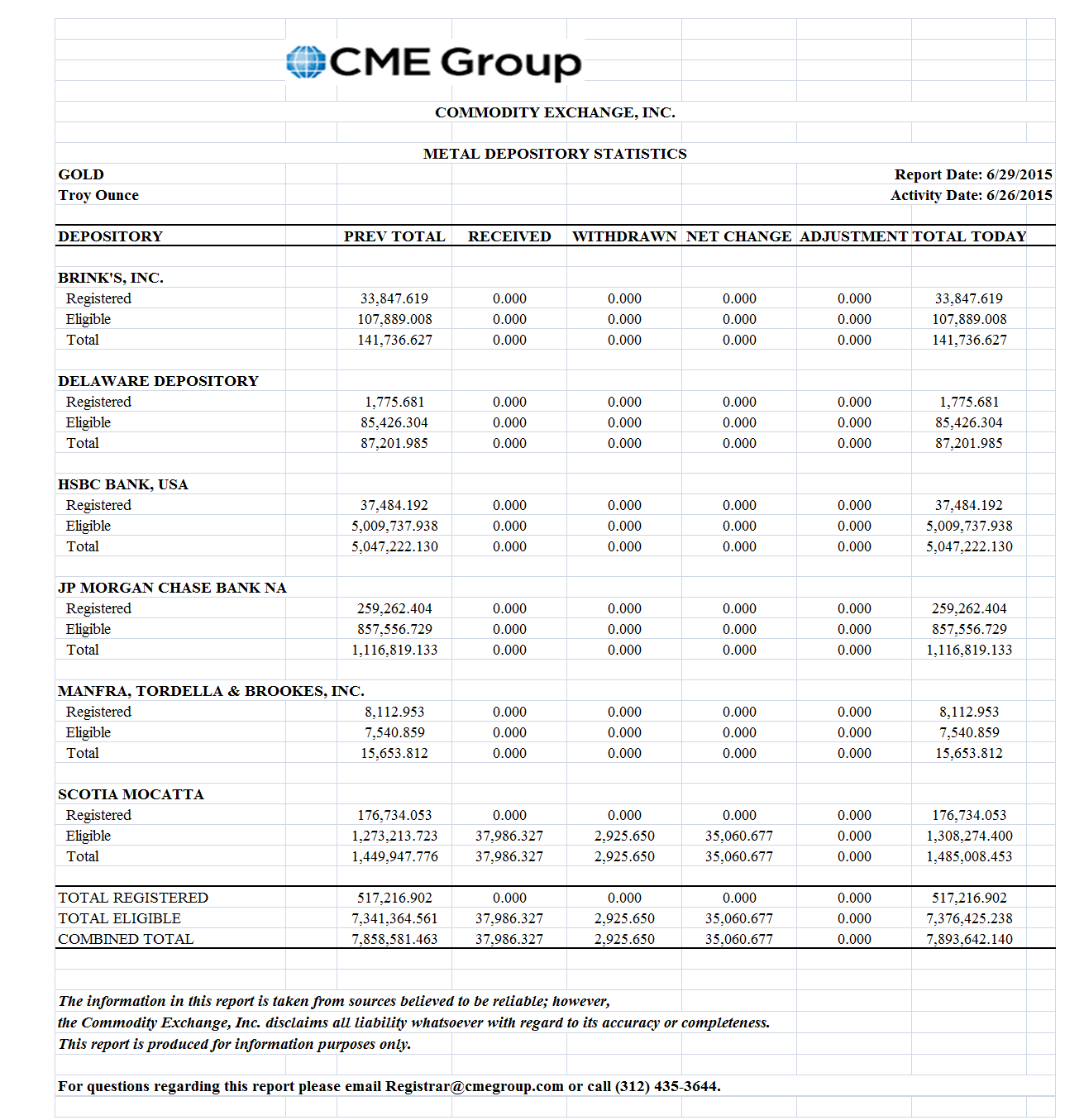
Gold Daily and Silver Weekly Charts - Capped - The Fog of Currency War


The Lord is my light and my salvation;
          whom shall I fear?
The Lord is the center and refuge of my life;
           of whom shall I be afraid?

Psalm 27:1

With the VIX soaring and the US equity markets seeing their first 2% correction in many moons, the capping on the precious metals was determined and obvious.

So much for 'Greek capitulation.'

I think Syriza realized they were being presented an untenable solution, the 'generous offer' of extend and pretend by Merkel and the Eurocrats, with the IMF playing heavy.

This bailing out of private creditors while extracting a pound of flesh from the Greek people, facilitated by corporate friendly governments, was exactly how Greece came into this situation in the first place.

I thought fomenting a bank closure on Greece by the EU was a bit tough, and probably senseless. Showing them the lash to get them to fall to heel and all that.

Most economic commentators in the US are completely clueless about money these days, and global economics as well.

More surprises will therefore be coming I am sure.

Have a pleasant evening.


25 April 2016

The Arsenal of Hypocrisy


"The enormous gap between what US leaders do in the world and what Americans think their leaders are doing is one of the great propaganda accomplishments of the dominant political mythology."

Michael Parenti

America and Her Allies in the News by C. K. Michaelson of Some Assembly Required

On the world stage full of purported leaders who are dangerous fools, Turkey's Recep Tayyip Erdoğan has a special place. He charged the EU several billion dollars to let the EU force hundreds of thousands of terrified refugees into concentration camps in Anatolia, then upped the ante and said there would be no deal unless Turks were allowed visa-free travel throughout the EU. He also wants journalists who “disrespect him” jailed, and comedians who make fun of him extradited to Ankara for appropriate punishment - a condition that Angela Merkel found reasonable. Meanwhile his troops are gunning down women and children (suspected of being Kurds) fleeing Syria as Erdoğan pursues his genocidal war against the Kurds while trying to pretend that the slaughter of half a million or more Armenians a hundred years ago never happened. All with US President Obama – who has committed a few war crimes himself – pretends that the Armenians committed suicide...

Amusingly, the US now claims that it had understated the number of collaterally damaged dead civilians in US air strikes in Iraq and Syria, and that there had actually been 42. This does not, obviously, include the hundreds of thousands of dead and wounded civilians previously collaterally inflicted on Iraq, Afghanistan, Pakistan, Libya...

The circus over the – gasp! - Saudi involvement in, planning of and financing of both Ossma Ben Laden and the 9/11 attackers is hard to understand. (That some of the 9/11 hijackers lived with an FBI informant prior to the attack is not being much mentioned.) It has been obvious to all since the day of the attacks the the Saudis were deeply involved. That's what is in the 28 pages totally removed from the 9/11 report. Ask any of the members of the commission who produced it. On top of that there is not the “Document 17” which includes documentary evidence of the direct invoolvement of the Saudi Embassy in Washington DC in the tragedy. And Seymour Hersh's report that the Saudi government paid Pakistan hundreds of millions of dollars to hide Ben Laden seems to be another solid piece of reporting that will be ignored.
Why does the US continue to submit meekly to the Saudis? It is not the oil – we seem to have plenty. It is not their usefulness as an ally, they are scorpions in the bed. What to the Saudis have? Money. And a lot of blackmail material in the form of past dirty deeds and in the form of $800 billion in treasury notes that they use to threaten Obama.


10 October 2011

Gold Daily and Silver Weekly Charts - La Douleur du Monde - Dec Gold Futures


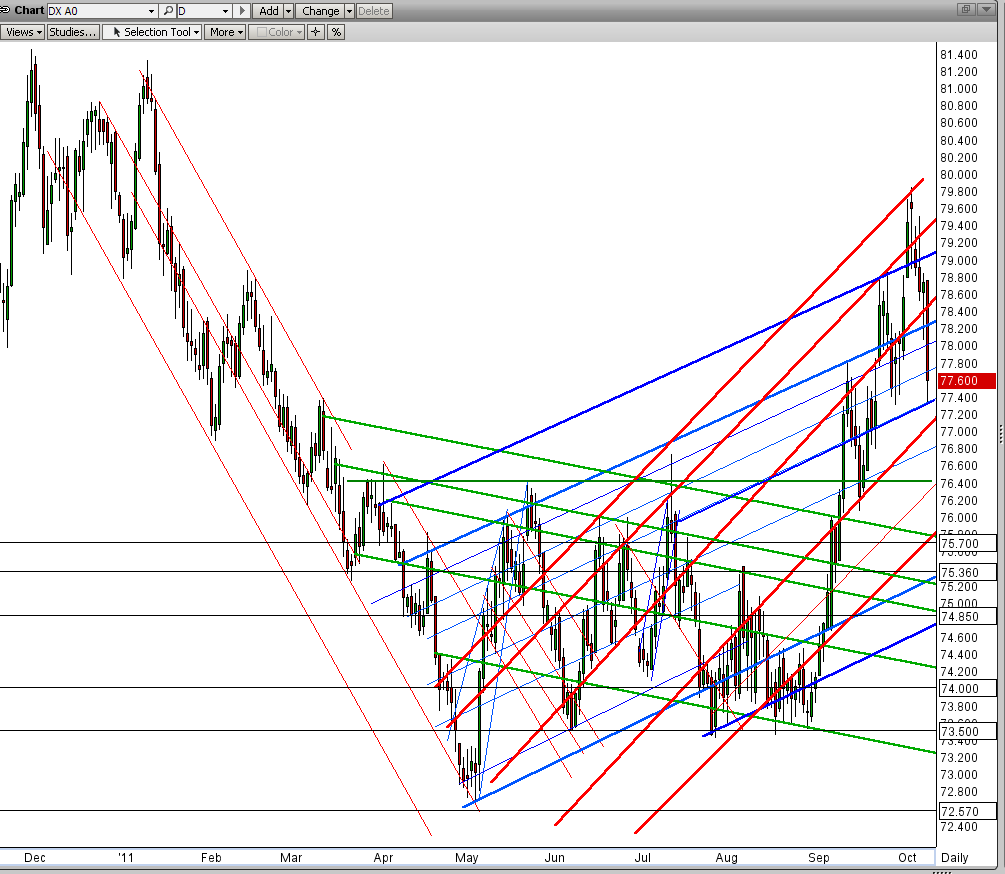
Silver and especially gold had nice rallies today as it was 'risk on' with Sarkozy and Merkel crooning a lullaby to the equity markets. The dollar retreated sharply from its zenith. It has not yet broken uptrend.

I wonder if the metals liquidation is over, and if the hands that remain are strong and relatively unleveraged. We will not know until the stock market corrects again and we see if the metals follow.

Earnings season is coming up for stocks. I am not impressed with the stock rally today and put a small short position back on since we have reached my 'bounce' targets. Now we see if we rally on or not.

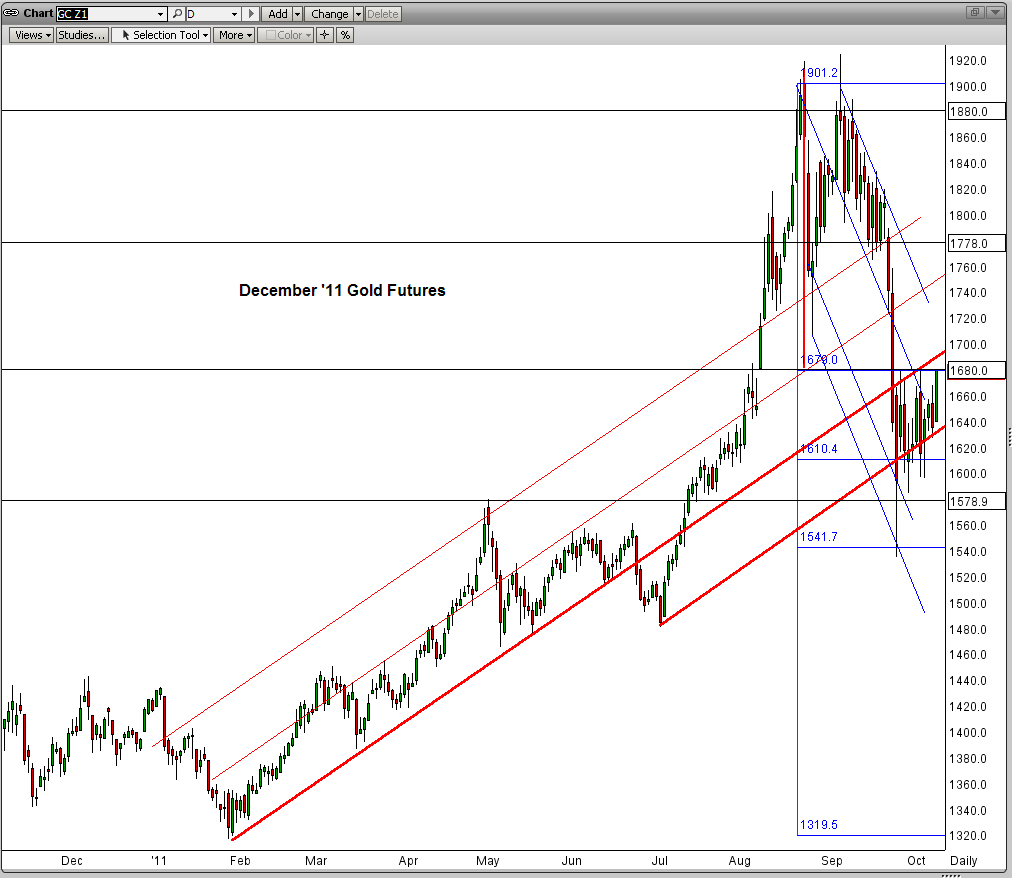
I am long gold bullion. We have not yet broken out and may be coming to a similar situation that we have had a bounce, but it must move higher than 1680 and 1700 and stick a couple days close to say the trend is higher again in the short term.

So I have a little hedge back on. If the metals break out and stocks keep rallying then the miners look a little more interesting.

I have included the December Gold futures chart to make some of the levels of resistance and their meaning easier to see.


20 July 2016

SP 500 and NDX Futures Daily Charts - Bubble Up to the Bar


Stocks were in rally mode today, as it was risk on all the way.

The markets were cheered by Microsoft's results last night, and the love in between May and Merkel that is dispelling the Brexit fears.

After the bell today, Intel beat the numbers. However the markets were not impressed, as the numbers that INTC beat were recently lowered this week. It would have missed the numbers in place last Friday. Picky, picky.

Qualcomm and eBay were rallying after hours on their adjusted results.

Financial assets are in a bubble again, compliments of the Fed. It's what they do.

Too bad it does nothing positive for the real economy.

Have a pleasant evening.


16 September 2016

Gold Daily and Silver Weekly Charts - FOMC Next Week - Little Finger and Cersei


Gold and silver gave up a little today, which was not as much as one might have expected from the little rally up in the US douleur du monde.

Gold in particular has an interesting formation in the making, and as can be seen on its chart, is approaching an area of key support.

Next week could be 'interesting.'

I won't assign odds to what the Fed might do next week. There are obviously two factions on the board, the hawks and the doves. Yellen is the dove-in-chief, with Fischer presumably the hawks'.

The warehouses and clearing were relatively quiet for the precious metals.

The currency war continues. That rather impressive fine levied on Deutsche Bank by the DoJ was clearly a shot in the war of some sort. Perhaps Frau Merkel is not toeing the line sufficiently.

The US election is an interesting one, with both candidates having very high unfavorable ratings. This is sure to be a divided, contentious four years ahead no matter who wins.

One twist, which may not seem likely now, is that for some reason the lady Hillary would have to drop out, presumably for health reasons. The Democrats would have to show their true colors then.

As for the Republicans, they are stilll the loyal servants of the corporate moneyed interests as they have long been, only for a different faction of the one percent compared to the Wall Street Democrats.  In corrupting the DNC, the Clintons did a great damage to the political balance of the country and government by the lesser of two evils.

These two candidates remind might remind one more of Lord and Lady Macbeth, rather than the standard bearers of ideological contrasts.  Or in keeping with the current tastes in literature, like Little Finger and Cersei.    All the people seem to need to decide is a lot of name-calling and a good show, and the caricature of their humanity to beat upon.

We have only just begun to sit down and eat at that banquet of consequences.

The weather is taking on a definite flavor of Autumn, and at night it is even a bit chilly.  There are plenty of leaves already on the ground, not from the changing of the weather, but from the almost unbearable heat and lack of rain we have had over the past few weeks.

Well, it will be raining here on Sunday.  And it will be welcome.  All good things come to those who wait.

Winter is coming.

Have a pleasant weekend.


06 August 2012

Currency Wars: Move to Make Treasury's Geithner a Permanent Member of US National Security Council


"To put it crudely, the US wants to inflate the rest of the world, while the latter is trying to deflate the US. The US must win, since it has infinite ammunition: there is no limit to the dollars the Federal Reserve can create.

What needs to be discussed is the terms of the world’s surrender: the needed changes in nominal exchange rates and domestic policies around the world."

Martin Wolf, Financial Times, 12 Oct 2010


"...the Treasury secretary, who has primary authority on economic and financial issues in the cabinet, should be at every meeting to advise on how economic and security issues intersect, and to ensure that the United States is using its economic and financial strength in the most effective way."

Robert Kimmitt, NY Times, 23 July 2012

Looks like the US is getting ready to flex its financial muscle.  I don't think the Anglo-American banking cartel will relinquish the dollar reserve currency supremacy easily.  This is currency war.

I somehow missed this editorial when it first came out. But over the weekend and today I heard echoes of the same sentiment from various places in what looks like a loosely organized public relations campaign.

The National Security Council, formed in 1947 and comprised of the President, Vice-President, Secretary of State, Secretary of Defense, Director of the CIA, and the Joint Chiefs of Staff.

The National Security Council has an unmistakable military flavor.

The move to add the Treasury Secretary as a permanent member is just another sign of the currency wars heating up. At least from the US perspective, there is an unmistakable convergence between military and economic action.

As I have noted before, the language used often suggests that the US considers its TBTF's to be a modern form of financial battleship, able to move key markets at will to support official policy. And the credit rating agencies are like agile destroyers.

I think this will become very interesting.

NY Times
Give Treasury Its Proper Role on the National Security Council
By Robert M. Kimmitt
July 23, 2012

THE National Security Act of 1947, which created the National Security Council, the Defense Department, the Joint Chiefs of Staff and the Central Intelligence Agency, turns 65 on Thursday. But it’s not ready for retirement; it needs, instead, to be rejuvenated by making the Treasury secretary a statutory member of the National Security Council, rather than an invited attendee.

The act and the organizations it created performed well during the cold war, the post-cold-war decade and the period after 9/11. But they need to be updated to recognize the close connection between security and economic issues as we look forward from the global financial crisis of the last few years. The concept of national security has broadened considerably since the N.S.C.’s early decades, elevating economic and financial issues to crucial elements to our nation’s security, alongside the traditional diplomatic and military issues. Diplomatic and military issues are still important, of course. Iran, Syria and North Korea make that clear. But the growth areas in national security policy are economic and financial.

During the cold war, the German chancellor, Helmut Kohl, knew with precision the throw-weights of American nuclear weapons based in Germany; today, Chancellor Angela Merkel has to know with equal precision the spreads on Spanish and Italian sovereign debt.

It may seem odd that the Treasury secretary would have been left off the list of statutory members of the National Security Council by the generation of American leaders who helped lay the groundwork for Western Europe’s postwar revival with the Bretton Woods conference and the Marshall Plan. But at the time, military, diplomatic and economic policies were seen as largely separate tracks. And as the cold war deepened, the military challenge from the Soviet Union assumed overwhelming importance.

This is where the National Security Act has not kept pace. The statutory members of the National Security Council are still the president, vice president, secretary of state and secretary of defense, with the chairman of the Joint Chiefs of Staff and the director of national intelligence as statutory advisers. This is a good, but incomplete, team. Even though the Obama White House says that Treasury Secretary Timothy F. Geithner is a regular attendee, along with the statutory members, it is now time to add the secretary of the Treasury to the list of statutory members. That would ensure that the economic and financial dimensions of national security challenges are given equal weight in council deliberations, now and into the future...

There are, of course, other officials integral to international economic and financial success, like the secretary of commerce and the United States trade representative. They should still be invited to N.S.C. meetings. But the Treasury secretary, who has primary authority on economic and financial issues in the cabinet, should be at every meeting to advise on how economic and security issues intersect, and to ensure that the United States is using its economic and financial strength in the most effective way.

Read the entire editorial here.