skip to main |
skip to sidebar
As the old WW I ballad said, "I don't know where we're going, but we're on our way."
"Goodbye everybody I'm off to fight the foe
Uncle Sammy is calling me so I must go
Gee I'm feeling fine don't you wish that you were me?
For I'm sailing tomorrow over the deep blue sea.
And I don't know where I'm going but I'm on my way
For I belong to the regulars I'm proud to say
And I'll do my duty night or day
I don't know where I'm going but I'm on my way."
Boehner Pulls Out of Debt Talks - Economist's View
Although a complete failure is not likely, the drama queens, carnies, and thespians in Washington may take the budget deficit talks down to the wire to deeply impress the yokels and the locals of the seriousness of the situation, and be duly grateful that it is in the hands of major players.
Have you noticed a tendency amongst the pigmen to threaten dire consequences and annihilation whenever they are running a bluff and wish to get their way? These financial fellows and their minions have issued more threats and ultimatums in the last few years than al Qaeda.
While they are dancing on the edge of a precipice, it is possible that they could slip and fall. However, since no one in their right mind really wishes to see a default, except perhaps for a few delusional political opportunists and talk show Bonapartes, perhaps cooler heads will prevail. There are however, the ever present carrion feeders and sociopaths from Wall Street, who would benefit from any economic crisis, and would do so gladly no matter the pain endured by others.
Beside political campaign reform, it appears as though Washington is badly in need of adult supervision.
Have a pleasant weekend.
Markets were shocked when CAT came in light on earnings this morning despite posting a healthy 37 percent increase in revenue. The profit shortfall was attributed to "inflation in raw materials and labor." Of course there was no inflation in that revenue right? I wonder if they are having trouble hedging their forex exposure again.
Markets are coiling for moves which may be large based on the resolution of the US budget impasse, one way or the other.
I think it is theater, but it is not impossible that the players might accidentally stumble over a cliff. More likely the can will be kicked down road-wise, and both sides will claim victory, although the Dems will eat crow served up by that rascally Uncle Obama. How come he never betrays the money men? Oh, dumb question, never mind.
However, out of all this, I think a credible challenge to Obama is shaping up for the elections next year, and not from the extruded corporate man, Mitt Romney, or the banjo-playing daisy mae's Palin and Bachmann.
The fat cats were begging Chris Christie to run, but he knows he is over his head as it is and the skeletons in his closet might not survive national exposure. There is Perry of course, but that strawman needs a brain like Karl Rove to pull it off.
The O-Man talks a great game, and he might pull it off again, but this time he is burdened with a track record that does not match his words.
No I think we will see a dark horse candidate, maybe a third party or even a Democrat primary challenge, take Obama on. And he has no one to blame but himself. He will most likely cry all the way to the bank, following young Timmy to Wall Street in some capacity. I think he has blown his chance to be the greeter at Wynn's Las Vegas.
This interview was done in 1994, when Bill Clinton was promoting free trade and multinationalism, but had not yet made a deal with China to allow them to devalue their currency and then receive favored nation status.
You can decide for yourself, with the benefit of retrospect, the value of the arguments presented.
"Free trade" as defined by neo-liberal policies is a leveling tool that creates a few big winners and many more big losers, and reduces the middle class to the lowest common denominator of indentured servitude.
The goal of multinationalism is to destroy local government, choice, and sovereignty, through financial and military means. The will to power cuts across diverse forms of government, because of its attitude of the power of the few and the worth of the many. It defines what is 'human' to suit its needs of the moment.
The primary problem with unregulated trade, not considered within the context of overall social and public policy, is that it becomes a natural weapon for oligarchies and multinationals to use against local and regional government and public policy decisions, taxation, environmental laws, human rights. It is a major stepping stone to world government. There is a recurring movement among the powerful to bring the world under their control. It is the natural extension of their greed for power. There is never 'enough.' Sociopathic greed is a disease, and it sows the seeds of its own destruction. Always.
And this is why idealistic models of unregulated free market economics fall apart in practice, always.
Trade *could* be used to uplift the developing world, if it was accompanied by local reforms and progressive public policy, but in practice is most often used to create a huge social divide in the developed countries, and promote a return to a feudalistic political structure. Rather than uplift, it reduces the world to the least common denominator of quality of life and freedom.
One of the most significant problems is mercantilism, employed by oligarchic countries and multinational corporations, within the context of a fiat currency system wherein they are relatively free to short circuit all the market mechanisms that would prevent a few countries from creating enormous trade imbalances in a partnership with powerful elites and the privileged around the world.
Macro-economics has never been a pure science, but is often represented as such by those who are promoting theories that are purely political, cloaking them in false objectivity. Macro-economics is a social science, more like sociology than physics. In reality it is a subset of public policy discussions, highly slanted to ends and assumptions, attitudes and points of view about what is 'good' and valuable rather than what is a hard and replicable principles of nature, objectively true based on some endurable physical law.
So for example, if someone were to come out and say, "I think we should adopt the social structure of a nation and form of government your father spent much of their lives fighting and dying, where you give up most of your wealth and freedom to serve the powerful few who run the state," there would be a general uprising. But if the proposition is structured as the logical consequence of 'hard economic choices,' and a serious of crises, people can be led off the cliff, a few steps at a time.
"The liberties of our country, the freedoms of our civil Constitution are worth defending at all hazards; it is our duty to defend them against all attacks. We have received them as a fair inheritance from our worthy ancestors. They purchased them for us with toil and danger and expense of treasure and blood. It will bring a mark of everlasting infamy on the present generation – enlightened as it is – if we should suffer them to be wrested from us by violence without a struggle, or to be cheated out of them by the artifices of designing men."
Samuel Adams
If this trend continues, I would imagine the next step is civil unrest, and political crises that will be used to tighten the control over the public in the 'free countries,' and repress them for their own safety. We are seeing this now in the Anglo-American client states and unpopular dictatorships overseas.
Most men are easily fooled, entrapped by their emotions, easily herded by clever arguments and the dialectic of false enemies. It is only when they step back, and look at what is happening, who benefits and who is above the law, that they begin to realize the truth. But they will not do this for quite some time, because to do so is to admit that they have been fools.
How sad that the heirs to the 'greatest generation,' almost surely the most privileged generation in history, have in their excess become selfish, petty, and cruel.
The corollary of a few "Too Big To Fail" is that there are many individuals and small businesses who become "Too Small To Care" and then "Too Weak To Survive."
And so the weak and the undesirable are eliminated, first slowly and then with growing efficiency, for the good of the chosen few, the ubermensch, however a society chooses to define it.
Does this sound *conspiratorial* and outlandish? Check back in another ten years, and let me know how you and your children are doing. There was a budget surplus in the 1990's. And now the nation is throwing the middle class and the weak under the bus for the sake of the financial sector and the wealthy.
Once a single global currency is achieved, it is the end game for freedom for all but a few. Those who imagine that they are part of the few are all for this, although they are sadly mistaken. The few view them as useful idiots, disposable, and prey.
What the few themselves may not yet realize is that tyrants and empires tend, almost inevitably, to fall in disgrace, blinded and betrayed by the will to power, overcome by the love of freedom and the tide of history. So there is hope. But sometimes hope can become a distant memory, and freedom regained only by significant pain and loss of life, once you have released it from your grasp.
"When I despair, I remember that all through history the ways of truth and love have always won. There have been tyrants, and murderers, and for a time they can seem invincible, but in the end they always fall. Think of it--always.
Mohandas K. Gandhi
Risk on, and there was consolidation in gold and silver, while the US dollar slumped against the euro.
Markets soared today as it was risk on, with hopes buoyed by the 'European Deal' and 'better than expected' results from Leading Indicators and the Philly Fed.
There was a rumour of a US budget deal that was released intraday, but it was quickly denied by the White House.
Forecast: cloudy with a chance of fraud, high heat, and isolated disasters.
Surmise on my part, based on the facts at hand, but Mr. Sprott seems to have an interesting problem with his Physical Silver Trust. And that problem is indicative of a physical bullion market that is riddled with leverage and irredeemable paper, reminiscent of the Collateralized Debt Obligation and Credit Default Swaps markets, before their virtual default and meltdown.
Cash levels in his fund are rather low, down to about 2 million US dollars or so, which is not much cash on hand for a decent sized fund with a market cap of slightly over one billion US dollars. As a note, I have to extrapolate the cash on hand since PSLV does not release this figure, but they do put out the figures surrounding it. It could be as high as 4 million, which is still rather slim, and a testimony perhaps to their belief in the silver bull and low operating expenses.
But the question remains, with a premium to NAV of over 19%, and with strong demand in silver and their units, how do they respond to this need for additional cash reserves and units?
The answer of course is a follow-on, a secondary offering, acquiring more silver and adding more units, and selling them into the public demand.
Now that they have digested their follow on gold offering of several hundreds of millions of dollars, perhaps they can turn to the silver market again.
But here is the catch. Funds like Sprott don't do paper, to the extent that a listed company's equity might do. They just print more shares.
Even supposed bullion offerings like SLV and GLD do paper chases almost every week. They do swaps for for virtual metal, for example, throwing IOUs on the pile that may or may not be good in a demand crunch for bullion, because they are tracking ETFs, and not closed end funds. They have to manage inventory to the fluctuations in almost real time.
What you see with PSLV and PHYS, and funds like them, is presumably what you get, and in these days of what appears to be a shell game in the silver market, that type of product commands a substantial premium if one has some chance of taking possession in something approaching a reasonable manner.
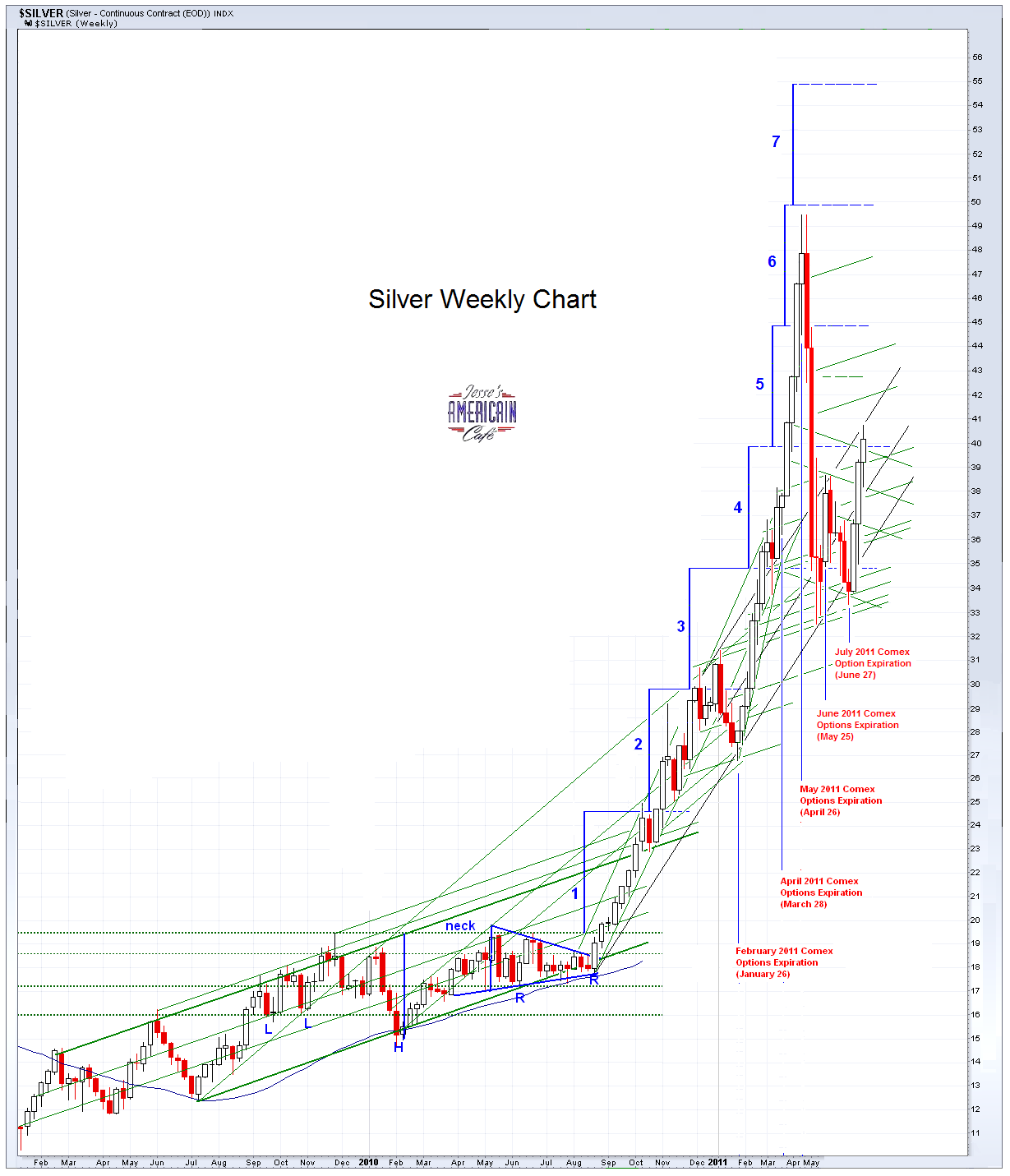
And in this market structure, no responsible fund manager would agree to do a follow on unless they were able to secure potential bullion inventory in advance at something approaching the market price, which today is around 39.60 per ounce, and have a reasonable plan to take delivery in the foreseeable future. I hear that their last purchase took THREE MONTHS for delivery. Three months or more is a significant period of time in today's volatile global markets. Three months puts us in the historically stormy seas of October, well beyond the known horizon these days.
The current deliverable inventory at the Comex, the single largest depository of tradeable, traceable silver in North American, stands around 27 million ounces, with total value of just over one billion dollars. Not much in today's world of billions flying about, even through individual accounts.
Can Mr. Sprott obtain about 1/5 of the 'visible float' in silver bullion without buying against himself in the market, that is, raising the prices he pays by the demand he himself presents, chasing his tail in the market as it were?
He might turn to the LBMA, the storied London Metals Exchange which is the locus of bullion trade. But with their secretive inventories that change hands in daily multiples of themselves, and purported 100:1 paper leverage, the problem remains the same. When you pull actual bullion out of that system, you start raising leverage, and risk, geometrically.
Alas, the central banks do not have stores of silver which they can strategically sell into the market to satisfy demand and help their cronies in the bullion banks as they do with gold.
Doing a deal to satisfy demand in size is going to become increasingly difficult in such an imbalanced, poorly regulated market. A default tends to occurs at the core of the market, even while supply is available on the retail level, 'at the margins.' Until it is not.
In other words, you will probably be able to buy a few coins locally the day before the wholesalers default on their obligations, there is a run on supply, and nothing is available as deliverable inventory is quickly pulled off the market, except at the most usurious prices. And of course the governments intervene to save, and probably somewhat selectively, the naked shorts from ruin.
Ah, the problems of the successful entrepreneur in times of collapsing paper and its associated delusions.
"Why, this is very midsummer madness.”
William Shakespeare, Twelfth Night, 3.4.55
"We are developing processes and procedures by which the Treasury communicates to us what we are going to do," Plosser said, adding that the task was manageable. "How the Fed is going to go about clearing government checks. Which ones are going to be good? Which ones are not going to be good?"
Fed Preparing for US Default - Reuters
Very bullish reversal in the metals intraday, with closes in gold and silver above the psychological numbers of 1600 and 40 respectively.
If they can move higher and stick a close, and hold it through option expiration next week, you can say goodbye to these levels, the dollar, and quite a bit more.
As an aside, the other day I read an essay in a recent issue of Discover Magazine called, The End of Morality. I also found this commentary on it.
In this article, which promotes the triumph of scientific reason, utilitarianism, over what it contends are mere emotions, holdovers from history, it was put forward that it makes rational economic sense to kill one healthy person and harvest their organs, in order to provide them to five other people who can then live a higher quality of life, as an increase of goodness on the whole. The revulsion that one feels at murder is an unthinking instinct which can be overcome by higher thinking, the power of the will.
And it held this out as the higher 'good' in the new scientific morality, freed of the restraints of the mere instinct to preserve innocent life.
"You have these gut reactions and they feel authoritative, like the voice of God or your conscience. But these instincts are not commands from a higher power. They are just emotions hardwired into the brain as we evolved."
The logical extensions of such reasoning should be perfectly obvious to anyone with a sense of history.
And one does not even have to kill them to put them to the good service of the State, and those predestined for a higher quality of life, the übermenschen. At least, not in the beginning.
Plus ça change, plus c'est la même chose.
Not a constructive day for the bulls. Let's see if they can gather themselves together tomorrow. If not, downside beckons.
The intramurals in Washington are shaking the confidence of the markets. The House Republicans are starting to resemble economic brownshirts, in the radical service of their masters, the monied interests.
"Government has coddled, accepted, and ignored white collar crime for too long. It is time the nation woke up and realized that it's not the armed robbers or drug dealers who cause the most economic harm, it's the white collar criminals living in the most expensive homes who have the most impressive resumes who harm us the most. They steal our pensions, bankrupt our companies, and destroy thousands of jobs, ruining countless lives."
Harry Markopolos, Madoff Investigation Congressional Testimony
The 'good news' from IBM and especially a hint that the debt ceiling talks are making progress rallied the market hard today, as the shorts scrambled to cover.
It was 'risk on' and gold and silver were hit hard in a cheap shot on weakness, in the manner of a calculated bear raid as the Comex closed and the thin Globex session opened.
The dollar gave up a little more ground.
Nothing is resolved in Europe, and the debt ceiling crisis in Washington is highly artificial, more of an ideological impasse, or even coup d'etat, than a genuine crisis.
Let's see how the correction goes. Just for reference, gold has had its strongest rally off support since 1980, so a pullback is warranted and expected here.
As a reminder it is option expiry on the Comex next week.
It looked as though we might get some action in stocks today, and sure enough, on the 'better than expected' news from IBM the markets rallied hard, led largely by tech. Obama and the Congress threw the market a bone and hinted that there might be a resolution to the debt ceiling 'crisis.'
So far this is just a counter trend relief rally. It may have further to go, but a downdraft is just a news headline from Europe or Washington away, so be careful.