14 January 2011

SP 500 and NDX March Futures Daily Charts - Brits and Russia Announce Energy Alliance


Today's market commentary is included here.

On the news that JP Morgan bankers will be splitting a $10 billion bonus pool, the Robin Hood Tax campaign said it was "outrageous" that JP Morgan Chase's investment bankers are to receive an average payout of $369,651 (£233,000) for 2010. The group, which supports a global tax on banks' financial transactions, said the size of the payments were "a slap in the face to ordinary people".

"If banks can afford to pay billions in bonuses, they can clearly afford to be taxed a great deal more. A £20bn Robin Hood tax in the UK would help avoid the worst of the cuts and show we are all in this together," said David Hillman, spokesman for the Robin Hood Tax campaign.

"While bankers wallow in cash, the general public are suffering unemployment and cuts to public services," Hillman added.

The financial media news are beside themselves with the after hours news that British Petroleum and the Russian state-controlled oil giant Rosneft will be swapping spit and taking long walks in the park, with potential consequences yet to come. BP is nominally a private company, but Her Majesty's government still owns a 'golden share' which it uses to make suggestions to a number of her subjects and especially former children, as do most developed nations. Or so I have been somewhat reliably informed.

After all, the Yanks have called dibs on the Mideast. Someone has to grab the Arctic while it is still melting.

It appears to some like a pre-emptive strategic move by the Brits who have been concerned about rumours of a joint economic deal developing between Germany and Russia involving engineering expertise and energy products such as natural gas.

The couples seem to be pairing off, but the evening is still early, and the band is just warming up.


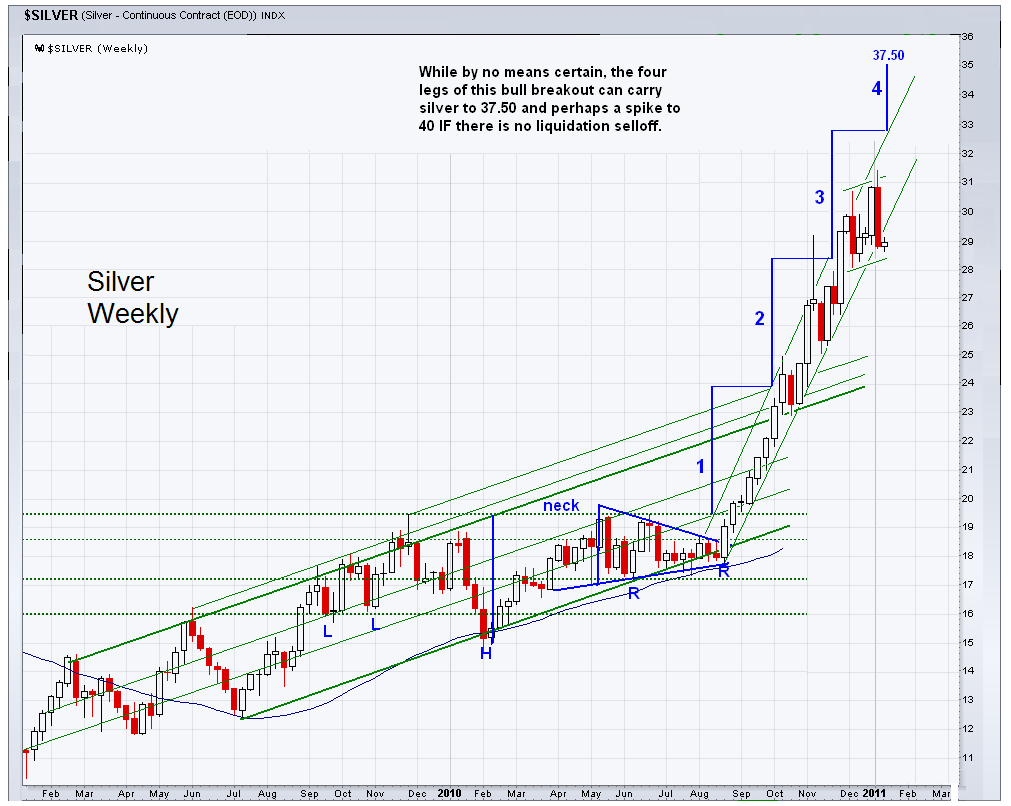
Gold Daily and Silver Weekly Charts


There was a concerted effort to drive down the price of gold and silver this week, much moreso than any usual price correction or pullback. For those that watch the markets on a daily basis such a market operation is hard to miss, but easy for the monied interest's commentators to rationalize.

Late note: The drop Thursday was due to short selling as the open interest ROSE.
"The CME Final for Thursday confirms that volume was 252,778 lots, 29.2% or 57,000 lots above estimate. Open interest rose 1,449 lots – 4.51 tonnes or 0.24% - to 590,817 contracts. Gold fell $17.05, or 093% basis stock market close. Yet it was obviously not a day dominated by long liquidation – short selling had the edge."
So why did it happen this week? Here are two theories.

The first is that JPM was given a 'green light' by the CFTC this week, which I heard from several sources. Here is a writeup on this by Chris Martenson.

CFTC Caved In to JP Morgan - Martenson

I do not know if the CFTC 'caved' in to JPM or not because I have not had time to consider the matter. I will be disappointed greatly if this is true, and if Brad Chilton was a party to it. But it is a la mode of the Obama Administration.

The second and most probable in my mind is that the US Consumer Price Index (CPI) came in much higher than expected today. The Fed and Treasury are very concerned about managing the perception of inflation, even as they levitate the stock markets on excess liquidity to manage the perception of economic recovery amidst growing foreclosures and jobs losses. I was actually on the lookout for this one since the arrival of adverse economic data is the second greatest cause of a smack down in the metals, the first being key date such as an option expiration.
"There are numbskulls in the financial media — toadies to the Federal Reserve — who would like to think that energy and food inflation do not count. Simply put, the monthly December inflation releases for the CPI-U (annualized 6.2% inflation), CPI-W (annualized 7.8% inflation) and PPI (14.0% annualized inflation) were disasters, with December inflation far from being calm, as touted in one widespread media report. The sharp increases in December energy and food prices were not due to normal price volatility in those areas, instead, they were created directly by Federal Reserve Chairman Bernanke’s ongoing push to debase the U.S. dollar — to destroy the purchasing value of the U.S. currency. As Mr. Bernanke moves to prove his contention that a central bank and central government can create inflation at will, by debasing their currency, the bad news for the Fed remains that the inflation created here reflects monetary policy distortions, not strong economic demand, as naively advertised. Then again, since much of this inflation mostly is food and energy, not yet "core," the problem of rising gasoline prices may not even be a concern for the U.S. central bank. Nonetheless, these problems are serious and are problems specifically of the United States and for the U.S. dollar.

There is little happening here that I have not written about recently (see for example Special Commentary No. 342). Since I am traveling and am heavily under the weather with a seasonal malady, this morning’s comments will be brief, but the inflation issue will be reviewed in the pending update to the Hyperinflation Special Report and supplements to same.

In the economy, it looks like the "advance" fourth-quarter GDP (January 28th) will be positive, given the numbers discussed below. Significantly, though, major negative revisions to data, such as payrolls and production, loom post-GDP reporting. As to retail sales, keep in mind that the December increase was due to higher prices, not to underlying strong demand. There remains no recovery at hand.

Increasingly, global investors will shun the U.S. dollar, as its purchasing power increasingly gets hammered by Mr. Bernanke et al. The regular gold, silver, oil and Swiss franc graphs are shown below. As investors flee from the dollar, the precious metals and stronger major currencies will continue to be the primary beneficiaries in U.S. dollar terms, irrespective of any near-term market volatility, extreme or otherwise. More-prudent economic and fiscal actions taken by major U.S. trading partners will tend to make the U.S. dollar look all the worse on a relative basis."

John Williams - Shadowstats.com

Those who do not think that the Fed and Treasury watch things like the price of gold are greatly mistaken.  Much of the current activity of financial engineering  these days revolves around the management of perceptions rather than real productive results.  Its the modern American way.
"Turn where we may, within, around, the voice of great events is proclaiming to us, 'Reform, that you may preserve!'" Thomas B. Macaulay
Please notice that I have added the possibility of a trading range developing in gold now that the uptrend appears to have been broken, although it will take another week and the January 26 option expiration to tell the whole story on this.


Piscataqua Research: Forecast for 2011 - 1933 All Over Again


Here is an interesting excerpt from the 2011 economic forecast from Piscataqua Research. Simple registration is required.

I am not sure I agree with their prescription to START with 4% short term rates and fiscal austerity, as I think it would shock the economy into a depression, even worse than the stagflation which seems to be unfolding already with today's CPI print and slack retail sales.   A healthy diet and rigorous exercise are good, but not for a patient in critical condition and on life support after twenty years of medical quackery and drug addiction. America needs a twelve step plan with changes starting from the top down.

And as for fear, well, with the resurgence of a US stock bubble, and incessant happy talk in the mainstream media and the nation's thought leaders there does not appear to be any, unless you are poor, old, middle class, without savings, or recently unemployed. The bottom 95%.

I most certainly agree with Piscataqua's assessment of what they call 'debt-onomics' in both of its manifestations as unproductive stimulus spending and more tax cuts for the corporate trusts and the wealthiest few.  Quantiative Easing without reform is creating further wealth disparity and another bubble in US financial assets.  And this is made possible only by the extravagant privilege of the US holding the world's reserve currency. The new normal is a dangerous illusion; this will not end well.

None of these simple approaches will work because the economy is broken, and badly distorted, with a greatly oversized financial sector and a global monetary regime that is highly imbalanced and unstable.

Until there is reform, significant changes, nothing will work and there will be no sustainable recovery. Trickle down ultimately leads to debilitating and widening social dislocations (homelessness, unemployment, poor health) that are highly unproductive.

Let me emphasize this. Trickle down economics is nothing more than an old rationale for the destructive selfishness of the monied interests and a powerful status quo. And the theory of efficient self-regulating markets is sheer non-sensical propaganda.

The obsessive tendency of greed and corruption to its own ultimate destruction has been this Cafe's forecast since 2005, and so far nothing has fundamentally changed. The collapse of the US is starting to take on the character of the breakup of the former Soviet Union.

Piscataqua Research
Economic Projections Summary
January 3, 2011

In our January 2010 summary, we said: “For the third year in a row, our 2010 guesses are easy to reach… what looks to Ivy League economists like a recovering economy looks to us like a pre-bankruptcy debt ramp.”

Our guesses for 2010 were: real consumption would decline without further direct government support; real residential investment should bounce along the bottom; an unusual inflation/deflation should push commodity prices higher and consumer product margins lower; government budget and pension problems and federal debts should continue to mount; and mortgage rates should set more new lows.

We also suggested gold and oil would average much higher prices in 2010 than in 2009 and national home prices would be stable or higher! We did very well in 2010! In July with oil at $75, we wrote: “We will not be surprised if oil prices exceed $100 (or $150!) per barrel by next spring!” We are getting closer!

Our guesses for 2011 are also easy to reach. The cash flow model shows a high probability of major U.S. economic difficulties starting in early 2011. Our guesses are:

• Residential investment could approach 1933 as a percent of GDP;

• Commodity price volatility should rise significantly;

• The trade deficit should rise and possibly reach a new high;

• Mortgage rates should reach a long-term bottom in 2011; and

• Government budgets will be more challenged in 12 months than they are now.

On the optimistic side: 2011 should not bring deflation; higher mortgage rates; or lower home prices. Why do the fearmongers get so much press? Low 4% mortgage rates gone forever? Housing prices down another 20%? A Federal debt limit slowdown “catastrophic”? A big bear market? Uncontrolled inflation?

We do not fear interest rate increases crashing the economy; a Federal debt slowdown; a crashing dollar; or market crashes. Since there are no “bond vigilantes”, it can happen if the Fed lets or makes it happen.

It was no surprise to see the Debt Commission support a higher 2011 deficit while “fixing” the 2050 deficit! Their recommendation is pure debt-onomics - raise the debt flow to keep asset prices higher!

The reality is simple: the Federal Reserve has messed up the economy with low interest rates. Since 2005, economic investment has closely followed the 1927 to 1933 path. 2011 is the year that 1933 arrives. The path after 2011 should show the underlying mathematical structure of debt-onomics.

There are two main problems with debt-onomics: 1) it is a choice to consume now and not save later; and 2) it causes booms and busts by accelerating economic investment. Deb-tonomics creates high profits and high unemployment and concentrates income and wealth. It looks like capitalism, but it is not.

Our model points to 2011 as the meeting point of many difficult monetary and economic problems. This intersection should bind governmental and personal budgets in a vice as QE2 and tax cut stimulated inflation drives costs head first into a stone wall of limited tax revenue and personal income.

We wrote in January, 2010: “America has reached the point where there are only two paths. The first path is Bernanke’s and Obama’s: more debt and higher deficits…” The tax bill added about $900B to the deficit and took the path of “Obama’s higher deficits.” The bill also took the path of “Bernanke’s more debt.” In 5 years as Chair, federal debt increased by about $6 trillion and will increase by almost $8 trillion after 6 years.

There is now ONLY ONE WAY to fix the economy. The STARTING point is 4% short interest rates and balanced budgets. We forgot to mention: “and getting past the fear.” Those first steps are hard, but they start the journey! Budget surpluses and higher rates would work even faster! The math is easy.

In our model, 2011 is a true mess! Could we be right about mortgage rates again?! We will see!

As Al Jolson said, "Brother, you ain't seen nothing yet."

Welcome to Zombieland.

And yet there is hope, always.

"Time advances: facts accumulate; doubts arise. Faint glimpses of truth begin to appear, and shine more and more unto the perfect day. The highest intellects, like the tops of mountains, are the first to catch and to reflect the dawn. They are bright, while the plain below is still in darkness...The sound opinion, held for a time by the bold speculator, becomes the opinion of a small minority, then a strong minority, and finally a majority of mankind. Thus, the great work of progress goes on."

Thomas B. Macaulay

13 January 2011

Gold Daily and Silver Weekly Charts: Bear Raids Abounding - Trading Range?


Note: addition in gold chart showing a potential trading range

At last a change of pace!

A series of determined and very heavy-handed bear raids took down both gold and silver in the afternoon trade, and of course their associated investments.

It is a bit early for an options expiration smackdown. The only thing I see on the economic calendar is the Consumer Price Index report for December. Today's Initial Jobless Claims number was a high end buzz kill, but the Street brushed it off.

It looks as though gold may enter a trading range here, as a determined effort to stop its advance gains seasonal traction. I think the 1455 target should be set aside if a trading trading range develops more fully, and a breakout target be set instead. Let's wait and see what happens around January 24 week.

As a reminder, US markets are closed on Monday for Martin Luther King Day.


SP 500 and NDX March Futures Daily Charts


A last hour rally took US stocks back closer to almost unchanged.

Onward and upward. In the go-go 1960's the 'big thing' was plastics. Today it is gourmet cupcakes.

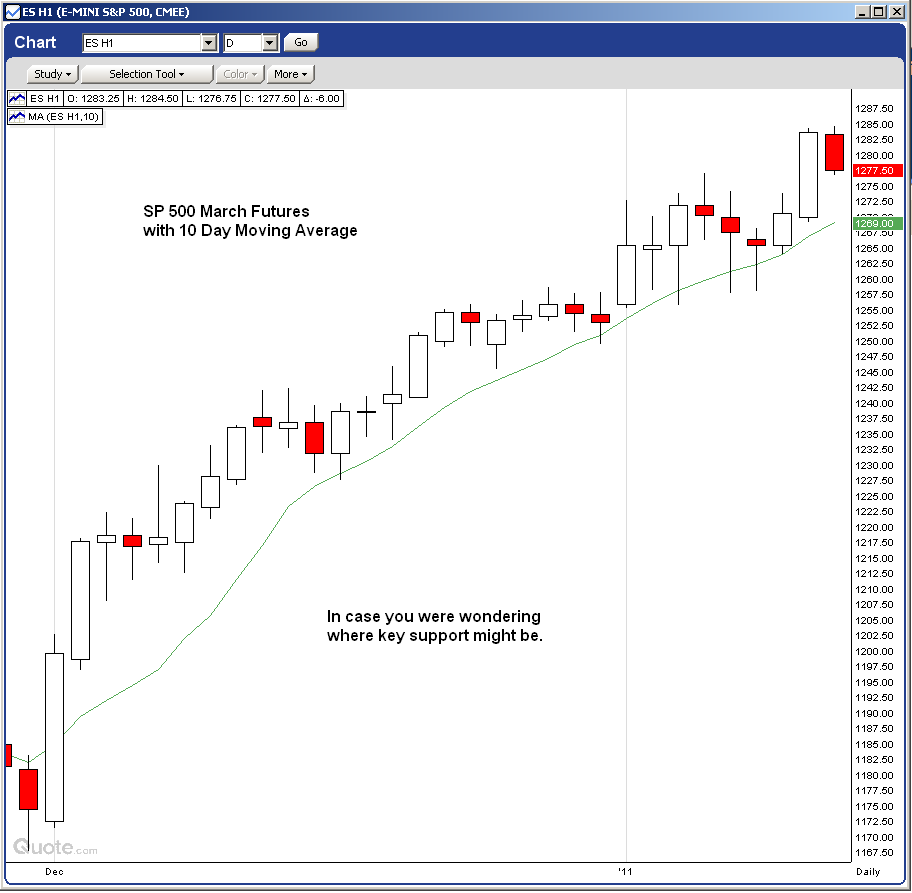
See the SP 500 with Ten Day Moving average for Today's Stock Commentary.

Whatever the case, try not to get in front of this market. Even death by a thousand paper cuts is possible.

As a reminder, US markets are closed on Monday for Martin Luther King Day.


Intraday SP 500: In Case You Were Wondering Where Key Support Might Be...


The picture is similar for the SP 500 cash market.

Someone who keeps track of these things said that this is the most consistent thirty day rally in US equities since 1929, with the SP never closing once below its 10 day moving average.

Do you think that maybe a Wall Street banking cartel is manipulating stock prices higher now as they did that year? Do you think if it is true it will end badly as it did then?

Intel after the bell, and JP Morgan reports tomorrow morning before the open.

VIX seems to be reaching its nadir, conversely the heights of complacency.

Do you think if the US financial system blows up again the Fed and the Wall Street crowd will claim complete ignorance, point to some nameless act of God, and simply blame the government and the public? And will Timmy and Ben appear before Congress (again) and demand many more billions to save the banking system with ugly threats of dire consequences?

Do you think Benny will apologize for being simply mistaken in his theory like Greenspan did and claim a 'mulligan,' and brazenly go on? As an aside, if Bernanke is knighted by QE II (the sovereign not the subsidy) I think its game over.

If a stock market asset bubble does collapse and wipe out many investors, do you think the talking hairball and the cheerleaders on bubblevision will once again say, "Well nobody MADE people buy stocks."

If you do, you might just be right. Or perhaps for now the band will just play on, Nearer My God to Thee, to keep the upper deck evacuations orderly...

You may be there, but I doubt the usual suspects will be at their posts in the wheelhouse.

What dark visions I have some days.


12 January 2011

SP 500 and NDX March Futures Daily Charts


No fear.

The Bernanke put, and the regulatory pass, an echo of 2005-2006.

But can they keep it going?

The volumes in this rally are thin and prices are being set on a margin backed by increasing leverage and credit. This is not a great prescription for market stability.


Gold Daily and Silver Weekly Charts


Different day same script. Early paper selling in NY is bought by steady hands and physical bullion buyers.

I think it is going to take a serious stock market selloff to stop silver's upward momentum.


11 January 2011

SP 500 and NDX Daily Charts


INTC reports on Thursday and JP Morgan on Friday before the bell.


Gold Daily and Silver Weekly Charts


"Gold is the money of kings, silver is the money of gentlemen, barter is the money of peasants - but debt is the money of slaves."

Norm Franz, Money and Wealth in the New Millenium


Charles Ferguson: MIT Brunel Lecture on Economics and the Financial Crisis


See Charles Ferguson's documentary Inside Job when you have the opportunity.  I understand that the DVD may be released sometime around March 2011.

Ferguson starts his presentation at about 7 minutes in.

I was glad to hear him admit that he was wrong, honestly wrong, about his assessment of Japan Inc. and the Japan asset bubble. He also goes on to make a rather pointed observation about economics which needs to be heard dispassionately by related institutions in particular, whose own credibility and integrity is at risk.
"It is one thing to be honestly correct or not correct about something; it's another thing for an academic discipline to have a systemic corruption problem. And that's what I will be talking about in part later, because the economics discipline in my view does have that problem."
In Charles' defense he is only saying publicly what is being said privately amongst academic scientists and mathematicians about the inordinate effect of power and money on the integrity of economic opinions and research.

As you may recall Alan Greenspan was caught up in the Keating Five S&L scandal. The point of this is that the 'empirical objectivity' of the Federal Reserve in setting policy is a myth as egregious as the trickle down theory and the efficient markets hypothesis.

At the heart of the current financial crisis is the weakening and even corruption of a number of institutions, both public and private. And their reform and restoration to a fully functional state remains to be accomplished. Reforms risks disclosure, and coverups protect the status quo against such the effects of such a disclosure. This is why reform from within is problematic.

Yes, there is always the need for some discretion and privacy in executive decisions. But it must be limited and exceptional, subject to overview by a more relatively impartial third party, always.

The Fed, and particularly the New York Fed, is a largely private institution making decisions not only about its own industry, but is taking actions with public funds that approach and sometimes become de facto public policy decisions with far reaching effects, and is doing so largely in secret. It is therefore highly vulnerable to insider dealing and conflicts of interest. Excessive secrecy is inimical to a free society, for wherever secrecy and power exist, corruption quickly follows.

The only cure for these conflicts of interest is a balance of power and above all, transparency. Sunlight is a marvelous disinfectant. Disclosure, disclosure, disclosure. The more that a bureaucratic organization resists even routine disclosure the more likely it is that they have become internally focused, less effective, and probably have some things to hide.


Link to original video at MIT here.

h/t to Paul Kedrosky and Yves Smith.

10 January 2011

The China Miracle: Forex Reserves Hit Record $2.87 Trillion


In the 'Japan Miracle' of the 1980-1990's it is said that Japan essentially 'monetized its real estate.' There was also a mythology of the superiority of Japanese management, with an emphasis on quality management ironically pioneered by the American W. Edwards Deming.

It gained some traction because it was of course a very real and highly useful innovation.  It succeeded in particular because so many Western manufacturing concerns were still under the influence of the management philosophy nurtured during the second World War of production in sheer quantity, and repair and correction of defects later in the field.  Consumer had risen in living standards and preferences and such arrogant treatment by the auto companies in particular was no longer considered acceptable.

But at the end of the day, Japan Inc. was a bubble fueled by a mispricing of risk and assets. I can remember arguing with my business school professors at the time about this, with all their familiar theoretical arguments about efficient markets and the inevitability of the Japanese.

So, with regard to China, it is not an enlightened management prowess, and few make that argument which would just seem silly to anyone who has been there. And it is not the superior quality of their products.

It certainly is fueled by Western investment, particularly driving by companies like Walmart who insisted on suppliers moving production to China starting in the 1990's. A favorable and sizable devaluation in the yuan and a relaxation of US trade rules by Clinton helped to spark the 'miracle' which we are seeing today.

It seems to me that China is monetizing cheap labor, and playing an arbitrage against the middle class sensibilities and public policies of the West. China is exporting deflation and lower living standards for workers in massive quantities, and acquiring sizable foreign reserves in the process. Multinational corporations find this attractive because in the short run it breaks the power which labor and the middle class had gained in the reforms after the 1930's. And it comes complete with vendor financing by China et al., and the promise of fresh economies for exploitation to come. As Bill Gates noted, China represented his kind of capitalism, if only they could start enforcing intellectual property laws. Oligarchy requires pliant labor and obedient and law-abiding consumers.

Unfortunately China and other developing nations must now start growing their domestic markets, and a consuming middle class of their own, or face an economic collapse that will make the Japanese deflation look like a cyclical recession. This is not easy for a oligarchical non-democratic government to manage gracefully. It is harder to control a healthy and wealthy and better educated rising middle class.

Miracles like China and Japan are made possible by a currency system that is broken, subject to manipulation and mercantilist trade policies that protect domestic markets while promoting exports. It is promoted by economic quackery that is funded by Wall Street that is masquerading as a scientific approach to maximizing the common good.

This remnant of the efficient markets hypothesis is creating even more dangerously destabilizing imbalances than those which provoked the collapse of Russia and the Asian currency crisis, and will be at the root of the global currency crisis to come, most likely later this year.

Never one to waste a crisis which they created, the oligarchs will put another emergency offer on the table, as they did with the American TARP bailout. Adopt our solution, one world currency, or suffer the consequences. The econo-parrots will quickly fall into line behind this latest twist in financial engineering, and there will be an hysterical antagonism towards all other competing solutions, anything that runs counter to a larger monetary authority.

With one monetary policy comes the necessity of one fiscal policy, as has been most recently shown in the European union. And with one fiscal and monetary policy, sovereign government becomes increasingly irrelevant.  Ponzi schemes by their nature must continue to grow and consume all, or collapse and be exposed for the fraud which they are.

AFP
China's forex reserves hit record $2.87 trillion

January 10, 2011

BEIJING (AFP) – China said Tuesday its foreign exchange reserves hit a record high at the end of 2010 as new loans topped an official target, highlighting Beijing's difficult task of stemming a flood of liquidity. The country's stockpile of foreign currencies, already the world's largest, expanded 18.7 percent from a year earlier to $2.847 trillion at the end of December, the central bank said in a statement.

New loans issued by state-owned banks in 2010 reached 7.95 trillion yuan ($1.2 trillion), exceeding the government's full-year target of 7.5 trillion yuan but less than the previous year's explosion of lending.

M2, the broadest measure of money washing around the world's second-largest economy, reached 72.58 trillion yuan at the end of last year, up 19.7 percent from a year earlier.

Analysts blame China's huge trade surplus -- $183.1 billion in 2010 -- and its massive stimulus measures since late 2008 to combat the financial crisis for the flood of credit that has been fuelling inflation and property prices.

Foreign exchange earned by Chinese exporters is changed for yuan with the central bank so it can control the value of the local unit -- a policy long criticised by China's trade partners for grossly undervaluing the currency.

The foreign exchange is added to China's growing coffers, while the yuan fuels the amount of money flowing into the economy.

Ever fearful of inflation's potential to spark social unrest, top leaders have been pulling on a variety of levers to rein in consumer prices and calm growing anxiety about soaring food costs and property values.

In December, the central bank hiked interest rates for the second time in less than three months. It has also ordered lenders to keep more money in reserve, effectively limiting the amount of funds they can lend.

Gold Daily and Silver Weekly Charts: Judge Orders Fed to Release Gold Records to Court


The New York traders are trying hard to keep a lid on silver and gold here.

Gold is struggling to break through the 1375 pivot and hold its gain, and silver is toying with the 29 handle.

Unless there is another liquidity market panic I expect these metals to follow their charts higher.

District Court Judge Orders Federal Reserve to Hand Over Gold Records

"If the U.S. gold reserves are just sitting somewhere, inert, unencumbered, and unused for surreptitious market intervention, what's the problem with full disclosure?"
Both Bernanke and Greenspan have testified that there have been no transactions in gold. Yet the Fed refuses to disclose documents that suggest circumstantially that there have been.

Even moreso, since the US bullion reserves belong to the people and not to a private banking cartel, there should be no records of any transactions by the Fed. Any transactions should have been handled by Treasury.

How Much Gold Does the US Have In Its Reserves?

How can the Fed be a trusted government regulator, given its position as a quasi-private banking cartel and an obsessive predilection for secrecy in its own dealings with what are clearly public assets?

If the Fed comes back and argues that it is not able to disclose its records of any gold transactions including sales, loans, and swaps because it was acting as agent for another party, whether it be the Treasury, BOJ, ECB, or the Bundesbank, then its time to audit the reserves by a third party answerable to the people.

Personally I am tired of their obfuscation, cronyism, and ad hominem attacks on even honest critics. If there is nothing to hide then disclose what are essentially public documents about public assets. If there is something to hide, it is time to come clean and stop the coverup.

As an aside, ex-Congressional powerbroker Tom DeLay was sentenced to three years in prison today for conspiracy and money laundering. 

Fiat justitia ruat caelum.


SP 500 and NDX March Futures Daily Charts


Market is struggling to hold its level, but is fighting off the overnight selloffs in light volumes.

Alcoa kicked off earnings season after the bell with a lackluster 'beat.'

Markets are looking forward to Intel and JP Morgan earnings this week, with PPI and CPI on the macroeconomic front.


08 January 2011

Massive Silver Withdrawals From The Comex


It will be interesting to see how the CFTC, the Obama Administration, and the Comex deal with this situation with silver, including the disposition of the massive paper short positions that appear to be undeliverable.

It could prove to be a watershed event, or at least an interesting scandal to observe as it unfolds.

Harvery Organ's commentary:

"And now for the big silver report.

We witnessed a massive withdrawal of silver unprecedented in the history of the comex. First there was a smallish 6507 oz of silver deposited to two customers, one being 497 oz and the other 6010 oz). But just look at the huge withdrawals:

Four customers (not dealers) withdrew a total of 1,019,310 oz from the comex vaults. This is real silver leaving from 4 registered vaults. The individual withdrawals are: 579,081, 30,380, 399,994 and 9855 oz.

The dealer (our bankers) also were involved in the withdrawal of silver to the tune of 769,941 oz (there were 2 dealers involved removing 102,866 and 667,875 ozs). When you see this massive drain of silver, the fire is raging. The total silver withdrawal by both dealer and customer totalled an astronomical 1,789,251. The Brink's trucks must have been very busy yesterday.

The comex folk notified us that an amazing 85 notices were sent down for servicing for a total of 425,000 oz of silver. The total number of silver notices sent down so far total 323 or 1,615,000 oz. To obtain what is left to be served, I take the open interest for January at 153 and subtract 85 deliveries leaving a total of 68 notices or 340,000 oz left to be serviced.

Thus the total number of silver ounces standing in this non delivery month of January is as follows:

1,615,000 oz + 340,000 = 1,955,000 oz (Thursday total = 1,625,000). As promised to you, this number is rising and will continue to rise until the end of the month as our banker cartel scrambles to get any morsel of silver to satisfy the massive demand for this metal. Our bankers are stunned to see such a huge amount of silver options in a traditionally slow month.

I hope everyone caught the Eric Sprott story on Kingworld news that he is having trouble locating silver."

Greenspan: Prove I Was Wrong!


The trickle down effect from a financial asset stock bubble will save the US economy (again).

Even odds chance of a US bond collapse unless the Congress gives the Banks what they demand.

Greenspan is the master of malpractice, a mad scientist of macroeconomics.


Mister Greenspan, at the Fed, with a Printing Press

07 January 2011

Gold Daily and Silver Weekly Charts


The last three days candlestick patterns are interesting.

Prices are smacked down in obvious selling raids designed to dampen price, especially after a higher overnight trade. And then determined buying brings the price back up but is held to a modest loss in the New York Comex session.

Silver is winding up for a run that will take no prisoners, show no mercy.

But these are just my opinions and I could be wrong. Here are two other similar perspectives.

“This may be the best opportunity you’re going to get at least from a price sense to buy gold and silver in the next few days. I think when this correction however long it will last is over, it will probably mark the lows for the year which will then be the liftoff to the eleventh consecutive year of higher gold prices.” John Embry, interview with KWN

New Buyers Are Taking On the Silver Shorts - Turk


SP 500 and NDX March Futures Daily Charts: Opera Buffa


Awful Jobs Report? Send in the clowns.


Progressive Reformer: Theodore Roosevelt


Theodore Roosevelt is an interesting figure in American history, little regarded or understood by most Americans who are, at most, familiar with his 'charge up San Juan hill' and the imperialist expansionism of his foreign policy, and perhaps his conservationism marred by numerous big game safaris.

Wonderfully ignorant of their history, only a few might even remember that he is one of the four president's depicted on their nation's Mt. Rushmore, much less why he was considered among Washington, Lincoln, and Jefferson.

He was a complex man of seeming contradictions, who was as comfortable in New York salons as he was on the back of a horse. As he was a man he had his foibles and shortcomings, which makes him fair game for his critics. His speech at the Sorbonne on The Man In the Arena addressed this.

Here is a brief description of his domestic political agenda from the PBS show American Experience.

The American Experience is a wonderful series of documentaries, and I highly recommend them in general. The Great Crash of 1929 is one of the better depictions of that era that I have seen in a short video documentary.

I wonder if this ignorance of history is a cause or an effect. Does ignorance facilitate gullibility and exploitation, or does it not also make it more bearable for lack of comparison? Perhaps it is something of both.  One can not otherwise explain America's fascination with and fatal attraction to second rate actors, narcissistic lotharios, idiot sons, wardheelers, and reality show divas. Such is the state of an empire in decline.  A still vibrant nation can survive its Warren Hardings and Andrew Johnsons, and perhaps even an unfortunate run of them.  One can only wait and see what will happen next, watchful and prayerful and hopefully prepared.


"Roosevelt appeared an unlikely candidate for a reform president. Born into a wealthy family, he enjoyed a youth beyond the reach of most Americans, touring Europe and the Middle East, studying with private tutors, and coming of age in a New York mansion. A Harvard man, he socialized with America's upper crust. In practice, however, TR looked after the interests of working class Americans against rapacious corporate trusts, defying -- and some would say betraying -- the very society from which he had sprung.

When TR entered the White House in 1901, he took control of a federal government that often aligned itself with big business. Roosevelt restrained his progressive leanings for a short time, wisely avoiding a shakeup on Wall Street, where jittery investors saw him at best as a loose cannon and at worst as a dangerous demagogue.

In early 1902, however, TR took the offensive against powerful corporate trusts. He convinced Congress to create a Bureau of Corporations to regulate big business, then shocked the nation by bringing an anti-trust suit against J. P. Morgan's Northern Securities Corporation. Morgan condemned the president, not just for what he had done, but for the ungentlemanly way in which he had done it -- publicly and without warning. A new paradigm had been established in Washington, and Roosevelt would go on to file suit against more than 40 major corporations during his presidency.

If Roosevelt's trust-busting surprised big business, it was certainly consistent with the major influences on his life. Theodore Roosevelt grew up worshipping a father who preached the moral duty of helping the poor, and he worked to be like his father in every way he could. As a young man, TR experienced life as a rancher in North Dakota's Badlands, where all the money in the world could not make a cow easier to rope or the summer sun less blazing, and years of honest work from sunup to sundown might still leave a person poor.

He learned to value working class people, and he never forgot them. From the time he took office in 1901 to the time he left it in 1909, the cowboy president did much to help working Americans. He passed laws to ensure the safety of food and drugs sold in the American marketplace. He placed millions of acres of land under federal protection, preserving America's natural resources. He regulated interstate commerce and helped laborers to get a fair shake at the negotiating table.

Plutocrats deplored Roosevelt. Yet TR adamantly defended the right of big business to exist. Trying to destroy the trusts, Roosevelt wrote in his Autobiography, "was a hopeless effort... those who went into it, although they regarded themselves as radical progressives, really represented a sincere form of rural Toryism." To TR, Progressivism meant a square deal for the American people and American business, a society where businesses profited by fair competition -- but not at the expense of the average American.

In fact, Roosevelt's relationship with labor was a tenuous one; he probably feared nothing more than he feared labor's potential for violence. "We can no more and no less afford to condone evil in the man of capital than evil in the man of no capital," Roosevelt wrote. One of his greatest frustrations was the inability of capitalists to see that their greed might well foment a bloody American revolution. Labor regularly condemned him, insisting that his brand of reform did not go far enough.

After leaving the presidency, Roosevelt continued to push for domestic reform, most notably during his Progressive party campaign for the presidency in 1912. He ran on a "New Nationalism" platform, calling for women's suffrage, an end to child labor, pensions for the elderly, unemployment insurance, and increased regulation of the trusts. While Theodore Roosevelt failed in this final presidential bid, others picked up his torch, and many of the ideas he championed would later come to fruition."

Note: Le patron is a member of long-standing in the Theodore Roosevelt Association.

06 January 2011

SP 500 and NDX March Futures Daily Charts


See SP 500 Intraday Chart: Credibility Gaps Abounding for today's stock chart commentary.

As a reminder, tomorrow is the US Non-Farm Payrolls report.