14 March 2013

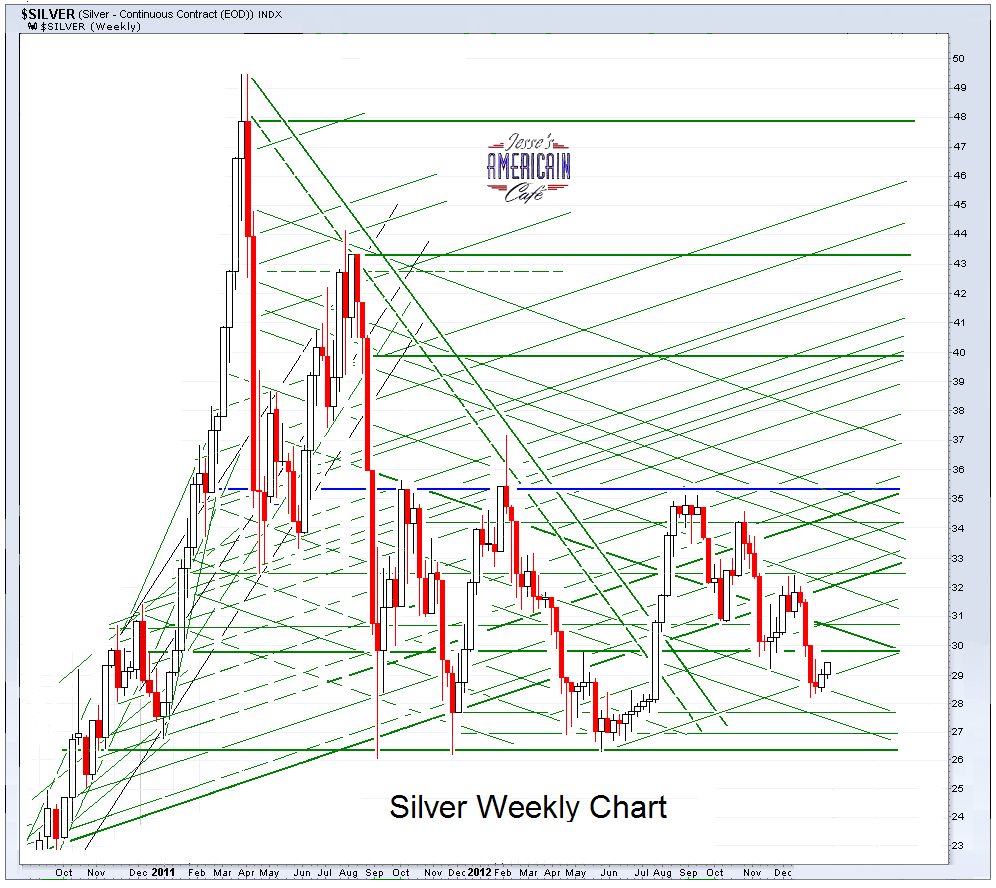
Gold Daily and Silver Weekly Charts - Stocks To Record Highs on Complacency


Gold held in rather well considering the new lows in the VIX and the new highs in stocks.

As a reminder, tomorrow is the March stock option expiration.


SP 500 and NDX Futures Daily Charts - 10th Rally Day, SP Nears Record - Complacency


Another new record high on the Dow Jones Industrials, as the SP 500 approaches its all time high set in 2007.

Bernanke is creating another asset bubble, once again in equities.

Check out the VIX. I bought some VIX as insurance. Tomorrow is stock option expiration for March.

I rolled my futures charts over to the June contract today. The new objective for the SP is in the 1565 to 1570 range.


13 March 2013

Gold Daily and Silver Weekly Charts


As a reminder this Friday is the option expiration for US equities.

Monday March 25 will be the option expiration for gold and silver on the Comex. This year's calendar is included below.

Today the miners were sold as the metals retreated a bit.


SP 500 and NDX Futures Daily Charts - Recurrent Complacency Into Option Expiration


VIX fell back as the Dow moved to another record high intraday led by IBM.

SP managed to rally back into the close, but the NDX continued to show a divergence.

As you know I have a chart objective of 1570 working on the March SP futures, which will be rolling over to June shortly, and the target will be about five points lower at 1565. June closed at 1550 today.

This Friday will be the March option expiration for stocks.


White Smoke Over the Vatican


Jorge Bergoglio of Argentina has been elected pope, Francis I.

Jorge Bergoglio was born in Buenos Aires, Argentina, one of the five children of an Italian railway worker and his wife. After studying at the seminary in Villa Devoto, he entered the Society of Jesus on March 11, 1958. Bergoglio obtained a licentiate in philosophy from the Colegio Máximo San José in San Miguel, and then taught literature and psychology at the Colegio de la Inmaculada in Santa Fe, and the Colegio del Salvador in Buenos Aires. He was ordained to the priesthood on December 13, 1969, by Archbishop Ramón José Castellano. He attended the Philosophical and Theological Faculty of San Miguel, a seminary in San Miguel. Bergoglio attained the position of novice master there and became professor of theology.

As Cardinal, Bergoglio became known for personal humility, doctrinal conservatism and a commitment to social justice. A simple lifestyle has contributed to his reputation for humility. He lives in a small apartment, rather than in the palatial bishop's residence. He gave up his chauffeured limousine in favor of public transportation, and he reportedly cooks his own meals.

His motto as a cardinal is 'miserando ateque eligendo' which is a phrase from the writings of Venerable Bede.
Vidit ergo Jesus publicanum, et quia miserando atque eligendo vidit, ait illi, Sequere me.


12 March 2013

Gold Daily and Silver Weekly Charts - The US Dollar: Keeping Up Appearances


Ron Paul: "I had a Federal Reserve Board Chairman testify before the committee that the gold standard had some merits but it was unnecessary because central bankers have now learned how to manage a Fiat currency in a manner in which it would mimic the gold standard. Would anybody care to comment about where the flaw is in that thinking?"

Mr. Lehrman: "I am anxious to comment on that, Dr. Paul. Under--and I must say Mr. Greenspan made the same insipid remark. Mr. Greenspan and Mr. Bernanke will have to then explain why it was that two of the greatest booms in American history, and two of the greatest panics and busts in American financial history, occurred under their 25-year watch..."

Mr. Grant: "The failure of AIG is so instructive in this respect. AIG, this immense insurance company with this ever so brilliant financial products group, didn't do one thing. It didn't mark its positions to market. Finally came the day of judgment and it argued with Goldman Sachs about what these things were worth, AIG said 100 cents on the dollar, Goldman Sachs said not close, Goldman Sachs won that debate and AIG failed.

As with AIG and Goldman Sachs, so it is today with the United States and its Asian trading partners. We never clear our trades. Our dollars go there, and they come right back here. We run twenty five consecutive years of debts on a current account and there will be for us, as there was for AIG, a moment in truth in which we must settle."

U.S. House of Representatives, Committee on Financial Services, Testimony of March 17, 2011

The US will settle, in paper dollars.  And if the payment is insufficient, they can always create more.

That is the long and short of it, and the sophistry of modern money.  Because the value of the money is self-referential, it is in essence a literal confidence game.  The dollar is worth what we say it is, and it is worth it because we say it, without regard to other opinions and considerations to the contrary. And as long as people believe this, or even pretend to believe this even if they don't but are afraid of the consequences of their disbelief, the dollar hegemony is secure.

Money is a matter of force and confidence; and when confidence wavers, force must provide. Force can take many forms, from persuasion to deception and even compulsion.

So the appearance of solidity and confidence must be maintained no matter what.   It must, as apparently Messrs. Greenspan and Bernanke have said, must 'mimic the gold standard.'  And they are right.  Caesar's wife must be above reproach, and the fiat dollar is the dowager queen of empire.

That is why the chat board gimmickry of the platinum coin was such a remarkably dangerous folly. Even given that money is a somewhat specialized area of study, it was shocking that a distinguished economist like Paul Krugman did not seem to understand it.  I could attribute that to a moment of political weakness. 

But the rest of the world did understand exactly what was happening, and held its breath.  Would the US dare to cynically impugn the basis of its debt, even by implication? 

Perhaps the greater question, such silliness as trillion dollar platinum coins aside, is how far the Anglo-American financial system is willing to go to keep up the appearance and dignity of a stable global reserve currency in the dollar, even while the dollar is being used and abused by the financiers like a 12th Avenue hooker?

I think you know that I believe that the paper metals markets are an accident waiting to happen, particularly with regard to silver.

It appears that the exchange and the regulators are managing the markets with reckless disregard for their soundness.

So let's see what happens.


SP 500 and NDX Futures Daily Charts - Quick Flip


We had a little backtracking today, but stocks bounced into the close.

VIX climbed a bit, and I took the highly levered bets off the table remarkably near its apogee. Thanks.  Every little bit helps. 

I have a balanced short riding just for grins, but it is greatly reduced. 

So what next. I still am thinking that the wiseguys will have a go at 1570 on the SP futures before this thing falls apart, but keeping the leverage under tight control at such a dodgy time is not so bad either.  To put it in a briefly pithy statement, these Wall Street jokers are barking mad, and Washington is living on their own planet.   Words do not quite capture how I feel about this.

The event risk here is enormous. These markets remind me of a big fat souffle, full of the air of HFT, QE, arrogance, and leverage. If someone slams the oven door it could go quite flat without much more provocation.


Kyle Bass On Japan and Two Key Slides


I was listening to Kyle Bass' forecast of what he sees as the coming financial collapse of Japan.  A link to that presentation at the Booth School is included below.

Here are two key charts that I obtained from Wikipedia that weigh on the economic situation in Japan.  They are a bit particular to that country.

Japan has a largely homogeneous population sharing a common racial heritage and language.  There is little immigration other than a few guest workers, and a shortage of natural resources.  It does have a strong store of intellectual human capital, a highly motivated and capable work force, and a remarkably strong central planning structure.  The public is unusually cohesive and oriented towards the common good. 

I think that although it is packed with facts, Kyle Bass's analysis is a little overly simplistic, and not completely fungible to other countries as he implies in the Q&A as indicated in the talk below. 

I am a little disappointed that Mr. Bass deals with the externalities through the numbers, but never discusses the structure of Japan's economy and the keiretsus, which is very important, and far from incidental.  He also gives a nod to Japanese culture and then dismisses it.  That also is an error, but it is a very common Western error, and he has plenty of company.  After all, inside every foreigner is a greedy, self-serving American style plutocrat just waiting to get out, right?

He also ignores the enormous private losses from the real estate bubble that were never realized, and were essentially buried by the industrial-financial combines together with a single party government of well-intentioned insiders.

He says that Japan is already in the zone of insolvency, and it is obvious that they will collapse.  I think that this is possible, but not inevitable.  If there ever was a case to be made for MMT,  or some sort of debt restructuring in the model of Iceland, another island nation, Japan might be it.  I suggest the latter might be more fruitful because of their dependency on natural resource imports.

Japan's strength, as always, is in what is not seen, not so readily apparent, to Western eyes. 

The primary obstacles to restructuring are the scarcity of natural resources which presumably must be imported, and the lack of population growth with immigration as a threat to racial homogeneity.  Available real estate and population density on an island are also key factors.  These are the classic scenario inputs that lead to colonial expansion which seems not to be a viable option at this time.

The comparisons to the US situation are overly glib and miss the key differences.  The solution for the US is growth, and it has all the options open that are so problematic for Japan.   

What the US lacks is a more public spirited policy making apparatus, one that is not captive to special interests.  It labors under the corruption of big money, and suffers from growing wealth inequality that is beginning to approach a third world oligarchy.  Japan has a GINI coefficient of 38, whereas the US has a coefficient of 45, and increasing.

I am not so much concerned for Japan, but for the tangled web of carry trades, derivatives, fraudulent misrepresentations, and leverage that is the Western financial system.  Japan would certainly be large enough to give it a stress test beyond the Fed's most rigorous scenarios. 

The financiers such as Kyle Bass might be more concerned about this, and not look so greedily at the situation as just another money making opportunity, if they were not so arrogantly sure of a US dollar bailout at any and all costs, even in the event of a major financial dislocation that begins abroad.

Here is a recent talk by Kyle Bass regarding 'The Coming Financial Crisis in Japan.'


Monetary Theory: Where Is the Flywheel and other Intellectual Ponderings and Squabbles


Money is power. And so like those other loci of power, politics, tribalism, and religion, the discussion can sometimes obscure rather than illuminate the facts and issues, such being the emotional state of people.

The discussion can sometimes become very heated, and very particular over the finer points, in a vacuum.   A system becomes rigorous and hardened by usage, and effete and elaborate the longer it is parked on the bench.

I am thinking of course of the recent case of Krugman v. Sachs. It tends to strike someone outside of professional economics as a nerdish slap fight.   If you are blissfully unaware of this, feel free to skim on to the next topic.

There are no quarrels so petty and yet so vicious as those in the faculty departments, precisely because there is so much and yet so little at stake.  It is where people who are essentially without the power to implement their ideas in the real world must leverage the power of their reputations.

I will not get into the specifics of this particular squabble, except to say that out of frustration Sachs was needlessly provocative in penning an op-ed in collaboration with a deficit hawk.  And Krugman has been similarly provocative, out of frustration, in answering objections to deficits by ardent austerians by saying things like 'deficits don't matter' in public forums. Yes, yes he modifies this in the footnotes. But he lowers himself to the level of economic luddites and that is a mistake.

This lowering of the discussion is an understandable outcome given the staged performances, little more than wrestling matches pitting talking head against sound bite adversary, that passes for information on the Sunday morning talking shows and the mainstream news.  It is the age of not of reason, but spectacle.

I suggest that the real reason that Krugman and Sachs are 'at each other' is because the standard bearer of the progressives is at best playing rope-a-dope, and at worst is little more than a cynical deal maker. I speak of course of Barack Obama, whose position is always hard to discern from the standpoint of principles if one watches what he does rather than what he says.  And I suggest that this is because he has few principles, rather than perhaps sentiments, that get in the way of his pursuit of the deal, and his own power. 

Now I turn to the curious situation of the Modern Monetary Theorists.

Let me state, unequivocally, that there is nothing new to be seen here. There are no new discoveries, there are no new wonderful theories that make things possible that were not possible before, in the manner of an invention like the transistor, atomic fission, or flight.

What is presented as 'new' is the notion that the state can simply print and distribute its own funds as needed, determined by it.  And in doing so there will be no serious consequences.

I am willing to suspend all other discussion and objections, and bring this down to the absolutely critical point in any monetary system. And that is, 'where is the flywheel?' Or for the less mechanically inclined, where is the constraint, the restraint, the governing factor, on expanding the money supply?

In the case of an external physical standard, like gold and silver, or a hard peg to another currency, that constraint is easily seen. The 'flywheel' that governs how fast the printing presses may go is the amount of gold and silver one can obtain, or the level of value of some other currency, that is hopefully stable but may not be.

One can expand the money supply beyond the metal supply, but only with a conscious and obvious devaluation of the units which each ounce of gold and silver represents.  Or one can cheat and lie, but that is another matter, and a facet of all human systems which lack transparency.

In the case of a debt based market system, the flywheel is the willingness of the market to take the government debt at some value which 'works' for the monetary authority's purposes.

It is undeniably true that Bernanke is gaming this mechanism in what is purported to be the short term by buying that debt, the government bonds, at non-market, artificial prices. And it shows up in the Fed's balance sheet, for all to see.

As I have pointed out at some length before, as long as the Fed has at least one Primary Dealer in on the scheme, the money machine can keep turning until the market is revulsed by the stated valuations, and the machine breaks down.

And this is by design.  It is the principle of 'lender of last resort.'  And it is supposedly what provides the Federal Reserve System more flexibility to address currency shocks than a hard external system.  That the Fed has caused those currency shocks by its own policy errors at times is another matter.

But at least I understand why the Fed and the board of governors are doing what they are doing now, and it is obvious what they are doing despite the enormous lengths to which some may go to say otherwise.  And since it requires the agreement of a number of different, somewhat independent parties, it may very well stop before it goes too far. 

So I would ask, where is the flywheel in Modern Monetary Theory, in which the government spends at much as it wishes, and simply issues the currency to 'cover' its expenditures?

And if the answer is the checks and balances of the Congressional appropriations process and the policy of the Treasury Department, you will understand if the general public runs screaming towards the exits, given our recent experience with the budgeting and spending levels.  Or if the answer is that it is 'in the cloud' and that a restraint is an old-fashioned concept that is no longer applicable, then we will know that as it stands it is another new era idea like efficient market theory.

So, with regard to Modern Monetary Theory, what acts as the restraining factor on the expansion of the money supply? Where is the flywheel?

Answer that honestly and straightforwardly in less than two paragraphs,  and it might be said that MMT at least has a system.  And if not, it is something that needs to be done to take it from sophistry, which dodges and changes as required by the turn of the debate, into the realm of a real system that can be examined and critiqued.


11 March 2013

Gold Daily and Silver Weekly Charts - Complacency Trade


Gold and silver held their price levels quite well despite the rally in stocks, which ordinarily would have spelled a selloff in the precious metals. VIX dropped to a six year low.

Let's see how the Merry Pranksters trade the rest of this week. We may be near a turning point, at least in the short term.


SP 500 and NDX Futures Daily Charts - VIX to a Six Year Low


The VIX, the indicator of volatility, dropped to a six year low today as the US equity markets shook off weak economic data out of China, and the downgrade of Italian debt, to move to fresh highs in the touristy Dow.

The SP futures have a measuring objective of 1570. They closed around 1555 today.

I took a long in volatility towards the close of US trading today to balance some other things out for the most part.


08 March 2013

US Unemployment Rates Adjusted For a Constant Labor Participation Rate


These charts courtesy of chartmaster Gary at NowAndFutures.com


Gold Daily and Silver Weekly Charts - God's Mills Grind Slowly


Gold and silver would not be denied, despite some fairly determined efforts.

Silver did the heavy lifting.  The intra-day charts are included below.
"Gottes Mühlen mahlen langsam, mahlen aber trefflich klein,
Ob auß Langmuth er sich seumet, bringt mit Schärff er alles ein."

Friedrich von Logau, Göttliche Rache

Have a pleasant weekend. See you Sunday evening.


SP 500 and NDX Futures Daily Charts - Selling Freedom, Playing For Time


I picked up a little volatility insurance near the close today.  

My timeframe on this is to the end of March.

It was hard to miss the big non-confirmation in the NDX today.

"The woods decay, the woods decay and fall,
The vapours weep their burthen to the ground,
Man comes and tills the field and lies beneath,
And after many a summer dies the swan."

Alfred Lord Tennyson, Tithonus

I am curious to see which black swan comes home to roost first: Europe or China.

Ed Lazear, the distinguished economist from Stanford, formerly chief economic advisor for G.W. Bush, and now a Senior Fellow at the Hoover Institution, thinks a good approach to immigration reform would be for the US to sell its citizenship on the open market to the highest bidders. 

He was expounding this after the close on Bloomberg television, which is a bastion for all things of the swinish persuasion.  He calls it 'importing human capital.' It sounds remarkably like indentured servitude.

As related by the Wall Street Journal:
"To ensure that not only the wealthy could gain citizenship, the sale of immigration slots could be coupled with a loan program that allows people to borrow the fee and to pay it back out of their earnings over an extended period. To minimize default, the loan payments would be automatically withheld from their paycheck, just as income and payroll taxes are today."

In a similar vein the US could reinstitute a military draft, but sell exemptions to the highest bidder.  And in fairness the government could offer loans to cover the cost of course, adminstered by the Banks of course.  This would have the additional benefit of opening up slots in the National Guard which have formerly been taken up by the idle sons of the wealthy.

There are similar proposals for rationing life saving medical care that are already on the table.

Personal air and water meters implanted at birth?  Think of the possibilities. 

There was a movie written along these lines called In Time.  In it people are fixed with meters that measure out their life.  They are able to buy additional time to live, at market prices.  I wonder if Ed has seen it.  It is the perfect market-based, technological solution for maximizing the output of human capital.
"I have always thought that all men should be free; but if any should be slaves it should be first those who desire it for themselves, and secondly those who desire it for others."

Abraham Lincoln, "Speech to One Hundred Fortieth Indiana Regiment" March 17, 1865
See you on Sunday evening.


Today's Non-Farm Payrolls Report - The Good News, Bad News - Unadjusted Unemployment at 13%


Today's Non-Farm Payrolls report was encouraging despite the downward revision from last month's headline grabbing number, which in part helped make up today's headline grabbing number.

The seasonality adjustment used in this number was out of the normal bounds from past seasonality adjustments. And as one might have anticipated, the Birth Death model added its customary large number of estimated (imaginary) jobs into the mix.

As you know I prefer to look at the trends, rather than the month to month numbers which can be used to manage perception in the market and the public.

The overall trend shows that the US is not faring as badly as if it might have, at least in the short term, under an austerity regime such as that being followed in Europe.

The most encouraging statistics are the steady although somewhat anemic jobs growth, and the upturn, finally, in average pay. I could not find current median pay numbers in a chart, and this is what is most interesting to me as you know.

The Labor Participation Rate continues its decline.  It is a much more significant number than the 'headline' unemployment rate which fluctuates in whom it decides to count as employment-seeking.  

According to Bloomberg if the Labor Participation Rate was maintained as steady from before the financial collapse, and 'discouraged workers were not eliminated, the current unemployment rate in the US would be a little north of 13%.  But as workers get discouraged the government stops counting them as employment seeking, and the Labor Participation Rate falls.

And finally there is Real Disposable Personal Income Per Capita, which is as close to median as I could get.  And just for comparison, a chart showing Total Personal Disposable Income from 1921 to 1939, including the secondary recession of 1937 which was due to a policy error in premature Fed tightening from a fear of inflation. 

I think we learned in the 1930's that austerity after a credit bubble induced financial collapse is a destabilizing influence on civil governments.  Or at least that was the case in much of the world back then.  We seem to have forgotten quite a few lessons from history about regulation, reform, and the consequences of extremes in wealth inequality.

There is little doubt that if the nascent recovery falters, the 'sequester' will be blamed, and not the lack of reform and safeguards in the financial sector which caused the most recent financial crisis in the first place, although it was most certainly a key player in the tech bubble and collapse as well. 

One can only speculate that if genuine reform, including restraints on rampant deregulation, had been enacted after the stock market excess of the Tech Bubble, would the people and the world have been spared the Financial Collapse of 2008?  And what is yet to come, most likely out of Europe or China?


Elizabeth Warren: What Level of Criminality Will It Take to Shut Down a Bank, (Mr. President)?


"A court martial, under orders, has just dared to acquit a certain Esterhazy, a supreme insult to all truth and justice. And now the image of France is sullied by this filth, and history shall record that it was under your presidency that this crime against society was committed."

Émile François Zola

How far above the law can Banks and their management go before they will be brought to account, besides a fine that is considered a cost of doing business?

It's a good question asked in the most straight faced, almost naively innocent, manner by Senator Elizabeth Warren.

Apparently amongst the Washington bureaucrats, with regard to any indictments and prosecution of financial matter 'the buck stops' with Eric Holder and his Justice Department.  Without that tool, the regulators can only levy civil fines, although often those fines are only wristslaps.

And the other day Mr. Attorney General Holder said that considerations other than criminality, including instances of brazen and repeated offenses, inhibit the Justice Department from doing their jobs in prosecuting financial crimes. 

Those considerations are the importance of that institution to the economy and the systemic threat that a loss of confidence might provoke.  In other words, size and power, and the fear of the consequences of enforcing the existing laws, much less reform, are at the heart of the Administration's policy towards prosecuting significant financial crimes at the highest levels.   And that policy sets the tone for the economy, and the market's attitudes towards regulation and reform. 

But since Eric Holder is Obama's personal representative, almost certainly acting in consultation on financial matters with the Treasury Secretary, the offensive corruption in the financial sector is the result of the President's policies.   That is also known as moral hazard.  And at this point he has no one else to blame. 

And so Senator Warren might as well ask: "Mr. President, to what level of criminality must a Bank, and its management, rise before you would be willing to allow your Justice Department to indict and prosecute it?  And as an aside, why are you so zealous in prosecuting whistleblowers and reformers, but so tolerant of even extreme examples of white collar financial crime that abets unrelated, non-financial felonies?"

It is doubtful that the mainstream Republicans and Democrats will ever bring anyone to account, because they are as, or even more, complicit in this web of corruption, having been given enormous amounts of money by the Banks in speaking fees and campaign contributions, with the promise of greater amounts for consulting after their terms in office.

And there it is: the credibility trap.   Justice for some. However one wishes to rationalize it, but always in order to preserve it.

Senator Warren may as well have asked, like the childlike innocent, "Why is the Emperor naked?" 

C'est la mode du temps, cherie, c'est la mode.


"A credibility trap is a condition wherein the financial, political and informational functions of a society have been compromised by corruption and fraud, so that the leadership cannot effectively reform, or even honestly address, the problems of that system without impairing and implicating, at least incidentally, a broad swath of the power structure, including themselves.

The status quo tolerates the corruption and the fraud because they have profited at least indirectly from it, and would like to continue to do so. Even the impulse to reform within the power structure is susceptible to various forms of soft blackmail and coercion by the system that maintains and rewards.

And so a failed policy and its support system become self-sustaining, long after it is seen by objective observers to have failed. In its failure it is counterproductive, and an impediment to recovery in the real economy. Admitting failure is not an option for the thought leaders who receive their power from that system.

The continuity of the structural hierarchy must therefore be maintained at all costs, even to the point of becoming a painfully obvious, organized hypocrisy.

The Banks must be restrained, and the financial system reformed, with balance restored to the economy, before there can be any sustainable recovery."

Related:

Treasury and Fed Officials Prevaricate Before Elizabeth Warren - Yves Smith
Failure to Prosecute Is Killing the Economy - Washington's Blog
Drug Possession Warrants Jail Time, But Laundering Billions of Drug Money Doesn't? - Raw Story

07 March 2013

Gold Daily and Silver Weekly Charts - A Jekyll & Hyde Market - SP/Gold Ratio


They said on financial TV today that "Bernanke is in control of this market."  Europe does not matter, and the dollar will provide its faithful servants with permanent prosperity.

Stress test results for the Big Banks will be coming.

This is a Jekyll/Hyde market, with Hyde exhibiting complacency, greed, and a brutal arrogance.   But occasionally the market reverts to a timid Jekyll driven primarily by self-loathing and a wanton fear.

Let's see what pops out of the box tomorrow.

The SP/Gold ratio is updated in the last chart.


SP 500 and NDX Futures Daily Charts - Better Than Blue Skies


The Street is looking for a 'better than expected' Jobs Report tomorrow and a tick down in unemployment.


The Middle Class: Death By a Thousand Cuts - Is Nothing Sacred?


"The corporate right and the political right declared class warfare on working people a quarter of a century ago and they've won... Take the paradox of Rush Limbaugh, ensconced in a Palm Beach mansion massaging the resentments across the country of white-knuckled wage earners, who are barely making ends meet in no small part because of the corporate and ideological forces for whom Rush has been a hero."

Bill Moyers


"The escalation of the class war against the poor and the working class is intense. More and more working people are beaten down. They are world-weary. They are into self-medication. They are turning on each other. They are scapegoating the most vulnerable rather than confronting the most powerful. It is a profoundly human response to panic and catastrophe. I thought Barack Obama could have provided some way out. But he lacks backbone.

Can you imagine if Barack Obama had taken office and deliberately educated and taught the American people about the nature of the financial catastrophe and what greed was really taking place? If he had told us what kind of mechanisms of accountability needed to be in place, if he had focused on homeowners rather than investment banks for bailouts and engaged in massive job creation he could have nipped in the bud the right-wing populism of the tea party folk. The tea party folk are right when they say the government is corrupt. It is corrupt. Big business and banks have taken over government and corrupted it in deep ways.

We have got to attempt to tell the truth, and that truth is painful. It is a truth that is against the thick lies of the mainstream. In telling that truth we become so maladjusted to the prevailing injustice that the Democratic Party, more and more, is not just milquetoast and spineless, as it was before, but thoroughly complicitous with some of the worst things in the American empire."

Cornel West


"Politicians are the public face of corporate power. They are corporate employees. Their personal narratives, their promises, their rhetoric and their idiosyncrasies are meaningless. And that, perhaps, is why the cost of the two presidential campaigns is estimated to reach an obscene $2.5 billion. The corporate state does not produce a product that is different. It produces brands that are different. And brands cost a lot of money to sell...

Unfettered capitalism is a revolutionary force which turns everything into a commodity. Human beings become commodities, the natural world becomes a commodity, that you exploit until exhaustion or collapse...

You can dismiss those of us who will in protest vote for a third-party candidate and invest our time and energy in acts of civil disobedience. You can pride yourself on being practical. You can swallow the false argument of the lesser of two evils.

But ask yourself, once this nightmare starts kicking in, who the real sucker is."

Chris Hedges


"The most sacred of the duties of government is to do equal and impartial justice to all its citizens.”

Thomas Jefferson

Nihilne sanctum est?

Politicians from both sides of the aisle will swear pious oaths to protect and foster the well being of the middle class.  They will say that their policies and proposals are all designed for its betterment.  And yet the state of the middle class continues to dwindle into despair and disrepair. Why is this?

It is not because of the predominance of a right or left ideology, of taxation and deficits and austerity. It is not because of the re-emergence of a perversion of the gospel, in the predestination of prosperity. We have seen all this before. It is not because in our comfort we have lost the sense of the imperative of common cause.

It is because of the overwhelming corruption of power, and of the cynical amorality of thoroughly modern political managers who worship power and personal wealth as ends unto themselves.   They distract the people with artificially divisive social issues and crises, while robbing them blind.

It is driven by the allure of the cartels, monopolies, and  monied interests, and their corrupt political bargains.  It is a child of the subornation of perjury on a massive scale. It is the unscrupulous servility to power of those who have sworn to uphold and protect the law.   What is truth?  Whatever suits us, whatever we say it is, by whoever has the power and the craft to define 'we.'  It is not the triumph of evil so much as the absence of any sense of the good, of honor, honesty, and of simple common decency.

And it is marked by the daily subverting of the law as a matter of convenience and comfort to the insatiable few, and the cravenness of their enablers, driven by personal ambition, ignorance, and fear.  It is the will to power, the elevation of the ascendant self and the system that supports it, above all else.  Greed is good.  Whatever works.  And the enemy is all that is not the self, which is the other.

And where there is nothing sacred, the people perish.


06 March 2013

Gold Daily and Silver Weekly Charts - Bounce Led By Silver


"Besides the Bank's money, the Bank holds the Title Deeds, and the houses and hotels prior to purchase by the players. The Bank pays salaries and bonuses. It sells and auctions properties and hands out the proper Title Deed cards when purchased by a player, it also sells houses and hotels to the players and loans money when required on mortgages.

The Bank collects all taxes, fines, loans and interest, and the price of all properties which it sells and auctions.

The Bank 'never goes broke.' If the Bank runs out of money, the Banker may issue as much as needed by writing on any ordinary paper."

Official Monopoly® Game Rules, The Bank

Sounds like the spirit of modern fiat money to me.

Despite an intraday 'gut check' of selling that came out of nowhere, the precious metals finished higher, as stocks faded.

Non-Farm Payrolls on Friday.

I cannot help but notice that Harvey Organ has not updated his site since Saturday. I hope that this is just a work respite, and that he has not encountered any health or personal troubles. His comments are missed, and he is in our thoughts.